A year ahead tarot spread is a thirteen-card layout for the next twelve months: one card for each month, plus a year card that names the theme holding them together. Lay it in early January for the calendar year, or in any month for a rolling twelve, and read the year card first, then the months in order. The cards will not tell you what is going to happen, name a date or reveal another person's plans; they give you twelve monthly prompts and one through-line to plan around.
This version of the 12 month tarot spread uses a calendar grid rather than a circle: four rows of three months, one row per quarter, with the year card above. You can then read the year three ways at once: month by month, across each quarter, and down the columns, where the first, middle and last months of every quarter line up.
At a glance, here is what each part of the grid is for:
- The year card (top): the theme of the twelve months and the lens for every other card.
- Row one, months 1 to 3: how the year opens and what you carry into it.
- Row two, months 4 to 6: where the year builds speed or meets its first real test.
- Row three, months 7 to 9: the long middle, where habits either hold or slip.
- Row four, months 10 to 12: what the year produces and how it closes.
- The columns: the opening, middle and closing month of each quarter, read as three threads.
Calendar year, rolling twelve months, or personal year
Pick the frame first, because it decides which month sits in the first position. The calendar year runs January to December and suits a life organized by school terms, budgets or work quarters; New Year's Day or the first quiet weekend in January are natural times to lay it.
A rolling twelve months starts with the month you are in. It fits when you reach for a year spread in May because something has just shifted, such as a new job or a move. Nothing about the spread depends on January.
The spring equinox, nature's new year, suits people who already follow the seasons in their practice. If the date that feels most like a fresh start is your own birthday, the birthday tarot spread counts the months from the day you turn and reads them in a ring; this grid is built for the calendar and for practical planning. Whichever frame you choose, write the twelve month names on a slip of paper before you shuffle, so you never read July's card for August.
Thirteen cards in four quarter rows
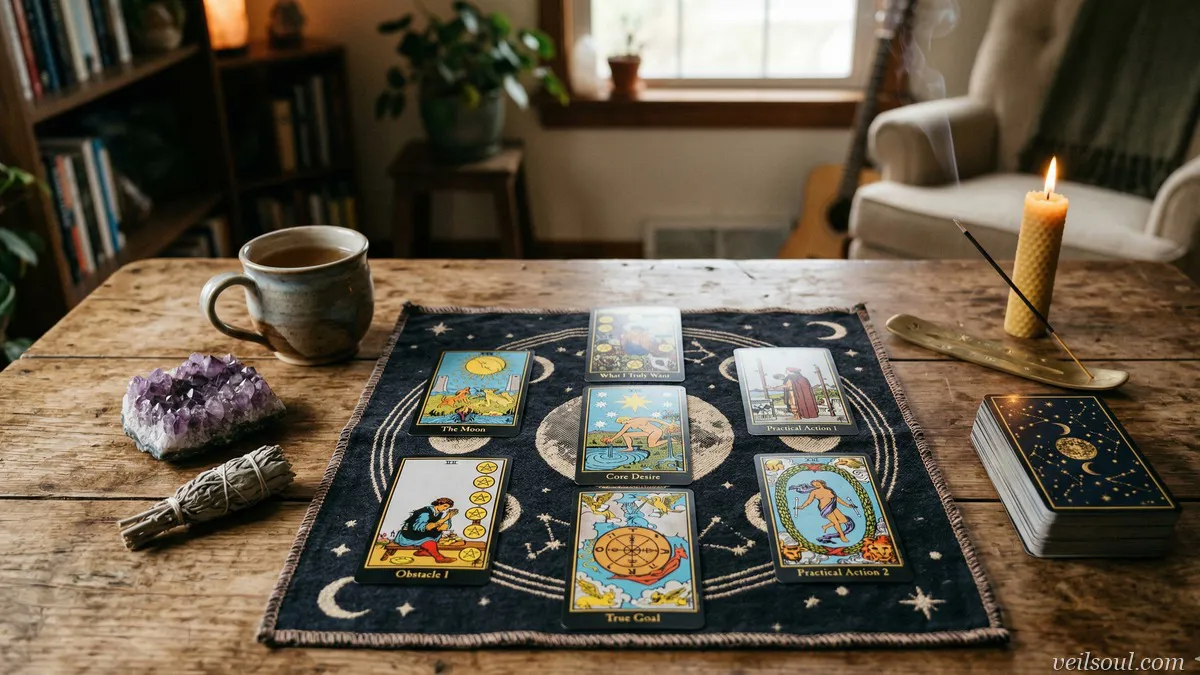
Clear a surface wide enough for four rows. Shuffle while you hold one plain question, such as "What does this year ask of me?" Then deal thirteen cards face down in this order:
- Card 1, the year card: placed alone at the top, centered above the grid.
- Cards 2 to 4, the first quarter: months one, two and three, left to right in the first row.
- Cards 5 to 7, the second quarter: months four, five and six in the second row.
- Cards 8 to 10, the third quarter: months seven, eight and nine in the third row.
- Cards 11 to 13, the fourth quarter: months ten, eleven and twelve in the bottom row.
Turn the year card first and spend a few minutes with it. Then turn the rest one row at a time. A row at a time stops you from hunting for the scariest image and building the whole year around it.
If you read reversals, keep them: a reversed month card points to energy that is slower, more internal or more resisted, not to the opposite meaning. If you do not, turn any upside-down card upright and read it as usual.
Start with the year card
The year card sets the register for everything below it. A Major Arcana card here describes a year organized around one large lesson, so even ordinary months take on weight. A Minor Arcana card describes a year whose subject is practical and specific: a skill, a household, a body of work, a relationship being tended. Neither kind is better.
The Star as the year card
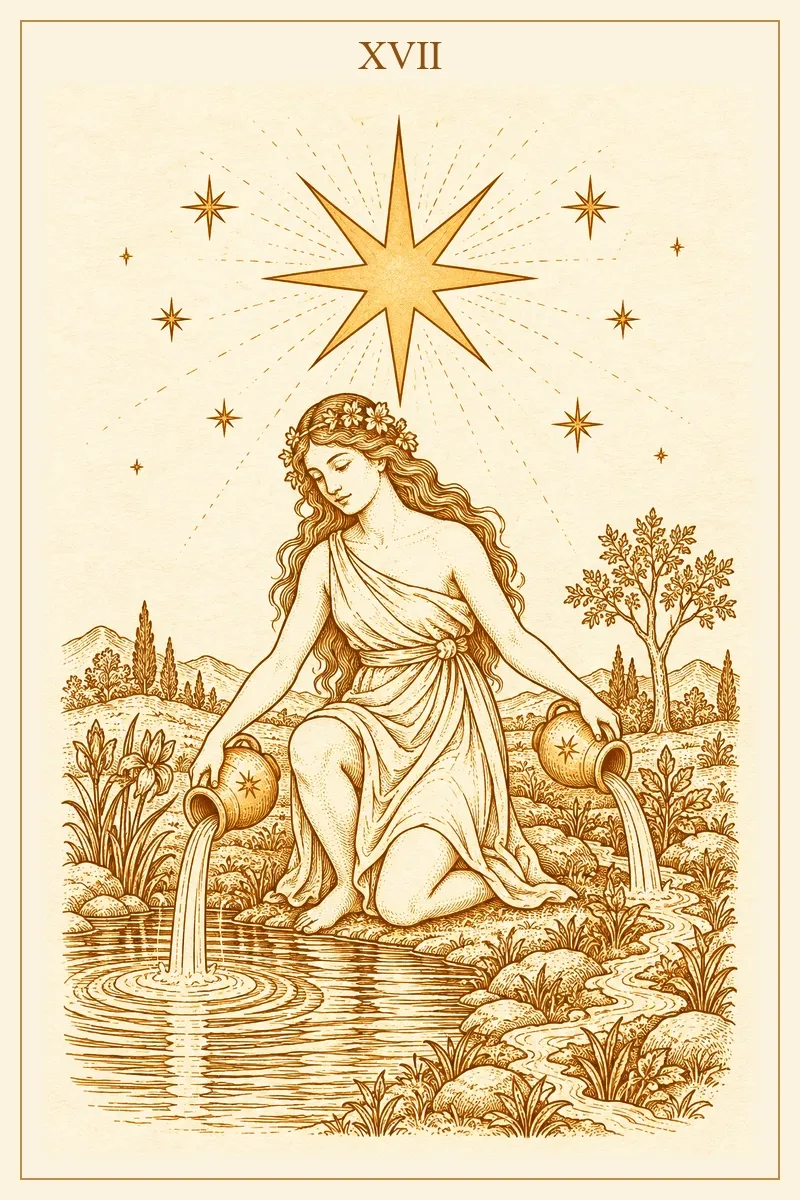
Here The Star shows a woman with a crown of flowers kneeling at the water's edge, pouring from one jug into a still pool and from the other onto the land, under one great eight-pointed star with smaller stars scattered around it. As a year card it describes recovery and renewed trust, the kind of year that comes after a hard one. The two jugs suggest giving back to your inner life and to the practical ground you stand on, both at once. The full Star tarot meaning covers the card in more depth.
Under a Star year card, a difficult month reads as part of healing rather than a setback. A reversed Star at the top suggests hope that has to be rebuilt on purpose, through small routines, rather than arriving as a mood.
Wheel of Fortune as the year card
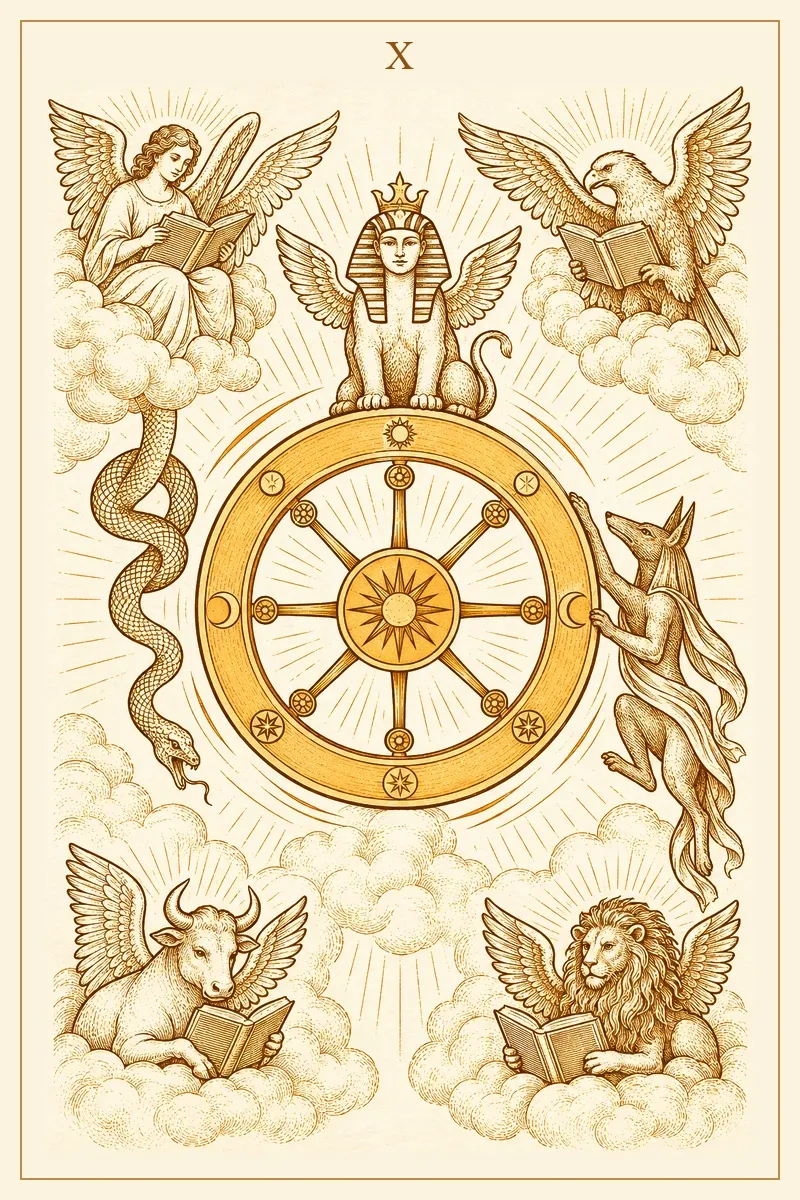
On this card, the Wheel of Fortune is a golden wheel with a sun at its hub, a crowned sphinx sitting at the top, a serpent sliding down one side and a jackal-headed figure climbing the other, while four winged creatures read their books in the corners. At the top of a year spread it says the year turns on events you do not fully control, and that your part is to notice the turn and adjust. The Wheel of Fortune tarot meaning explains its cycles and turning points in detail.
Under this card, look for the month where the grid changes direction: a run of quiet cards giving way to busy ones, or a suit that suddenly drops out. That hinge is where the Wheel turns. Reversed at the top, it can describe a pattern that repeats until you choose differently.
When the year card is a Minor Arcana card
A Minor year card names the arena. Cups point to feelings and relationships, Pentacles to work, money, home and the body, Swords to thinking, decisions and honest speech, and Wands to drive, projects and creative fire. The number tells you the stage: Aces and Twos describe beginnings and choices, Fives describe friction, Nines and Tens describe a cycle nearing its end. Ask what verb the card is doing (planting, deciding, repairing, finishing) and let that verb be the year's job description.
Reading across the rows and down the columns
Before you interpret any single month, read the shape. Four kinds of pattern carry most of the information in a grid of twelve.
The rows tell four short stories. Read each quarter as a sentence of three cards. A row that rises, such as a Page, a Knight and then a Queen of one suit, describes an area of life maturing quickly within those months. A row that falls describes something winding down.
The columns show your rhythm. Read down the first column to see how each quarter starts, and down the third to see how each one ends. If every closing month carries a heavy card, the weeks before each quarter's end are where you need slack in the calendar. A circle cannot show you this.
Suits and Major Arcana show where the weight sits. Several Pentacles in one row put work and money at the center of that quarter; Cups spread evenly across the year suggest relationships are a constant thread rather than one month's event. Months holding a Major Arcana card are the year's turning points, and a cluster of them in one row tells you which quarter carries the most change.
Numbers and court cards add detail. Repeated numbers in the Minor Arcana mark one lesson arriving more than once: three Fives describe a year that keeps asking you to handle friction well, while several Aces describe new starts in more than one area. The Tens in tarot deserve a second look, since they carry completion as much as weight. Court cards can point to months when a particular person, or a particular side of your own character, takes the lead.
Finish this pass by reading the first month and the twelfth month together as one sentence: the year starts here and ends there.
Four questions to ask of each month
Once the shape is clear, go month by month. For each card, write short answers to four questions in your notebook:
- What is the energy of this month? One or two words, such as "restless," "steady" or "tender."
- Which area of life does it light up? Use the suit as a first guide, then check it against your actual plans for that month.
- Does it ask for action, patience or reflection? Wands and the Knights lean toward action; Fours, The Hermit and The Hanged Man toward pause.
- How does it serve the year card? A month that seems unrelated to the theme can turn out to be where the theme is tested.
Keep the answers to one line each. Where a month already holds a fixed event, such as a wedding or an exam, note it beside the card: the card describes how you might meet that month, not whether the event happens.
An illustrative year: an album made around a day job
This is an invented example, not a real reading for a client. Imagine a lab technician who plays bass in a small band and wants to record the band's first full album this year without quitting her job. On January 2 she asks, "What does this year ask of me while I make the album?" Her grid reads:
- Year card: Seven of Pentacles
- First quarter: Two of Wands, Four of Cups, Three of Pentacles
- Second quarter: Eight of Wands, Six of Cups, The Hermit
- Third quarter: Nine of Pentacles, Five of Wands, Ten of Swords
- Fourth quarter: Page of Cups, Knight of Pentacles, The World
The year card: Seven of Pentacles
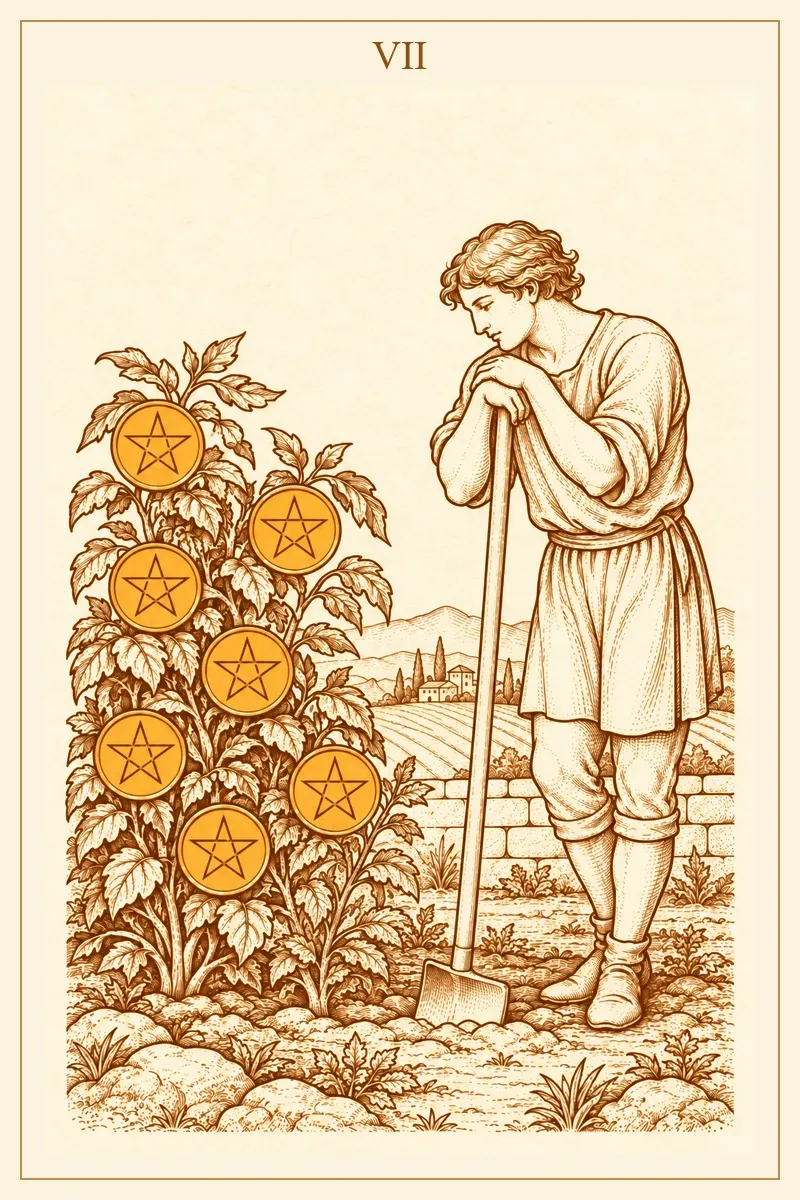
The Seven of Pentacles shows a young man leaning on his spade, looking at a leafy bush that holds seven gold pentacles, with fields and a low wall behind him. It is a card of slow growth and honest assessment: the crop is real but not ready, and digging it up to check on it would ruin it. For an album built in evenings and weekends, that is a precise job description: patience with a long project, and regular, calm reviews of what is growing. The Seven of Pentacles meaning adds the card's warnings about impatience, which matter here.
The first row reads as one short story. The Two of Wands in January shows a figure standing behind a stone battlement, holding a small globe and looking out to sea: the plan is made from a secure place, with the day job as the wall. February's Four of Cups warns of a flat month when the plan feels less exciting than it did on New Year's Day. March's Three of Pentacles brings in other people: a sound engineer, a borrowed studio, a shared schedule.
The second row speeds up, then turns inward: a burst of sessions with the Eight of Wands in April, old songs from the band's early years with the Six of Cups in May, and a month of writing alone with The Hermit in June, the grid's first Major Arcana card. The third row starts comfortably with the Nine of Pentacles, then tightens with the Five of Wands, read here as rehearsal-room arguments about which songs make the cut.
September: Ten of Swords
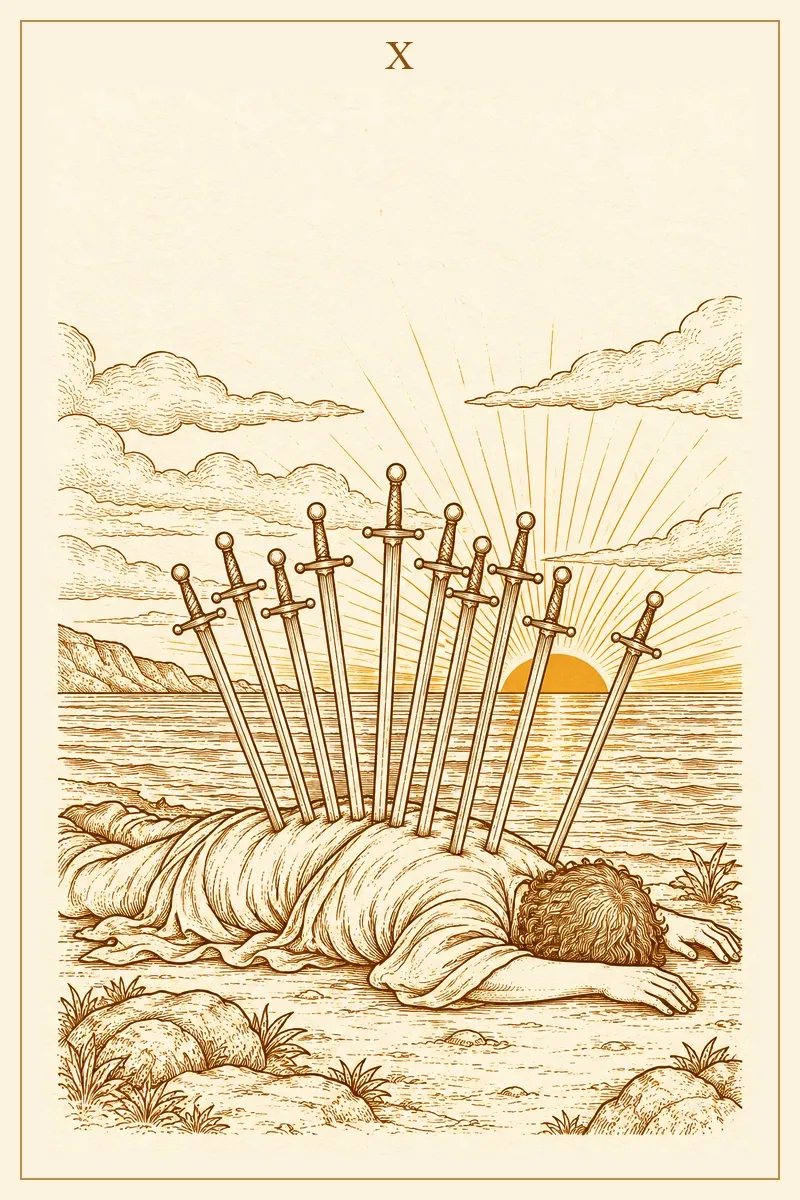
The Ten of Swords is the heaviest card in the grid. It shows a figure lying face down on the shore with ten swords standing in its back, while the sun sits on the sea's horizon and spreads its rays across the sky. Under a Seven of Pentacles year card, it does not forecast disaster in September. It describes a plan reaching its end: perhaps the original twelve-track list is cut, or one arrangement of the band no longer works. The light at the horizon is part of the card, and the Ten of Swords meaning treats it as rock bottom with a new day already showing.
Practically, she writes one line for September now: "If something has to end, let it be the version of the album that was too big." She keeps that month free of extra commitments and plans to finish the essential tracks by August, so an ending in September costs less.
December: The World
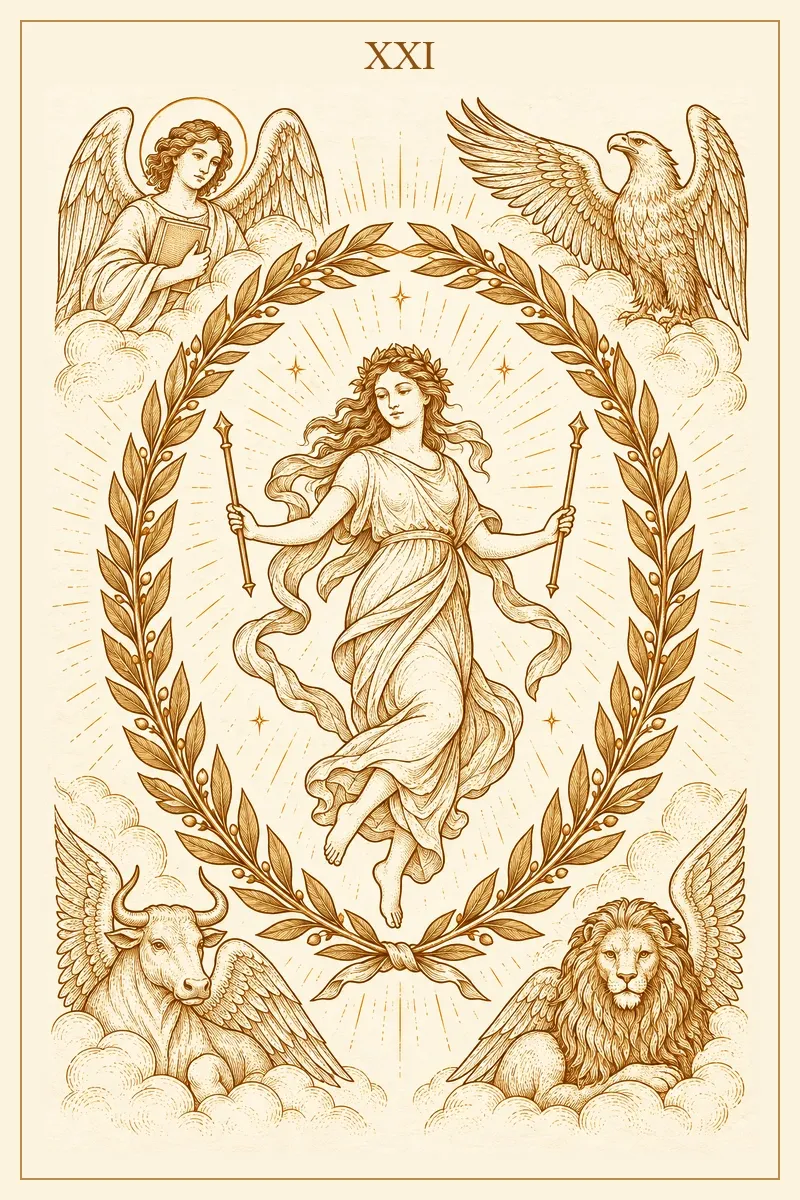
The final card is The World: a dancer inside a laurel wreath, holding a wand in each hand, with the same four winged creatures in the corners that sit around the Wheel. In the twelfth position it describes completion: something whole, finished and ready to be shared. Under the Seven of Pentacles, that finish is earned slowly, through the Knight of Pentacles' steady November rather than a final heroic push. The World tarot meaning describes the card's sense of a cycle closing so a new one can begin.
Read as a whole, the grid shows three patterns. The last column holds the weight (Three of Pentacles, The Hermit, Ten of Swords, The World), so the end of each quarter is when to schedule reviews and protect energy. Wands, Cups and Pentacles take three months each, and the year card is a Pentacle too, so drive, feeling and steady labor share the year while Swords appear only once. Both court cards fall in the last quarter, so the year's end may lean on other people. The opening and closing sentence: a plan made from a safe place in January becomes a finished whole by December, and every line of it stays open to adjustment.
Heavy cards in the grid, read without dread
Sooner or later a year grid holds a card you would rather not see. Do not reshuffle. The card you want to hide usually holds the most useful information, and redrawing teaches you to read for comfort rather than clarity.
Read the neighbors first. The month before shows what leads in; the month after shows what comes out. A hard card between two gentle ones describes a short disruption, while a hard card at the end of a tense row can mark the release of that tension rather than its peak.
Then translate the card into a condition instead of an event. The Ten of Swords in March does not mean March will be terrible; it means March involves an ending that clears space. The Tower in July is not "something collapses in July" but "around then, something held together by effort may stop holding."
Prepare in two small ways: write one sentence now about what you would want to be true for yourself if the hard thing arrives, and set one support in advance, such as a lighter week, money set aside or a conversation scheduled early. If a card keeps you awake, it says more about how you feel today than about the year. Put the spread away; if anxiety is already loud, the gentler practices in tarot for anxiety may serve you better this week.
Keeping the spread alive from January to December
A year spread earns its value over the months, not on the day you lay it.
- Record it twice. Photograph the grid and also write the thirteen cards as a numbered list with month names; a list is searchable, a photo gets lost.
- Check in on the first of each month. Reread that month's line and ask, "How can I work with this energy rather than against it?"
- Pair it with the moon. If you already practice new moon intention setting, let the month's card shape that month's intention.
- Write down what actually happened. At each month's end, add one sentence on how the card showed up. Kept in a tarot journal, these notes turn the spread into a record you can learn from.
- Close the year properly. In December, lay the grid out again from your list and mark what landed, what surprised you and what you misread. That review is where your reading skill grows.
If the year card and your plans line up, use the spread alongside tarot for goal setting: the year card can shape the one or two goals that matter, and each row can hold the step that belongs to its quarter.
Variations: quarter keys, life areas and a shared year
Add four quarter keys. For a seventeen-card version, deal one extra card at the right-hand end of each row and ask, "What is this quarter teaching me?" Turn each key only when its quarter ends, so it works as a reflection rather than a preview.
A five-card quarterly version. When thirteen cards feel like too much, lay the year card and one card for each quarter. You lose the monthly detail but keep the shape.
Twelve life areas instead of twelve months. A twelve-card wheel borrowed from the twelve houses of astrology gives each position an area of life: self, money, communication, home, creativity, health, partnerships and so on. It answers where the year's attention goes, not when, so read it as a separate spread.
Lay a year with a friend. Lay your grids side by side and compare the rows. Where your quarters share a suit or a theme, those may be months when your lives meet or when you can support each other's plans.
Frequently asked questions
Can I start a year ahead spread in a month other than January?
Yes. Start the grid with the current month and run it eleven months forward. A rolling twelve months reads exactly like a calendar year; only the month names on your list change.
Should I turn all twelve months at once or one each month?
Turning the whole grid shows you the patterns; leaving each month face down until it arrives keeps it fresh but loses the overview. A middle path is one quarter at a time.
What if the year card worries me?
Read it as the year's subject, not its verdict. A hard year card names what the year asks you to work on, and the months below it show the stages of that work. Write down the most constructive version of its message before you look at the months.
What if a month's card does not match what actually happens?
Note the difference in your journal rather than forcing a fit. The card may describe your inner experience of the month more than its events, or it may simply have been misread. Both are useful for next year's spread.
Can I lay a year ahead spread for someone else?
Only if they ask for it. A year-long reading stays in a person's mind for twelve months, and a hard card weighs on someone who did not choose to receive it. If they do want one, read it with them rather than handing over a finished interpretation.
Can a year spread tell me what will happen?
No. Tarot cannot predict events, guarantee outcomes, give dates or tell you what another person will decide. It offers a structured way to think about your own year. Keep medical, legal and financial decisions with qualified professionals, and treat each month card as a question to carry, not an event to wait for.
A calendar you can write on
Thirteen cards will not fix the shape of your year, and they are not meant to. They give you a theme to return to, four quarters to plan in, and twelve short notes to open on the first of each month. When you want to draw a few cards for the next step, you can start a calm reading with Veil Soul whenever your question feels ready.