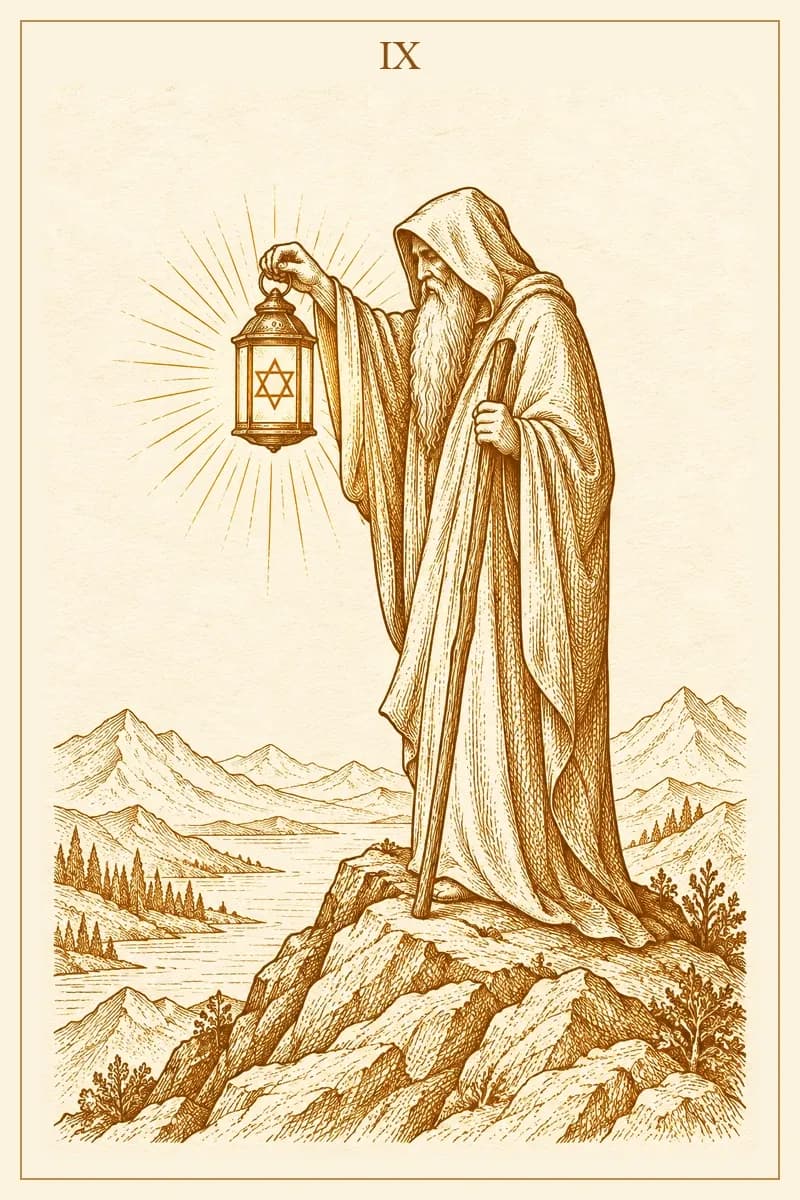
The Hermit means deliberate solitude: stepping back from other people's voices long enough to hear your own, and letting introspection do the work advice cannot do for you. Upright, it is a chosen withdrawal with a real question attached. Reversed, it points to isolation that has stopped being useful, or to self-examination you keep putting off because you half-suspect what it would show you.
What the card will not do is tell you what someone else is thinking, name a date, or confirm how a situation ends. It slows a decision down until the part that genuinely belongs to you becomes visible.
At a glance:
- Upright: chosen solitude, introspection, patient self-knowledge, the mentor and the student.
- Reversed: isolation, avoidance of the inner question, or analysis that has replaced living.
- Number: nine, the last step of a cycle, taken alone.
- Sign and element: Virgo, an earth sign ruled by Mercury.
- Hebrew letter: Yod, the small hand or seed every other letter is drawn from.
- Yes or no: not yet, because the answer exists but you have not sat with it long enough.
A lantern on a bare ridge: what the ninth card shows
The elder who has stopped walking
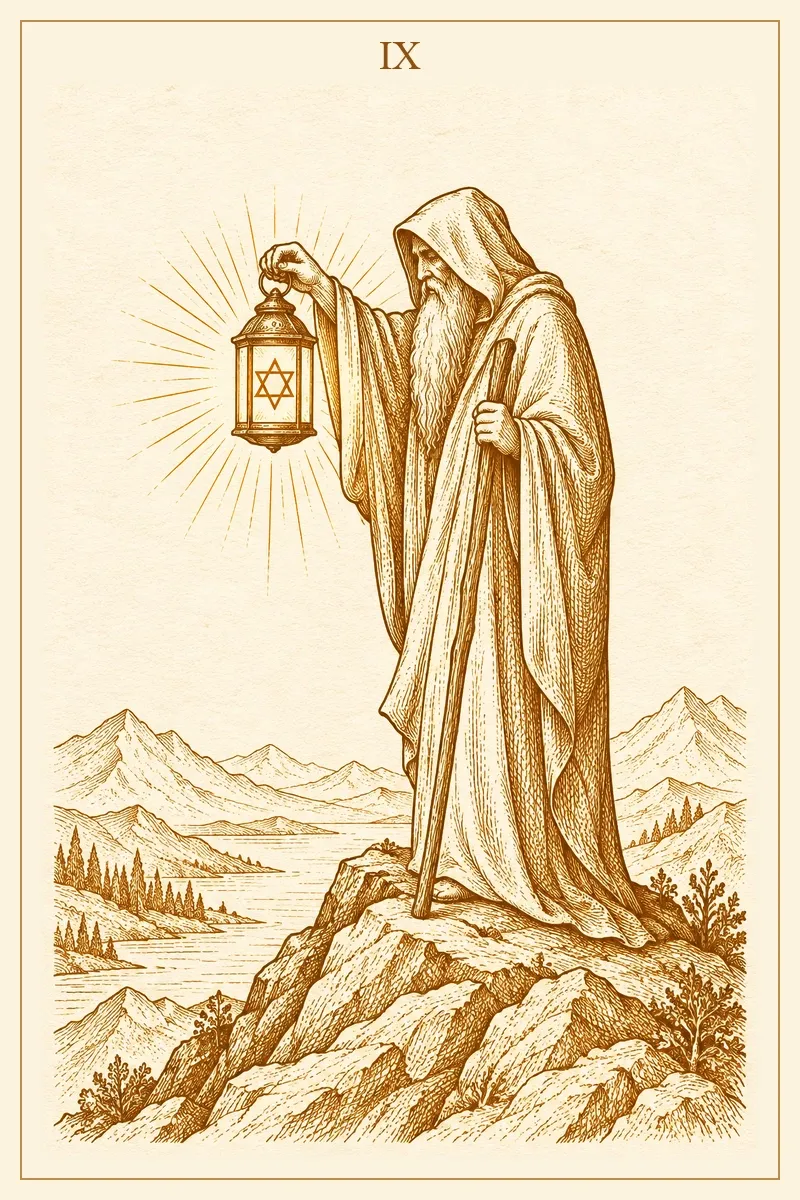
A hooded figure stands on a rocky summit in profile. He is old: a long beard spills over heavy robes that cover him from his head to the stone under his feet, and his bowed head means you never meet his eyes. He is not mid-stride and not climbing. He has stopped, and that is the message. The robes hide any sign of rank or trade, because whatever is happening to him is happening inside.
A six-pointed star inside the lamp
One raised hand holds a small lantern by its ring. Inside the glass sits a six-pointed star, and fine lines radiate far past the lamp's frame, so the light is the brightest thing in the picture. Two interlocking triangles, one up and one down, are an old shorthand for what is above meeting what is below, and carrying it in a lamp rather than wearing it as a crown reads as wisdom in use. The size of the lamp is the lesson: it shows the next few feet of rock and nothing beyond.
The staff, and the valley he has already crossed
The other hand closes around a long staff planted on the rock beside him. Older readings call it authority, and it is easier to use as knowledge you already paid for, the kind that holds your weight when you cannot see far.
Behind and below him the land opens into a wide river valley, low ranges folding toward the horizon, small conifers over the slopes. No storm, no snow peak, nothing being survived: he climbed through that country, and from this height its shape is finally legible.
Nine, Virgo and the letter Yod
- Number: nine, the last single digit, a cycle finished and reviewed before the next begins.
- Zodiac sign: Virgo, ruled by Mercury.
- Element: Earth, which the card inherits from Virgo.
- Hebrew letter: Yod, the smallest letter and the stroke every other letter begins from.
In the Major Arcana the card comes after Strength and before the Wheel of Fortune, and that position is its whole argument. Once you have steadied yourself from the inside, as the Strength card describes, you get one quiet stretch to understand what you learned, and then the wheel turns whether you feel finished or not; the Wheel of Fortune guide takes the story on from there.
Virgo is an earth sign ruled by Mercury, and both halves show in the drawing. Mercury sorts, names and discriminates, which is why this reflection is analytical rather than dreamy, while earth keeps it attached to results: a Hermit period should change what you do on Monday, not only how you feel. Virgo's shadow, the critical eye turned on yourself until nothing is good enough, is close to the reversed card.
Yod is the tenth Hebrew letter and the smallest, a flame-shaped mark usually translated as hand, from which every other letter is formed. It fits the lantern exactly: one small point of light is not much, and it is also the seed of everything that can be written.
The Hermit upright: solitude you choose on purpose
Introspection with a question attached
Upright, the distinction that matters is between solitude and loneliness. Loneliness happens to you; this solitude is a decision, usually an inconvenient one, taken because the answer you need is not in the room you have been sitting in.
The card rarely means rest more. It means go in holding something specific: whether the job is still right, what you actually agreed to, why the same argument keeps repeating in different clothes. It often arrives after a long stretch of asking around, when the advice has started to cancel itself out. Stop collecting and start sorting. A walk without headphones or an evening with the phone in another room counts; the card is not demanding a mountain.
The lamp carried for someone else
The second upright meaning is the mentor. Either you need one, or you have quietly become one. If people bring you their questions now, The Hermit asks whether you are answering honestly and whether you are still learning or only repeating what you settled years ago.
This is where the card meets The Hierophant, and the difference is instructive. The Hierophant teaches what a tradition has agreed on, and the full Hierophant meaning covers how useful that structure can be. The Hermit only has what he tested himself, and he lifts the lamp instead of handing over a doctrine.
The Hermit reversed: when the lamp goes out
Isolation that has stopped being useful
Reversed, the ingredients are the same and the proportions have gone wrong. The withdrawal was once purposeful and has become a habit: invitations declined, messages left for weeks, the whole thing called focus. The test is simple. Has anything come out of the quiet? A genuine Hermit period produces a decision, a changed routine, or a sentence you can finally say. If months have produced only distance, letting someone in is the move this card points at.
The reflection you keep postponing
The opposite failure is just as common. You know which conversation you are avoiding, so the days get filled: noise from the moment you wake, plans every evening, a new project whenever an old thought surfaces. Reversed, this can be the card of being too busy to find out what you think.
Thinking that has replaced living
The third version is analysis with no exit. You have considered the decision for months, examined your motives from four angles, and nothing has moved. At some point the reviewing becomes the avoidance, and the card asks you to act on a partial understanding, which is all the small lantern ever offers.
The Hermit in love and close relationships
When you asked about someone new
The Hermit does not predict loneliness; it describes a stretch where the honest work is individual rather than shared. Drawn about a possible connection, it usually says the timing is quiet rather than closed: either your attention is turned inward, or the other person's is. Tarot cannot report what another person feels, so use the card to work out what you want from a relationship before looking for someone to supply it.
Inside a relationship that has gone quiet
In an established relationship, the upright card often describes one partner needing genuine separateness: their own evenings, their own friendships, an interest nobody else is in. Handled openly that strengthens a partnership, because the card is about keeping an inner life, not about leaving. It can also describe two people living in parallel, polite and busy, not fighting and not meeting.
Reversed: space used as a wall
Reversed in love, watch for a request for space that means a refusal to have the conversation. Space with a return date is a boundary; space with no return date and no explanation is usually avoidance, from either side. For someone single, it can describe independence that has quietly become self-protection: did you choose the long stretch alone, or simply stop risking anything?
Work, study, money and rest
Work that rewards depth
In a career reading, the upright card favors the solo stretch over the meeting: the research, the audit, the rewrite, the work only one person can hold in their head. It also describes the specialist's path, becoming the person others come to. Reversed, the warning is narrow: independence that cuts you off from mentors, feedback and the people who would recommend you is a stalled career, not freedom.
Learning something properly
Virgo's patience with detail and the lantern's one-step light describe the only way a difficult skill is ever learned: a small amount, carefully, repeatedly, with no audience. If you are early in a long course of study and bored by how slow it feels, this card is unsympathetic in a kind way. Slow is the method.
Money decided slowly
On money, the upright card favors reading the terms and the actual numbers yourself, and asking whether the thing is yours to want. Tarot offers no financial guidance and predicts no outcome; what it supports is the pause before a decision taken under pressure. Reversed, money handled entirely in private, with no conversation with the person who shares the consequences, is how expensive mistakes get made.
Rest, and when to ask for company
Where health comes up, read The Hermit as a card about pace rather than diagnosis. It suits early nights and a thinner calendar, and nothing here replaces care from a qualified professional. Reversed, a long stretch alone can make a heavy period heavier, and reaching out is not a failure of the lesson. For a structure to put the quiet into, the practices in Tarot for Self-Discovery give it somewhere to go.
Yes, no and timing with The Hermit
As a yes or no answer
The Hermit is a not yet. Upright, it declines to answer in the terms you asked, which is itself information: the decision is unready because you have not sat with it, not because the world refused you. Reversed, read it as closer to no, a signal that you are too far inside your own head to judge well. The more productive move is to rewrite the question. Should I take it? is hard for a card to answer. What am I not admitting about this choice? is exactly what The Hermit is for.
How long a Hermit season runs
Timing from a single card is guesswork, and it is fair to say so plainly. Where readers assign a season, Virgo places this one in late summer and early autumn, and its number suggests nine of whatever unit the question uses. The practical answer is better: a Hermit period lasts until the question it arrived with has been answered.
The Hermit and Judgement: the lamp and the call
This pairing deserves a close look, because the two cards handle opposite halves of one process. The Hermit is the private review. Judgement is the moment that review becomes a decision you can be held to.
What Judgement brings
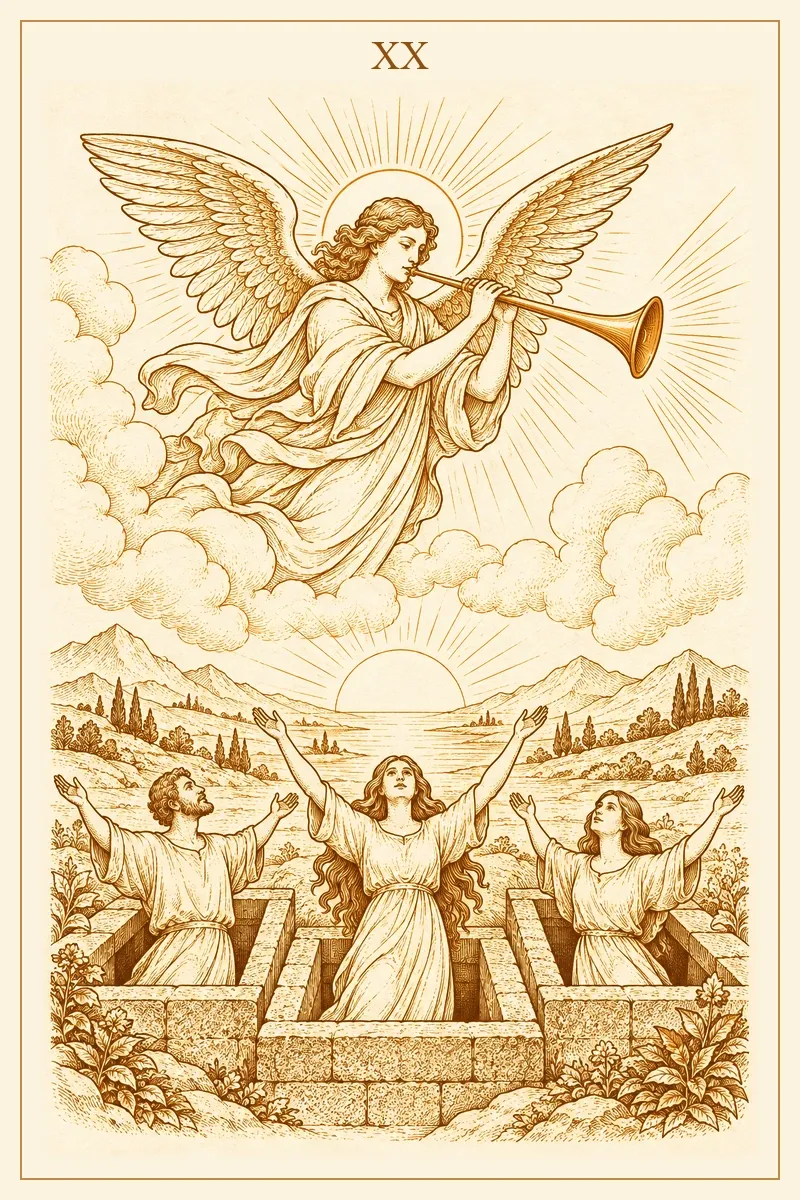
Judgement is card twenty, near the end of the Major Arcana: a summons, a reckoning with everything behind you, and a response that cannot be made quietly. It carries a finality The Hermit never does, and it is public: three figures rise from their tombs together, arms raised to the trumpet. The Judgement card meaning goes further into the awakening and the calling it describes.
Both upright: a private verdict, then a stated one
Together and upright, the pair reads as a sequence rather than a contradiction. The Hermit is where you work out what you actually think; Judgement is where you say it, and where saying it changes things. In practice the two turn up around a resignation, a long-postponed conversation, a return to something abandoned, or a decision to forgive, including yourself.
The order matters. The Hermit in a past or present position with Judgement ahead of it suggests the reflection has done its job and a declaration is due. Judgement behind with The Hermit ahead reverses the instruction: the call has arrived, and what remains is to work out quietly how you will answer it. Do not let the review postpone the call indefinitely, because The Hermit can always find one more angle to examine.
When one of the two is reversed
Hermit reversed with Judgement upright is the uncomfortable common case: a decision is being demanded and you have not done the thinking, so the answer risks being somebody else's. Hermit upright with Judgement reversed is the stuck version, where you know what you concluded and will not say it. Both reversed usually describes a long drift, a question avoided until neither the quiet nor the call feels available; the move there is small and outward, not another month of thinking.
The Hermit and The High Priestess: two ways of knowing without being told
If the Judgement pair is about sequence, this one is about contrast. Both cards describe inner knowledge and they reach it from completely different directions, which is why readers find the combination hard.
What The High Priestess brings
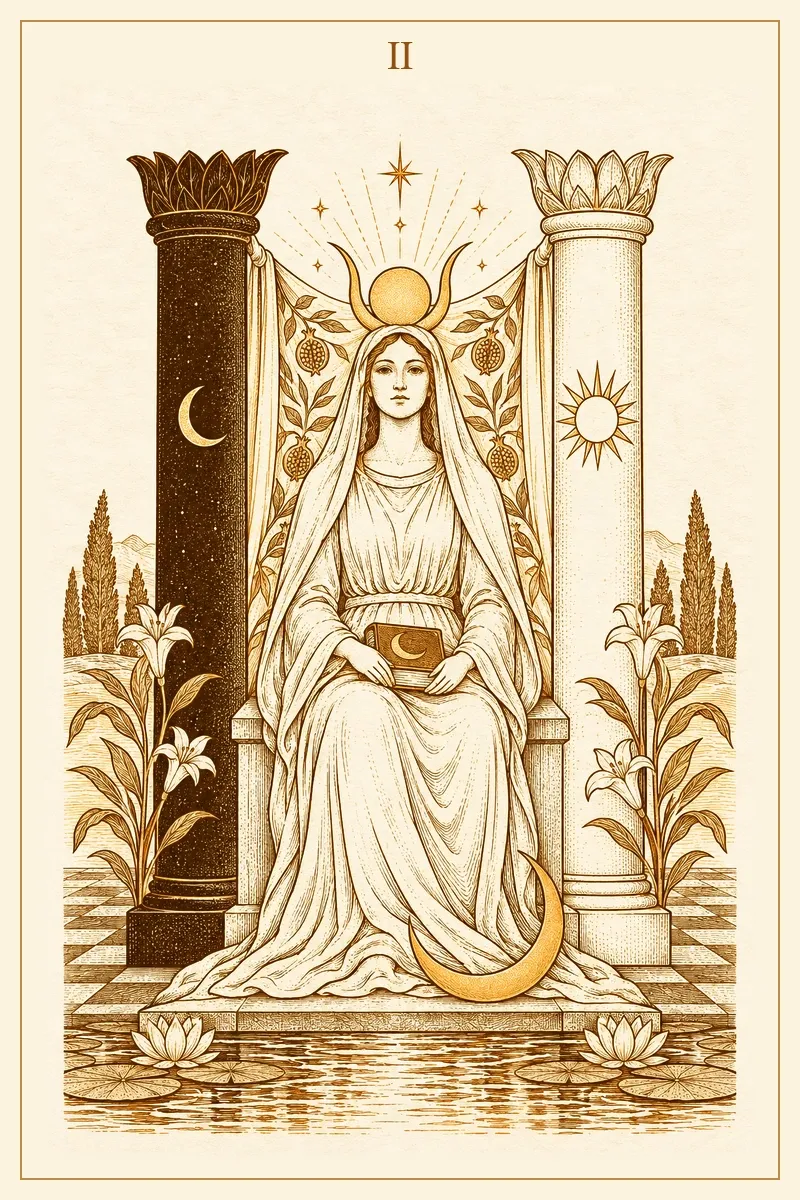
The High Priestess is card two: stillness, the veil, and the thing you know without being able to show your working. Her knowledge is received rather than constructed, and often unspoken on purpose; the fuller picture is in the High Priestess guide. Set beside her, The Hermit's method is almost plain: he walked up, looked back, reasoned about what he saw, and can tell you why he thinks it.
Together: knowing that arrives before the words
When both appear, the reading usually involves something you already know and have not formalized. The High Priestess says the knowledge is present; The Hermit says it is your job to bring it into language you can act on. It often shows up as a quiet certainty that has been sitting there for months and finally gets written down in one sentence.
The pair also tends to mean the answer is not external: no further research, no additional opinion, no fifth person consulted. The High Priestess in a position about what you cannot see, with The Hermit in a position about the next step, reads as stop gathering and start naming.
Telling them apart in a spread
A practical test: if the card asks you to wait until something surfaces, it is behaving like The High Priestess; if it asks you to work on a specific question until you can state the answer, it is behaving like The Hermit. Reversed together, the pair often describes self-deception, whether an intuition trusted too readily or a reasoning process that has started discarding what it does not want to find.
Other cards that change The Hermit's tone
- The Star: hope found in the quiet rather than in company, and often repair after a difficult stretch.
- Four of Swords: rest that is no longer optional. Where The Hermit chooses the pause, this card says a body or a schedule already decided it.
- Eight of Cups: walking away from something that was fine and is finished. The solitude is a departure, not a retreat.
- Three of Swords: solitude with grief in it, and the pairing to be gentlest with, since it benefits most from company you trust.
- Strength: courage practiced where nobody can see it, which reads as patience with yourself rather than discipline imposed on yourself.
- King of Swords: judgment formed alone and stated plainly, at risk of coldness if the Hermit's humility drops out.
- The Moon: reflection in poor light; conclusions reached here are worth re-testing in daylight.
- The Hierophant: inherited teaching meeting tested experience, at best a teacher who earned their authority.
The Lantern Spread: four positions for a quiet question
This layout follows the picture on the card and suits the questions The Hermit attracts: a decision you have been circling, a situation where everyone has an opinion, a stretch that has gone quiet for reasons you cannot name. Write the question down first, in one sentence.
- The noise. What I have been listening to instead of myself.
- The lamp. The one thing I can actually see right now.
- The staff. The experience I already have that will hold my weight.
- The next ledge. The single step the light currently reaches.
Resist making the fourth card dramatic; that position is deliberately small, one step and not a plan. Reversals here usually mean a blocked position rather than a negative one.
A worked example: the week that would not go quiet
The draw below is made up, to show the four positions in motion. Picture someone offered a role at a smaller organization: better work, less money, and four friends with four contradictory recommendations. The question at the top of her page was not whether to take it, but what she thought underneath everyone else's version.
Position one: King of Swords
In the noise position, the King of Swords was the voice of the friend who had laid the decision out as a logical problem with one correct answer. It was good advice, and it had been doing the thinking in her place.
Position two: The Hermit
The lamp position held The Hermit himself, which narrowed what she could see to one thing. She already knew she was bored. Not underpaid and not undervalued, just bored, and for about a year. That one fact changed the shape of the question.
Position three: Four of Swords
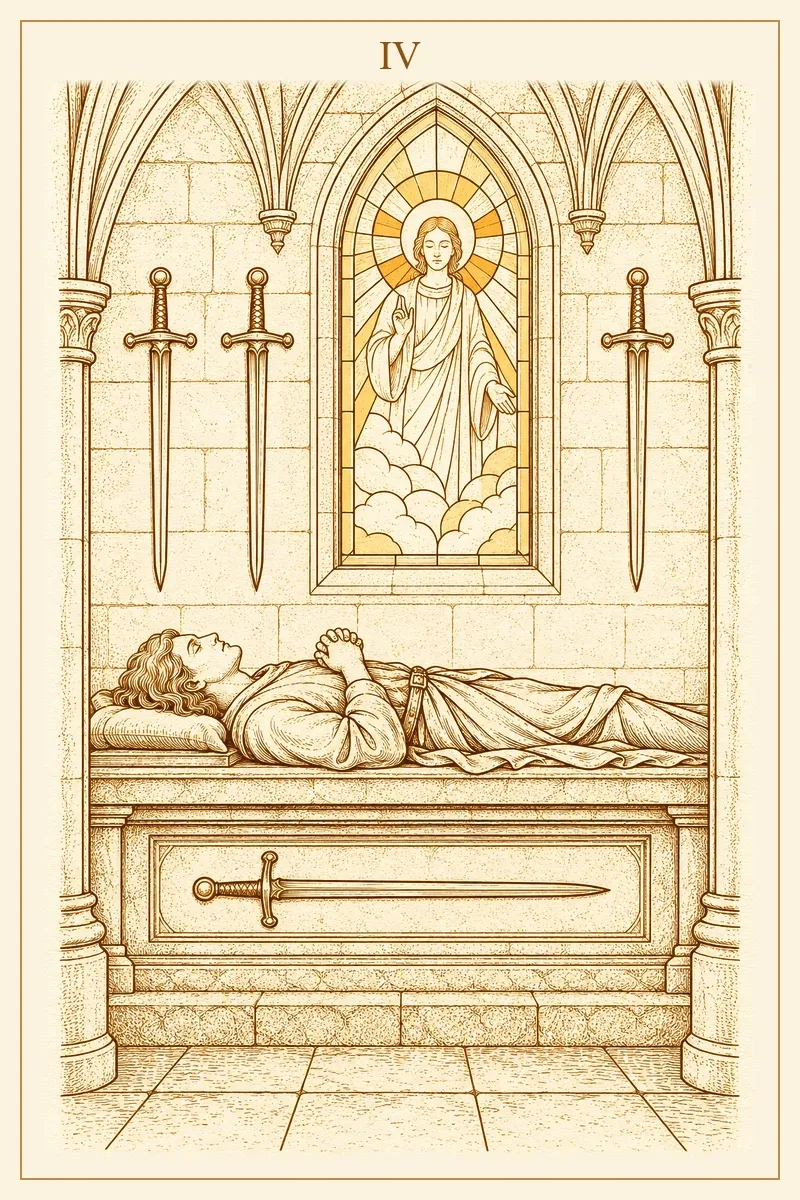
In the staff position, the Four of Swords pointed at what she had to lean on: she had taken a deliberate break between roles once before, so what she needed was not negotiation skill but the memory of surviving a quiet stretch without panic. The Four of Swords meaning sits close to The Hermit, with one difference: that card is recovery, where The Hermit is review.
Position four: Eight of Cups
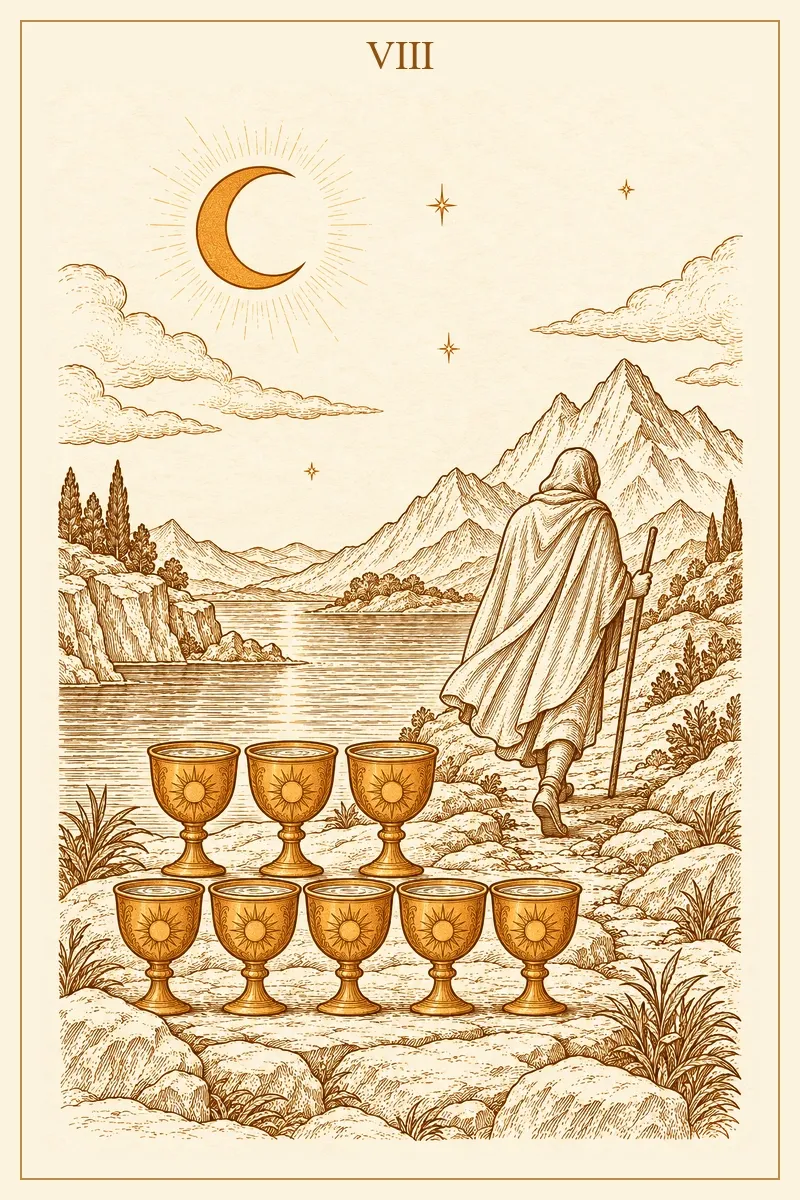
The next ledge held the Eight of Cups, leaving something that is not broken. Read as one small step rather than a prophecy, it suggested writing down the two conditions under which she would stay and taking them to her manager before answering anyone else. No card told her to resign; the step was a conversation.
Reading the four together
The spread did not produce a decision. It produced a sentence she could say out loud, that she had been bored for a year and had been letting a friend decide for her, plus one concrete thing to do that week. That is the shape of a good Hermit reading: less certainty than you wanted, more clarity than you had.
Frequently asked questions
Is The Hermit a bad card to draw?
No, it is an inconvenient one. It usually arrives when you wanted a clear yes, and it offers a period of clarity instead of an outcome.
What does The Hermit reversed mean in one line?
Solitude gone wrong in one of two directions: too much of it, held past its usefulness, or too little, because the reflection keeps being postponed. Which one depends on the cards around it and on whether the quiet has produced anything.
Does The Hermit mean I will stay single?
It does not predict that. In love readings it describes a period where attention is turned inward, yours or someone else's, and says nothing about who appears later. A card cannot report another person's intentions, name a date, or confirm an outcome.
How is The Hermit different from the Four of Swords?
Both ask you to step back, for different reasons. The Four of Swords is recovery: stop because you are depleted and need to heal. The Hermit is inquiry: stop because there is something you need to work out and the noise is in the way.
Why is The Hermit linked to Virgo and the letter Yod?
Virgo is an earth sign ruled by Mercury, which gives the card its discriminating, practical, detail-patient quality. Yod is the smallest Hebrew letter and the mark every other letter begins from, matching a lantern small enough to hold and still enough to walk by. Its number, nine, places it at the end of a cycle, just before the wheel turns.
I am new to tarot. Is The Hermit a good card to start studying?
It is a good one to sit with, because it is simple to picture and hard to reduce to a keyword. If you are still finding your footing with the deck, this introduction to tarot covers the basics first.
Light enough for the next step
The Hermit offers something narrower and more reliable than a complete answer: enough light for one step, a staff cut from what you have already survived, and permission to stop asking everyone else for a while. Three things make the most of it.
- Write the question in one sentence before you draw, and again afterward. If the sentence changed, that change is the result of the reading.
- Pause one source of input for a week, whether a group thread, a feed, or one well-meaning person, and notice what you think without it.
- Set a date to come back out. A review with no end turns into the reversed card.
If you want to sit with a question in that spirit, you can draw a reading and give the first thing that surfaces somewhere to be written down. Keep the question small and honest, and let the next step be the only thing you ask the light to show you.