
Forgiveness in tarot has no single card. The images readers return to again and again are Judgement for the honest reckoning that lets an episode close, Temperance for the slow blending that makes peace possible, The Star for hope coming back after the worst of it, the Six of Swords for leaving without pretending nothing happened, the Five of Cups for grief still turned toward what spilled, and The Empress for the plain self-kindness that self-forgiveness runs on.
Read this way, a deck is a mirror for where a hurt sits in you today: how much attention it takes, what the holding protects, and what you are still waiting for from the person who caused it. The limits are real. Cards cannot confirm that someone is sorry, cannot name the week your chest unclenches, and cannot forgive anything on your behalf.
What follows covers what forgiveness does not require of you, those six cards upright and reversed, a short readiness check, one reading followed end to end, and the point at which a deck should be set down in favor of a conversation with a qualified person.
At a glance, the six cards read in full below, plus two that recur in the warning signs and the worked reading:
- Judgement: seeing the episode whole and deciding it is finished.
- Temperance: patience and proportion; anger and compassion mixed into something you can live with.
- The Star: hope returning, and the softness that makes feeling safe again possible.
- Six of Swords: moving to quieter water with the memory on board.
- Five of Cups: accurate grief, facing one direction only.
- The Empress: warmth toward yourself, the ground self-forgiveness grows in.
- Justice: accountability, and the wish to hear the wrong named out loud.
- Five of Swords: the argument you keep winning in your head and losing everywhere else.
Four things forgiveness does not require
Most of the trouble in a forgiveness reading comes from a definition nobody chose on purpose. You inherited one, usually from a relative or a sermon or a film, and you have been refusing its terms ever since. Before the cards can be useful, say plainly what you are not agreeing to.
- Approval. Putting something down is not a ruling that it was acceptable. What was wrong stays wrong afterward.
- Forgetting. Memory is a safety system. Keeping what an experience taught you differs from keeping the grudge, and only the second one charges you rent.
- Reconciliation. You can stop carrying the weight and never answer that number again. Letting a person back in is a separate choice, made on separate evidence, usually much later.
- Warm feelings. Nothing here asks you to like anyone. Neutral is a perfectly good destination, and for some relationships the only honest one.
Pick which of those four you have quietly been treating as the entry fee. That sentence explains most people's resistance better than any card will, and it tells you what the deck is actually being asked about. If what you are setting down is a chapter or a plan rather than a person, the approaches in tarot for letting go suit that shape better.
Signs in a reading that the hurt is still in charge
Before looking for the healing cards, read what is actually on the table. Resentment has recognizable postures, and a spread shows you which one you are standing in long before you would admit it in conversation.
- Still prosecuting. The Five of Swords keeps the score, Justice reversed wants a ruling that is not coming, and the Nine of Wands stands guard years after anyone last tried the gate.
- The hurt as a seat. The Five of Cups beside the Four of Cups describes a loss that has become a place to live rather than a passage through; Wheel of Fortune reversed adds the feeling that the same episode keeps coming around.
- Turned inward. The Empress reversed with the Ten of Swords and a reversed Sun often means the person being punished is the reader: pleasure postponed, care refused, rest treated as something to be earned first.
- Looking away. Four of Swords reversed with The Moon and the Seven of Cups describes numbing, fog and fantasy, three efficient ways to stay busy near a wound without touching it.
- Nearly through. The Eight of Cups arriving with Judgement and the Six of Swords suggests the leaving has already started inside you, whatever this week's mood reports.
None of those postures is a failure. A reader who meets the prosecuting pattern three readings in a row has learned something more useful than a hopeful card would have told them.
Six cards that carry the forgiveness story
Each card below is read the same way: what it says upright in a forgiveness question, what a reversal shifts, and one thing to do with it this week.
Judgement: the reckoning that lets a story close
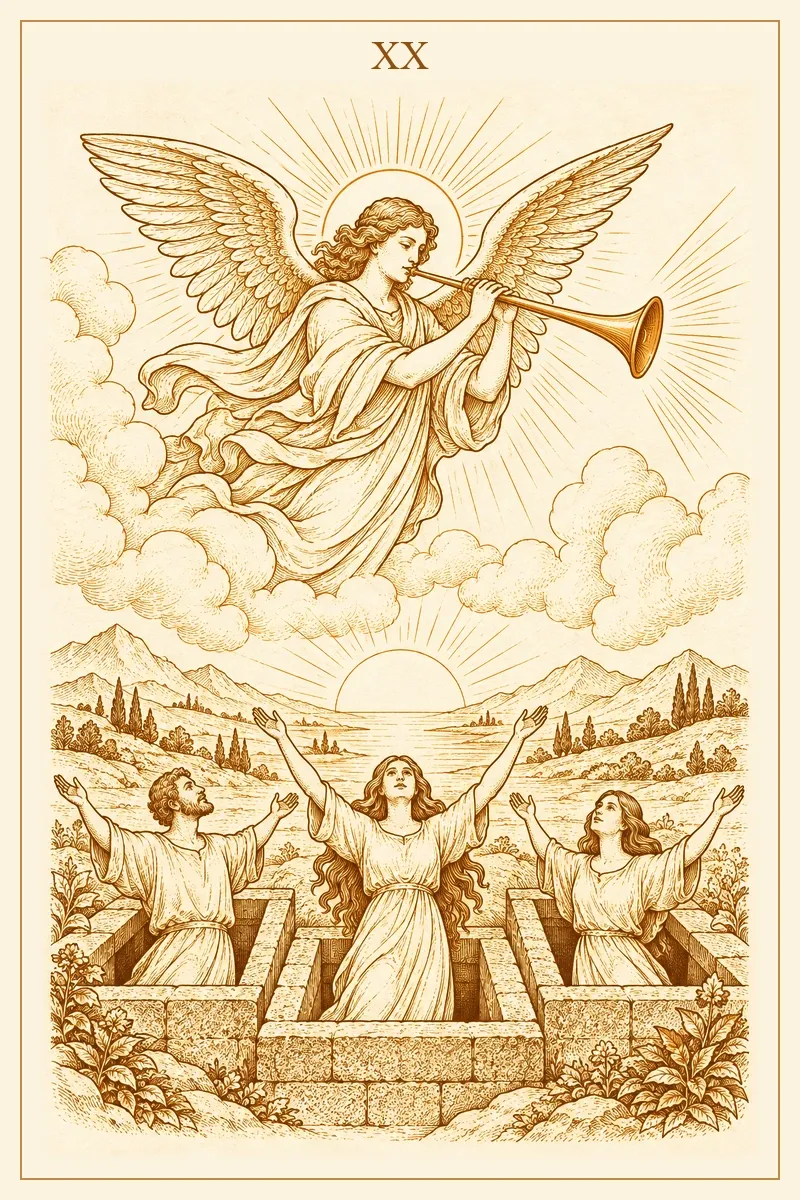
Upright, Judgement shows figures rising at the sound of a horn, arms open, looking up. It is a card of review and release rather than punishment. In a forgiveness question it marks the moment you can hold the whole episode at once — what they did, what you did, what it cost, what it taught — without needing a sentence attached to the end of it. It can turn up even for readers who feel nowhere near ready.
Reversed, the case is still being argued. Either you are rehearsing the prosecution, or you have turned that severity on yourself and are applying a standard you would never apply to a friend. A common form is the apology clause: the quiet condition that you will release this on the day they admit it, which hands the timing of your peace to someone who may never pick it up.
In practice, write the episode in the third person, in six sentences at most; the compression strips the editorial and what remains is usually smaller than the version you carry. The Judgement card meaning covers the card outside a forgiveness question.
Temperance: mixing it into something you can hold
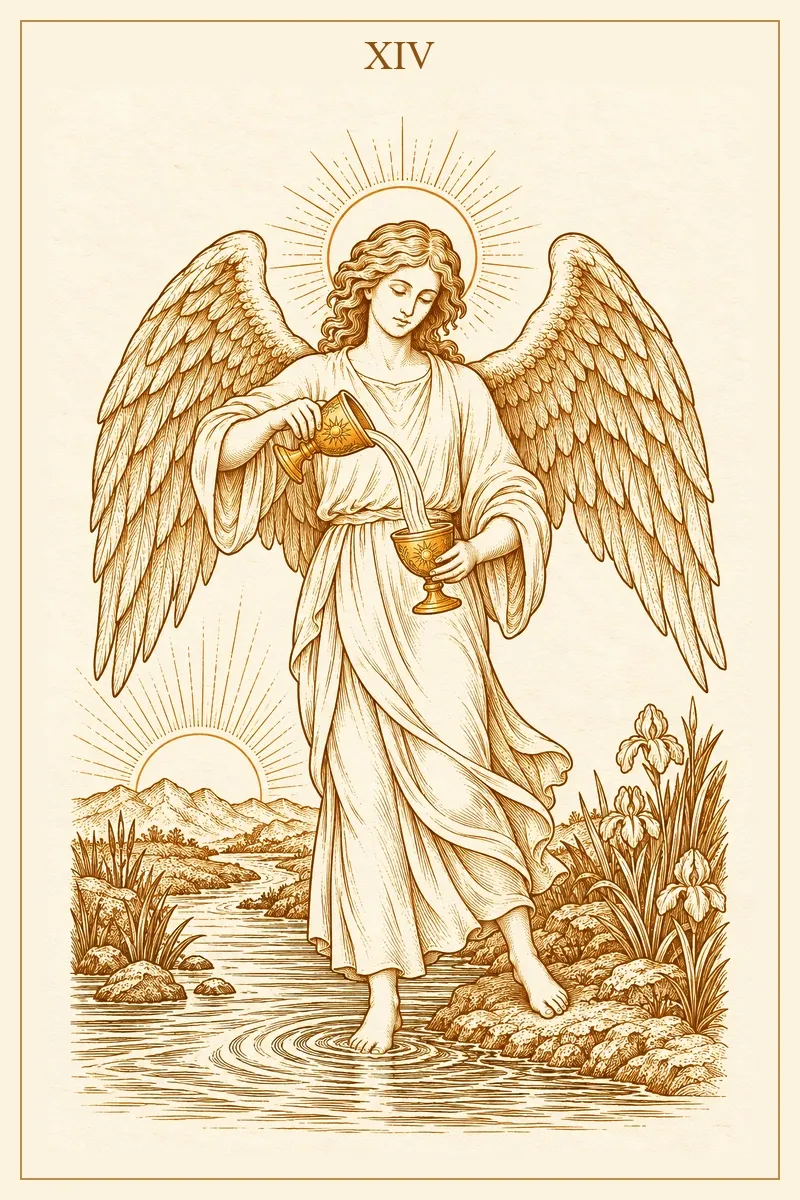
Upright, Temperance pours from a jug into a cup with one foot on land and one in the water. It is the card of proportion and the middle path, and it gives the most honest picture of forgiveness in the deck, because it shows a process rather than an event. Anger and understanding are not alternatives here; they are being blended, patiently, into a mixture you can carry without being burned. Slower than you wanted is not the same as stalled.
Reversed, the usual meaning is forced timing: someone declared the matter closed to end an uncomfortable conversation, and the declaration keeps collapsing at the next reminder. The other reversed form is swing — total contact then total silence, generosity then coldness. Both ask what a moderate version would look like this month.
In practice, measure in seasons rather than days: note today's date, and the next time the subject rises ask only whether it feels lighter, heavier or quieter. The Temperance card meaning has more on its sense of balance.
The Star: hope that does not need an apology
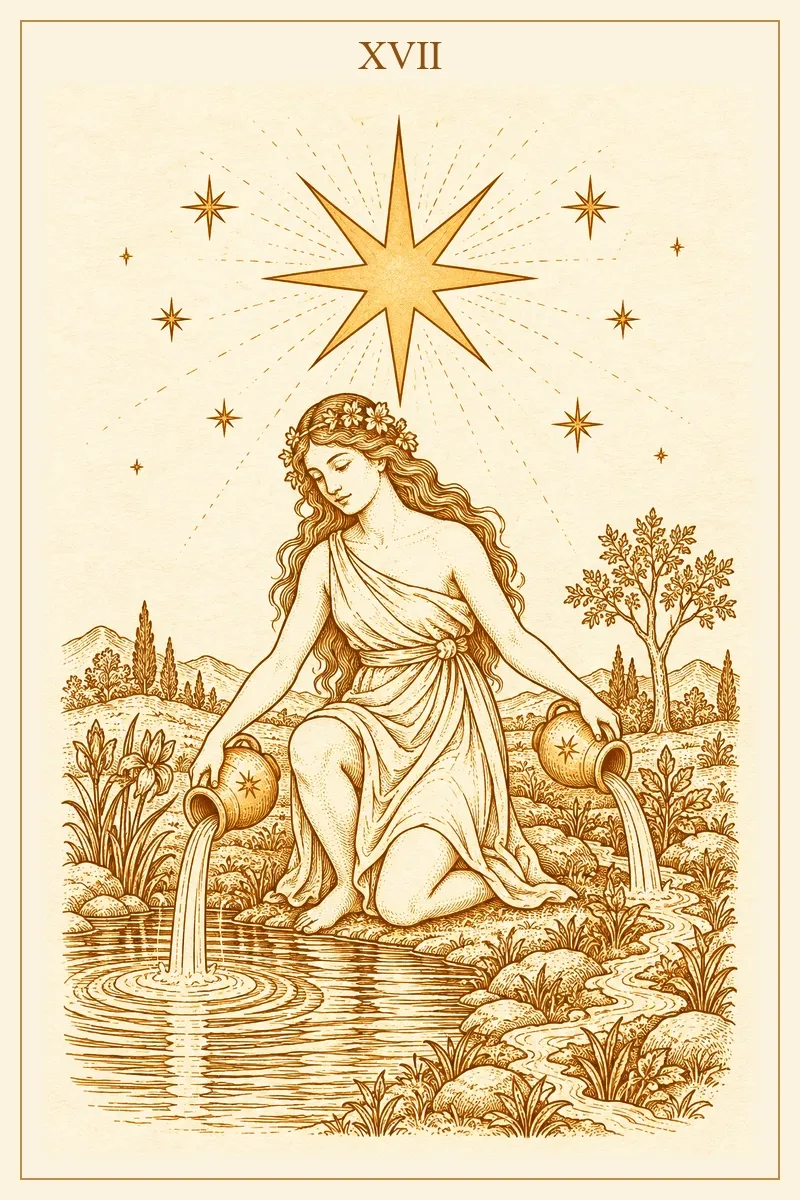
Upright, The Star follows the collapse. A figure kneels at the edge of a pool under one large star and the smaller ones around it, unhurried, pouring from two jugs — one stream back into the water, one onto the ground. In forgiveness work it describes a peace that does not depend on the other person explaining themselves, changing, or even remaining in your life. It is also a card of openness: nothing in the picture is braced or defended, and that is the point. Hope and an unguarded posture arrive together or not at all.
Reversed, faith has gone flat, or you have concluded that being open is exactly what got you hurt and have kept your guard up since. That is a reasonable conclusion and an expensive one. A reversed Star asks which small ordinary pleasure you stopped allowing yourself, and whether the restriction still does any protective work.
In practice, name one thing you enjoyed before and have avoided since, and do a scaled-down version of it this week. For its full range of hope and renewal, see The Star card meaning.
Six of Swords: leaving with the memory on board
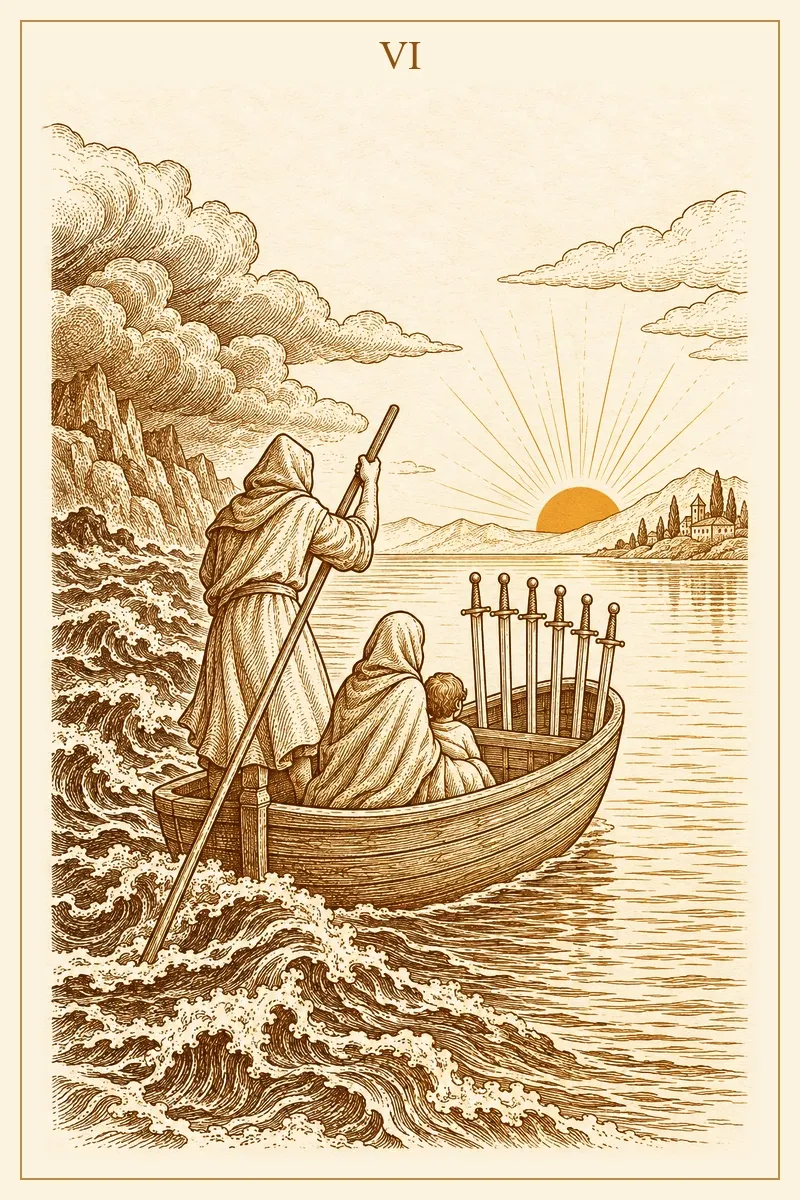
Upright, a ferryman poles a small boat toward still water while six swords stand upright in the hull. Nothing has been thrown overboard, and that detail is the whole teaching: you can change direction while keeping every sword, every memory, every lesson. Departures under this card are sad rather than triumphant, and usually assisted — someone is steering, someone came along.
Reversed, the water stops moving under the hull. Either the boat never left, or you have arrived somewhere new and laid out the same cargo in the same pattern, which is why the new place feels oddly familiar. The reversal also shows up when a reader keeps returning to a conversation they supposedly finished.
In practice, choose one behavior to suspend for thirty days: retelling the story, checking a profile, drafting the message you never send. The Six of Swords card meaning describes that crossing in other contexts.
Five of Cups: grief that is facing one way
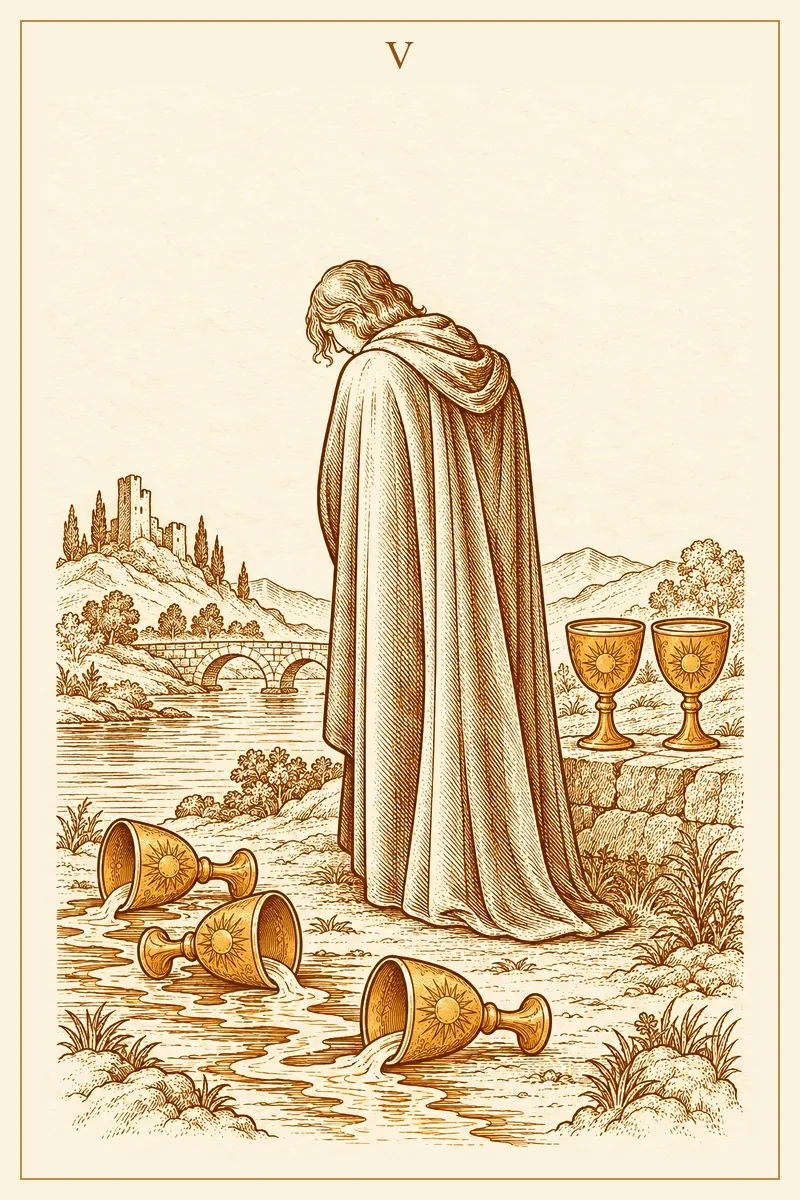
Upright, a cloaked figure looks down at three spilled cups. Two more stand upright behind them, unnoticed, and a bridge leads home across the river. This card is never an instruction to cheer up. The grief is accurate and the loss was real; the card only notes the direction of the gaze. In a forgiveness reading it marks the stage where the hurt has become the main feature of the story and everything still standing has gone out of focus.
Reversed, the head turns. Help gets accepted, the bridge gets used, and the two remaining cups come back into view. Read in a harder light, the reversal can also describe grief that has settled into routine: familiar, comfortable and no longer moving.
In practice, write the two upright cups down — two specific things the episode did not take from you. The Five of Cups card meaning goes deeper into the grief side.
The Empress: the softness self-forgiveness needs
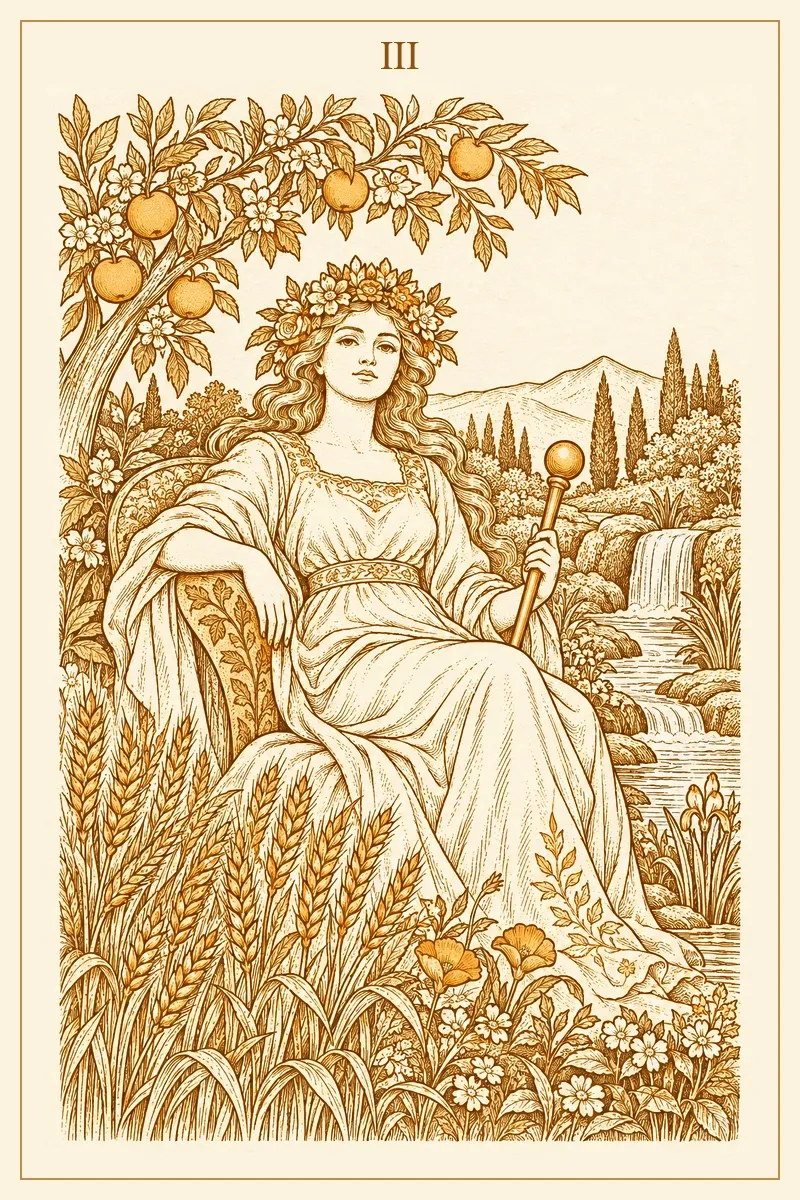
Upright, The Empress sits in a ripe field, comfortable in her body, surrounded by things growing because they were tended rather than driven. In a forgiveness question she is almost always about the reader rather than the other person, and she carries one of the harder instructions in the deck: let yourself be cared for, including by yourself, without having earned it first. Self-forgiveness wants food, sleep, warmth and some ordinary pleasure before it has anything to grow on.
Reversed, care has stopped flowing — self-neglect, a creative life gone quiet, or care poured outward so generously that none is left over. The useful question is who receives the kindness you refuse yourself, and what would change if you kept a tenth of it back.
In practice, do one small act of physical care today and attach no reason to it. The Empress card meaning covers her wider themes of abundance and creation.
Who you are forgiving changes how you read
The same cards say different things depending on where the other person stands in your life. These three situations come up constantly, and confusing them is why some readings refuse to make sense.
Someone still in your life
When you see the person weekly, forgiveness and access get tangled. A reading that answers "can I stop carrying this" gets heard as "must I behave as though it never happened," and the reader panics. Keep the two questions apart: ask the deck about the weight, and decide about access in daylight, with evidence. A warm card describes what might become possible inside you, not a recommendation about contact.
Yourself
Self-forgiveness readings run hotter, because the one you want to hold accountable is also the one shuffling. Two things reliably go wrong: treating every card as a ruling, so the spread becomes a trial you prosecute and lose, or seizing a hopeful card so fast that the relief has evaporated by evening. If a real repair is still available — an apology you could make, money you could return — the reading is not a substitute for it.
Someone you cannot reach
Some people die, some disappear, and some will never concede a thing. The conversation then has to happen without them, which feels like cheating and is the only option on the table. Cards give that exchange a shape: one for what you would say, one for what you imagine they would answer, one for what you are left holding. Where the unforgiven thing is tangled with mourning, tarot for grief and loss is the gentler starting point.
A three-card readiness check
This is an orientation, not a release ritual. It tells you where you are standing today and what the holding is for. Write the hurt as one sentence, shuffle, and deal three cards from left to right.
- Card 1 — Today's weather: how alive this is right now, as distinct from how alive you assume it is. It is easy to misjudge this in either direction by a wide margin.
- Card 2 — The job the grudge is doing: what the holding protects, proves or organizes. Nothing this heavy gets carried for no reason, and the reason is rarely foolish once named.
- Card 3 — What you are still waiting for: the apology, the admission, the explanation, the fairness, the acknowledgment from someone else entirely. Named out loud it can be weighed; unnamed, it quietly runs the whole arrangement.
Read card three first if card one lands hard, since the waiting usually explains the weather. If the answers suggest you are ready to work one specific hurt the whole way through, the five-card forgiveness and release spread takes it position by position at a slower pace.
A reading in practice: the friend who repeated what you said
Here is the check used end to end on an illustrative case, so the method is visible rather than described. About a year ago, a woman told a close friend something private about her marriage, and within a month three other people in their circle knew it. Nothing was ever said openly, and the friendship continued — lunches, messages, birthdays — with a cold stripe through the middle of it. Her question was not whether to confront anyone, but why she could not put this down.
Card 1, today's weather: Five of Swords. Not grief, which she had assumed, but a fight still in progress. She was winning an argument daily that the other party did not know was happening, and the card named the sour energy attached to the friendship, along with the small satisfaction she took in being the wronged one at lunch.
Card 2, the job the grudge is doing: Four of Pentacles. Holding tightly, arms closed around what is left. As long as she stayed slightly cold, she could not be made a fool of twice. The grudge was a security system, and security systems are hard to switch off while the house still feels unsafe.
Card 3, what you are still waiting for: Justice. Not an apology, she realized, and not the friendship restored to its old shape. She wanted the thing named — somebody saying out loud that it happened and was not acceptable. Nobody in that circle was ever going to do it, which meant the waiting had no finish line and could absorb another year.
The reading did not tell her to forgive, and it did not tell her to keep the friendship. She decided to deliver the missing ruling herself, in a notebook: this happened, it was not acceptable, and I am no longer waiting for anyone to agree with me. She kept the friendship at its new distance. Six weeks later the sourness at lunch had mostly gone, which was the only change she had asked for.
When forgiveness is not the next step
If the harm is ongoing, nothing needs forgiving yet, because it has not stopped. Pressure to forgive while something is still happening is a familiar way people get talked out of protecting themselves, and a deck should never be used to apply it. Safety first, reflection afterward.
Where abuse, violence or a frightening pattern is involved, work with a qualified therapist or counselor rather than a spread. Your well-being matters more than a tidy resolution on schedule. The same applies if a reading consistently leaves you shaking, sleepless or unable to think about anything else for days: that is a signal to talk to a person, not to draw more cards.
Timing matters too. A reading taken three days after a betrayal will mostly report that you are furious, which you already knew. A hurt you set down a year from now is not a lesser achievement than one you set down tonight.
Practices that carry the work between readings
Readings mark positions; the movement happens in the weeks between them. These are small, repeatable and need nobody else's cooperation.
Journal against the card, not around it. Take the one that unsettled you most and answer in writing rather than reflecting vaguely. Six prompts that work with almost any forgiveness spread:
- The thing I have not put down is ___. In my body it shows up as ___.
- If I stopped carrying it, the part of me that would object loudest would say ___.
- For me, forgiving this would mean ___ and would not mean ___.
- Carrying this has cost me ___ over the past year. Would I pay that again?
- If I separated the person from the act, what I would see is ___.
- A note to the part of me that is not ready yet: ___.
The two-minute release breath. Breathe in and let the resentment gather somewhere specific in your chest. Breathe out slowly and let that gathering loosen slightly. Not gone, looser. Repeat for two minutes, often enough that your body learns the feeling is adjustable.
The unsent letter. Write everything, with no editing for fairness, then decide what to do with the paper. If you are forgiving yourself, write the reply as well, in the voice of someone who likes you.
Boundaries as the practical half. For many readers the weight only lifts once something concrete changes: a conversation declined, a room left earlier, a subject no longer raised. The adjustment is not revenge; it is what lets the softer part become possible.
A date in the calendar. Write a check-in six weeks out and ask one question on the day: lighter, heavier or quieter? Three readings spaced like that tell you more than thirty taken in a fortnight.
Frequently asked questions
Is there a tarot card that means forgiveness?
No single card owns it. Judgement is closest for the moment of release, Temperance for the long process, The Star for what settles afterward. Which one means forgiveness in your spread depends on the question you asked and the position the card landed in.
Can the cards tell me whether I have really forgiven someone?
They cannot, and no reading can confirm another person's remorse or supply a date when this will be over. The honest test happens outside the spread: their name comes up, and you notice what your body does. If the surge is smaller than last season, something has moved.
I am still angry. Is it too soon to read about this?
Anger is good material, not a disqualification. The only reading worth avoiding while furious is the kind taken to get a ruling — asking the deck whether you were right, repeatedly, until it agrees. Ask instead what the anger protects, or what it has cost this week.
Can I forgive someone and still keep them out of my life?
Yes, and for some relationships that is the only sane combination. Releasing the weight concerns your interior; access concerns your schedule, your home and your safety. People regularly reach the point where the old hurt stops stinging and the door stays exactly as shut as it was.
Should I tell the person I have forgiven them?
Often not. Announcing it can land as an accusation, especially where the other person never knew they had injured you. If a repair is what you both want, a conversation may serve; if the point is to be seen as the bigger person, a notebook does the job with fewer consequences.
The same old hurt keeps appearing in unrelated readings. What does that mean?
Most often it means your attention is there, and a deck reflects attention rather than fate. A card that keeps surfacing is a prompt, not a message about destiny. Give the hurt a reading of its own, and the unrelated spreads usually stop being invaded by it.
A smaller thing to carry
Forgiveness is less a gift handed to someone else than a reduction in what you personally haul around. It can be done badly, partially, and then again next year. It requires no ceremony and nobody's agreement, and it survives the days when the anger returns fully loaded, because those days are part of its shape rather than evidence against it.
What the cards contribute is modest and real: they give the thing an outline you can look at instead of a fog you live inside. Seeing a weight accurately is already different from hauling it blindly.
When you are ready to look, you can open a quiet reading and start with a single card.