Tarot meditation techniques use one card's picture as the point you rest your attention on, the way other practices use the breath or a candle flame. To meditate with tarot cards, choose a single card, stand it at eye level, take three slow breaths, and look at it softly for five minutes without interpreting it; then close your eyes, recall the image, and write one line about what you noticed. That is the whole basic method, and the five techniques below are variations on it.
A card used this way is an object for attention, not a forecast. It cannot tell you what will happen, what someone else is thinking, or when a hard stretch will end. What it can do is give a restless mind something detailed and quiet to come back to.
The five techniques at a glance:
- Soft gaze (5–10 minutes): look at one card without interpreting it, then hold its afterimage with your eyes closed.
- Stepping inside the picture (10–20 minutes): rebuild the scene in your imagination and walk into it.
- One detail per breath (5 minutes): land on a detail with each inhale, widen your view with each exhale.
- Sitting with a card you avoid (15–20 minutes): stay near an uncomfortable card long enough to hear what it asks of you.
- The two-minute carry (2–3 minutes): take the feeling of your daily card into the rest of the day.
- Where to begin: the soft gaze or the two-minute carry, with a calm card such as The High Priestess for your first week.
How to meditate with tarot cards: one basic session
Every technique here rests on the same short session. Learn it first with a card you like, and the variations will feel familiar.
- Pick the time and place. Ten minutes when nobody needs you, a chair you can sit on without strain (no cross-legged pose required), and enough light to see fine lines on the card. Silence your phone.
- Choose the card. Look through the deck face-up and take the card your eyes keep returning to, or shuffle and draw one.
- Set it at eye level. Lean it against a book or a jar about an arm's length away.
- Arrive in your body. Feet on the floor, hands loose. Take three breaths a little slower than normal, each exhale longer than the inhale.
- Look without explaining. Set a timer for five minutes and let your eyes rest on the card. When your mind starts naming meanings, return to color, line and shape.
- Close your eyes. Hold the image for thirty seconds and notice which parts fade first.
- Write one line. A word, a sentence or a physical sensation is enough. Then put the card back so the session has a clear end.
The last step is the easiest one to drop, and the one that pays off. Over a few weeks those single lines show which images steady you and which stir you up. If you already keep a tarot journal for your readings, give meditation sessions their own page so they stay separate from question readings.
Five tarot meditation techniques, from two minutes to twenty
The first and last techniques fit a weekday morning; the middle three need a quieter evening. Use one per sitting, because mixing them turns meditation back into a busy reading.
1. Soft gaze: resting your eyes on one card
Time: 5–10 minutes. Good for: settling a busy head, building focus, first sessions.
This is the basic session with the looking stretched out. It borrows from the candle-gazing practice of yoga, with a card in place of the flame.
- Prop the card at eye level and set a timer for five minutes, or ten once five feels easy.
- Keep your gaze wide and soft, as if looking at a landscape, and let details come to you: a fold of cloth, the direction of a line, the space around a figure.
- When you catch yourself thinking about meanings, return to one plain detail without scolding yourself.
- At the end, close your eyes and keep the afterimage for thirty seconds, then write the single word that fits the session.
Expect the first minute to feel long. With practice there comes a moment when the card stops looking like a symbol to decode and starts looking like a picture you are simply sharing a room with. That shift is the point, and the same unhurried looking sits at the heart of building intuition for tarot reading.
2. Stepping inside the picture
Time: 10–20 minutes. Good for: deep inner work, getting to know one card, and using tarot for self-discovery.
This is a guided visualization in which the card supplies the scenery. Major Arcana cards suit it best because their pictures hold a whole place: a figure, a landscape, weather and a horizon.
- Study the card for one full minute, then close your eyes and rebuild the scene. Gaps are fine; let them stay blurry.
- Imagine stepping over the card's border. Feel the ground under your feet and the temperature of the air.
- Look past the edges of the picture: what lies behind the hill, or at your back?
- Approach the central figure and ask one plain question, such as "What do I need to notice right now?" Wait, and accept whatever comes, including silence.
- Thank the figure, walk back to the border and step out. Feel the chair under you and open your eyes.
- Write down what you saw, heard and felt before you look up the card's meaning.
The answer you receive is your own imagination speaking in the card's language, which is exactly why it is useful. Treat it as material for reflection, not an instruction from outside you, and always leave by the border you came in through.
3. One detail per breath
Time: 5 minutes. Good for: grounding, a quick reset, a racing mind.
- Choose any card and hold it in your hands or set it in front of you.
- On each inhale, let your eyes land on one detail: a color, a hand, a star, a stone.
- On each exhale, soften your focus until the whole card is in view again.
- Continue, a new detail with each breath, until the timer ends.
Pairing the breath with a small visual task gives an anxious mind two simple jobs at once, which leaves less room for spiraling thoughts. If you turn to the cards on hard evenings, this technique sits well beside the approaches in tarot for anxiety. Keep the breathing natural; if slowing it makes you lightheaded, let it return to its own pace.
4. Sitting with a card you avoid
Time: 15–20 minutes. Good for: difficult feelings, cards you dread, shadow work.
If there is a card that makes you flinch, this technique turns toward it slowly, on a steady day, never in the middle of a crisis.
- Choose the card you least like to see in a reading and set it in front of you.
- Look at it for two minutes and notice where the discomfort shows up in your body: jaw, chest, stomach, hands.
- Ask yourself: "What in this picture reminds me of something I would rather not look at?"
- Close your eyes and step into the scene as in technique 2, but this time stand where the central figure stands.
- From there, ask: "What do I understand here that my everyday self needs to hear?" Listen without arguing.
- Step back out, open your eyes, put both feet on the floor, and end with one ordinary kindness: a glass of water, a short walk.
A card that frightens you can carry an unexpected lesson. The falling figures of The Tower might speak about loosening a grip, Death about the room that opens after an ending, the Ten of Swords about the strange relief of reaching bottom. For a fuller method with aftercare, see shadow work with tarot. If the session brings up more than you can hold, stop; you can return another day, or not at all.
5. The two-minute carry
Time: 2–3 minutes. Good for: busy days, pairing with a daily draw.
- After you pull your card for the day, hold it and close your eyes.
- Take three breaths.
- Ask: "What does this card feel like?" Not what it means: warm, tight, open, heavy, still.
- Let that feeling settle in your body, and pick one moment to recall it, such as the walk to the bus.
Two minutes sounds too small to count, but its size is what makes it easy to keep. It fits neatly after the one-card daily draw, and in the evening you can ask whether the feeling you carried matched the day you actually had.
Five cards that reward a long look
Any card can hold a meditation, yet some pictures invite stillness more readily than others. These five range from quiet receptivity to the shock of sudden change, and each description follows the engraved picture shown with it.
The High Priestess: listening before speaking
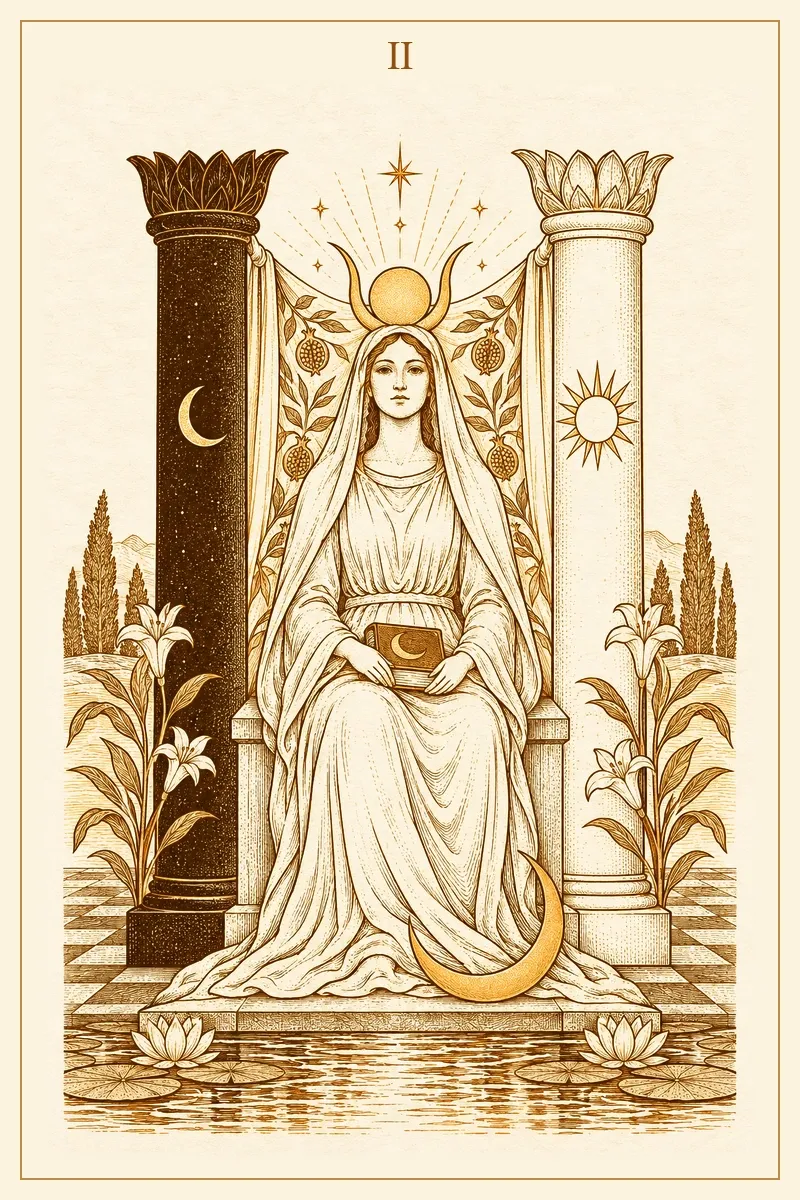
The High Priestess sits on a stone throne between two pillars: a dark one marked with a crescent moon and a pale one marked with a sun. A veil patterned with pomegranates hangs behind her, she wears a horned crown cradling a full disc, a closed book marked with a crescent rests in her lap, and a crescent moon lies at her feet. Lilies grow on both sides, and below the step, water lilies float on still water.
She is the card of receptive attention. Use her with the soft gaze, letting your eyes travel slowly between the pillars and down to the water. Notice that the book is closed: she is not reading, she is listening. If your sessions fill up with commentary, a week with her teaches the difference between noticing and narrating.
Upright, she invites you to trust what you sense before you can explain it. Reversed, she can point to a gap between what you feel and what you allow yourself to say. The High Priestess tarot meaning covers her full range in readings.
The Star: letting something flow back in
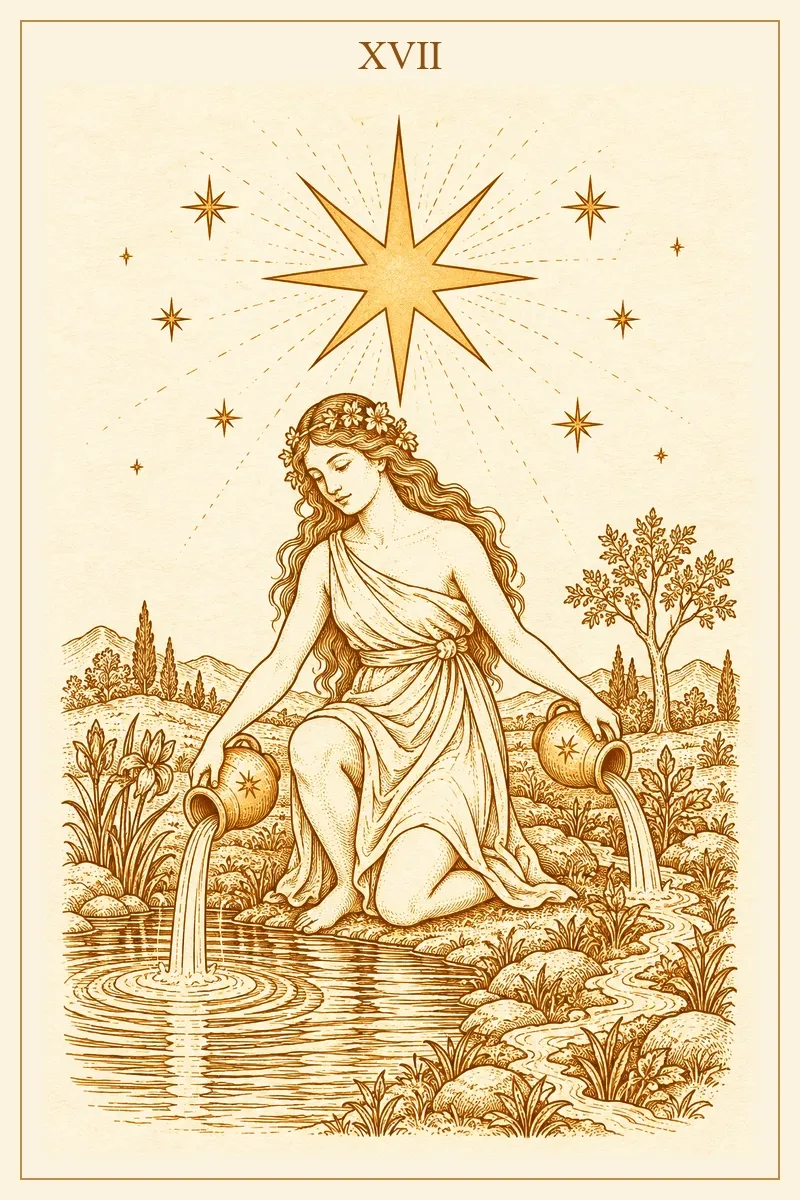
The Star shows a woman with a crown of flowers kneeling at the edge of a pool. She pours from two jugs, each marked with a small star: one stream falls into the pool and sends out rings, the other runs over the ground and becomes a little brook. Above her shines a large eight-pointed star with smaller stars scattered around it, a young tree stands on the right, and irises grow on the left.
The Star suits the breath technique. On the inhale, look at the great star; on the exhale, follow one stream down to the water. The rhythm of pouring is already in the picture, so the breath has something to match. Choose it after a draining week, when you want rest more than insight.
Upright, the card speaks of hope returning and of being able to receive again. Reversed, it can suggest you are pouring out more than you take in; ask which jug in your life is emptying fastest. More on its meanings sits in the guide to The Star tarot card.
Temperance: finding the middle pace
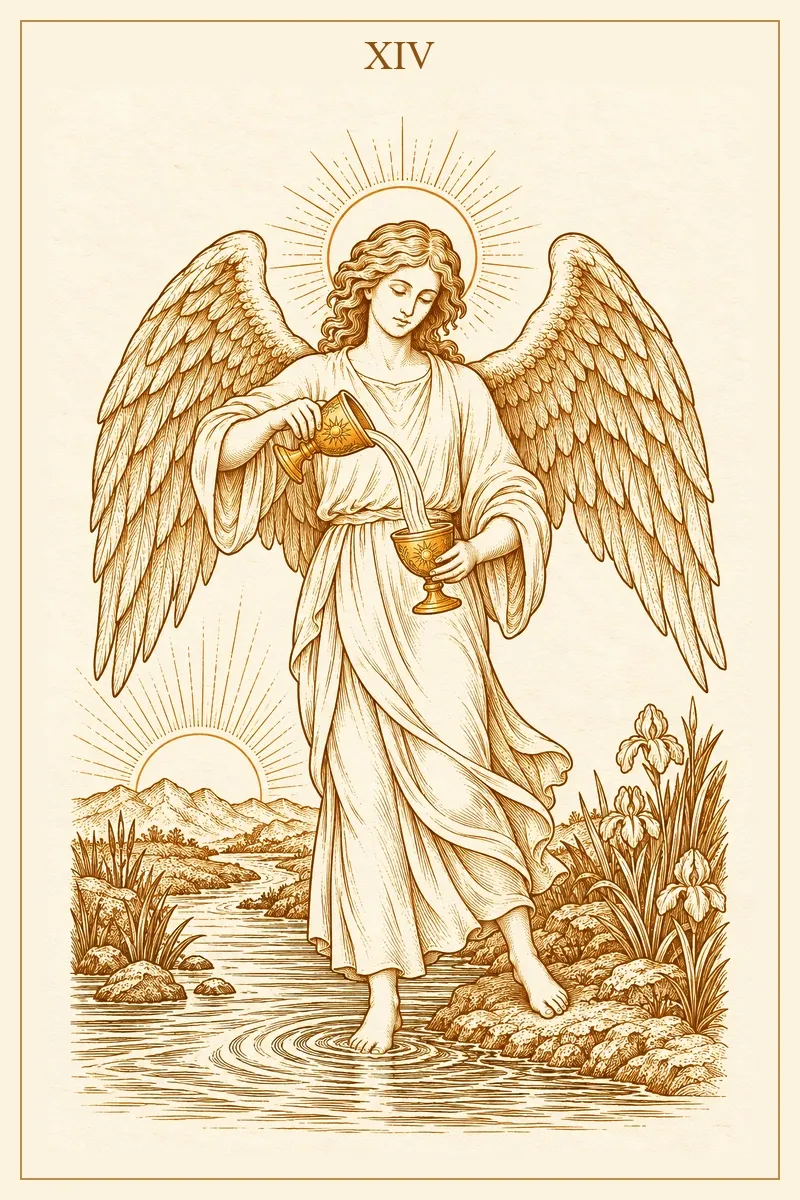
Temperance is a winged angel with a halo, pouring water from one golden goblet into another in a steady arc. One bare foot stands in a winding stream, the other on a rocky bank. Irises grow at the right, and on the left a sun sits low over distant mountains where the river begins.
This is the card for a session about pace. Watch the arc of water between the goblets and let your breathing match it, neither rushed nor held. The foot in the water and the foot on stone make a quiet picture of balance between feeling and practicality, useful on days when you feel pulled in two directions.
Upright, Temperance asks for moderation and patient blending. Reversed, it can describe excess, impatience or a life tipped too far one way. Read the full Temperance tarot meaning for the card's wider story.
The Hermit: a lamp for the next step
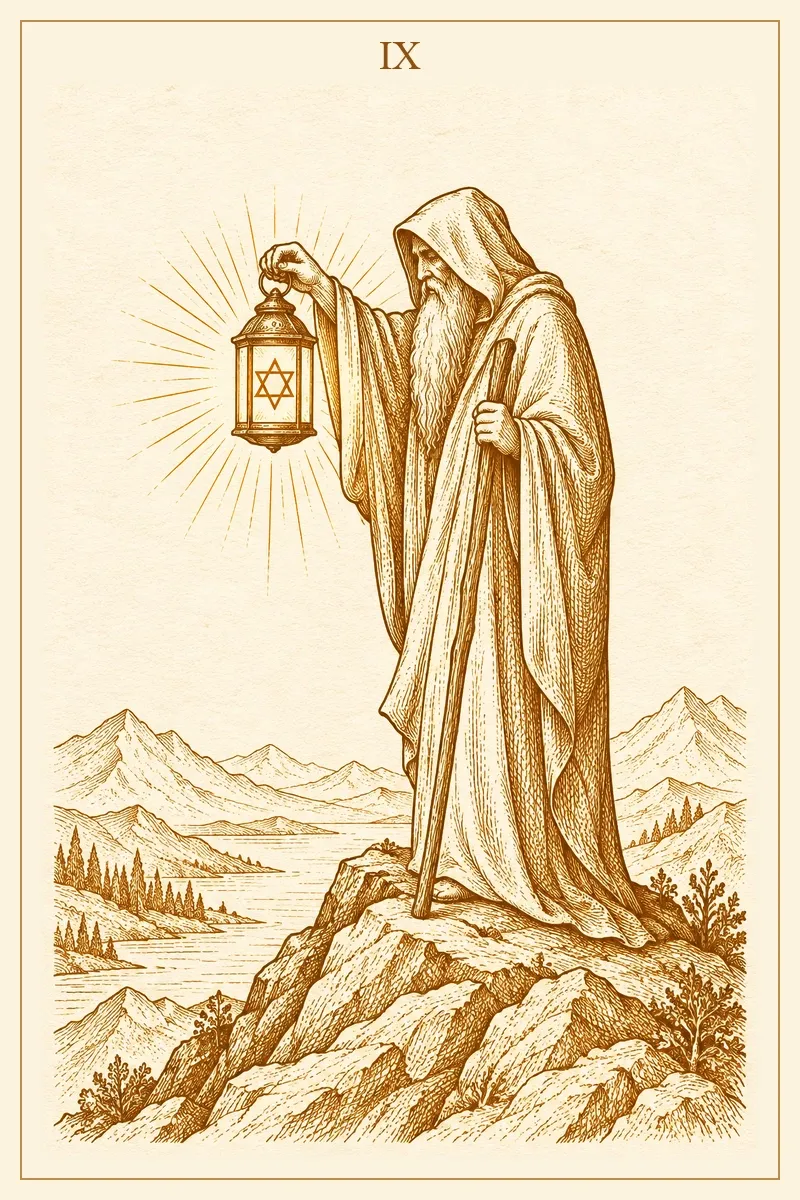
The Hermit stands on a rocky peak in a long hooded robe, leaning on a staff. In his raised hand he holds a lantern with a six-pointed star inside it, its light spreading in fine rays. Far below him lie a lake, pine trees and a range of mountains, all small from where he stands.
The Hermit pairs naturally with stepping inside the picture. Imagine climbing the last stretch of rock to stand beside him and look down at the valley you came from. The lantern lights only a few steps ahead, which makes this a good card when a big decision feels overwhelming: you need only the next step.
Upright, he describes chosen solitude and inward listening. Reversed, he can point to isolation that no longer helps, or to avoiding quiet altogether. The Hermit tarot meaning explores both sides.
The Tower: staying present through upheaval
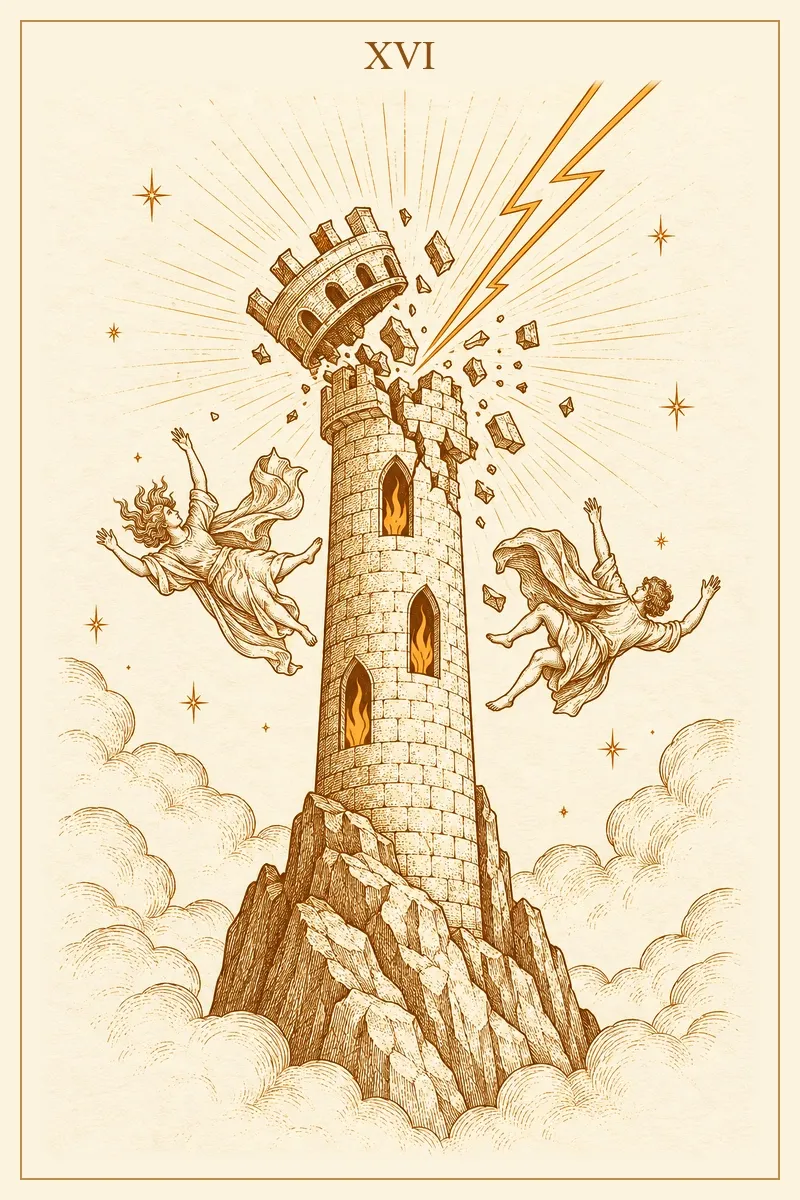
Here the Tower rises from a jagged crag above a sea of cloud. A bolt of lightning strikes its top and knocks the crown-shaped battlements loose, stones fly outward, flames show in three arched windows, and two figures fall through the air on either side. Small stars dot the sky around it.
This is a card for technique 4, not for a first session. Sit with it on a calm day and let your eyes go to the base of the image: the rock is still holding. Breathing slowly while you look at a picture of collapse lets you watch how your body reacts to sudden change, and what helps you steady yourself.
Upright, the Tower names sudden change and the end of a structure that was less solid than it looked. Reversed, it can describe a change you see coming and keep postponing. The Tower tarot meaning covers the card in love, work and timing.
Other cards to choose by what you need
Once the basic session feels familiar, choose cards by the mood you bring to it.
- Courage: Strength for patient courage, The Chariot for direction when you feel scattered, and The Sun for warmth and plain joy.
- Fears and endings: The Moon for uncertainty you cannot see through yet, The Devil for habits that hold on, and Death for clearing space.
- Rest: the Four of Swords, a picture of stopping on purpose, for days when you are tired rather than restless.
- Feelings: any Cups card that mirrors your mood, so you start where you already are.
- Grounding: the Pentacles suit, whose earthy scenes steady a drifting mind.
Over a few months, a handful of cards may keep working for you. Gather ten or fifteen of them into a small meditation pile and choose from it by mood rather than by meaning.
A worked example: ten minutes with The Star
Here is how one soft-gaze session might unfold. The person is invented for illustration.
The intention. Maya has spent a week of late nights finishing a project at work. She wants ten minutes of quiet, not a reading about the project, and writes at the top of a page: "Rest my attention; solve nothing."
The card. She looks through the deck face-up and stops at The Star, because the water looks cool.
Minutes one to three. Her mind lists tomorrow's tasks. Each time, she goes back to one detail: the flowers in the woman's hair, the rings on the pool, the small tree. By the third minute the lists have quieted.
Minutes four to eight. She notices that one stream falls into the pool and the other runs onto the land. Her shoulders drop, and a thought arrives: "This week I poured everything onto dry ground and nothing back into the pool."
Eyes closed, then the line. The large star stays clear while the landscape fades. She writes: "One jug for work, one for me." Afterward she reads the card's meaning, hope and renewal, but her own line is what she remembers the next morning.
The card did not say whether the project will succeed. It gave her a picture to rest on and a sentence she could act on, such as leaving work on time one evening.
A seven-day plan with one card
Staying with one card for a week shows layers a single session cannot. Pick a card you feel neutral or warm toward and keep each day's line in the same notebook.
- Day 1, soft gaze. Five minutes of looking, one word at the end.
- Day 2, one detail per breath. Afterward, list the details you landed on that you missed on day 1.
- Day 3, the edges. Look only at the background: sky, ground, whatever the frame cuts off.
- Day 4, stepping inside. Ten minutes in the card's world, then write what you found.
- Day 5, upside down. Turn the card reversed and repeat the soft gaze; the guide to tarot reversals can help you make sense of what comes up.
- Day 6, the carry. Take the card's feeling into an ordinary task.
- Day 7, read it back. Read your six lines in order and write one sentence, in your own words, about what this card means to you now.
Only then compare your sentence with a book definition. Where they agree, the meaning has become yours; where they differ, you have something to explore in your next reading.
When the practice gets in its own way
Meditating with cards is simple, but simple is not the same as easy. Here are a few snags and a small adjustment for each.
- Your mind will not stop talking. The practice is the return, not the silence. Shorten the timer to three minutes, or switch to one detail per breath, which gives the mind a job.
- You start falling asleep. Sit more upright, try an earlier hour, or keep your eyes open and skip the closed-eye step.
- Nothing seems to happen. Some sessions feel like staring at cardboard. They still count, because the aim is presence, not a special state.
- You want more depth. Add soft instrumental music, try box breathing (four counts in, hold, out, hold) while you gaze, or move from five minutes to ten.
- A strong feeling arrives. Open your eyes, name five things you can see in the room, and feel your feet on the floor. You can end the session there.
If meditating with a card leaves you with distressing thoughts, overwhelming emotion, or a sense of being detached from yourself, stop the practice and talk with a mental health professional. The cards can wait.
Frequently asked questions
Do I need meditation experience to meditate with tarot cards?
No. The card does part of the work that beginners find hardest: it gives your attention somewhere to rest. If you can sit for five minutes and look at a picture, you can start today with the basic session.
Which card is best for a first tarot meditation?
Pick a card with a calm scene and plenty of detail. The High Priestess, The Star and Temperance are gentle starting points. Save cards you find unsettling for later, once the basic session feels comfortable.
Should I choose the card or draw it at random?
Either works. Choosing a card face-up lets you match the session to a mood or theme, such as Temperance on a hectic day. Drawing at random keeps you curious and stops you from always picking favorites.
Can I meditate with a reversed card?
Yes. Turning a card upside down changes how the picture sits in your eye, and that alone can bring new details forward. In reflection, treat the reversal as the card's theme turned inward, blocked or asking for attention, rather than as a bad omen.
Can tarot meditation predict what will happen or replace therapy?
No to both. A meditation card cannot reveal the future, another person's feelings or a date, and nothing you see while visualizing is a message you must obey. It is a reflection practice that can sit alongside professional care, never in place of it.
One card, one quiet room
Tonight, choose one card, set it where you can see it, and give it five minutes of your attention. Look, breathe, close your eyes and write a single line. If a question surfaces while you sit, you can bring it to a calm reading with Veil Soul another day.