Feeling trapped, with fewer options than you actually have: that is the Eight of Swords tarot card meaning in one line. Upright, it describes a situation where some limits are real, but fear, old beliefs or missing information make the walls look closer than they are. Reversed, the Eight of Swords usually means the blindfold is coming off as you notice an exit and start to move, though it can also show worry tightening its grip before it lets go. In love, it points to someone who feels stuck inside a relationship, or who keeps new love at a distance to avoid being hurt again.
This is a card about perception, not doom. It asks you to separate what genuinely holds you from what you have assumed holds you, then take one small step through the gap. Tarot cannot tell you what another person intends, set a date, or decide whether you should stay or go, so read the Eight of Swords as a mirror for your thinking rather than a verdict.
The Eight of Swords at a glance:
- Upright: feeling trapped, self-imposed limits, fear that shrinks your options, waiting to be rescued.
- Reversed: release, a fresh view of the exits, asking for help; sometimes deeper worry before the turn.
- Love: staying out of fear, or guarding your heart so tightly that nobody gets close.
- Work and money: a job or a debt that feels inescapable, with more options than you are counting.
- Yes or no: no for now, until you can see the situation clearly.
- Element and astrology: Air; Jupiter in Gemini; the Golden Dawn title Lord of Shortened Force.
- Advice: name the real constraint, question the assumed one, take one step.
Eight blades in the shallows: reading the picture
Every detail on this card makes the same argument: the trap is looser than it feels.
Rope, blindfold and bare feet
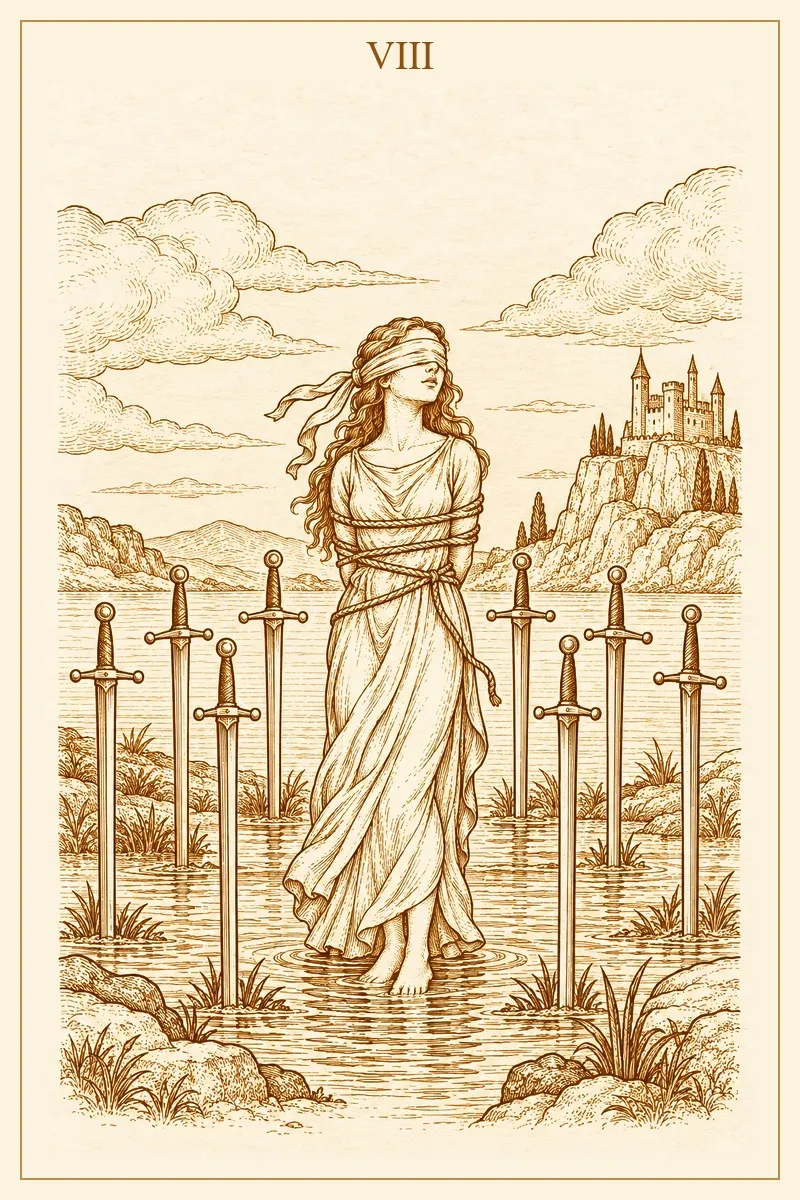
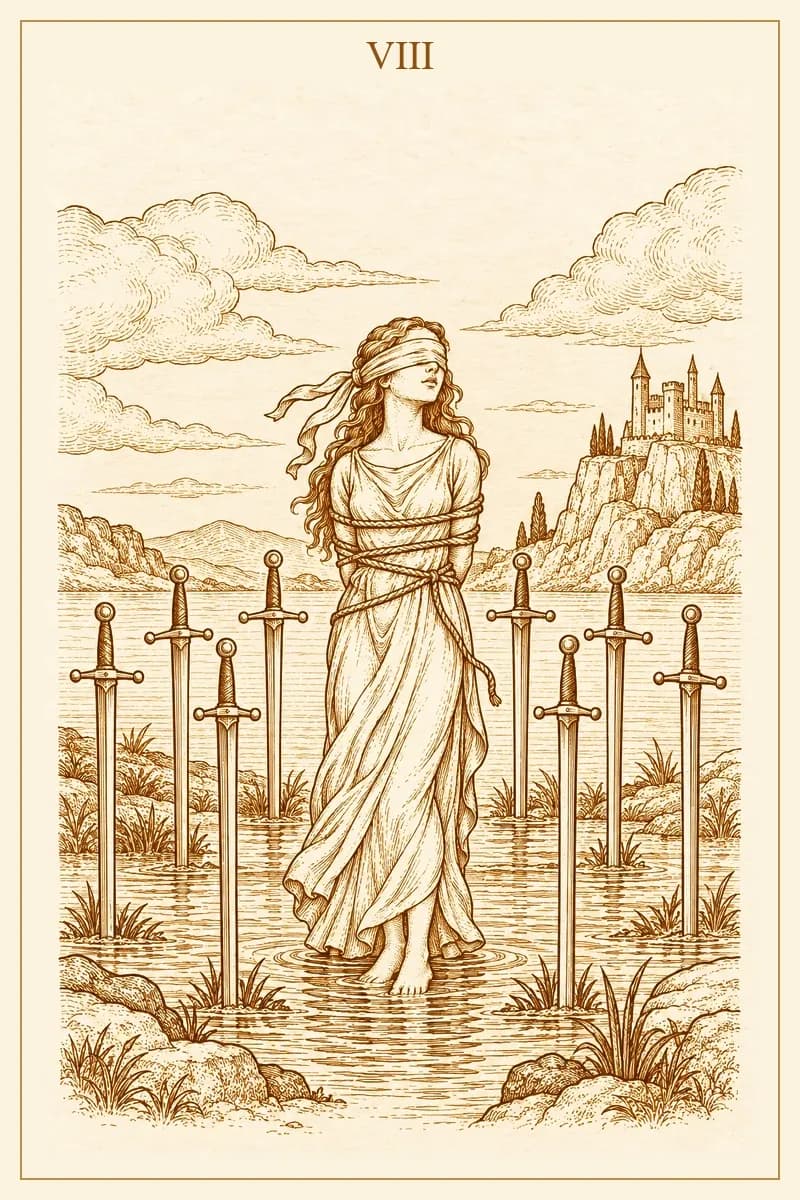
A young woman with long, wavy hair stands barefoot in shallow water. A cloth is tied over her eyes, its ends trailing off in the breeze. A rope is wound several times around her upper arms and waist, holding her arms behind her back, yet one end hangs free at her hip. Nobody guards her, and the rope is not tied to any post.
The restraint is real enough to feel, but nothing outside her holds it in place. What keeps her still is the cloth over her eyes: she cannot see how much room there is, so she does not move.
Four swords on each side, none in front
Eight swords stand point-down in the water, four to her left and four to her right, rising beside and behind her like a fence. The space in front of her is empty. The way out runs straight toward the viewer, through the shallows and the reeds.
Swords are the suit of thought, so this fence is built from thoughts: predictions, old rules, other people's opinions, worst-case stories. Some blades are solid. Others only look solid because you have never walked up and touched them.
Water, reeds and a castle on the cliff
She stands ankle-deep, so every step feels uncertain; water usually points to feeling, and here the feeling is unease. Behind her a wide lake stretches toward low hills, and on the right a castle with several towers sits on a rocky cliff among slim cypress trees. The castle reads as safety, home or help: reachable and in plain view, yet invisible to her from where she stands. The sky above is calm, with no storm in it.
Lord of Shortened Force: Jupiter squeezed into Gemini
In the Golden Dawn system the Eight of Swords carries the title Lord of Shortened Force and is assigned to Jupiter in Gemini, the first decan of Gemini, roughly May 21 to 31. Like the rest of the Swords, it belongs to the element of Air.
Jupiter is the planet of growth and of faith that things can expand. Gemini is a quick, changeable air sign that thinks in pairs and alternatives. Together they make a mind with plenty of power and nowhere for it to land: every option spawns a counterargument, every plan meets a "yes, but." The force is cut short before it becomes action. If you feel stuck despite being capable, this is a useful lens: you are not short of strength, you are spending it on circling. Our guide to Gemini and tarot follows the sign through its other cards.
Upright: a cage that is partly real and partly fear
What the upright card usually describes
Upright, the Eight of Swords describes the feeling that you have no good options. You may be telling yourself "I can't leave," "I have to say yes," "nobody would hire me," or "it's too late." The card does not dismiss the situation. There are swords around you: a contract, a lease, children, health limits, money, family expectations. What it questions is the conclusion you have drawn from them, that nothing can change and nothing is yours to change.
It can also carry a way of waiting: hoping someone will come and untie the rope. Outside help can be part of the way out, but the first movement usually starts with you, even if it is only asking.
Sorting fact from fear: an eight-sword inventory
A practical way to work with the upright card is to give each sword a name. Write down up to eight things that seem to keep you where you are, then sort each one into a group.
- Real and fixed: a constraint that will not move soon, such as a notice period or a medical need. Plan around it.
- Real but negotiable: something that holds you today but could change with a conversation, a request or time.
- Assumed: a belief you have never tested, such as "my manager would never agree" or "I'm too old to retrain."
- Unknown: a fact you do not have yet. Your next step is to find it out.
Usually only one or two swords belong in the first group. The rest are where movement is possible, and you do not need to pull out all eight at once: one clear step into the open water changes the woman's whole position.
Eight of Swords reversed: stepping out, or pulling the knot tighter
Reversed, the Eight of Swords most often means release: the pressure eases because you see the situation differently. Context matters, though, and this reversal has a shadow side.
Walking out between the blades
The common reading is liberation through a change of perspective. A rule you treated as law turns out to be someone's opinion. You make the phone call, open the spreadsheet, or tell someone how stuck you feel, and the walls stop looking like walls. The change is usually quiet, more like untying a knot than a dramatic escape. Help can be the turning point too: the rope loosens once you let a friend, a counselor or a mentor see the whole situation, and on the card, the castle is right there on the hill.
Fear that tightens instead
Sometimes the reversal shows worry turning further inward before it eases. Seeing the exit can make you more frightened, because now the choice is yours, or anxious thinking can deepen into sleeplessness and dread, leaning toward the Nine of Swords. If the surrounding cards are heavy, read this as a sign to slow down and gather support, not to force your way out.
Eight of Swords in love: staying, guarding, or waiting to be rescued
In a love reading, the Eight of Swords rarely describes the other person. It describes the shape your own fear has taken around the relationship.
Feeling stuck inside a relationship
If you are with someone, the upright card often reflects a sense that you cannot leave or change anything, because of money, children, a shared home, what people might say, or a belief that you would never find anyone else. It asks: are you staying because you choose to, or because you have decided that leaving is impossible? Some people find they do want to stay once they let themselves ask. When both partners feel hemmed in by habits or by an argument nobody wants to reopen, the rope is shared, and one honest conversation starts to loosen it.
If the restriction comes from a partner who controls your money, your contacts or where you can go, that is not a self-imposed limit, and no card should talk you into treating it as one. Reach out to someone you trust or to a local support service.
Single and keeping everyone at arm's length
For singles, the card often shows protection that has turned into confinement. After a painful breakup you tied the blindfold on so you would not be hurt again, and now nobody gets close enough to matter. You rule people out before meeting them, expect rejection, or decide there is nobody worth meeting where you live. The way through can be small: accept one invitation, or let one person see an opinion you would usually keep to yourself.
When it describes how someone feels about you
In a feelings position, the card suggests the other person feels stuck between what they want and what they believe they are allowed to do. It does not mean they feel nothing. It means they are not moving, and you cannot untie their rope for them. Watch what they actually do, and decide how long you are willing to wait.
Reversed in love
Reversed, the Eight of Swords in love signals movement: leaving a relationship that kept you small, renegotiating one that had grown rigid, or opening up after a long guarded spell. It can also mean the other person is starting to free themselves from whatever held them back, which may or may not lead them toward you.
A job you think you can't leave, a budget that feels like walls
Work and career
At work, the upright card describes feeling boxed in: a role you have outgrown, golden handcuffs, a manager who seems to block every path, or the belief that you are not qualified for anything else. Some swords are real, like a visa tied to one employer, but often the strongest blade is the story "I'd have to start from zero." Test it: read three job listings, ask one person in your target field how they got there, and list the skills you use daily without naming them. Reversed, options open because you start looking, and a course, a transfer or a frank talk with your manager turns out to be possible.
Money and debt
With money, the card points to feeling trapped by debt or bills, often with a layer of shame that keeps the envelope unopened. The numbers may be serious, but avoidance is part of the cage: a payment plan, a talk with the lender or free debt advice all stay invisible while you do not look. This is reflection, not financial advice, so take the figures themselves to a qualified advisor. Reversed, the first practical step gets taken and the fog starts to lift.
Anxiety, rest and the mind's own walls
This is the most psychological card in the Swords, and it speaks directly to anxious thinking. The trapped feeling is real and painful, yet the card says your thoughts shape how narrow the room looks. It is not a diagnosis. If worry is affecting your sleep, your eating or your work, a doctor or therapist is the right next step; tarot can sit beside that support but cannot replace it.
Spiritually, the card says the bonds that hurt most are the ones we never question. Notice the sentence your mind keeps repeating about your situation, and ask whether it is a fact you have checked or a story you were handed.
Is the Eight of Swords a yes or no? Not yet, with a condition
Upright, the Eight of Swords leans toward no, or not yet. It is not a curse on the outcome; it says you are deciding from behind the blindfold. Ask again once you have checked your facts or talked with someone outside the situation. Reversed, it leans toward a cautious yes: you can move, and you have more room than you thought. As for timing, things move when you do. A stuck period ends when the first small action is taken, not on a date written in the cards.
Where the card sits in the Swords story
The Swords run from the clean idea of the Ace to the hard ending of the Ten, and the Eight sits where thinking starts to work against you. The cards on either side, and the suit's other blindfolded figure, help explain it.
Seven of Swords: the slippery plan before the ropes
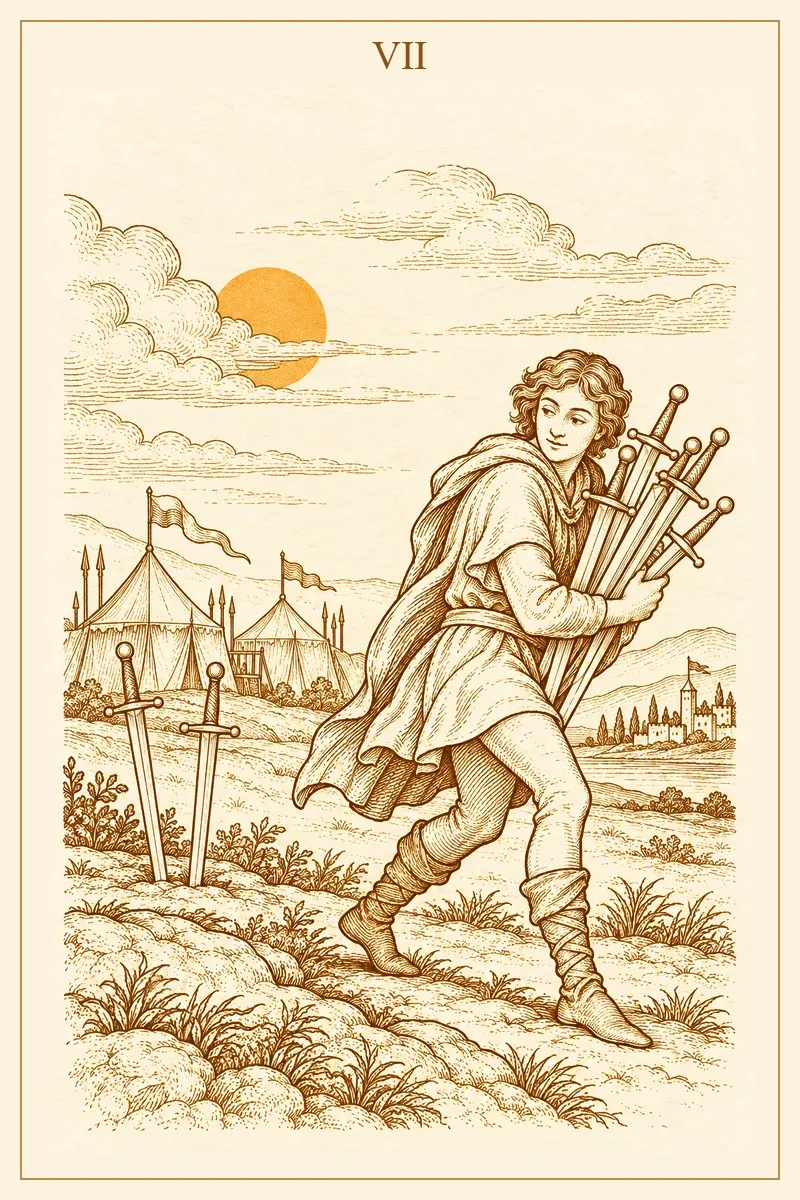
On the Seven of Swords, a young man in a hooded cloak slips away from a camp of tents with five swords bundled in his arms, glancing sideways as he hurries off, while two swords stay planted in the ground behind him. It is the card of strategy and of trying to get away with something. The Eight can follow it: after trying to outmaneuver a situation, or fooling yourself about it, you end up hemmed in by the consequences. The full Seven of Swords meaning covers its love and work readings.
Nine of Swords: when the fear follows you to bed
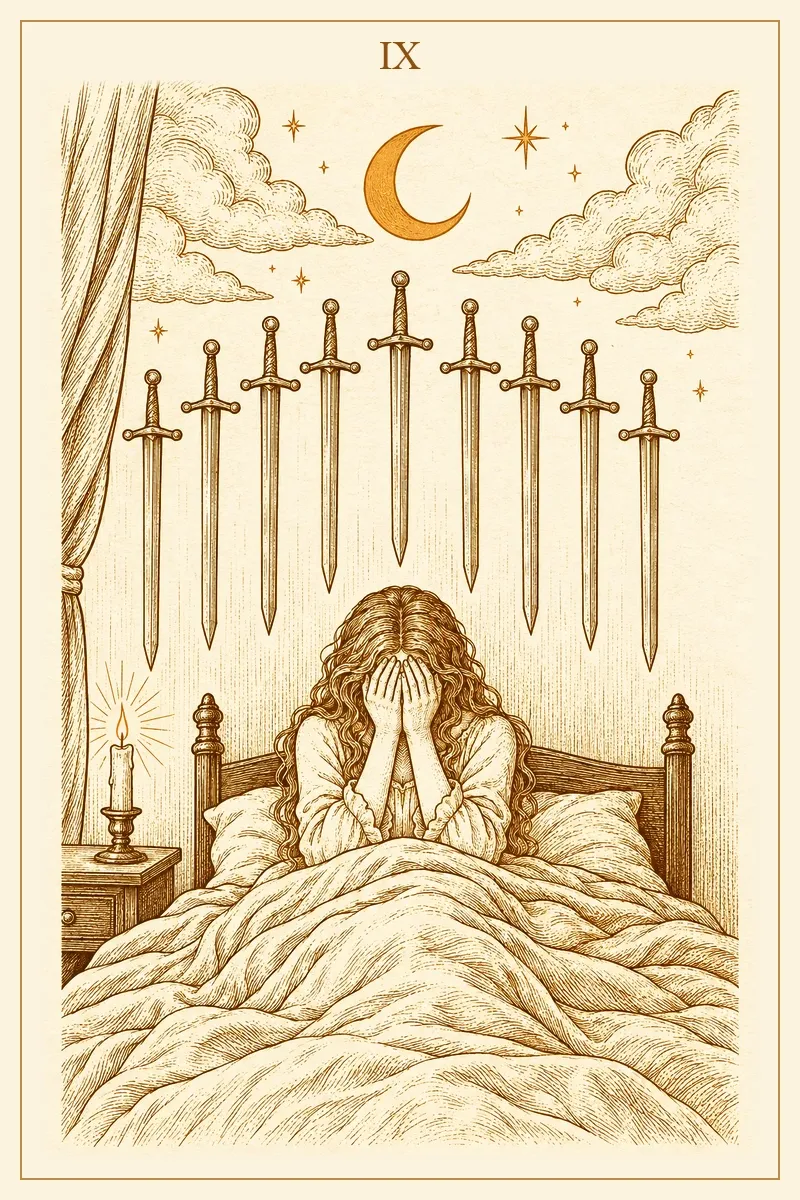
One step later, the Nine of Swords shows a woman sitting up in bed with her face in her hands. Nine swords hang in a row above her, a crescent moon and a few stars sit high in the dark, and a single candle burns by the bed. The Eight is feeling stuck; the Nine is lying awake over it. Together they ask for rest and care before any big decision, and our Nine of Swords guide looks at that card on its own terms.
Two of Swords: a blindfold chosen on purpose
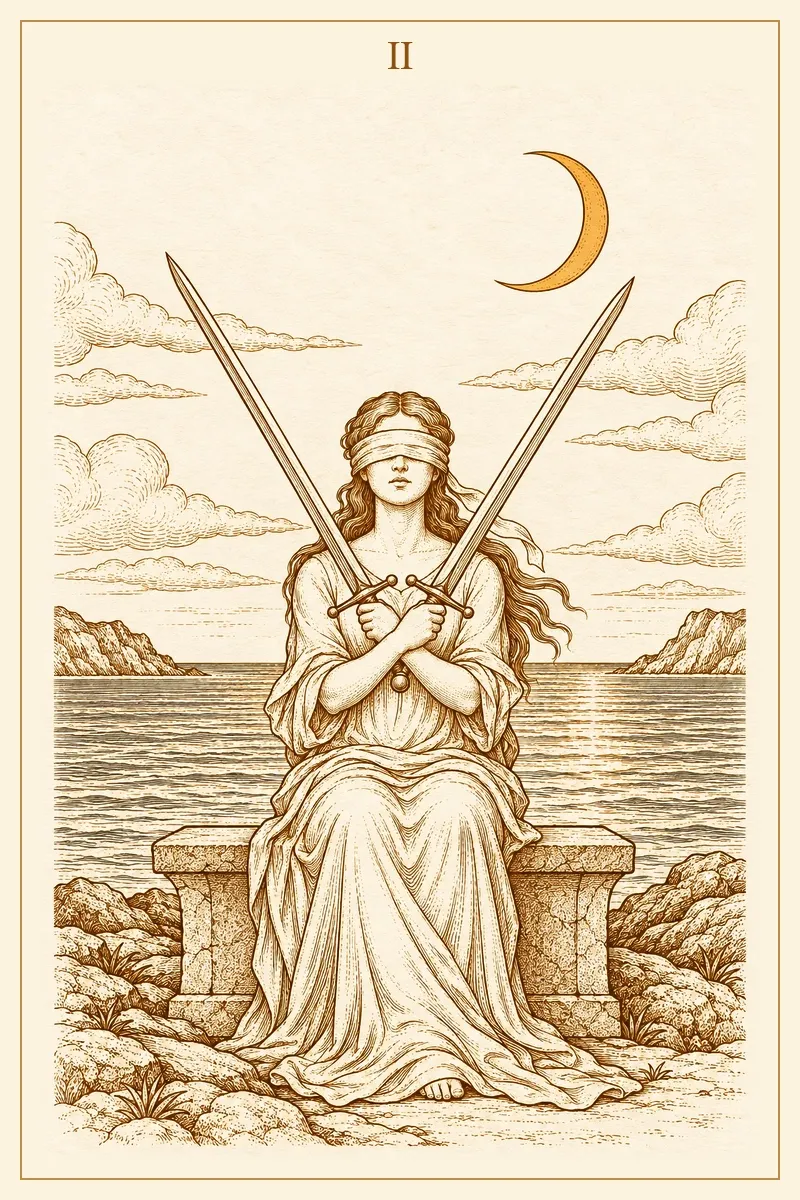
The suit's other blindfolded figure sits on a stone bench by the sea under a crescent moon, two swords crossed over her chest. On the Two of Swords she holds the blades herself and has chosen not to look, so that card is about avoiding a decision. On the Eight the swords surround her and she is tied, so this card is about believing there is no decision to make. You can set the two side by side in the Two of Swords meaning.
Five cards that loosen or tighten the rope
The cards around the Eight of Swords show whether the trap is about to give way or dig in.
With The Devil: two kinds of loose bond
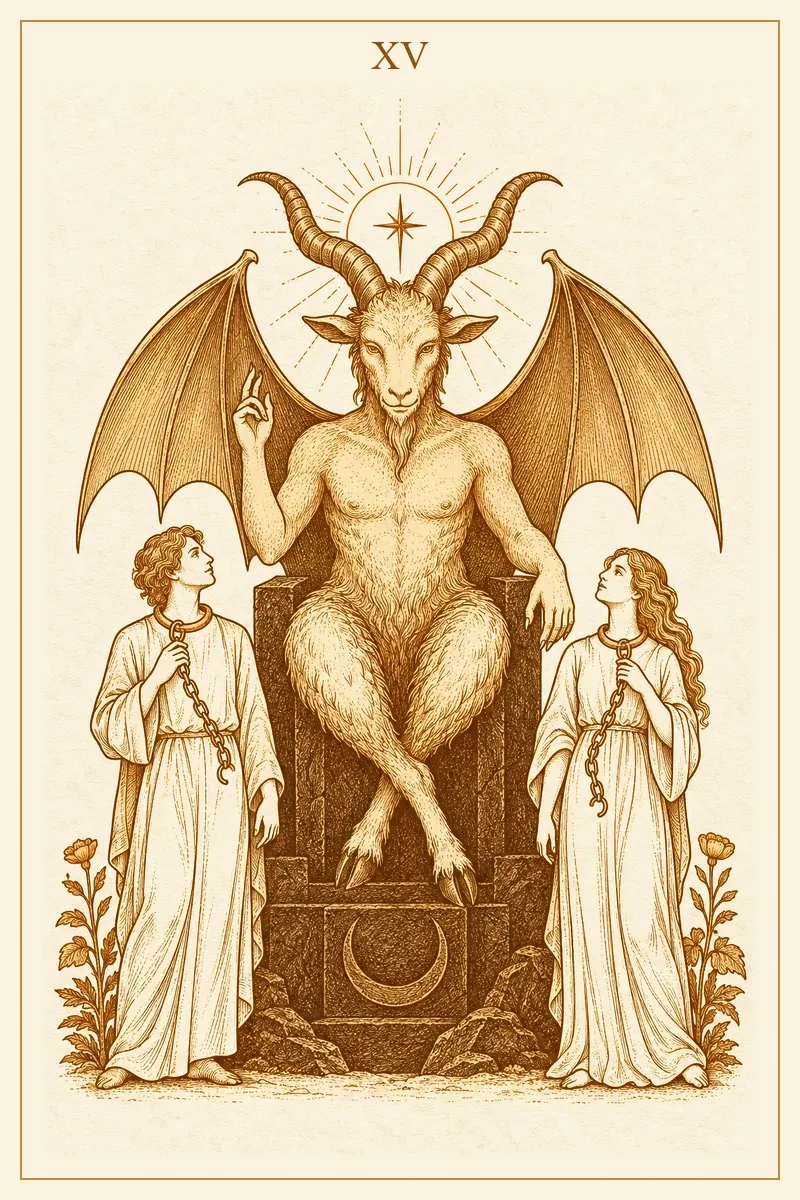
On The Devil, a horned, winged figure sits on a stone throne while two people in long gowns stand on either side, each with a chain around the neck and each holding that chain in one hand. Like the rope on the Eight, the bond could be lifted off. Together the cards point to a habit or dependency that holds you because it is familiar, not because it is locked; ask what you get out of staying. The Devil tarot meaning covers the full card.
With Strength: courage that does not need force
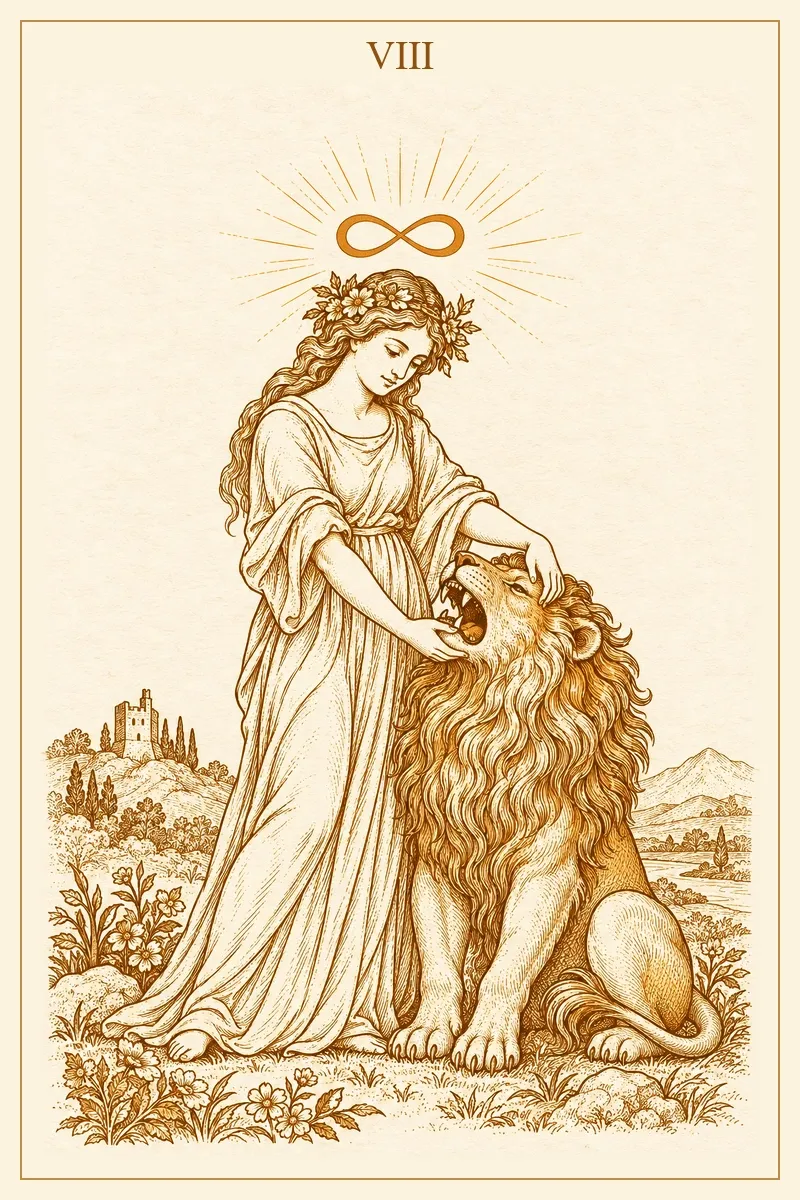
Strength shows a woman with a crown of flowers and an infinity sign above her head, calmly holding the jaws of a lion. Beside the Eight, it says the way out needs no dramatic break, only steady courage, patience with your own fear and a gentle hand on whatever scares you. The Strength tarot meaning says more about that quiet kind of power.
With The Star: hope you can act on
With The Star, hope arrives after a long period of feeling shut in: you can picture a life outside the circle of swords and start to believe in it. Turn that hope into something concrete; the Star tarot meaning explains why this card favors renewal over rescue.
With The Fool: the step before the mind objects
With The Fool, the remedy is a leap. The Eight overthinks; the Fool moves. Take a small, reversible risk before your mind builds another argument against it: sign up for the class, book the apartment viewing, send the message. The Fool tarot meaning looks at that kind of leap more closely.
With the Ace of Swords: one clear sentence cuts the cord
With the Ace of Swords, one clear thought breaks the spell: a fact you finally check, a truth someone says out loud, a sentence that names what you want. It is the clean cut the Eight has been waiting for, and the Ace of Swords meaning shows how that clarity works.
The open-gap spread: five positions for when you feel boxed in
This spread follows the picture on the card, from the blindfold to the first step out of the water. Shuffle with the question "What is keeping me here, and where is the way out?" and lay five cards in a row.
- The blindfold: what you are not letting yourself see.
- The rope: the constraint that genuinely holds you.
- The open water: an option already in front of you.
- The castle: help or support within reach.
- The first step: one small action for this week.
Worked example: a job that feels impossible to leave
Imagine someone six years into an office role they have outgrown, who keeps telling themselves that leaving is impossible. They ask, "What keeps me in this job, and what is one way out?"
The blindfold: Four of Pentacles. The card of holding on tight. Much of the stuckness comes from guarding a steady paycheck, despite some savings and skills other employers would pay for. Security has become the blindfold.
The rope: Ten of Wands. This rope is real: the workload leaves no energy at the end of the day, so any exit has to fit into very little spare time.
The open water: Page of Pentacles. A learner's card: a short course, or an hour a week of study in the field they are curious about.
The castle: Three of Cups. Help comes from people. Telling two or three friends or former colleagues about the search would widen the view.
The first step: Two of Wands. Planning from where you stand: a six-month plan on one page, with the course, the people to contact and a rough budget.
Read together, the trap is partly real (the workload) and partly a protective habit (the paycheck as blindfold), and the exit is gradual. Nothing here promises a new job; it gives the person a way to start moving again.
Small ways out this week
When the Eight of Swords keeps turning up, pick one or two of these rather than all of them.
- Write down the sentence that feels like a wall ("I can't...") and add "yet" or "on my own" to the end. Notice which version is true.
- Ask one person outside the situation how it looks to them: someone honest, not someone who will agree with your fear.
- Take one small, reversible action that proves you can move: apply, ask, book, sign up.
- Rest. A tired mind builds tighter cages, and sleep and food change how big the room looks.
To journal with: Where do I feel trapped, and how much of that is fact? Which sword have I never touched? If a friend described this situation, what would I tell them?
Frequently asked questions
Is the Eight of Swords a bad card?
No. It is uncomfortable because it reflects a stuck feeling, but its message is hopeful: the trap is looser than it seems, and part of the way out is already within reach.
Does the Eight of Swords mean someone is holding me back?
Other people are sometimes part of the picture: a demanding family, a controlling partner, a rigid employer. The card focuses on the part of the restriction that lives in your own thinking. If someone is genuinely limiting your safety or freedom, that calls for real-world support, not only reflection.
How is the Eight of Swords different from the Two of Swords?
Both figures wear blindfolds. The woman on the Two holds her swords and avoids a choice she knows is there. The woman on the Eight is surrounded and bound, and believes she has no choice at all. The Two asks you to decide; the Eight asks you to notice that you can.
What timing does the Eight of Swords suggest?
There is no fixed date. The card describes a stall that ends when action begins, so watch for the first step rather than the calendar.
Can a tarot reading tell me whether I am really trapped?
A reading can help you sort your thoughts, notice fears you have not named and choose a next step. It cannot see your contract, your bank balance or another person's intentions, and it cannot predict what happens if you leave or stay. Use the cards to ask better questions, then check the facts in your own life.
Taking off the blindfold, one knot at a time
The woman on the Eight of Swords does not need to fight her way out. She needs to notice the open water in front of her and take one step into it. If you would like to lay out your own situation and see what the cards reflect back, you can begin a calm reading with Veil Soul whenever you are ready.