To connect tarot cards, read each card against the one beside it rather than one at a time: say what the first card is doing, then ask how its neighbor changes that. Three questions do most of the work — what does this card add to the one next to it, which suit or number repeats across the spread, and where does the sequence start and end. Tarot cannot confirm another person's private thoughts, name a date or settle an outcome; it can hold the parts of your situation side by side until the relationship between them becomes visible.
That move is the difference between knowing words and writing sentences. Readers who feel stuck after a year usually have plenty of card meanings and no way to join them, so every spread comes out as a list of definitions that never becomes an answer. What follows covers adjacency, five linking techniques, suit-heavy and number-heavy spreads, a worked four-card reading, a spread built for connection, and a daily practice.
Six things to look at in every spread, in this order:
- Suit count: which part of life the question actually lives in.
- Number count: which stage of a process is repeating.
- Neighbors: how each card narrows the card beside it.
- Direction: which way the figures face, and what they face toward.
- Contrast: the least likely pair, which is usually the spine.
- Arc: where the row begins and where it ends up.
Why a memorized meaning stops working in a spread
A card meaning is a range, not a point. Eight of Cups covers leaving, outgrowing and quietly withdrawing; which of those you are looking at depends on what sits around it. Read alone, you pick the sense that suits your mood. Read in company, the spread picks for you, and that is the more useful answer.
Meanings are vocabulary; connections are grammar. "Rest", "speed", "offer", "grief" are words. A reading is the sentence they make: rest arriving in the middle of speed, an offer refused out of grief. Vocabulary can be memorized in a few months. Grammar is built by practice, which is why it feels out of reach right up until it suddenly does not.
Two habits follow. Interpret late — lay the whole spread, look at its shape, and only then start naming cards, because a meaning chosen before you see the pattern is hard to let go of afterward. And treat the cards as a description rather than a verdict, since a spread shows forces you can still act on.
Adjacency: what the card next door does to the meaning
The strongest relationship in any spread is between neighbors. A card standing beside another works like an adjective beside a noun: it narrows the range until one sense is left.
Ace of Cups alone is a feeling that has just begun. Put The Devil next to it and neither card changes, yet the pair says what neither says alone: a new feeling with a hook in it, a rush that could harden into a habit you cannot easily leave. Move the same Ace beside The Star and it becomes an opening safe enough to be honest in.
Neighbors also contradict each other, and the contradiction is usually the message. Four of Swords asks for stillness. Eight of Wands shows everything arriving at once. Side by side they describe a familiar bind: you need to stop, and the week will not let you. Neither card wins; the tension between them is the reading, and the practical question becomes which single thing you are allowed to slow down.
Adjacency works across gaps too. In a row of five, card one speaks loudest to card two but still answers card five. Read the near pairs first, then check the two ends against each other.
Five ways to link two cards
These moves are small enough to use mid-reading. Learn them one at a time, and expect two of them to suit you better than the rest.
1. Say the sentence out loud
Force the cards into one grammatical sentence with a connector you choose: because, so, despite, which is why, until. "I keep leaving situations once they go flat because I never said what I wanted from them, which is why the next one starts the same way." The connector is the interpretation — the part you supply, and where the insight sits. If you cannot pick one, you have not yet decided what the cards are doing.
2. Follow where the figures are looking
In most illustrated decks the people in the pictures face somewhere. A figure turned toward the next card is moving into that energy; a figure turned away is leaving it behind. If the left card shows someone walking off and the right card shows still water, the sequence reads as departure toward relief. Swap them and it reads as relief abandoned. The images carry direction even when the keywords do not.
3. Read the elemental dignity
Elemental dignities grade a pair by the elements of its suits. Two cards of the same element amplify each other. Wands (fire) with Swords (air), and Cups (water) with Pentacles (earth), support each other: air feeds fire, water feeds soil. Fire with water, or air with earth, pull against each other — enthusiasm meeting a feeling it cannot absorb, or an idea meeting a budget. The grade is not good or bad news; it says whether the pair cooperates or argues.
4. Find the sharpest contrast
Scan for the least likely pair and start there; it is usually the spine of the reading. Nine of Cups, the wish granted, next to Five of Cups, where a figure stands over what spilled. Satisfaction beside grief asks one of two questions: did getting what you wanted cost something you have not mourned, or are you counting what is missing while something good is in front of you?
5. Lay the arc from first card to last
Read the row as a story with a beginning, a middle that complicates it and an end that resolves or refuses to. A spread opening on The Fool and closing on The World traces a full cycle: a step taken blind, finished knowingly. The same two cards reversed in order tell the opposite story, something complete dissolving into unmapped ground.
When one suit takes over the spread
Before interpreting anything, count the suits. A spread weighted toward one suit tells you which part of life the question actually lives in, and that frame usually matters more than any single card in it. Three of one suit in a five-card spread is worth naming out loud; four is the headline. Count the Major Arcana in the same pass: majors outnumbering minors suggest a chapter rather than a task, while an all-minor spread usually means the matter is still in ordinary hands.
Multiple Cups: the question is emotional, whatever you asked
Several Cups mean feeling is the working material — attachment, grief, hope, the state of a bond. A career question that comes back in Cups is usually asking how you feel about the work, not whether the numbers add up. Read them in sequence instead of as one mood: Three of Cups into Four of Cups is company turning into withdrawal, while the reverse order is withdrawal slowly reopening. When the whole spread arrives in this suit, our guide to a reading that comes out all Cups works through it.
Multiple Wands: energy is moving faster than the plan
A spread crowded with Wands points to drive, pace and competition for your attention. It appears when you already know what you want and are really asking whether to move now. Read the suit for speed and load: Two of Wands is a plan still being looked at from the balcony, while Ten of Wands is one person carrying more than the task requires. Together they ask what you would have to put down in order to start.
Multiple Swords: you are thinking about it more than living it
Swords describe thought, speech and the stories we repeat to ourselves. Three or four rarely announce disaster; they say the situation currently exists mostly in your head, as argument, replay or worry. Separate the card that shows the thinking from the card that shows the speaking — Nine of Swords is the three-in-the-morning version of a problem, Six of Swords the quiet leaving of it. A Swords-heavy spread is often answered by one conversation held out loud.
Multiple Pentacles: the answer is in time, money and bodies
Pentacles bring a question down to resources — hours, health, rent, skill, the slow build. A reading that keeps returning to them wants something measurable: a number, a date in the calendar, one protected hour a week. Seven of Pentacles beside Eight of Pentacles is the difference between waiting for growth and doing the next repetition, and many Pentacles spreads turn on that choice.
Repeated numbers and what they tie together
Numbers run across all four suits, so a repeated number says several different areas of life are at the same stage of the same process. Where suits name the subject, numbers name the chapter. Read two or more of a number as one statement before reading those cards separately; the number symbolism of the minor arcana is the shortest route into the habit.
Multiple Aces: more than one thing is starting at once
Aces are openings, the raw beginning of a suit. Two Aces mean two beginnings have arrived together, and the reading is usually about whether they are one beginning wearing two coats or two separate demands on the same calendar. Ace of Swords with Ace of Pentacles is a clear realization and a concrete resource in the same week: the idea finally has somewhere to land. Three Aces is real momentum and thin attention. Aces describe doors rather than results, so read them as "this is available now" and ask what walking through each one would cost. Our guide to Aces in tarot takes the four one by one.
Repeated middle numbers: the same stage in different rooms
Twos ask for a choice or a pairing. Threes show the first result of effort and other people arriving in it. Fives are friction and the gap between what you have and what you expected. Sevens are the moment of holding your nerve. Two Fives in one spread, say Five of Pentacles with Five of Swords, do not double the trouble; they say the strain in your resources and the strain in your conversations are one strain described twice.
Multiple Tens: something is genuinely finishing
Tens are completions, the point where a suit has nowhere further to go. More than one of them moves the question from "will this change?" to "what do I carry into the next version?" A pair of Tens beside an Ace is one of the clearest sequences in the deck — an ending and an opening in the same breath.
A worked reading: two Aces and three Cups
Here is the method on one spread. The question: "I have been offered a share in a friend's small project and I keep putting off my answer. What is the hesitation made of?" Four cards went down in four named positions — where I actually am, what is being offered, what it would ask of me, and where this tends if nothing is said.
The draw: Four of Cups, Ace of Cups, Ace of Wands, Eight of Cups. Before any single meaning, look at the pattern. Three of the four are Cups, so this is a feelings question wearing a business coat; two Aces sit together in the middle, so two beginnings have arrived at once. That much is already most of an answer.
Four of Cups in "where I actually am"
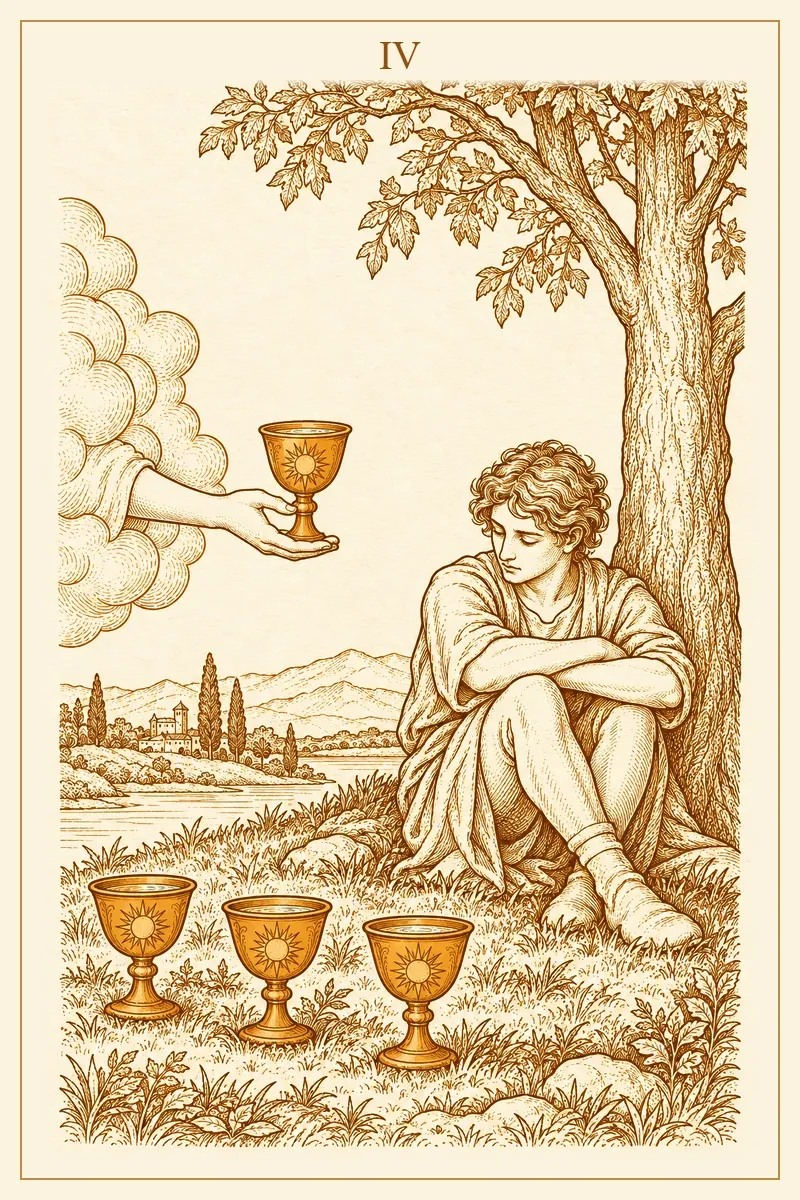
This card shows discontent with a cup held out that nobody has looked at. In the opening position it is not a verdict on the project; it describes the state the question is being asked from — flat, slightly closed, more aware of what is missing than of what is on the table. Reversed it would read as the first stirring of interest after that flatness. The fuller picture is in the Four of Cups card meaning.
Ace of Cups in "what is being offered"

Standing directly beside the Four, the Ace is the cup the previous card was not looking at. Adjacency does the work: the offer is emotional before it is commercial — being wanted on a team, being included again. Water beside water is the same element in the same key, which is why the hesitation feels heavier than the practical facts justify. The Ace of Cups meaning has more on what the suit opens with.
Ace of Wands in "what it would ask of me"
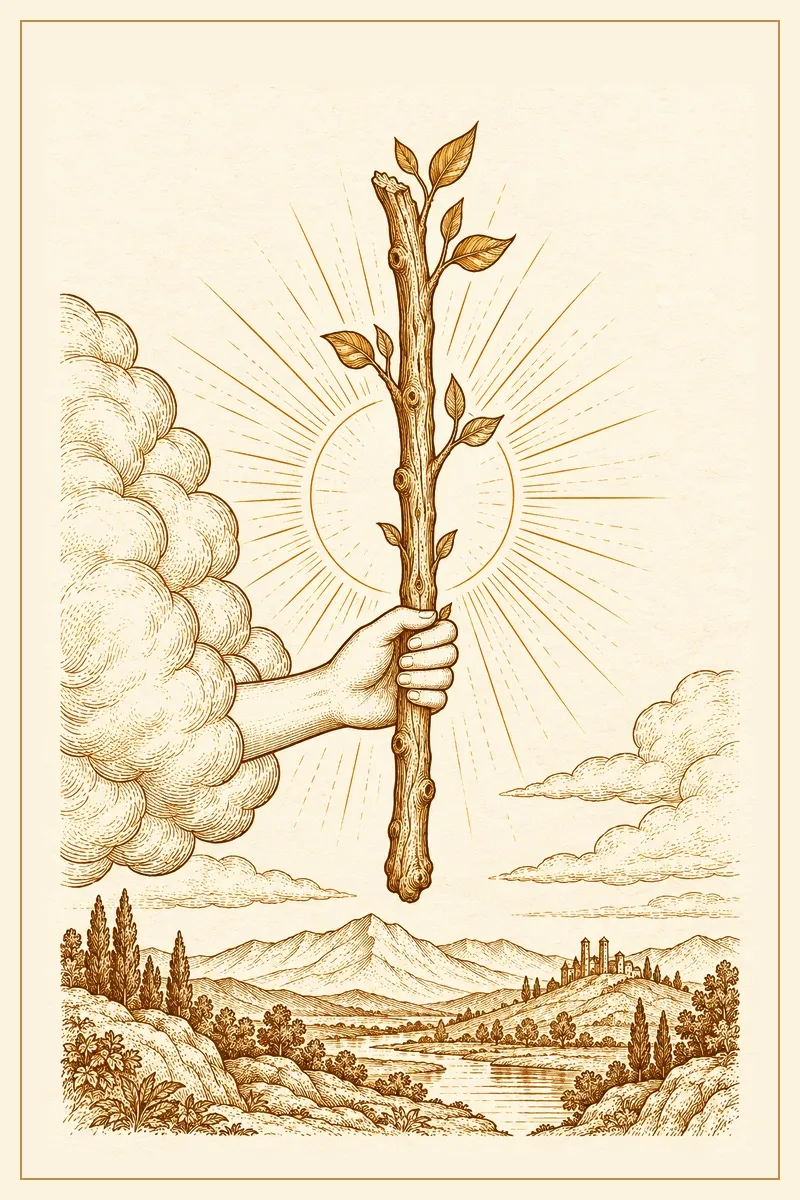
The second Ace changes the subject from feeling to doing. Ace of Wands is a spark, a start and, in plain terms, hours. Water beside fire is the tense pair from the dignities above: the heart has said yes and the calendar has not been consulted. The sentence method gives the spine — I am half closed because something warm is being offered that I have not let myself want, and saying yes would cost energy I have not budgeted. See the Ace of Wands meaning for the card alone.
Eight of Cups in "where this tends"

The last card closes the arc, and the direction of the figure matters: the walk is away from a row of cups that are still standing, not knocked over. It is not a prediction that the friendship ends. It is what the first three cards tend toward if the hesitation is never spoken — a slow exit from something that was still perfectly fine. The Eight of Cups meaning covers the difference between leaving and drifting.
The reading in one line: you are being offered something warm at a moment when you are too flat to feel it, the cost is energy rather than loyalty, and unsaid hesitation turns into a polite exit. The next step writes itself — tell your friend what you can honestly give this month and let the project be shaped around that number.
The Thread Spread: five positions built for connection
Most spreads are lists of topics, which quietly encourages reading card by card. This one is laid out so the links carry the reading. Use it when you have the techniques but no structure to practice them in.
- The ground. What the situation is made of right now.
- The pull. What is drawing you forward.
- The drag. What is holding you in place.
- The bridge. What would let the pull and the drag exist together.
- The honest end. Where the four above tend if nothing is said.
Read it in pairs. Two against three first, because the pull and the drag are the argument. Then one against five, because the ground and the end show the direction of travel. Then four on its own, the only position that asks for an action. If the bridge card feels impossible, positions two and three were probably stated wrong.
Lay the five in a row so you can see adjacency working. If five feels like too much, three cards are plenty, and the three-card spread is the most forgiving place to start.
Three habits that keep a spread from cohering
Reading one card all the way to the end before looking at the next. By the final card you have already committed to three fixed meanings, and the last card has to fight all of them. Lay everything, step back for a breath, and let the pattern arrive before any single definition does.
Quietly skipping the card that does not fit. The card that seems irrelevant is usually the informative one, because it is the part of the situation you have not been considering. The Empress in a career spread is not a mistake; it may be asking what you are growing, or what you stopped tending while you were busy producing.
Forcing one story when the spread is telling two. Some layouts hold two narratives — the cross and the staff of a Celtic Cross, or the first three and last three cards of a six-card line. If the cards resist a single thread, let them have two, then read the relationship between the two stories.
When the cards refuse to connect
Sometimes the cards genuinely will not form one story. That is information, not a failed reading.
A spread that will not cohere often mirrors a situation that has not cohered yet — a stretch of life so transitional that no clean narrative exists for it. The cards are reporting disconnection accurately, and naming that plainly is worth more than a story you had to force into shape.
Before concluding that, check two ordinary causes. The first is a question with two questions inside it: "should I move, and does my partner want to?" cannot be answered by one spread, and the cards split along the seam. The second is a question that belongs to somebody else's decision, which the deck has no access to. When readings keep coming out muddled, the piece on what to do when a reading feels confusing goes through the usual causes.
If the question is clean and the cards still scatter, say so: these are fragments, not a story. Then draw one more card for a single position — what would have to become true for these to connect — and sit with it alone. An honest "not yet" beats an invented narrative.
Thirty days of connecting, ten minutes a day
This skill is built by repetition, not by reading more about it. Ten minutes a day for a month changes how spreads look to you.
Pull three cards. Set a timer for three minutes and tell the story out loud, beginning to end, without checking a book — only what you see in the images and what the sequence suggests. Speaking matters: written interpretation lets you hedge, while a spoken one has to commit to a connector.
Afterward write two lines, the sentence you landed on and the connector that got you there. That list of connectors becomes the real record of your progress: beginners live on "and", while readers who have built the skill reach for because, despite, until and in order to.
Expect the first week to feel slow. By the second the stories arrive before the timer runs out, and by the fourth you will catch yourself seeing the shape of a spread before naming a single card.
Frequently asked questions
What if my story doesn't match the traditional meanings?
Your reading of the connection is usually more accurate for the specific situation than a textbook pairing, as long as the individual cards are not bent out of shape to fit. The test: could you explain which part of the image or sequence gave you that idea? If yes, trust it. Our guide to reading tarot intuitively goes further into holding both at once.
How many cards should I connect at once?
Start with two, then three, then five. Two-card pairs are where the grammar is learned, and many experienced readers still pull only two for everyday questions. Do not attempt a ten-card narrative until three-card stories come easily.
Does the order of the cards matter?
In a positional spread, yes — a card means something different in "what is leaving" than in "what is arriving". In a free-form pull you choose the order, usually left to right or starting from whichever card your eye went to first. There is no wrong order, only the one that produces a story you can state in a sentence.
What do I do when two cards flatly contradict each other?
Name the contradiction instead of resolving it. Real situations are full of them: wanting to leave and being afraid to go, craving change while holding tight to what is familiar. When two cards pull in opposite directions, that pull is the reading, and the useful next question is which of the two you have been pretending is not there.
Does a spread full of Cups always mean love?
No. Cups cover the whole emotional register — friendship, family, grief, creative attachment. A Cups-heavy career spread is far more likely to be about belonging at work, or disappointment you have not processed, than about romance. The suit tells you the material; the question and the positions decide the subject.
Do reversals change how cards connect?
They change the tone of a connection rather than breaking it. A reversed card in a pair often means the energy is delayed, internal or not yet owned, so the sentence shifts from "this is happening" to "this is being held back". If you do not read reversals, the same information usually shows up in the surrounding cards.
Can connecting the cards tell me when something will happen?
No. A connected reading shows what the parts of a situation are doing to each other, but it cannot supply a date, guarantee an outcome or report what another person has decided in private. Treat timing impressions as a description of pace — fast, stalled, building — and make real plans from facts you can check.
Write the connection yourself
Cards give you the words; the connections are yours to write, and the connector you choose is where the meaning lives. When you want to practice on a real question, you can draw a reading with Veil Soul and begin with the pair that argues loudest.