Offered, never demanded: the Ace of Cups means a new feeling placed in front of you — love, tenderness, forgiveness, creative warmth, or a sense of connection to something larger than your own day. Upright, the offer is real and your part is simply to accept it. Reversed, the cup is still full, but something between you and it — numbness, a wall built after an old hurt, or a heart already spent on other people — keeps you from drinking.
It is the first card of the Cups, so whatever it describes is a beginning rather than a finished story. What it cannot do is tell you what somebody else privately feels, promise that a relationship will last, or put a date on anything. Read it as a report on your own emotional weather and on the opening in front of you.
The short version, before the detail:
- Upright keywords: new love, emotional opening, compassion, intuition, forgiveness, creative and spiritual overflow.
- Reversed keywords: blocked feeling, emotional exhaustion, self-protection, an offer you are not ready to take, giving more than you receive.
- Yes or no: a warm yes upright; reversed, closer to "yes, but not in the state you are in right now."
- Element and suit: Water; Cups, the suit of feeling, relationship and inner life.
- Astrology: the aces sit outside the decans and stand for a whole element. The Golden Dawn gives this one the quarter of the zodiac from Libra to Sagittarius, centered on Scorpio; many modern readers link it with the water signs Cancer, Scorpio and Pisces.
- Number: one — a seed, a source, a single undivided thing with no history yet.
The chalice, the dove and the five falling streams
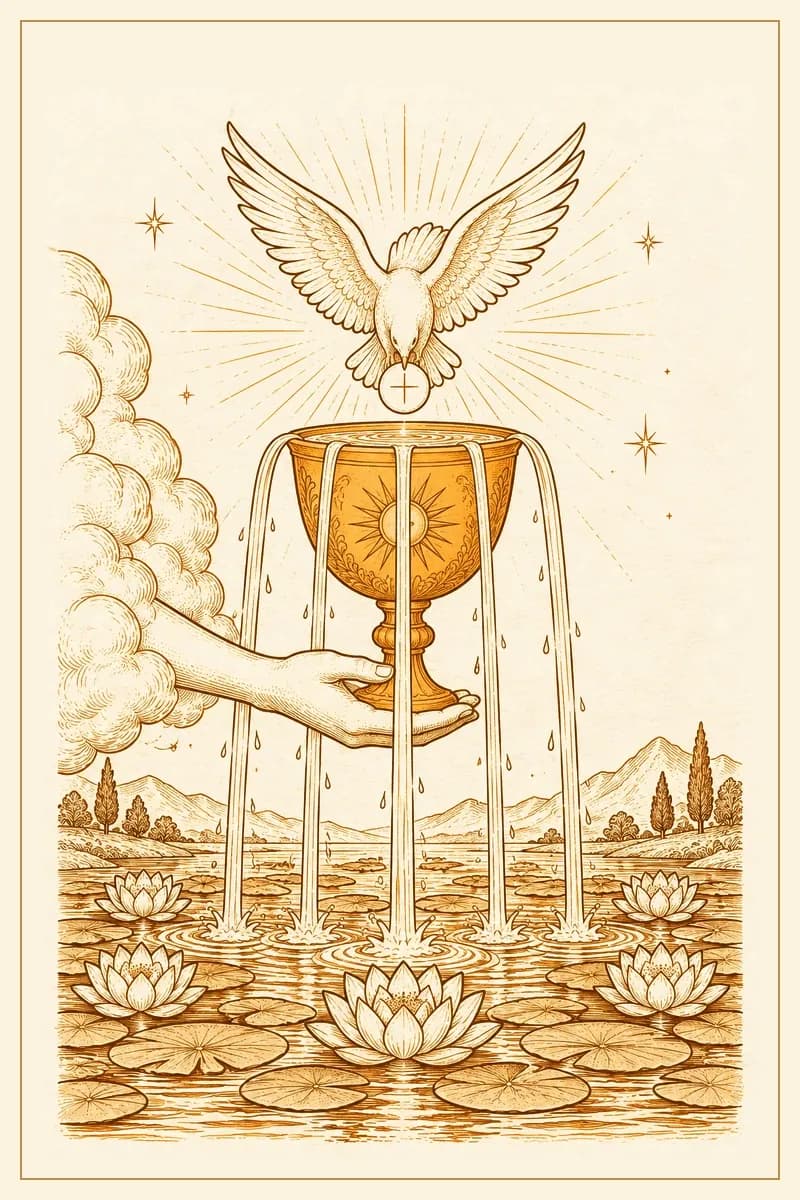
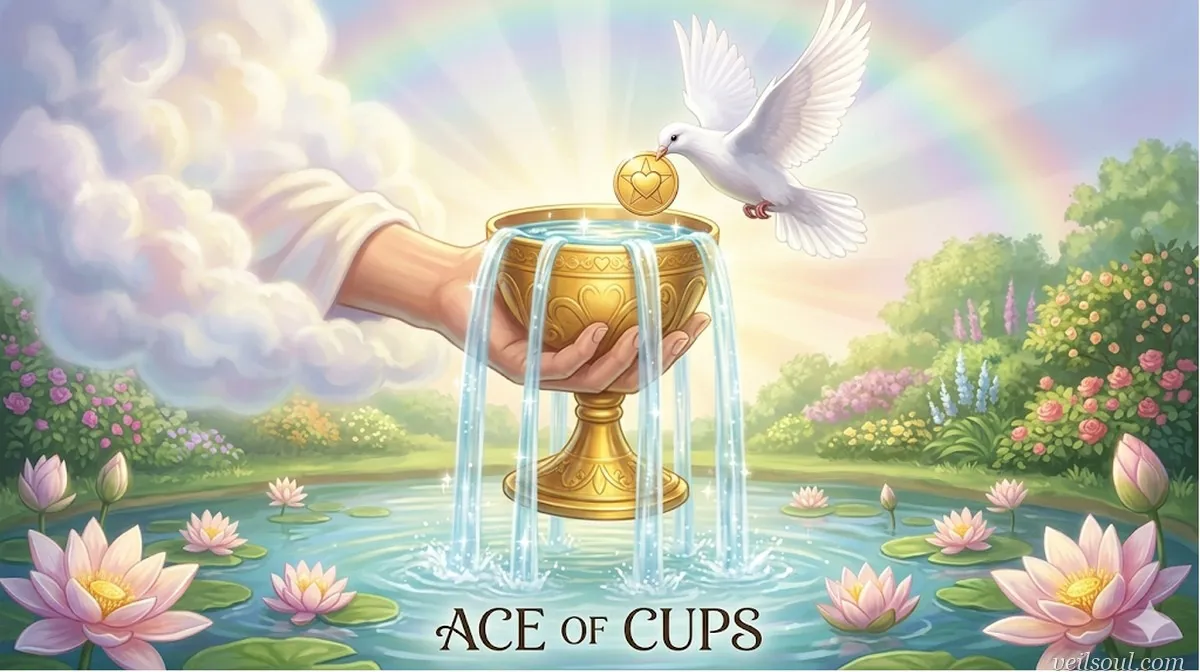
The card is engraved in gold line on cream. A wide golden chalice stands at the center, its bowl engraved with a radiant sun framed by laurel sprays. Five straight streams pour over the rim and fall into a lake below, where lotus flowers sit open across the lily pads. Many readers count those streams as the five senses. The lotuses root in silt and open on the surface, so the card insists that a heart which has been through mud can still flower.
A hand that offers and never grasps
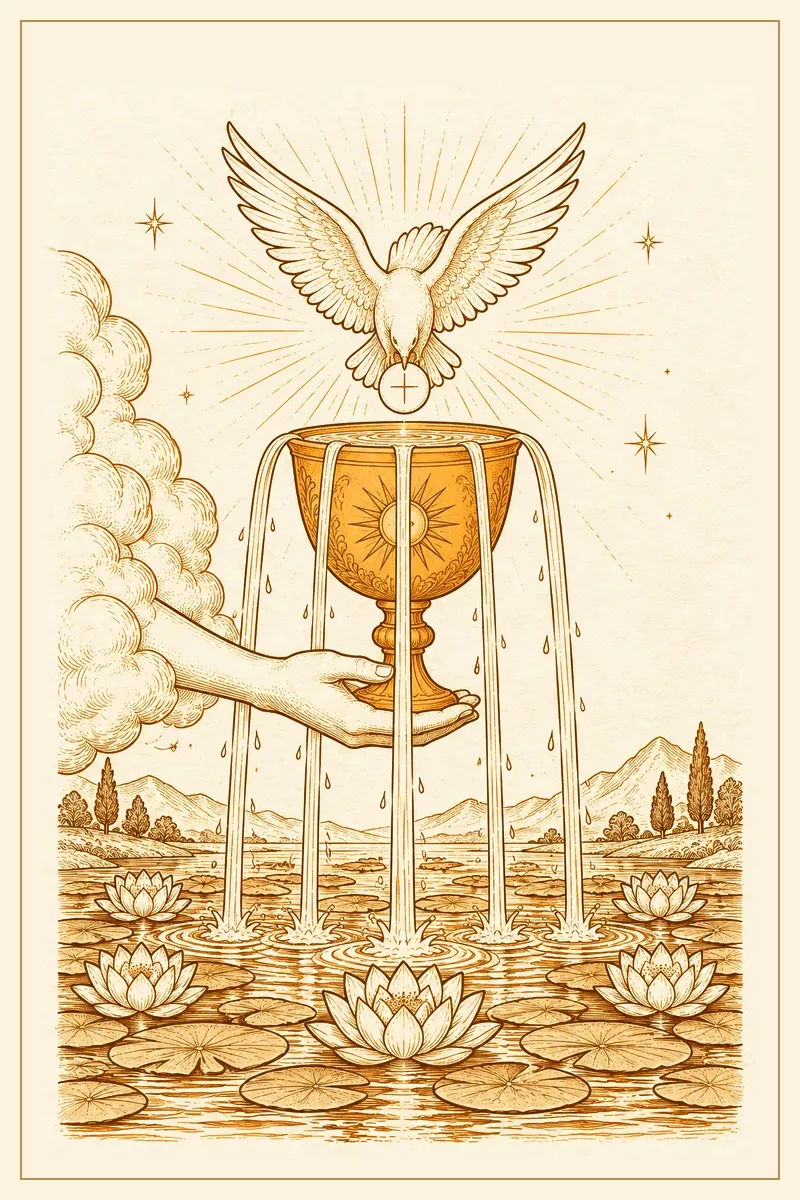
Out of a bank of cloud on the left, a single hand reaches in and holds the chalice from underneath, palm open, fingers steadying rather than gripping. Nobody is drinking. Nobody is pulling the cup away. That posture carries most of the card's meaning: a feeling is being held out toward you, and the gesture is an offer rather than a demand. When this ace turns up, the question is rarely whether something good is available. It is whether you will put your hands under it.
The hand also comes out of cloud rather than out of a person, which most readers take to mean the opening was not earned or arranged. It arrives. You can prepare the ground without being able to schedule it.
The dove and the round wafer above the rim
Above the cup a dove descends with its wings spread, carrying a round wafer marked with a cross: spirit coming down into ordinary life, and peace after a flood. The wafer marks the moment a feeling becomes something you can take in rather than only admire from a distance. In a reading, this half of the picture points to the kinds of love that feel slightly larger than you — the rush of care for a newborn, a forgiveness you did not plan, a piece of music that undoes you in the first bar.
Water, the number one and the start of the Cups story
Every ace is a root: its suit in the purest, least complicated form. The Ace of Wands is raw will, the Ace of Swords is raw clarity, the Ace of Pentacles is a tangible offer with weight in the hand, and this one is raw feeling before it has taken a shape or found a name. Our guide to the four aces sets them side by side.
The element is Water: emotion, intuition, memory, the things a body knows before the mind catches up. Water takes the shape of whatever holds it, which is why Cups readings so often turn on the container — the relationship, the household, the job — rather than on the feeling alone. If your spreads keep coming up heavy in this suit, our guide to the water element explains how that weather behaves.
And it is a one, which means no history and no accumulated pattern: both why the card feels so clean and why it promises so little on its own.
Ace of Cups upright: a feeling arrives before you can name it
Upright, the card describes an emotional opening that is genuinely available to you. Something has thawed: new love, renewed closeness, a return of kindness toward yourself, creative flow, or a spiritual experience that leaves you softer than it found you. The signature is the same in each case. You feel more than you expected to, and the feeling moves toward other people rather than away from them.
How the upright card shows up in ordinary weeks
- A conversation with a near-stranger that leaves you walking home differently.
- An apology you had given up on, arriving without being asked for.
- The first idea in months that you want to make rather than plan.
- Crying at something small, after a long stretch of feeling very little.
- A friendship quietly shifting into something both of you notice.
It can also point inward with no other person in it: the week the self-criticism lets up, or the decision to be gentle with a version of you who did not know better.
What the card asks of you
Aces give; they do not arrange. This one will not introduce you to anybody, finish the painting or carry the conversation. Its single instruction is receptive: be available. In practice that means saying yes to the invitation, answering the message properly, and letting a compliment land instead of deflecting it. Because the cup overflows rather than fills, it also favors generosity: if something warm reaches you this week, pass a portion of it on inside the same week.
Ace of Cups reversed: a full cup you cannot drink from
Reversed, the offer does not disappear, and that is the part short keyword lists get wrong. The hand is still there and the cup is still full. What has changed is your capacity to take it in, and the obstacle is often old and entirely reasonable, which is why this reversal deserves patience.
Four shapes the reversal usually takes
- Self-protection. You can see that the person, the job or the opportunity is kind. You cannot yet make yourself trust it, because the last one looked kind too.
- Emotional exhaustion. Nothing is wrong in particular. You have been the steady one for everybody for a long time, and there is nothing left to pour.
- Feeling with nowhere to go. Love for someone who cannot receive it, or a creative impulse with no hour in the week assigned to it.
- Numbness. A flat stretch where nothing tastes of much, and the card has come to name it rather than to scold you for it.
A gentler way to read the reversal
Try taking the reversed ace as a direction rather than a verdict: the cup is tipped toward you instead of outward. Before this feeling can go anywhere else, it has to land somewhere in your own life first. That is the practical sense behind the familiar advice about self-love — rest, one honest conversation, a limit set with somebody who takes more than they bring. In a difficult spread, this card reversed is rarely the problem itself; more often it describes the cost of whatever else is on the table.
Yes or no, upright and reversed
Upright it is a yes, one of the warmest in the deck, and especially dependable for questions about feeling: is there something here, should I reach out, is this worth opening up about. It is a weaker yes for logistics, money or timing, because the card speaks about emotional truth rather than about whether a plan will work.
Reversed, the honest answer is "not as you are now." It is rarely a flat no. The thing you are asking about may well be good; the card is saying that in your present state you cannot receive it, or that the feeling involved runs in one direction only. If your question was whether somebody cares, the reversal does not mean they do not. It means something is blocking the exchange, and that block is worth identifying before you ask the cards again.
One caution: an ace answers about the opening, not the outcome, so a yes from it says the door is unlocked, not that you will like every room behind it. Our walkthrough of yes or no readings covers how to phrase the question so the answer is usable.
Ace of Cups and Ace of Wands: the feeling and the fuel
Two aces in one spread double the sense of beginning, and these two make the warmest pair of the four. Water and Fire are usually called a difficult mix, yet at ace level they complement each other unusually well: the cup supplies the reason to care, the branch supplies the energy to move. Each has a familiar weakness alone — this ace can feel deeply and do nothing, the Wands ace can start eagerly and feel little. Side by side, those weaknesses cancel out.
The Ace of Wands on its own
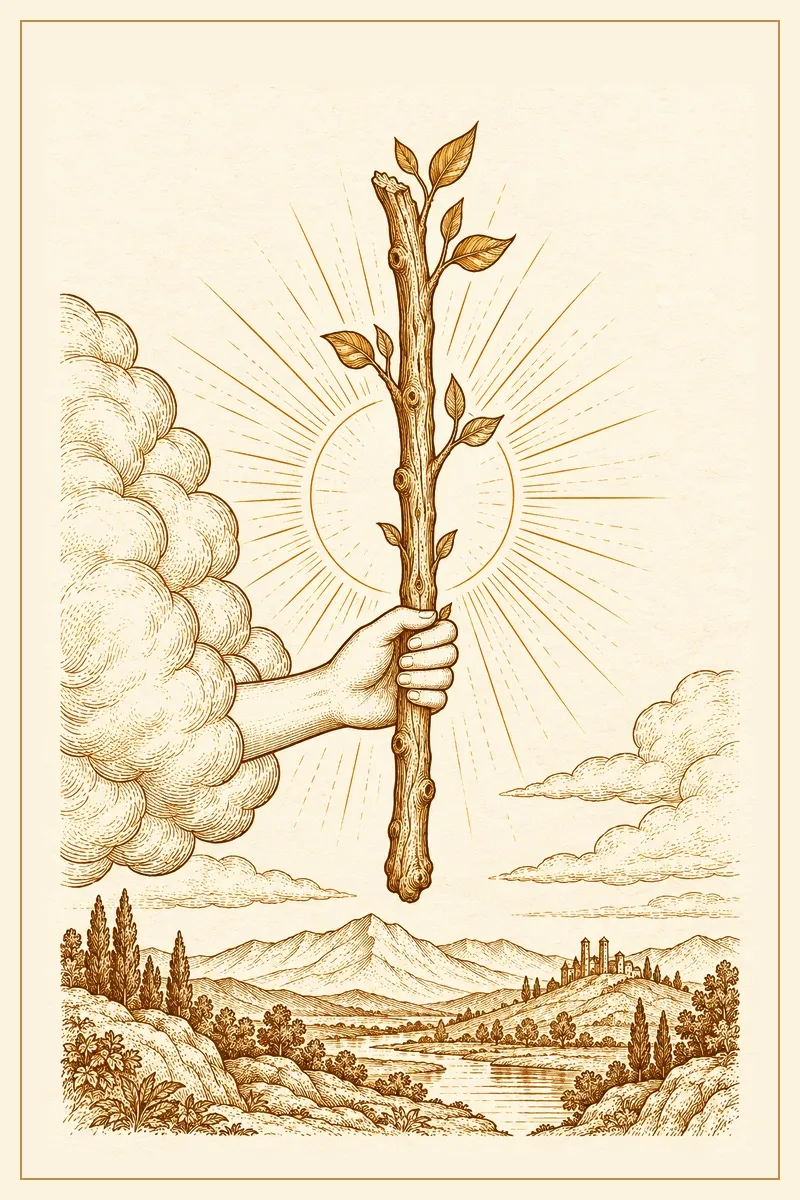
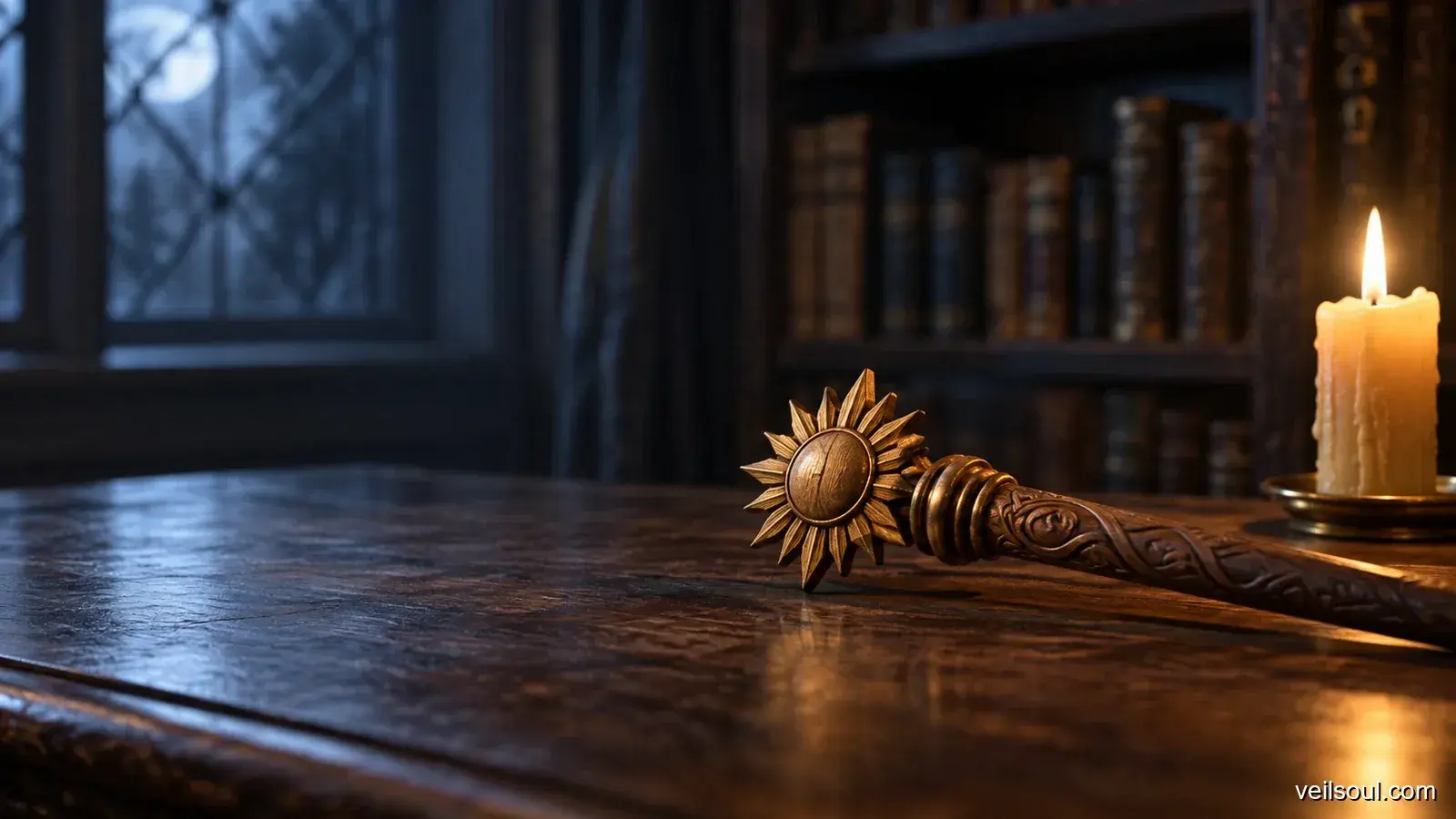
Its card shows a fist closed around a knotted branch that is still putting out leaves, held up in front of a burst of light, with a river valley and a far hilltop town below. Where the chalice is open and offered, the branch is gripped: appetite, nerve and the impulse to begin. The full Ace of Wands meaning sets out its range, and the short form is desire with somewhere to go.
The pair in a love reading
Together they describe attraction with both heat and tenderness in it. For someone single, it often reads as a meeting where the interest is immediate and the warmth underneath it is real as well. For a couple, it shows up when affection comes back with some appetite attached: a trip booked, a habit broken, a conversation finally started. Two aces are two beginnings, though, and neither says anything about endurance.
The pair at work and in creative projects
For creative work this is close to an ideal pairing: the cup names what you actually care about and the branch gets a first version made. In a career question it points to a role, a client or a venture that you want for a reason you could say out loud. If you have been choosing work purely by money, these two arriving together argue for weighing how a job makes you feel alongside what it pays.
When one of the two arrives reversed
With the cup reversed and the branch upright, there is plenty of drive and not much warmth behind it: busy, impressive, slightly hollow, often a sign of starting something in order to avoid feeling something. With the cup upright and the branch reversed, the feeling is real and nothing is being done with it — a crush nobody acts on, an idea described to friends for a year. With both reversed, the honest reading is low tide, and neither card punishes a pause.
Love readings: new feeling, old walls
If you are single
Upright, this is one of the better cards to draw about a new connection. It suggests feeling arriving — yours, theirs, or the kind that appears between two people before either has decided anything. It does not identify the person and it does not say the connection becomes a relationship. What it describes is openness: you are in a phase where you could be moved, which is the condition most new relationships need. Take it as an instruction to be reachable rather than to search harder.
If you are already with someone
Inside a relationship, this ace usually marks a softening: a quarrel that finally resolves, affection returning after a flat period, a new stage such as moving in together, or the conversation where one of you says something true for the first time. The card makes no claim that the relationship is secure. It says a channel has reopened, and channels close again when nobody uses them.
Reversed in a love reading
Reversed in love, read the direction the water is running: feelings held back on one side, a person who wants closeness but cannot bear being seen, or affection poured steadily toward someone who returns little. For a question about an ex, the reversal rarely means no feeling at all; more often it means feeling with no safe route between the two of you.
If the Knight of Cups or the Page of Cups sits nearby, a specific message or approach is usually involved. With the Queen of Cups or the King of Cups, the reading leans toward someone able to hold feeling steadily, which may be the person you are asking about or the one you are being asked to become.
Work, creative projects and money
Career and vocation
In work readings this ace points at meaning rather than advancement. It favors anything where the human part is the job: teaching, nursing, counseling, hospitality, care of any kind. It also turns up for an ordinary role that suddenly feels different because of the people inside it. Reversed, it is one of the clearest burnout cards in the deck for caring professions — still competent, no longer present, going through the motions of warmth. For makers the same reversal reads as a dry spell, and the suggestion is usually not to push harder but to refill.
Money
This is a poor card for forecasting income and a good one for noticing how feeling moves money. Upright, it can point to support arriving through a relationship: a family contribution, a friend who refers work, generosity nobody calculated. Reversed, it describes money spent to manage a mood — the order placed at midnight, the gift given to repair something that needs words instead.
Cards that tell you what the cup is filling with
An ace on its own says only that an opening exists. The cards lying around it tell you what kind, and they shift the reading more than most beginners expect.
With The Empress: feeling that wants to become something
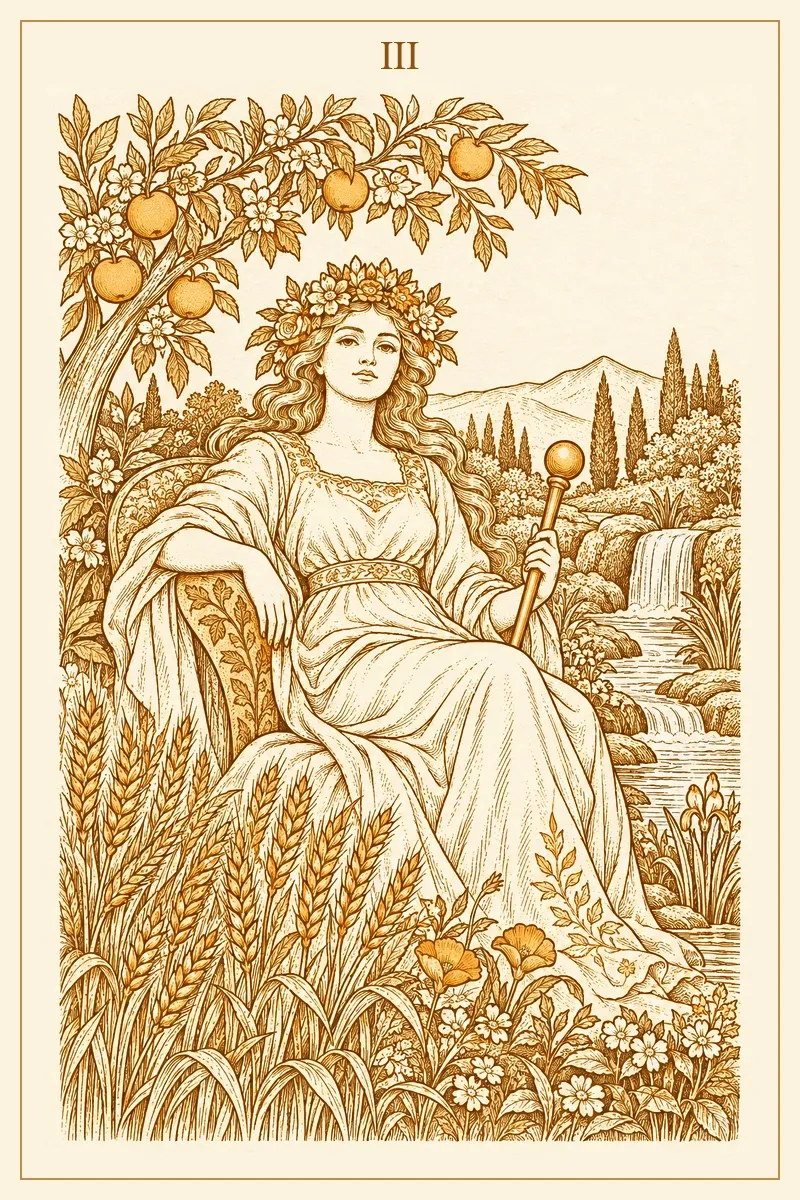
The Empress takes the overflow and gives it a body: fertility in the broad sense. Some readers take it literally when the question is about a pregnancy, but more often it describes a relationship moving into a shared life. Our guide to the Empress explains why she governs things that grow at their own pace.
With The Moon: a feeling still under the surface

The Moon deepens the water and darkens it. This pair points to feeling that is genuine but not yet clear: attraction mixed with projection, an intuition you are right to trust sitting beside a story you built around it. It is not a warning that somebody is deceiving you, but a reminder that a feeling can be real while your reading of it is not. The Moon's own meaning covers that difference.
With the Two of Cups: the feeling finds a second person
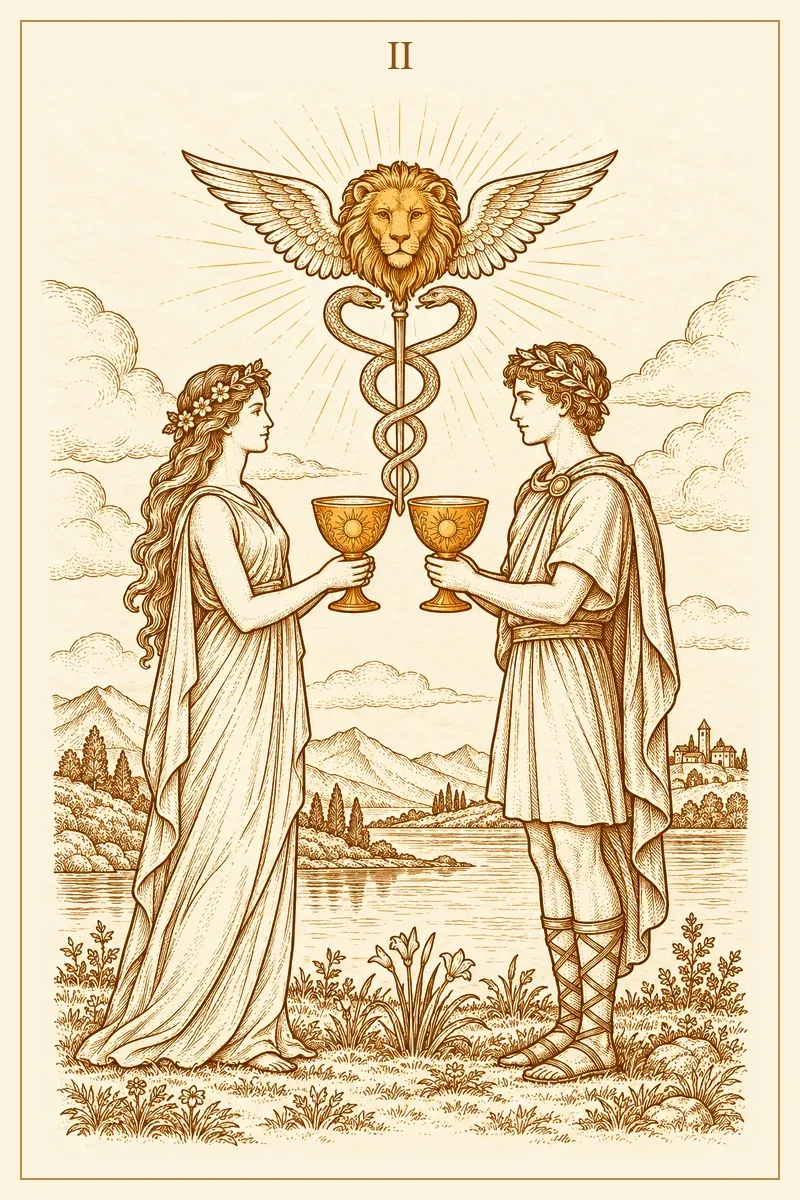
Where the ace is one cup held out, the Two of Cups is two cups raised to the same height. Drawn together, they describe the moment a private feeling becomes mutual, which is why the pair is read so often for the start of a relationship and for making up after a long silence. The Two of Cups meaning picks the story up where this card sets it down.
Other pairings worth knowing
- With The Star: healing that holds, and hope after a long stretch of damage, described well in our reading of the Star.
- With the Ten of Cups: the beginning and its best possible ending in one spread, a feeling with the shape of a home around it.
- With the Five of Cups: grief standing between you and the offer. Something has to be mourned before it can be accepted.
- With the Four of Cups: the offer is there and you are looking past it.
- With The Devil: warmth tangled up with need, and worth asking which of the two is doing the talking.
The Open Cup: a four-card spread
Shuffle with one question about an emotional opening and lay four cards in a row from left to right.
- What is being offered. The nature of the opening in front of you, as the cards see it.
- What is in the way. Your side of it: the habit, fear or tiredness that makes receiving hard.
- What accepting would cost. Something real is usually given up — control, a story about yourself, a safe distance.
- The first honest step. One action small enough to take within the week.
No position here asks what another person is thinking, and that is deliberate. Keep the layout pointed at what you can act on, and the reading stays useful even when the answer is uncomfortable.
A reading in practice: a message from someone who left
Imagine a reader whose closest friend moved abroad two years ago and let the friendship go quiet. A message has just arrived, warm and slightly awkward, suggesting a call. The question written down first: what is being offered here, and what is stopping me from saying yes?
What is being offered: Ace of Cups, upright. A genuine reopening. The warmth in the message is not a formality.
What is in the way: The High Priestess, reversed. Things known and not said. The reader has been quietly hurt by two years of silence and has told nobody, including themselves.
What accepting would cost: Five of Cups, upright. Naming the loss, and admitting those two years mattered instead of meeting the message with easy brightness.
The first honest step: Six of Cups, upright. Answer with one shared memory, one real question and one suggested time for the call, rather than a summary of two years.
The week after an Ace of Cups
- Name the offer. Write one sentence saying what is actually on the table. If you cannot finish it, the card may be pointing at something you have not noticed yet.
- Find the block kindly. If it came reversed, ask what receiving would cost you, and whether that cost was fair in some earlier situation but not here.
- Do one receiving thing. Accept a compliment without qualifying it, or let somebody help with a task you normally carry alone.
- Pour some out. Send the message, make the thing, tell the person. An ace that is never spent goes stale.
- Look again in a month. Aces are easy to romanticize in advance and very clear in hindsight.
Frequently asked questions
Does the Ace of Cups mean someone new is coming into my life?
Often, but not always. The beginning it describes can be a person, a reconciliation with someone you already know, or a change in how you treat yourself. Court cards and the Two of Cups push the reading toward a specific person; Wands or Pentacles nearby point to work instead.
Is the Ace of Cups reversed a yes or a no?
It is closest to "not yet." The opening usually still exists, so a flat no is too strong, but something is preventing the exchange: tiredness, self-protection, or feeling that only flows one way. Treat it as a yes with a condition attached, and spend your next question on the condition.
Can the Ace of Cups tell me how another person feels about me?
No card can confirm what somebody else privately thinks or feels, and none can supply a date or guarantee an outcome. What this one describes is the emotional climate around a situation and your own readiness inside it. Use it to decide whether to open a conversation, then let the conversation answer what the cards cannot.
Does the Ace of Cups mean pregnancy?
It is one of the cards traditionally associated with conception, especially beside the Empress or The Sun, but it is not a medical indicator and should never be read as one. In most spreads it means fertility in the wider sense: something new that will need care, time and feeding before it is anything at all.
How soon does the Ace of Cups happen?
Aces are read as fast cards and the Cups are given the slow, tidal pace of Water, so the common compromise is weeks rather than days or years. Timing is the weakest thing tarot does. More useful: the opening is available now, and will not stay open indefinitely if nothing is done with it.
What is the Ace of Cups as advice?
Receive before you analyze. Let the feeling be true for a day before deciding what it obliges you to do, then act warmly and in the open: say the kind thing, make the first gesture, let yourself be glad where someone can see it.
When your own cup is the question
The Ace of Cups keeps asking the same quiet thing: something warm is being held out, and are your hands free enough to take it? When that question belongs to a situation of your own, you can draw a reading with Veil Soul and see what the cards place around it.