An all-Swords tarot reading is about your mind. When every card, or most of the cards, comes from the Swords suit, the spread is pointing at thoughts, words and decisions: what you keep telling yourself, a conversation that is sharp or overdue, a truth you have recently seen, or a choice you have been turning over for too long. Lots of Swords is not a sign of doom. It says the way forward runs through honest thinking, and usually through one clear decision.
Several of the suit's best-known images show worry or defeat, yet the same suit holds clarity, rest and fair judgment; the numbers, courts, reversals and any Major Arcana tell you which side you are seeing. Treat the spread as a mirror rather than a verdict: tarot cannot tell you what another person is thinking, pin an event to a date, or promise an outcome. It can show where your mind is spending its energy.
A quick guide to the mood of a Swords-heavy spread:
- Aces and Pages lead: a new idea, fresh information or a moment of clarity is arriving.
- Twos and Sevens lead: something is undecided or not fully said; look at what you are avoiding or holding back.
- Threes, Fives and Tens lead: a hard truth, a quarrel or an ending is being processed.
- Eights and Nines lead: worry and self-limiting beliefs carry most of the weight, and they are often heavier than the facts.
- Fours and Sixes appear: rest and a calmer crossing are part of the answer.
- Several courts: other people's opinions, or your own inner voices, are crowding the question.
- Mostly reversed: pressure turned inward, or tension starting to loosen.
- Major Arcana among them: the mental story belongs to a larger turning point in your life.
Why Swords speak for the mind
Swords belong to air, the element of thought, speech and judgment. Air is invisible, yet it moves everything around it, and the mind works the same way: one belief can change how a whole week feels. In the suit this shows up as ideas, plans, arguments, news, contracts, study, truth-telling, boundaries and decisions.
The sword itself is the clue. It is a tool for cutting, and it cuts in two directions. Used well, it separates fact from fear, ends a situation cleanly and defends what matters. Turned on yourself, it becomes harsh self-talk, replayed conversations and the story at three in the morning that everything will go wrong. So a spread full of Swords is not asking whether your situation is good or bad, but how clearly you are seeing it. The guide to the air element in tarot follows this element through the rest of the deck, including the Major Arcana cards linked to air.
Where the numbers fall: Ace to Ten
In a one-suit spread, the numbers show how far along the story is. Read them as stages of one mental process rather than as ten separate omens. Here is each numbered Swords card upright, then the usual reversed turn:
- Ace of Swords: a breakthrough, a clear idea, the truth cutting through; reversed, muddled thinking or force used before the idea is ready.
- Two of Swords: a stalemate or a choice you are avoiding; reversed, too much information, or a decision that can no longer wait.
- Three of Swords: a painful truth, heartbreak or grief; reversed, the hurt beginning to heal, or pain kept quiet.
- Four of Swords: rest, recovery and quiet reflection; reversed, restlessness, or burnout from refusing to stop.
- Five of Swords: conflict where winning costs more than it gains; reversed, making peace or letting an argument go.
- Six of Swords: a transition toward calmer water; reversed, reluctance to move on or unfinished business.
- Seven of Swords: strategy, secrecy or going it alone; reversed, coming clean, or a plan being exposed.
- Eight of Swords: feeling trapped by your own thoughts, with more freedom than you can see; reversed, release and a new perspective.
- Nine of Swords: worry, sleepless nights and fear at its loudest; reversed, anxiety easing, or worry hidden from others.
- Ten of Swords: a painful ending, the point where something is truly over; reversed, slow recovery, or resisting an ending that has already happened.
Taken as groups, Ace to Three describe a thought or a truth arriving, Four to Six your response to it (stepping back, fighting it out or moving on), and Seven to Ten a mental pattern running its full course. A spread clustered low is about something new to understand and usually feels lighter than it looks. A spread heavy at the high end is intense, yet high Swords sit closest to the turn: in the traditional image of the Ten, dawn is already breaking on the horizon.
The four Swords courts: who is talking
Court cards in a Swords spread usually stand for voices: a person whose words carry weight in your situation, or a way you yourself are thinking and speaking. Several courts suggest many opinions, which can be the very reason a decision feels stuck.
- Page of Swords: curiosity, questions, news and watchful alertness; a student or someone gathering information. Reversed, gossip, defensiveness or talk that runs ahead of the facts.
- Knight of Swords: fast, direct, determined action and arguments made at full speed. Reversed, rashness, bluntness that wounds, or energy scattered in too many directions.
- Queen of Swords: clear perception, honest boundaries and independence, often shaped by experience. Reversed, coldness, cutting words, or old hurt hardening into bitterness.
- King of Swords: fair judgment, principle and authority grounded in reason; a professional, a mentor, or the part of you that can decide. Reversed, rigid rules, cold control, or intellect used to manipulate.
Ask which voice is yours. Knights and Kings answering a quiet personal question may mean you are treating yourself like an opponent in a debate. A Queen in the advice position often recommends saying what you see, plainly, without apology and without cruelty.
What a spread full of Swords asks of you
Swords rarely ask you to feel more or to work harder. They ask for precision, and most Swords-heavy readings come down to one of three requests.
Separate the thought from the fact
Write down the sentence your mind keeps repeating, such as "They are angry with me." Then write what you actually know. The Eight and the Nine often describe the distance between those two lists. Your fear is not silly, but it is a thought, and thoughts can be tested.
Say the honest sentence
Air is also speech. Many Swords spreads point to something unsaid, or said too sharply: a boundary, an apology, a question you have been afraid to ask. The suit favors short, plain, kind words over long explanations and over silence.
Make the decision you keep circling
When the Two of Swords, the King or Justice sits in the spread, a choice has usually had enough thinking. More information will not make it painless; a fair deadline is kinder than another month of weighing it up. For larger choices, the guide to tarot for decision making offers spreads built for exactly that.
The quiet elements: no Cups, Pentacles or Wands
A spread that is all Swords also shows what is not on the table. Read each absence as a gap to fill in daily life, not as a warning.
No Cups. Feelings are being analyzed rather than felt, perhaps grief explained instead of allowed, or a relationship judged against a checklist. Music, an unhurried evening with a friend or a good cry can do what another round of reasoning cannot.
No Pentacles. The body and the practical world have dropped out of the picture, and sleep, meals and money tend to slip. One concrete task with your hands, such as cooking or a walk around the block, brings you back to the ground.
No Wands. Drive has gone quiet, often because worry is using up the energy that would go into wanting something. Small acts of play, done without judging the result, return some warmth.
The opposite imbalance is a spread full of water, which the guide to an all-Cups tarot reading explores in depth. Where a Cups-heavy reading tends to need words and a little structure, a Swords-heavy one tends to need softness and a body to live in.
Reversed Swords: pressure turned inward or loosening
Reversed Swords move in two directions, and the surrounding cards tell you which. Sometimes the blade turns inward: the conflict is internal, the criticism is self-criticism. At other times a reversal loosens a hard card, as when the reversed Eight shows the bindings coming off or the reversed Ten describes getting up after an ending. A reversed Nine can mean worry easing, or worry gone underground where nobody sees it; only you can say which is true. If reversals keep filling your spreads whatever the suit, the guide to readings where most cards are reversed helps you tell a reflective phase from a blocked one.
Swords beside the Major Arcana
A Major Arcana card among many Swords makes the mental story part of a larger chapter. Read the Major as the theme and the Swords as the way you are thinking your way through it. In the Golden Dawn tradition, three Majors are tied to air signs, and they sit especially naturally with this suit: The Lovers (Gemini), Justice (Libra) and The Star (Aquarius).
- Justice: fairness, accountability and a decision made on the facts; with many Swords, a contract, a formal process or simply owning your part.
- The Lovers: a choice that rests on your values, often in a relationship; the Swords ask you to name those values rather than wait for a feeling to decide.
- The Star: hope and repair after strain; beside the Nine or Ten of Swords, a clear sign that the hardest part is behind you.
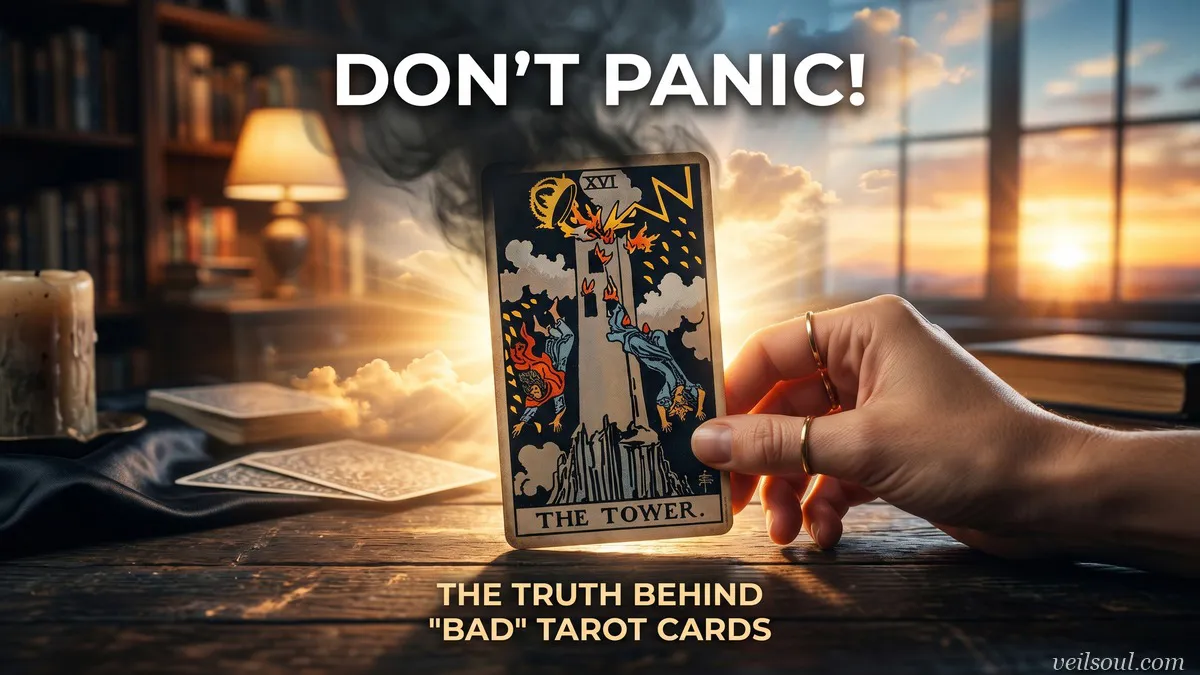
- The Tower: a sudden truth that changes the picture, usually news or a conversation rather than an outward event.
- The Moon: uncertainty and fear in low light; next to the Nine of Swords, check fears against facts before acting.
If Majors outnumber the Swords, read the layout as a life-direction reading with a sharp mental edge.
Six Swords cards that set the tone
Any card can steer a one-suit spread, but these six tend to tell you fastest which side of the blade you are on.
Ace of Swords: the moment things become clear
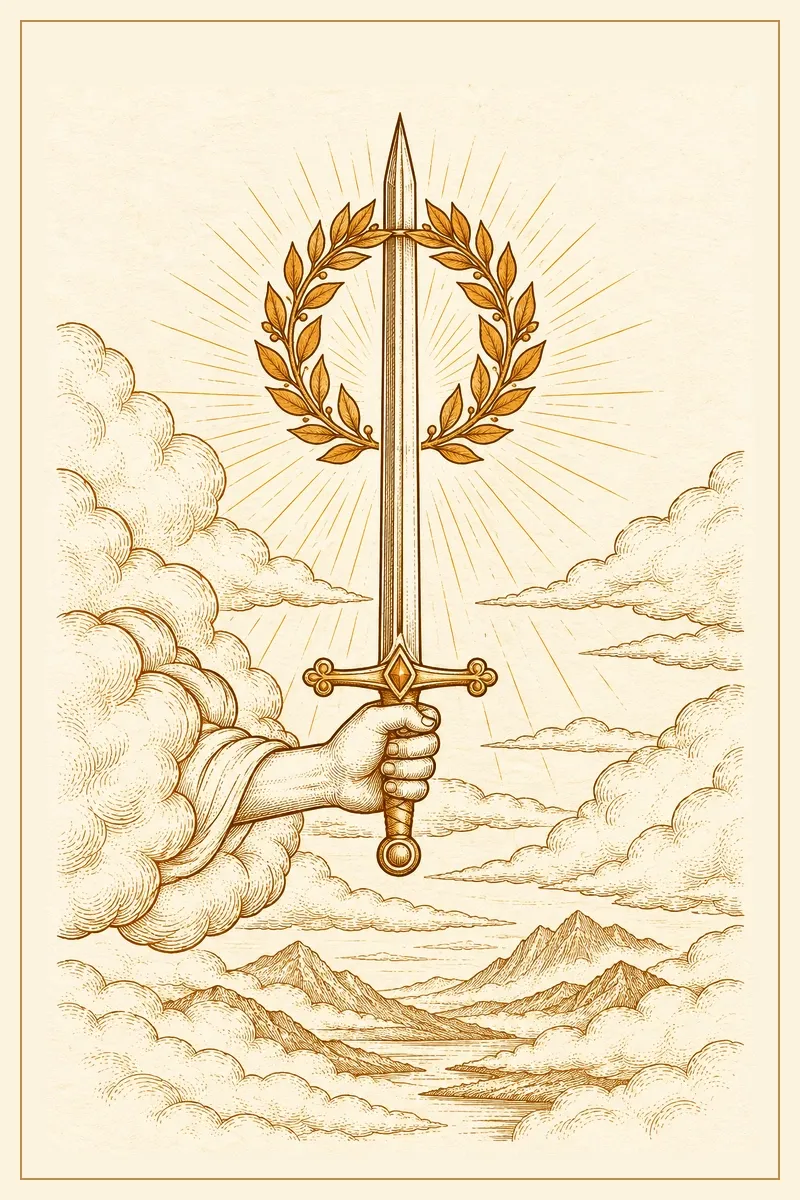
Upright, the Ace of Swords shows a hand from a cloud holding a single upright sword ringed by a victor's wreath of leaves. It brings a breakthrough: a new idea, a clear decision, the truth said out loud. In a spread full of Swords it redeems the rest, showing that all this thinking is going somewhere. For its love and career readings, see the Ace of Swords tarot meaning.
Reversed, the Ace suggests clouded thinking, an idea pushed before it is ready, or words used with more force than care. Slow down and check the facts before acting on a conclusion.
Two of Swords: the choice you are not making
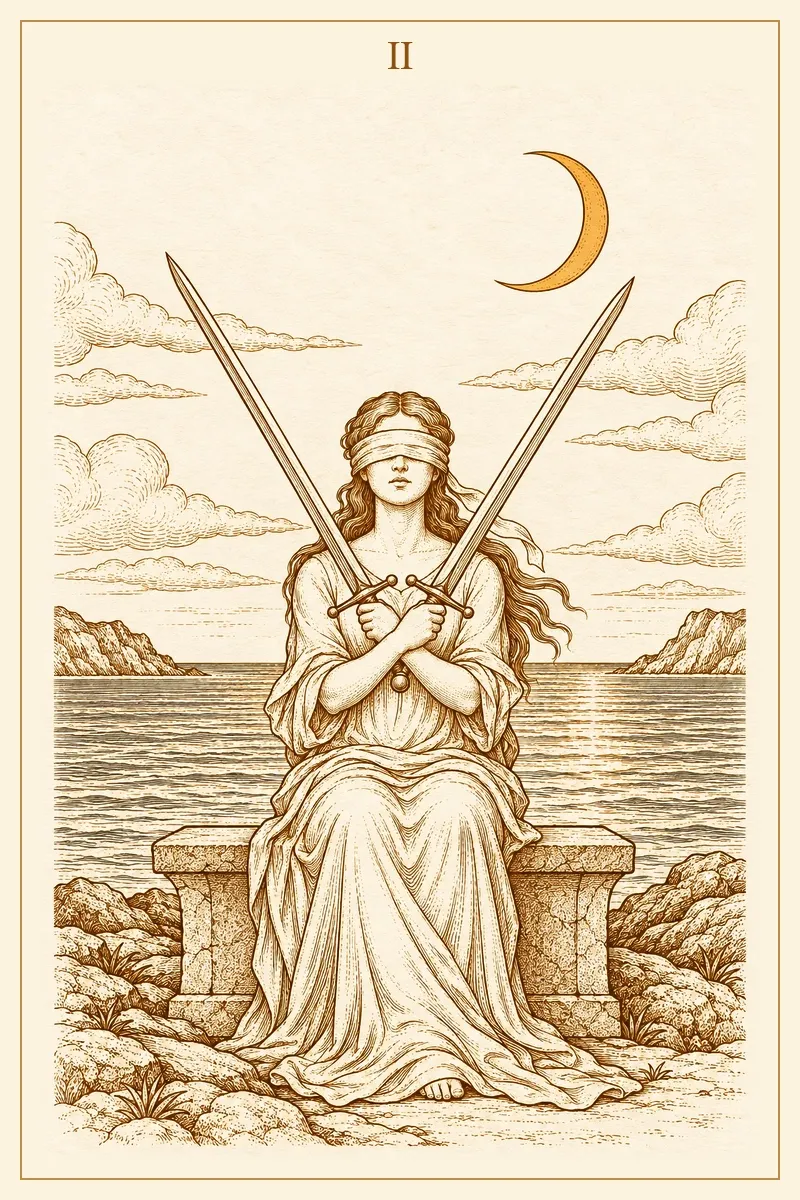
Upright, the Two of Swords shows a blindfolded figure holding two crossed swords with the sea behind her: balance kept by refusing to look. It describes stalemate or a decision put off because both options hurt; in love, two people avoiding the same conversation. The Two of Swords tarot meaning covers the card in more situations.
Reversed, the Two can mean too much information and too many opinions, or a deadline that means the choice can no longer wait. Sometimes it simply shows the blindfold coming off.
Three of Swords: a truth that hurts
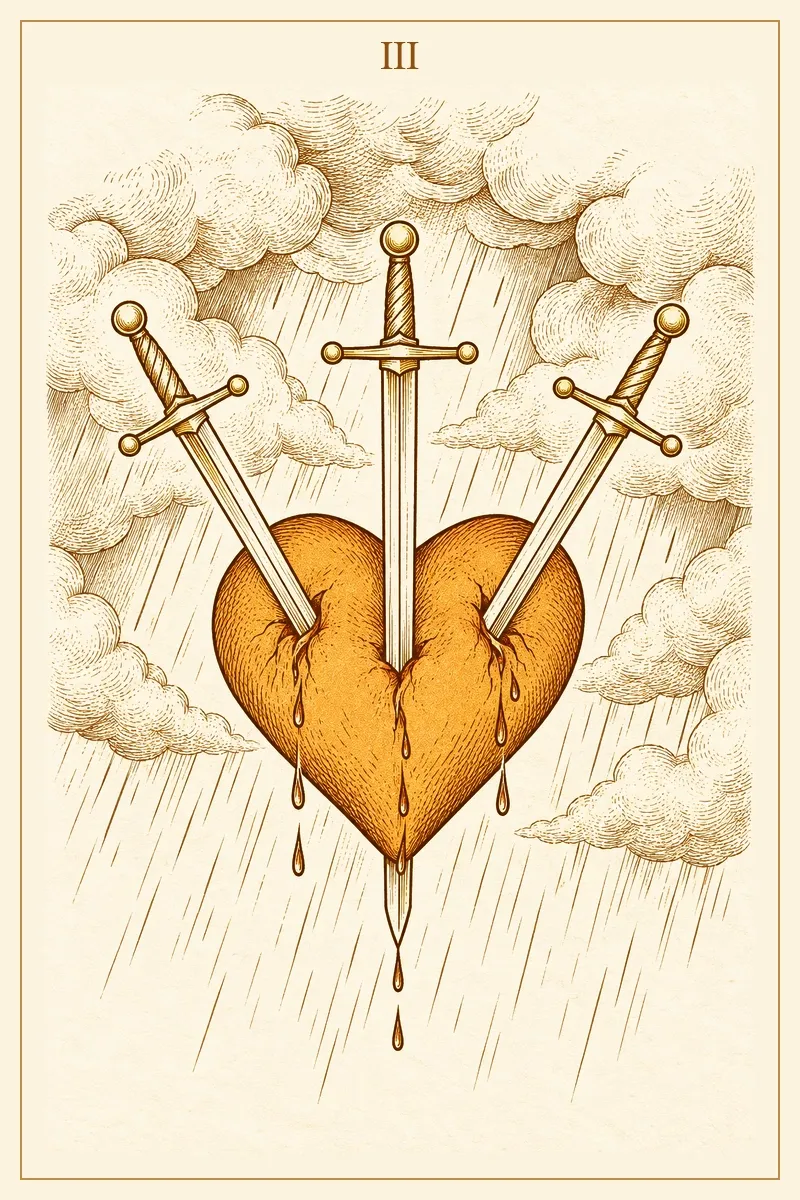
Upright, the Three of Swords is a heart pierced by three swords under rain. It names heartbreak, grief, a painful discovery or words that wounded. In a Swords-heavy spread it often marks the event the rest of the thinking circles around, and asks you to let the hurt be real so it can heal cleanly. The Three of Swords tarot meaning looks at it in love readings in more depth.
Reversed, the Three often describes recovery: forgiving, releasing, finally talking about what happened. It can also point to grief pushed down rather than worked through.
Eight of Swords: a trap made of thoughts
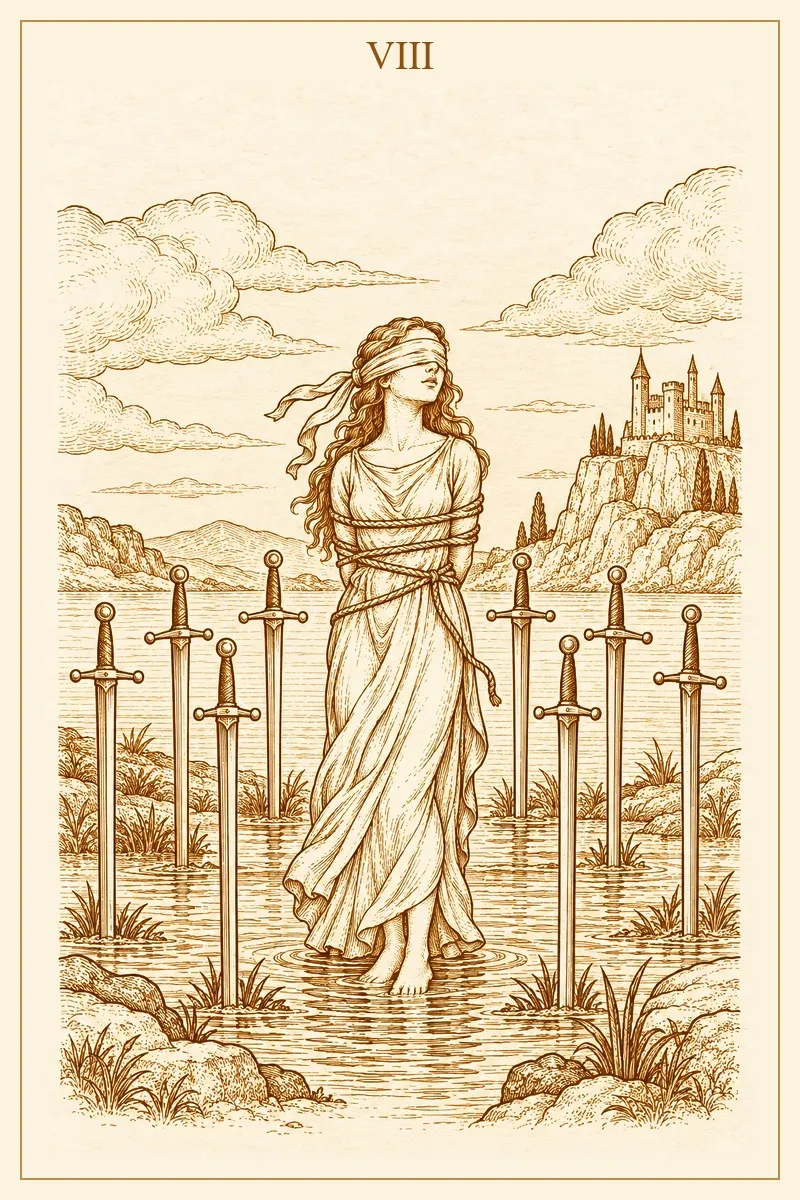
Upright, the Eight of Swords shows a bound, blindfolded figure standing among swords, yet the bindings are loose and the path away is open. It is the card of self-limiting beliefs such as "I can't leave" or "I have no choice." Among many Swords it is often the key card, because it says the cage is built mostly from thinking. The Eight of Swords tarot meaning explores how to find the way out.
Reversed, the Eight is release: a new perspective, help accepted, a first step out of a situation that felt fixed.
Nine of Swords: the three in the morning card
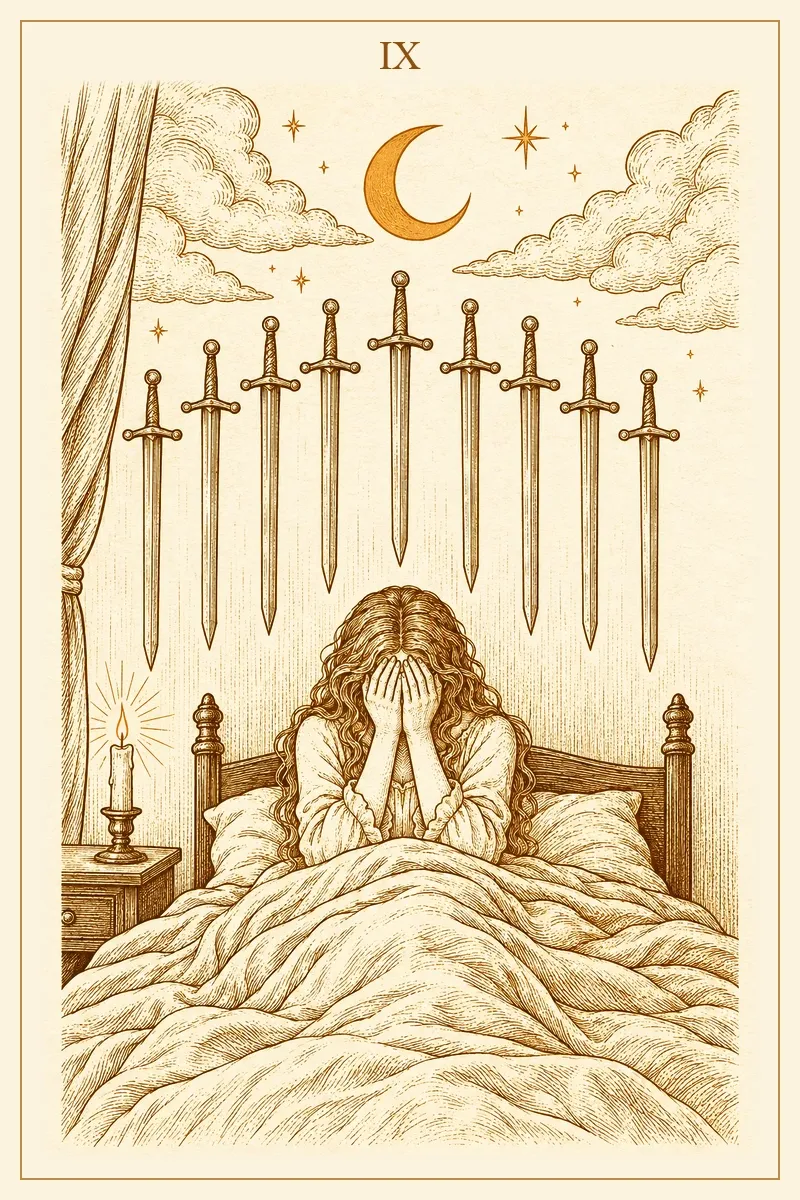
Upright, the Nine of Swords shows a figure sitting up in bed with head in hands while nine swords hang in the night air above. It describes anxiety, sleepless worry, guilt and catastrophic thinking. The swords hang above the figure, not in them: the fear is real, but often larger than the facts. Read more in the Nine of Swords tarot meaning.
Reversed, the Nine can show worry starting to lift, or distress kept private. If worry has been disturbing your sleep or daily life for weeks, a doctor or counselor is the right person to talk to; the card is a prompt, not a treatment.
Ten of Swords: when something is truly over
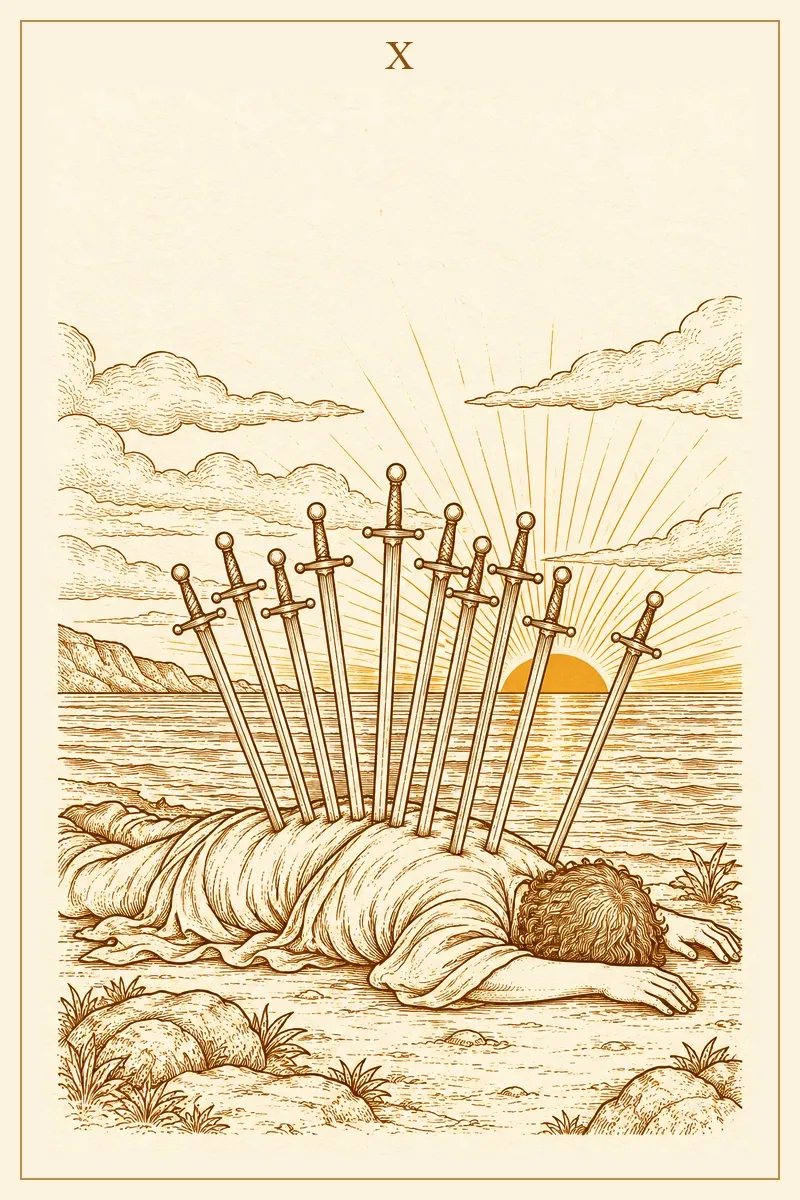
Upright, the Ten of Swords shows a figure lying face down under ten swords while dawn breaks on the horizon. It is symbolic, not literal: a painful ending, a low point, the moment there is nothing left to defend. Its quiet gift is finality, because recovery begins once something is finished. The Ten of Swords tarot meaning follows the card from ending to new start.
Reversed, the Ten describes getting up slowly and learning from what happened, or holding on to a story that is already over.
Love, work and money when the Swords pile up
In love
Swords in a love reading are about communication: what is said, what is not, and the stories each person tells about the other. They do not mean the relationship is doomed. The Two suggests avoidance, the Five a fight nobody wins, the Three a hurt that needs acknowledging, the Queen or King a call for honesty. The most useful next step is usually a calm conversation in person, one topic at a time.
At work and in study
Swords are at home at work: exams, writing, negotiation, strategy and office politics. Lots of them, especially with the Five or Seven, can describe a tense, competitive environment or a mind overloaded with tasks. The Page and the Ace favor learning; the Ten can describe a role or project reaching its natural end.
With money and paperwork
Money belongs to Pentacles, but Swords cover the thinking around it: contracts, terms and postponed choices. Read the fine print, ask direct questions and see a qualified professional for anything legal or financial; the cards cannot replace that advice.
Worked example: a friendship gone quiet
The question: "My closest friend and I have barely spoken since an argument over a canceled trip. What can I do?" The reader uses a four-card spread called Clearing the Air, with named positions: 1. The thought on repeat. 2. What I actually know. 3. What needs to be said. 4. The choice in my hands.
- The thought on repeat: Nine of Swords, upright.
- What I actually know: Five of Swords, reversed.
- What needs to be said: Queen of Swords, upright.
- The choice in my hands: Justice, upright.
Three Swords and one air-linked Major: a mind-and-words reading from start to finish. The Nine of Swords names the late-night loop, probably "the friendship is ruined and it is my fault." The card does not confirm that story; it shows how loud it has become.
The reversed Five of Swords answers it. Upright, the Five is a fight with a hollow winner; reversed, the argument is losing its heat and both sides are tired of it. What the reader actually knows is that nobody has cut contact for good, and the quarrel was about a trip, not the friendship.
The Queen of Swords describes one honest message, without a long defense or a list of grievances: "I miss you, and I am sorry for my part in how the trip fell apart. Can we talk?" Justice asks the reader to own their share fairly, no more and no less, and to let the friend own theirs.
With no Cups, the affection between the friends is not shown, so the reader states it openly in the message. The spread did not say whether the friend will reply. It showed which part of the situation is in the reader's hands.
Steps for a mind full of Swords
- Write the loop down. Give your racing thoughts ten minutes on paper, then close the notebook. Thoughts that are written down become finite and easier to review.
- Make two lists. Put what you fear on one side and what you know on the other. Act on the second list.
- Give the decision a date. If a choice has circled for weeks, set a fair deadline and keep it. A decent decision made in time often beats a perfect one that never arrives.
- Rest on purpose, and move. Borrow from the Four of Swords: ten minutes lying still, an early night, a walk without your phone. Scrolling is not rest.
- Talk by voice, not just text. Swords are words, and tone gets lost in messages. A call or a meeting softens what a text can sharpen.
- Ask for support when worry lingers. The gentle practices in tarot for anxiety can sit alongside, but persistent worry deserves a real conversation with a doctor, counselor or someone you trust.
Frequently asked questions
Is an all-Swords reading bad news?
No. It says the situation is being shaped by thinking, words and decisions. A spread led by the Ace, Four, Six, Page or King can describe a mind working well, and even the hardest cards usually show a turning point rather than a final state.
I asked about love and got all Swords. Is the relationship over?
Not necessarily. Swords in a love question say that communication is the real subject: arguments, silences, misunderstandings or a truth that needs to be told. Many relationships go through a Swords season and come out clearer. Use the reading to decide what you want to say, then say it to the person.
Does the Seven of Swords mean someone is lying to me?
It can point to secrecy, strategy or someone acting alone, but it cannot prove what another person is doing. Sometimes the Seven describes your own half-truths, or a situation where you need to protect your plans for a while. If trust is the issue, look for facts and have a direct conversation rather than relying on a card.
Can a Swords-heavy spread tell me what someone thinks of me?
Tarot cannot confirm another person's thoughts, tell you when something will happen, or guarantee how it will end. A spread full of Swords can show what you are thinking about that person, which conversations might help, and where your fears may be running ahead of the facts. Their view of you comes from them.
Why do I keep getting Swords in every reading?
A suit that repeats across several readings usually reflects a season of life: exams, a legal or work process, a hard decision, or a habit of overthinking. It can also reflect your questions, since "should I" and "why" questions invite a mental answer. Try asking what would help you rest or act, and notice whether the suits shift as your situation does.
A spread full of Swords asks for clear sight and kind words, starting with the words you use on yourself. When you want to bring your own question to the table, a free reading with Veil Soul is a calm place to start.