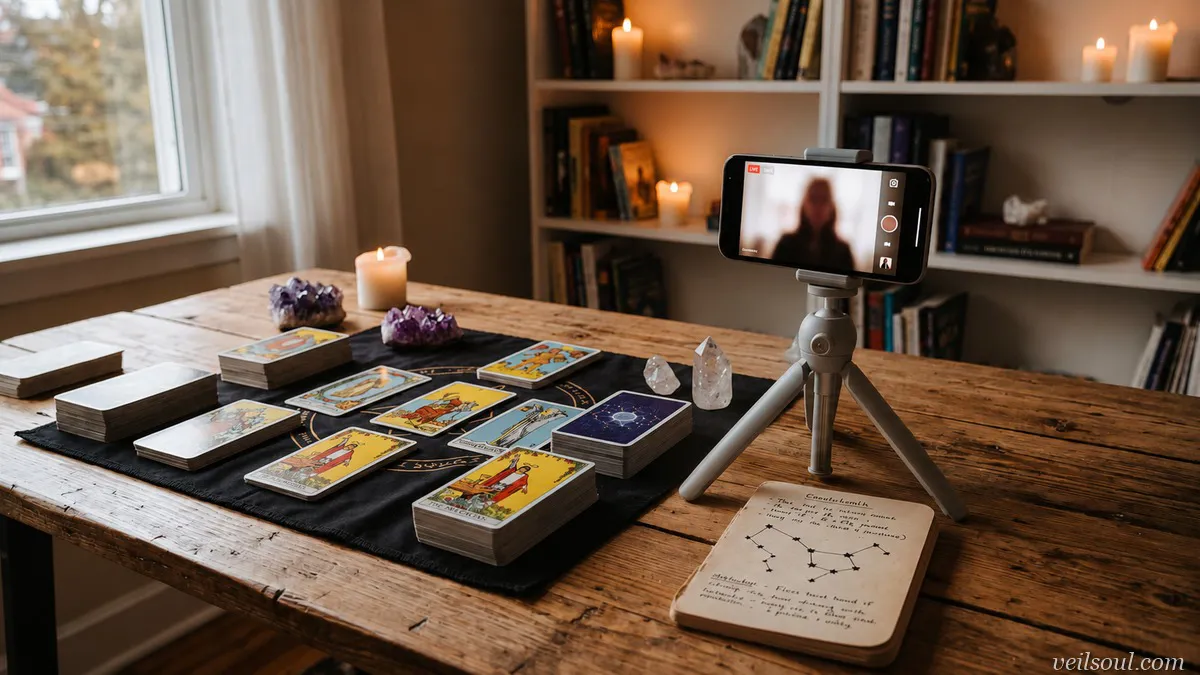
Yes, you can do a tarot reading for someone far away, and it works much like a reading at the same table. Agree on the question first, then shuffle and draw the cards yourself while the person is on a call with you or after they have sent their question in writing. Share a clear photo of the spread and read it together, live or in a written reply they can keep.
A distance reading offers what any reading offers: images that help someone look at their situation from a new angle and choose a next step. Its limits are the same too. Tarot cannot confirm what another person thinks, give a reliable date or guarantee an outcome, whether that person is beside you or on another continent. Keeping that in view makes remote readings calmer and more useful for both of you.
At a glance, a distance reading follows these steps:
- Ask first: read only for someone who has asked you, and agree on what the reading is for.
- Get the question in writing: one open question, in the person's own words.
- Pick a format and a time: live video, a voice call, or an exchange by message.
- Shuffle and draw: you handle the deck; the person can say "stop" or choose numbers from afar.
- Photograph the spread: one clear, well-lit photo before you start interpreting.
- Read together: go position by position and check what fits for them.
- Write it up: a short summary with the cards, the through-line and one practical step.
- Close kindly: no predictions about health, money or other people, and room for a follow-up question.
What changes when the person is not in the room
Very little about the cards changes. You still shuffle, lay out a spread with named positions and read the cards against a question, and the person can see the images in a photo or on camera as clearly as across a tablecloth. You do not need a special technique, an energy ritual or an object that belongs to them.
What changes is the conversation around the cards. In person you notice a pause, a laugh or a frown and adjust as you go. At a distance, especially by message, some of those cues are missing. That is why remote readings depend more on the setup: a well-worded question, a format you both agree on, and the habit of checking in ("Does that fit, or does it feel off?") instead of assuming you have found the right meaning.
Remote readings have advantages too. A written reading can be reread a week later, a voice note can be played on a walk, and people who feel awkward being watched often speak more openly on a call or in text.
Ask first: consent and reading about other people
A distance reading should always begin with a request. Before you shuffle, agree on three things: that the person wants a reading, what they want to look at, and how they would like to receive it. If you are new to reading for anyone but yourself, the guide on reading tarot for others covers how to set expectations, and all of it applies at a distance.
Only read for someone who asked
Never read for someone who has not asked, even with good intentions. A friend going through something hard has not agreed to have their life examined, and a reading done behind their back easily turns into speculation you then carry into the friendship. If you are worried about someone, read about your own part instead: "How can I support my sister right now without taking over?"
Consent also includes the right to stop. Tell the person at the start that they can pause, skip a topic or end the reading at any point, and mean it.
When the question is about a third party
Many people who ask for a reading want to know about someone else: a partner, an ex, a parent, a manager. You can still help, but shift the question from the absent person's mind to the asker's experience. "Does he still love me?" becomes "What do I need to understand about this relationship and what I want from it?" "Is my boss going to fire me?" becomes "What can I do to feel steadier at work this month?" The cards can reflect the asker's patterns, feelings and options; they cannot reveal the private thoughts of someone who is not part of the conversation.
Distance readings are often requested by people who are apart from someone they love. If the question is really about your own relationship across the miles, the guide to tarot for long-distance relationships is the better place to start; this post stays with the practical side of reading for another person from afar.
Prepare before the session
Good preparation does more for a remote reading than any ritual. Ask the person to send their question in writing a few hours or a day ahead. Writing it down slows them down and gives you a fixed wording to read against. If the question is vague ("What's going on with my life?"), help them narrow it to the one area where they most want clarity this month. The guide on how to ask effective tarot questions has examples of open questions that work well.
A sentence or two of context helps as well: what the situation is and what they have already tried. You are not collecting their life story or information to "prove" the reading, only enough background to choose a sensible spread and phrase your interpretation in terms that make sense to them.
If you are reading live, agree on a time with a little margin on either side, and check the time zone twice. Ask the person to find a quiet, private place, and do the same: a cleared table, your phone on silent, a notebook, and good light for the photo.
Some readers like to keep the person's first name in mind or a photo nearby while they shuffle. That is a personal preference, not a requirement. You do not need a photo, a birth date, a full name or anything that belongs to the person, and if someone offers details you do not need, you can politely decline them.
Choose a format that suits you both
There is no single right way to deliver a distance reading. Pick the format that suits the question, the person's comfort and your own strengths.
Live video call
Video is the closest to sitting together. Point a second camera or your phone at the table, or hold each card up as you turn it. The person watches the spread take shape and reacts in real time. Keep the card area well lit and the background plain so the images are easy to make out on a small screen.
Voice call
A voice call suits people who would rather not be on camera. Because they cannot see the cards, describe each one briefly before you interpret it: what is in the image, what the position means and one question it raises. Send the photo of the spread straight after the call.
Text or asynchronous reading with a photo
For different time zones or busy schedules, a message-based reading is practical. The person sends their question; you shuffle, lay out the spread, take one clear photo and write the reading. They read it when they are ready and reply with thoughts or one follow-up question. Your words carry the whole reading here, so this format takes the most care in writing.
Letting the person take part from afar
Many people like to have a hand in choosing the cards even when they cannot touch them. On a call, they can say "stop" while you shuffle, or choose one of three piles after you cut. By message, they can send numbers between 1 and 78, and you count down through the shuffled deck to find each card. None of this is required, but it often makes the reading feel shared rather than done to them.
Step by step: a distance reading from question to follow-up
- Confirm the question. Read it back in the exact words you will use. If it is a yes-or-no question, offer an open version and agree on the final wording before any card moves.
- Choose the spread. Match it to the question, and tell the person the position names in advance.
- Settle and shuffle. Keep the question in front of you and shuffle as you normally do, following their "stop" or numbers if they are choosing.
- Lay out the cards and take the photo. Photograph the whole spread before you interpret anything, with every card exactly as it fell and the position order clear.
- Read position by position. Say what each card shows, link it to its position, then connect the cards to each other.
- Check what fits. Ask which part rings true and which does not, and let the person choose the layer that matches their situation.
- Agree on a next step. End with one small action the person chooses, such as a conversation, a list to write or a decision to sleep on.
- Send the summary and leave a door open. Share the photo and a short write-up and invite one follow-up question within a few days.
Two spreads that work well at a distance
Simple spreads photograph clearly and are easy to follow on a phone screen. Both of these use named positions so the person can match every card to a question without you there to point. For more ways to read three cards in a row, see the guide to the past, present, future spread.
Three-card check-in
Use this for a quick reading on a call or a short reply by message.
- Where you are: how the situation feels right now.
- What needs care: what deserves attention or gentleness.
- A next step: one direction worth trying.
Five-card situation spread
Use this when the question involves several people, pressures or options and the person wants to see the whole picture.
- The heart of the situation: what this is really about.
- What is helping: strengths, support and resources already in place.
- What is in the way: the obstacle, fear or habit making it harder.
- What you can influence: the part within the person's control.
- A step to try: a practical action for the coming weeks.
Avoid very large spreads for a first remote reading: ten or more cards are hard to see in one photo and hard to follow in a long message.
How to write up a reading you deliver remotely
A written reading is often what the person keeps, so give it a clear shape:
- The question: restated in their words so the reading stays anchored.
- The spread: the photo and the position names.
- Card by card: one short paragraph each, linking the card to its position.
- The through-line: two or three sentences on what the cards say together.
- A question to sit with: one reflective question for the person.
- A next step: one practical action they can choose to take.
Keep the tone warm and plain. Write "this card suggests" or "you might ask yourself" rather than "this will happen", use the person's own words where you can, and avoid jargon unless they know tarot. A three-card reading rarely needs more than 400 to 600 words.
Because you cannot see their face, offer more than one layer when a card is open to several readings, and let them choose. The Empress in a "what needs care" position might point to rest, to a creative project that wants attention, or to a nurturing person in their life; naming the options lets the person recognize the one that fits.
Take extra care with cards that look frightening. The Tower or Death read alone in a text message can feel alarming in a way they would not on a call. Name the theme calmly (sudden change, an ending that makes room for something new) and connect it to the position, so the person does not fill the gap with fear. Leave out what you cannot know: dates, diagnoses, verdicts, investment results or what a third person secretly feels.
Worked example: a three-card check-in by message
The following is a sample written to show the process, not a real client. A friend who moved to another country two years ago sends a message: she feels stuck in her job and wonders whether to start applying elsewhere. After a short exchange, you agree on the question: "What would help me make a calm decision about my work over the next few months?" She sends three numbers, and you draw the three-card check-in.
Four of Cups: where you are

The Four of Cups shows a figure sitting with arms folded, looking at three cups while a fourth is offered from the side. Upright in "where you are", it describes a tired withdrawal: the job is not terrible, but it no longer feels like hers, and she may be overlooking options because nothing seems worth the effort. You can find the card's other layers in the Four of Cups meaning guide.
In the write-up you might say: "This card suggests you have been holding back, maybe out of tiredness rather than lack of interest. Is there an offer, contact or idea you have set aside without really looking at it?" Reversed, the card would describe the moment of looking up again: curiosity returning and readiness to consider something new.
Strength: what needs care
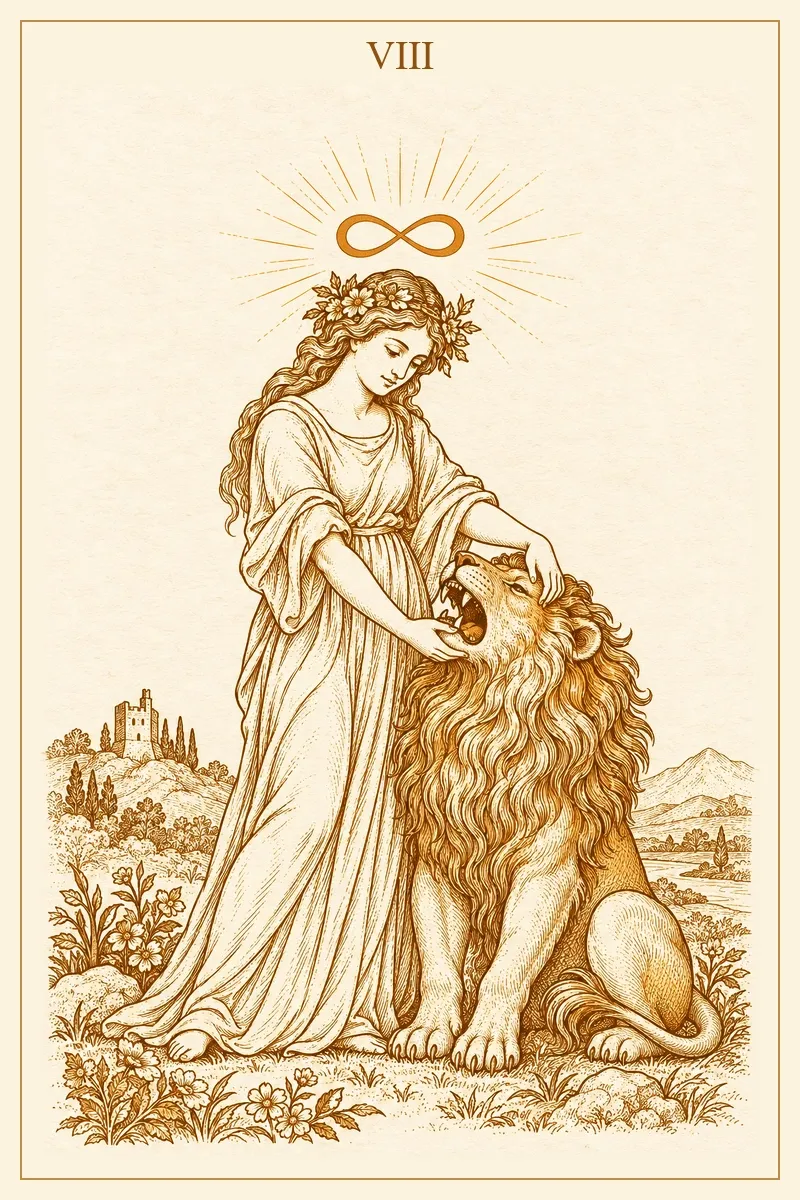
Strength shows a figure calmly holding a lion's jaw, courage expressed as patience rather than force. In "what needs care", it suggests the decision does not need to be forced. What needs care is her own steadiness: the worry about change, the self-criticism about feeling stuck, and the energy she has left after work. The Strength tarot meaning guide goes deeper into its quieter side.
You might write: "Strength here is about being gentle with yourself while you decide. You do not have to quit or commit today." Reversed, the card would point more directly to low energy or self-doubt, and the advice would lean toward rest and support before any decision.
The Fool: a next step

The Fool steps toward the edge with a light bag and an open face, the start of a journey without a full map. In "a next step", it does not say "quit tomorrow". It suggests a small, curious move into the unknown: updating her résumé, talking to one contact at another company, or looking at what roles exist without committing to anything. The Fool tarot meaning guide explains how the card balances openness with care.
You might write: "The Fool invites a first step, not a leap. What is one thing you could explore this month just to see what is out there?" Reversed, it could suggest either hesitation to move at all or a pull toward an impulsive exit, and you would ask which feels closer.
Together, the through-line is clear: she is tired rather than finished, her steadiness matters more than speed, and the next move is exploration rather than a dramatic exit. Your closing note might read:
Your cards describe someone who has been running on low and has stopped looking at what else is on offer. The middle card asks you to be patient with yourself while you decide, and the last one suggests a small, curious step rather than a big one. A question to sit with: what would you want to learn about your options before you choose? One step for this month: have one conversation or look at one opening, without deciding anything yet.
The reading does not predict her career. It helps her see where to start.
Common mistakes in distance readings
- Starting without an agreed question: reading on a vague request leaves both of you guessing what the cards are about.
- Skipping the photo: without a picture of the spread, the person cannot follow, and you cannot revisit it later.
- Writing too much: a long block of text buries the useful part. Aim for clear sections and one next step.
- Filling silence with certainty: when you cannot see a reaction, it is tempting to sound more sure than you are. Ask instead.
- Drawing again and again: redrawing because the first spread was uncomfortable muddies the reading. Read what came up.
- Forgetting privacy: keep their question, photos and messages to yourself, and delete what they ask you to delete.
Boundaries: health, legal, money and third parties
Some topics need firmer edges in any reading, and distance makes them easier to blur because there is less back-and-forth. Decide before you read what you will not do, and say it plainly if the question goes there.
Health: tarot cannot diagnose, predict the course of an illness or replace medical advice. If someone asks about a symptom, shift the question to how they can look after themselves and encourage them to see a doctor. Legal matters: the cards cannot predict a verdict or say how to handle a contract or dispute; a qualified professional can. Money: do not use a reading to recommend investments, debts or large purchases. You can explore how someone feels about a financial decision, but the facts belong with them and, if needed, an adviser.
Third parties: do not read about whether a partner is cheating, what a relative really thinks or what an ex is planning; bring the question back to the person who asked. Crisis: if someone tells you they are in danger or thinking about harming themselves, pause the reading and encourage them to contact local emergency services or a crisis line straight away.
Frequently asked questions
Does a distance reading work as well as one in person?
The cards and the method are the same, so a well-prepared distance reading can be just as useful. In person you have more cues; at a distance you rely on a clear question and on checking in.
Do I need the person's photo, birth date or full name?
No. A clear question and the person's agreement are enough. Keeping a first name in mind while shuffling is fine if it helps you focus, but asking for less personal information is the more respectful choice.
Can I read for someone without telling them?
It is better not to. Reading about someone who has not asked tends to become guessing about their private life. If you are concerned about them, read about your own role: what you can offer, what boundaries you need, or how to start a conversation.
Should the person shuffle or choose the cards?
They cannot shuffle your deck from afar, and that is fine. If they want to take part, they can tell you when to stop, choose a pile after you cut, or send numbers that you count to in the deck. The reading rests on the question and on how carefully you interpret it.
Can tarot tell me what someone far away is thinking or feeling?
No. Tarot cannot confirm another person's thoughts, feelings or plans, and it cannot give a reliable date or outcome. It works best as a mirror for the person asking: what they feel, what they want and what they can do. To learn what someone else thinks, the honest route is to ask them.
What if the reading does not make sense to them?
Ask which part feels off and look again at the question and the positions; often the wording was too broad or the spread did not match the question. The guide on why a tarot reading may not make sense lists common causes and fixes.
Reading across the distance
A distance reading is a conversation held over a call or a message instead of a table. Agree on the question, choose a simple spread, share a clear photo, read together and end with one step the person chooses for themselves. Kept within its limits, a remote reading can be as thoughtful as one in the same room.
If you would like to practice on your own question first, you can start a quiet reading with Veil Soul and notice how the positions guide each card.