A confusing tarot reading usually means something has slipped out of line between your question, the job of each position and the cards that landed there; it rarely means the deck failed or that you cannot read. When a reading doesn't make sense, restate the question in one plain sentence, read each card only for the job its position gives it, and look hard at the one card that refuses to fit, because that card is a good place to start looking for the message. Tarot cannot confirm what another person thinks, give you a date or settle an outcome. What it can do is set the parts of a situation where you can see them, and a muddled spread is still doing that, just less tidily than you hoped.
Below are seven reasons a spread turns to noise, five cards that make a reading harder by their nature, a ten-minute rescue routine, a four-position spread for untangling, and an illustrative reading worked from first confusion to a usable next step.
At a glance, the seven reasons and the quickest fix for each:
- The question was too wide: narrow it to one situation and one decision.
- Your mind was on another question: name the worry you were actually holding while you shuffled.
- You read only the headline meaning: look at the card's full range before ruling it out.
- The time frame moved: read the cards as a longer or shorter stretch than you planned.
- The positions were blurry: say each position's job out loud before you interpret.
- You were too close: photograph the spread and come back to it in a day or two.
- The answer was clear but unwelcome: ask whether the reading is puzzling or simply uncomfortable.
Three kinds of "this makes no sense"
Before you try to fix a reading, name the kind of confusion you are holding, because each asks for a different response. Blank confusion is when nothing comes to mind at all. That is a vocabulary or fatigue problem: the cards are still unfamiliar, or the day has been long. Rest and a reference book solve it better than another shuffle. Crossed confusion is when every card means something, but the meanings point in different directions: celebrate, retreat, wait for the wheel to turn. Most of what follows is for this kind. The cards are each answering a slightly different version of your question, and the work is to find the version that lets them agree.
The third kind is unwelcome clarity. The reading makes perfect sense; you just wish it said something else, and no number of clarifier cards will untangle a spread whose only problem is its answer. A reading that made sense when you drew it and later seemed to miss is a different matter again, a question of accuracy, and the piece on whether tarot cards can be wrong takes that up in detail.
Seven reasons the cards look like noise
Each reason comes with a test you can run on a spread that is already on the table, without reshuffling.
1. The question was too wide to land anywhere
"What do I need to know?" invites every part of your life into the spread at once. Work, family, health and an old friendship can each claim a card, and the reading touches all of them without saying anything useful about one. The test: could each card plausibly belong to a different area of your life? If so, the question never gave them a shared subject. "What would help me decide whether to take the evening class this term?" gives every card the same target, and the guide to asking effective tarot questions shows how to tighten a question without turning it into a yes-or-no trap.
2. You asked one thing while worrying about another
You wrote "my career this month" at the top of the page, but while you shuffled, your mind kept returning to a message that has gone unanswered for four days. A spread drawn in that state can read as if it ignored the question on the page. Whether you see that as the cards following your attention or as your own mind picking out the meanings that matter, the effect is the same. The test: read the spread again as an answer to the worry you were actually holding. If it suddenly makes sense, you have your answer and your next question.
3. You read the headline and stopped there
Every card carries a range of meanings, and a reading turns confusing when you lock onto the first one you learned. The Ten of Pentacles in a love question looks like money until you remember it also speaks of family, roots and what lasts. The Four of Swords in a career position looks like "do nothing" until you see recovery before the next push. The test: for the card that does not fit, list three meanings instead of one and check each against the position.
4. The cards answered a different stretch of time
You asked about next week, and the spread seems to describe the next year; or you asked about the present, and the cards keep pointing at something long past. The things you care about rarely fit a neat window, so a spread does not always keep to yours. The test: read the whole spread once as a longer period and once as the next few days. If one version clicks, adopt it and write the time frame down. Cards describe pace and readiness far better than dates.
5. The positions were blurry or forgotten
Three cards can mean past, present and future, or situation, obstacle and advice, or you, the other person and the connection. Draw without deciding, and each card gets read through a different lens. The test: write each position's name on a slip of paper, lay it under the card, and read each card only as an answer to that position. A card that looked random as "the future" can make immediate sense as "the obstacle."
6. You were standing too close to the situation
Fear, grief and strong hope all narrow the way you see. Every card starts to look like a yes or a no to the one thing you need, and cards that carry nuance look like nonsense. The test: photograph the spread, put the cards away, and look at the photo a day or two later at a different time of day. If a calm friend who knows tarot will look, ask what they see before you tell them what you asked.
7. The answer is clear, and you do not like it
This is the hardest reason to admit. The Tower in an outcome position is not hard to read; it is hard to accept. Death as advice is not unclear; it asks you to let something end. The test: imagine a friend drew this exact spread for this exact question. If the meaning comes easily on their behalf, the reading is clear for you too. When the card itself is what frightens you, this look at reading scary tarot cards without panicking can help you take the message in without assuming the worst.
Five cards that make a spread harder to read
Some cards describe confusion itself, or a situation that is not ready to be seen. When one of them lands in a spread that already feels muddled, the muddle may be the honest answer for now.
The Moon: when the path is only half lit
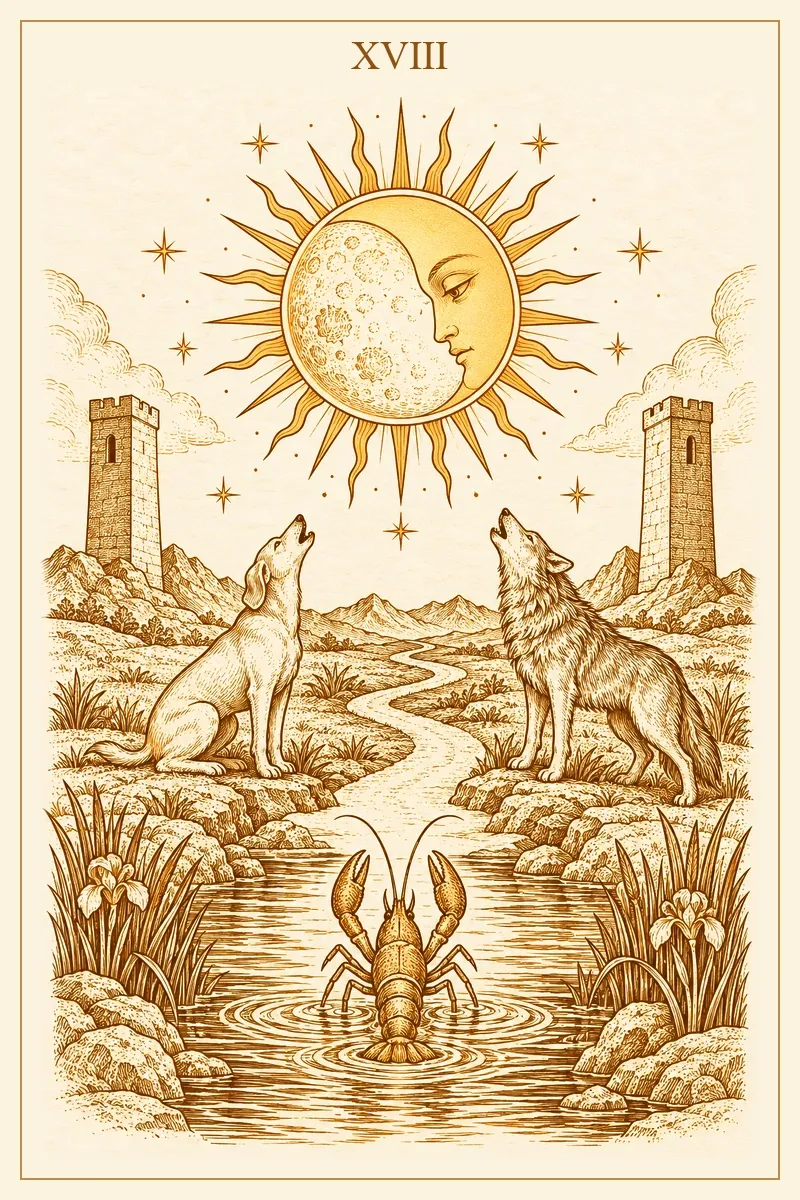
The Moon shows a winding path between two towers, a dog and a wolf howling on either side, and a crayfish climbing out of a pool. Above them hangs a pale disk with a crescent face inside it, ringed with rays: light, but not daylight. Upright, the card speaks of uncertainty, half-formed fears and incomplete information. In a confusing spread it can simply describe trying to see clearly before the facts are in. That is not a failure of the reading; it is the reading.
Reversed, The Moon can suggest the fog lifting, a worry shrinking once you face it, or something kept quiet coming into view. It can also mean you are doubting your own perceptions more than the situation deserves. When it appears, make three short lists: what you know, what you are guessing, and what you fear. The full Moon tarot meaning goes deeper into its imagery.
Seven of Cups: too many possible stories at once
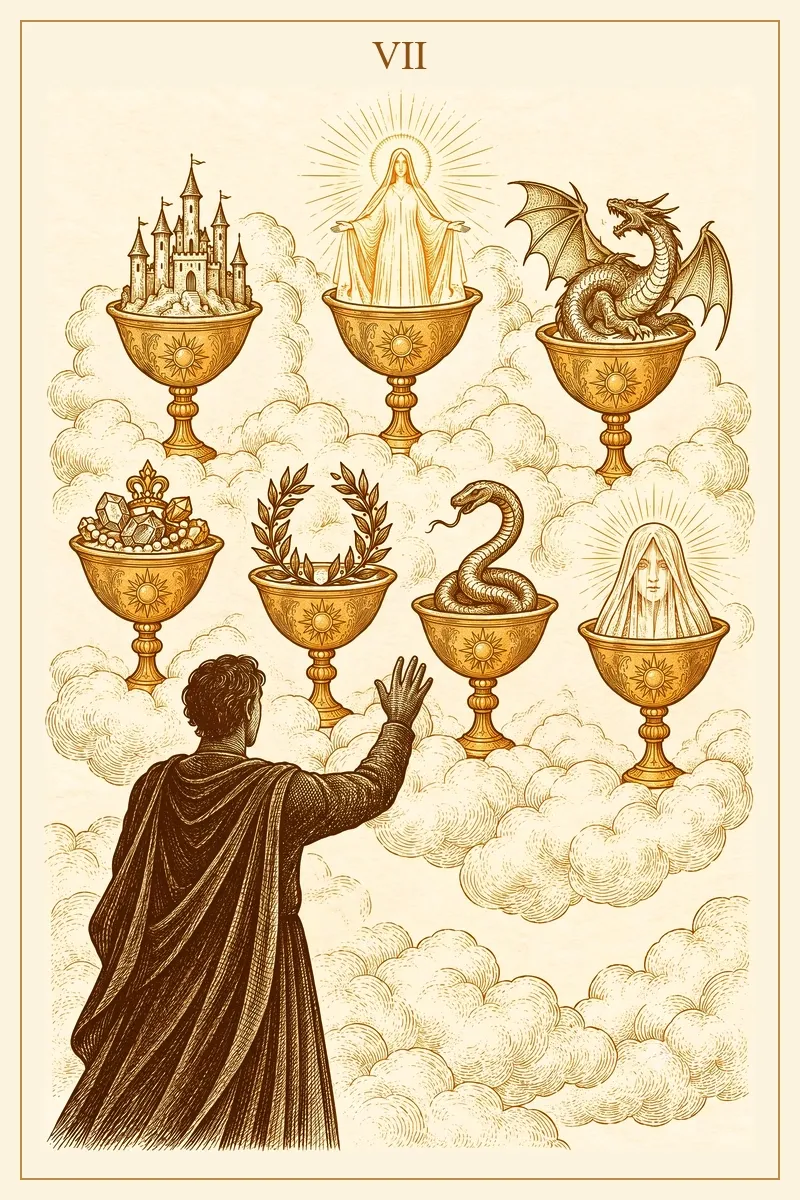
In the Seven of Cups, a cloaked figure reaches toward seven golden cups floating in cloud, holding a castle, a radiant veiled figure, a dragon, a heap of jewels, a laurel wreath, a snake and a veiled head. Upright, the card is about options, fantasy and the difficulty of choosing when everything looks possible. If your spread seems to tell five different stories, this card may be describing exactly that.
Reversed, it can mark the moment the choices narrow and you see which cup holds something real. It may also show a refusal to choose dressed up as keeping options open. With this card in a puzzling spread, pick one story the cards could tell and follow it to the end before trying another. The Seven of Cups tarot meaning covers its love and career angles.
Two of Swords: a decision you have not let yourself see
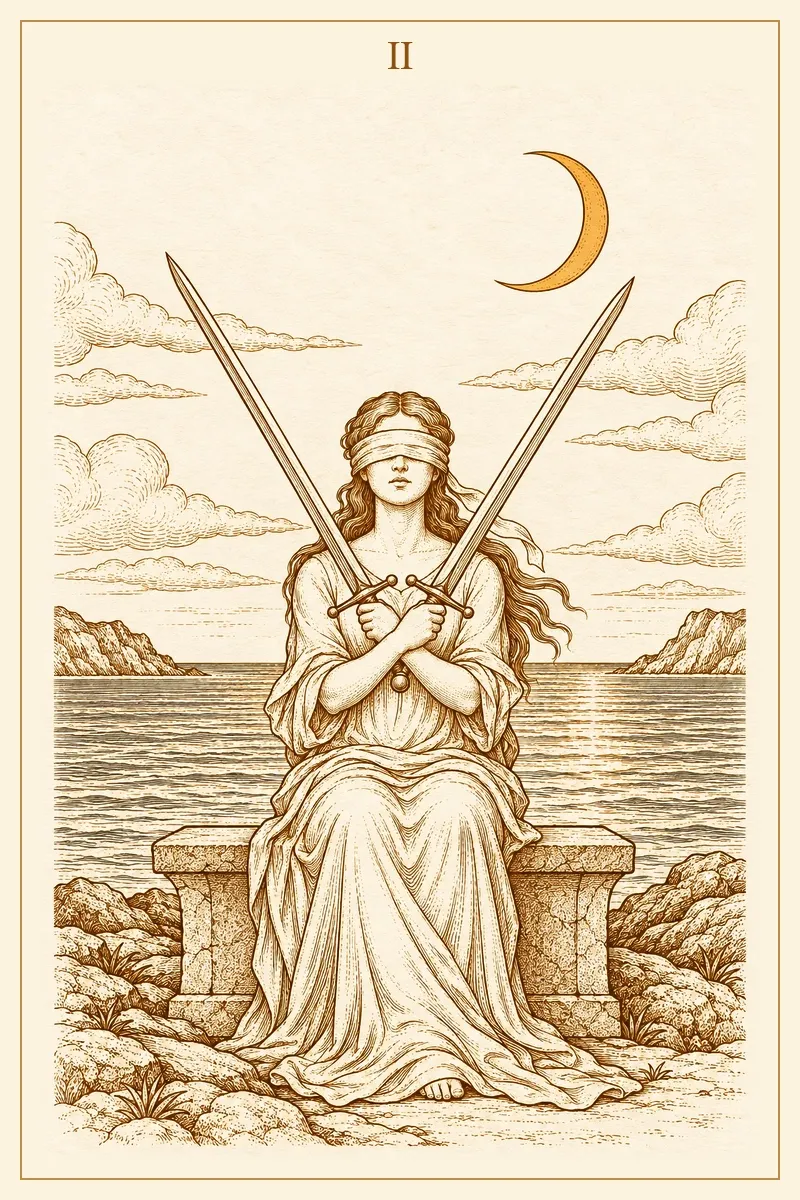
The Two of Swords shows a blindfolded woman on a stone bench by the sea, arms crossed over her chest, two long swords rising from her hands in a wide V beneath a crescent moon. Upright, it describes a stalemate: a choice put off, information not looked at, a balance kept by holding still. In a confusing reading, ask whether the confusion is protecting you from a decision you already half know you need to make.
Reversed, it can suggest the blindfold slipping as new information makes delay impossible, or plain overload. Either way, the practical step is to name the two options in plain words, even before you can pick one. The Two of Swords tarot meaning has more on the card.
The High Priestess: what is not ready to be said
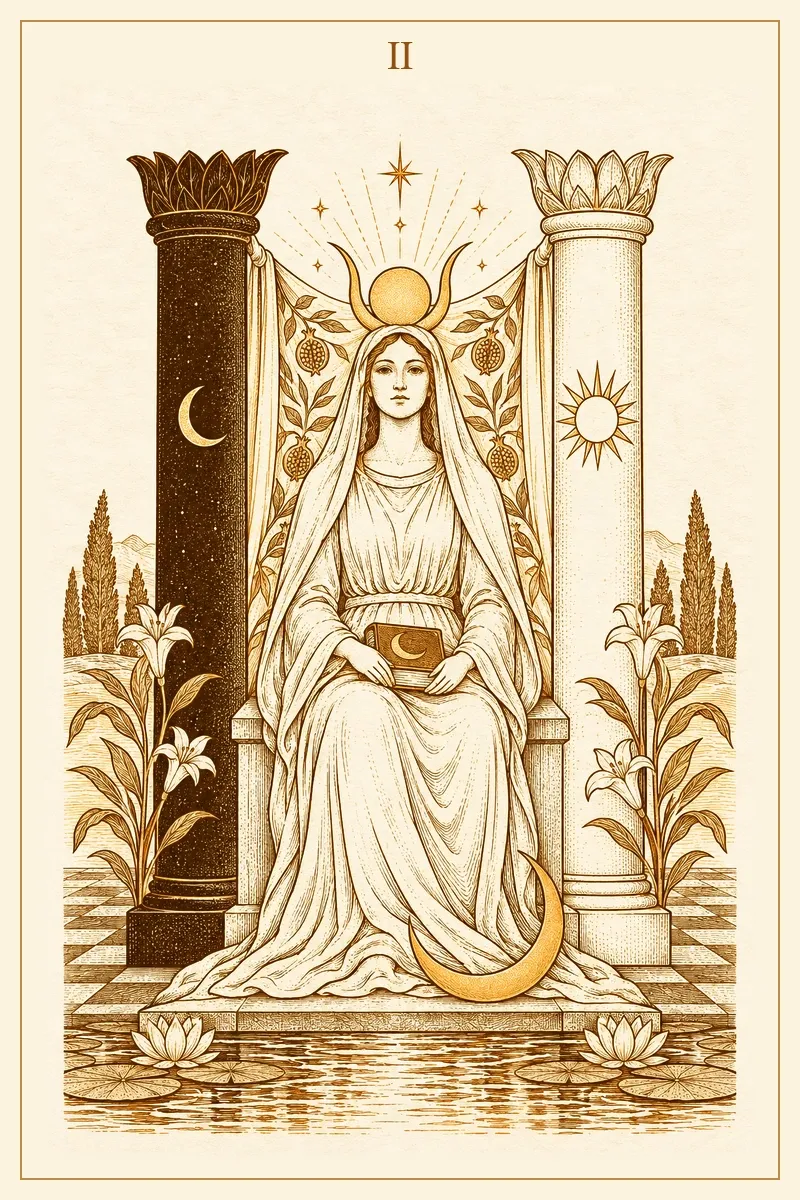
The High Priestess sits between a dark pillar marked with a crescent and a pale pillar marked with a sun, a book in her lap, a crescent moon at her feet and a veil of pomegranates behind her. Upright, she stands for quiet knowing, patience and things not yet spoken. In a reading that refuses to explain itself, she can be a reminder that some answers arrive through attention over time rather than analysis tonight.
Reversed, she can point to ignored instincts, secrets weighing on a situation, or a mind too busy to hear what it already knows. If she appears, stop interpreting for a moment and recall your first, wordless reaction to the whole spread; that reaction belongs to the reading. Her full High Priestess tarot meaning explores the pillars and the veil.
The Empress: when the obvious meaning hides the useful one
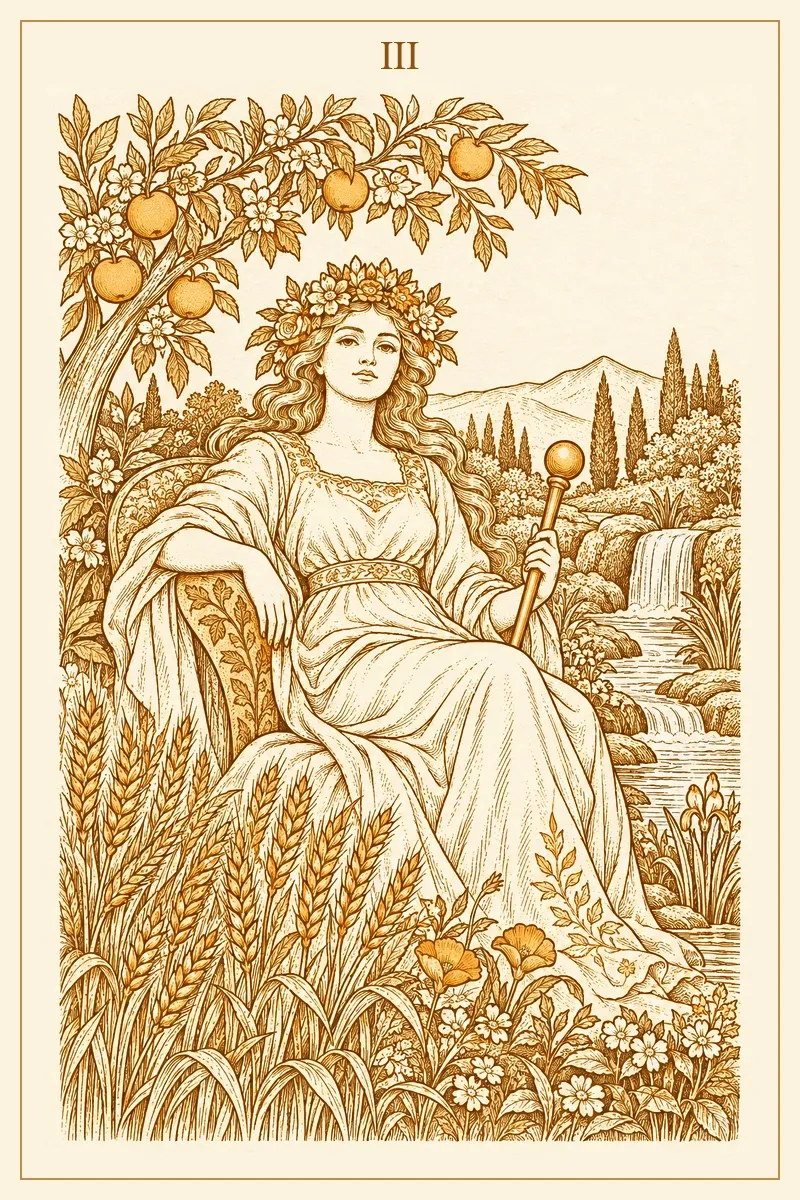
The Empress sits beneath a tree hung with oranges, a crown of flowers in her hair and a golden scepter in her hand, with wheat at her feet and a waterfall behind her. Many people learn her first as motherhood or pregnancy, so she looks absurd in a career position or a question about moving. Upright, she is also growth, comfort, creativity and anything you tend so it can flourish, and those meanings fit a great many questions.
Reversed, she can point to neglect, a project that is not being fed, care poured outward until none is left for you, or a creative block. When she seems out of place, ask what in this situation needs nurturing rather than pushing. The Empress tarot meaning lays out her other sides in love and money.
A ten-minute rescue for a spread that won't come together
When the cards are still on the table and nothing connects, work through these steps in order. Each takes a minute or two.
- Write the question as one sentence. If you cannot, the question was the problem; rewrite it first.
- Name each position out loud. Say "this card is the obstacle" before you say anything about what is on it.
- Give each card one line. One short phrase per card, in its position. Long interpretations are where confusion grows.
- Count what repeats. Several cards of one suit, several Major Arcana or a repeated number show where the weight sits, and connecting multiple tarot cards into a story explains how suits, numbers and neighbors link up.
- Find the odd card out. Read it last, with everything else in view, and ask what it would mean if it were the most important card on the table.
- Draw one clarifier, if you need it. Place a single card beside the one you cannot read. One card, not five; more cards add noise.
- Record it. Photograph the spread and write your one-line readings under the date. Keeping a tarot journal to track your readings turns a confusing spread into something you can return to.
If the spread still reads as noise after all seven steps, stop for the day. Putting a reading down is a decision, not a defeat, and it keeps you out of the habit of reshuffling until the cards say something you like.
The untangling spread: four positions
This layout is for a reading you have already drawn and cannot read. Leave the original spread where it is, shuffle the rest of the deck, and lay four new cards in a row beneath it.
- What I asked: what the question on the page was really about.
- What I was holding: the concern underneath it, which may have been louder while you shuffled.
- The card I can't read: a fresh angle on the card in the original spread that will not fit.
- One step I can take: something small and concrete to do before you read on this again.
Read the first two together. If they describe different things, you have found why the original looked scrambled: it was answering the second card's subject. Set the third beside the stubborn card and read the pair. Treat the fourth as the most practical card of the evening, and act on it before you draw on the topic again.
Worked example: a garden, a thief and a wheel
This is an illustrative reading, built to show the method rather than taken from any real person. The question was "Should I move to a new apartment this spring?" The reader drew three cards for situation, feelings and advice.
- Situation: The Empress, upright.
- Feelings: Seven of Swords, upright.
- Advice: Wheel of Fortune, upright.
The first reaction was that none of it fit. The Empress meant pregnancy, the Seven of Swords meant theft, and the Wheel felt like "it's all luck," which is not advice.
The question held up as one sentence, so the reader named the positions and gave each card one line. The Empress in the situation, with her garden, fruit and waterfall, describes a home that is comfortable and well tended: the current apartment is not the problem. The Seven of Swords in feelings shows a young man slipping away from a camp with an armful of swords, glancing back over his shoulder; as a feeling, that is guilt, or a wish to leave without a conversation, both among the quieter senses in the Seven of Swords tarot meaning. The Wheel of Fortune in advice, with a sphinx on top and four winged figures reading in the clouds around it, describes a cycle coming round, which in a housing question can be as literal as a lease renewal date.
The odd card out was the Seven of Swords. Read as the most important card, it said the move was not the issue: a roommate was, along with the wish to leave without telling them. A single clarifier beside it brought up the Page of Swords, a card of curiosity and a first frank conversation. The one-line reading became: the home is fine, the worry is the conversation, and the lease date offers a natural moment to have it. The reader's step was to check the lease terms and talk with the roommate before deciding anything. The cards never said whether to move. They showed where the knot was.
When to set a reading aside
Not every confusing reading needs rescuing. Put the deck down when you have already drawn on the same question more than once today; each new spread adds cards without adding clarity. Put it down, too, when you are in acute distress, since a spread drawn in panic tends to reflect the panic back. If you are struggling with anxiety, sleep or low mood, talk to someone you trust or a qualified professional; tarot can sit alongside that support but cannot replace it.
If every reading feels confusing for weeks, either your card knowledge needs time to settle, which improves with practice, or several readings are pointing at one theme and you have not yet looked at them side by side. Lay three weeks of photos together. A run of hard Swords, say the Three of Swords one week, the Eight of Swords the next and the Ten of Swords after that, can look like random bad news one reading at a time and like a clear picture of mental strain once they sit together. For the first case, practices for building intuition for tarot reading help meanings stick through use rather than memorization.
Frequently asked questions
Should I redraw a confusing reading right away?
Usually not. An immediate redraw puts a second puzzling spread on top of the first. Work through the rescue steps, then wait at least a day. If the original still makes no sense, a fresh draw with a reworded question is reasonable.
Does a confusing reading mean I'm bad at tarot?
No. Experienced readers meet spreads that refuse to come together as well. Skill makes more readings clear, not all of them, and confusion is information about the question, the moment or the meanings you are still learning.
How many clarifier cards should I draw?
One, placed beside the specific card you cannot read. A clarifier is a lens for that card, not a second reading. If one does not help, the problem usually lies in the question or the positions rather than a shortage of cards.
Can tarot tell me exactly what the confusing cards are predicting?
No. Tarot cannot confirm another person's thoughts, fix a date or guarantee an outcome, and a confusing spread does not hide a precise forecast waiting to be decoded. The cards reflect the forces and feelings around your question, which you can use to decide what to do next.
Is a confusing reading the same as a "no"?
Not necessarily. A muddled spread can mean "not clear yet," "ask a narrower question," or "the real question is somewhere else." If you need a yes or a no, ask that kind of question with a single card, and treat a still-unclear result as a sign the situation itself is unsettled.
Should I keep a reading I don't understand?
Yes, but hold it lightly. Photograph it, note the date and the question, and look again in two to four weeks. Some readings make sense only once events have moved, and others never do.
Give the spread one more look
A reading that does not make sense is still a record of what you were carrying when you drew it: a question, a worry, and a handful of images that caught your eye or slid past it. Treat the confusion as a clue about the question, give the odd card out the last word, and let time do some of the work. When you are ready to ask again with a clearer question, start a free reading with Veil Soul and see what the cards bring up.