The Celtic Cross is a ten-card tarot spread: six cards form a cross that describes the situation itself, and four cards stand in a column to its right, called the staff, that describe you, your surroundings, your hopes and fears, and where things are heading. To read it, take each position as a question, read the two central cards as one sentence, then follow the timeline and the staff until the ten answers tell one story. The spread can show you how a situation is built; it cannot confirm what another person thinks, fix a date, or guarantee an outcome.
The position order below is the common modern one, and it is not the only one. Some books swap positions 5 and 6, some number the card above the cross before the card below it, and some lay the arms of the cross in a different sequence. None of these is wrong. Pick one layout, write it down and keep it, because a position only means something when you decided what it asks before the card landed.
The ten positions at a glance:
- 1. The present: the heart of the matter right now.
- 2. The crossing card: the tension, challenge or missing piece that cuts across it.
- 3. The foundation: the root beneath the situation, which can be older than it looks.
- 4. The recent past: what is passing out of the picture.
- 5. The crown: your conscious aim, or the best this situation could become.
- 6. The near future: the next development if nothing changes.
- 7. The self: how you stand in it, including what you do not show.
- 8. The environment: the people, places and pressures around you.
- 9. Hopes and fears: what you want and what you dread, sometimes the same thing.
- 10. The outcome: the likely direction if the current forces hold.
Laying out the cross and the staff
Before you shuffle, write your question in one or two lines. The Celtic Cross works best with an open question that carries some weight, such as “What do I need to understand about this job offer?” rather than “Will I get the job?” If you want help shaping it, the guide to asking clear tarot questions walks through turning a closed question into one the cards can answer.
Then lay the cards in this order:
- Place card 1 in the center of your space.
- Lay card 2 sideways across card 1, so the two form a small cross.
- Place card 3 below the center pair.
- Place card 4 to the left of the center.
- Place card 5 above the center pair.
- Place card 6 to the right of the center. The six cards now form the cross.
- Start a column to the right of the cross: card 7 at the bottom, then 8, 9 and 10 above it, so card 10 sits at the top of the staff.
Card 2 lies sideways, so it has no orientation of its own. Decide before you lay it whether you read it upright or by the way its top points. In A. E. Waite’s 1910 description of this spread, the reader also chose a court card to stand for the person asking, called a significator, and placed it under card 1. That step is optional. Leaving the significator in the deck keeps all 78 cards in play and lets the center card describe the situation in its own terms.
Some readers also place the recent past on whichever side the significator’s figure looks away from, so the left and right cards can trade places. Either way, know which side holds the past before you turn a card.
What each of the ten positions asks
Memorizing position names helps less than knowing the question each one puts to its card. Here is that question for every position, with a note on how it connects to the others.
Position 1, the present: what is this really about?
The first card names the core of the situation as it stands, and it can surprise you. Someone who asks about a relationship might find a card about solitude or work here, which suggests the question sits on top of something more personal. Read it plainly first: what would this card mean if it were the only one on the table?
Position 2, the crossing card: what cuts across it?
The crossing card shows the tension that complicates the present. It is not automatically an enemy. A gentle card in this position can point to a need you keep setting aside, and a hard card can give a name to a pressure you already feel. Cards 1 and 2 together form the central pair of the spread, and the other eight cards comment on them.
Position 3, the foundation: what lies underneath?
This card sits below the cross and shows the root of the matter: an old belief, a past choice, a habit or a circumstance the present was built on. It may reach back years. If the outcome card later worries you, the foundation shows what the situation keeps resting on, and whether that is something you still agree with.
Position 4, the recent past: what is moving out of the picture?
Card 4 describes something that has just happened or is ending: a conversation, a decision, a mood. Its influence is fading but still present. Reading it next to card 1 shows how you got here.
Position 5, the crown: what are you aiming for?
The card above the cross carries two traditional readings, and you should pick one before you lay the cards: your conscious goal, or the best outcome the situation could reach. Either way it is a possibility, not a promise. It becomes most useful when you hold it against card 10.
Position 6, the near future: what comes next?
This card shows the next development, roughly within the coming weeks, if the current direction holds. Treat it like a weather forecast rather than a sentence handed down. Read from left to right, cards 4, 1 and 6 make a short timeline: what is leaving, what is here, what is arriving.
Position 7, the self: how are you standing in this?
The staff begins with you. Card 7 shows your attitude, your state of mind or the role you are playing, which may differ from what other people see. When this card feels uncomfortable, it may mark the place where you have the most room to change something.
Position 8, the environment: who and what surrounds you?
Card 8 shows the people, conditions and pressures around the question: a team, a family, a deadline, a market. A court card here can describe a real person or a style of influence. The position also marks what lies outside your control.
Position 9, hopes and fears: what do you want, and what do you dread?
This is the position with two doors. One card covers both hope and fear, and the two can turn out to be one thing seen from different sides, such as wanting a promotion while dreading the visibility that comes with it. Notice which side of the card you feel first, then ask what the other side would say.
Position 10, the outcome: where is this heading?
The last card shows the likely direction if the forces in the other nine positions continue as they are. It reads momentum, not a verdict. If you dislike it, go back to cards 2 and 7: the tension and your own stance are the two places where a change on your side can shift the direction.
Turning ten answers into one story
A list of ten separate meanings leaves you with ten loose threads. The spread becomes useful when you read the positions against each other. Work through these pairs in order:
- Cards 1 and 2, the central sentence. Say them as one line: “Right now there is [card 1], and [card 2] complicates it.” Everything else in the spread adds detail to this sentence.
- Cards 3 and 5, the root and the aim. The card below shows what the situation rests on; the card above shows what you are reaching for. When they pull in different directions, that gap is worth naming.
- Cards 4, 1 and 6, the timeline. Read them left to right as a short story of what is leaving, what is here and what is arriving.
- Cards 7 and 8, inside and outside. Compare how you feel with what is happening around you. Calm inside a busy environment says something different from worry inside a stable one.
- Card 9 against card 7. Your hopes and fears color how you stand in the situation. Ask whether the fear in card 9 explains the stance in card 7.
- Card 10 against cards 5 and 6. If the outcome echoes the crown, the current path leads toward your aim. If it does not, look at cards 2, 7 and 9 for what is pulling it away.
Two more habits help. Notice repetition: several cards of one suit, or a cluster of Major Arcana, show where the weight of the question lies. And meet reversed cards without panic. If you read reversals, a reversed card in the cross can describe energy that is blocked, delayed or turned inward rather than something bad, and the guide to reversed tarot cards covers the main approaches. Keep a short note of the reading so you can compare it with what actually happens later.
A worked example: one question through all ten positions
Here is a sample reading built to show the method. The person asking, whom we will call Mia, has been offered the role of leading a small team at work. Her question: “What do I need to understand before I answer this offer?” She shuffles, lays the ten cards in the order above, and all ten come up upright.
- Present: Two of Pentacles, juggling two demands at once.
- Crossing: Five of Wands, friction between competing voices.
- Foundation: Eight of Pentacles, years of careful, hands-on craft.
- Recent past: Six of Wands, recognition for a recent success.
- Crown: Three of Pentacles, building something well together.
- Near future: Page of Swords, questions, information and alert curiosity.
- Self: Nine of Wands, tired but on guard.
- Environment: Queen of Pentacles, a practical, steady and supportive presence.
- Hopes and fears: The Chariot, taking the reins and steering.
- Outcome: Ten of Wands, carrying too much alone.
The central sentence reads: Mia is already juggling two demands, and friction between competing voices complicates it. Her recent success explains why the offer arrived, and the Page of Swords suggests the next step is a round of questions rather than an immediate yes or no. Five of the cards carry most of the story, so they get a closer look.
Five of Wands: the tension that crosses
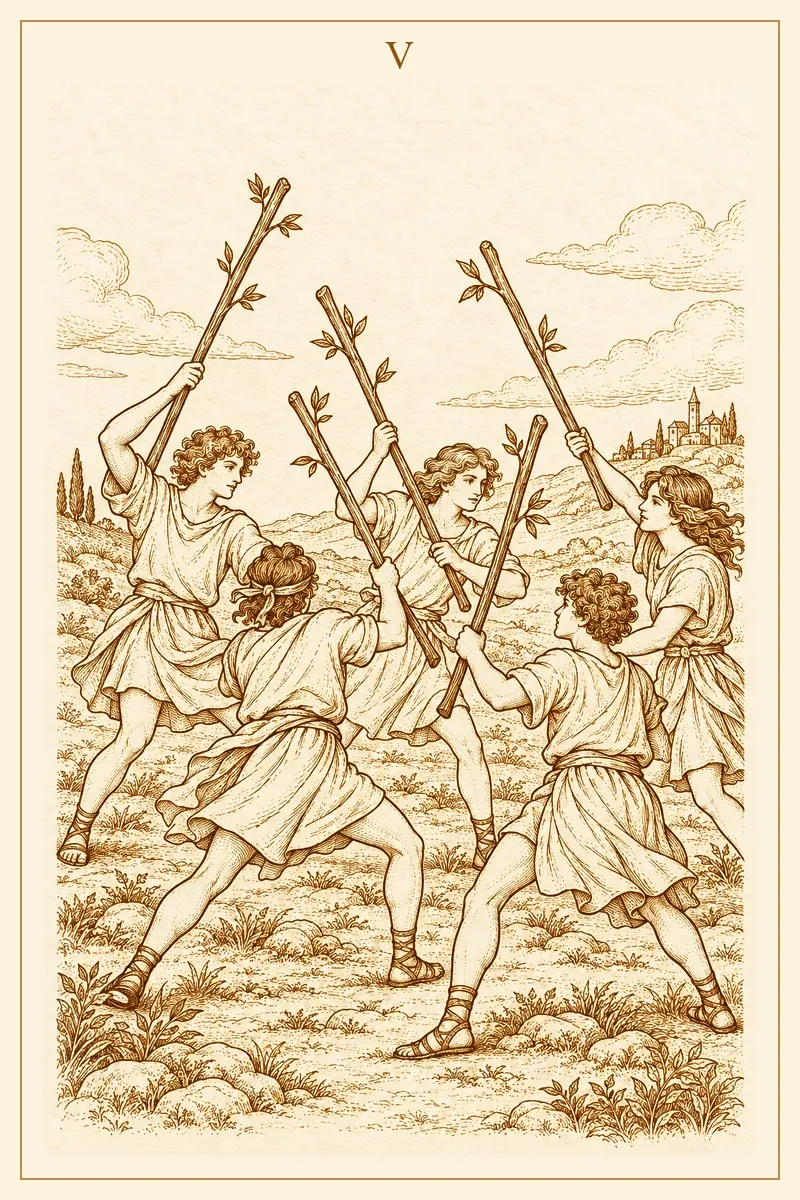
The card shows five young people in short tunics swinging leafy staffs at one another in an open field, with a small hilltop town in the distance. The staffs cross in every direction, yet nobody looks hurt; it reads more like a heated practice than a battle. In the crossing position, the card suggests the hard part of the offer is not the work itself but the competing opinions about how it should be done: a colleague who wanted the role, or managers who expect different things from it. The full Five of Wands meaning includes the reversed reading, where a conflict goes quiet without being settled. For Mia, the practical question is which voices she would need to bring together, and whether she wants that task.
Eight of Pentacles: a foundation of skill
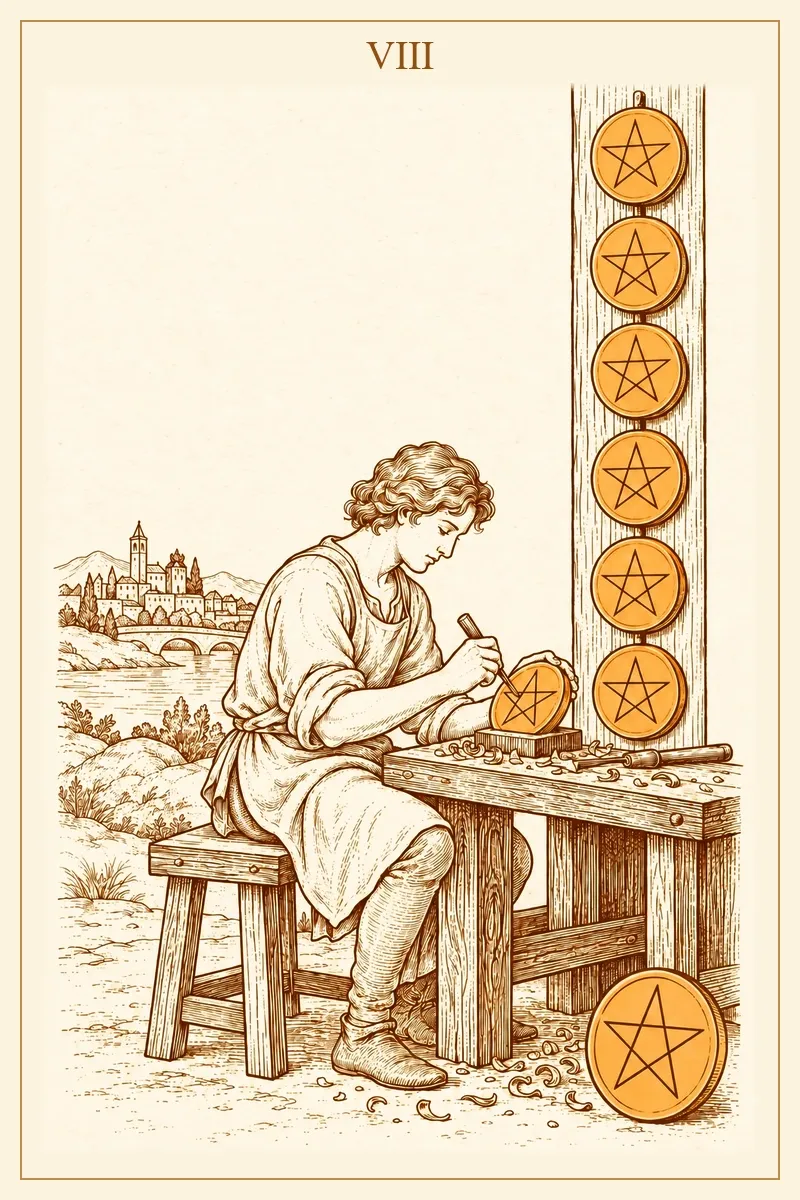
A young craftsman sits on a wooden stool, carving a pentacle at a workbench. Six finished pentacles hang on a tall post beside him, another leans against the bench, and wood shavings cover the ground; a river town sits behind him. As the foundation, this card says Mia’s career rests on doing the work herself, carefully and well. That is a strength, and it is also the habit a leadership role would ask her to loosen. The Eight of Pentacles meaning post shows how the card speaks about skill and practice in other positions too.
Three of Pentacles: the crown of shared work
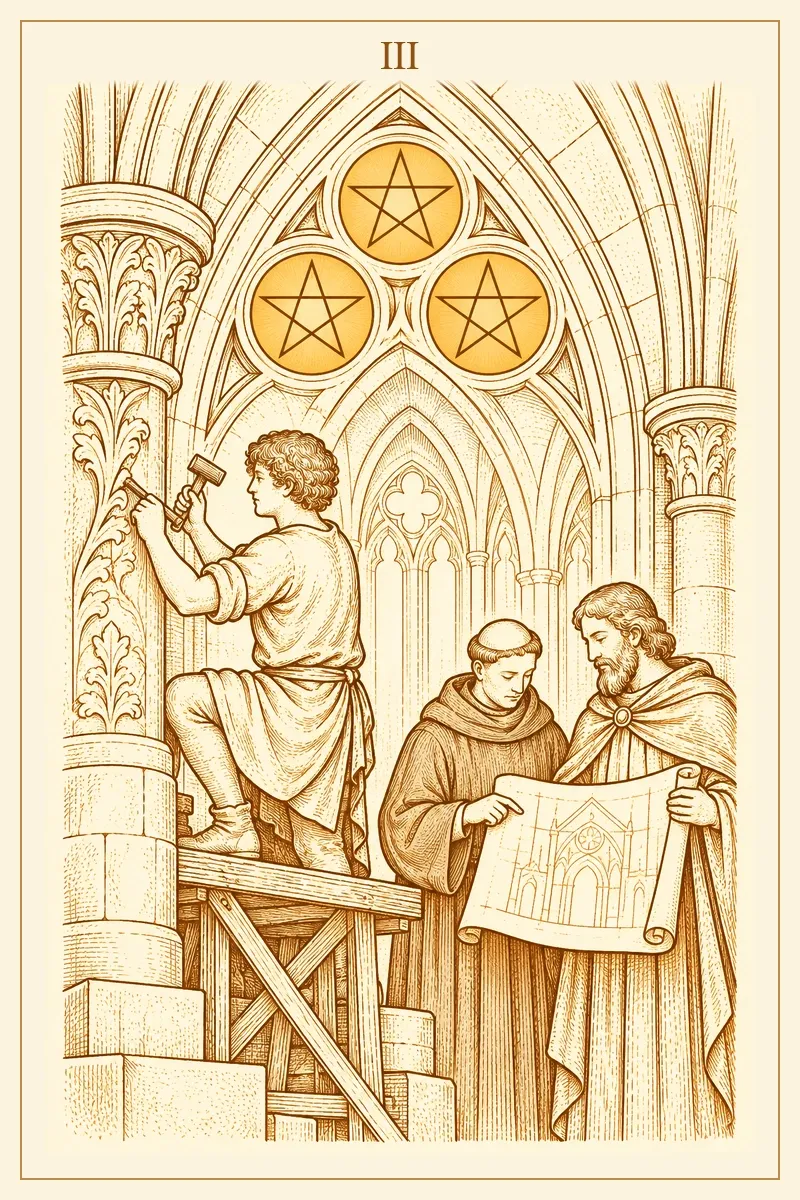
Inside a vaulted stone church, a mason on scaffolding carves leaf patterns into a column while two figures, one in a monk’s hood and one in a long cloak, study a drawn plan of the building. Three pentacles are set into the arch above them. In the crown, the card names what Mia is reaching for: work built together, where her craft and other people’s plans meet. Read with the foundation beneath it, the offer looks like a move from one carver at a bench to one member of a building crew. The card’s upright and reversed sense is covered in the Three of Pentacles guide.
Nine of Wands: a self on guard
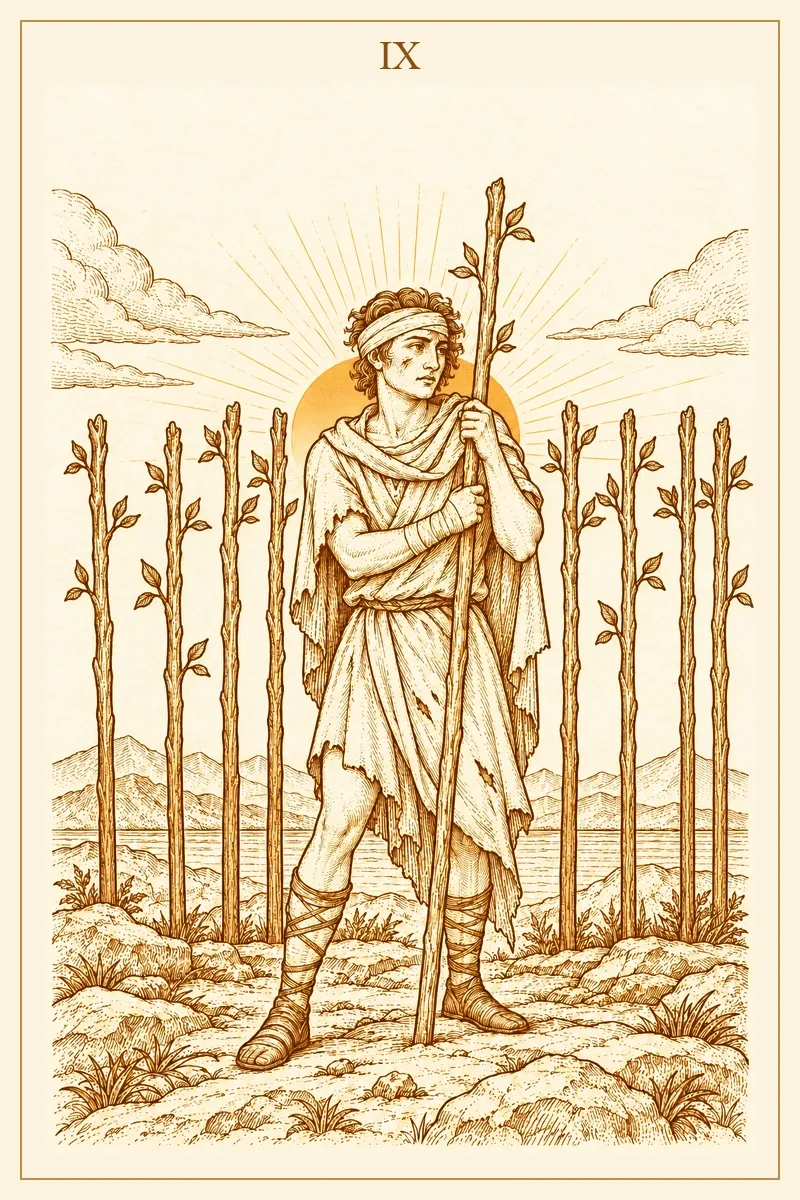
A figure with a bandaged head, a wrapped wrist and a torn tunic grips one staff and glances sideways, while eight more staffs stand upright behind him, four on each side, with the sun at his back. In the self position, this is Mia’s stance: she has already put in a great deal of effort, she is tired, and part of her treats the offer as one more thing to defend against. Set beside the Queen of Pentacles in the environment position, the picture sharpens. Her surroundings look practical and supportive, while her own guard is still up, and that contrast is the most useful finding in the staff. The Nine of Wands meaning explores this mix of resilience and fatigue.
Ten of Wands: an outcome under load
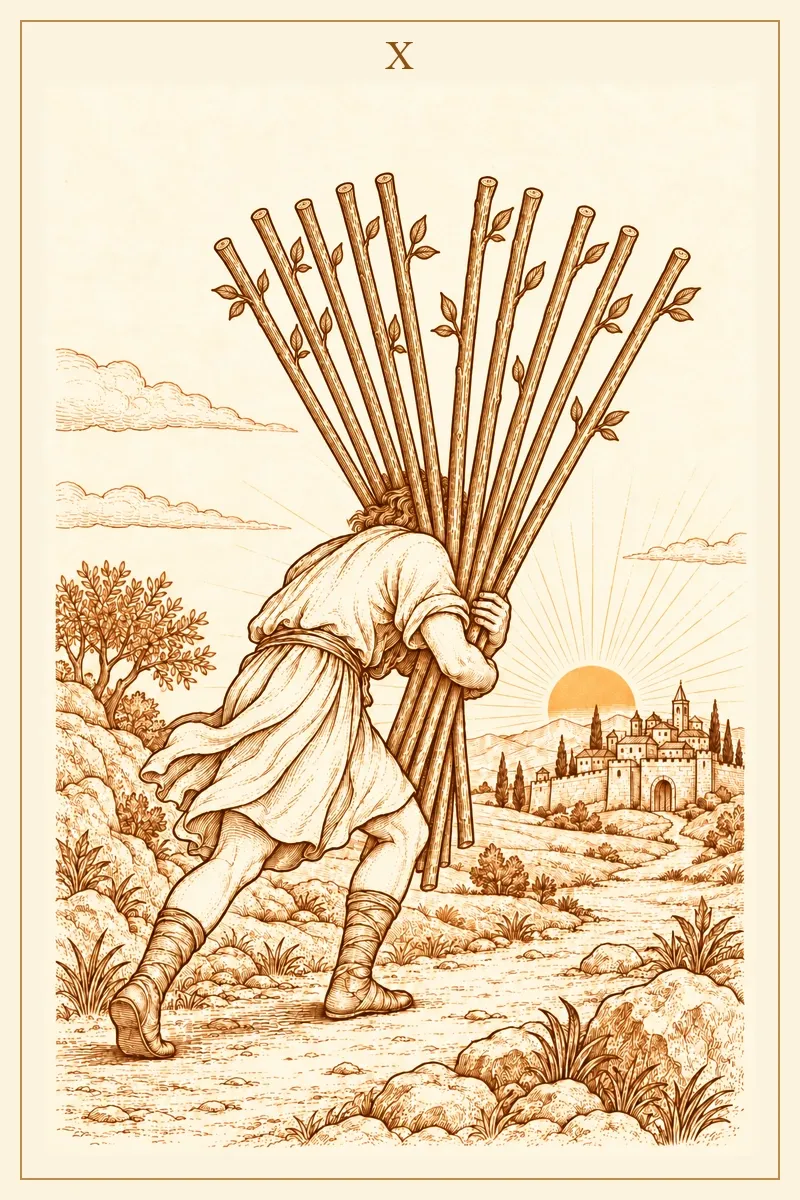
A figure bends forward under a bundle of ten leafy staffs, his head hidden behind them, walking a path toward a walled town while the sun sits low on the horizon. As the outcome, the card describes where things head if nothing changes: Mia takes the role, keeps doing every task herself as the Eight of Pentacles habit would have it, and carries the whole load. Hold it against the crown and the gap is plain. The Three of Pentacles shows shared building; the Ten of Wands shows one person carrying everything. The Chariot in hopes and fears explains why: she wants to steer, and she is wary of what steering would demand. The Ten of Wands meaning also covers its reversed reading, when a load starts to come down.
So what does the reading say? Not “take it” or “refuse it.” It says the offer fits Mia’s aim if she can delegate, and that the outcome card warns about her habits rather than about the role. The leverage sits in card 2, which asks her to talk with the people who hold opinions about the role, and in card 7, which asks her to lower her guard enough to accept help. Her next steps are practical: ask what support comes with the role, name one task she would hand to someone else, and give her answer after the round of questions the Page of Swords points to. If she later wants to compare two choices directly, a two-path decision spread lays the options side by side.
Four habits that blur a Celtic Cross
Reading the crossing card as the villain. Card 2 names a tension, and tension can come from something good. A nurturing card here may point to care you give everyone except yourself. Ask what the card wants from you before you decide it is against you.
Skipping the foundation. It is tempting to jump from the center straight to the outcome. The card beneath the cross explains why the present looks the way it does, and in the example above it explained the outcome as well.
Treating card 10 as fate. The outcome is a direction based on the current pattern. A reading exists so you can notice that pattern while there is still time to adjust it.
Drawing again because you dislike the result. A second full cross on the same question an hour later adds noise, not clarity. Write the first one down, sit with it, and come back when something has actually changed.
When a smaller spread serves you better
Ten cards produce a lot of information, and not every question needs it.
- A yes-or-no question. If you only need a lean in one direction, a yes or no tarot reading keeps the answer short.
- A heavy or anxious moment. When your mind is already racing, ten cards can add to the noise. One of the simple spreads for beginners gives you a calmer place to start.
- A question about timing alone. The Celtic Cross describes how a situation is built; it is not designed to produce dates.
The Celtic Cross earns its length when a situation has layers: a decision with history behind it, a relationship that keeps circling the same knot, a crossroads where your feelings and the facts do not line up.
Variations worth trying
A clarifier card. After the ten are down, draw one more and place it beside any position that stays unclear. Position 9 is a natural candidate, since a second card there can show whether the hope or the fear is louder.
Two crosses for two options. For a choice between two paths, lay one cross for each option and compare them position by position. Wherever the two crosses differ, you can see where the real difference between the paths lies. This takes time, so save it for decisions that deserve it.
A suit count. After the reading, count the suits. A spread heavy in Cups leans toward feelings, Swords toward thoughts and words, Pentacles toward practical and material matters, Wands toward drive and energy, and Major Arcana toward larger turning points. Treat this as a light summary of tone, not a rule.
Frequently asked questions
Which position in the Celtic Cross matters most?
No single card carries the whole reading, but the central pair, cards 1 and 2, sets the theme the other eight comment on. If time is short, read that pair first and then compare the crown with the outcome.
Why does my book number the positions differently?
Because the Celtic Cross exists in more than one written version. Some books swap positions 5 and 6, some put the card above the cross third and the card below it fifth, and some lay the arms of the cross in another sequence. Use the order your source gives, or the order on this page, and stay with it so your positions keep their meaning from one reading to the next.
Do I need a significator card?
No. Choosing a court card to represent yourself is a traditional step, but it is optional. Leaving it out keeps every card in the deck and lets card 1 describe the situation on its own terms.
Can the Celtic Cross predict exactly what will happen?
No. Tarot cannot confirm another person’s thoughts, a date or a fixed outcome. The outcome card reflects the current direction, which your choices and other people’s choices can change. Use the reading as a structured way to reflect, and make decisions with the real information you have.
What if I cannot connect all ten cards?
Start smaller. Make the central sentence from cards 1 and 2, then hold card 5 against card 10. Those four cards give you the core, and the rest fills in detail as you practice. A past, present and future spread is good practice for reading cards as a sequence before you return to ten.
Can I lay a Celtic Cross about someone who is not present?
You can, though the reading describes your side of the connection more clearly than their inner world. Frame the question around your own choices, such as “How can I approach this conversation?”, rather than what the other person secretly feels. If you read alone, the guide to reading tarot for yourself covers keeping that kind of reading honest.
Before you lay the ten cards
The Celtic Cross gives a question room: a center and its tension, a root and an aim, a short timeline, and a column for you and your world. Choose your layout, write your question, and read the pairs before the parts.
When you want a quiet space to try it, begin a reading with Veil Soul and give each card a moment before you move to the next.