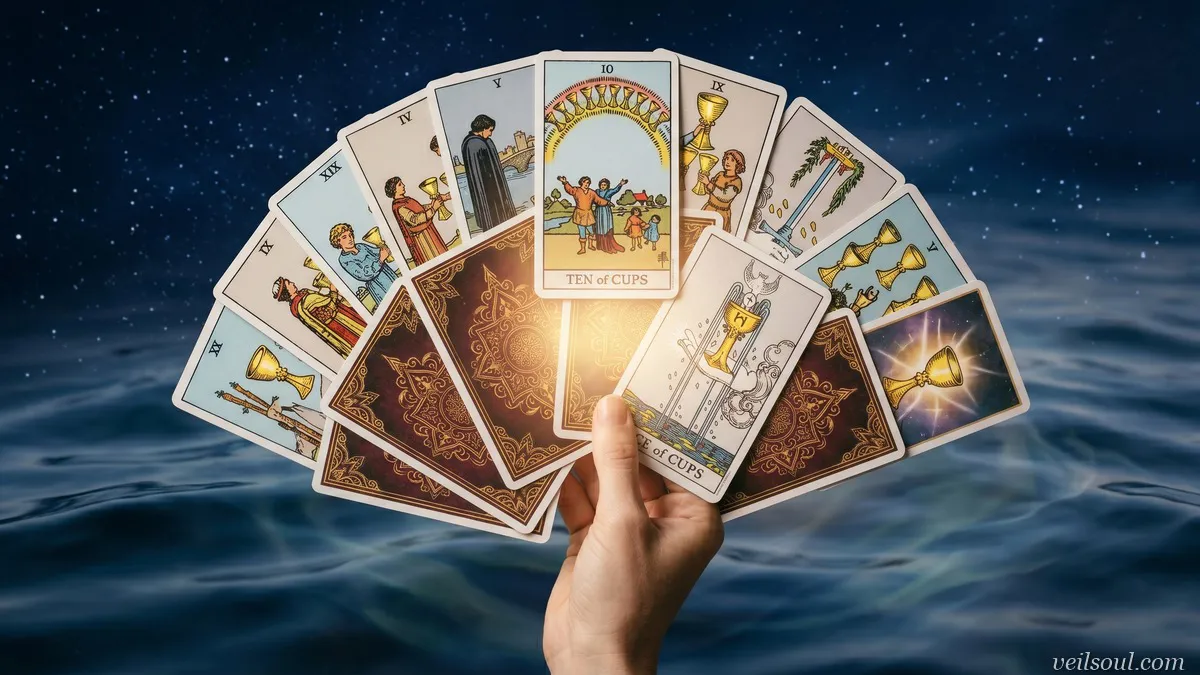
When your tarot reading is all Cups, or when lots of Cups fill the spread, the cards are saying that emotion, relationships and intuition are leading your question right now. Whatever you asked about on the surface, the reading points to how you feel, who you feel connected to, and what your gut already senses. Multiple Cups do not mean "yes" or "no"; they mean the heart of the matter is a feeling that deserves attention before any plan.
This holds whether three of your five cards are Cups or every card on the table is; the more Cups you see, the more clearly the reading asks you to listen inward. Treat it as a mirror for reflection rather than a verdict: tarot cannot confirm what another person thinks, give you a date, or guarantee how something will turn out. It can show where your attention is being pulled, and a spread full of Cups pulls it toward the inner life.
At a glance, this is how to read a Cups-heavy spread:
- A majority of Cups: feelings and relationships are the main storyline; the other suits show what supports or complicates them.
- Every card a Cup: the question is emotional at its root, even if it looks practical.
- No Pentacles: money, the body and practical details are not in view yet, so check them separately.
- No Swords: analysis will not settle this on its own; honest feeling comes before the pros-and-cons list.
- No Wands: the next step is about receiving and listening rather than pushing.
- Cups with Major Arcana: a personal feeling tied to a larger turning point in your life.
- Mostly reversed Cups: feelings turned inward, unspoken or waiting to be acknowledged.
What the Cups suit means
Cups are the suit of water. Each suit of the Minor Arcana carries one element: Wands hold fire and drive, Swords hold air and thought, Pentacles hold earth and material life, and Cups hold water, which covers emotion, love, friendship, family, creativity, intuition, dreams and memory. Water is receptive. It takes the shape of whatever holds it and moves around obstacles rather than through them. Cups ask how something feels and what it means to you, not what you will do about it or how much it costs.
That is why a Cups-heavy reading so often surprises people who asked a practical question. The suit speaks just as clearly about grief, an old friendship, creative work that has lost its spark, or the relief of feeling at home somewhere as it does about romance. The guide to the water element in tarot traces how this element runs through the whole deck, including the Major Arcana.
All fourteen Cups cards in one line each
Before reading patterns, it helps to have every card of the suit in view. Upright meanings come first; the reversed note shows the usual inward or blocked turn.
- Ace of Cups: a new feeling, love or creative opening; reversed, feelings held back or a need to fill your own cup first.
- Two of Cups: mutual connection and a meeting of equals; reversed, imbalance or a connection that needs repair.
- Three of Cups: friendship, celebration and community; reversed, overindulgence or feeling left out of the circle.
- Four of Cups: withdrawal, boredom, an offer you are not ready to notice; reversed, re-engaging after a flat spell.
- Five of Cups: grief and regret, with something still standing; reversed, the first steps of recovery.
- Six of Cups: memory, nostalgia, kindness and innocence; reversed, being stuck in the past or ready to leave it.
- Seven of Cups: many options, wishful thinking, daydreams; reversed, clarity returning and choices narrowing.
- Eight of Cups: walking away from what no longer nourishes you; reversed, hesitation about leaving or fear of the unknown.
- Nine of Cups: contentment and a wish fulfilled; reversed, satisfaction that feels hollow or a wish worth re-examining.
- Ten of Cups: emotional fulfillment, family and belonging; reversed, a gap between the ideal home and the real one.
- Page of Cups: a tender message, a creative idea, a surprising feeling; reversed, emotional immaturity or a shy feeling kept hidden.
- Knight of Cups: romance, an offer, following the heart; reversed, moodiness or promises that run ahead of action.
- Queen of Cups: compassion, intuition, holding feelings with care; reversed, absorbing others' moods or losing your own boundaries.
- King of Cups: emotional maturity and calm under pressure; reversed, feelings suppressed or used to control.
How many Cups? A majority versus every card
Count before you interpret. Cups make up fourteen of the seventy-eight cards, so in a ten-card spread you would usually expect about two. Four or more in ten cards, three in a five-card spread, or two in a three-card draw is enough to call the suit a theme. Every card being a Cup is rarer, and it changes how you read the whole layout.
When Cups are the majority, read them as the main storyline and the other suits as the conditions around it. A single Sword among the Cups often marks a hard truth or a conversation that has to happen for the feelings to move. A single Pentacle is a practical anchor, such as money, health or a physical place. A single Wand shows the spark or action that will carry the feeling into the world. The minority card is often the most practical clue in the spread, so give it a moment of its own.
When every card is a Cup, the whole question sits in water, and a practical question usually has an emotional root you have not named yet. "Should I take this job?" may really be "Will I feel valued there?" "Should I move?" may be "Will I feel at home, and who will I miss?" The cards are pointing to the feeling that will decide how you experience the outcome.
Position matters too. Cups gathered in the past and present with other suits in the future suggest an emotional phase giving way to thought or action; Cups in the future positions suggest the coming weeks will ask more of your heart than your schedule.
What the missing suits say
In a spread dominated by one suit, what is absent tells you almost as much as what is present. Read each missing suit as a part of life the reading is not highlighting right now.
No Pentacles. The practical side is not in view: money, routines, the body, the home, the contract on the table. Those things still matter, but the weight of the question is elsewhere, or you may be leaning on feelings to make a decision that also needs facts. Handle the practical details in ordinary ways, such as reading the terms or checking the budget, rather than expecting the cards to settle them.
No Swords. Analysis, boundaries and clear communication are not featured. Sometimes that is a relief, because thinking harder will not untangle a feeling. Sometimes it is a caution: Cups without Swords can drift into wishful thinking or a situation where nobody says what they mean. Ask whether there is a sentence you have been avoiding saying out loud.
No Wands. Drive and bold action are quiet. This is a reading for receiving and listening, not for forcing a result, and momentum tends to return once the feelings are clear.
No Major Arcana. The situation is human-scale and personal: a friendship, a mood, a relationship pattern, a creative block. The next step is usually within your reach.
Cups mixed with Major Arcana
When Major Arcana cards appear among many Cups, the feeling you are working with is tied to a larger chapter of your life. Read the Major first as the headline, then let the Cups describe the emotional texture around it.
A few pairings come up often. The High Priestess with many Cups doubles the emphasiz on intuition: trust what you quietly know before asking for outside opinions. The Moon adds uncertainty and dreams, so feelings may be strong but not yet reliable; wait before acting on a fear. The Lovers turns an emotional situation into a values-based choice about a relationship. Death among Cups usually marks an emotional ending or a chapter closing, not a literal loss. The Star brings hope and gentle healing, often after a period of grief.
If the Majors outnumber the Cups, the reading becomes more about life direction than a single feeling, and the patterns in an all-Major Arcana reading become the better guide. Two or three Majors among five or more Cups is still a Cups reading with a turning point inside it.
When most of the Cups are reversed
A spread of mostly reversed Cups is not a bad omen. It usually describes feelings that have turned inward, gone unspoken, or are still being processed; the water is there, but it runs underground. Reversed Three of Cups can point to feeling outside your social circle. Reversed Four can mean slowly re-engaging after a numb period. Reversed Six may ask you to stop measuring the present against the past. Reversed Eight can show hesitation at the door of a change you already know you need. Reversed King and Queen often speak about boundaries: feelings held too tightly, or other people's moods absorbed too easily.
The common thread is acknowledgement. Name the feeling privately first, then decide whether it needs one honest conversation. If reversals dominate your readings in general, the guide to readings where most cards are reversed explains how to tell an inward phase from a blocked one.
Reading the numbers from Ace to Ten, and the courts
When one suit fills the spread, the numbers carry the story. Low cards (Ace to Three) describe a feeling that is new or still forming: a first attraction, an early friendship, a creative idea. Middle cards (Four to Six) describe adjustment: the boredom of the Four, the loss of the Five, the memory and kindness of the Six. Upper cards (Seven to Nine) describe choice and evaluation: options in the Seven, leaving in the Eight, contentment in the Nine. The Ten is completion and the shape of a settled emotional life.
Notice the direction. Numbers rising across the spread suggest an emotional story that is maturing; numbers falling may suggest starting over after an ending. A cluster in the middle often means you are in the thick of it, past the first excitement but not yet at resolution.
Court cards describe people, or roles you are playing. The Page brings a new feeling or a message, the Knight pursues and offers, the Queen holds emotion with compassion, and the King keeps it steady under pressure. Several Cups courts together often mean more than one emotionally important person is involved; before deciding who is who, ask which role is yours.
Combinations worth noticing
Some pairs carry extra meaning when the rest of the spread is also Cups:
- Ace and Ten: the beginning and the fulfillment of the same feeling. Something starting now has room to grow, if old disappointment does not make you refuse it.
- Five and Six: grief linked to the past. A present loss may echo an older one, and healing runs through those memories rather than around them.
- Four and Eight: withdrawal turning into departure. Refusing to feel for too long can make leaving seem like the only option; check whether a conversation would serve better.
- Seven and Nine: a wish and a fantasy side by side. Ask which hope is grounded and which is mainly a daydream.
- A run such as Two, Three, Four: connection, then celebration, then flatness. Consecutive numbers read like chapters, in order.
Five Cups cards that shape the reading most
Any Cups card can set the tone, but these five tend to show most quickly what kind of emotional story you are in.
Ace of Cups: an emotional beginning
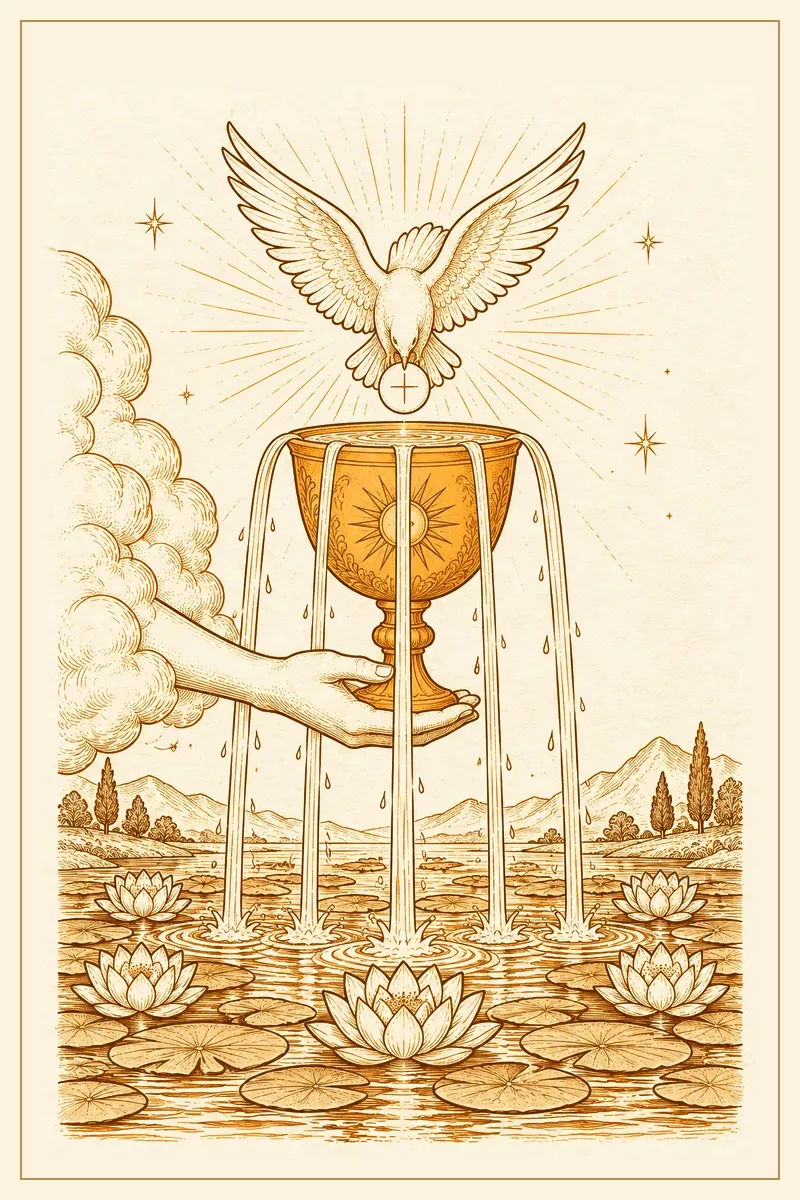
Upright, the Ace of Cups is the cup filled to overflowing: new love, a renewed friendship, a creative idea, or a softening toward yourself. In a Cups-heavy spread it often marks where the story starts, and its position shows whether that beginning is behind you, happening now or still arriving. The full Ace of Cups tarot meaning covers its other contexts.
Reversed, the Ace suggests a feeling held back, or a cup that needs filling before you can offer it to anyone else. In a relationship reading, it may ask whether you let yourself receive care, not only give it.
Two of Cups: a mutual connection
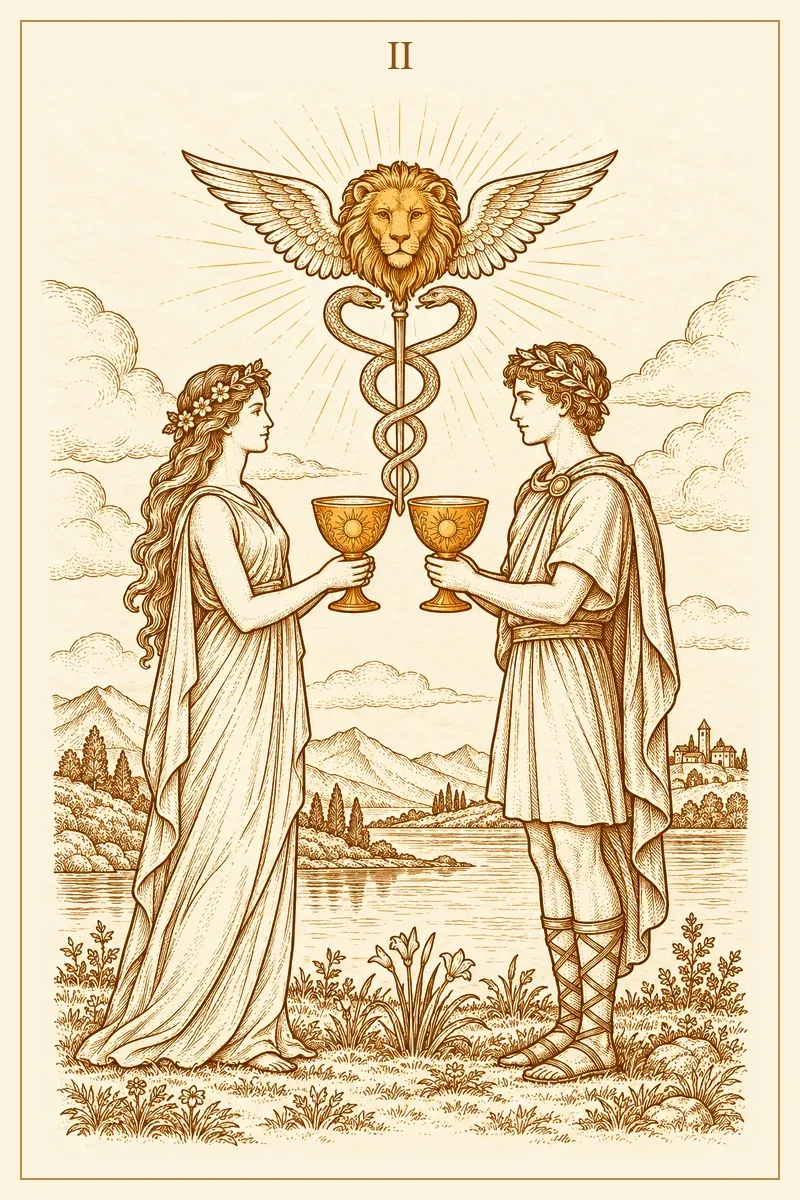
Upright, the Two of Cups shows two people meeting as equals and choosing each other. It can describe romance, but also a close friendship, a partnership built on trust, or reconciliation after distance. Among many Cups it points to the relationship at the center of the question. For its love and career readings, see the Two of Cups tarot meaning.
Reversed, the Two points to imbalance: one person giving more, a misunderstanding, or a connection that needs honest repair. It asks what you have both actually said.
Five of Cups: grief that wants room
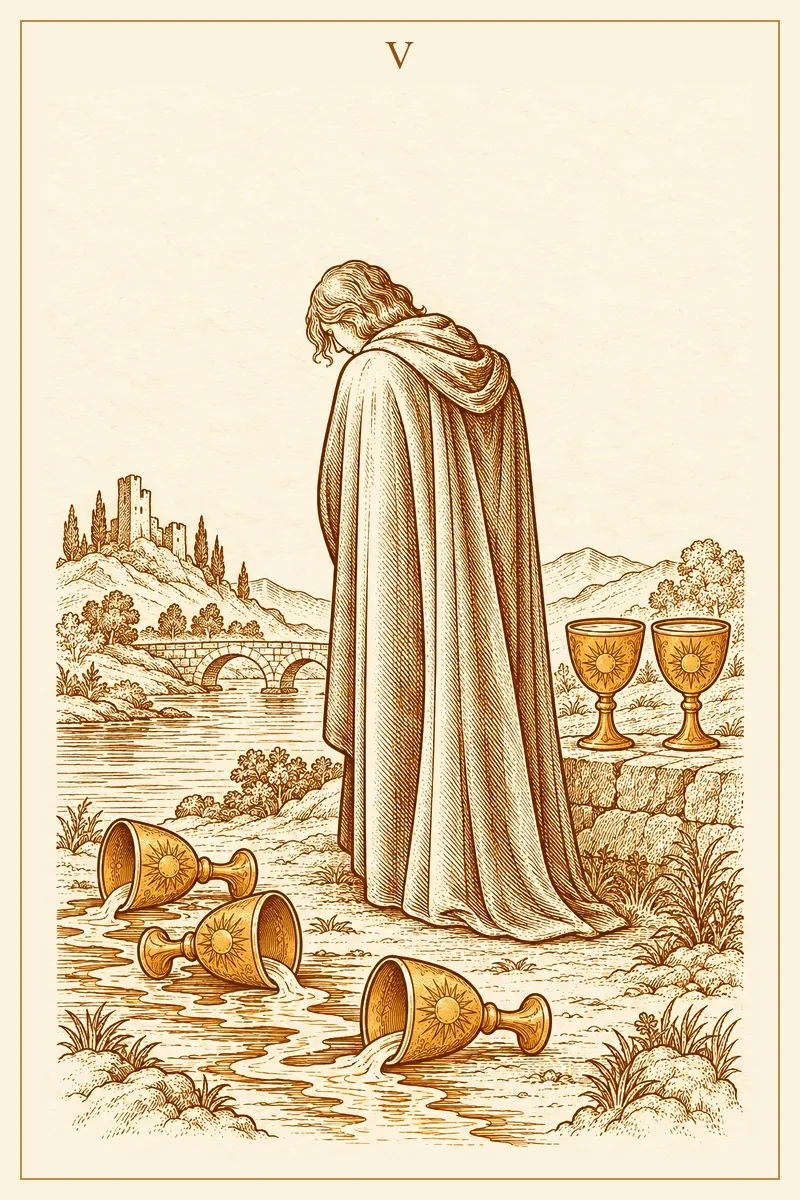
Upright, the Five of Cups is the card of loss and regret, with the traditional detail that not every cup has spilled. In a spread full of Cups it often names the feeling underneath everything else: disappointment that has not been mourned. Its message is not to hurry past the grief but to notice, in time, what is still standing. The Five of Cups tarot meaning explores this balance in more depth.
Reversed, the Five suggests recovery beginning: accepting what happened, forgiving yourself, or reaching for support. It can also point to grief that has been pushed down and is asking to be felt.
Ten of Cups: emotional fulfillment and belonging
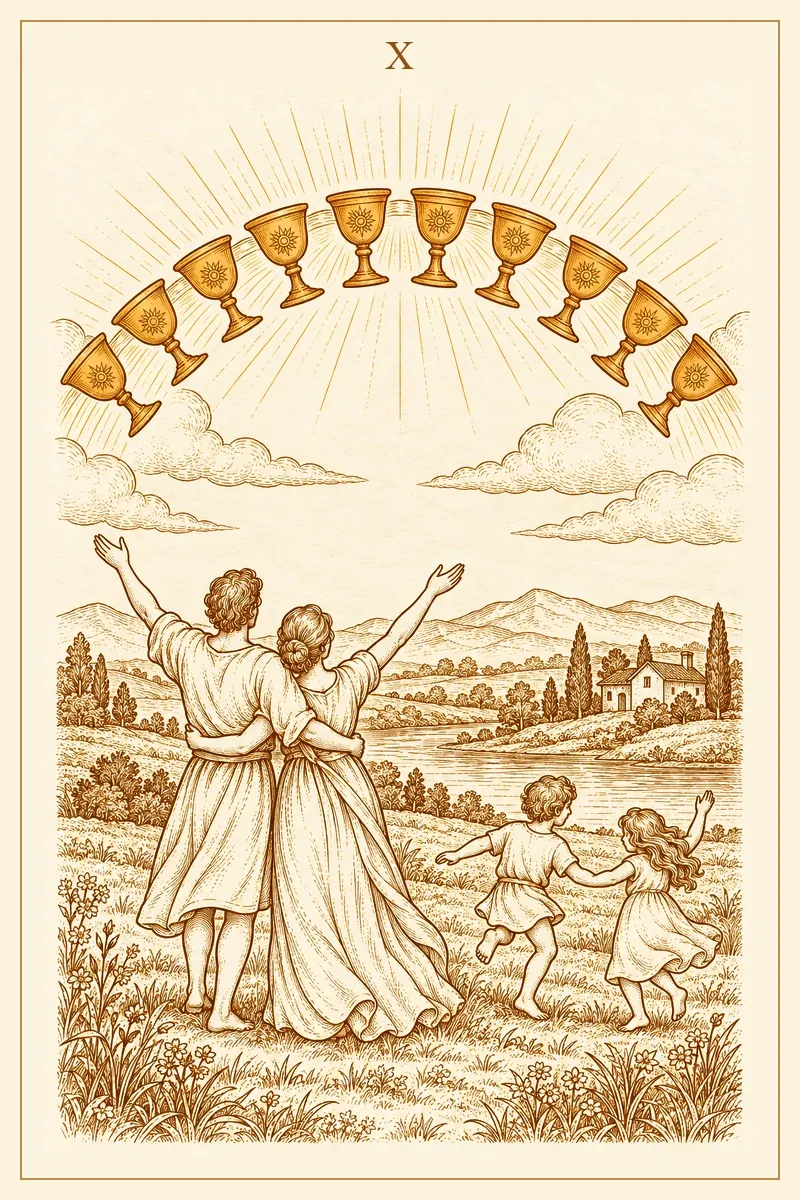
Upright, the Ten of Cups completes the suit: belonging, family or chosen family, and a home where feelings are safe. In a Cups-heavy reading it shows what the emotional story is reaching toward, and it can be a reminder of what you already have. Read the Ten of Cups tarot meaning for its timing and relationship angles.
Reversed, the Ten points to a gap between the picture of a happy home and daily reality, or to different ideas of what family should look like. It invites a conversation about expectations rather than a judgment of the relationship.
Page of Cups: a tender message or new feeling
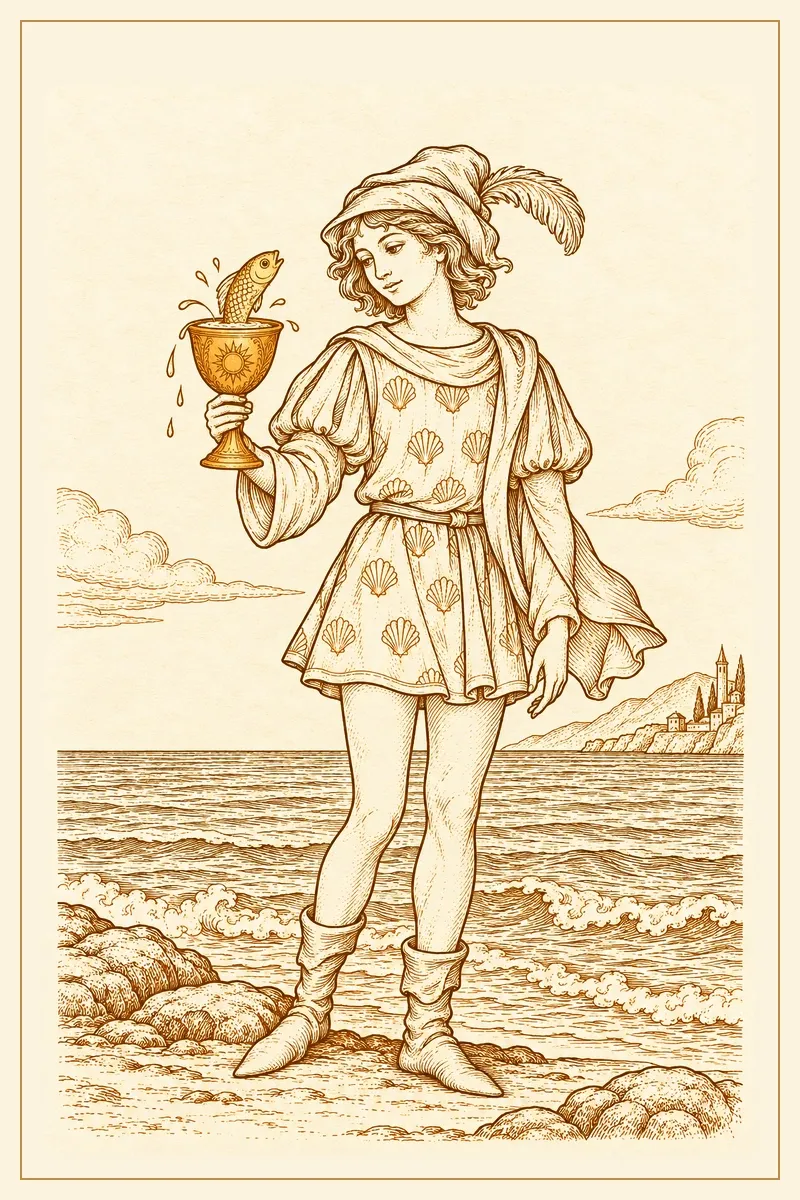
Upright, the Page of Cups brings a surprising feeling, a sweet message, a creative idea or an intuitive nudge. In a spread full of Cups it can describe the newest part of the story: a fresh connection, a younger person, or a playful side of you that wants to come back. The Page of Cups tarot meaning describes the card as a messenger in more detail.
Reversed, the Page suggests a feeling kept secret out of shyness, or reactions a little younger than the situation needs. Gentle honesty usually helps more than waiting for the perfect moment.
Love, career and self: reading Cups by topic
Love and relationships
In a love question, lots of Cups confirm that the emotional connection is the real subject. Look at whether the Cups show mutuality (Two, Ten), longing (Knight, Page) or loss (Five, Eight). If the spread leans toward grief after a breakup, the guide to tarot for heartbreak offers spreads designed for that stage. Use the reading to clarify what you want to say, then say it to the person, not to the cards.
Career and money
A career question answered with mostly Cups is asking about meaning and belonging: whether you like the people, whether you feel valued, whether the role fits who you are becoming. With no Pentacles, salary and terms are not the focus of the reading, so check them yourself. With a Four or Eight of Cups, look at fading motivation before blaming the job itself.
Self and inner life
Asked about yourself, a Cups-heavy spread is often an invitation to rest, feel and create. It may point to an emotion you have been too busy to notice, or to a creative project that needs play more than discipline.
A worked example: five cards for a job decision
The question: "Should I accept the team-lead role I have been offered?" The reader uses a five-card spread with named positions: 1. The heart of the question. 2. What I feel underneath. 3. What I am not seeing clearly. 4. What helps. 5. Where this is heading if nothing changes.
- The heart of the question: Four of Cups, upright.
- What I feel underneath: Six of Cups, upright.
- What I am not seeing clearly: Seven of Cups, reversed.
- What helps: Queen of Cups, upright.
- Where this is heading: The Star, upright.
Four Cups and one Major, with no Pentacles, Swords or Wands: a practical promotion question has come back almost entirely as feeling. The Four of Cups at the heart says the offer is not exciting the reader, and the question is why. The Six of Cups underneath answers part of it: loyalty to current teammates who are also friends, and a fear that leading them will change the relationship.
The reversed Seven of Cups suggests the fog is lifting, as daydreams about a completely different career narrow toward a realiztic choice. The Queen of Cups describes a way of leading that listens and holds feelings with care, which could make the new role feel less like leaving the team and more like looking after it. The Star as the direction brings hope: this turning point can feel good if it is approached honestly.
What the reading leaves out matters too. With no Pentacles, pay and workload are not addressed, so the reader asks for the terms in writing. With no Swords, the hard conversation is not shown, so the reader plans one: telling a close teammate about the offer before deciding. The spread did not say yes or no. It showed that the decision rested on a feeling about friendship, and that is something the reader can work with.
What to do after a Cups-heavy reading
- Name the feeling in one sentence. Write "Right now I feel..." and finish it without switching to "I think". Stay with feeling words for a full page if you can.
- Restate the question. Turn the surface question into the emotional one underneath it, such as "Will I feel valued?" or "What am I afraid to lose?"
- Check what the missing suits point to. Note the practical details, conversations or actions the spread did not show, and plan how to handle them in everyday ways.
- Talk to someone you trust. Choose a person who listens without rushing to fix things. If the feelings are heavy or lasting, a counselor or other professional is a good place to bring them.
- Draw again only when something has changed. A new conversation or a decision made is a good reason; the hope of a different suit is not.
Frequently asked questions
Is a reading full of Cups always about romance?
No. Cups cover every kind of feeling and connection: love, but also friendship, family, grief, creativity, nostalgia and self-compassion. Romance is one expression of the suit, not its whole meaning. Read the cards in the light of the question you actually asked.
What if I asked a practical question and got mostly Cups?
Then the practical question likely has an emotional root. Ask what you hope to feel once the decision is made, and what you fear feeling if it goes wrong. Once that is clear, the practical choice is often easier, though you still need to check the facts yourself.
Does a lot of Cups mean I am being too emotional?
Not necessarily. It means feelings are louder than logic for now, which is a description, not a criticism. Some situations need to be felt before they can be thought through, and the reading gives you permission to take that time.
Can a Cups-heavy spread tell me how another person feels?
It cannot confirm what someone else thinks or feels, when something will happen, or how it will end. Tarot works as a reflection of your own situation and choices. Many Cups can show that a relationship matters deeply to you and suggest what to bring to a real conversation, but the other person's answer comes from them.
How is an all-Cups reading different from an all-Major Arcana reading?
All Cups describe emotional immersion at a personal, day-to-day scale. All Majors describe larger life themes and turning points that feel bigger than any single mood. When both appear together, read the Majors as the chapter and the Cups as how that chapter feels.
Should I shuffle again if every card comes up Cups?
Usually not. A one-suit spread is a strong message, and redrawing to get a different answer tends to blur it. Spend time with what came up, take one small next step, and return to the cards when your situation or your question has genuinely changed.
A spread full of Cups asks you to treat your feelings as information worth hearing, then carry what you learn into honest conversations and practical choices. When you are ready to look at your own question, a free reading with Veil Soul is a quiet place to begin.