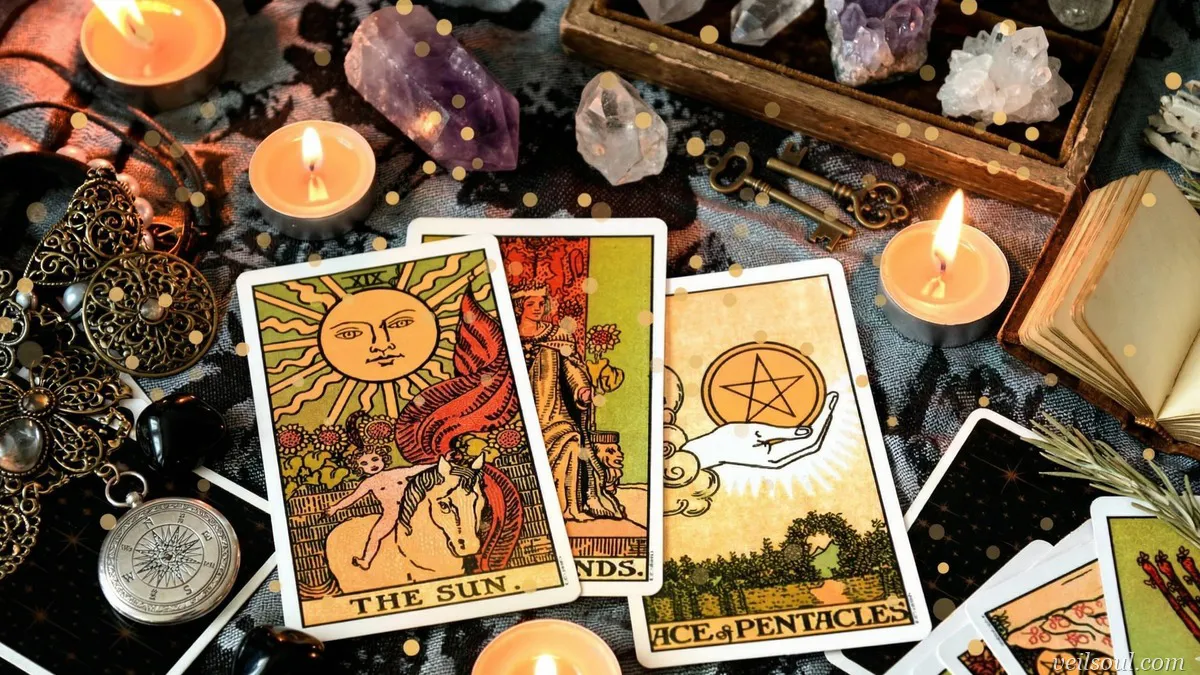
Letting go speaks most clearly through Death, the Eight of Cups, The Hanged Man and The Tower, joined by the Ten of Swords for endings you did not choose, the Four of Pentacles as the card of holding on, and The Star for what follows. A reading helps with release by putting words to what you are carrying: what it is, why your hands are still closed around it, and what one small act of loosening might look like. It cannot decide the right moment for you, tell you what another person feels, or promise when the ache will ease.
What you need to release might be a relationship, a habit you have outgrown, a plan that will not happen the way you pictured it, an identity you wore for years, or the slow grief of a chapter that has closed. If you are working through a romantic split specifically, our breakup tarot reading looks at that case in detail. This piece stays with release in the wider sense.
At a glance, these are the seven cards read here for release:
- Death: an ending that has already happened and is waiting to be acknowledged.
- Eight of Cups: choosing to walk away from something that still looks fine from outside.
- The Hanged Man: stopping the struggle so a new view can arrive.
- The Tower: a structure that falls whether or not you feel ready.
- Ten of Swords: the worst is over, and the work now is getting up.
- Four of Pentacles: the grip itself, holding on for safety.
- The Star: quiet hope and the space that opens afterward.
What releasing really involves
Letting go is rarely one decision. It is closer to a series of small permissions: to stop checking an old message thread, to stop rehearsing the argument, to stop keeping a room ready for a plan that has quietly changed. People who struggle with release are not weak; they are attached because the thing mattered. Letting go is also not forgetting. You can release a hope and keep the memory, the lessons and the gratitude.
A card helps because it gives you something outside your own head to look at. After weeks of circling the same thoughts, an image of a traveler walking away can name the situation from a new angle. You may want to let go and hold on within the same hour; a reading does not need to settle that, only show both sides clearly enough to choose a next step.
Seven cards for release and what follows
Each card below describes a different kind of letting go. Notice which one feels uncomfortably accurate.
Death: acknowledging an ending
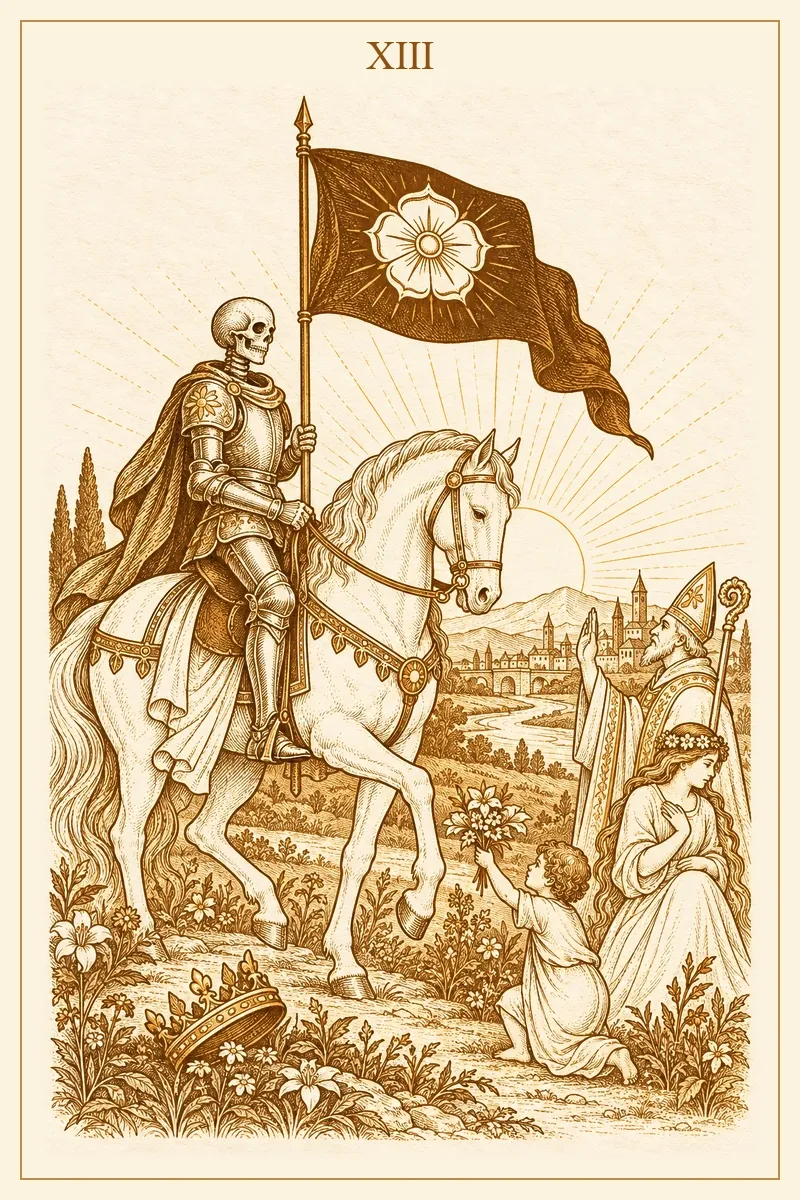
An armored skeleton rides a pale horse and carries a dark banner marked with a white rose. A crown lies fallen among the flowers at the horse's feet. A bishop in a tall miter raises a hand, a woman kneels with her face turned aside, and a small child holds up a bunch of flowers, while a low sun shines over a distant town. The fallen crown says that rank and effort do not stop some endings.
Upright, Death usually describes a chapter that has already closed, even if you have not admitted it yet, and it asks whether you are holding the thing itself or the memory of what it used to be. Reversed, it often shows an ending being stalled: a door kept half open, or a decision delayed because finishing it would make the loss real. In love or at work, it can mark a pattern, role or ambition that has run its course.
The full Death tarot meaning covers its other contexts. When it appears, ask what you would do differently this week if you accepted that this part is finished.
Eight of Cups: walking away by choice
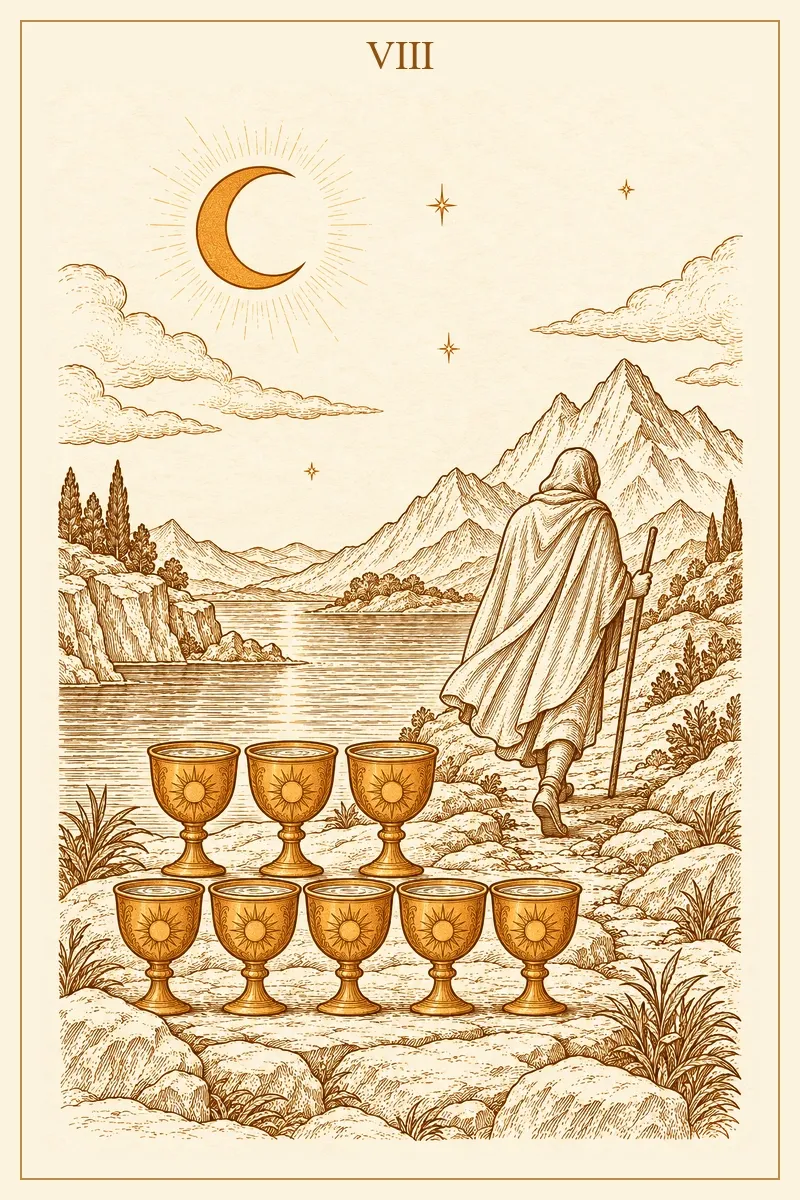
A hooded, cloaked traveler with a walking staff heads along a rocky lakeshore toward the mountains, under a crescent moon and a scattering of stars. Behind them, eight gold cups stand in two tidy rows, three above five, none knocked over. Nothing is broken; the cups still stand for real effort and feeling, and the traveler leaves anyway.
Upright, the Eight of Cups suggests you already sense that staying costs more than leaving: a friendship that has become one-sided, a hobby kept up out of guilt, a city that no longer feels like home. Reversed, it can show hesitation, a bag packed and unpacked again, or the opposite habit of leaving every situation the moment it becomes difficult.
Ask what you are staying in out of obligation, comfort or fear rather than real desire, and what you could carry with you if you went. Our Eight of Cups tarot meaning explores the card's emotional courage in more depth.
The Hanged Man: surrender instead of struggle
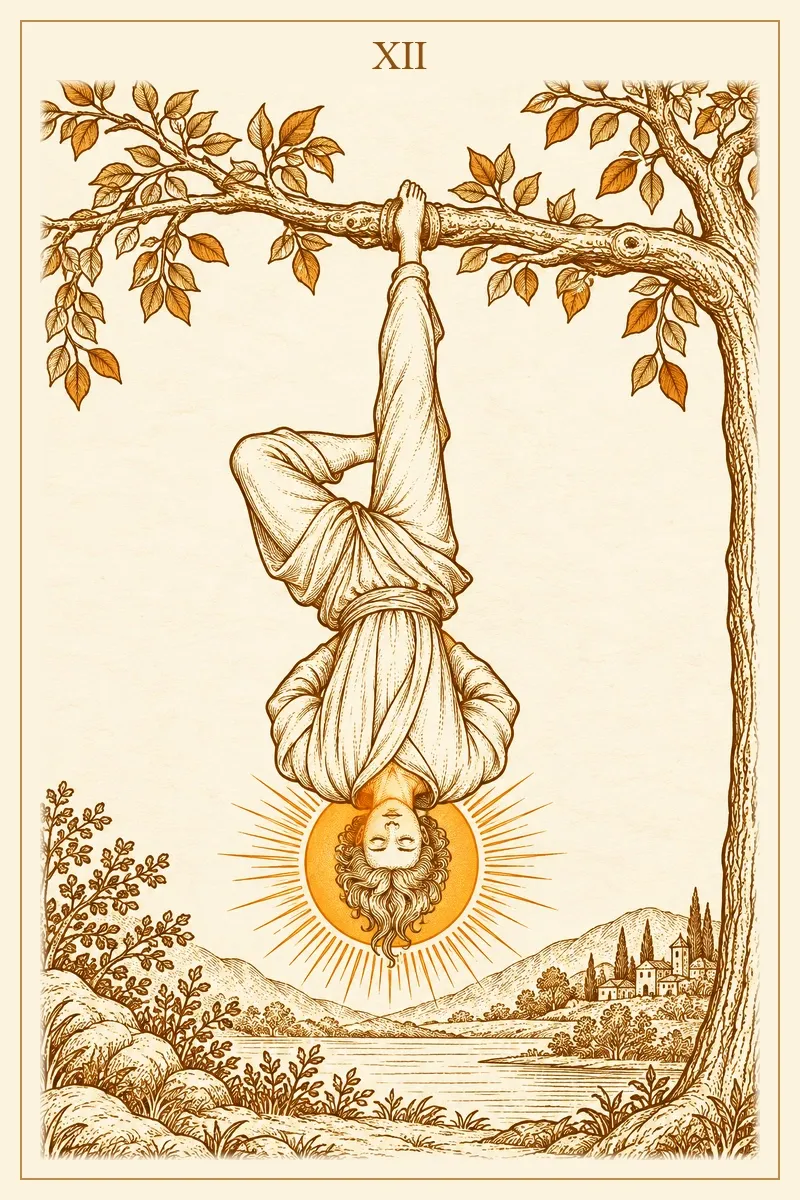
The figure hangs upside down from the branch of a leafy tree, one leg straight and the other bent behind it. Their eyes are closed, their face is calm, and a soft glow of golden rays circles the head. Below, a lake reaches back to hills and a small village. Nothing is being achieved, and that is the point.
Upright, The Hanged Man asks you to stop pushing and put the effort down for a while. Surrender here is not defeat; it is admitting that some outcomes are not yours to control, and that a pause can show angles constant effort hides. Reversed, it can describe stalling, such as waiting for permission that will not come. At work it often appears when a project is on hold and you keep forcing movement; in relationships, it can suggest no longer trying to make someone change.
The full Hanged Man tarot meaning explains its gift of perspective. Ask yourself where you are exhausting yourself trying to control what happens next.
The Tower: when the structure falls
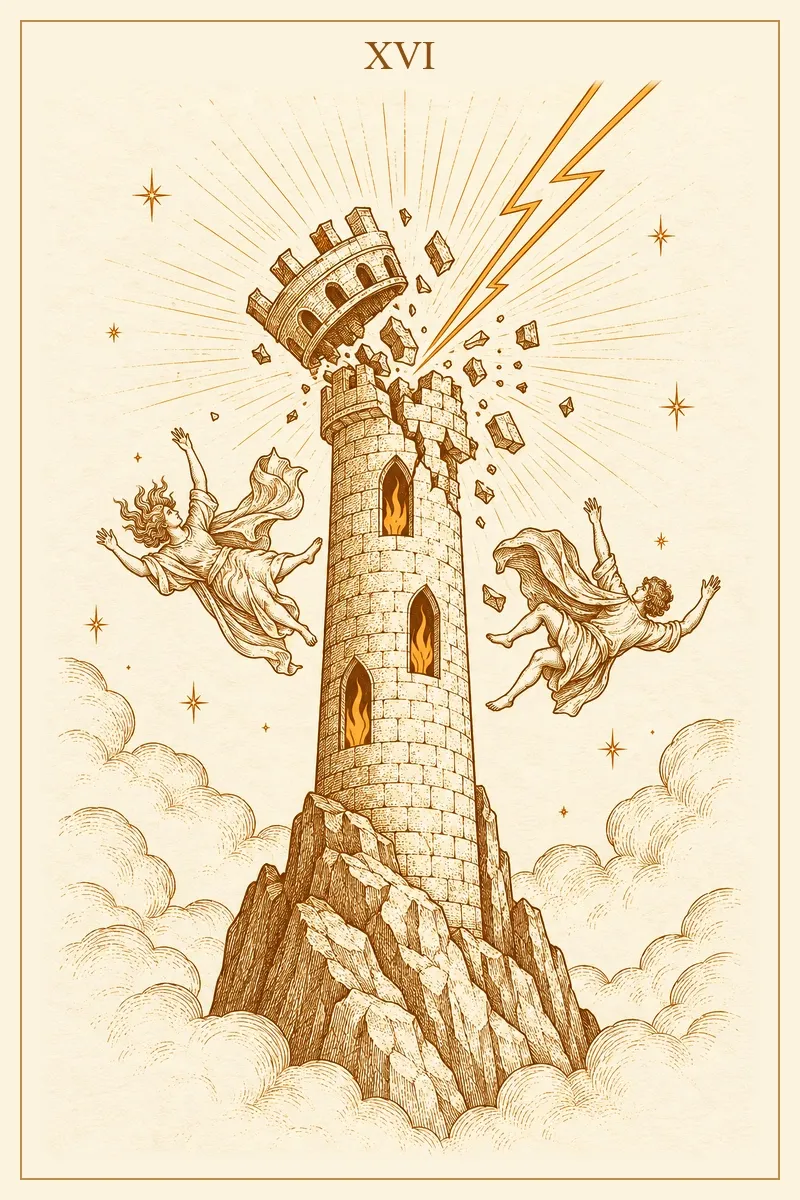
A stone tower stands on a rocky peak above the clouds. A bolt of lightning knocks off its crowned top, flames show in its windows, and two figures fall through the air on either side. This is release that is neither gentle nor planned: something built on a shaky foundation gives way, and the falling is out of your hands.
Upright, The Tower can describe sudden news, a revelation that changes how you see a relationship, or the collapse of a plan you had organized your life around. Painful as that is, the card also clears ground; the tower that falls was not as safe as it looked. Reversed, it can show an upheaval you are trying to hold off, or one happening quietly on the inside.
The card does not ask you to welcome the shock. It asks what was already unstable, and what you might build on firmer ground. Our Tower tarot meaning looks at its sense of breakthrough.
Ten of Swords: the ending you did not choose
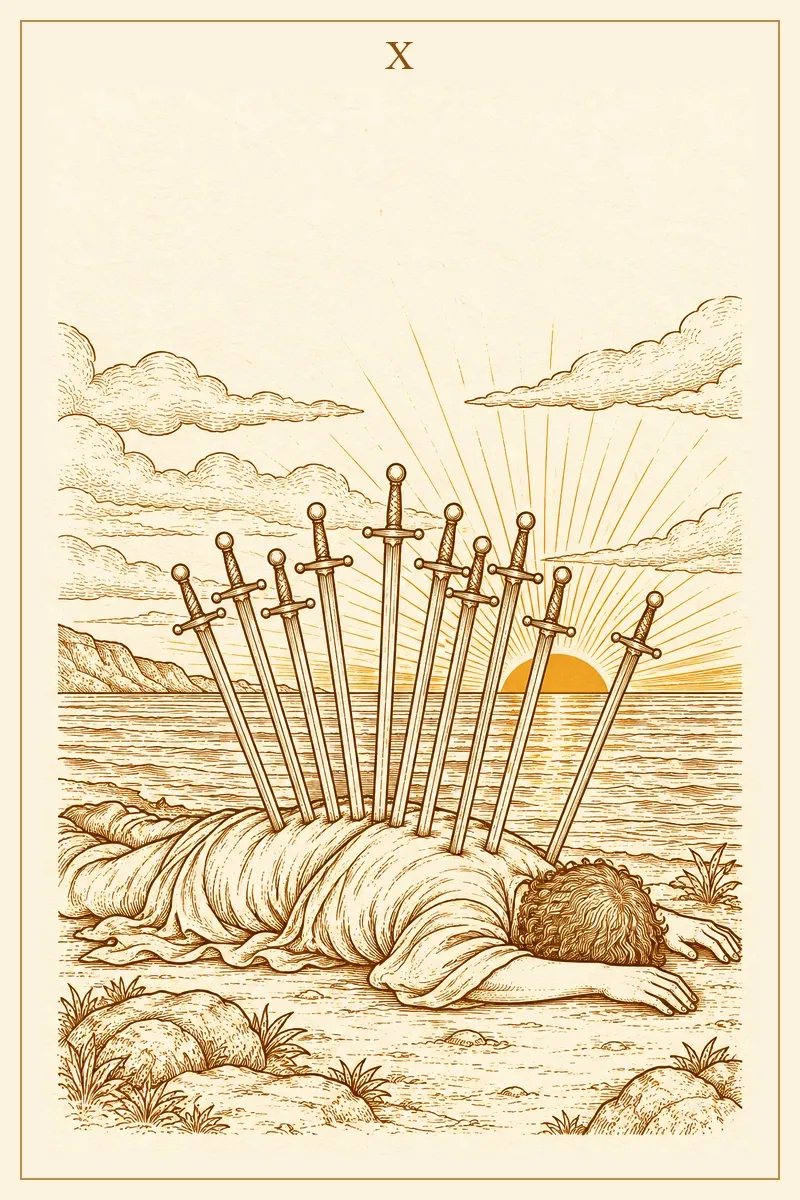
A figure lies face-down on a shore with ten swords standing in their back. Beyond them, calm water stretches to the horizon, where a half sun sends rays across a pale sky. The distant light belongs to the picture too: the worst has happened, and the day keeps moving.
Upright, the Ten of Swords can mark the point where something is clearly over, such as a job loss, a final conversation or a door that has firmly closed. Once it arrives there is nothing left to defend, which can bring an odd relief. Reversed, it can describe the slow work of getting up again, or the opposite: replaying the ending so often that it keeps happening in your mind.
The card is not about blame. It asks you to notice that you are still here and to take the next small step instead of bracing again. The full Ten of Swords tarot meaning covers its sense of rock bottom and new dawn.
Four of Pentacles: the card of holding on
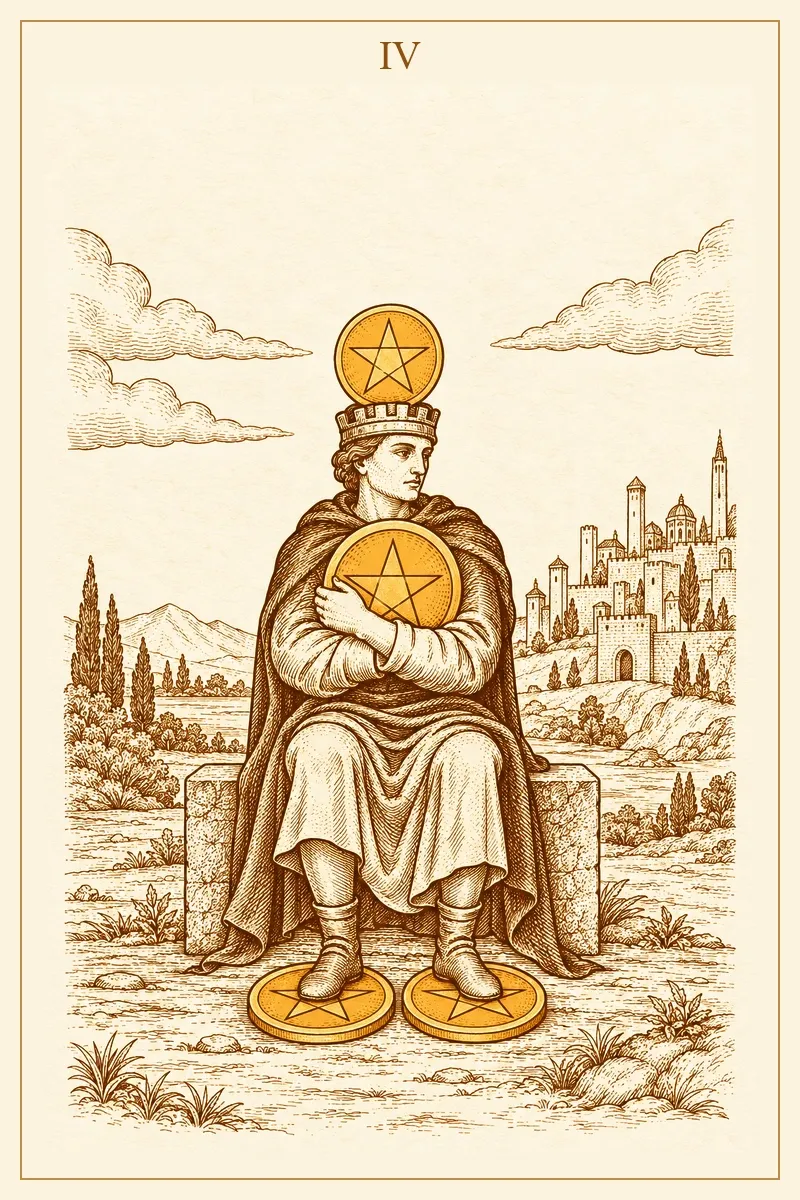
A crowned man sits on a stone block with his arms crossed tightly around a pentacle pressed to his chest. A second pentacle balances on top of his crown and two more lie under his feet. A walled town rises behind him, and he looks off to one side. Every part of him is busy guarding what he has.
Upright, the Four of Pentacles describes holding on for security: money saved for a plan that will not happen, a relationship you will not discuss because talking might change it, a role you protect because it defines you. Stability sometimes matters, so the card asks whether your grip protects something alive or simply keeps you in place. Reversed, it can show the grip loosening, frightening and freeing at once, or warn against giving away what you will need later in a rush to feel free.
In a release reading this card rarely means you are failing; it shows where the work is. Our Four of Pentacles tarot meaning looks more closely at control and security.
The Star: the space after release
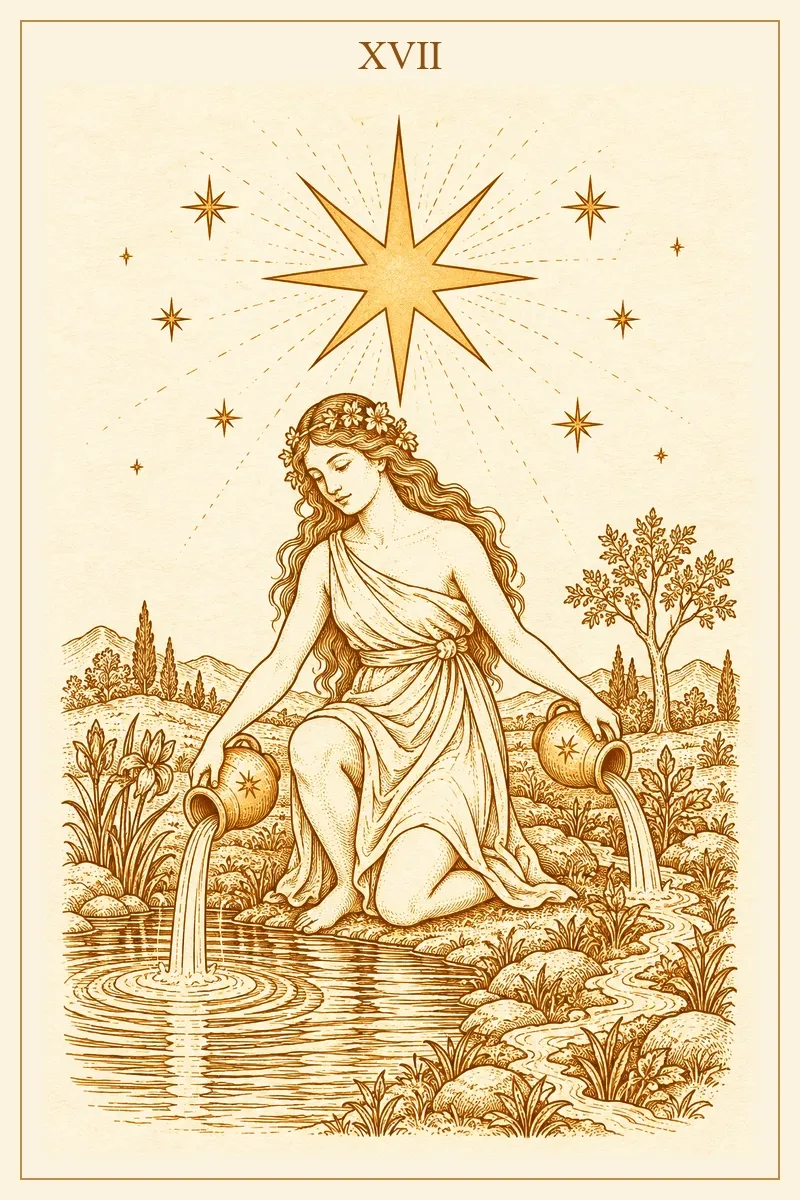
A woman with a crown of flowers kneels at the edge of a pool and pours water from two jugs, one into the pool and one onto the land, where it runs off in a small stream. Above her shines a large eight-pointed star surrounded by smaller ones, and a young tree grows behind her. She gives the water freely, because nothing in the scene needs guarding.
Upright, The Star describes what can grow after a release: calmer hope, room to breathe again, the first ideas of what you might want next. Reversed, it can show hope that has dimmed or a disconnection from what usually restores you; the answer is rarely a big gesture, more often rest, small routines and steady people.
Read more in the full Star tarot meaning. In a letting-go reading, The Star invites one simple question: now that my hands are a little more open, what would I like to receive?
Reading the grip: five things people hold onto
Cards about attachment tend to cluster by what is being held, which helps you name the shape of your own holding.
- People: the Two of Cups or The Lovers reversed, or the Eight of Cups reversed, can point to clinging to a bond that has already changed.
- Identity: The World reversed, the Ten of Wands or the Wheel of Fortune reversed can show a self-image ("the reliable one," "the one with the plan") that no longer fits who you are becoming.
- Control: The Emperor or The Chariot reversed, alongside the Four of Pentacles, can describe refusing to accept that some outcomes sit outside your influence.
- Resentment: the Five of Swords, a reversed Justice or the Nine of Swords can show anger kept alive as a way of staying connected to the person who hurt you.
- Fear of the unknown: The Moon, The Star reversed or the Four of Swords can point to staying with the familiar because whatever lies beyond it feels too vague.
If resentment is the heaviest part, our guide to tarot for forgiveness works with that theme directly. None of these groupings is a diagnosis; they help you say, in plain words, what kind of holding you are doing.
Pairs that tell a release story
Two cards side by side often say more than either one alone.
Four of Pentacles with Eight of Cups: part of you is ready to leave and part of you is still clutching the cups. The decision is made in principle while the practical steps keep slipping, so ask which single possession, habit or routine you could release first.
Death with The Star: an ending followed by quiet renewal. Grief and hope are both real and both allowed; give the first card time before rushing toward the second.
The Tower with The Hanged Man: a sudden collapse followed by enforced stillness. After a shock, this pair advises against big decisions made in a hurry. Let the dust settle before you rebuild.
Eight of Cups with The Hanged Man reversed: you know you need to go, yet you keep waiting for a sign that will make the choice painless. That sign may never come, and a small step can be taken without it.
The Open Hands spread for letting go
This five-card spread shows what you hold, why, and what might open up if you loosen your grip. It does not ask you to let go today, only to look clearly, so that when you do release, it is on your own terms.
Before you shuffle: close both hands into tight fists for about ten seconds and notice the effort. Then slowly open them. Nothing that was in your hands was destroyed by opening them; only your relationship to it changed. Carry that feeling into the reading.
- What I'm holding onto: the person, plan, belief, habit or identity at the center of the question, named plainly.
- Why I'm still holding: the reason underneath the grip, whether love, fear, duty, pride or the comfort of the familiar.
- What holding costs me: the energy, time, chances or peace the grip is using up.
- What letting go looks like: the practical or emotional form release might take here, often smaller and quieter than you expect.
- What becomes possible: the space that could open afterward. Treat it as a possibility to explore, not a promise.
Write your question before you draw, for example "What do I need to understand to release this?" rather than "When will I stop hurting?" The first can be explored; the second asks the cards for a date they cannot give.
A worked example: letting go of a plan
As an illustration, imagine someone who spent years saving for a small bakery. Circumstances changed and the plan no longer fits their life, yet the equipment still fills a spare room and the idea still fills their thoughts. Their question: "What do I need to understand to let go of the bakery plan?"
- What I'm holding onto: Four of Pentacles. The savings, the equipment and the identity of "the one who is going to open a bakery" are all being guarded at once.
- Why I'm still holding: Six of Cups. Nostalgia sits underneath. The plan is tied to childhood memories of baking with family, so releasing it feels like releasing those memories too.
- What holding costs me: Ten of Wands. The plan has turned into a load: guilt each time they pass the spare room, and energy spent defending a future they no longer want.
- What letting go looks like: Eight of Cups. A deliberate, quiet walk away. Nothing needs to be broken or declared a failure; the cups can be left standing.
- What becomes possible: Ace of Wands. A new spark of energy and interest, not yet defined.
Read together, the cards separate the memory from the plan. The Six of Cups suggests the childhood warmth does not depend on owning a bakery; it can live on in baking for friends or keeping a family recipe book. The Eight of Cups points to a calm, practical release, perhaps selling some equipment and keeping one favorite tool. The Ace of Wands does not name what comes next, which is honest: energy will be free for something new once it is no longer spent guarding the old plan.
A next step could be as simple as clearing one shelf this weekend and writing down what the plan gave them. The reading has not made the decision; it has shown where the attachment sits.
Journaling prompts for loosening your grip
Writing moves what is in your head onto paper, where you can look at it instead of being run by it. Use one or two after a reading and keep the answers in one notebook.
- The thing I'm most afraid of losing if I let go is ______. Is it still present, or am I protecting a memory of it?
- I have been holding onto ______ for ______. If I picture myself five years from now still holding it, how does that feel?
- What would I say to a friend holding what I am holding? Why is it harder to say it to myself?
- For me, letting go does not mean ______. It means ______.
- If I opened my hands right now, the first thing I would feel is ______. After that, I might feel ______.
- A short thank-you note to what I am releasing: ______.
Gentle practices between readings
Release is a practice, not a single event, and it can happen a little at a time.
- Through the body: notice where you hold tension, often in the jaw, shoulders or hands, and soften it a few times a day.
- Through a small ritual: write what you are releasing on paper and tear it up, place a stone in running water, or blow the seeds from a dandelion. A symbolic act can mark a moment that words alone do not reach.
- In stages: you do not have to release everything at once. Reduce contact, clear one drawer, cancel one reminder. Gradual release is still release.
- With gratitude: name what the thing gave you. "This mattered. I learned from it. I can go on without it." Honoring what you release often makes it easier to set down.
If letting go feels like mourning, our guide to tarot for grief and loss offers readings for that slower process. Where what you are trying to release is tied to trauma or abuse, or a loss is making ordinary days hard to get through, a licensed counselor or therapist can offer support that a deck cannot, and reaching out is an act of care for yourself. For reflection on who you are becoming, tarot for self-discovery makes a good companion.
Frequently asked questions
Which tarot card means letting go?
Death is the card most often linked with letting go, because it describes an ending that has already happened. The Eight of Cups covers choosing to walk away, The Hanged Man covers surrender, and the Four of Pentacles shows the opposite: holding on too tightly. Which one matters most depends on your question and the card's position.
Is the Death card a sign that someone will die?
No. In a reading, Death describes the close of a chapter, such as a role, a relationship pattern or a way of living. If a card frightens you, write down the exact question you asked and read the card in that context rather than as a literal event.
Can tarot tell me when I will finally be over it?
No. Tarot cannot give a date for healing, confirm what another person feels, or guarantee how a situation will turn out. It can help you notice what keeps you attached and what a next step might be. Healing tends to follow those steps, not a calendar.
What if I keep drawing the Four of Pentacles?
Repeated holding-on cards usually mean the question has not changed because the situation has not changed. Rather than drawing again right away, find one concrete thing you could loosen, even slightly, and return to the cards after you have done it.
Is letting go the same as giving up?
Not quite. Giving up often comes from exhaustion and leaves you feeling defeated. Letting go is a choice to stop gripping something that no longer serves you, and it usually leaves more room rather than less. You can release an outcome and still keep your memories and your care for the people involved.
Setting it down, one piece at a time
Every act of release holds two feelings at once: sadness for what you are setting down, and relief at no longer carrying it. Both are honest. These cards do not ask you to rush past either one; they offer language for where you are.
When you want a quiet space to ask your own question, you can start a reading and see which card meets you there.