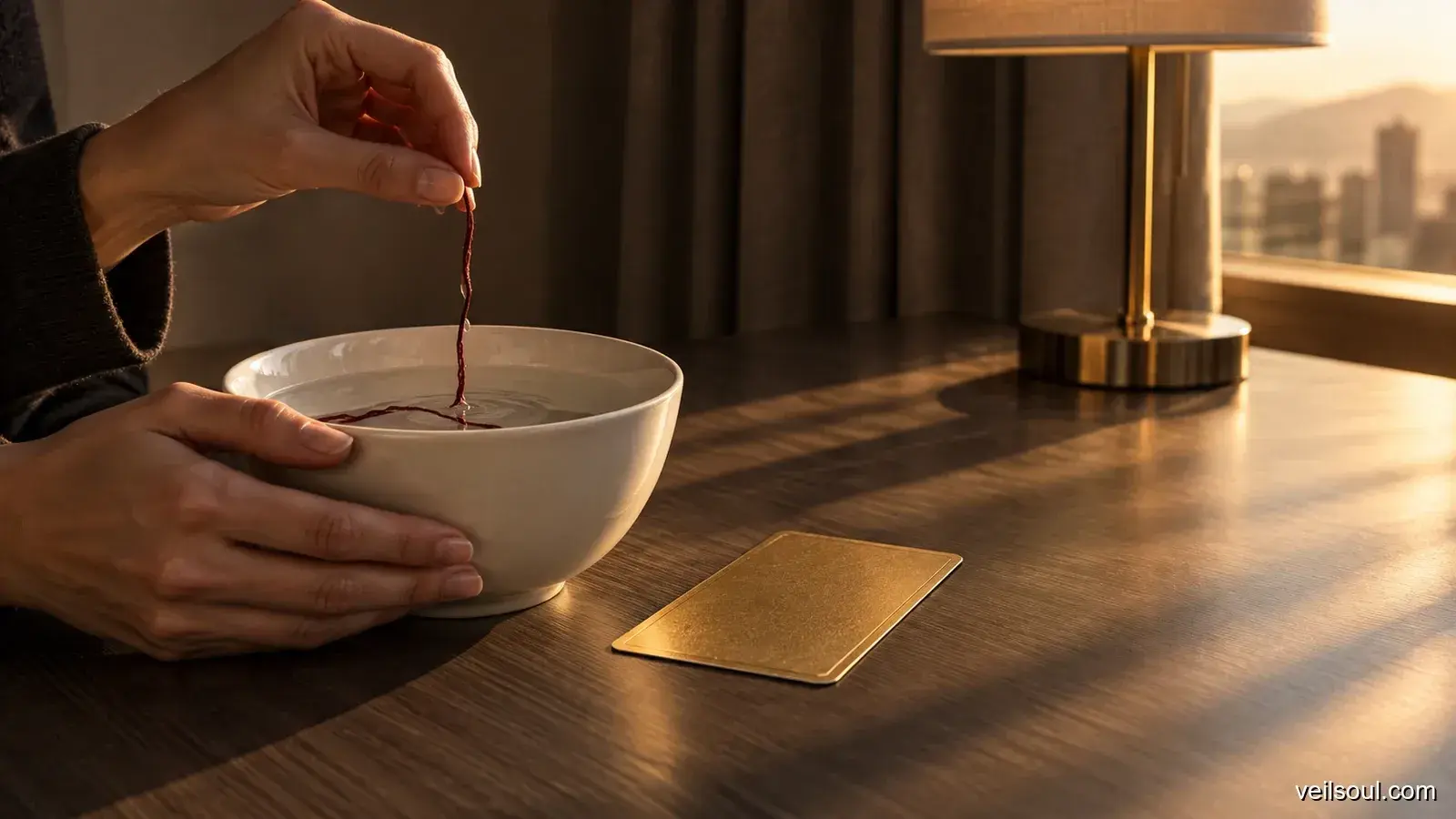
Self-doubt has a short list of cards that answer it well: The Magician, Strength, the Six of Wands, The Star, The Sun and the Nine of Pentacles. Used for self-doubt, a tarot reading is a way to lay out what the critical voice is actually claiming and set that claim beside what you already know about yourself.
One limit is worth saying once, plainly: no card confirms your competence, predicts whether you will be chosen, or reports what a manager or a partner privately thinks. If the critical voice runs constantly, or it is shaping your sleep and your ordinary week, a doctor or a licensed therapist can help in ways a deck cannot, and a reading practice sits comfortably alongside that support.
At a glance, these are the six cards readers reach for when confidence has thinned out:
- The Magician: the skills and resources already in your hands.
- Strength: courage that is patient rather than loud.
- Six of Wands: recognition you are allowed to accept.
- The Star: a sense of value that does not move with your output.
- The Sun: a day you can walk through without bracing.
- Nine of Pentacles: visible proof of what your own effort built.
Doubt, modesty and the inner critic are three different voices
Not every hesitation needs fixing. Someone who says “I have never done this before” is reporting a fact, and that kind of accuracy keeps people learning and asking for help. Modesty is a social habit: you play the work down so the room stays comfortable. The inner critic does something different from either. It takes one piece of evidence, usually an old one, and turns it into a verdict about the kind of person you are.
You can hear the difference in the grammar. Honest uncertainty uses verbs and time frames: I have not learned this part yet, I need two more weeks, I would want help with the budget. The critic uses the verb to be and no time at all: I am not the sort of person who leads things. A reading helps mostly because it moves that sentence out of your head and onto a table, where you can describe it out loud instead of standing inside it.
So the question you write down before shuffling decides what you get back. “Am I good enough for this?” cannot be answered by a picture. These can: what am I most afraid will be seen, which evidence do I refuse to count, and what is the smallest honest step available this week. Keep the question in front of you while you read.
Six cards that answer self-doubt
Each of these six meets a different claim the critic likes to make, which is why a confidence reading rarely needs many cards. Read them as descriptions of what is already true and available to you, not as promises about how an audience will react.
The Magician: the toolkit you keep forgetting
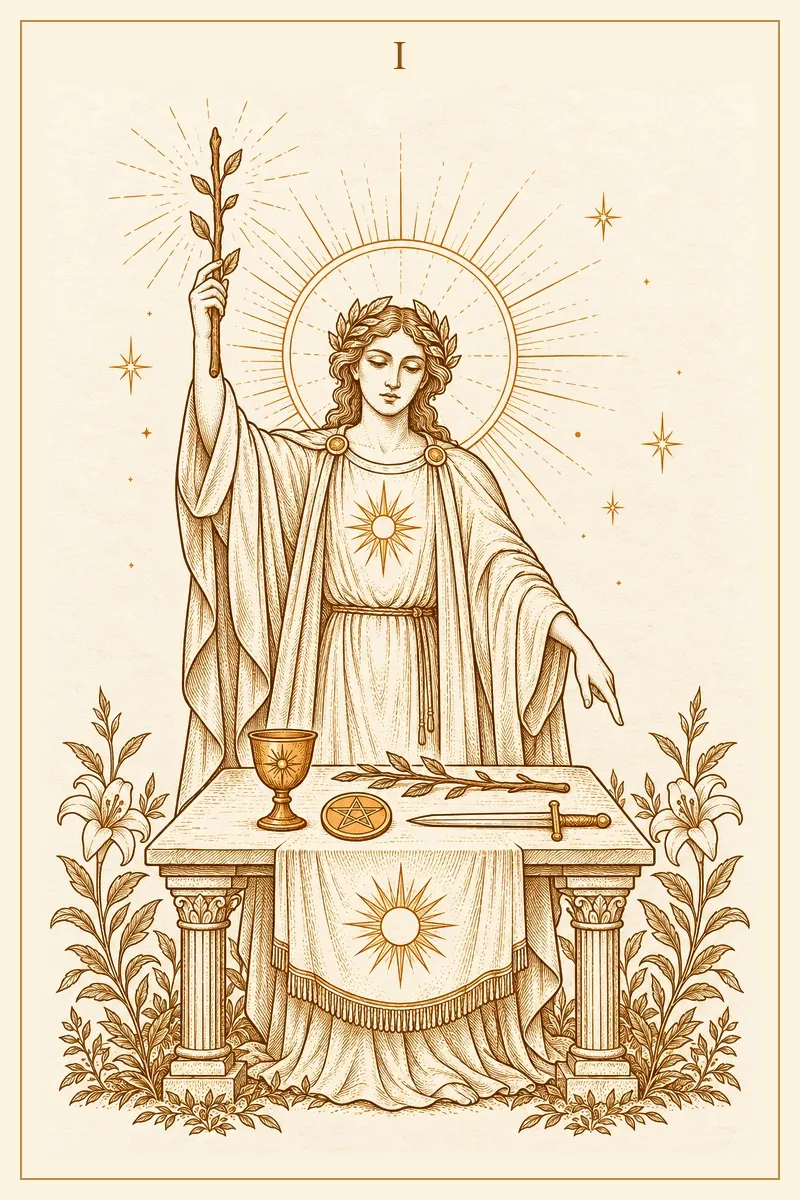
The Magician stands at a table with a cup, a wand, a sword and a pentacle laid out in front of him, one hand raised and one pointing down. Against self-doubt this works as an inventory card. Most people discount the skills that came easily to them, and it asks you to write the whole list down anyway: training, years served, tools you can use, repairs you made, people you have calmed down in a crisis. The list is almost always longer than the feeling suggested.
Reversed, the tools are still on the table and you cannot seem to reach them. That looks like preparation that never becomes a first move, a draft rewritten instead of sent, or a skill you discount because a colleague has more of it. It rarely means the ability is missing; more often it marks hesitation, or energy spent on persuading yourself rather than starting. The full Magician tarot meaning covers the card outside a confidence question.
In a work reading it often separates two things that have blurred together: what the job actually asks for, and the extra requirements you quietly added to it.
Strength: courage with a quiet voice
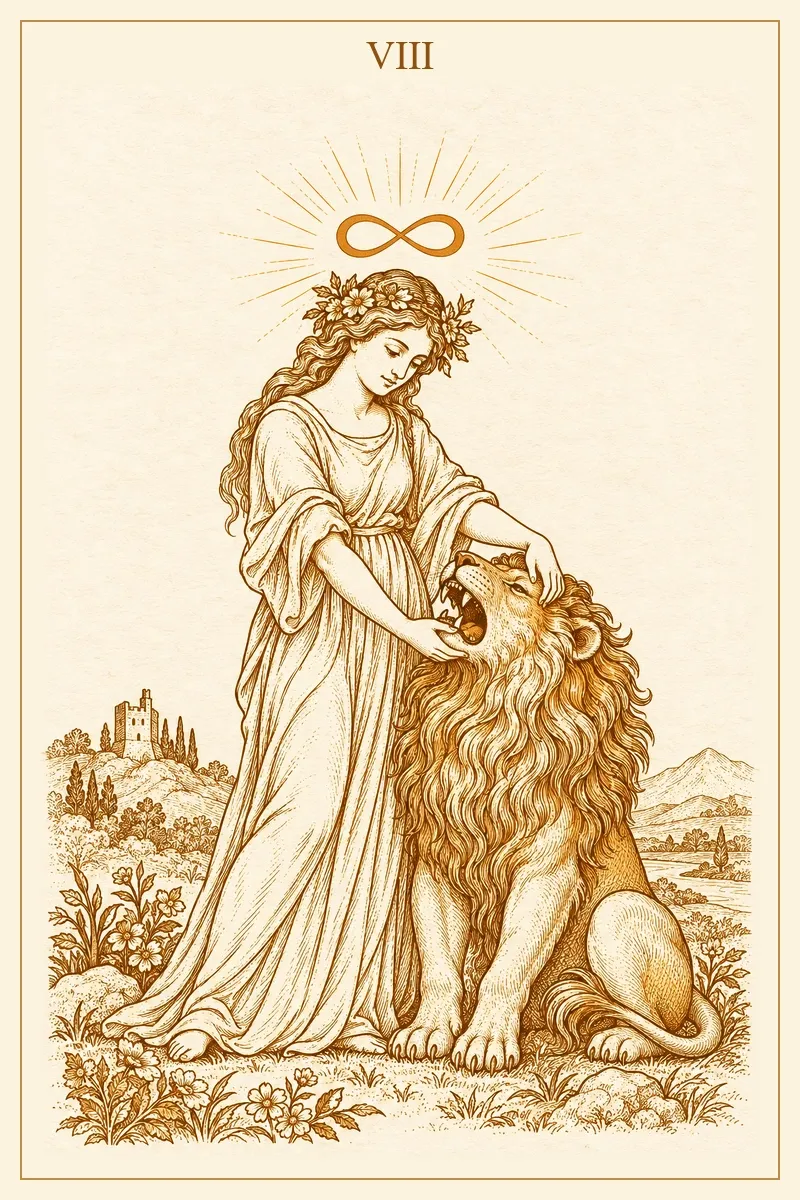
Strength shows a figure closing her hands gently around a lion's jaws, with no struggle anywhere in the picture. For self-doubt it corrects one specific lie: that a confident version of you would be louder, faster and more certain. Patience and the willingness to stay in a hard conversation are power of a kind the room does not always applaud, and the card treats them as the real thing rather than a consolation prize.
Reversed, that same force tends to turn around on you. It can describe pushing through exhaustion, treating one wobble as proof of weakness, or managing everyone else's feelings until there is nothing left over for your own. A useful question with this reversal is what would change if you spoke to yourself the way you speak to somebody you are teaching. The Strength tarot meaning has more on its upright and reversed range.
In a love reading, Strength often concerns staying present while a partner is upset without reading their mood as a judgment on your worth.
Six of Wands: letting recognition land
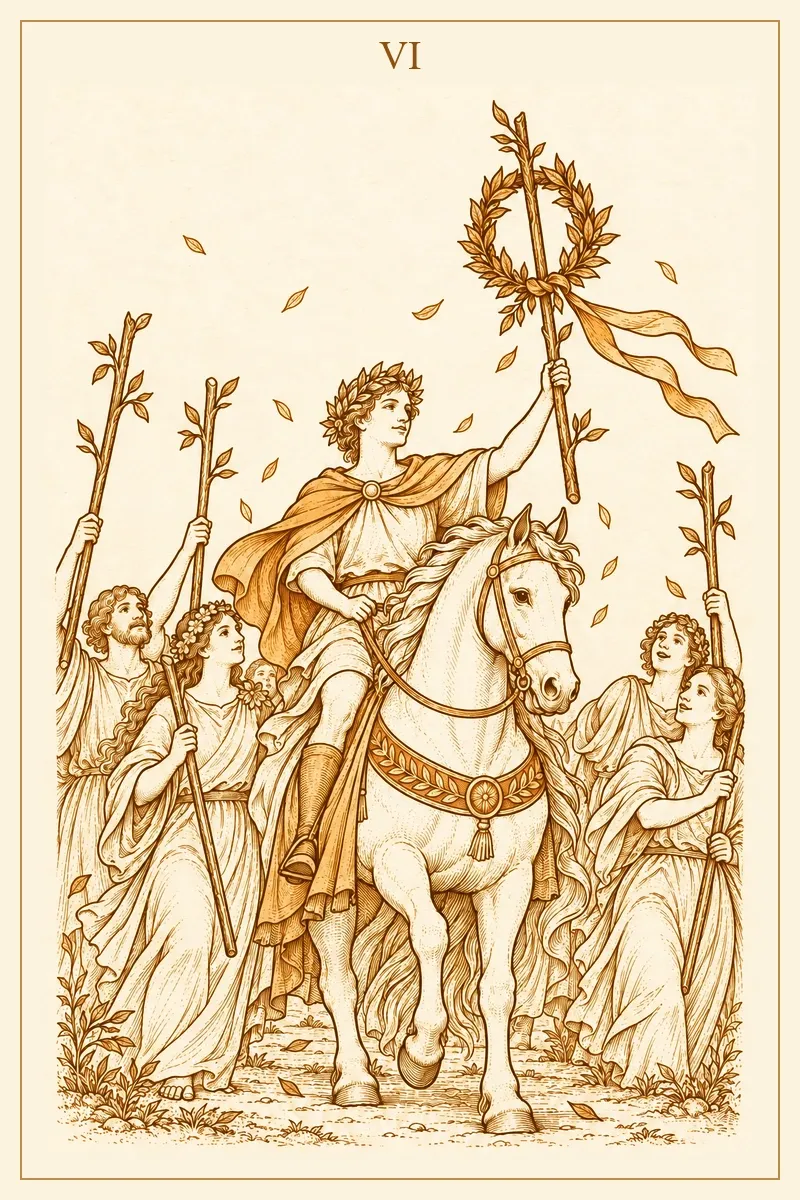
A rider comes back through a crowd with a wreath on the staff, and people walk alongside. The part that matters for self-doubt is not the victory but whether you can receive it. A loud inner critic collects praise and immediately refiles it: lucky timing, an easy brief, somebody being kind. Upright, this card asks you to let one piece of it stay where it was put.
Reversed, it can describe recognition that never came, or recognition that arrived and did not land: good work nobody mentioned, or applause that felt like it was for a performance rather than for you. It can also mark confidence rented from other people's reactions. For the card's full range, see the Six of Wands tarot meaning.
A small practice goes with it. The next time somebody thanks you, answer with thank you and nothing else: no correction, no list of what was still wrong with it.
The Star: a sense of value that does not move
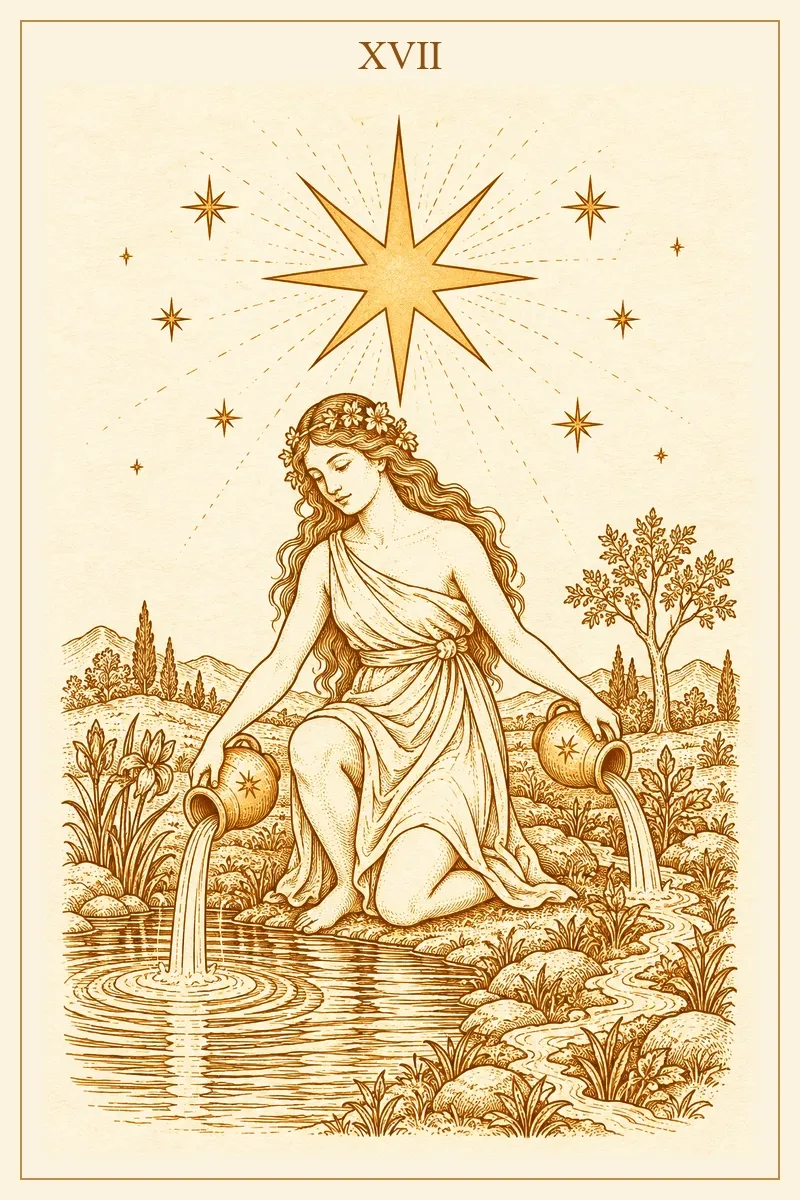
The Star pours water into a pool and onto the ground, unhurried, with the worst of the night already behind it. In a self-doubt reading it speaks to the belief that your value is a score recalculated each week from what you produced. Upright, it describes worth that stays level while you rest, between projects, or while you are visibly bad at something new, which is the only condition under which anybody learns.
Reversed, the light is harder to find. That often shows up as comparison, a run of rejections, or a sense that other people were handed something you were not. More often than not it points to depletion rather than to a verdict about you, and the first answer is rest rather than effort. The Star tarot meaning looks at the card beyond this one context.
In a money or career reading, it usually asks you to keep a thin month and a conclusion about your character in separate columns.
The Sun: the day you stop bracing

A child rides a horse past a garden wall, sunflowers above it, nothing hidden and nothing to decode. In a confidence reading The Sun describes visibility that does not hurt: being seen clearly, and discovering that nothing bad happened afterward. It is the opposite of the exhausting strategy where you stay slightly out of frame so that nobody can evaluate you properly.
Reversed, the light is still there but something sits in front of it: a good day you could not feel, an achievement you explained away within the hour, or a stretch where everything is fine on paper and flat in practice. The card does not say the warmth is gone; it asks what you are standing behind. You can read more in the Sun tarot meaning.
The practical version is almost too simple: choose one thing this week that you do purely because you enjoy it.
Nine of Pentacles: the garden you planted
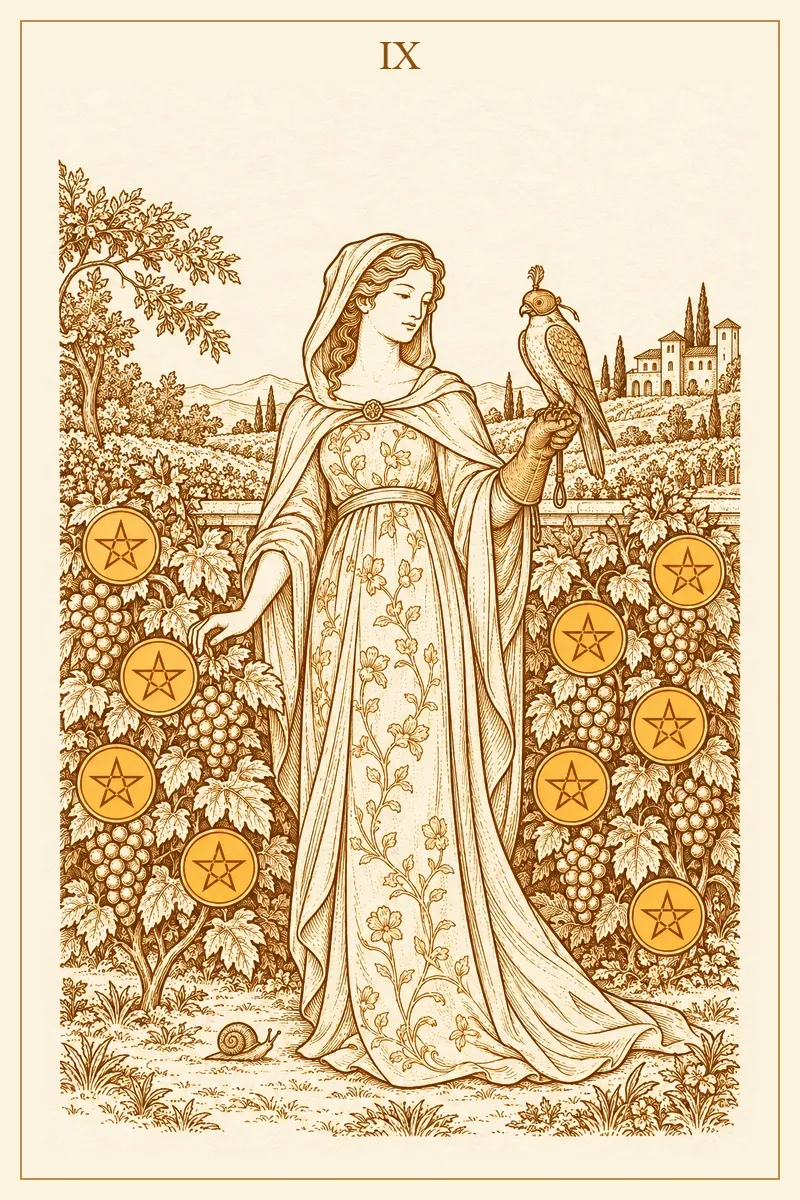
A figure stands in a walled garden with a falcon on the glove and the vines heavy around her. This is the card that meets the fraud feeling head on, because a garden is grown rather than given. Upright, it asks you to reconnect what you have with the hours that paid for it: the early mornings, the unglamorous years, the things you learned by getting them wrong first.
Reversed, the comfort can feel borrowed, or it came at a price you have not named out loud: a position you kept by never asking for help, or security built by never stopping. The reversal is not a demotion; it asks what the garden cost and whether the terms still suit you. The Nine of Pentacles tarot meaning covers its independence and self-made themes in more depth.
One exercise fits this card well: name three things in your life that you built, and say plainly what each one took.
Cards that describe the doubt itself
A confidence reading often includes cards that name the shape of the doubt rather than the answer to it. They are not bad news, and they are not confirmation either. Naming the thing accurately is most of the work.
- Feeling like a fraud: Seven of Swords and a reversed Nine of Pentacles, for the certainty that you slipped in through a side door and will eventually be found out.
- Comparison: Five of Pentacles and Four of Cups, for standing outside a lit window, or missing the cup being offered because it is not the one you wanted.
- Decisions you cannot make: Two of Swords and Seven of Cups, for a choice held at arm's length because every option looks like a possible mistake.
- Perfectionism: a reversed Eight of Pentacles and the Nine of Wands, for refinement with no finish line, and guard duty long after the threat has gone.
- A sense of not being enough: Five of Cups, a reversed Empress and The Moon, for attention fixed on what spilled, care that never gets turned inward, and fear that fills in whatever the dark leaves blank.
The Eight of Swords deserves its own mention, because it describes the mechanism rather than the mood: a bound, blindfolded figure standing in shallow water with blades planted on either side of her and the way ahead left open. The restriction is real and self-made at once, which is exactly how an inner critic operates. The Eight of Swords tarot meaning goes further into those self-imposed limits.
When one of these appears, resist reading it as agreement. A card that describes the doubt is reporting the weather in the room, not delivering a judgment on your ability.
When a confident card arrives reversed
Reversals often cause unnecessary alarm in confidence readings. A useful default: read a reversal as the same quality turned inward, delayed, or not reachable right now, rather than as its opposite or as a mark against you. A reversed Sun is not a dark card. It is daylight with something standing in front of it.
Before you decide what a reversal means, say the upright meaning out loud, then describe what blocking it would look like in your actual week. A reversed Magician in a week of unsent drafts is specific and workable; “reversed, so this is bad” is neither. And if you do not use reversals at all, the same information still reaches you through the neighboring cards and the position you drew into.
Pairs that show where the doubt started
Two cards side by side often say more about where a doubt began than five cards read separately. These combinations come up often when the subject is confidence:
- The Moon with the Five of Cups: an old disappointment is still tinting how you read new chances, and the fear is older than the situation in front of you.
- A reversed Magician with the Eight of Swords: the capability is there, sitting alongside a story that you are not allowed to use it yet.
- Six of Wands with the Seven of Swords: a success you cannot bring yourself to claim, which is imposter syndrome in its clearest two-card form.
- Nine of Wands with the Eight of Pentacles: a skill practiced far past the point of proof, with nobody appointed to tell you when it is enough.
If the pairs keep pointing backwards, to a parent's phrasing, a school report or an early manager, a slow practice suits that better than one spread does. Working through shadow work with tarot over several weeks gives those older sentences more room than a single reading can.
The True Mirror spread, five positions
This layout separates the claim from the evidence. Before you shuffle, notice the doubt without arguing with it, and name the one situation you are asking about: a decision, a piece of work, a conversation. A vague question returns a vague mirror.
- What the critic is saying today. The claim itself, written as one sentence you would recognize in your own voice.
- What the claim leaves out. The evidence the doubt skips over: a strength, a track record, a piece of context.
- Where you first learned the sentence. The older source, which is rarely the situation in front of you.
- What you would do without it. The action waiting behind the doubt, often smaller and more ordinary than you expect.
- The smallest honest step. One thing you can do this week with the doubt still talking, rather than after it goes quiet.
Write a keyword and your own sentence beside each card, and spend the longest with the second position, since that is the one the critic will try to hurry you past. Reading for yourself is harder than reading for someone else mainly because you already have a preferred answer; the guide to reading tarot for yourself covers ways to stay honest about that.
Notice which card surprises you. The surprise usually sits in position two or four, where the familiar story has the least to say.
Worked example: asked to run a workshop
Nobody in the example below is a real person; the draw is put together to show how the five positions work. Picture someone who had been asked to run a two-hour session for her team and spent a week drafting a polite refusal. She did not ask whether it would go well. She asked what the refusal was protecting, and drew five cards into the positions above.
Position one gave her the Eight of Swords: they will find out I am not really an expert. Position two gave the Nine of Pentacles, and she sat with it a while before admitting what it pointed at: six years in this specialty, and two colleagues who already come to her desk for exactly the help the session would cover. Position three brought the Five of Cups and a specific memory, a presentation years earlier that went badly and had quietly become the reference point for everything public she has done since.
Position four was The Sun, simpler than she wanted it to be: without the sentence from position one she would say yes, run the session in her own plain style, and probably enjoy it. Position five gave the Eight of Pentacles upright, and the smallest honest step became obvious once named: build one twenty-minute section this week and walk a colleague through it, rather than deciding the whole question at once.
She sent the acceptance that evening and the draft section four days later. The reading did not promise her a good workshop. What it did was show her which sentence she had been obeying, and how old that sentence was.
Journal prompts when the critic is loud
The critical voice is loudest while it stays unwritten, because nothing on paper gets to stay that vague. These prompts work beside a card, or on their own on a day you do not feel like shuffling:
- My critic's most repeated line is “_______”. If I had to defend that in front of someone fair, the evidence would be _______.
- A friend describing my three strengths would say _______. What makes those words so hard to say in my own voice?
- The last time I was sure I would fail at something and turned out to be wrong was _______. What did that teach me that I have not applied since?
- The person I compare myself to most is _______. What am I actually hoping to get from the comparison?
- If this decision could not damage my reputation, I would _______ before the month ends.
- A letter to me from the version of me who has already lived through this doubt: _______.
If these keep opening onto larger questions about direction and identity rather than one situation, a longer tarot practice for self-discovery gives them more room than a confidence spread does.
Small ways to rebuild self-trust
Self-doubt is a habit of attention, and habits change through repetition rather than insight. Four practices do most of the work between readings:
- Keep a plain evidence file. Finished work, messages that thanked you, problems you solved. Read it on a bad day. It helps because it is specific, not because it is flattering.
- Take one visible risk a week. Ask the question in the meeting, send the draft a day earlier than is comfortable, say the fee you actually want. Confidence tends to follow the action rather than arrive before it.
- Cut your comparison intake. Edited highlights are not a fair opponent for an unedited Tuesday, and self-trust will not grow while that scoreboard runs all day.
- Correct the sentence rather than inflating it. “I have no idea what I am doing” becomes “I am learning this part”. That is not positive thinking; it is a more accurate description, which is why it holds up.
A single card each morning with one question, such as what did I handle well yesterday, builds the habit faster than one long reading a month, and building confidence with tarot has more on keeping a daily pull from turning into a verdict.
Set a limit on re-asking, too. Drawing a fourth time because the first three answers were not reassuring enough turns reflection into a checking loop, and the loop feeds the voice you are trying to quiet.
Frequently asked questions
Which tarot card means self-doubt?
No single card owns it. The Eight of Swords comes closest, because it shows restriction that is partly self-made, while the Two of Swords describes the paralysis and the Seven of Swords the sense of having fooled everyone. Reversed Majors such as The Magician, The Sun or Strength often carry self-doubt in a spread as well. Which one applies depends on your question and the position it fell into.
Which tarot cards are best for confidence?
The Magician, Strength, the Six of Wands, The Star, The Sun and the Nine of Pentacles cover most of the ground, each from a different angle: resources, steadiness, recognition, worth that holds while you rest, visibility and earned results. Pulling one of them does not install confidence. It gives you something specific to look at and, usually, something to do before the week ends.
Can tarot tell me whether I am good enough for this job?
It cannot. A reading cannot measure your competence, predict a hiring decision, or report what an interviewer thought after you left the room. It can help you describe what you bring, notice which requirement you invented, and decide what to ask about. For an assessment of your work, ask someone qualified to give one.
What if every card seems to confirm my doubt?
Usually the question did that work. “Why am I not good enough?” assumes its own answer, and the cards get read in that light whatever they show. Rewrite the question so it is answerable, pick one specific situation, and read each card in its position rather than as a collective verdict.
Does a reversed confidence card mean my confidence is gone?
No. A reversal more often marks a quality that is blocked, turned inward or out of reach this week. A reversed Six of Wands can simply mean nobody noticed a good piece of work, which is a fact about the office rather than about you.
Can a reading replace talking to someone about this?
No, and it is not meant to. Tarot is a reflective practice with no way of diagnosing anything or treating it. If the critical voice is relentless and it is affecting your sleep, your appetite or your relationships, a therapist or counselor can work with it in ways a deck cannot, and the cards can help you put words to what you want to bring into that room.
Steadier rather than louder
Confidence is not the absence of doubt. It is the willingness to move while the doubt is still talking, and that willingness grows out of evidence and repetition rather than out of a single good card.
If you want ten quiet minutes with the sentence you have been obeying, try a reading and write one line for each card you draw. Then choose the smallest step on the page, because that is the part that changes anything.