Loneliness is a signal more than a verdict, and tarot for loneliness works best as a quiet companion while you listen to it. The cards can help you name what kind of lonely you feel, notice the connection already within reach, and choose one small step back toward people. Five cards speak to this most directly: The Hermit holds a lantern for solitude, The Empress turns care inward, the Ace of Cups reopens the heart, the Three of Cups points toward friendship, and The Star is the light you meet on a lonely road.
What a reading cannot do matters just as much. No spread can make someone call, reveal what another person really thinks of you, or set a date when the lonely stretch will end. It can slow you down long enough to see your situation with more kindness, and that is a better place to choose a next step from.
You can be surrounded by people and still feel unseen. Loneliness is about the quality of being known, not the number of people nearby, and it says nothing about your worth. It hurts because belonging matters to you.
Here is the deck at a glance for lonely moments:
- The Hermit: solitude that teaches, with a lantern for the next step only.
- The Empress: warmth you can begin by offering yourself.
- Ace of Cups: a heart ready to give and receive again.
- Three of Cups: friendship and community within reach.
- The Star: hope that keeps you company in the dark.
- Four of Cups: an offer you may not be seeing yet.
- Eight of Cups: walking away from what no longer fits, and walking alone for a while.
- Five of Cups: grief or regret that keeps your eyes on what was lost.
- Nine of Pentacles: independence that can quietly turn into isolation.
- Four of Swords: rest and recovery before reaching out.
- The Lovers reversed: distance inside a close relationship.
- The Moon: feeling cut off from yourself as much as from others.
Five shapes loneliness can take
Before choosing cards, it helps to know which loneliness you are carrying, because each one asks for something different. The ache of an empty apartment is not the same as feeling invisible at a crowded dinner, and you may recognize more than one shape.
- Physical isolation: The Hermit reversed, the Four of Cups and the Eight of Cups. You are apart from community, by choice or by circumstance. The need is contact, even in small doses.
- Emotional loneliness: The Lovers reversed, the Three of Swords and the Five of Cups. People are around, but no one feels close enough to hear the real story. The need is depth rather than more company.
- Loneliness after loss: the Five of Cups, the Six of Swords and the Ten of Cups reversed. Someone or something that filled a space is gone, and the quiet keeps pointing at the gap. If this is your shape, the companion piece on tarot for grief and loss walks more slowly through that territory.
- Creative or spiritual loneliness: The Hermit, The High Priestess reversed and the Seven of Cups. Your inner world feels too intense or too unusual to share. The need is a few people who speak your language, and permission to keep exploring.
- Disconnection from yourself: The Moon, The Star reversed and the Four of Cups. You feel far from your own purpose, not only from other people. The need is to come home to what you value before anything else.
Name your shape in one sentence before you shuffle. "I feel lonely at work since the team went remote" leads to a different reading than "I miss my sister."
Five cards for a lonely season
These five cards carry most of the comfort in a loneliness reading. Each section describes the card as it is drawn, how to read it upright and reversed, and a question for your journal.
The Hermit: solitude with a lantern
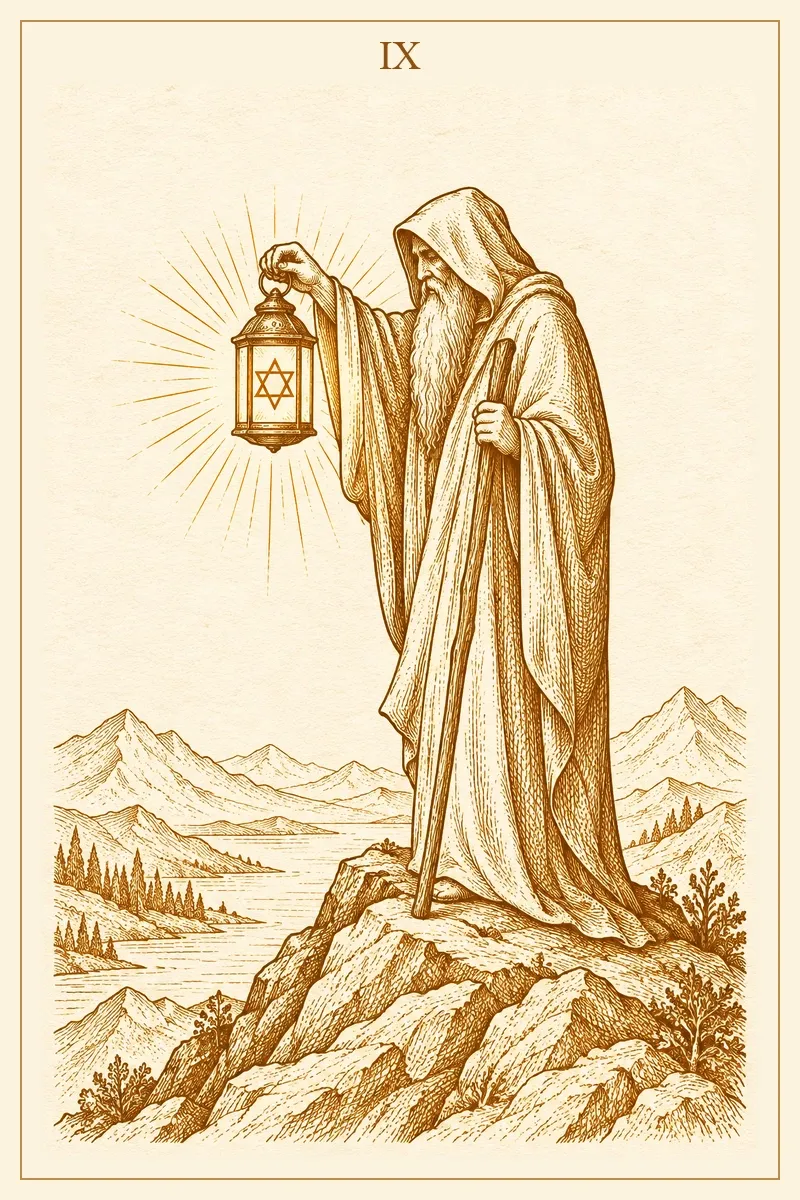
A hooded old man stands on a rocky crag above a lake and a range of distant mountains, raising a lantern with a six-pointed star inside it and leaning on a long staff. He is alone, but he is not lost. The lantern lights only the ground directly ahead, which is the card's quiet point: you do not have to see the whole path out of a lonely season, only the next step.
Upright, The Hermit suggests that this solitude has something to teach. Time away from other people can show you what you enjoy, what drains you, and which relationships you keep out of habit. If your loneliness was not chosen, the card does not pretend it feels good; it asks a gentler question: while you are here, what can you learn about yourself that a crowd would never show you? The fuller Hermit tarot meaning covers its other contexts, and the guide to tarot for self-discovery has more ways to use quiet time like this.
Reversed, The Hermit can describe withdrawal that has gone on past the point of being useful. Perhaps rest became hiding, or "I need some space" became a habit of declining every invitation. In a love question, it may ask whether you are pulling away from someone who is still reaching for you. Either way, the card asks you to make the choice consciously again.
Journal question: Is this solitude a tunnel I am moving through, or a room I have stopped trying to leave?
The Empress: warmth that starts at home
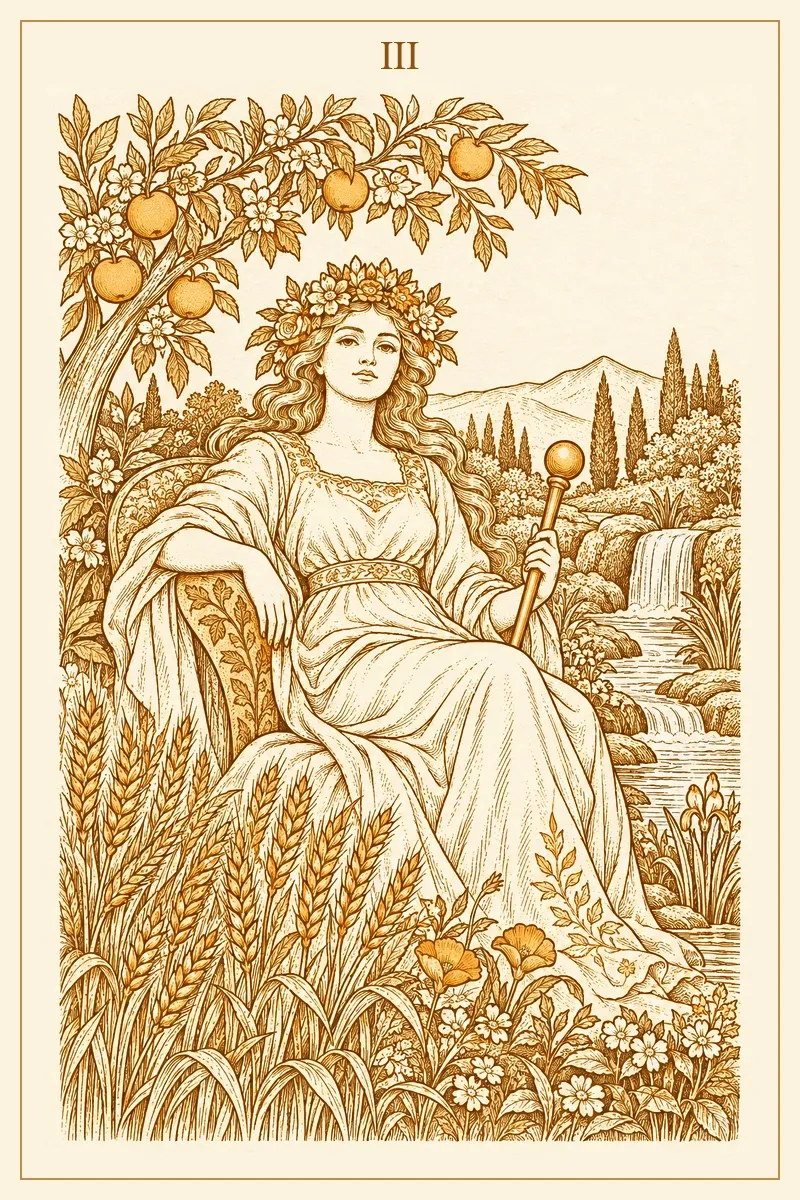
The Empress sits on a cushioned chair beneath a blossoming tree heavy with golden fruit, wearing a crown of flowers and holding a scepter topped with a golden orb. Ripe wheat rises around her feet, poppies bloom beside her, and a waterfall runs into a stream behind her. Everything in the scene is growing and being fed.
In a loneliness reading, The Empress does not dismiss the ache. She reminds you that the capacity for warmth lives inside you, and that some of the care you hope to receive can begin with how you treat yourself today. That might mean cooking a proper meal instead of eating standing up, taking a walk somewhere green, or speaking to yourself the way you would speak to a struggling friend. These are not substitutes for people; they keep you well enough to reach out. Her broader symbolism is covered in the full Empress tarot meaning.
Reversed, The Empress can point to care that only flows outward: you look after everyone, and no one asks how you are. If loneliness has shaken your confidence and you feel you have little to offer, the guide to tarot for self-doubt pairs well with this card.
Journal question: What would I do for myself this week if I treated myself as someone worth caring for?
Ace of Cups: a heart that can open again
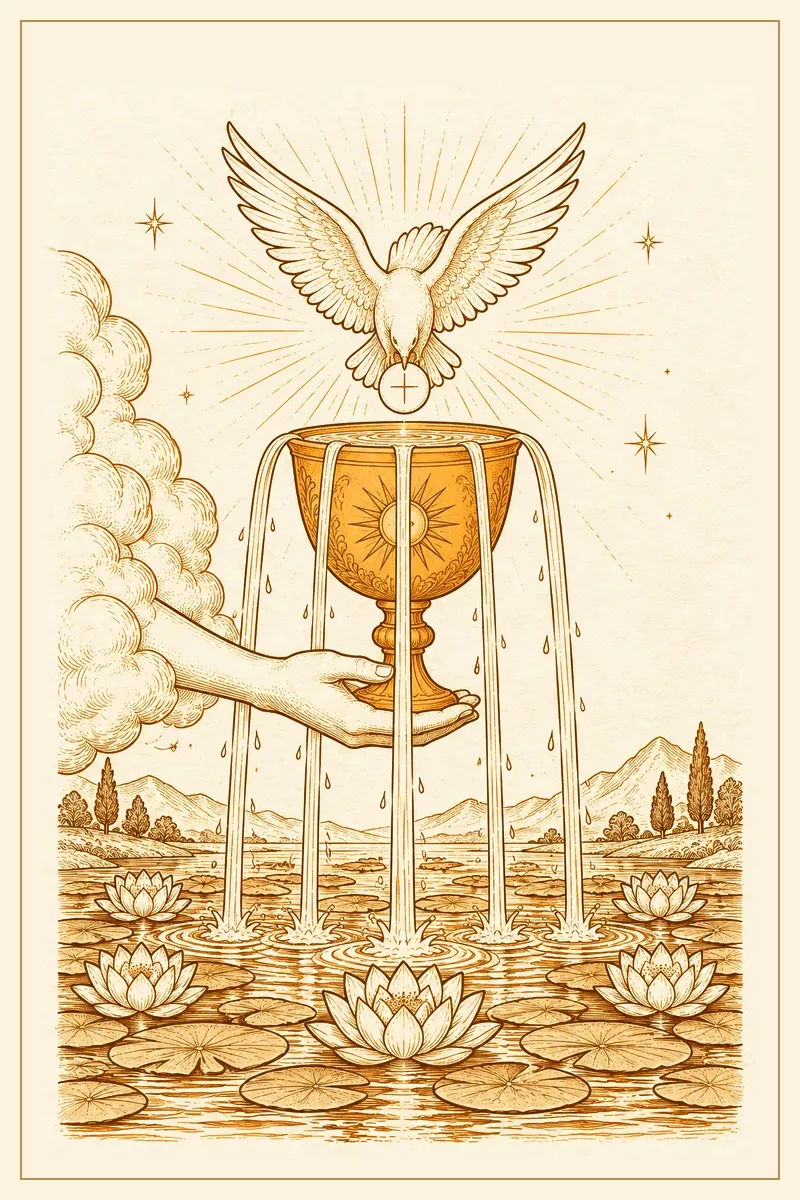
A hand reaches out of a cloud holding a large golden cup. Above it a dove descends with a small disc marked with a cross, and streams of water spill over the rim into a pond of lotus flowers. It is an image of feeling that has somewhere to go.
Upright, the Ace of Cups says that love and emotional richness have not gone missing from you. Loneliness can build walls that keep connection out even when someone offers it. This card asks whether you are letting warmth in when it arrives: a friendly message you leave unanswered, a compliment you brush away, an invitation you assume was only polite. Its upright and reversed meanings are explored further in the Ace of Cups tarot card meaning.
Reversed, the Ace can describe a heart that has closed for protection after disappointment. That is understandable, and the card is not a scolding. It suggests opening a little at a time, with people who have shown they are safe, rather than waiting for a perfect moment to trust everyone at once.
Journal question: Where has warmth been offered to me lately, and what did I do with it?
Three of Cups: friendship within reach
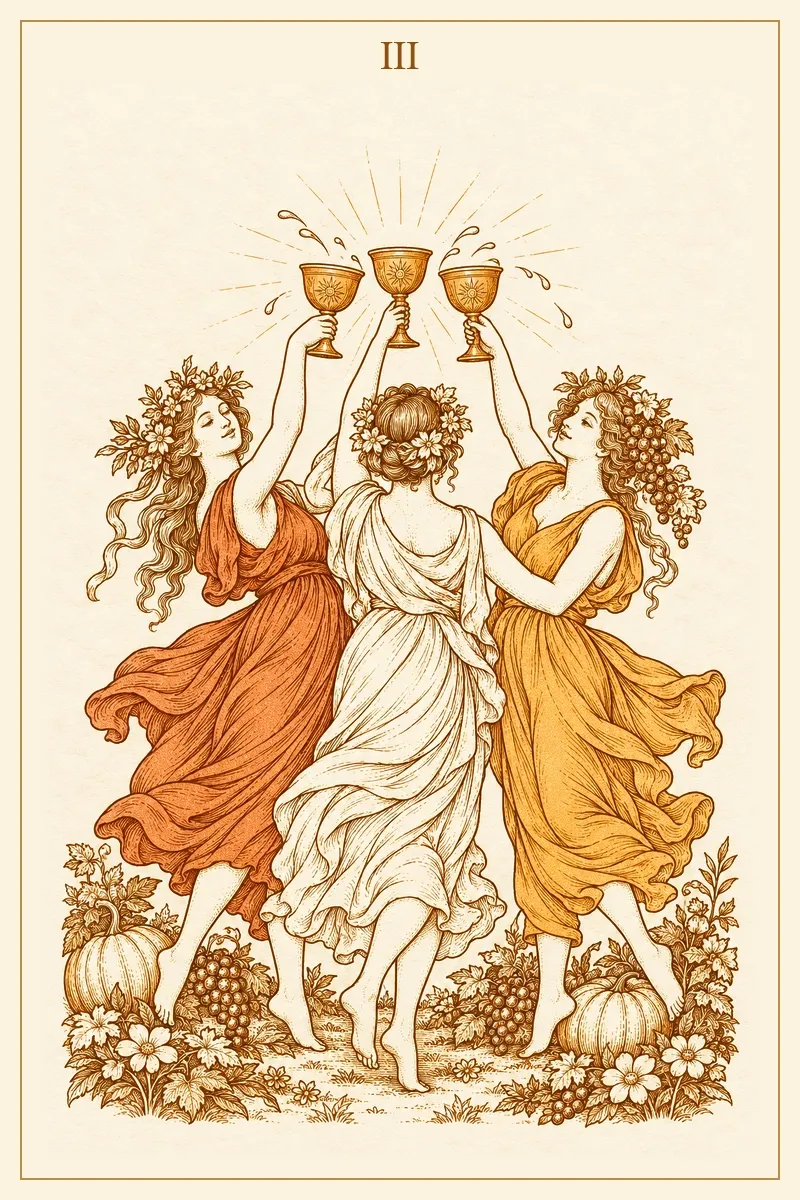
Three women in flowing red, white and golden dresses dance in a circle, raising their cups so they nearly touch overhead. Pumpkins and bunches of grapes lie at their feet, and flowers crown their hair. The scene is a celebration among equals: no one is performing, and everyone belongs.
Upright, the Three of Cups is a hopeful card for anyone who feels alone, but it is better read as an invitation than a promise. It points toward community, shared joy and friendship, and it asks where you could place yourself to be found by those things. A class, a volunteer shift, a hobby group, or a message to someone you have been meaning to contact can all become the circle in this card, and it may turn out to be a deeper bond with a friend you have taken for granted. The Three of Cups meaning goes further into its friendship themes.
Reversed, it can describe a circle you have drifted out of, a friendship that has become one-sided, or the particular loneliness of watching others celebrate without you. It can also suggest that you are spread thin across many acquaintances and missing one or two closer bonds.
Journal question: Which group or person would I contact this week if I trusted that I would be welcome?
The Star: light on a lonely road
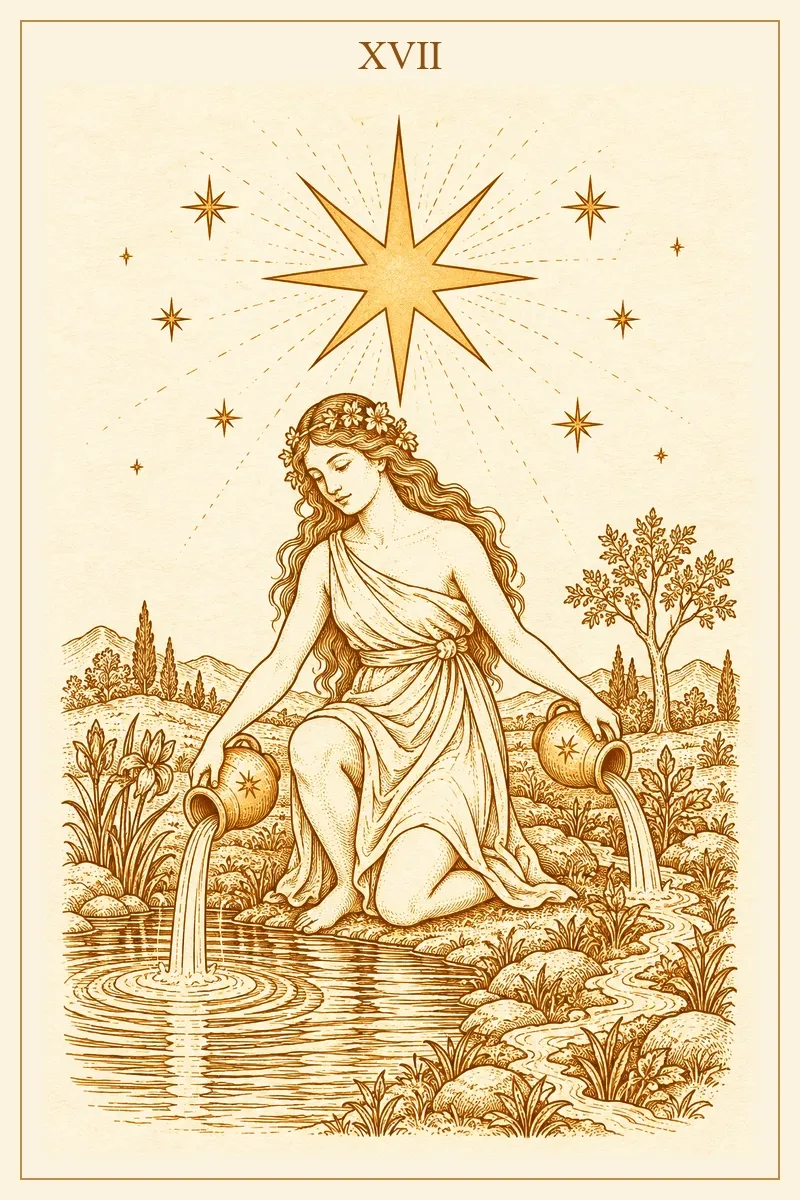
A young woman kneels at the edge of a still pool, a crown of flowers in her hair, pouring water from two jugs: one into the pool and one onto the bank, where it runs off as a stream. A single large eight-pointed star shines above her, ringed by a scatter of smaller ones, and a slender tree grows on the far side. She is alone in the scene, and nothing about it feels abandoned.
That is why The Star belongs in any reading about loneliness. It is the light you meet on a lonely road: not a crowd arriving, but a sign that hope can sit right beside the ache. You can feel alone tonight and still trust that you are worth being known. The Star does not ask you to deny loneliness; it asks you to hold it alongside a steadier sense of your own worth. Its wider symbolism, from healing to renewed faith, is in the full Star tarot meaning.
Reversed, The Star can describe a stretch where hope feels far away and you have stopped expecting anything to change. Here the card gives its quietest message: hope is something you can tend in small ways, like the woman pouring water, rather than something you must feel fully before you act. One kind act, one walk outside, or one message sent can be enough to start refilling the jug.
Journal question: What small light has kept me company in this lonely stretch, even if I barely noticed it?
Harder cards that may appear
Some cards in a loneliness reading are uncomfortable to see. They do not predict more isolation; they describe the habits or circumstances that keep connection at a distance, which is what makes them useful.
Four of Cups. A young man sits under a tree with his arms crossed and three cups on the grass, while a hand from a cloud offers him a fourth he has not noticed. The card asks whether something is being offered that you are too tired or too guarded to see. Reversed, it can mark the moment you finally look up.
Eight of Cups. A cloaked figure with a staff walks away from eight cups set in two rows toward the mountains under a crescent moon. This is the loneliness of leaving a city, a friend group or a relationship that no longer fits, and it feels lonely because it is honest.
Five of Cups. Grief and regret keep your attention on what was spilled. Be gentle with the sadness first; turning toward what remains can come later, at your own pace.
Nine of Pentacles. A woman in a hooded cloak stands in a vineyard of grapes and golden coins, a falcon on her gloved hand. She has built a good life on her own, and the card may ask whether that self-sufficiency has become a wall that no one is invited past.
Four of Swords. A figure rests on a stone tomb with hands folded beneath a stained-glass window, three swords on the wall above. If you are exhausted, rest comes first; reaching out will be easier once you are less depleted.
The Lovers reversed and The Moon. The first points to distance inside a close relationship; the second to fog, a loneliness that comes from not quite knowing your own mind. Both ask for honest conversation, first with yourself and then with someone you trust.
The Companion Within spread
This five-card spread is for evenings when the silence feels loud and other people seem very far away. It is a conversation with yourself, and it works best slowly.
Before you begin, get comfortable: a blanket, soft light, your phone on silent. Place a hand on your chest and say, "I am here, and I am paying attention." Shuffle slowly, then lay the cards in a row.
- The shape of my loneliness: what this loneliness actually looks like, whether it is the absence of a person, distance from community, or the feeling of being unseen.
- What I need most right now: not what you think you should need, but what would help in this moment: rest, contact, one honest conversation, a change of scene.
- Where connection already exists: a relationship, community or resource that is available now and easy to overlook.
- What I offer to others: the gift you bring to relationships. Remembering it can shift the story from "no one wants me" to "I have something real to give."
- A message from my wisest self: what the steadiest, kindest part of you would say to the lonely part.
Afterward, sit with what came up before acting on it. Write one sentence for each position in your own words, and circle the one that feels most true. You do not need to solve anything tonight.
A sample reading: eight months in a new city
Imagine someone who moved to a new city for a job eight months ago. Work is fine, the apartment is fine, and the evenings are very quiet. Their question is "What would help me feel less alone here?" They draw five cards in the Companion Within spread.
- The shape of my loneliness: Four of Cups. The figure under the tree, arms crossed, not seeing the cup being offered. This reader admits they have turned down two invitations from coworkers because they felt worn out and assumed the invitations were only polite.
- What I need most: Four of Swords. Rest first. The move took more energy than they acknowledged, and part of the withdrawal is plain exhaustion. Forcing a busy social calendar would backfire.
- Where connection already exists: Three of Cups. A coworker who hosts a monthly board-game night has asked twice. The circle is already there.
- What I offer: The Empress. Back home, this person was the one who cooked for friends. Hosting is a strength they have not used since the move.
- A message from my wisest self: The Star. Hope is not naive here. Small, steady acts of tending will fill the jug again.
Read together, the cards do not say that friends are about to appear. They describe a tired person declining real offers, and they suggest a gentle order: rest properly for a week, say yes to the next game night, then invite one coworker over for a simple meal.
Journal prompts for quiet evenings
Writing while lonely can feel like sending letters into a void, but the reader of those letters is you. Choose one or two prompts rather than all of them.
- I feel loneliest when ____. What about that moment makes the aloneness louder?
- The last time I felt truly connected to someone was ____. What made it different from an ordinary conversation?
- If I could design one perfect conversation right now, it would be about ____, with someone who ____.
- The things I am afraid to tell people, because they might make me seem ____, are ____.
- One small step I could take tomorrow toward connection is ____.
- A letter to my loneliness: what are you trying to tell me, and what do you need?
Small steps back toward people
Loneliness is both a feeling and a signal. The feeling deserves tenderness, and the signal deserves a response. These practices honor both:
- Small contact counts: a real conversation with a neighbor, a warm word at the bakery counter, or an honest text to an old friend are the building blocks of belonging.
- Be findable: if you have withdrawn, begin placing yourself where people gather around something you care about, in person or online.
- Deepen before you widen: sometimes the answer is not more people but closer ties with those already in your life. Who could you call today and tell the truth to?
- Befriend your own company: cook with care, take walks, keep a journal. That relationship lasts your whole life.
If loneliness has lasted for months, if you find yourself pulling away more and more, or if the ache feels unbearable, please reach out to a counselor, a doctor or a support line. You deserve to be heard, and there are people whose work is listening. Asking for that kind of help is a form of connection too.
Frequently asked questions
Which tarot card represents loneliness?
The Hermit is the card most closely tied to solitude, but loneliness has several shapes. The Four of Cups, Eight of Cups and Five of Cups describe isolation, leaving and grief, while The Lovers reversed points to distance inside a relationship. The question you ask and the card's position matter more than any single label.
Can tarot tell me when I will stop feeling lonely?
No. Tarot cannot give a date, confirm what another person feels about you, or guarantee that a friendship or relationship will arrive. It can help you understand what kind of loneliness you feel and which step is within your control, and that step is the part that changes things.
Is it a bad sign if The Hermit appears?
Not at all. The Hermit describes a season of inward attention, and upright it can be one of the most nourishing cards for someone who is alone. Reversed, it may suggest that withdrawal has gone on too long. Either way it asks for a conscious choice, not fear.
Can reading tarot alone make loneliness worse?
It can if the cards become a replacement for people, or if you draw again and again looking for reassurance. Keep readings short, end each one with a small real-world step, and notice whether you are reaching for the deck instead of a person you could contact.
What if the reading feels harsh or hopeless?
Pause before drawing more. Uncomfortable cards such as the Five of Cups or the Four of Cups describe what is happening now, not what must happen next. Write down one thing in the reading that feels true and one small action it suggests, then put the cards away for the night.
Can I read tarot about feeling lonely in a relationship?
Yes. Feeling alone beside a partner is a real and painful kind of loneliness. The Lovers reversed or the Ace of Cups can frame a conversation about what feels distant, but the conversation itself, with your partner, is where things change.
A lantern for the next step
The experience that makes you feel separate from the world is one that people everywhere have shared. Every card in the deck is a portrait of that shared life, and when you sit with the cards, you practice the thing you need from other people: attention without judgment.
If you would like a quiet place to start, try a reading with one of the questions above, then take its smallest step tomorrow. Connection can begin with something as small as one message.