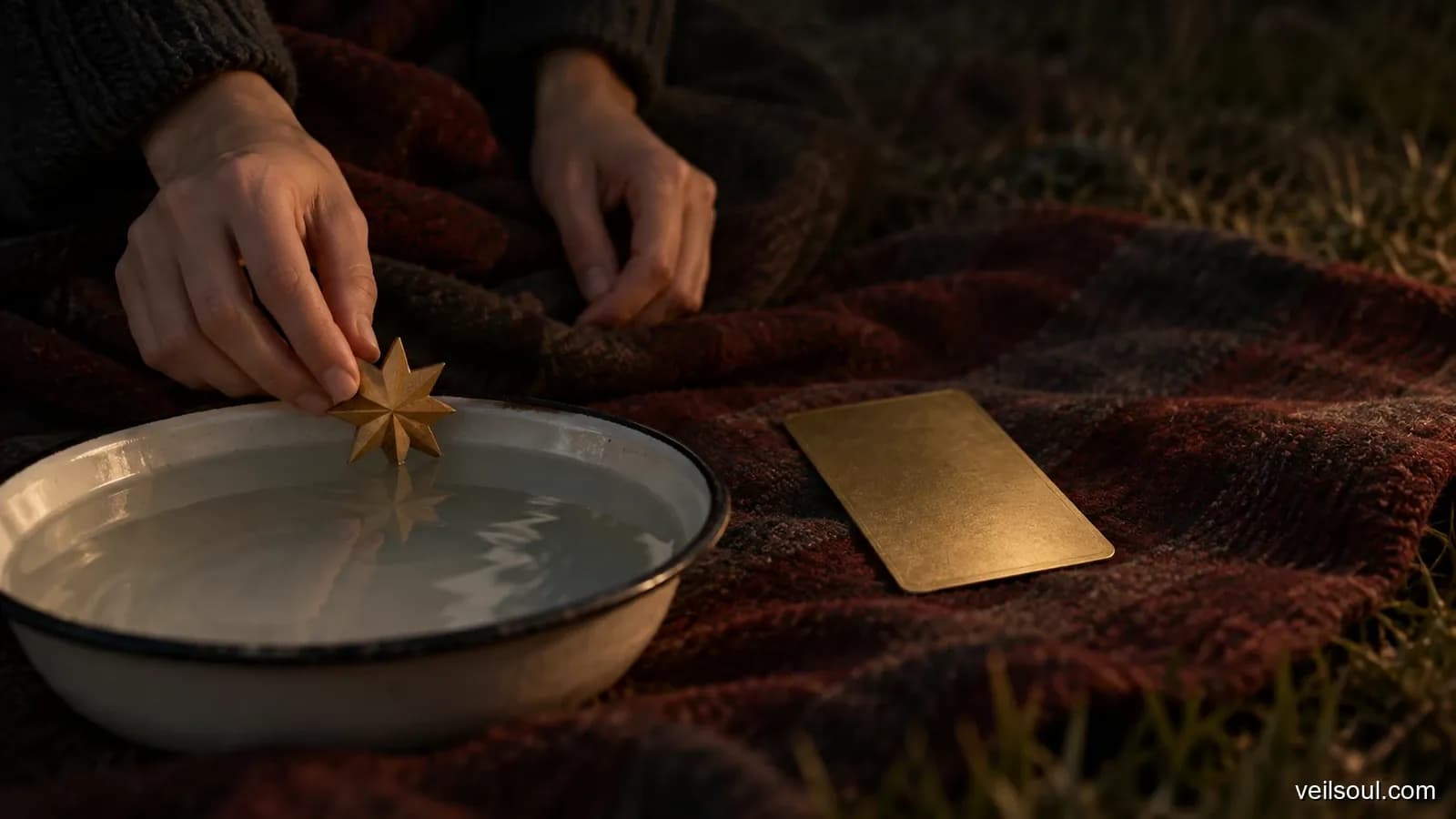
The Star tarot card means hope that has come through something hard: steady trust returning after a crisis, healing that unfolds gradually, and the relief of being yourself with nothing left to perform. Upright, it says recovery has started and that what you give will be replenished. Reversed, it describes hope you cannot feel yet rather than hope that is gone, and its timing is slow and gradual rather than sudden.
Like any card, The Star cannot promise a date, tell you what another person feels, or guarantee how a situation ends. What it can do is show you where hope is already returning and what keeps it flowing.
The card in brief:
- Upright: hope, healing, renewal, authenticity, inspiration, generosity that does not run dry.
- Reversed: discouragement, fatigue, giving from an empty pitcher, or hope pinned on rescue instead of action.
- Number: XVII, the card that follows The Tower.
- Astrology and element: Aquarius, a fixed air sign.
- Hebrew letter (Golden Dawn): Tzaddi, the fishhook.
- Yes or no: yes, gently, and usually not overnight.
- Timing: gradual, weeks and months of recovery rather than a single day of news.
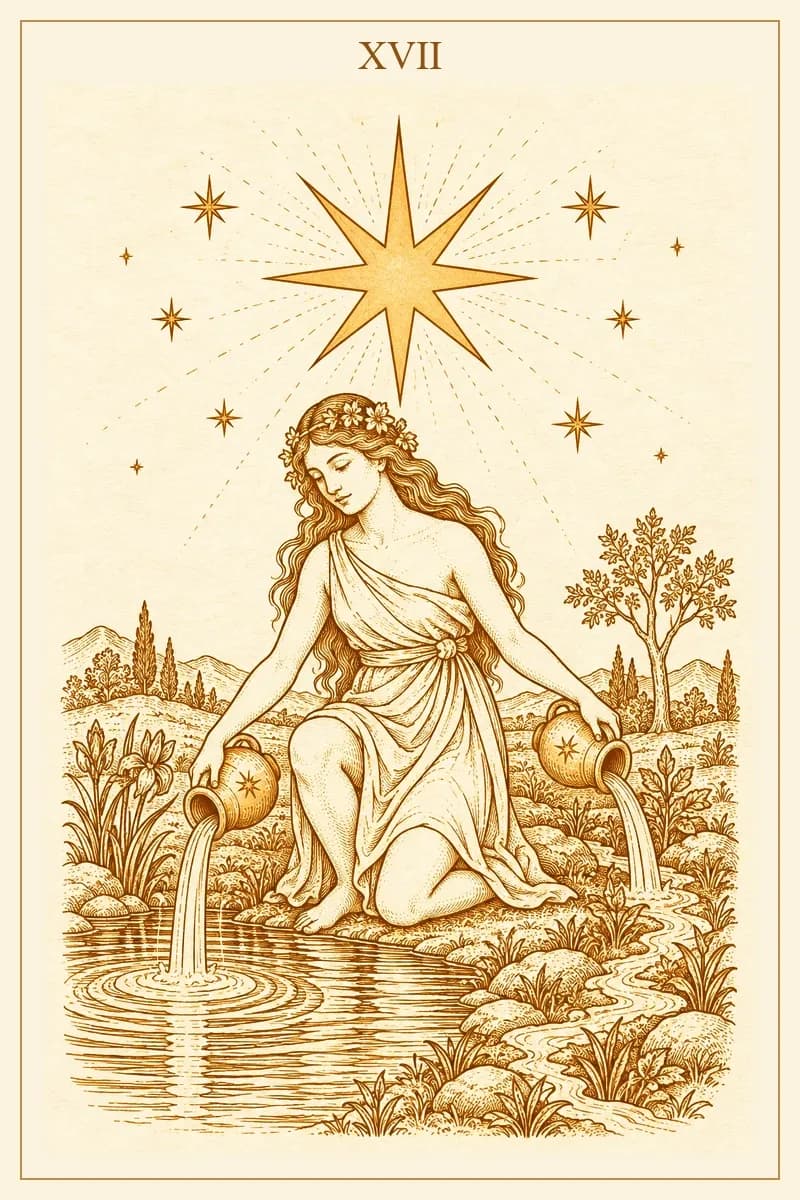
Two pitchers under one great star: the picture on card XVII
A woman kneeling at the water's edge
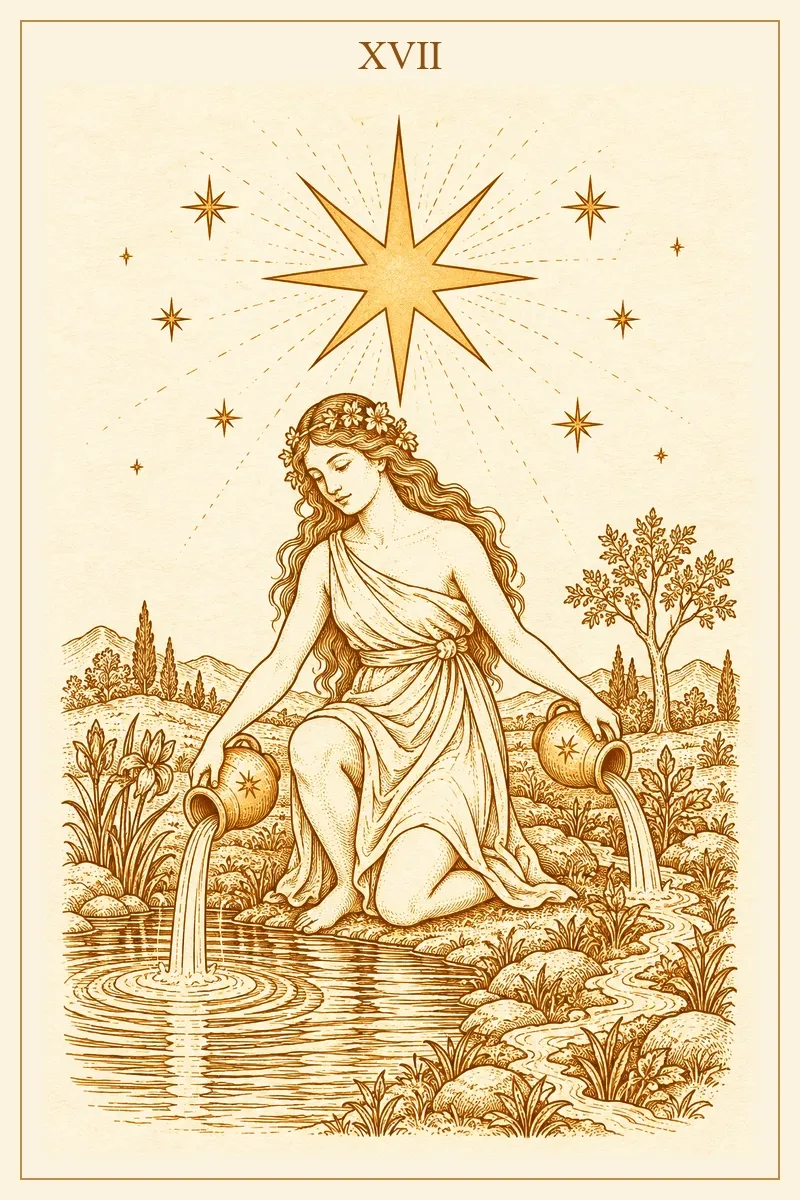
A young woman kneels barefoot on a grassy bank beside a still pool. Her long hair falls loose, her only ornament is a small wreath of daisies, and her dress is a single length of cloth knotted at the waist and left off one shoulder. Her eyes are lowered to her work rather than to whoever is watching.
That unguarded quality is where the card's meaning of authenticity comes from. In many decks she is drawn unclothed; here she wears one plain garment, with no crown, no armor and no jewelry beyond flowers she might have picked that morning. Either way, the point holds: after the upheaval of the card before it, there is nothing left to defend, and she does not try to look like anything other than what she is.
One pitcher for the pool, one for the land
She holds a clay pitcher in each hand, each marked with a small star. From the left one, water pours into the pool and spreads in rings. From the right one, it falls onto the bank and becomes a small stream winding between stones toward the bottom corner of the card.
Readers usually take the pool as the inner life and the ground as daily, practical life. She tends both at once, and neither pitcher seems close to empty. That is The Star's quiet claim about generosity: giving from a source that is being refilled does not drain you. The reversed card is often about the moment that stops being true.
The great star and a stream finding its way
Above her hangs one large eight-pointed star with fine rays, surrounded by smaller stars and pinpoints of light. There is no lightning, no cloud, no moon pulling at the tides; the sky is simply clear. The great star does not light the whole landscape the way the sun would. It gives a direction, which is exactly this card's kind of hope: it rarely shows you the whole road, only which way is forward.
Below, irises line the left bank and a young leafy tree rises on the right. The growth is recent and modest, which suits a card about recovery, and the stream she pours onto the land has already started to find its own path without her guiding it.
Aquarius, Tzaddi and the Daughter of the Firmament
The Star's correspondences come from the Hermetic Order of the Golden Dawn, whose system most modern decks follow:
- Zodiac sign: Aquarius, the Water Bearer, a fixed air sign (roughly January 20 to February 18).
- Ruling planet: Saturn in traditional astrology, Uranus in modern astrology.
- Hebrew letter: Tzaddi, usually translated as fishhook.
- Golden Dawn title: the Daughter of the Firmament, the Dweller between the Waters.
A card full of water belonging to an air sign can seem odd, but the Water Bearer is not a water creature. Aquarius pours, shares and distributes, a mental and social act as much as an emotional one, which is why The Star's hope tends to arrive with new ideas and a sense of belonging to something bigger than one bad year. The Aquarius tarot guide follows the sign through its Swords cards and court card.
Tzaddi's fishhook waits patiently under the surface and draws something up, much as The Star's healing brings back what sank during the crisis. Aleister Crowley later moved Tzaddi to The Emperor, so Thoth-based books may give The Star the letter Heh instead. Seventeen also reduces to eight, the number of Strength in most modern decks, and both cards describe power that works through patience rather than force.
Hope, healing and authenticity: the upright Star
Hope that has been through something
The hope in this card is not the optimism of someone who has never been hurt. It is closer to waking one morning and noticing that the dread is lighter than it was last month. You have come through a loss, an illness, a breakup or a professional collapse, and you are still here. Upright, The Star names that turning point and asks you to trust it a little. You do not have to feel certain to begin.
Healing that keeps its own pace
The picture shows how this healing works: water poured slowly, ring by ring, rather than a flood. The Star rarely describes a dramatic cure. It describes the next stage of recovery, where sleep improves before mood does, a friendship is rebuilt one conversation at a time, and confidence returns through small, repeated proof. The rings on the pool do not hurry, and neither does real recovery.
The same flow brings inspiration back. Ideas return, and you may want to make something simply because you want to. Because Aquarius is a humanitarian sign, that energy often turns outward into mentoring or sharing what you learned the hard way, which the card supports as long as one pitcher stays pointed at your own pool.
Authenticity: nothing left to perform
After a crisis, the roles you used to play may simply be gone: the person who never needed help, the partner who held everything together, the professional who never looked unsure. The Star suggests that losing them may be part of the healing. With less to defend, you can say what you actually want, let people close to you see how you really are, and choose work and relationships that fit who you have become. Authenticity here is not a personal brand. It is kneeling at the water in plain clothes and getting on with the work you care about.
The Star reversed: the light is there, the view is clouded
Reversed, The Star does not cancel hope. It describes a stretch when you cannot feel it, or when the conditions that let it flow have been disturbed. Occasionally it shows hope that has drifted into waiting for rescue, a sign or the perfect moment instead of taking a step. Most often, though, it takes one of two forms, and neither is a verdict; it usually means not yet, or not this way.
Discouragement after a long effort
The first form is tiredness that has turned into doubt. You have been trying to recover, find work or rebuild trust for a long time, and progress feels too slow to count. The reversed card acknowledges how exhausting that is, and reminds you that discouragement is a feeling about the future, not a report on it. The stream on the card kept moving when nobody was watching.
Pouring from an empty pitcher
The second pattern is giving more than you receive. The caregiver, the friend everyone calls in a crisis, the person holding a team together through a hard year: reversed, The Star often appears when that generosity has outrun its source. Turn one pitcher back toward your own pool. Rest, ask for help, or scale back what you have promised before resentment does it for you.
The Star in love: opening up after a hard season
If you are single
For a single reader, The Star upright usually arrives after a painful ending has been grieved and the heart is growing curious again. It does not point to a particular person on a particular date. It describes readiness: you are more willing to be seen, less interested in performing, and more likely to notice someone kind because you have stopped chasing someone dazzling.
In a relationship that is mending
In a relationship, the card often follows a rupture: a betrayal brought into the open, a near breakup, a long period of stress. Upright, it says repair is underway, with trust coming back the way the pool fills, through small, consistent actions rather than one grand gesture. If you are asking about an ex, it can describe renewed contact or simply being able to think of them without pain; the card supports whichever leaves you more whole.
Reversed in love
Reversed, The Star points to a guarded heart: someone, perhaps you, who has decided not to hope again so as not to be disappointed. It can also show a partner who keeps giving with nothing coming back. Either way, it asks for one honest conversation rather than more silence.
Work, purpose and money under The Star
Career and creative work after a setback
At work, The Star upright often follows a layoff, a failed venture or burnout. It describes purpose returning: a role that fits better, renewed interest in your field, or simply lighter mornings. It favors work that serves others or makes something, such as teaching, care work, design, writing and counseling, and for artists it signals ideas coming more easily and the courage to share them. Reversed, it describes disillusionment or a creative dry spell; whether you need a change or rest, the card helps you notice which.
Money: recovery in small deposits
Financially, The Star upright suggests gradual recovery after a loss: a debt slowly shrinking, savings rebuilt in small amounts, a calmer relationship with spending. It does not promise a windfall, and a reading is no substitute for financial advice. Reversed, it warns against abandoning a reasonable goal because progress feels slow, and against giving away money you cannot spare.
Rest, recovery and the spiritual side of card XVII
In questions about health, read The Star as a card about the conditions for recovery rather than a medical forecast. Upright, it supports rest, patience and practical care such as sleep, water, gentle movement and the plan you agreed on with your doctor. Reversed, it often reflects discouragement during a long recovery, which deserves care and company too. Nothing in a reading replaces a qualified professional.
Spiritually, The Star is the card of grace: a sense of connection you did not earn and do not have to defend, often felt after a period of being cut off. The exercises in Tarot for Self-Discovery pair well with it, especially journaling about what has survived a hard season.
When does The Star's hope arrive? Reading its timing
Timing questions are where readers most want certainty and where the cards say the least. Even so, The Star speaks clearly about pace and sequence, if not about calendars.
Slow light, not sudden news
The Star describes a process, not an event. Where The Tower is a lightning strike, The Star is the night afterward, when the sky clears and you can see again. Read it as gradual improvement over weeks or months that begins after the difficult event has already happened. If you ask "When will I feel better?" and draw The Star, the honest reading is that it has already begun and will continue at its own speed.
Aquarius season and other conventions
Readers who use astrological timing link The Star to Aquarius season, roughly late January to mid-February, and some count its number as seventeen days or weeks. These are conventions, not rules, and they work best as a date for checking in with yourself. The guide to reading timing in tarot cards compares the main systems.
Let the surrounding cards set the pace
With the Eight of Wands or other quick Wands cards, renewal comes sooner and more visibly. With the Four of Swords or slow-moving Pentacles, The Star asks for patience and rest first. Reversed, it usually reads as "not yet," a statement about readiness rather than a refusal.
The Star as a yes-or-no answer
Upright, The Star is a hopeful, patient yes that depends on you continuing to show up. It suits "Is this worth trying again?" better than "Will they text me tonight?" Reversed, read it as "not yet" or "yes, once you have rested," rather than a flat no. If the answer matters, ask a follow-up about what would help; this card tends to answer that generously.
Between the Tower and the Moon: The Star's place in the Major Arcana
The Star sits between two of the most unsettling cards in the deck, and its calm is partly a contrast with both.
The Tower before it
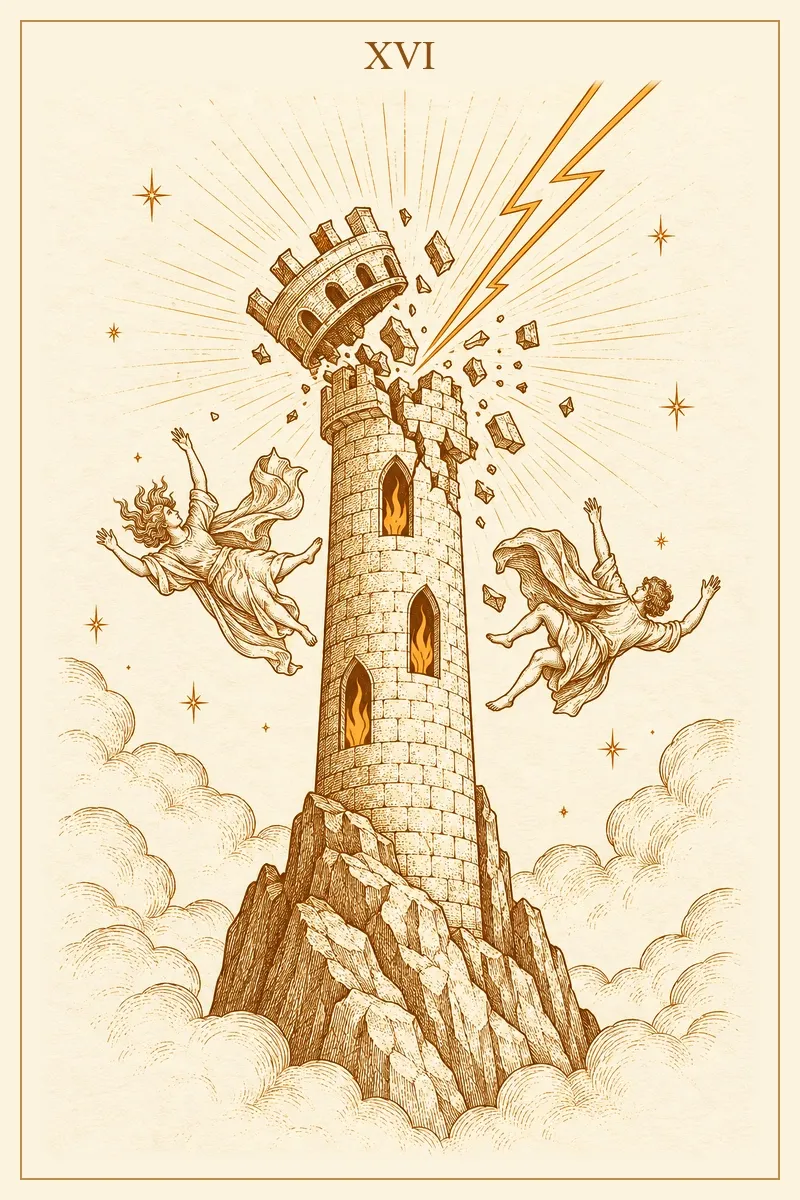
The Tower, card XVI, shows a stone tower on a rocky peak above the clouds. Lightning has knocked off its battlemented top, flames show in the windows, and two figures fall among flying stones. It is the card of sudden collapse, especially of structures built on something untrue, and the full Tower card meaning explains why that collapse is so often a release as well.
Together, the two cards usually describe healing that begins close behind a shock. The Tower clears the ground, and The Star is what grows there first. With The Tower in a past position and The Star in the present, many readers see one of the most reassuring sequences in tarot.
The Moon after it
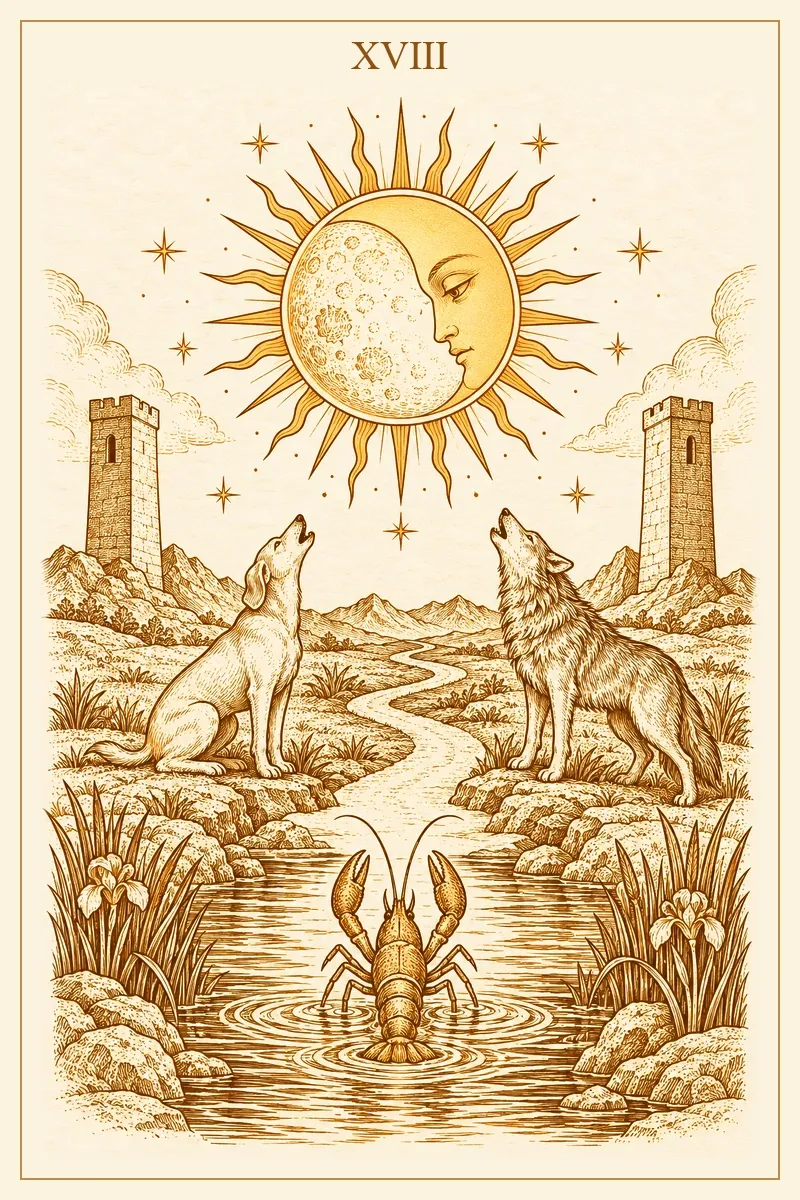
Next comes The Moon, card XVIII: a crescent face inside a rayed disc, two stone towers, a dog and a wolf howling on either side of a winding path, and a crayfish climbing out of a pool. The clear sky gives way to uncertainty and half-seen fears, territory that The Moon tarot card meaning covers in detail. Paired, the two ask you to keep faith while things are unclear. The Star's light does not disappear when The Moon rises; it is only harder to see.
The Star and Temperance: two vessels, two kinds of healing
The Star is often confused with Temperance because both show a figure pouring water, yet they describe different stages of the same recovery.
What Temperance does with its cups
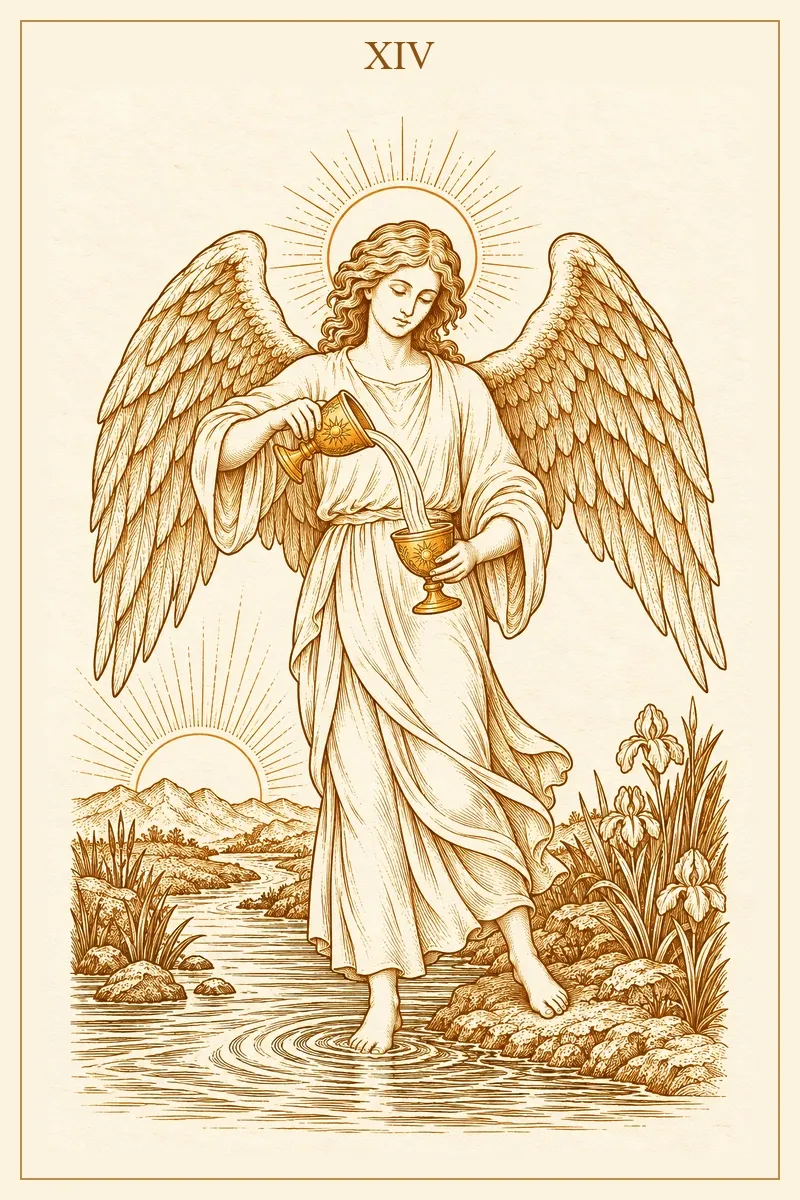
Temperance, card XIV, shows a winged figure with a halo, one foot in a stream and one on the bank, pouring water carefully from one golden goblet into another while the sun rises over distant hills. Nothing spills. It is the card of blending and patient adjustment, and the Temperance card meaning explores that balance in depth.
Telling them apart in a spread
Temperance measures; The Star pours freely. Temperance heals through careful management and the middle path, The Star through release and trust. When both appear, the reading often describes a recovery that needs structure and faith at once: a plan you keep and a hope you allow.
Other pairings that change The Star's tone
- The Star with The Empress: creative and physical renewal, a fertile period for projects and home, as The Empress card meaning describes.
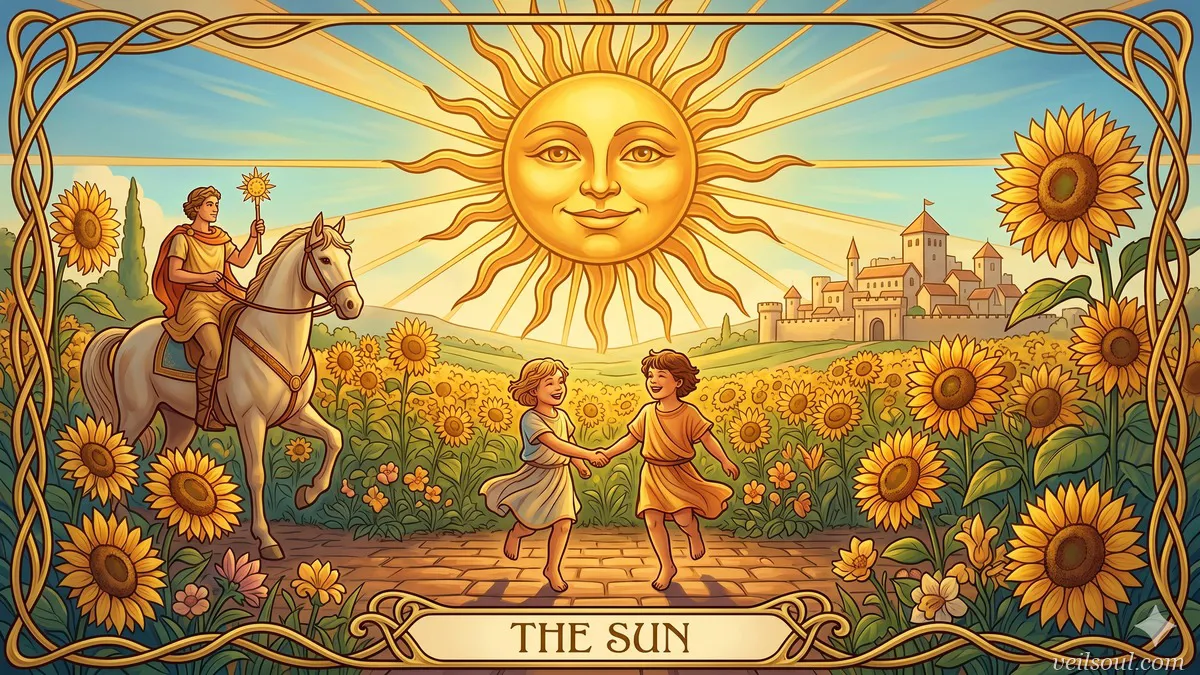
- The Star with The Sun: hope turning into visible joy, the promise followed by daylight.
- The Star with the Three of Swords: grief beginning to heal; the hurt is real, and no longer the whole story.
- The Star with Death: life after an ending, when the empty space starts to feel like room.
- The Star with the Ace of Cups: an open heart, often a fresh start in love or friendship.
The Two Pitchers Spread: five positions for a season of recovery
This spread borrows the picture on the card. Use it when you are coming out of a difficult period and want to know where to put your energy next. Lay five cards in a row.
- The night behind you: what has ended, and what it taught you.
- The star overhead: what you can steer by now, whether a value, a hope or a person.
- The pitcher poured on the land: what to give to practical life, such as work, home and routines.
- The pitcher poured into the pool: what to give back to yourself.
- The stream finding its way: the first sign that renewal is underway.
Read positions three and four together. If one is much heavier than the other, that imbalance is often the real answer.
A worked example: starting over after burnout
The question: "I left a job I loved after burning out last spring. How do I start trusting my own work again?"
The cards drawn:
- The night behind you: Ten of Swords
- The star overhead: Page of Cups
- The pitcher on the land: Eight of Pentacles
- The pitcher into the pool: The Star, reversed
- The stream: Three of Wands
Reading it: The Ten of Swords confirms that the burnout was a genuine ending, not a pause; there is nothing left to rescue in that old way of working, which is oddly freeing. The Page of Cups makes curiosity the guiding light: small, playful projects done for their own sake. The Eight of Pentacles asks for steady practice, an hour of skill work on most days, kept modest enough that it cannot become new pressure.
The reversed Star in the pool position is the key card. The person asking is still pouring from an empty pitcher, perhaps helping former colleagues or overcommitting to friends, and has not yet turned that care toward their own pool. Refilling comes first. The Three of Wands then shows the first sign of renewal: looking outward again, perhaps sending one piece of work into the world once practice and rest both feel steady.
Bringing The Star's light into your week
- Write down one thing that survived. Name what the hard season did not take: a friendship, a skill, a sense of humor.
- Check both pitchers. List what you are giving to others this week and what you are giving to yourself. If one list is empty, adjust it.
- Drop one performance. Tell one trusted person the truth about something you have been pretending is fine.
- Set a check-in, not a deadline. Choose a date a month from now to notice what has changed.
Questions to sit with: What gives me hope even now? Where am I rushing a recovery that needs time? Who sees me as I actually am?
Frequently asked questions
Is The Star a good card to draw?
Yes. It is one of the most reassuring cards in the deck. Upright, it confirms hope and healing; reversed, it asks you to look after the conditions that let hope return, which is advice rather than a warning.
What does The Star say about how someone feels about me?
Tarot cannot read another person's mind or confirm their feelings, and The Star is no exception. In a feelings question it usually describes the quality of the connection: hopeful, gentle and honest. Treat it as a mirror for what you bring and hope for, not a report on someone else's heart.
Does The Star reversed mean there is no hope?
No. It describes hope you cannot feel at the moment, usually because of exhaustion or overgiving, and points to what needs attention so hope can return. The shift often begins with rest.
How long does a Star period last?
No card sets a fixed length. Because The Star describes gradual recovery, most readers think in weeks and months rather than days, and the period lasts as long as you keep tending both pitchers.
What is the difference between The Star and The Sun?
The Star is the night sky after a storm: hope and direction while things are still quiet. The Sun is full daylight: confidence, visible success and joy. If you have drawn The Star, you are on the way toward The Sun.
I am new to tarot. Where should I start with the Major Arcana?
Read The Star alongside the cards on either side of it, since the sequence teaches more than any single card. If you are starting from scratch, this beginner's introduction to tarot explains how the deck is structured and how spreads work.
Under a clear sky
The Star does not ask you to pretend the hard part never happened. It asks you to notice that you are still here, to give a little to the land and a little to yourself, and to let the stream find its own way. When you are ready to bring your own question to the cards, you can begin a calm Veil Soul reading and see which light you are steering by.