The Hanged Man stands for a pause you stop fighting: a stretch where pushing harder has stopped working and the useful move is to hold still, let something go, and look at the problem from the opposite side. Upright, it is suspension with a purpose, a trade of speed for a clearer view. Reversed, the same pause has curdled into stalling, a sacrifice that buys nothing, or a restless refusal to wait at all.
No card can read another person's mind, set a date, or promise how a situation ends, and this one is especially unwilling to try. What it does well is name the difference between waiting that is working and waiting that has quietly become avoidance.
At a glance:
- Upright: a chosen pause, surrender of control, a new angle on an old problem, a sacrifice that buys something real.
- Reversed: stagnation, resistance to a change of view, martyrdom, or impatience that cuts the lesson short.
- Number: XII, the twelfth step of the Major Arcana, between Justice and Death.
- Element: Water, with Neptune as its modern planetary link.
- Hebrew letter: Mem, the letter of water.
- Yes or no: not yet; reversed, it asks you to decide whether the wait should end.
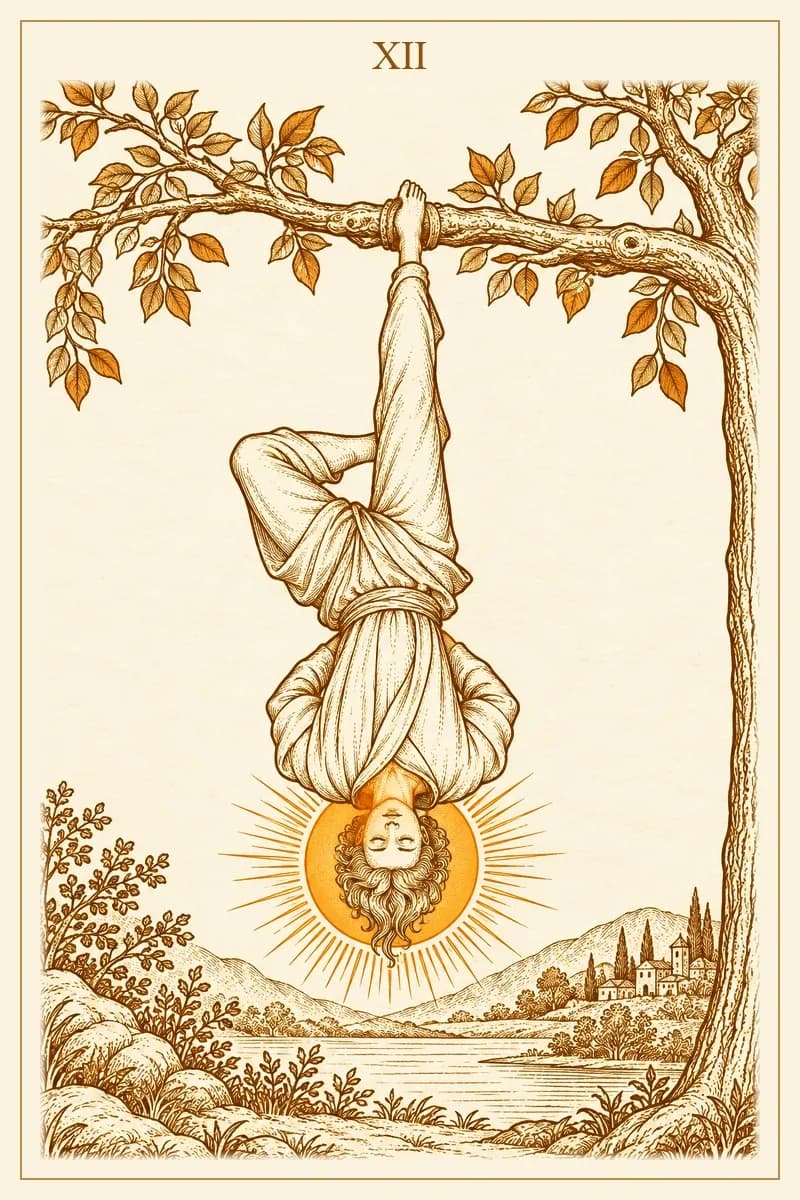
Head down, eyes closed: the figure on card XII
A bound ankle on a living branch
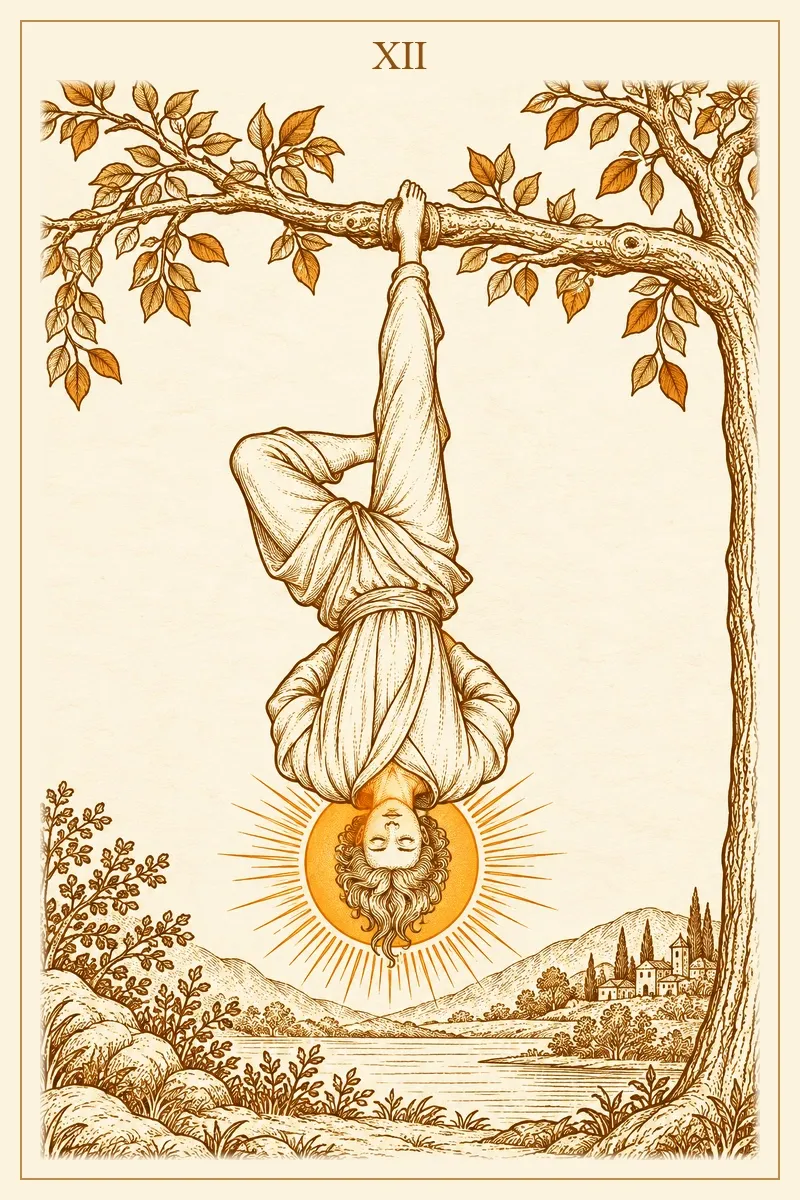
A young man hangs head-down from the horizontal branch of a leafy tree whose trunk climbs the right edge of the card. One ankle is tied to the branch with a few turns of rope, and the branch is alive, sprouting amber leaves. This is no gallows but a tree he could climb back into, the first clue that the suspension is temporary.
A figure four, and hands kept out of the way
His free leg bends at the knee and tucks behind the straight one, so the legs make a rough figure four. His arms fold behind his back, out of sight, and a loose pale tunic, cinched with a sash at the waist, slides down toward his head. With his hands out of view he cannot grab, fix or untie anything; this is a body that has stopped trying to get down.
A golden disc of rays behind his face
His eyes are closed, his expression is calm, and his curly hair falls toward the ground. Behind his head sits a round golden disc with rays spreading from it, the brightest thing on the card. Call it a halo or a sun; either way the light is around his head, not his hands. Whatever he gains here, he gains by seeing, not by doing.
The still lake and the village on the far shore
Below him the world goes on, right side up. A smooth lake or slow river stretches across the lower third, low hills roll behind it, and on the far bank a small village with a tower and tall cypress trees sits in full daylight. Life in the village has not paused; only he has, and from his inverted angle that ordinary landscape looks new.
Water, the letter Mem and the Spirit of the Mighty Waters
- Element: Water, one of the three Major Arcana cards tied directly to an element rather than a sign or planet.
- Planet: Neptune, a modern addition; some readers also connect the card with Pisces.
- Hebrew letter: Mem, whose name is usually translated as water.
- Traditional title: the Spirit of the Mighty Waters.
Water explains how this card behaves. It does not force its way through rock; it waits, finds the lowest path, and wears the obstacle down. In a Hanged Man stretch, the pressure you apply by refusing to let go is often what keeps you stuck. Neptune, the planet of fog and dissolving boundaries, adds the less comfortable side: old certainties blur before new ones form, and that blur is part of the process rather than a sign it is failing.
Many readers also compare the picture to the Norse story of Odin, who hung for nine nights on the world tree Yggdrasil and came down holding the runes. Something is given up, time and comfort above all, in exchange for knowledge that could not be reached any other way.
Upright Hanged Man: the pause you agree to
Seeing the problem from underneath
Upright, the card speaks to the moment after every obvious approach has hit the same wall. It suggests the trouble is not effort but angle. Turn the question over. If you have been asking how to make the other person agree, ask what you would do if they never did. This is a practical skill, not a mystical one: write the problem as you have been framing it, write the opposite framing underneath, and notice which version makes your shoulders drop.
A trade, not a punishment
The other upright theme is sacrifice, which is not suffering for its own sake but a trade: a comfort, a belief, a plan, or a piece of identity released because holding it blocks something you want more, such as a grudge dropped so a family conversation can happen. The test of a real Hanged Man sacrifice is that you can name what it is buying. If you cannot, read the reversed section closely.
Waiting that is still doing something
The upright card does not mean do nothing. It means stop doing what is not working and let the pause do its job: information arriving, emotions settling, priorities shifting under the surface. Active waiting looks like rest, observation and small experiments, rather than a fresh push every morning against the same locked door.
The Hanged Man reversed: stuck, stalling or giving too much
Hanging on after the lesson is learned
The first reversed reading is stagnation. The pause once had a purpose and has outlived it. You understood what the wait was teaching weeks ago, but coming down would mean deciding, so the suspension continues under the name of patience. If a friend described this exact situation, would you call it patience or stuck?
Refusing to turn the picture over
The second reading is resistance. A new perspective is available and you keep looking away from it because the old one is familiar, flattering, or simply easier. This version shows up as the same complaint repeated in different words, or as advice you keep asking for and never take.
The sacrifice nobody asked for
Reversed, the card can point to martyrdom: giving time, money, energy or opportunity that produces no return, often for someone who never requested it. Check honestly whether you are quietly hoping it will be noticed and repaid. A loss that buys nothing is just a loss, and you are allowed to stop paying it.
Thrashing on the branch
The last reversed meaning runs the other way: you will not wait at all. The pause is genuinely needed, and its discomfort drives a rash move: a sent message, a quick resignation, a purchase made to feel in motion again. If this fits, hang a little longer and let the decision be made calmly.
Love readings: when a relationship is hanging in the air
Single and tired of trying
For someone single, the upright card speaks to the point of exhaustion with apps and introductions. It does not say love is off the table; it says the current method has stopped producing anything but fatigue. Step back, and look at the pattern from underneath: what kind of person do you keep choosing, and what were you hoping they would solve?
Inside a relationship that has stalled
In a relationship, The Hanged Man describes a holding pattern: a conversation about moving in or having children postponed again, a distance after a hard season, two people waiting for each other to make the first move. Upright, the pause can be healthy if both partners understand it as one. Try describing the relationship from your partner's side, as fairly as you can, before deciding what to say.
Reversed in love: waiting for someone to change
Reversed, the card warns about waiting that has no end date: staying in an on-again, off-again connection, holding out for a promise that keeps being deferred, or giving up your own plans for someone who has not asked you to. Ask what the waiting is buying. If the honest answer is time with a person who is not choosing you, the reversed card is suggesting you come down from the branch and set a boundary.
Career and money: a project on hold, a decision deferred
Work that is paused for reasons outside your control
In career readings, the upright card often describes delay: a hiring freeze, a launch pushed back, approvals stuck in someone else's inbox. Rather than chasing harder, use the pause: learn the skill the next stage will need, or ask what success in this role would look like if the original plan never came back.
Money and the purchase that can wait a week
With money, the card favors a cooling-off period before any large commitment. Sleep on the contract, read the terms twice, and ask someone with a different view to look at the numbers. Tarot offers no financial advice and cannot tell you how an investment will perform; what The Hanged Man supports is not deciding under pressure.
Reversed at work and with money
Reversed, the warning is stagnation that calls itself prudence: staying in a role you outgrew years ago because leaving feels risky, or putting off a money decision until the choice is made for you. It can also describe unpaid extra work done for recognition that never arrives.
Rest, spirituality and letting go of control
When a reading touches on health, read The Hanged Man as a card about pace and rest, not diagnosis: a slower week, sleep taken seriously, no more pushing through exhaustion. Nothing in a card replaces care from a qualified professional, and reversed, it can be a nudge to book the appointment you keep postponing.
Spiritually, the card describes the discovery that control has limits, and that some understanding only arrives when you stop trying to analyze your way to it. Meditation, a walk without a destination, or ten minutes with a single card before opening any guidebook all fit its spirit. If you want a structured way into that kind of reflection, tarot for self-discovery offers prompts that suit a Hanged Man season well.
Does The Hanged Man mean yes, no or wait?
Upright: not yet
Upright, the card gives neither a clean yes nor a clean no. It says the question is not ready to be answered, usually because some information has not arrived or because you have not yet looked at the situation from the side that matters. A better question is often what you would need to see before you could decide.
Reversed: decide whether the waiting ends
Reversed, many readers treat the card as a no, but it is a specific kind of no: no to further waiting. The delay has stopped serving you, and the next step is to make a decision, even an imperfect one, rather than wait for certainty that is not coming.
How long the suspension lasts
A single card cannot give a reliable date; readers who link it to Pisces sometimes place it in late winter, which is a convention, not a forecast. A Hanged Man period tends to end when its lesson is understood, often felt as a shift from frustration to curiosity.
Between Justice and Death: card XII in the Major Arcana sequence
Justice before the pause
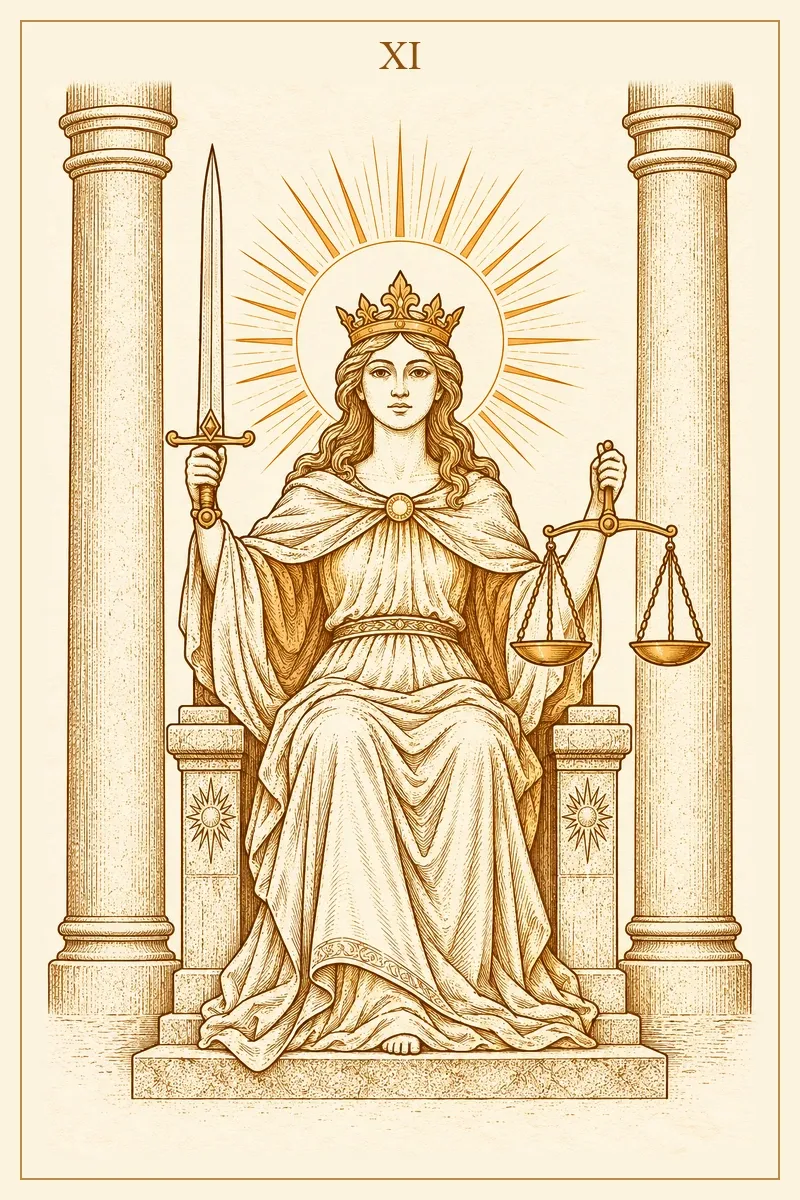
Justice, card XI, sits on a stone throne between two columns, a raised sword in one hand and balanced scales in the other. It is the card of accountability and clear-eyed decisions, and the full Justice tarot meaning covers that weighing in detail. The Hanged Man follows it for a reason: once the facts are weighed, what remains is to accept the verdict and let it change you, which cannot be rushed.
Death after the pause
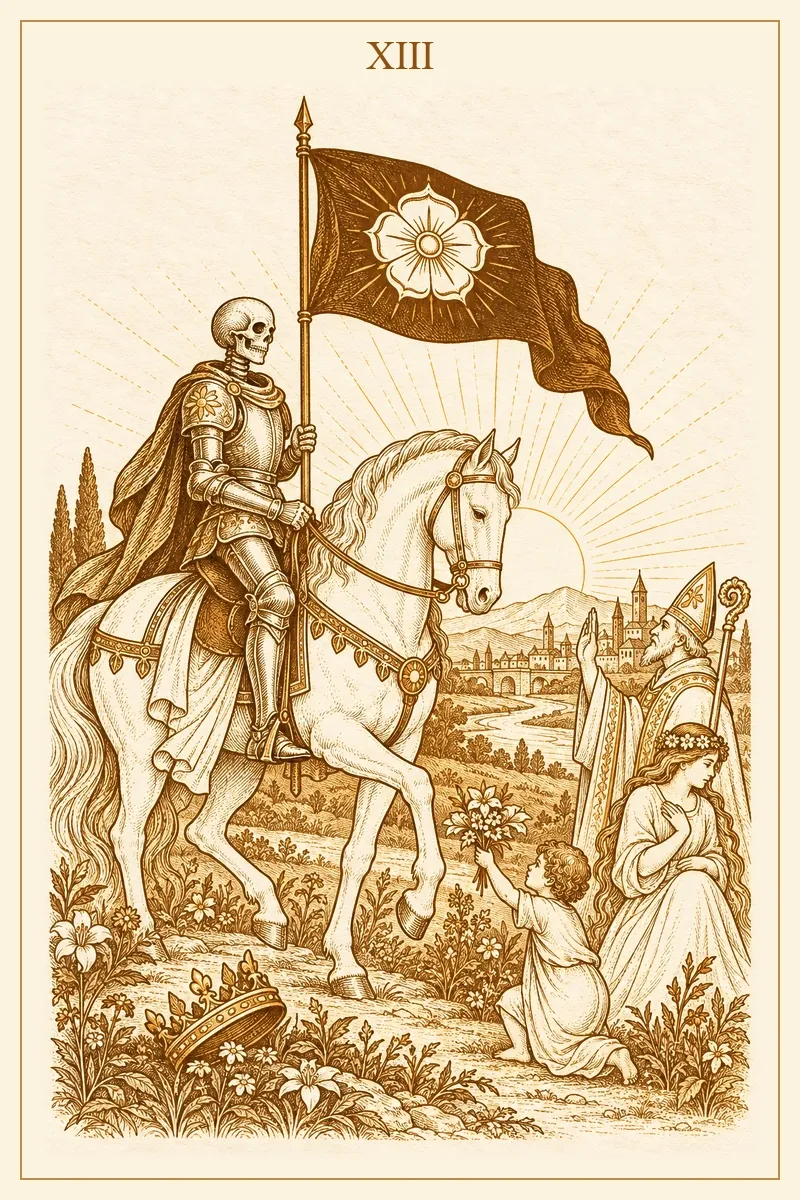
Death, card XIII, rides in on a white horse under a dark banner marked with a pale five-petaled flower, while a crown lies fallen in the grass and a sun rises behind distant towers. It is the card of endings that make room, rarely anything literal, and the Death card meaning explains why it is so often a relief. The Hanged Man is the waiting room before that ending: the time when you already sense something has to close but have not yet let it.
Reading the three together
In order, the three cards describe one movement: Justice names what is true, The Hanged Man accepts it and lets the view rearrange itself, and Death releases what no longer fits. Justice beside The Hanged Man says the truth is known and the letting go is underway. The Hanged Man beside Death says the suspension is nearly over.
Six companions that change how he hangs
- The Hermit: a long, deliberate retreat, where the answer comes from solitude and time rather than more advice; the Hermit card meaning describes that kind of chosen quiet.
- Wheel of Fortune: a turning point that arrives once you stop trying to steer, and the Wheel of Fortune guide covers how those cycles turn.
- The Star: healing on the far side of surrender; the Star tarot meaning explains why that card is read as the calm after a hard season.
- Temperance: patience with a method; together they favor slow, steady change over a dramatic break.
- Two of Swords: a stall that is not a surrender, asking whether you are pausing or hiding.
- Eight of Wands: sudden movement after a long hold when upright; reversed, the delays run a little longer.
The Upside-Down Spread: five positions for a stalled question
This layout follows the picture on the card and works for any situation that feels stuck: a delayed plan, a relationship in limbo, a decision you keep postponing. Write the question in one sentence first, and phrase it about yourself rather than another person.
- The branch: what is holding the situation in place right now.
- The knot: what I am still tied to, or pulling against.
- The view from below: what the situation looks like when I turn it over.
- The light around the head: what this pause is giving me that rushing would not.
- The ground: one step to take when the wait ends, or to end it.
Lay the cards in a vertical line from top to bottom, matching the drop from branch to ground. Reversed cards in this spread usually mean a blocked or slow position rather than a bad one. If you are newer to laying out cards, the layouts in five simple tarot spreads for beginners are a gentle warm-up before a five-card spread.
A worked example: a launch pushed back three months
The reading below is invented to show the positions in use. Picture a team lead whose product launch has been delayed by three months because a partner company missed its deadline. She has spent two weeks trying to win the date back. Her question: what is this delay asking of me?
The branch: Eight of Wands reversed
Eight flying wands, reversed, describe messages and momentum that will not land: approvals stuck, replies slow, a schedule no longer hers to set. The card confirmed what she already knew, that the delay sat outside her control, and that more emails would not speed it up.
The knot: Four of Pentacles
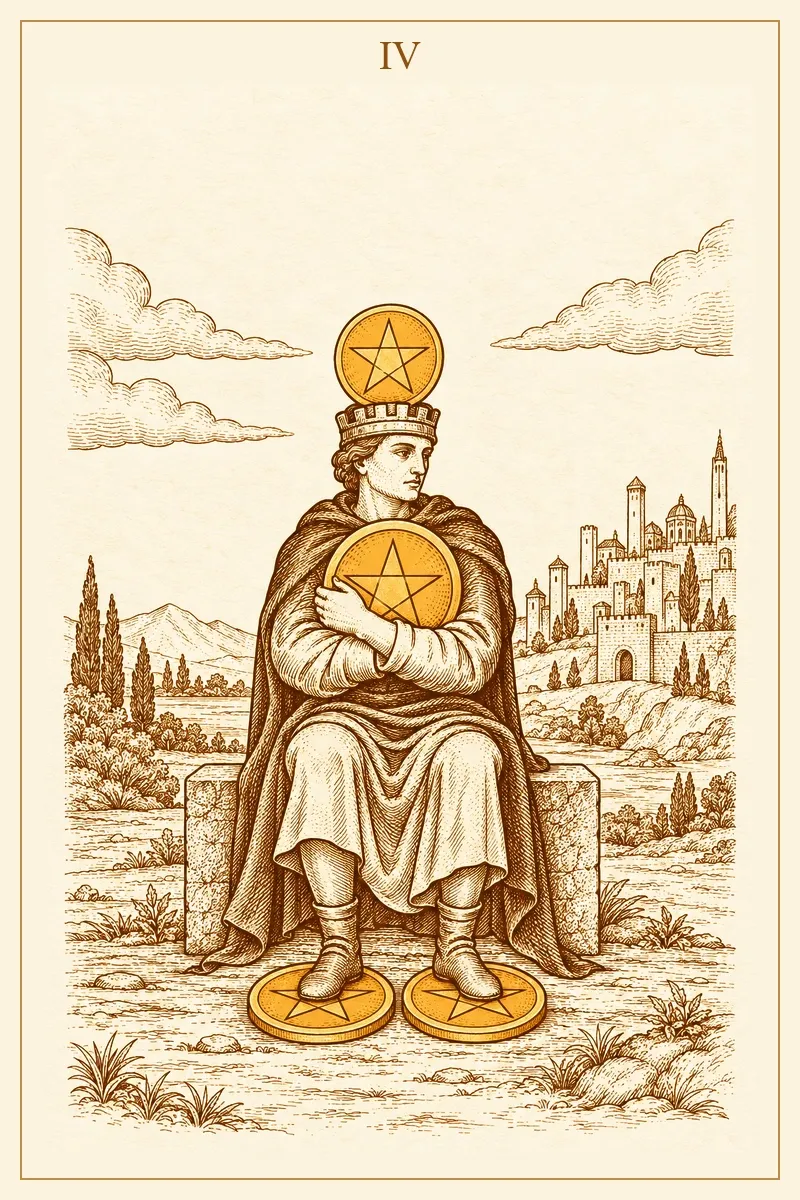
The Four of Pentacles shows a crowned figure on a stone bench, one coin balanced on his crown, one clutched to his chest and two pinned under his feet, while a walled city rises off to one side. In the knot position it pointed at her grip on the original launch date. She had been holding the plan so tightly that the three months felt like a loss rather than time she could use.
The view from below: Page of Cups
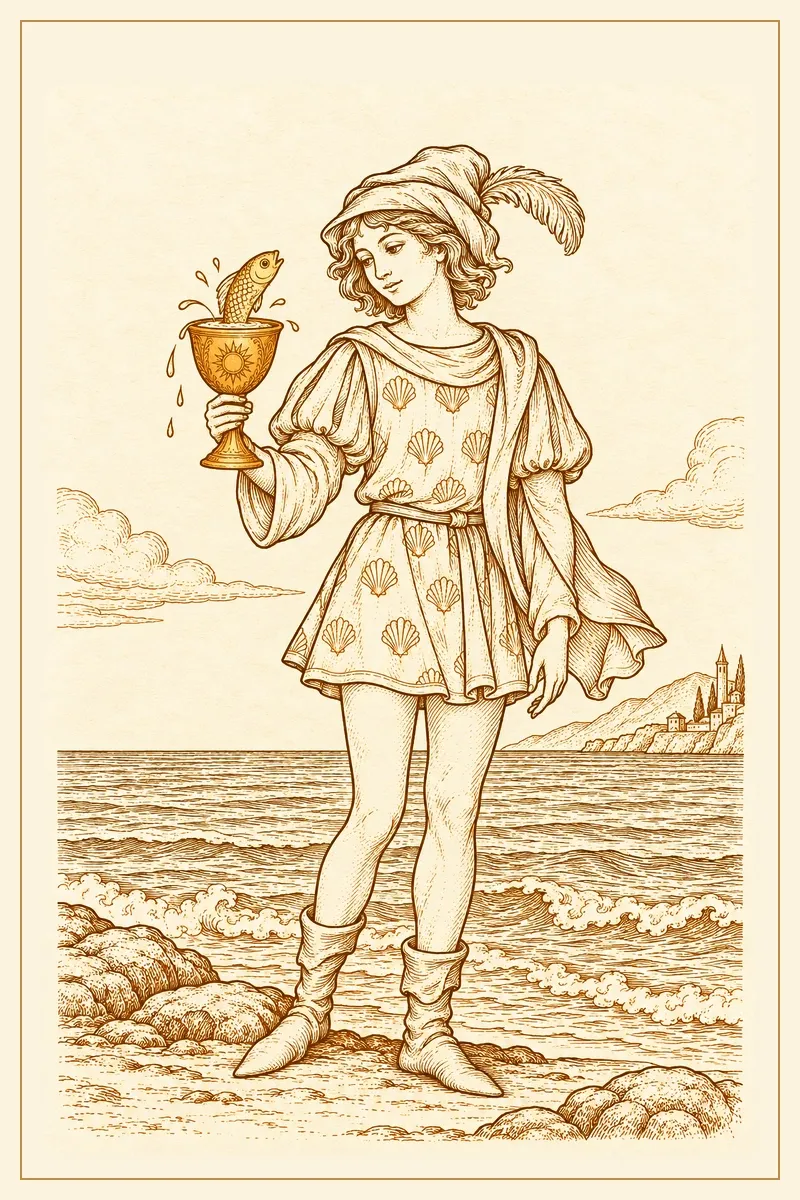
The Page of Cups stands at the edge of the sea in a tunic patterned with shells, studying a fish that has leapt up out of the golden cup in his hand. Turned over, the delay looked different: a surprise, a small creative opening. She remembered a feature the team had shelved for lack of time, which could now be tested with a few early users.
The light around the head: Temperance
Temperance, the angel with one foot in a stream and one on the bank, pouring water between two cups, described what the pause was offering: a steadier pace and the chance to blend the team's ideas instead of rushing one version out. That is not a gift a tight deadline allows.
The ground: Three of Wands
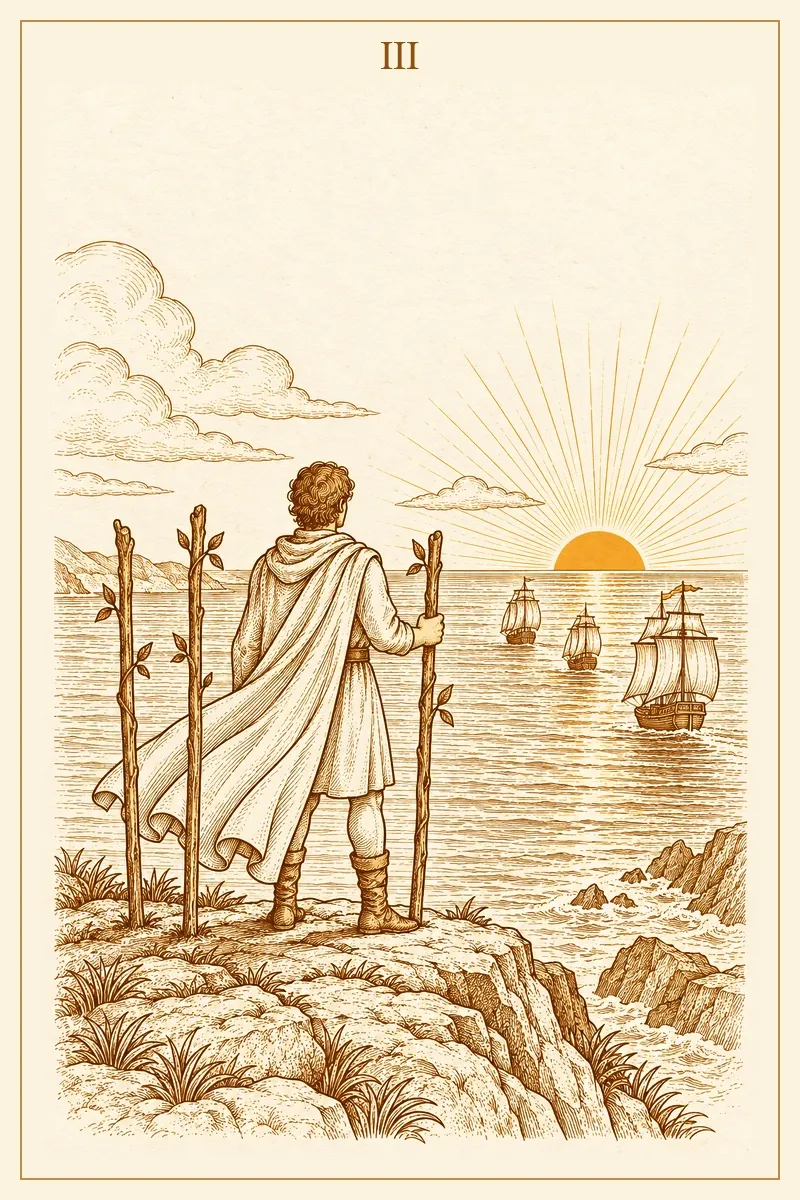
The Three of Wands shows a cloaked figure on a cliff, one hand on a staff, watching ships cross a bright sea toward the sunrise. As the first step down, it suggested looking ahead rather than back: write a revised plan with the new feature in it, send it to the partner company, and choose one date for checking progress.
What the five cards said together
No card promised the launch would succeed. The spread moved her question from how to undo the delay to how to use it, and gave her one concrete thing to do that week, which is the shift from pushing to looking that this card is about.
Reflection prompts for a season of suspension
- What am I trying to force that might move on its own if I stopped pushing?
- How would this situation look from the opposite side, or from the other person's chair?
- What am I afraid to release, and what do I think will happen if I do?
- Is my waiting calm and useful, or anxious and stuck?
- What would I be free to notice if I stopped trying so hard?
Frequently asked questions
Is The Hanged Man a bad card?
No. It is an inconvenient card, because it offers a pause just when you want action. Upright, it is often one of the more hopeful cards in a reading, since it says a new view is close.
What does The Hanged Man mean about someone's feelings for me?
Tarot cannot tell you what another person feels or thinks, name a date, or guarantee an outcome. Read the card as a description of the situation between you: a connection in limbo, with one or both people waiting. The more useful question is what you need while things are unresolved.
What kind of sacrifice does The Hanged Man ask for?
Usually something small and specific: time, a comfort, a habit, a fixed idea of how things should go. The card never asks you to give up your safety, health or self-respect. A sacrifice that buys nothing belongs to the reversed reading.
How is The Hanged Man different from the Two of Swords?
Both describe being stuck, but the stance differs. The Two of Swords refuses to look at a choice and holds the tension rigidly. The Hanged Man has stopped resisting and is using the pause to see differently. One is a stalemate; the other is a surrender that leads somewhere.
What does The Hanged Man mean in an outcome position?
As an outcome, it rarely describes a dramatic result. It suggests the situation is heading into a pause, and that the most useful thing it will produce is a changed point of view. Read the cards before it to see what you may need to release for that change to arrive.
Should a beginner read The Hanged Man reversed?
You can, but it helps to learn the upright meaning thoroughly first, since the reversed readings are variations on it: too much waiting, too little, or a sacrifice gone wrong. If you are still learning the basics of the deck, our introduction to tarot is a calm place to start.
Coming down from the branch
The Hanged Man does not stay hanging forever. The card describes a season, and it ends in one of two ways: the view shifts and you come down knowing something you could not see before, or you decide the waiting has done its work and step down on purpose. Either way, the change starts with loosening your grip.
- Choose one small experiment that is only possible because the original plan stalled, and try it this week.
- Name one thing you are holding that is costing more than it returns, and decide whether to keep paying for it.
- Set a date to review the pause, so waiting stays a choice rather than a habit.
When you are ready to look at your own situation from a new angle, you can start a reading and let the first card you draw be the view from below.