When someone you love dies, or a life you counted on comes apart, tarot can help in one modest way: it gives your grief a shape you can look at. Drawing cards for grief and loss is not about reaching the person who died or finding out when the pain will stop. It is a quiet way to name what you feel today, notice what you need, and remember what still holds you.
It is worth being clear about the limits from the start. Tarot cannot bring anyone back, pass on messages from the dead, explain why a loss happened, or set a date for feeling better, and it does not replace the family, friends and professionals who support grieving people. Used gently, though, a few cards on a table can help when words run out and well-meaning people say the wrong thing.
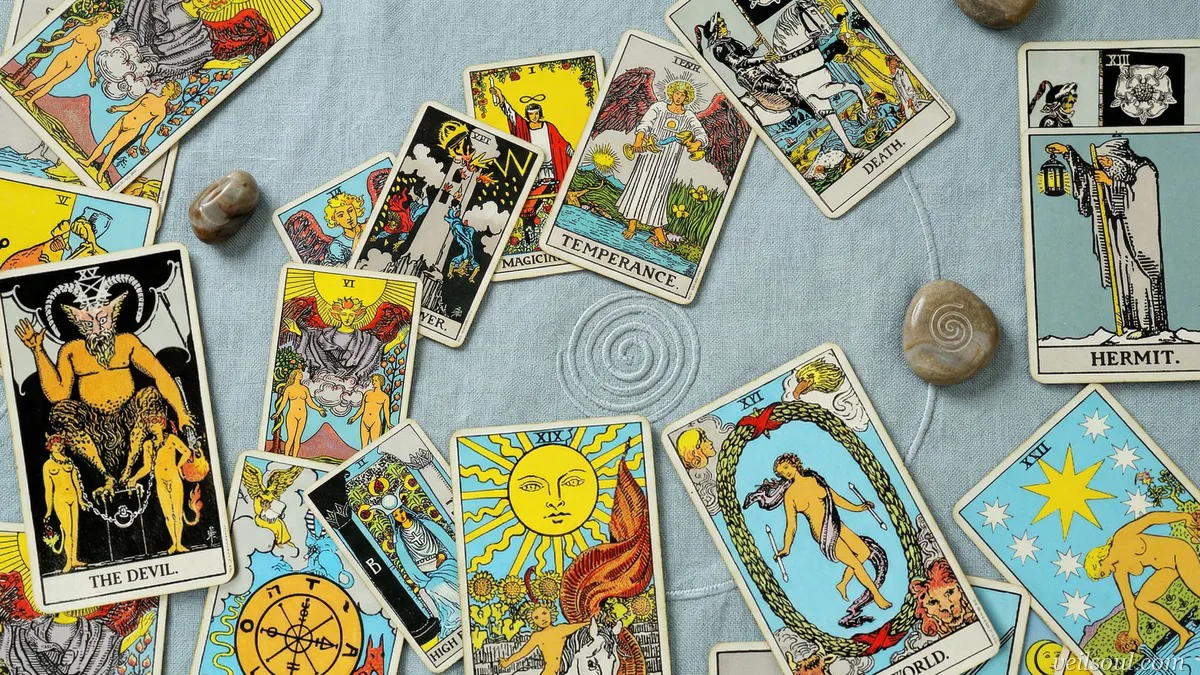
These are the eight cards this article reads closely, each with the part of mourning it reflects:
- Death: an ending that is real and cannot be undone; never a forecast of another death.
- Three of Swords: the sharp, plain pain of the loss itself.
- Five of Cups: permission to mourn what has spilled, for as long as it takes.
- Four of Swords: the exhaustion of grief and the need to rest.
- Six of Cups: memory, tenderness and the past you shared.
- Six of Swords: the slow middle stretch, moving even when it does not feel like it.
- Temperance: learning to carry the loss alongside daily life.
- The Star: hope that arrives quietly and asks nothing of you.
Grief comes in waves, and a reading can follow them
You may have heard that grief moves through five stages, from denial to acceptance. The psychiatrist Elisabeth Kübler-Ross first described those stages from her conversations with dying patients, not as a timetable for the people left behind, and grief does not have to follow them in order. Anger can return after acceptance; a song playing in a shop can undo a calm week.
Bereavement research offers another picture. The dual process model, described by Margaret Stroebe and Henk Schut, sees a grieving person moving back and forth between facing the loss (crying, remembering, missing) and attending to life (paperwork, meals, work, new routines). Both belong to grieving. Four of the cards below face the loss directly: Death, the Three of Swords, the Five of Cups and the Six of Cups. The other four turn toward the life that continues. When a spread holds both kinds, it may simply show where you are in that swing today, not that you are grieving the wrong way.
Grief is also wider than bereavement. People mourn a pet, a pregnancy, a marriage, their health, a home or a job, and each loss can be read with the same care. If yours is a relationship that ended, tarot for heartbreak after a breakup looks at that grief on its own terms.
Eight cards that keep you company in grief
Each card is described from its picture, then read upright and reversed with mourning in mind. A reversal here is not a worse version of the card; it points to the same feeling turned inward, held back, or beginning to shift.
Death: the card that agrees the ending is real
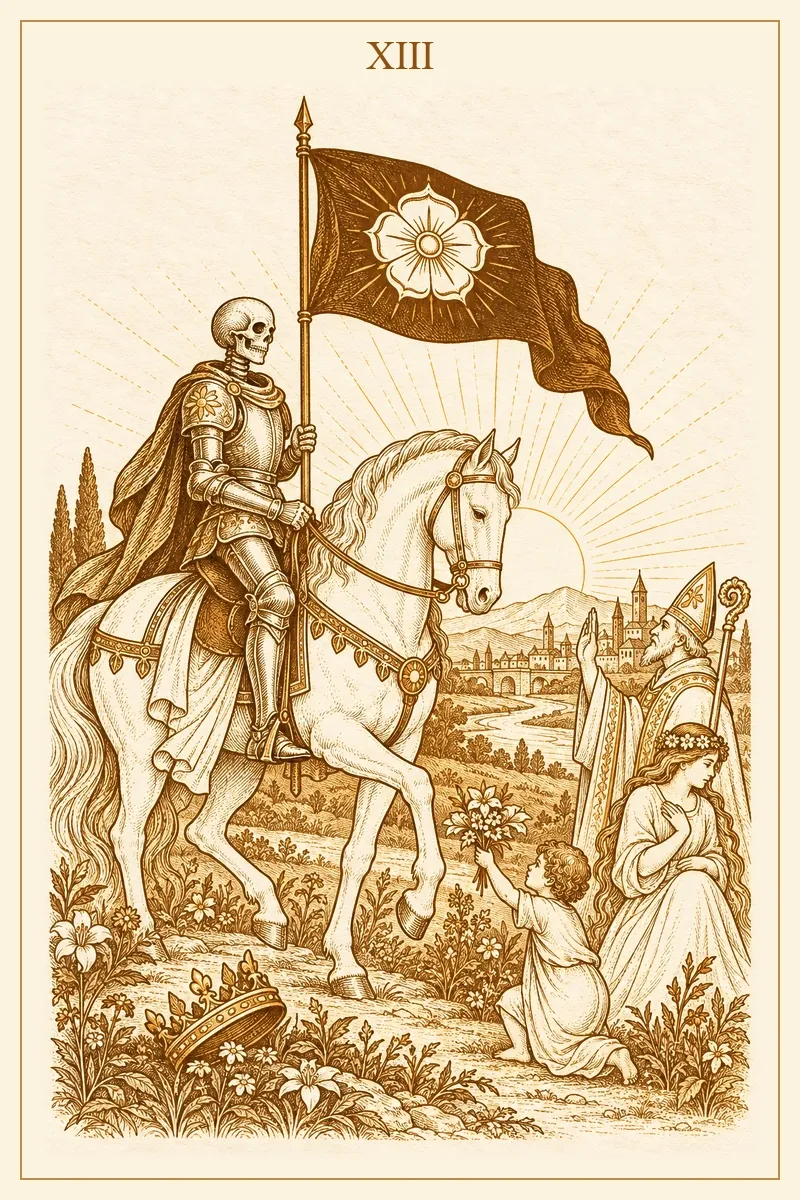
A skeleton in armor rides a white horse, holding a dark banner marked with a white five-petaled rose. A fallen crown lies among the flowers below. A small child kneels and holds out a bouquet, a woman kneels beside the child with a hand pressed to her chest, and a bishop in a tall miter raises his hand. Behind them a river winds toward a town, and the sun sits on the horizon.
In a grief reading, Death does something many comforting words cannot: it agrees with you. Something has ended, and it will not be undone. The card's traditional meaning is the close of a chapter, so here it reflects the loss you already know about. It is not a prediction that someone else will die. None of the people in the picture can stop the horse; each meets it in their own way.
Reversed, Death can reflect resistance to an ending that has already happened: keeping a room exactly as it was, or putting off a task that would make the loss official. None of that has a deadline. If the card's reputation worries you, the full meaning of the Death card, upright and reversed explains why tarot reads it as transformation rather than physical death.
Three of Swords: when the pain is simply sharp
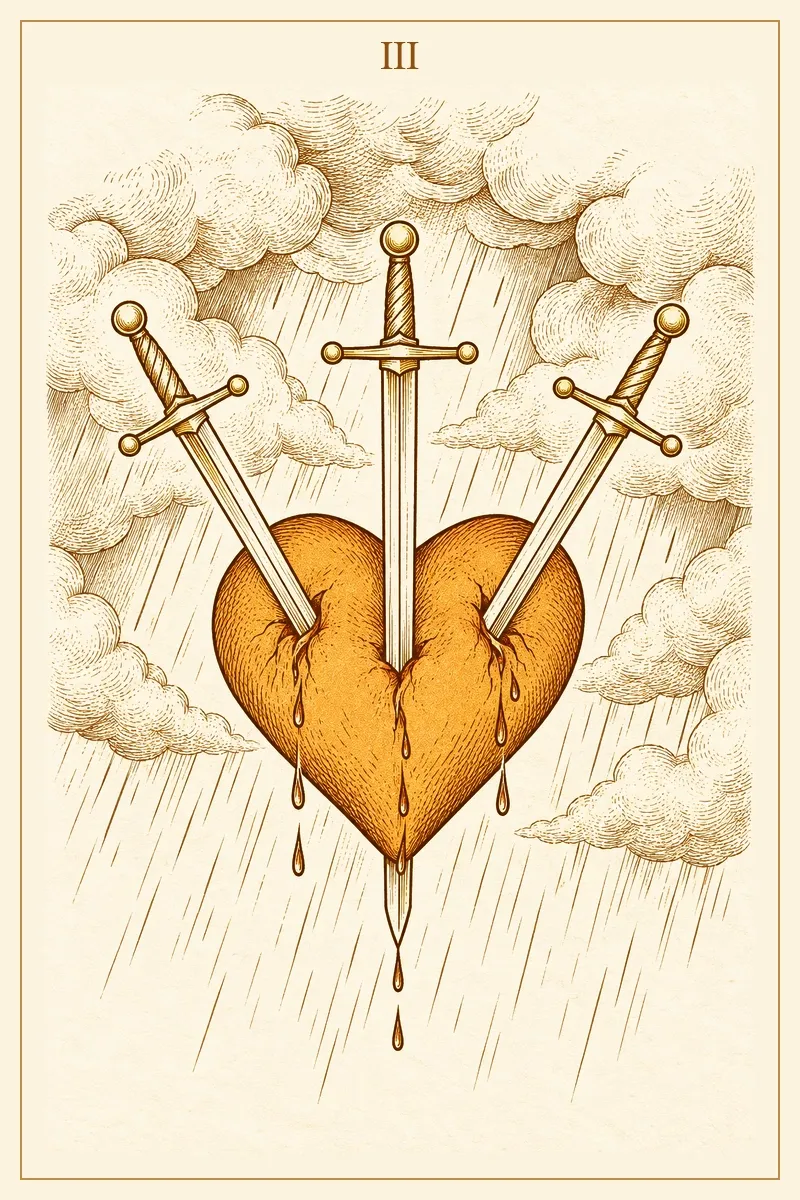
Three swords pierce a heart, drops fall from it, and rain slants down from heavy clouds behind. There is no figure and no story, only the hurt.
Upright, it reflects the raw pain of the loss: the moment the news landed, the first time you reached for the phone to call them and stopped. The card does not ask you to find meaning in the pain. It confirms that the pain is the right size for what you lost. The rain matters too: storms pass, even though nobody can tell you when.
Reversed, the Three of Swords can mean the edge of the pain beginning to dull, or grief held so tightly behind a composed face that it cannot move. If it is the second, one safe person or one page of writing may let a little of it out. For how the card reads beyond grief, see what the Three of Swords means upright and reversed.
Five of Cups: permission to stand still and mourn
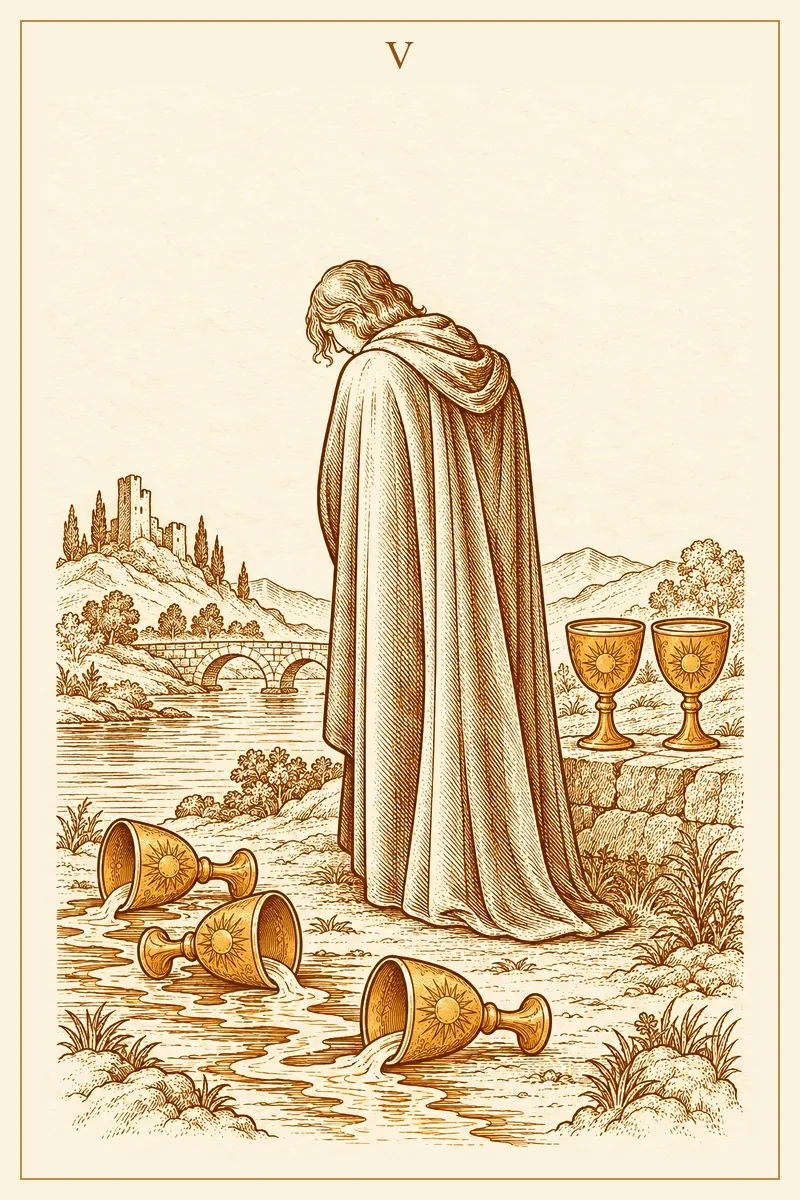
A figure in a long cloak stands with head bowed over three goblets lying on their sides, their contents running across the ground. Behind and to the right, two goblets still stand on a low stone wall. On the left, an arched stone bridge crosses the river below a castle on a hill.
Outside of grief, this card is sometimes read as a nudge to stop dwelling on what spilled and turn to the two full cups. In mourning, that can sound harsh. Read with grief in mind, the Five of Cups says that standing over what has been lost is the right thing to be doing now. The two cups will still be there later.
Reversed, the card can show the moment you notice the standing cups on your own: a friend who kept calling, a routine that steadied you. It can also reflect guilt about the words you wish you had said. Guilt and grief can travel together, and this card makes room for both. The Five of Cups card meaning goes further into regret and the hope that sits beside sorrow.
Four of Swords: grief is tiring, and rest counts
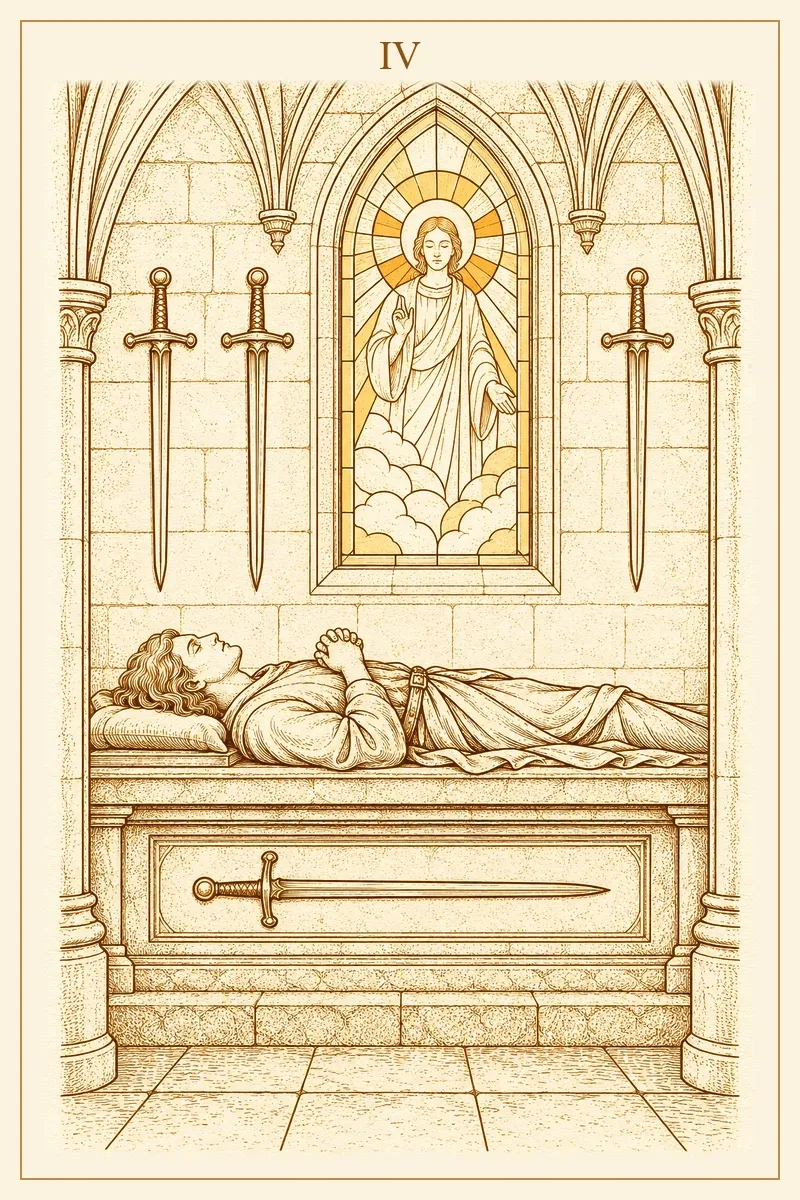
A figure lies on a carved stone slab in a quiet chapel, head on a pillow, eyes closed and hands folded. Three swords hang point-down on the wall, a fourth lies sideways in a panel on the front of the slab, and a stained-glass window shows a haloed figure with one hand raised.
Grief tires the body as well as the heart. The Four of Swords reflects that tiredness and gives you permission to rest without earning it: an early night, a day off work, a weekend with no visitors. Upright, it says that stepping back is part of mourning, not a break from it.
Reversed, the card can describe rest that will not come: lying awake replaying the last days, or filling every hour so there is no quiet for the grief to arrive in. One unscheduled hour a day helps more than a big resolution. The wider reading is in the Four of Swords as a card of rest and recovery.
Six of Cups: memory, and the love that keeps it
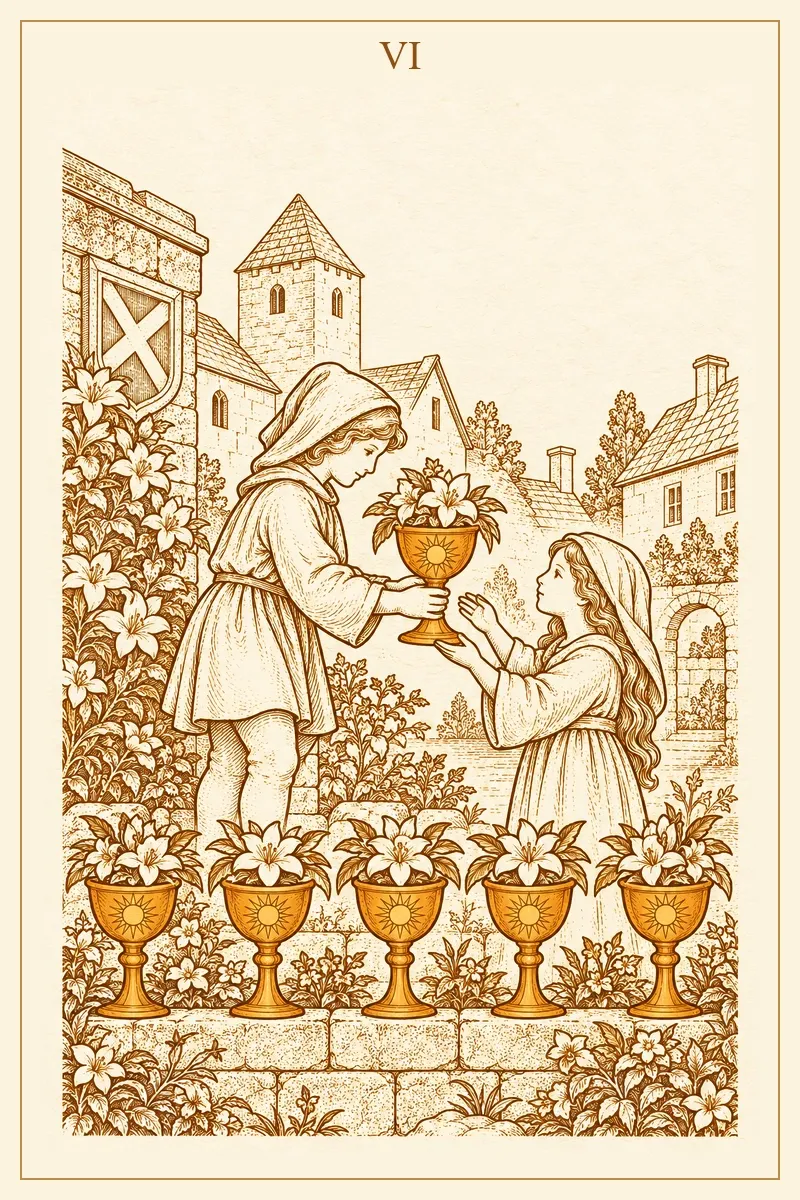
In a village courtyard, a hooded child hands a younger girl a golden goblet filled with white lilies. Five more lily-filled goblets stand in a row on the low stone wall in front of them.
The Six of Cups is the card of shared memory. In grief it brings back the small, specific things: a recipe, a nickname, a walk you used to take together. Upright, it reflects love turning toward remembrance, through photos on a shelf, a favorite dish cooked on a birthday, or a visit to a grave or a family altar.
Reversed, it can point to memories that still hurt too much to touch, or to living so fully in the past that the present has no room. Neither is a failure. Ask which memory you would like to keep close this week, and which can wait in a box. What the Six of Cups means in readings about the past and family covers its nostalgic side.
Six of Swords: the long middle stretch
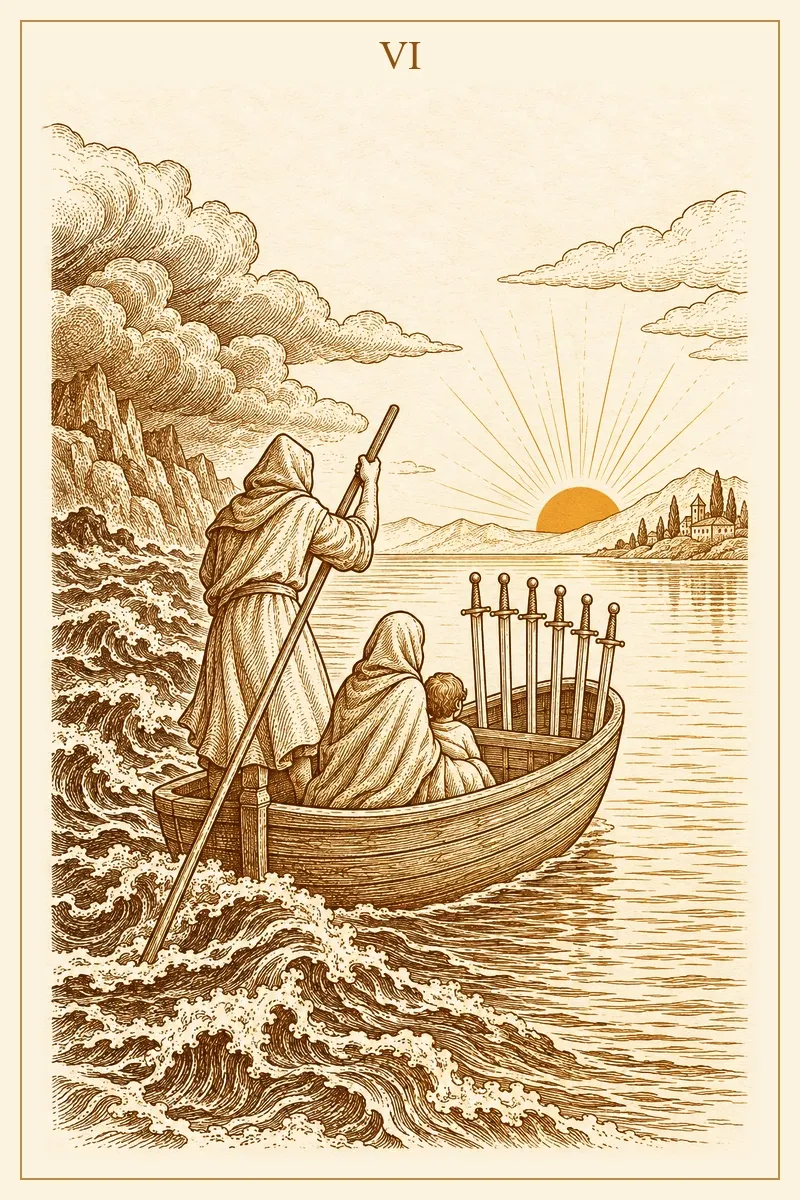
A hooded figure stands in a small boat, pushing it forward with a long pole, while a hooded adult and a child sit huddled in the middle. Six swords stand upright in the bow. Behind them, rough waves break against dark cliffs; ahead, the water is calm toward a far shore and a low sun.
This is grief's middle passage, when the worst of the storm has passed but you have not arrived anywhere yet: the drive home after the funeral, the months that blur together. Upright, the card says that the boat is moving even when you cannot feel it. The people being carried are not the ones holding the pole; for a while, others and simple routines may carry you.
Reversed, it can reflect a crossing that feels stalled, or a reluctance to move because leaving the shore feels like leaving the person behind. Moving forward does not leave your love behind. The Six of Swords meaning of moving toward calmer water reads the card for transitions of every kind.
Temperance: carrying the loss and living too
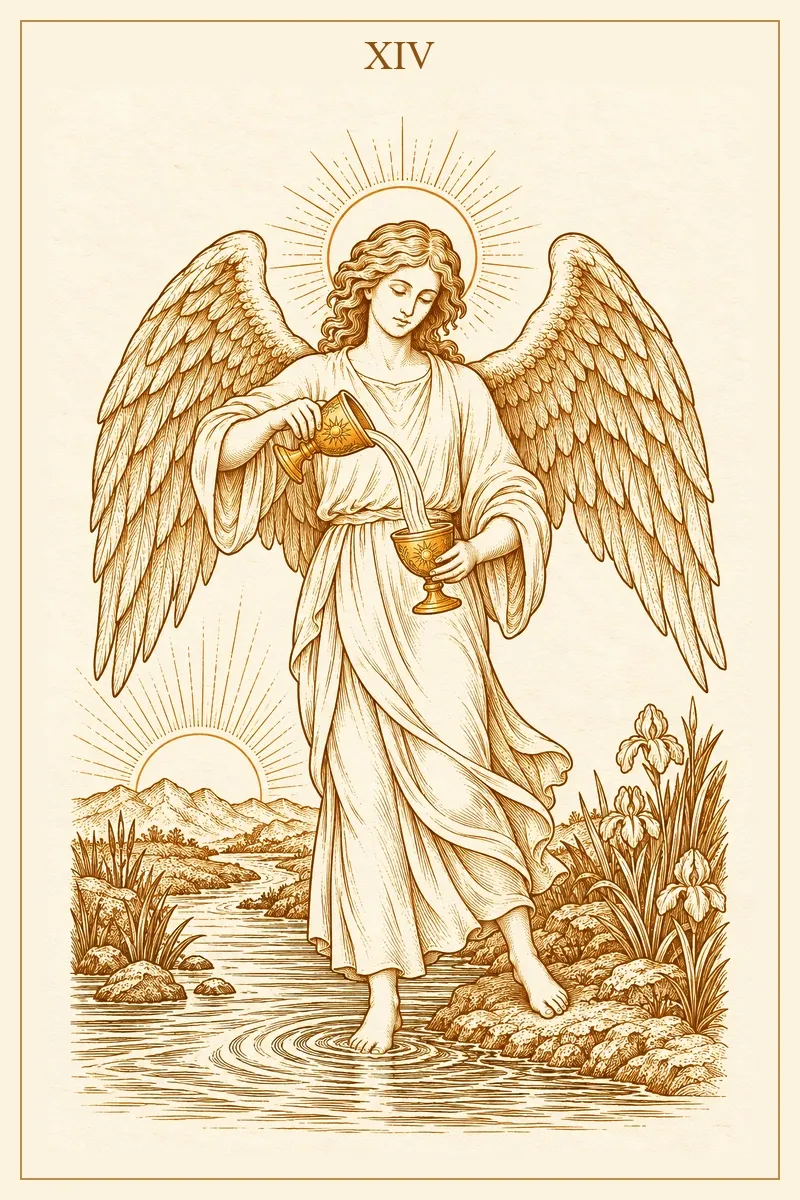
A winged angel with a halo pours water from one golden goblet into another, one foot in a stream and the other on the rocky bank. Irises grow at the water's edge, and the sun peeks over distant hills.
Temperance is the card of blending, a little at a time. In grief it reflects the point where you stop trying to get over the loss and begin to live alongside it, much like the dual process model: one foot in the water of grief, one on the bank of daily life. Upright, it says that cooking dinner on the evening of a day you cried is not a contradiction.
Reversed, the balance tips too far one way: days filled with nothing but grief, or a schedule so busy that not a drop of it gets in. Noticing which way you lean lets you adjust the pour. The Temperance card's meaning of balance and healing explains what this angel stands for.
The Star: hope that does not hurry you
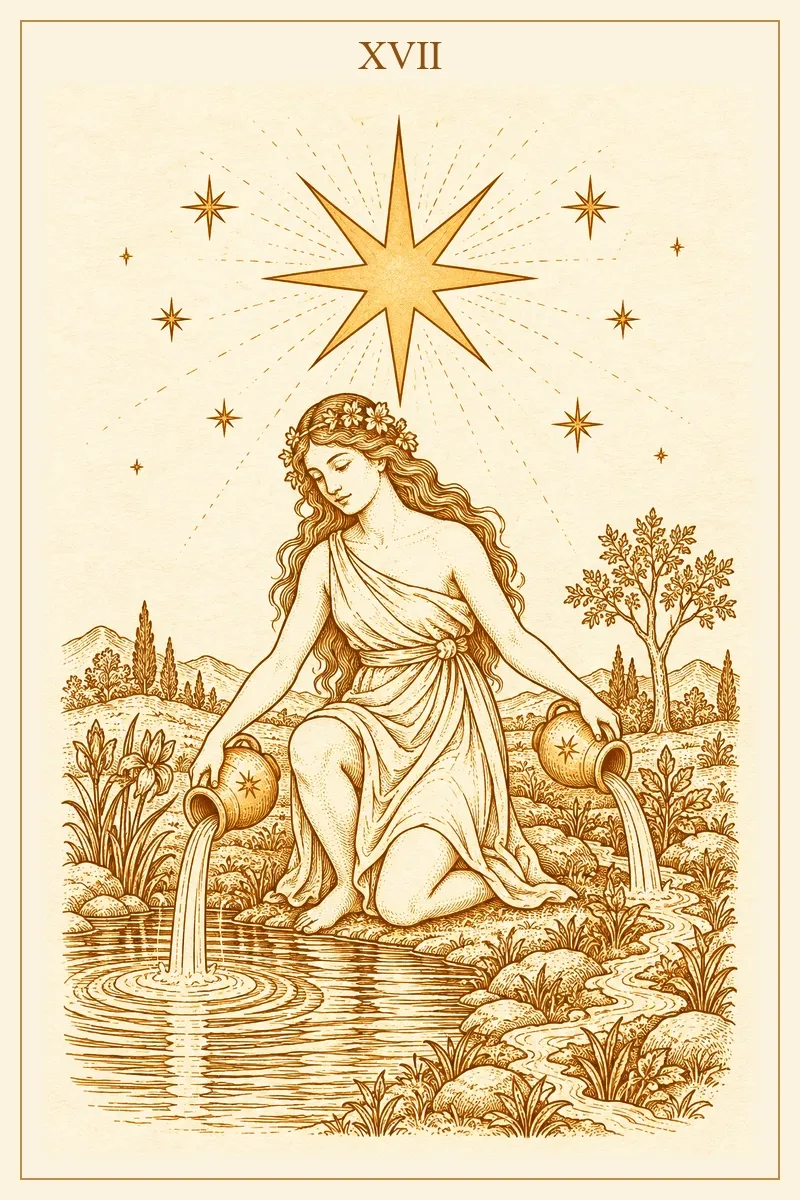
A woman in a draped gown, a wreath of flowers in her hair, kneels at the edge of a pool. She pours water from one jug back into the pool and from the other onto the land, where it runs off as a small stream. Overhead, one large eight-pointed star is ringed by smaller ones.
In the Major Arcana, the Star comes straight after the Tower, the card of collapse. In a grief reading it is a quiet reminder that water and light still exist after everything has broken. Its hope is not pressure to feel better soon; the woman is not rushing anywhere. Upright, the Star is like a light left on in a distant window: you do not have to feel its warmth yet to know it is there.
Reversed, it can reflect hope that feels far away, or hope you push back because feeling better seems disloyal. Laughing again one day does not mean your love has faded. The Star card's meaning of hope and renewal reads it upright and reversed in more detail.
Other cards worth reading gently while you grieve
Any card can appear in a grief reading. These eight carry themes that sit close to loss:
- The Tower: the shock of a sudden loss, when the structure of a life falls in a single day.
- The Moon: numbness and unreality, the fog in which nothing feels quite real.
- Nine of Swords: the worst thoughts in the middle of the night, full of "what if" and "if only."
- Ten of Swords: the feeling of hitting bottom, which is also a point that cannot sink any lower.
- Wheel of Fortune: the unfairness of chance; reversed, the protest that this should never have happened.
- Ace of Cups: love that is still flowing, now with nowhere obvious to go.
- The Sun: warmth and laughter returning, able to sit beside grief without erasing it.
- The World: a life seen whole, and a loss slowly folded into a longer story.
When a card lands that is not covered here, look it up among all 78 tarot card meanings and ask: what does this show about how I am carrying the loss today?
Reading for yourself while you are grieving
Keep a grief reading short, unhurried and on your own terms.
Choose questions that look inward
- What do I need this week that I have not asked anyone for?
- Which part of my grief am I avoiding, and is it safe to look at it today?
- What do I want to keep doing in their memory?
Set aside questions no card can answer
Some questions grief asks have no answer in a deck: whether the person who died is at peace, whether they forgave you, whether the loss could have been prevented. Drawing on these can leave you holding a card you read as a verdict. Turn the question toward yourself instead: "What would help me live with not knowing?" or "What do I wish I had said, and how could I say it now?"
Keep it small, and stop whenever you need to
One card or three is plenty. If a card lands too hard, turn it face down; you can come back to it another day, or never. Writing a few lines after each draw shows you, over weeks, how your grief is moving, and keeping a tarot journal of your readings shows a simple way to do it.
Before anniversaries, birthdays and holidays
Dates can bring grief back sharply. Drawing one card the evening before, with the question "What would help me tomorrow?", can give a day you have been dreading one small plan: calling someone, buying their favorite flowers, setting aside time alone.
The Mourning Light Spread: five gentle positions
This spread has no outcome position. Every position asks about the present, so nothing on the table claims to know your future.
- Where my grief is today: the shape the loss takes right now, seen without judgment.
- Where my love wants to go: what the love behind the grief would like to do: remember, speak, make something, care for someone.
- The care I keep postponing: the rest, help or permission you have been holding back from yourself.
- What is holding me up: a person, a habit, a place or an inner strength already supporting you.
- A small light I can let in: one gentle opening for the coming days, not a demand to feel better.
Lay the cards in a row, perhaps with a photo of theirs nearby, and stop after any card if that is enough for today.
Hypothetical example: the week of a mother's birthday
This example is invented to show how the positions work together. Imagine a woman eight months after her mother's death, facing the first birthday without her. She asks, "What would help me through this week?"
- Where my grief is today: Three of Swords. After a few calmer weeks, the birthday has brought the pain back to the surface. The card says this is not a setback; it is the wave this date brings.
- Where my love wants to go: Six of Cups. Her love wants to remember out loud, starting with the soup her mother made every winter.
- The care I keep postponing: Four of Swords. She has agreed to a work dinner and a weekend trip that same week. The card points to rest she has not allowed herself.
- What is holding me up: Three of Cups. Her sister and two old friends have kept checking in, and she realizes they could share the day with her.
- A small light I can let in: The Star. A quiet hope that the birthday might hold a little warmth as well as sorrow.
The cards do not promise an easy week. They suggest a plan: move the work dinner, cook their mother's soup with her sister on the birthday, and ask her friends for company that evening. The loss is unchanged, but she meets the date with people beside her.
When grief needs more than a reading
If grief makes daily life very hard for a long time, if you cannot eat, sleep or work for weeks, or if hopelessness settles in and does not lift, talk to a grief counselor, your doctor or someone you trust. Hospices, hospitals and community groups may run bereavement groups open to families. If you have thoughts of harming yourself, contact your local emergency number or a crisis line in your country right away.
Frequently asked questions
Can tarot help me contact someone who has died?
No. This article treats the cards as prompts for your own reflection, not as messages from the dead, and a card cannot speak for the person you lost. A reading can help you notice what you still want to say to them; writing it as a letter, or saying it aloud at a grave or a place you shared, is one way to say it.
Does drawing the Death card mean someone else will die?
No. In tarot, Death stands for an ending or a change of chapter, and it does not predict a physical death. In a grief reading it reflects the loss you are already living with. If the card frightens you right now, put it back in the deck and return to it another time.
How soon after a loss is it okay to use tarot?
There is no rule. Some people want the quiet of a single card in the first days; others cannot face a deck for months. Early on, keep to one card about how to get through today.
Can tarot tell me when my grief will end?
No. A card cannot set a date for feeling better, confirm what someone else felt, or decide an outcome. Grief does not run on a schedule; it can soften and change shape without ever fully disappearing. A reading can show how you are carrying the loss now and what might lighten it this week.
What if I draw a hopeful card and it feels too soon?
That reaction makes sense. The Star or the Sun can feel like being told to cheer up. Read it as a sign of what is still possible, not an instruction for today, and leave it in your journal until it feels kinder.
Can I use tarot for grief over a pet, a breakup or a lost job?
Yes. Grief follows any loss that mattered, and the cards and spread here work for all of them. "Where my love wants to go" can mean the love you gave an animal, a partner or work you cared about.
Carrying the love forward
Grief lasts because love lasts. The cards will not take the loss away, and they do not need to. What they can offer is a few minutes of honest company: a picture of what hurts, a reminder of what holds you, and one small next step. When you want to sit with a single question about your own grief, you can draw a gentle reading on your own question and take it one card at a time.