Using tarot for self-discovery means treating each card as a question about you rather than a verdict on you. You draw, describe what you see, and ask where that theme already shows up in your days; the knowing comes from your own answers, written down and tested against how you actually live. Over weeks, those answers sketch a clearer picture of what you value, what you avoid and what you are ready to grow into.
The cards have real limits here. They cannot assign you a personality type, diagnose anything, reveal a fixed destiny or tell you who you are supposed to be. What they can do is slow you down long enough to notice something you already half knew. Seventy-eight images give you a wide vocabulary for that noticing, and a handful of them speak to inner life with unusual directness.
At a glance, these five cards make useful mirrors when the question is "who am I right now?":
- The High Priestess: what you sense before you can explain it.
- The Hermit: who you are when nobody's expectations are in the room.
- The Moon: fears, longings and dreams you have not looked at in daylight.
- The Star: the steady self that remains after a hard season.
- The World: gathering the pieces into a self you can live with.
Below you will find how the mirror idea works, each card upright and reversed, the five-position Mirror Within spread with an illustrative reading, writing prompts, and ways to make the practice part of ordinary life.
How a card turns into a question about you
Tarot images are built from archetypes: recurring human figures and situations such as the seeker, the guide, the wanderer at night, the one who starts over. Carl Jung wrote about archetypes as patterns the psyche keeps returning to, and modern readers borrow that idea to explain why a picture drawn for strangers can still feel personal. You do not need any theory to use it, though. You only need to look at the card and ask, "Where is this in me?"
That small question changes what a reading is for. A personality quiz places you in a category and stops there. A card meets you where you are on a particular morning, so the same image can say something different in March than it does in October. The answer belongs to you; the card only frames it.
In practice, a self-discovery reading does three kinds of work:
- Showing blind spots. Habits, assumptions and gifts you take for granted are hard to see from inside. A card that irritates you, or that you want to skip past, deserves a second look, because resistance can point at something unexamined.
- Holding contradictions. You can be brave and afraid in the same week, close to someone and in need of distance from them. A spread with several cards lets two true things sit side by side without forcing you to pick one story.
- Tracking change. If you keep notes, you will see your relationship with certain cards shift. The Tower might read as pure threat during one year and as relief in a later one, once you have lived through a structure falling and found you were still standing. The change in how you read it is a record of how you have changed.
Five mirror cards, upright and reversed
Any card in the deck can serve as a mirror, but these five ask the questions self-discovery keeps circling: what do I know, who am I alone, what am I hiding, what remains, and how does it all fit together. Read the upright and reversed notes for each as starting points, then answer the reflection question in your own words.
The High Priestess: what you already sense
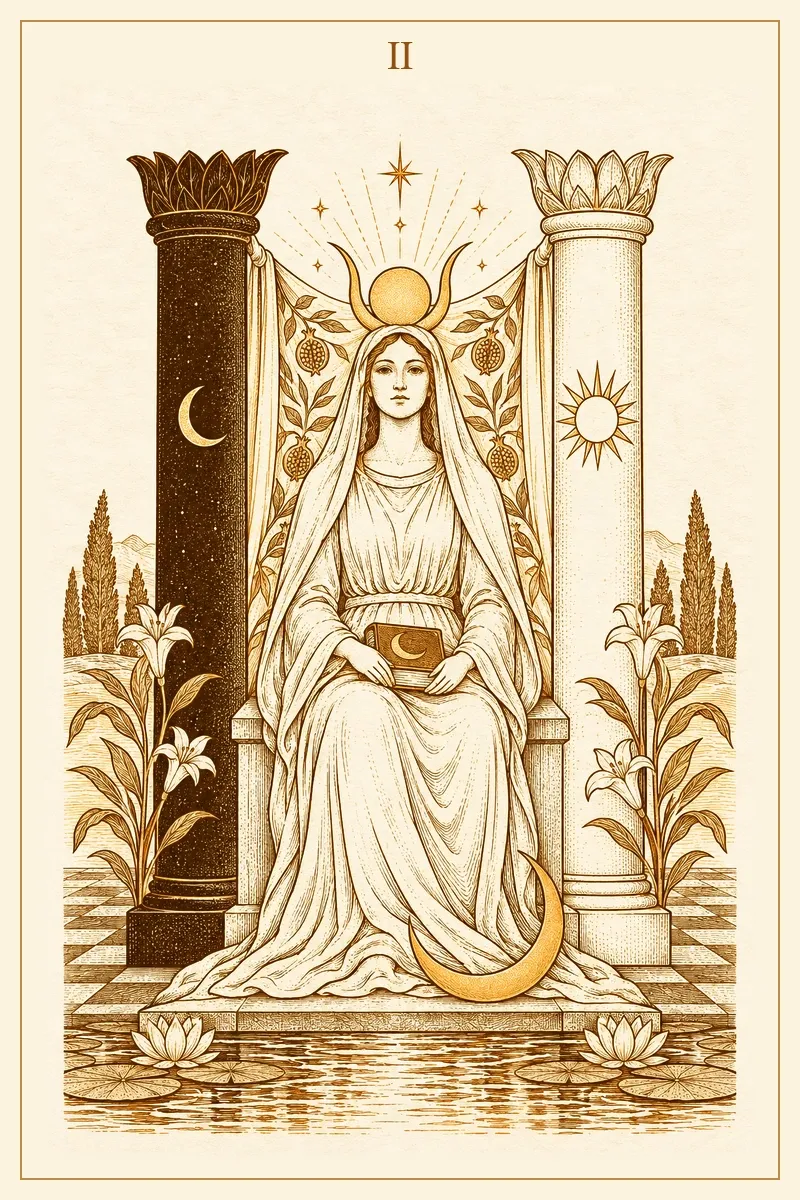
The High Priestess sits between two pillars, one dark and marked with a crescent moon, the other pale and marked with a sun, with a curtain of pomegranates behind her and a closed book resting in her lap. She keeps something in reserve. In a self-discovery reading she points to quiet knowing: the impression you formed in the first minute of a conversation, the hunch about a job that you talked yourself out of. Her wider meanings are laid out in our High Priestess guide; here the focus is on what she asks of you.
Upright, she invites you to trust your intuition and to test it. Write the hunch down before you argue with it, then watch over the following days whether events bear it out. That habit of recording and checking builds a working relationship with your inner sense instead of blind faith in it.
Reversed, she can describe a voice drowned out: too much input, too many opinions, a calendar with no silence in it. She may also point to a truth you are keeping from yourself because acting on it would be inconvenient. In love this can look like ignoring a small, persistent discomfort; at work, like overriding the sense that a role no longer fits.
Reflection: What do I know about my situation that I have not said aloud, even to myself?
The Hermit: who you are without an audience
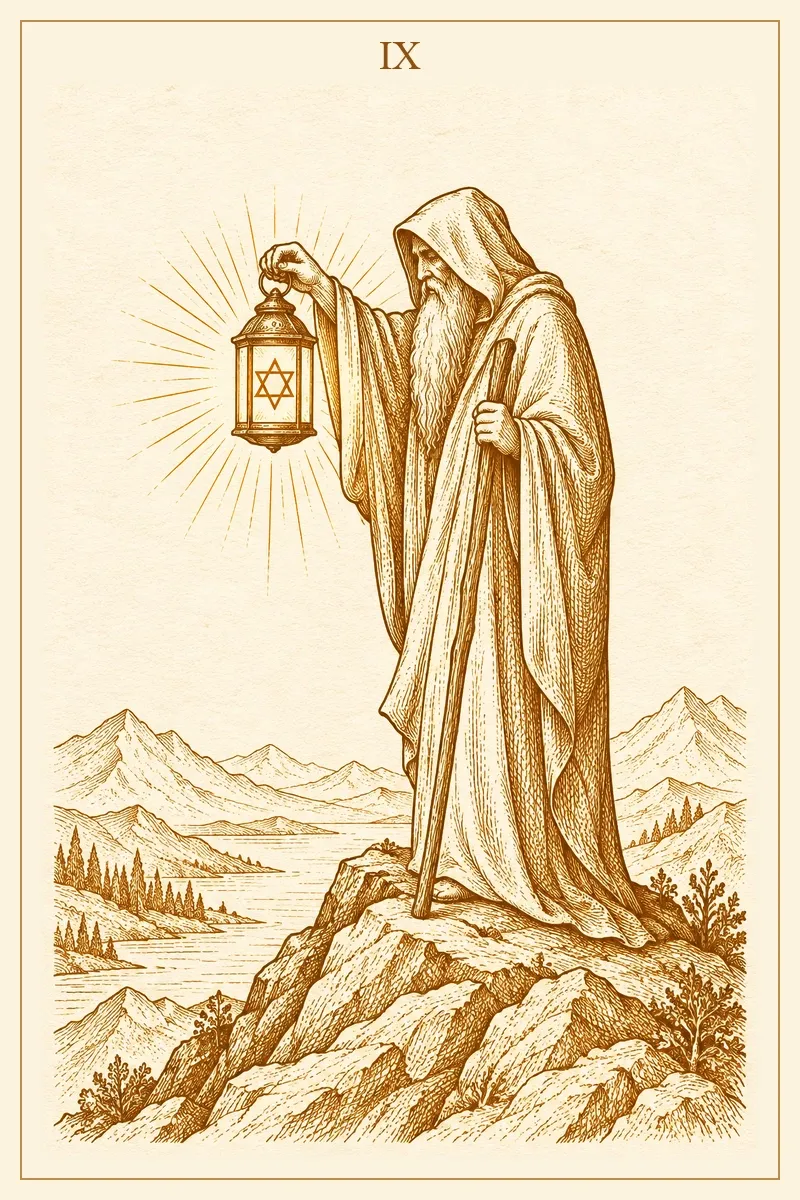
The Hermit stands on a rocky height above a lake and a range of mountains, leaning on a staff and holding up a lantern with a six-pointed star inside. He has climbed away from the crowd on purpose. In self-discovery he stands for the self that appears when roles fall away: not the colleague, the partner or the dutiful child, just the person. You can read more about his broader symbolism in The Hermit's card guide.
Upright, he suggests chosen solitude: an evening without your phone, a walk alone, a weekend where your own preferences decide the plan. The aim is to hear your opinions without immediately checking them against anyone else's.
Reversed, the card can lean two ways. One is isolation that has stopped being restful and started to feel like hiding. The other is the opposite problem: so much company and feedback that you no longer know which views are yours. Ask which one fits before deciding what to change.
Reflection: If no one's approval were at stake, which of my current choices would I keep, and which would I drop?
The Moon: the parts you keep in the dark
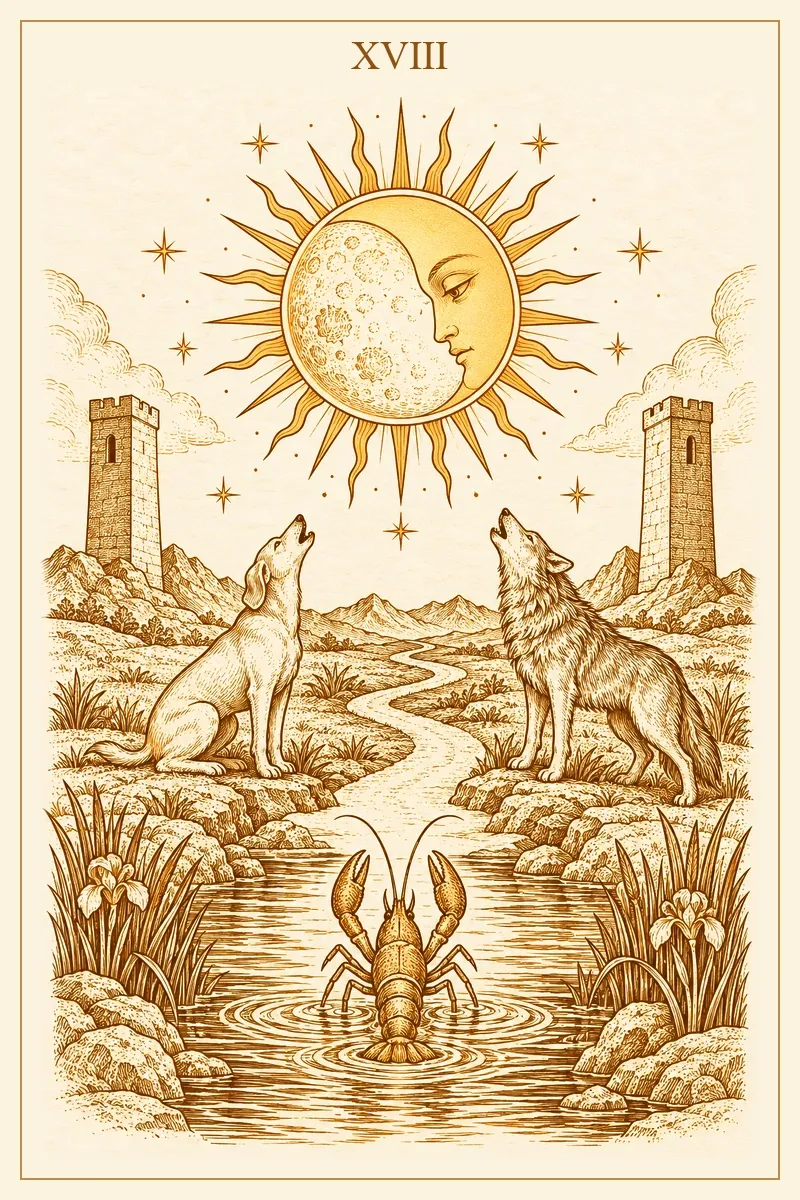
The Moon shows a face inside a lunar disk, a dog and a wolf howling on either side of a winding path, two towers in the distance and a crayfish climbing out of a pool. Everything is half lit. In a self-discovery reading the card points toward material your daytime self would rather not examine: fears, envy, longings, old stories about who you are allowed to be. Our guide to The Moon covers its other meanings, including confusion and illusion.
Upright, The Moon asks you to slow down when things feel unclear. Not every anxious image in your mind is a fact. Separate what you know from what you fear, and give dreams and recurring moods some attention, as information rather than prophecy.
Reversed, it can mark a fog beginning to lift: a fear named, a self-deception noticed, a pattern you can finally see from outside. It may also show you avoiding inner work by staying busy. If this card unsettles you, the approach in shadow work with tarot offers a slower, gentler way in.
Reflection: Which part of myself have I been reluctant to look at, and what do I imagine I would find?
The Star: what remains after a hard season
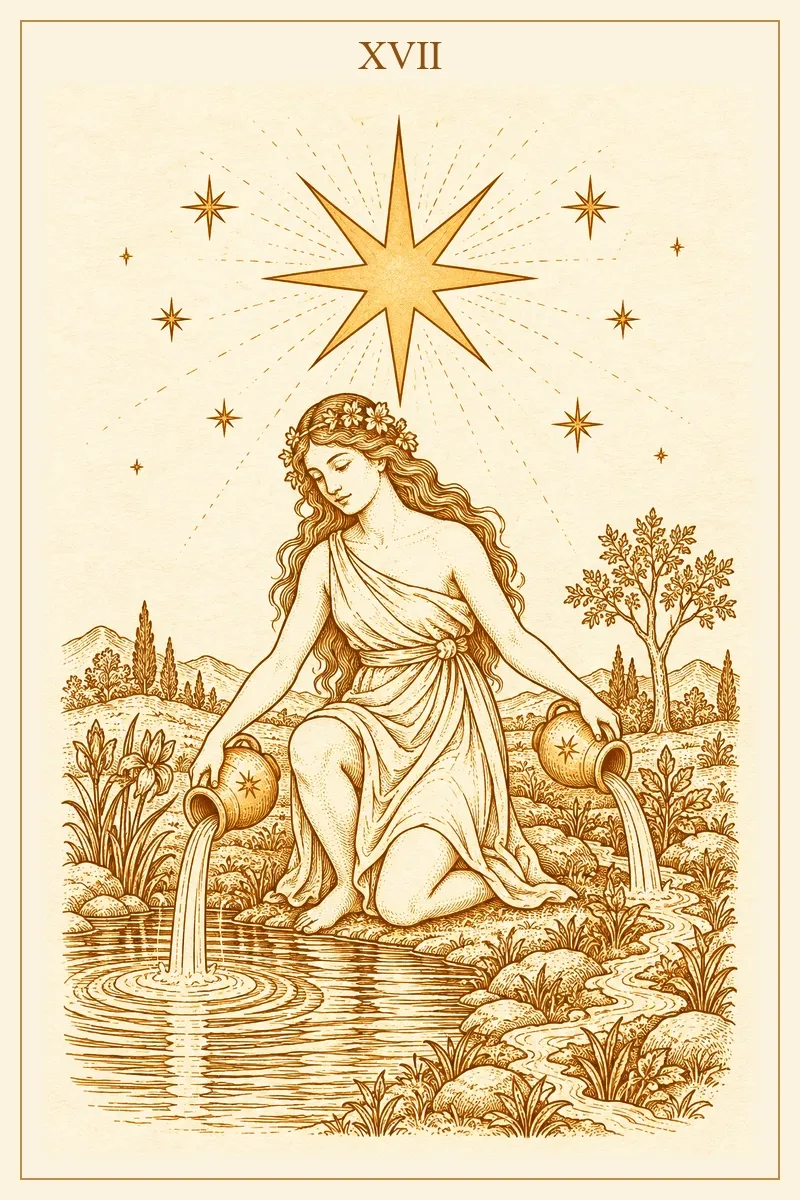
The Star shows a woman kneeling at the water's edge beneath one large eight-pointed star and several smaller ones, pouring from two jugs: one into the pool, one onto the earth. She is unguarded and unhurried. In the sequence of the Major Arcana the card follows The Tower, and in self-discovery it describes what is left once a false structure has fallen: values, tenderness, a sense of direction that never depended on the thing you lost. Its full range is explained in the Star meaning guide.
Upright, it points to renewal and self-trust coming back. You may notice you feel most like yourself during simple, unperformed moments: cooking, gardening, helping a friend, making something with your hands. Those moments are evidence about who you are.
Reversed, The Star can describe discouragement, a stretch where hope feels thin, or a habit of measuring your worth against an ideal you cannot reach. The card does not ask you to force optimism; it asks for one small act of care, the kind you would offer anyone else in your position.
Reflection: When do I feel most at ease being exactly who I am, and what is present in those moments?
The World: integration, not perfection
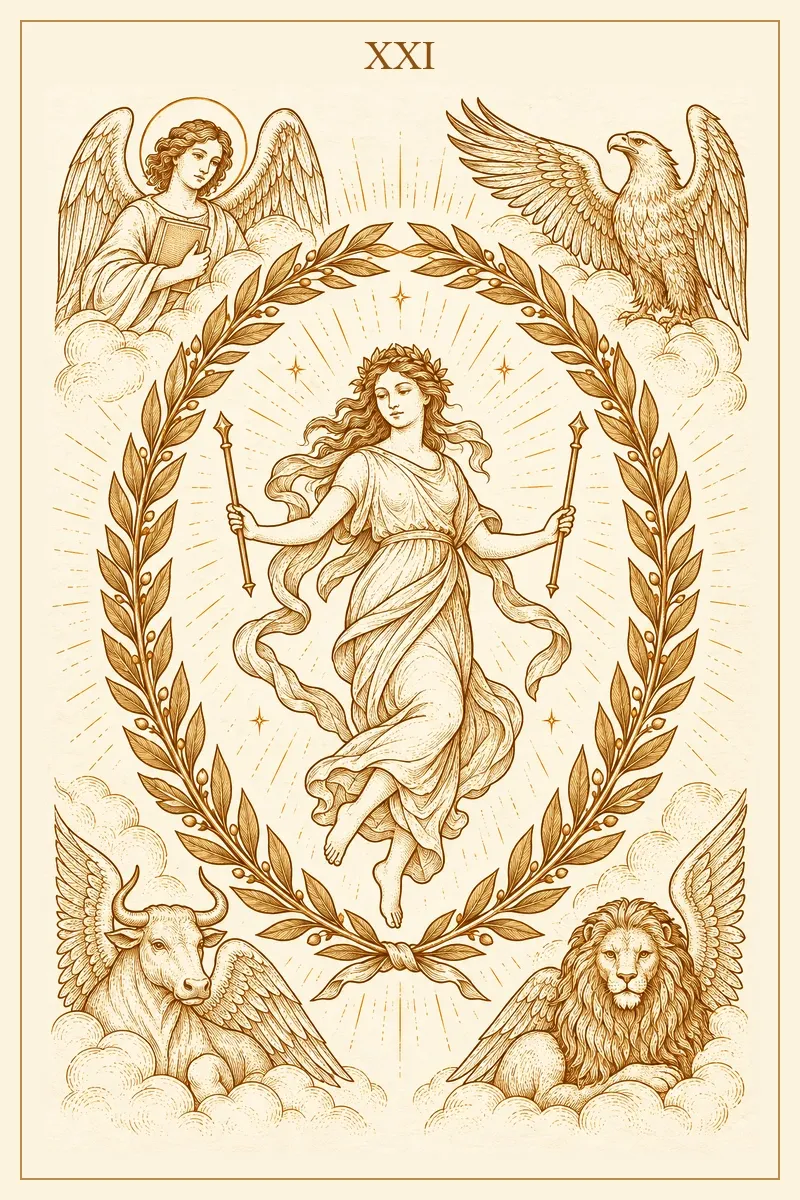
The World shows a dancer holding two wands inside an oval laurel wreath, with an angel, an eagle, a bull and a lion in the four corners. Those four figures can stand for the four elements, held in balance around her. In a self-discovery reading the card speaks about integration: strengths and flaws, past chapters and the present one, all recognized as yours. Our World tarot guide explores its themes of completion in more detail.
Upright, The World suggests a sense of fit: a stage of life where who you are and how you live line up. It does not mean you are finished. Self-discovery has no final exam; the wreath is a circle, and the next cycle begins from a fuller self.
Reversed, it can show a chapter you have not closed: a former identity you still carry, an achievement you do not let yourself enjoy, a lesson you keep relearning. Naming what is unfinished is the first step toward completing it.
Reflection: Which parts of my history am I ready to accept as part of me, rather than as mistakes to hide?
The Mirror Within: a five-card spread for knowing yourself
This spread looks at several layers of identity at once. It suits a transition, a period when you feel out of touch with yourself, or a regular check-in. Before you begin, find a place where you will not be interrupted, take a few slow breaths and say a simple intention, such as "I want to see myself honestly and kindly." Shuffle until you feel settled, then lay five cards in a row.
- The face I show the world: how I come across right now, and the energy I put out.
- The face I keep hidden: what I keep private or hold back because it feels too tender, too odd or too big to show.
- My core: the quality that runs through every version of me, across years and circumstances.
- My growing edge: where I am being asked to stretch, learn or change.
- What I offer: what becomes possible for others when I live as myself.
Read positions one and two together first. The gap between them is the heart of this spread: the wider it is, the more energy you may be spending on performance. Then read position three against both, asking whether your core shows up in public, in private or in neither. Positions four and five turn the reading toward action. Let the images speak before you reach for memorized keywords; your first description of each picture is part of the reading.
An illustrative reading with the Mirror Within
The example below is invented to show the method; it is not a real person's story. Picture someone in their thirties who has just moved to a new city for work. Friends describe them as dependable, yet they feel as if they are playing a part. Their question: "Who am I, now that my old routines are gone?"
- The face I show the world: Knight of Pentacles. Reliable, careful, always on time, which matches how new colleagues see them.
- The face I keep hidden: Page of Cups. A playful, sensitive, imaginative side that has had no outlet since the move.
- My core: The High Priestess. A rich inner life and a strong sense of what feels true, even when it cannot be explained.
- My growing edge: Two of Wands. Looking past the familiar and planning what this new chapter could hold.
- What I offer: Three of Pentacles. Collaboration and care for craft, making things well alongside others.
Reading the first two cards together, the person sees a split: the dutiful Knight runs the weekdays while the Page has been packed away with the moving boxes. That is not a flaw; it is a clue. The High Priestess in the core position suggests that their sense of self rests on inner perception more than on output, which helps explain why a life of pure reliability feels hollow.
The Two of Wands asks them to plan instead of waiting for the new city to shape them. The Three of Pentacles hints at how: the Page's imagination and the Knight's steadiness could meet in a shared, hands-on project such as a pottery studio, a community garden or a volunteer building crew. The next step they write down is small: sign up for one evening class within two weeks and notice which part of them shows up there.
Notice what this reading did not do. It did not tell the person who they are. It gave them five angles, one tension worth exploring and an action they chose for themselves.
Questions to write down after a reading
Writing turns a passing impression into something you can return to. After a reading, pick one or two of these prompts; there is no need to answer them all in one sitting.
- Which card felt most uncomfortable, and what might that discomfort be protecting?
- If my core card could speak to my hidden card, what would it say?
- Which card has turned up in several recent readings, and what message have I not fully taken in?
- Write a short letter to myself in the voice of the card that surprised me most.
- What would knowing myself look like on an ordinary Tuesday? What would I do differently?
Keep the answers in one notebook or file along with the date, the question, the cards and your first impressions. A simple format is set out in our guide to keeping a tarot journal, and rereading old entries after a few months is where patterns begin to show.
Turning reflection into a regular practice
Self-knowledge grows through repetition more than through one dramatic reading. Choose a rhythm that suits your life; the habits below can be combined or used alone.
A single card in the morning
Draw one card and ask, "What part of me needs attention today?" Before looking up any meaning, describe the picture in two or three sentences and note what it brings to mind. In the evening, spend a minute recalling where that theme appeared. The point is attention, not accuracy.
A monthly Mirror Within check-in
Once a month, lay the five-card spread above and compare it with the previous month's. Over a season you will see which positions change and which hold steady. The steady ones point to your core; the changing ones point to your edges and to whatever is in motion.
Shadow sessions, when you feel ready
When you feel resourced, set aside time to look at the parts of yourself you have rejected or denied. Ask questions such as "What am I not seeing about myself?" or "What strength is hidden inside my biggest fear?" Meet the answers with curiosity rather than judgment, and stop if the session leaves you more shaken than clear.
Keeping yourself honest
Reading for yourself has one built-in risk: you already know what you want the cards to say. Decide the question and the meaning of each position before you draw, write your interpretation before you consult any guide, and resist redrawing until a preferred answer appears. The step-by-step method in how to read tarot for yourself covers these habits in depth.
Other ways to listen to yourself
Tarot sits well alongside other reflective habits. Each of these gives the insights from a reading somewhere to land:
- Quiet sitting. Rest your eyes on a single card for five minutes and breathe. Details you skimmed past during the reading may come forward.
- Making something. Sketch, collage or write a short poem from a card. Creative work reaches feelings that analysis misses.
- Walking outside. Carry your daily card in mind and notice where its theme appears around you: a closed gate, a stream, a crowded street corner.
- Talking it through. Share a reading with a trusted friend and ask what they recognize in it. Their view can fill in what no single card shows.
Frequently asked questions
Can tarot tell me who I really am?
No. Tarot cannot define your identity, measure your personality or confirm a fixed purpose for your life. It offers images and questions; the self-knowledge comes from your honest answers and from how those answers hold up in daily life. Treat any reading as a draft you are free to revise.
Which card represents me?
There is no single correct card. Some readers choose a court card that matches their temperament as a significator, while others pick whichever card they feel drawn to that day. You can also draw at random with the question "How am I showing up right now?" and let the answer change over time.
What if I keep drawing the same card?
A card that returns can mark a theme you have not fully addressed. Write down what was happening each time it appeared and how you responded. If nothing in your life connects to it, simply note it and move on; a repeat is a prompt to reflect, not a warning.
Is tarot for self-discovery the same as shadow work?
Shadow work is one part of it. Self-discovery also means recognizing your strengths, values and sources of joy, the things The Star and The World point toward. You can begin with that lighter side and move into shadow questions once you feel steady.
Can a self-discovery reading replace therapy?
It cannot. Tarot can support reflection, but it is not a treatment for anxiety, depression, trauma or any other health concern. If a reading brings up something heavy, a licensed counselor or doctor is the right person to talk to, and you can bring your journal along if that helps.
What should I do if a reading leaves me feeling worse?
Pause and put the cards away. Ground yourself with something physical, such as a glass of water, a short walk or a call to someone you trust. Later, look at the reading again and ask what fear it touched rather than what it predicted. A card is an image, and the meaning you take from it is still yours to choose.
You are more than one card
Self-discovery through tarot is not a hunt for a final answer to "who am I?" It is an ongoing, honest and kind relationship with yourself that deepens each time you sit down with a real question. You are not one card. You are closer to the whole deck: the fool and the sage, the hermit and the lover, the tower and the star, each showing up in its season.
When you want a quiet place to begin, try a reading with the Mirror Within positions in mind, and write down the first thing you notice about yourself.