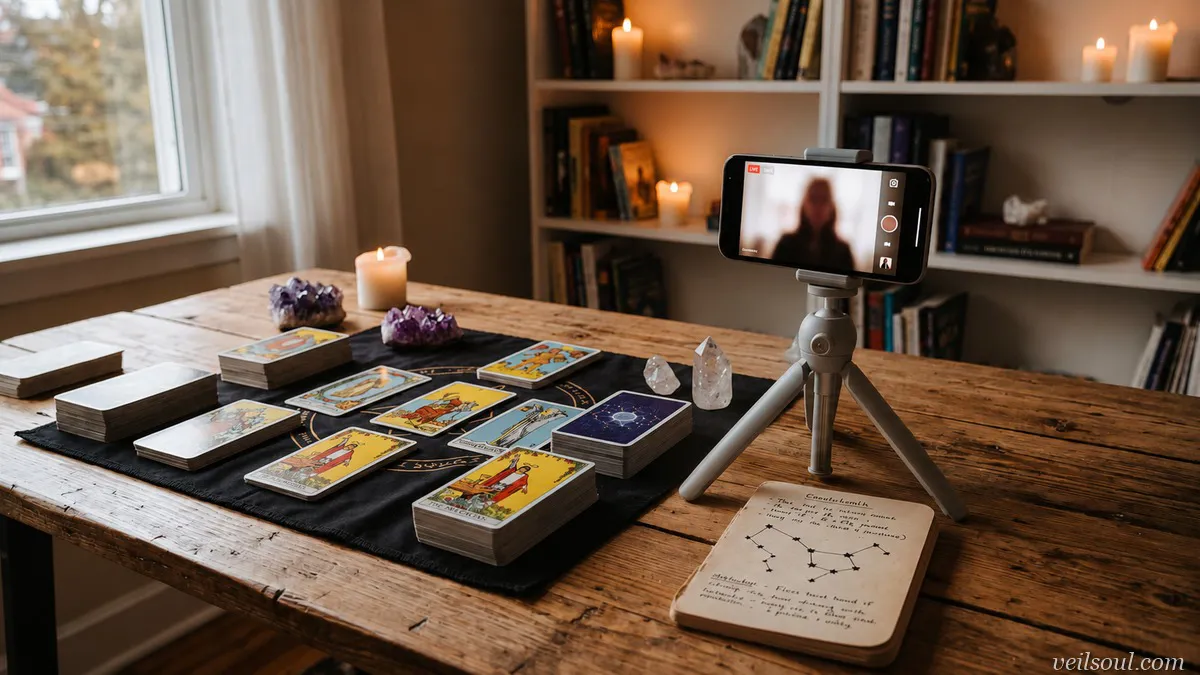
Several cards have a fair claim to be the most powerful tarot card, and none of them wins in every reading: the honest answer is a set of perspectives, not one fixed name. The card that carries the most weight changes with the reading tradition you follow and with the question in front of you. Readers who think in terms of sequence point to The World, the last card of the Major Arcana; readers who define power as will point to The Magician; readers who watch for sudden change name The Tower or Death. A practical answer sits underneath all of them: the most powerful card in a reading is the one that shows you something true you were not ready to hear.
None of these cards has power over your life. Tarot cannot confirm an outcome, read another person's mind or set a date. What a card can do is gather your attention around one theme. That is the sense of "power" used here: how strongly a card reorganizes the way you see a situation.
At a glance, here is how each perspective answers the question:
- The World: completion; the final Major Arcana card, holding the whole journey in one image.
- The Magician: will and agency; the tools of all four suits within reach.
- Strength: power named outright, but as patience and steady courage rather than force.
- Death: the clean ending that clears ground for what comes next.
- The Tower: a sudden truth that knocks down a false structure.
- Judgement: a calling you cannot pretend you did not hear.
- Four of Cups, Two of Swords, Eight of Cups: quiet Minor Arcana cards that ask you to act.
- The Sun and The Star: gentle cards that can carry more weight than the frightening ones.
Five lenses for measuring a card's power
"Powerful" can mean at least five different things, and naming which one you mean turns a vague question into an answerable one.
- Rank in the deck. The 22 Major Arcana describe large life themes, and the 56 Minor Arcana describe the daily scenes where those themes play out. On this lens the trumps outrank the rest, and the last cards of the sequence hold the most gathered meaning. The overview of how the Major and Minor Arcana differ explains the split in more depth.
- Force of change. Some cards describe events that are hard to undo: an ending, a collapse, a decisive turn. Death and The Tower lead here.
- Agency. Some cards describe what you can do rather than what happens to you. The Magician and Strength belong to this lens.
- Clarity of message. A card whose meaning is hard to argue with in context, such as The Sun as a warm yes or Judgement as an unmistakable call.
- Personal resonance. The card that touches your own unresolved question. This lens has no fixed winner.
The lenses can disagree: a spread full of trumps feels weighty on the first lens, yet the card that changes your week might be a modest Two. If you ever lay out a spread made entirely of trumps, the piece on drawing all Major Arcana in a reading covers what that cluster can suggest.
Endings and completion: Death, The Tower and The World
Three cards answer the question through events that close a chapter. They differ mainly in pace: Death is a deliberate ending, The Tower a sudden one, and The World an ending that arrives as fulfillment.
Death: the ending that clears ground
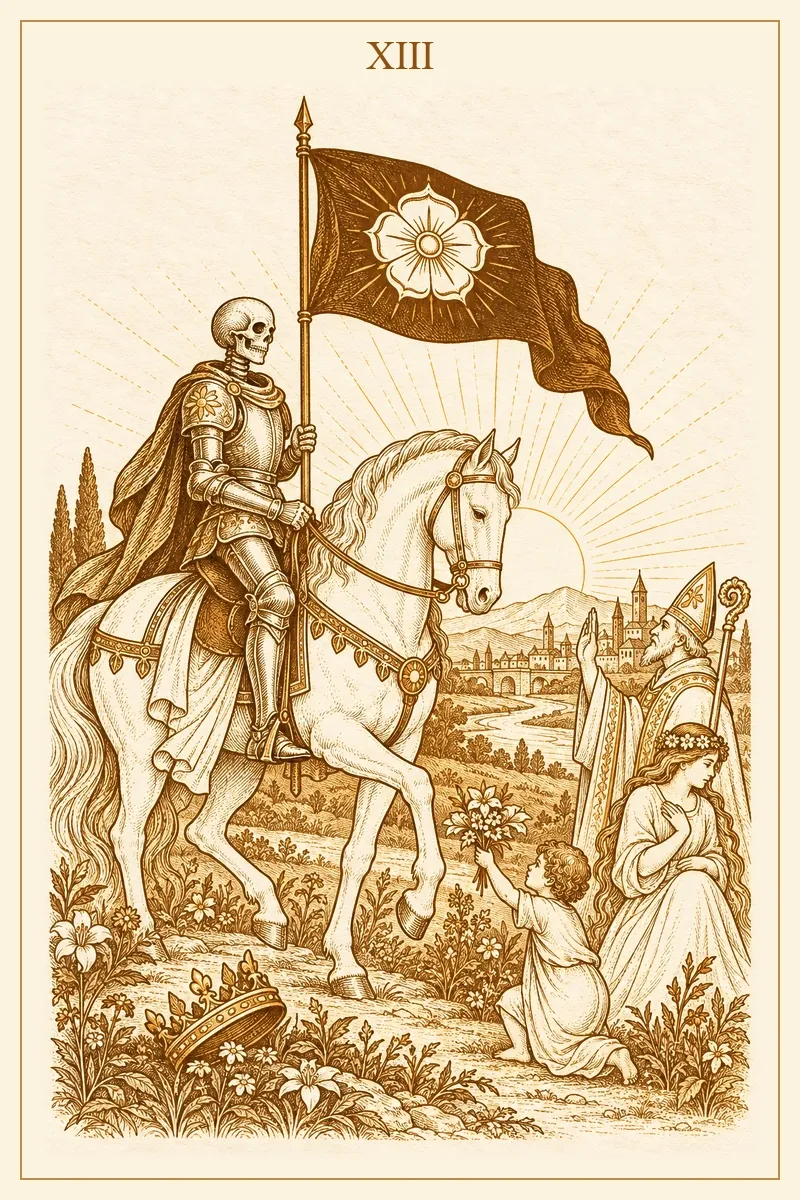
On this card, Death is a skeleton in armor riding a white horse and carrying a black banner marked with a white rose. A crown lies fallen in the grass, a bishop stands with his crozier, a woman kneels and a child holds out a bunch of flowers, while a low sun shines beyond a distant town. Everyone meets the rider, whatever their rank, and that impartiality is the source of the card's authority. Upright, Death names one specific chapter that is over, whether a role, a habit or an arrangement, and makes room for the next. Its force lies in that precision, not in fear. The full Death tarot meaning walks through its symbols one by one.
Reversed, Death can describe an ending that is being resisted: you know the chapter has closed, yet you keep living as though it has not. The reversal does not cancel the change. It asks what holding on is costing you. In Golden Dawn correspondences Death is linked to Scorpio, a sign associated with depth and transformation, which suits the card's quiet intensity.
The Tower: the truth that arrives all at once
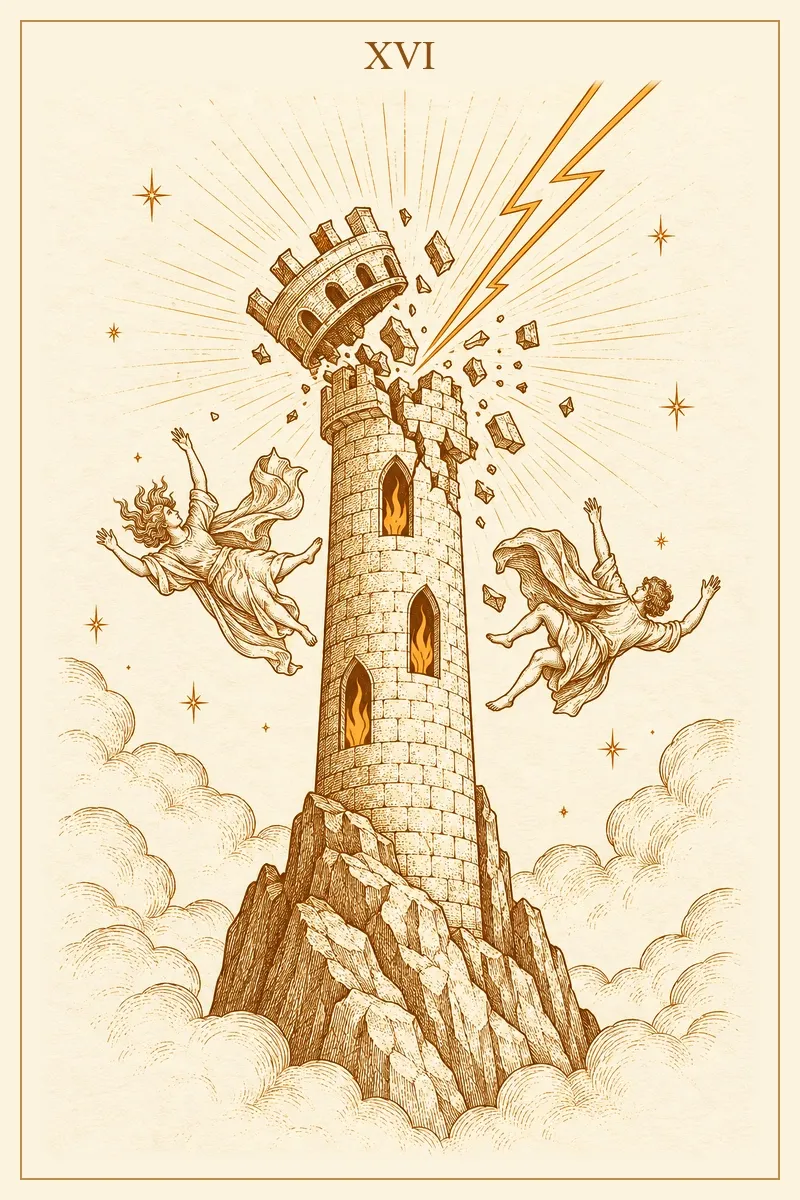
Here the Tower stands on a rocky peak above the clouds. A bolt of lightning knocks the crown off its top, flames show in its windows and two figures fall through the air. No other card in the deck pictures a faster change. Upright, The Tower describes a structure built on a weak assumption giving way: a plan, a belief or an arrangement that could not hold. The Tower tarot meaning explains why the card can be read as a release as well as a shock.
Its power is acute rather than lasting: the lightning strikes, the stones fall, and rebuilding begins on surer ground. Reversed, The Tower can point to a collapse you keep postponing, or to a belief being taken apart slowly and privately. Golden Dawn correspondences tie it to Mars. The useful question is what you would build if you no longer had to defend the old walls.
The World: the whole journey in one image
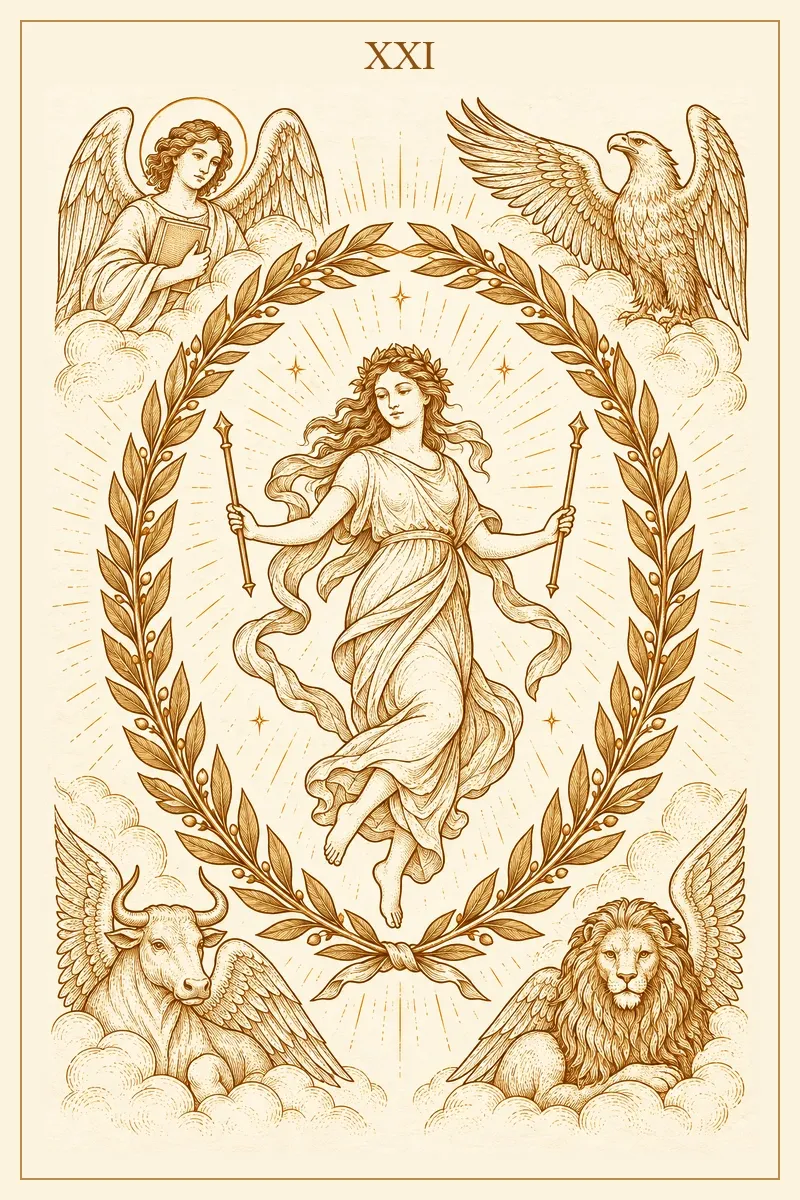
The World is card XXI, the final card of the Major Arcana. A dancing figure holds a slender wand in each hand inside a tall laurel wreath, and the four corners hold winged figures: an angel with a book, an eagle, a bull and a lion. For readers who measure power by sequence, this card has the strongest claim, because it gathers every lesson that comes before it into one moment of completion. The World tarot meaning covers the four corner figures and their link to the four fixed signs of the zodiac.
Upright, The World signals completion and a cycle that closes well: a degree finished, a project delivered, a long effort that has become part of you. Reversed, it can suggest an ending left loose or a final step you keep postponing. After XXI the sequence begins again with the Fool at zero, so even completion points toward a new start.
Will and calling: The Magician, Strength and Judgement
A second group of perspectives defines power as something a person uses rather than something that happens to them. These three cards describe agency, inner steadiness and a summons to act.
The Magician: every tool on one table
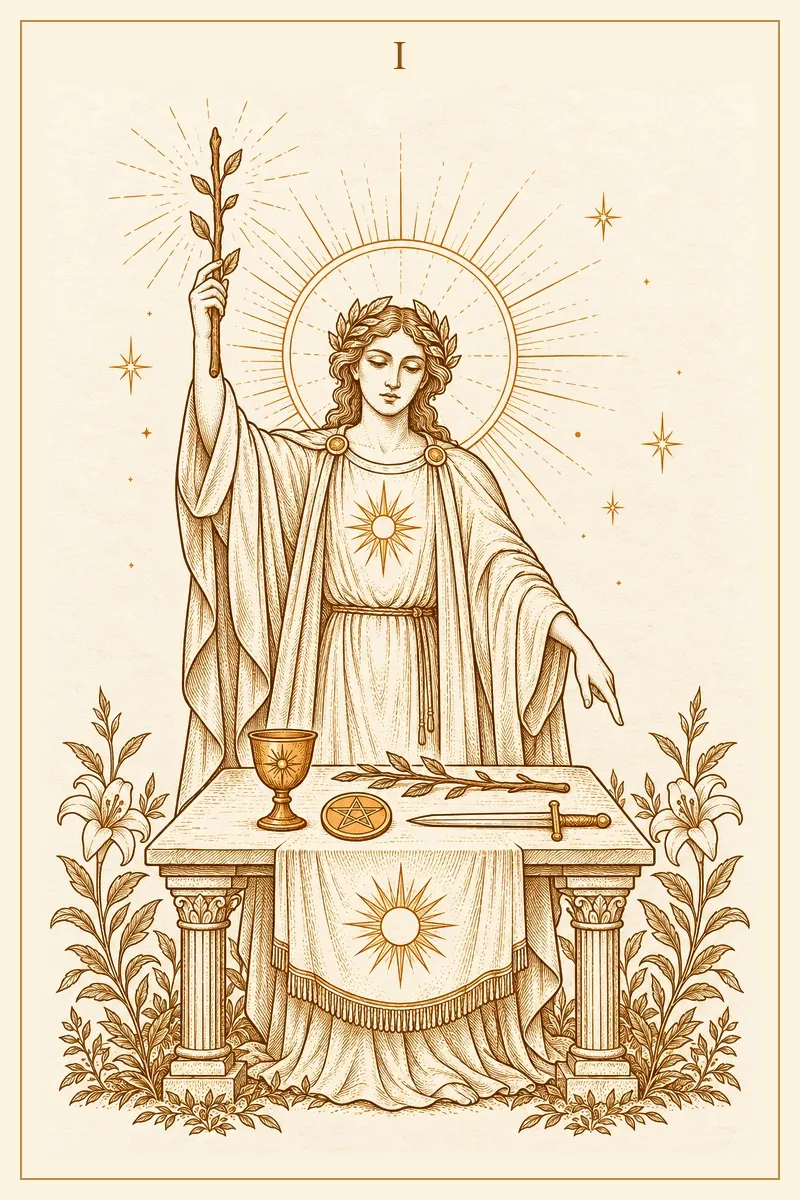
The Magician is card I, the first numbered step after the Fool. The figure stands crowned with laurel and ringed by a halo of light, one hand raising a leafy wand toward the sky and the other pointing down to the earth. A cup, a pentacle, a sword and a second leafy wand rest on the table, so all four suits are within reach. Readers who define power as agency choose this card: the tools are present, attention is focused, and intention can become action. The Magician tarot meaning adds the card's traditional link to Mercury and skilled communication.
Upright, The Magician says you already have enough to begin: a pitch, a launch, or saying plainly what you want in love. Reversed, the same energy blurs into idle talent, scattered effort or persuasion used to impress. Its question is practical: which tool on your table will you pick up this week?
Strength: power as patience
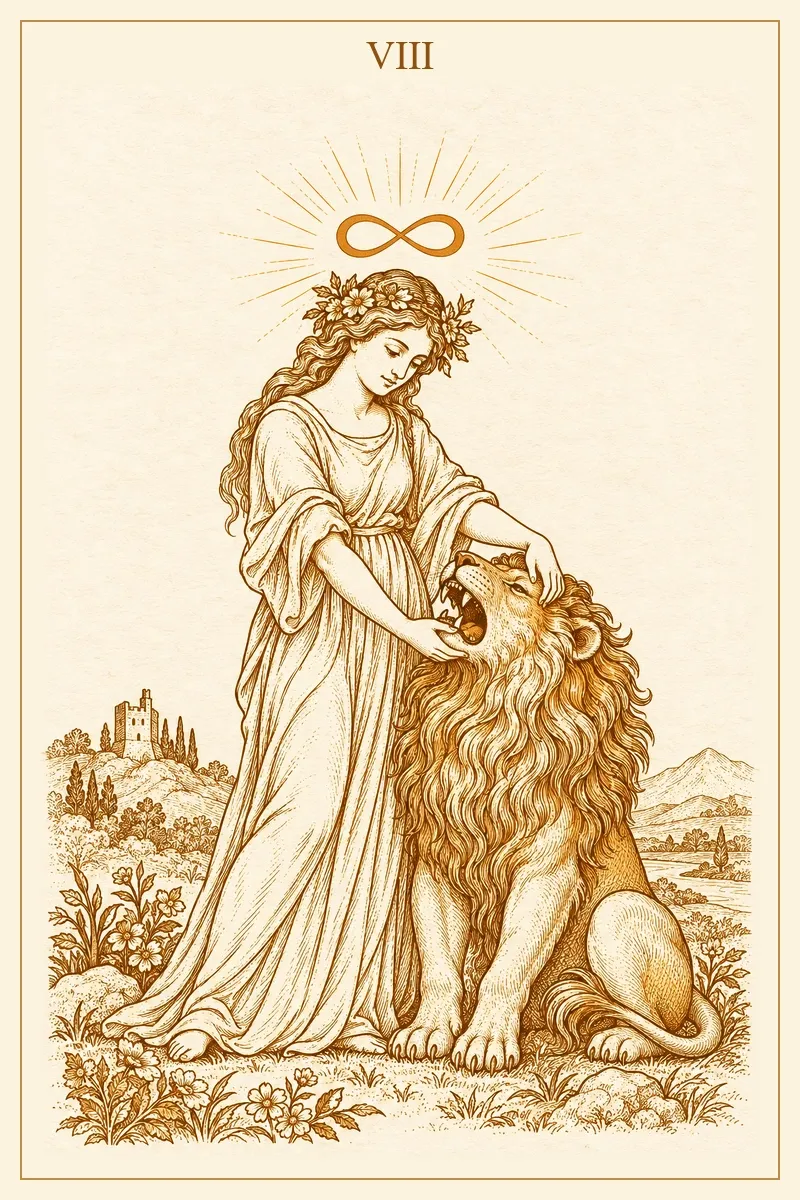
Strength is the only Major Arcana card whose name answers the question directly, and it redefines the word. A woman crowned with flowers, a loop of infinity above her head, rests one hand on a lion's mane and the other at its open jaw, with no weapon and no strain. In the Waite-Smith order, used here, the card is number VIII; older Marseille-style decks place it at XI. The Strength tarot meaning covers both numberings and the card's link to Leo.
Upright, Strength describes courage that does not need to shout: staying kind under pressure, guiding a strong feeling instead of being dragged by it. Reversed, it can point to self-doubt or a reaction that has slipped its leash. On this lens, power held gently is something you practice daily rather than wait to receive.
Judgement: the call you cannot unhear
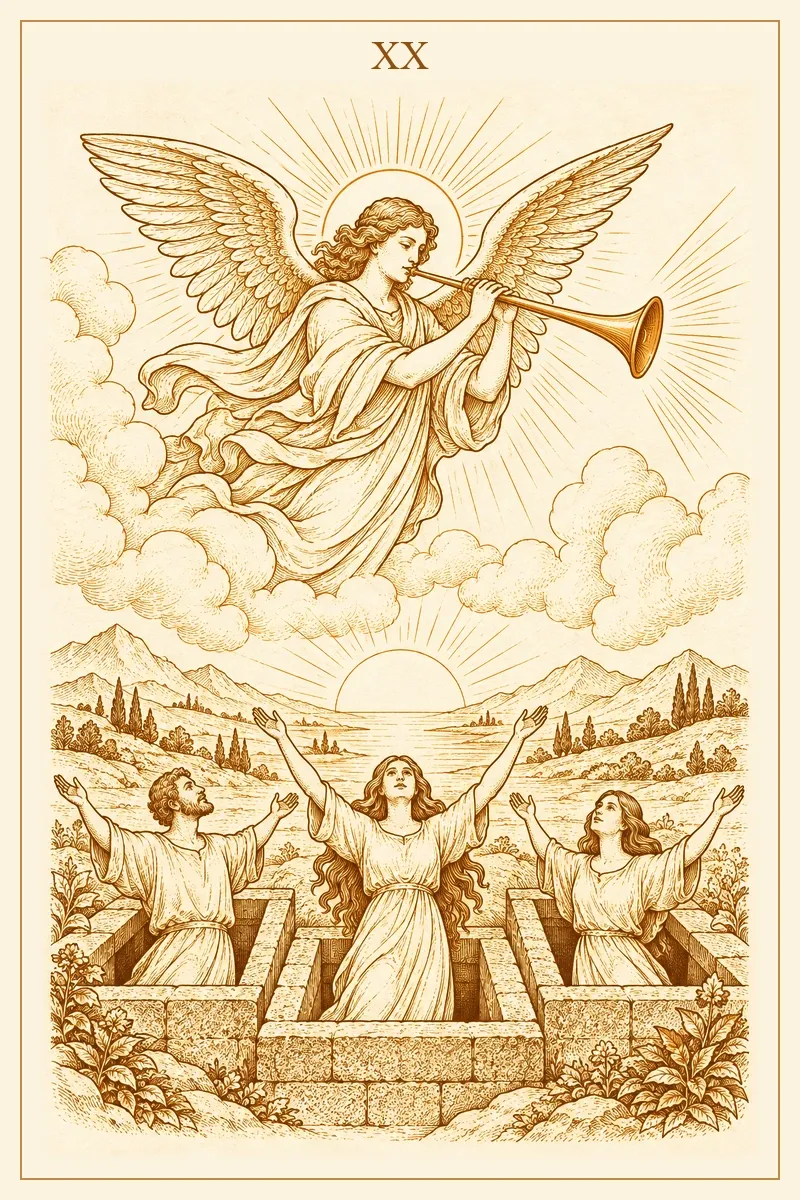
An angel with broad wings blows a long trumpet above the clouds, while three people rise from stone tombs below with their arms lifted toward the sound and a low sun on the horizon behind them. Judgement neither ends a chapter the way Death does nor tears one down like The Tower. It asks you to answer for the whole of your story so far and to choose who you will be next. Some readers regard it as the deepest card of all for that reason. The Judgement tarot meaning explores its themes of renewal and its link to the element of Fire.
Upright, Judgement describes an awakening, a reckoning made in good faith, a vocation finally named out loud. Reversed, it can describe hearing the call and turning away, perhaps because an old inner critic still speaks louder. Its power is the power of a question: knowing what you know now, what will you rise to do?
Small cards that hit hard
Rank is not the same as weight. Some cards that leave a person silent for a long minute are modest Minor Arcana scenes with no lightning and no skeletons, only a mirror.
In the Four of Cups, a young man sits under a tree with his arms folded over his knees. Three cups stand on the grass before him, and a hand reaching from a cloud offers a fourth that he does not look at. Upright, the card names boredom or withdrawal that hides an opportunity; reversed, it can show the moment you finally look up. The Four of Cups tarot card meaning explains its link to contemplation. Its power lies in how hard it is to argue with: you may already have what you need.
The Two of Swords shows a blindfolded woman on a stone bench by the sea, two long swords crossed over her chest and a crescent moon above. It describes a decision held at arm's length, sometimes a choice already made but not yet admitted. Reversed, the blindfold begins to slip and information rushes in. The Two of Swords tarot card meaning shows how that blindfold reads in a love question and at work.
In the Eight of Cups, a cloaked figure with a walking staff leaves eight upright cups stacked by the water and heads toward the mountains under a crescent moon. Death ends things for you; the Eight of Cups asks you to do the ending yourself, walking away from something you built because it is no longer enough. The Eight of Cups tarot card meaning explores that kind of chosen departure.
When a gentle card carries the most weight
Frightening imagery is not the only kind of force. A card that shows what you have been missing can be harder to sit with than one that confirms a fear.
The Ace of Cups shows a hand from a cloud holding a golden cup. A dove descends with a wafer marked by a cross, and five streams spill from the cup into a pond of water lilies. Its familiar reading is new love and emotional beginnings. For someone who has decided that closeness costs too much, though, it becomes a gentle confrontation: love is on offer, so are you willing to receive it?
The Sun is the plainest yes in the deck: a sun with a calm face, sunflowers above a brick wall, and a child crowned with flowers riding a white horse with arms flung wide. In a long stretch of grief it can feel jarring at first, then like a line of light at the edge of a closed shutter. Tarot cannot treat low mood; if heavy feelings persist, a doctor or counselor is the right next step.
The Star works more quietly. A kneeling woman pours water from two jugs, one into a pool and one onto the land, beneath a large eight-pointed star with smaller stars around it. It speaks of hope after difficulty and of a purpose you can trust. The Star tarot meaning describes how the card can bring a hidden wish out from behind practical plans, and in that sense a soft card may hold more power than a loud one.
The card that stays with you
A personal measure of power is the card you are still thinking about a few days after the reading. Fear is a reaction; a card that follows you into the next week has formed a relationship with your question.
The Moon makes a clear example. Two towers frame a winding path, a dog and a wolf howl on either side, a crayfish climbs out of the water, and a crescent face sits inside a blazing disk. The card asks whether you are seeing clearly or filling the gaps with fear. For a person whose recurring question is whether they can trust their own perception, The Moon may matter more than any other trump; for someone else, it may barely register. The Moon tarot meaning covers its upright and reversed sides.
The same holds for the Five of Cups, where a cloaked figure mourns three spilled cups while two full ones stand behind and a bridge leads toward a castle, and for the Seven of Cups, where a man in a dark cloak reaches toward seven cups in the clouds, each holding a different fantasy, from a castle to a dragon. One shows grief that hides what remains; the other, many dreams that delay one commitment.
Context sets the weight. The Fool carries power when you stand at a threshold; the Ten of Pentacles carries it when you are thinking about family and legacy. Some readers also work with a birth card, found by adding the digits of a birth date and reducing the total, which can name a long-term theme such as The Empress or The High Priestess. If a card keeps unsettling you, shadow work with tarot offers a gentle way to stay with it instead of shuffling it away.
How position and orientation change a card's weight
The same card can whisper or shout depending on where it lands, so read the position name aloud before you weigh it.
- Center or core position. A card at the heart of a spread sets the theme the other cards answer. A Minor card here can outweigh a Major card at the edge.
- Obstacle. Even a warm card here shows where you get in your own way.
- Advice. A card in this seat has power because it names an action, so a quiet card here can be the most usable card in the reading.
- Outcome. An outcome card describes a likely direction if nothing changes, not a fixed verdict. Its power is conditional.
Reversals shift the kind of power rather than removing it: a reversed Major card can describe a theme working inwardly or resisted, a reversed Minor card a small habit that keeps a larger pattern in place. Reading the cards as a sentence helps, and the guide to connecting tarot cards into one story shows how. When a frightening card lands in a key position, reading scary tarot cards without panic gives a steady method.
A five-card spread to find where the power sits
Use this spread when a reading feels heavy and you cannot tell which card matters most. Shuffle with your question in mind, then lay five cards in a row from left to right.
- The situation as it stands: the facts and the atmosphere right now.
- The loudest force: the pressure or event that grabs your attention first.
- What you are holding onto: the habit, belief or comfort that keeps things as they are.
- The quiet voice: what you have been skimming past or not saying aloud.
- Where your power is: one step that is within your reach.
Once the cards are down, notice which one made you pause and compare it with the fifth card. If they match, the reading has a clear center; if not, the first shows the feeling and the fifth shows the action.
Worked example: a steady job and a quiet wish
This is an illustrative reading, not a real client. Imagine someone who has worked in accounting for eight years and keeps postponing a decision about retraining as a teacher. Their question is: "What is really holding the power in this decision?" The spread above gives these cards:
- The situation as it stands: Ten of Pentacles. Security and family expectations.
- The loudest force: Wheel of Fortune. A restructure at work moves the ground either way.
- What you are holding onto: Two of Swords. A choice kept blindfolded for a long time.
- The quiet voice: The Star. A hope for meaningful work, never written into the spreadsheet.
- Where your power is: The Magician. The tools are already on the table.
At first glance the Wheel of Fortune looks like the headline, and on the rank lens it is the strongest card in the spread. Yet the Two of Swords explains why nothing has moved: the decision has been suspended, not lost. The Star in the quiet-voice position changes the reading, because it names what the spreadsheet left out.
The Magician in the fifth position turns that hope into a task. Savings, a friend who teaches, an evening course: the tools are within reach, and a grounded step this month might be one information session. Which card was most powerful? On rank, the Wheel; on resonance, the Star; on agency, the Magician. Seeing all three side by side is what lets the person choose their next move.
Steps for the days after a reading
When a card lingers after a reading, a few habits turn that feeling into something useful:
- Write it down the same day. Note the card, the question and one sentence on why it caught you.
- Check again after three days. If the card is still on your mind, treat it as a personal card for this question.
- Name the lens. Is its power about rank, change, agency, clarity or resonance for you?
- Turn it into one small action you can take within a week.
- Revisit after a month. Has the card's weight faded, shifted or deepened?
A short log like this teaches you more about your own deck than any ranking can.
Frequently asked questions
Is Death the most powerful card in tarot?
Death has the most famous reputation, and on the force-of-change lens it is a strong candidate. Its power, though, is precision about what has ended, not doom. Quieter cards can feel harder, because they ask you to make the ending yourself.
Can a Minor Arcana card be more powerful than a Major Arcana card?
Yes. Major cards describe broad themes, and Minor cards describe the daily scenes where those themes play out. A Three of Swords in a love reading can feel heavier than any trump because it touches one specific hurt. Position and question matter more than rank.
Why do different readers name different cards as most powerful?
Each answer reflects a lens. A reader who values sequence names The World; one who values agency names The Magician; one focused on change names The Tower or Death; one focused on purpose names Judgement.
Which card is the strongest yes in a yes-or-no reading?
Within the yes-or-no tradition, The Sun is the clearest yes, with The World and the Ace of Cups as other warm, open answers. Even so, a yes card describes favorable conditions rather than a guarantee, and the cards around it shape the message.
Can one card decide my future?
No. Tarot cannot predict a fixed outcome, read another person's mind or give you a date. A card can focus your attention on a theme, and the choices stay yours. For medical, legal or financial decisions, a qualified professional is the right source of advice.
Does my most powerful card change over time?
It can. As your life changes, different cards speak louder: the card that stopped you at twenty-five may feel gentle at forty-five.
Choosing your own answer
"What is the most powerful tarot card?" has several honest answers: The World by sequence, The Magician by will, Death and The Tower by change, Judgement by calling, Strength by name. The answer that matters in a real reading is the card that shows you something true and leaves you with a step you can take. When you want to see which card holds the weight in your own question, you can start a free reading on Veil Soul.