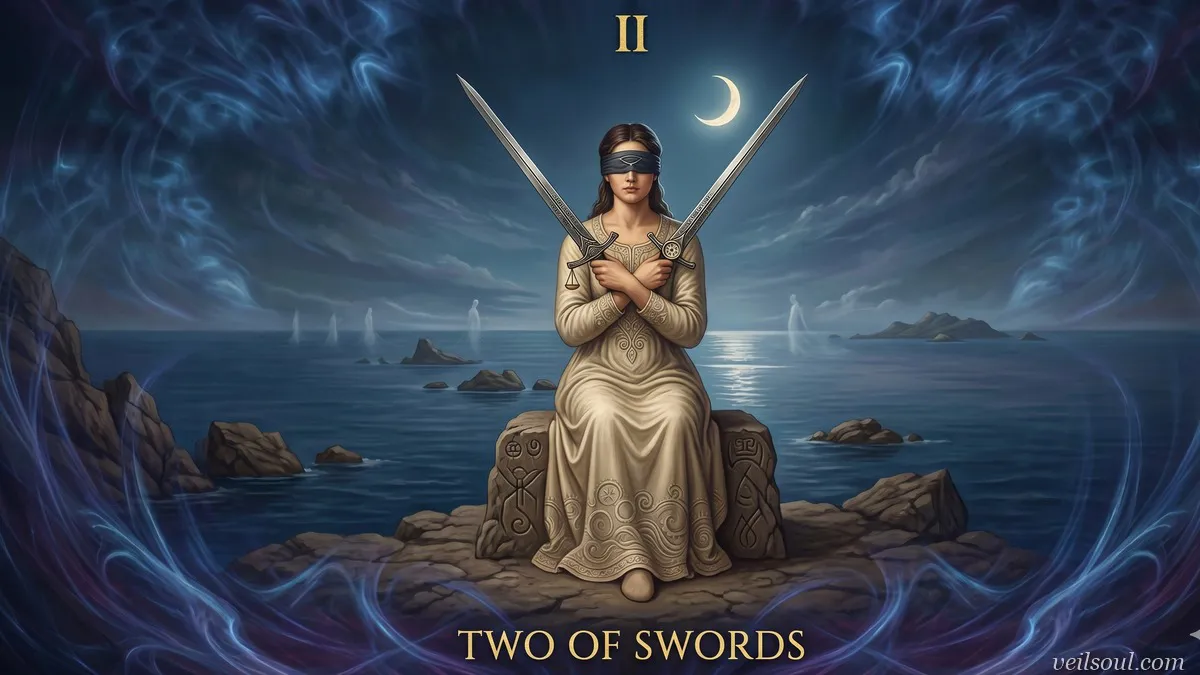
Two blades crossed over the chest, a blindfold tied on, still water behind: the Two of Swords is the card of a decision you have decided not to look at. Two options sit at almost exactly equal weight, so instead of choosing you hold both, keep your eyes covered, and call the silence that follows peace. Reversed, the blindfold slips and the information you had shut out arrives anyway.
That stalemate is why the card hits so close to home in love readings: a couple keeps a careful calm by never raising the one subject that matters, or a single reader holds two people side by side so neither has to be given up. Tarot cannot tell you which option is correct, what another person privately intends, or when a situation will resolve. What it does is remind you that you already know more than you are letting yourself use.
A quick orientation before the detail:
- Upright: indecision, a stalemate kept on purpose, avoidance, a truce that settles nothing.
- Reversed: the truth arriving uninvited, a choice forced by events, overwhelm and then relief.
- In love: the subject neither person raises, and the pull between two people or two futures.
- At work and with money: two offers, a stalled negotiation, statements left unopened.
- Yes or no: not yet, and usually because something is still being withheld.
- Element and sky: air, and the Moon in Libra.
- Advice: say the real question out loud, then look at one piece of evidence you have been stepping over.
A woman who will not look at the water behind her
Everything this card means comes out of a single gesture, so it is worth looking at the picture before reaching for keywords.
The figure, the blades and the moon
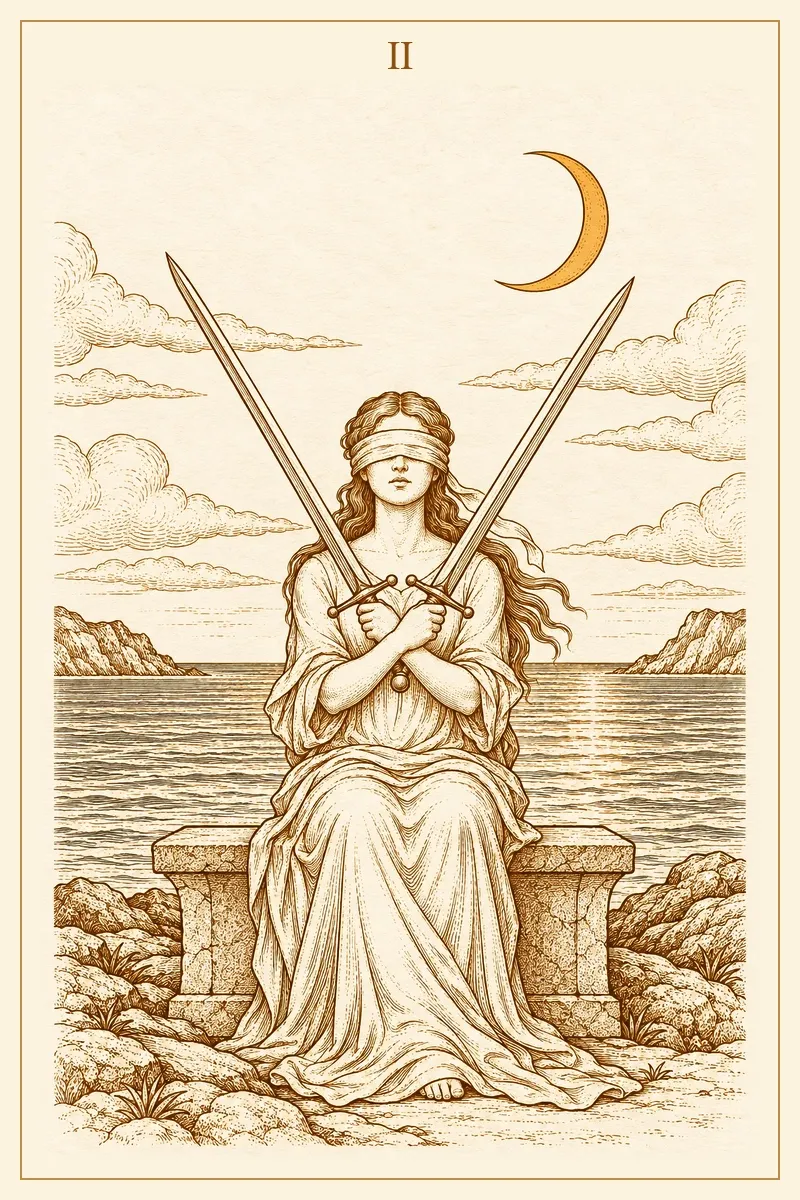
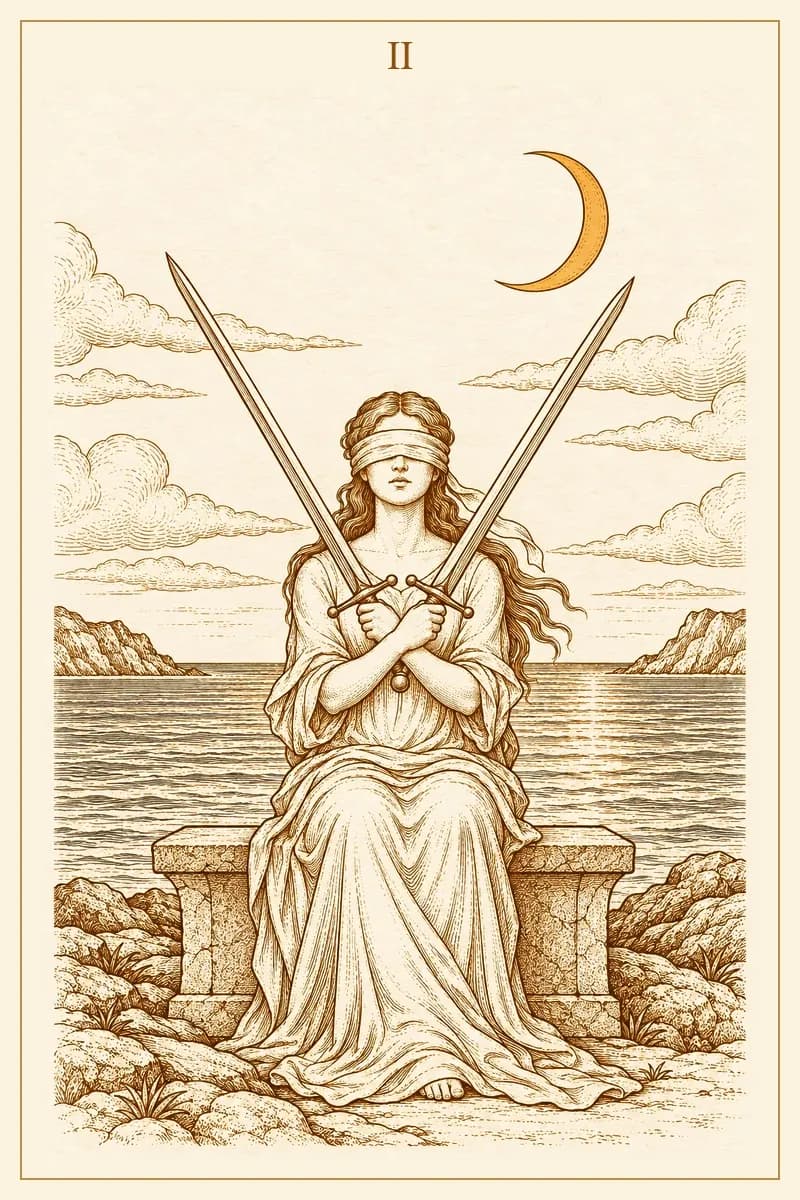
The scene is engraved in gold line on cream paper, with the numeral two at the top. A woman sits on a plain stone bench among rocks at the water's edge, her gown falling in heavy folds to the ground, one bare foot at the hem and a small round clasp at her chest. A wide band of cloth is tied across her eyes, its loose end lifting past her shoulder. Her arms are crossed, each hand closed around the hilt of a long straight sword, and the blades rise outward into open sky and stop well short of the border, so neither one points at anything. Behind her the sea lies flat to the horizon, rocky headlands press in from both sides, and a crescent moon hangs at the upper right, the one shape on the whole card filled in solid gold.
The blindfold is tied, not fallen
The detail that decides the meaning is that the blindfold is fastened. Nobody crept up and covered her eyes; she is holding herself in the dark, and the knot is within reach of her own hands. So the card rarely means you lack information. More often you have it and have quietly agreed with yourself not to use it: the message you did not answer, the figure you did not add up, the sentence your partner said last month that you filed away as nothing. Covering your eyes is usually a way of buying time when looking felt like more than you could carry that week.
Calm water behind, one lit crescent
The sea at her back is everything she can sense about the situation but has not examined, and it is calm rather than stormy: nothing has gone wrong yet, which is exactly why the arrangement is so easy to maintain. The crescent is the one lit shape on the card, and it sits behind her. Her instinct is already working and already pointed somewhere; she has simply arranged herself so that she does not have to receive it.
Air, Libra and the Moon: where the stalemate comes from
Swords are the suit of air, meaning thought, speech and judgment, and air is quick and precise, which also makes it good at talking you out of what you already noticed. In the correspondence most modern readers follow, the card belongs to the Moon in Libra: Libra keeps weighing in order to be fair, while the Moon answers in feeling rather than in argument, so you get someone who senses the answer and refuses to let that count as a reason. Our guide to Libra and tarot goes further into the scales and the cards that share that temperament.
Two of Swords upright: choosing not to choose
Upright, the card describes a live decision placed on hold, and a reader paying for the hold without quite admitting it. The stalling is not laziness; it is the sensible-looking response to two options whose costs you can both see.
The truce that settles nothing
The most common form is a truce. Two people stop arguing without agreeing, and the quiet gets mistaken for repair. Ask what the truce is costing, because it is paid in small amounts: a little less honesty each week, a topic you steer around, energy spent managing the silence. Those costs do not announce themselves, which is why a stalemate can run for a year before anyone calls it one.
Information you are keeping out on purpose
The second form is sharper. There is one specific thing you are not looking at: a balance, a test result, a message thread, a question you could ask in eleven words and have not. Here the suit's own first card makes a useful contrast. The Ace of Swords is the moment clarity arrives and cuts cleanly, and the full Ace of Swords meaning describes that decisive stroke; the Two is what happens when clarity is offered and politely declined. Nothing is wrong with your thinking. You have aimed it away from the thing.
What the card asks of you
It asks for a very small action rather than a resolution. Say the real question out loud, in one sentence, because most stalemates survive by never being put in plain words; kept vague, a question can go on meaning whatever is least frightening that day. Then look at one piece of evidence. One. Open the statement, read the thread, ask the person. A surprising number of these situations stop being stalemates the moment somebody looks.
Two of Swords reversed: the blindfold slips
Reversed, the arrangement fails. Sometimes you untie the cloth yourself and sometimes events pull it off for you, and either way the card describes the stretch of time right after the seeing starts. In its friendliest form it is simple release: you put the swords down and the room gets bigger.
Everything at once
The first days often arrive as too much rather than too little. Once you let yourself look, everything you had been holding out comes in together, and the mind that was carefully not thinking about one subject now cannot think about anything else. Treat that as a load problem rather than as proof you were right to avoid it: write the facts down in short lines, and separate what you know from what you are inferring. The volume settles within days. The clarity stays.
A decision that gets made for you
Often the reversal means circumstances closed one option while you were weighing, because an offer expired, a position was filled or a deadline simply arrived. Losing control of the timing stings, and there is honest relief underneath it, since the exhausting part was never the choosing but the holding of both. The card is not a judgment on the time you took; it is a reminder that not deciding is itself a decision with a price attached.
Seeing it, and wishing you had not
Sometimes what surfaces is what you suspected: a partner says the thing, the numbers are what you feared, a friend confirms what you noticed in the summer. This is the hardest face of the reversal, and the truth was there before the card was drawn. Knowing did not create it; it gave you the first position from which you can respond. If the discovery is genuinely painful, the Three of Swords takes over from here, and the Three of Swords meaning covers grief and the work of recovering from a clean, unwelcome fact.
Two of Swords in love: the subject nobody raises
Love is where the card is at its most recognizable: here it almost always points to a specific unsaid thing rather than to a general mood.
If you are in a relationship
For couples it describes a shared agreement not to open one topic, and both people know what it is. It might be money, a move, children, a family member, an old breach of trust that was handled rather than resolved, or the plain question of where this is going. What the card asks is modest: pick the smallest true sentence about the topic and say it at a calm moment, without a conclusion attached. "I have been avoiding talking about the lease" is a complete opening.
If you are single
For single readers it shows up in one of two shapes. The first is two people, or one person and the idea of someone else, held at once because committing to one means losing the other. The second is quieter and more common: part of you wants connection, another part has decided it is not worth the exposure, and rather than settle that you keep both positions and stay busy. Both are a stall with a cost, and the cost is time spent in a holding pattern that feels like caution.
When it lands on how someone feels about you
Drawn in a position about another person's feelings, this card does not mean they feel nothing. It describes someone sitting with the blades crossed: aware of something unresolved, not ready to say it, holding the situation still while they work out what they want, which may be about you or about their job, their last relationship, or something they have told nobody. A card about withheld information is not evidence of what is being withheld, so treat it as a reason to ask a direct question rather than as an answer.
Reversed in a love reading
Reversed in love, the unsaid thing gets said. Someone raises it, or a situation forces it into the open, and the relationship has to deal with information it was organized around not having. That can mean honesty and a real repair, or the end of an arrangement that was only held together by not looking. If what surfaces makes you feel unsafe rather than uncomfortable, the people who can help with that are human beings rather than cards.
Work and money: the decision you keep rescheduling
Outside of love this card tends to be dryer and easier to act on, because the facts you are avoiding are usually written down somewhere.
Career and work
At work it is two job offers you cannot separate, a negotiation where neither side will move first, a resignation you have drafted four times, or a role you have outgrown and have not let yourself evaluate, because evaluating it honestly would commit you to doing something. Give yourself a deadline and the authority to choose on incomplete information, since in most career decisions the missing information never arrives. If the two options really are equal, the cost sits in the delay rather than in picking wrong.
Money
With money the card is almost literal: unopened statements, a subscription you know you should cancel, a shared account neither partner mentions, a tax question moved from week to week. Not looking preserves your mood today and raises the eventual bill. Open one thing and write down one real number. An unexamined worry can be any size at all, while an actual number is simply the size it is.
The card beside it decides what you are avoiding
On its own the Two of Swords tells you that something is being held out of view. The cards around it tell you what, and that is where a reading becomes usable.
With The Moon: a fear you have not named
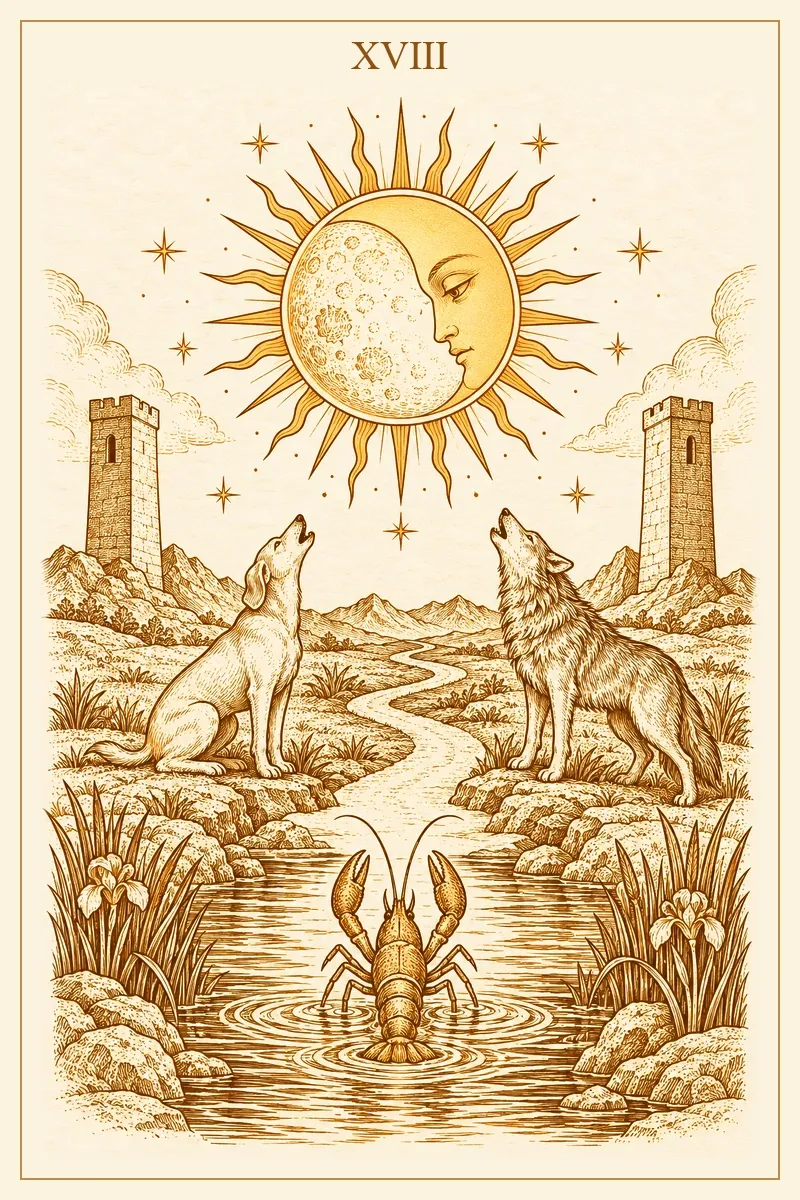
The Moon beside it says the thing you are avoiding has no clear outline yet. It is a fear rather than a fact: a worry that gets vaguer the closer you look and loud at two in the morning. Together they often describe someone reading signs and atmospheres instead of asking a question, and the Moon tarot meaning goes deeper into that fog. Convert the feeling into a sentence, because once a fear is written in one line it usually turns out to be checkable.
With the Eight of Cups: the choice is whether to stay
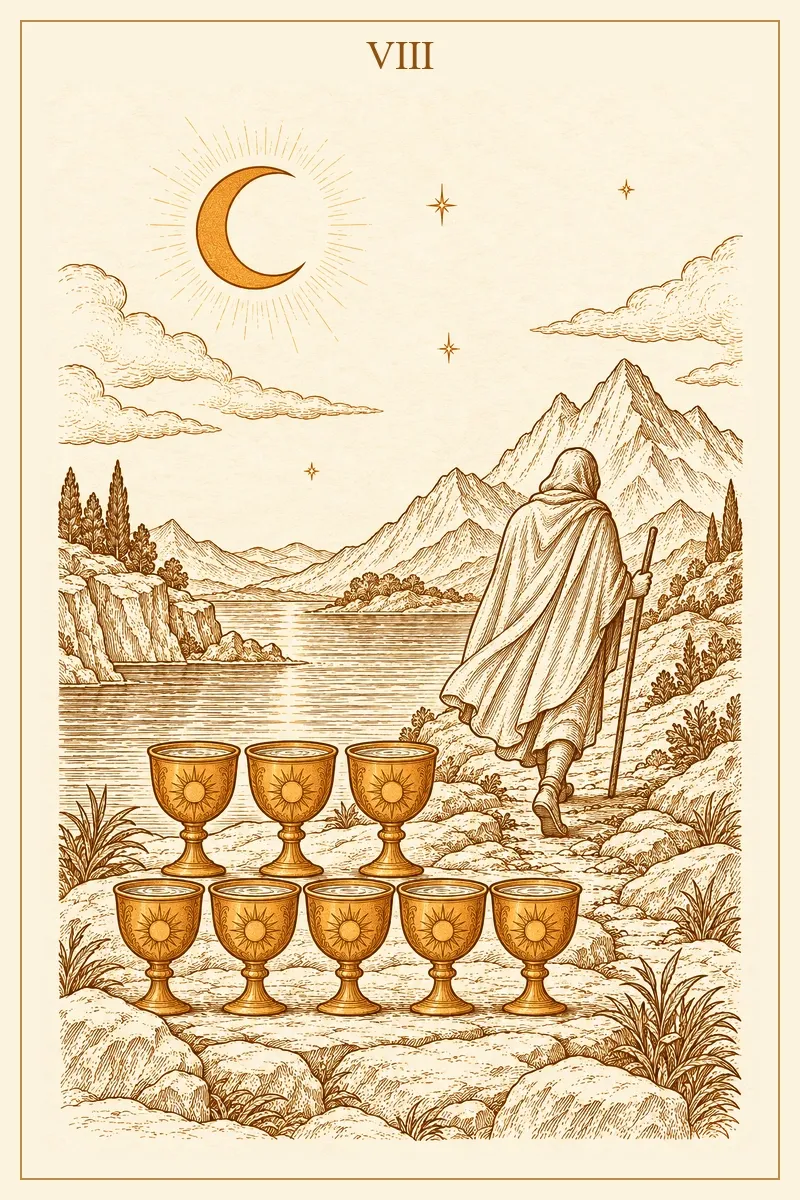
When the Eight of Cups arrives, the two options you have been weighing are frequently not the real pair. You have been choosing between two ways of staying, and the question underneath is whether to stay at all, which is also why it felt unanswerable. The Eight of Cups meaning is careful about the difference between leaving something that is finished and leaving because leaving is easier than talking.
With The Lovers: a choice about values, not preference
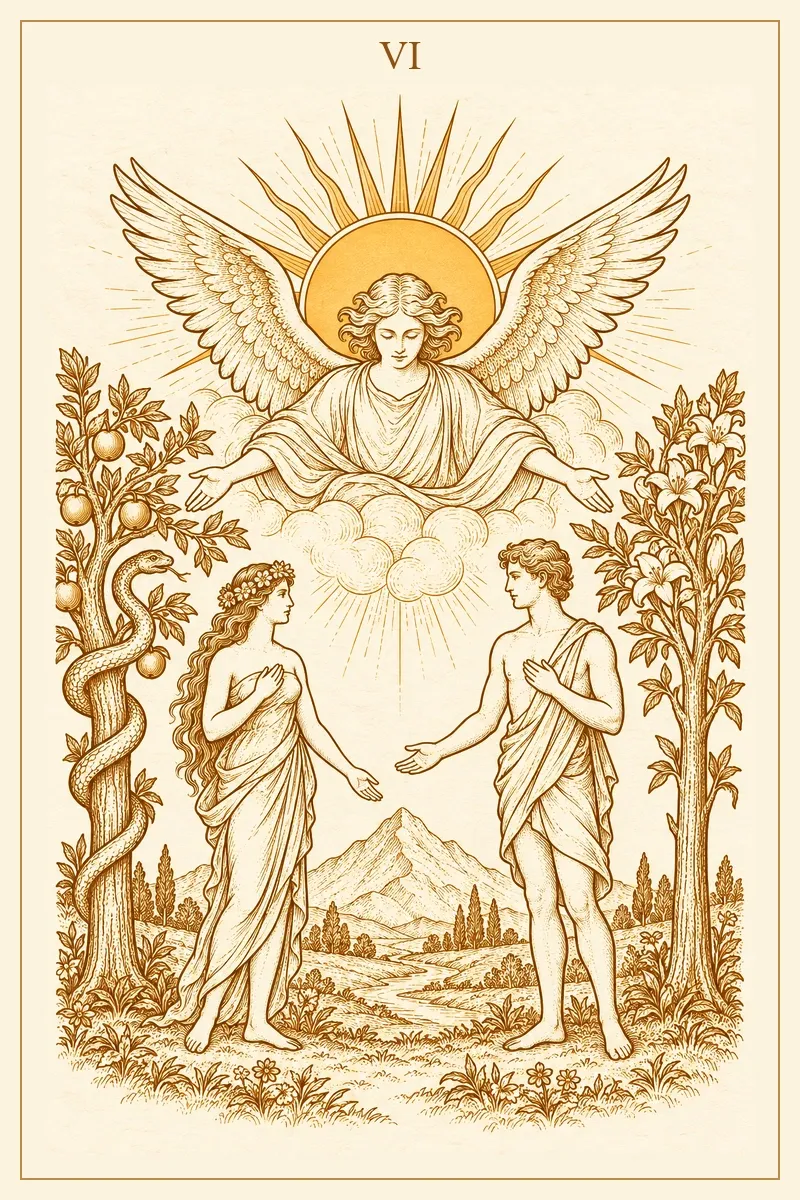
With The Lovers, the decision you are postponing is one you will have to make with your whole self, because it touches what you value rather than what you would prefer. People stall longest on these, since either option asks you to give up something you consider part of who you are. Read the pair as an instruction to name the two values rather than the two outcomes, which the Lovers tarot meaning treats as the heart of that card.
A few more pairs are worth knowing:
- Judgement: the matter is being called rather than chosen, and the Judgement tarot meaning describes that kind of summons.
- The Star: a calm stretch waits on the far side of the choice, so the dread belongs to the deciding rather than to the outcome; the Star tarot meaning describes that relief.
- Eight of Swords: avoidance has hardened into feeling trapped, and the Eight of Swords meaning is the better guide once a reader believes there is no choice left.
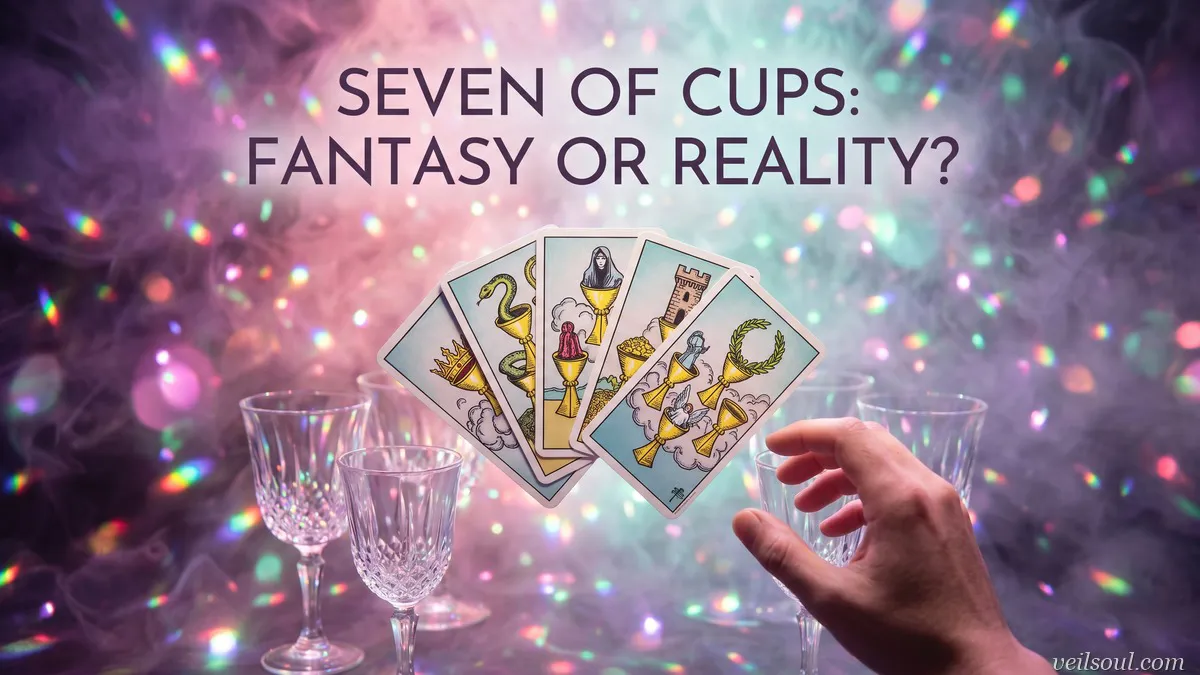
- Seven of Cups: the problem is not two options but seven, most of them imagined.
- Four of Swords: you are genuinely too tired to decide well, so rest first, with a date to come back to it.
Untie the knot: a four-card spread
This spread is built for a choice that has been sitting still, and it deliberately has no position for the answer. Shuffle with a written question, lay four cards in a row, and read them in order. Our wider guide to tarot for decision making has other layouts if you want to compare approaches.
- What I have decided not to look at. The specific thing, not the general area.
- What the blindfold is protecting. Avoidance is always doing a job. Energy, a relationship, an image of yourself, someone else's comfort: this position names what you would risk by looking.
- What I already know. Evidence only, meaning something said, done, written or counted. If you cannot connect the card to a real event, the honest reading is that you know less than you thought.
- The smallest honest step. Not the decision. One action you could take this week that moves you from holding to knowing.
Read position three strictly. The whole difficulty of this card lies in the gap between what you know and what you have agreed to count as knowledge.
A worked example: the conversation about moving in
Imagine a reader who has been with her partner for two years. They have talked loosely about living together for most of a year, the subject comes up and then slides away, and she has stopped raising it because the last two attempts ended in a vague promise of soon. Her written question: What am I not letting myself see about this, and what is my next honest step?
One, what I have decided not to look at: Two of Swords. The card of the question itself, which is common and worth noticing rather than dismissing. In this position it narrows things down: the avoidance is not about her partner's answer but about her own. She has not decided what she will do if the answer is no, so she has made sure the question never completes.
Two, what the blindfold is protecting: Four of Swords. She has had a hard year at work, and the relationship is the one part of her life that has not required anything difficult. The avoidance is buying her rest, which is a real thing to weigh rather than a flaw to correct, though the Four of Swords meaning carries a warning with it: a pause that was earned can quietly turn into a habit.
Three, what I already know: Eight of Cups. Uncomfortable evidence. In the past three months she has twice caught herself imagining a flat of her own, and has looked at listings without telling anyone. That is not a decision; it is a fact about where her attention has been going, and it belongs in the knowledge column rather than the fear column.
Four, the smallest honest step: Ace of Swords. One clean sentence, not an ultimatum and not a plan: a question asked once, plainly, with the shape of the answer requested. Do you want to live together this year, yes or no, and may I have that answer within a week. The reading did not say whether they will move in together or whether the relationship will last; it turned a mood she had been carrying into one sentence she could say on a Thursday evening.
Frequently asked questions
What does the Two of Swords mean in a love reading?
It points to a specific subject neither person is raising, held in place by a quiet agreement to keep things pleasant: often money, a move, commitment or an old hurt that was smoothed over rather than resolved. For single readers it tends to describe being suspended between two people, or between wanting connection and not wanting the exposure that comes with it.
What does the Two of Swords reversed mean?
The avoidance stops working. Information arrives, a deadline closes one option, or you decide to look, and the period right afterward feels like too much at once. The discomfort is real and usually short, and the clarity it leaves behind is what the card is offering.
Is the Two of Swords a yes or a no?
Upright it is not yet, and not with what you currently have, because the answer is not being withheld by fate so much as blocked somewhere, and often you are the one blocking it. Reversed it leans toward yes with a condition, since the matter will move and information is about to arrive. It gives no date either: the situation will keep its shape until somebody acts. For wording that a single card can actually answer, see our guide to yes or no tarot readings.
Is the Two of Swords a bad card to draw?
No. It is uncomfortable rather than harmful, and it is one of the more actionable cards in the deck, because what it describes is almost always within your control. Nothing in the picture is happening to the figure; she is doing all of it herself, which means she can stop.
Can the Two of Swords tell me which option to choose?
It cannot, and neither can any other card. Tarot does not know what another person intends, which outcome will suit you better, or when a situation will resolve. A reading can show you the shape of your own hesitation and the information you have been skipping, and the choice stays yours.
Does the Two of Swords mean someone is keeping something from me?
Sometimes, but that is the less likely reading. The card describes withheld information without saying who is withholding it, and in most spreads the person holding the blades is the reader.
How is the Two of Swords different from the Eight of Swords?
The Two is a choice you are declining to make, while the Eight is a situation you believe you cannot escape. In the Two, the blindfold is in your own hands and the options are still open. In the Eight, you have come to feel there are no options left, which is why it reads as restriction rather than indecision.
Stop paying for the quiet
The Two of Swords is not asking you to make the decision today. It is asking you to stop paying for the quiet, which is a smaller and far more achievable thing. Say the question plainly, look at one piece of evidence, and let the choice become an ordinary problem with an ordinary answer.
When you are ready to sit with it, you can draw a reading at Veil Soul and bring the one question you have been circling. Whatever comes up, the next step is still yours, and it can be very small.