A professional tarot reader is someone who reads for other people with a steady session structure, informed consent, clear limits and fair terms agreed in advance, not someone who holds a license or never misses. Becoming a professional tarot reader is mostly a matter of craft and care: practice on people outside your circle, learn to listen as closely as you read, and decide ahead of time what you will and will not do. Tarot can help a client see a situation more clearly; it cannot confirm what another person thinks, guarantee an outcome or replace a doctor, lawyer, financial professional or therapist, and a professional reader says so plainly.
At a glance, these are the skills and habits that separate professional practice from casual reading:
- Card fluency: knowing each card well enough to read it in context, upright and reversed.
- Listening: noticing what the client says, avoids and reacts to.
- Question shaping: turning "Will he come back?" into something the client can act on.
- Session structure: a clear opening, a spread with named positions, and a real closing.
- Scope and ethics: no medical, legal or financial advice; consent; confidentiality.
- Boundaries: time, topics, contact between sessions, and repeat bookings.
- Clear terms: price, length, cancellations and records explained before anyone pays.
What makes a tarot reader professional
No certificate makes someone a good reader. "Professional" describes how you work: you explain your approach before the cards come out, keep to the agreed time, tell the truth about difficult cards without frightening anyone, and protect the client's privacy.
Compare two evenings. In the first, you read for a friend at the kitchen table, chat, wander into your own stories, and nobody minds if it runs late. In the second, a stranger books a session about a painful choice. They need to know what will happen, how long it will take, what you will not comment on, and that what they say stays private. The cards are the same on both evenings. The container around them is not.
If you have only read for friends, start with acquaintances and friends of friends, people who will give honest feedback rather than reassurance. Our guide to reading tarot for others covers that first step; this article picks up where it ends, at the point where you are thinking of offering readings to the public.
Going professional also has a practical side. Depending on where you live, offering paid readings may involve registering a business, keeping records for tax, following consumer and advertising rules, or rules that apply specifically to fortune-telling services. These vary widely, so check your local rules or ask a qualified advisor before you advertise. Nothing in this guide is legal or tax advice.
Skills to build before you charge anyone
Knowing card meanings is the starting line, not the finish. The four skills below matter more once a stranger is sitting across from you.
Card fluency that goes beyond keywords
A reader who knows only keywords will say the same thing every time a card appears. A fluent reader can see how a card shifts with its position, its neighbors and the question. The Eight of Pentacles, a craftsman carving one coin at his bench while six finished coins hang on a post beside him, can describe diligent skill building in a career question, slow repair in a relationship question, or the steady practice of becoming a reader yourself.
Build fluency deliberately: pull one card a day and write how you would read it for work, for love and for a decision, upright and reversed. If you want a structured path through the deck, the lessons in Learn move through the cards in order.
Listening as closely as you read
Clients tell you a great deal before and between the cards: the word they repeat, the topic they skip, the moment their voice drops. A professional reader notices and checks instead of assuming. "When I said 'leaving,' you paused. What came up?" is a better move than pressing on with a prepared meaning.
Listening also means letting the client correct you. If a reading lands wrong, ask what does fit; a card read in someone's actual circumstances beats a card read as a formula.
Shaping the question with the client
Many clients arrive with a question tarot cannot answer well: "Is he cheating?" "Will I get the job?" "When will I meet someone?" Part of your work is helping them turn it into a question about what they can see, choose or do. "What do I need to understand about trust in this relationship?" or "What can I do to prepare for this interview?" gives the cards something useful to address.
Do this gently and out loud, so the client hears why. The guide on asking effective tarot questions lists patterns you can borrow, and the question library has ready wording for common situations.
Speaking about difficult cards
Sooner or later The Tower, Death, Ten of Swords or Three of Swords will appear for someone who is already struggling. Two rules hold. First, do not soften a card into something it is not; clients notice and stop trusting you. Second, do not turn a card into a verdict. "Your marriage is over" is not a reading.
Describe what you see and leave room for choice. The Tower shows lightning knocking the top off a tower while two figures fall, so you might say, "Something here cannot hold as it is. Let's look at which part is shaking and what you can protect." Death shows an armored skeleton on a white horse, a fallen crown among the flowers and a low sun beyond a distant town; it speaks of an ending and a transition, never of a literal death. For more ways to stay steady with these cards, see interpreting scary tarot cards without panic.
How a professional tarot session is structured
Structure is what lets a client relax. When they know what will happen, they can spend their attention on the reading rather than on wondering what you are doing. A simple flow:
- Before booking: publish what you offer, how long it lasts, the price, your cancellation policy and the topics you do not read on.
- Opening (about five minutes): welcome the client, explain that you read tarot as a tool for reflection rather than fixed prediction, and ask, "Is there anything you would rather I not touch on today?"
- The question: ask what brought them and shape the question together.
- The spread: name the spread and each position before you lay the cards, so the client can follow.
- Interpretation: read card by card, then as a whole, checking in as you go.
- Closing: summarize in two or three sentences, name one concrete next step, and say clearly that the session is ending.
- Afterward: write brief private notes only if your client agreed to that, and do not follow up uninvited.
The consent question does a lot of work. Some clients do not want to hear about health, a recent loss or a particular person, and asking tells you where to tread carefully. If a card later touches that area, you can say, "This card relates to something you asked me to leave aside. Shall I pass over it?"
A five-position spread for client sessions
You can use any spread you know well, but a short layout with practical positions suits most paid sessions. This one keeps the focus on what the client can see and do:
- Where things stand: the situation as it is now.
- What the client is carrying: the pressure, feeling or belief they bring.
- What may be overlooked: a factor they have not given weight to.
- A resource within reach: a strength, person or skill they can draw on.
- A next step to test: one small action to try, not a fixed outcome.
The last position is named on purpose. "Outcome" invites clients to hear a prediction; "a next step to test" invites them to act and see what changes.
Worked example: one illustrative session
The session below is invented to show the structure in use. It does not describe a real client.
A client books a forty-five-minute session and opens with, "Should I quit my job?" The reader explains that the cards will not make the decision and suggests a different question: "What do I need to understand about my work before I decide?" The client agrees, and the reader lays out the five-position spread.
- Where things stand: Four of Swords. A figure lies on a stone tomb with hands joined, three swords on the wall above and one carved along the side, beneath a stained-glass window. The reader describes the image and asks what rest looks like at the moment. The client says she has been exhausted and sleeping badly for months. The reader does not interpret the sleep problem, suggests a doctor if it continues, and keeps the reading on work.
- What she is carrying: Eight of Cups. A cloaked figure with a staff walks away from eight golden cups toward the mountains under a crescent moon. The reader names a wish to leave something that no longer satisfies, and asks whether that wish is about the job itself or about how tired she is. The client is not sure, which is useful to know.
- What may be overlooked: Page of Pentacles. A young man studies a coin he holds up in both hands. The reader suggests curiosity about learning something new, and the client mentions a course she has been reading about for a year.
- A resource within reach: Eight of Pentacles. The craftsman at his bench points to skills she already has. The client names three that would carry over into a different role.
- A next step to test: Two of Wands. A figure on a stone battlement holds a small globe and looks out to sea. The reader frames it as planning before moving: map the options from where you stand.
The reader closes with a summary: the spread points to exhaustion and a real curiosity, and the decision may be clearer once both get attention. The next step is small: check the course schedule and talk to one person in that field. When the client asks whether she can afford to leave, the reader says that is a question for her budget and, if needed, a financial professional, not for the cards. Notice what the reader did not do: say "quit," diagnose, or predict a date.
Cards that teach the craft of reading for others
Some cards read like advice to the reader. Their images describe the habits a professional practice depends on.
The Hierophant: structure that makes a space safe

The Hierophant sits between two pillars, one hand raised in blessing and the other holding a tall staff, with two figures kneeling before him beside a patterned carpet. Upright, for a reader, the card is a reminder that form serves people: a set opening, a named spread and a clear closing let a client feel held. It also points to learning from those who have practiced longer, through classes, mentors or peer study.
Reversed, the card can warn against two opposite habits: rigid scripts that ignore the person in front of you, and no structure at all, where sessions drift and overrun. The full Hierophant tarot meaning goes further into tradition and teaching.
The High Priestess: knowing what to leave unsaid
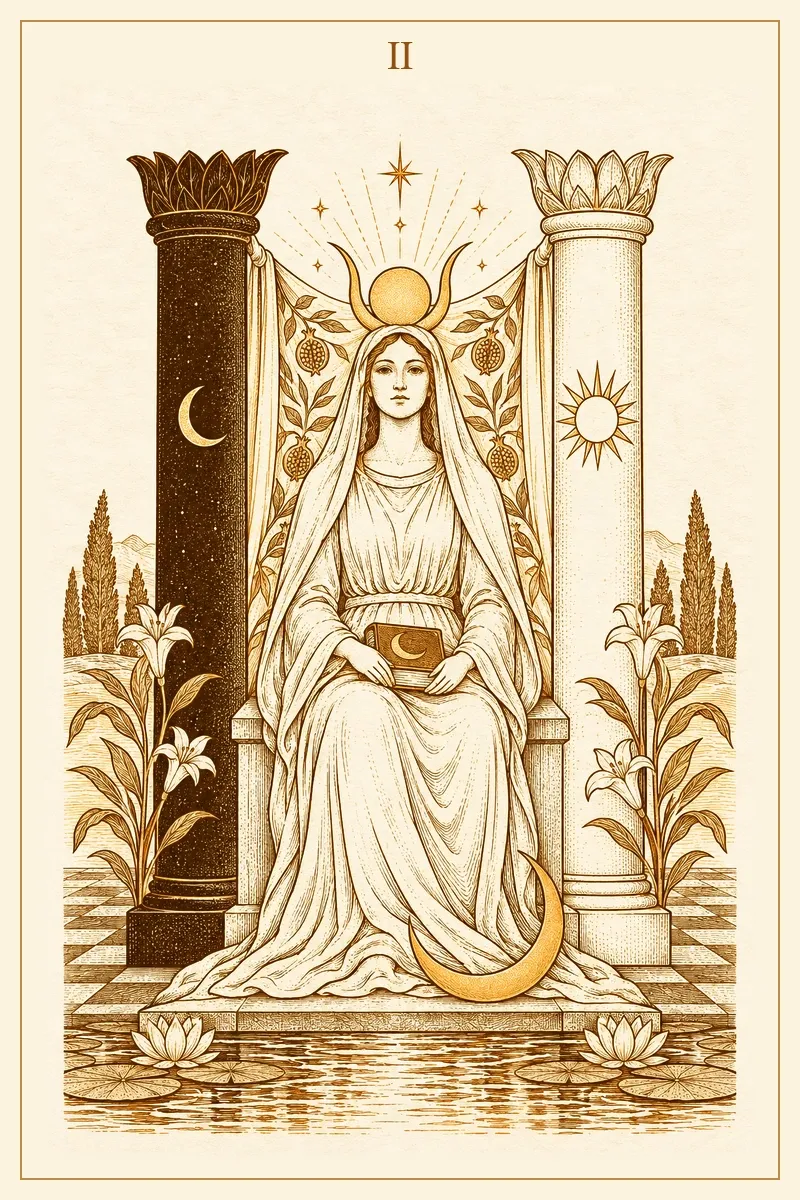
The High Priestess sits between a dark pillar marked with a crescent moon and a pale pillar marked with a sun, a closed book resting in her lap and a veil patterned with pomegranates behind her. Upright, she stands for discretion and intuition. A professional reader does not voice every passing impression. Before you speak, ask whether it helps the client, whether it is within your scope, and whether they asked for it.
Reversed, she can point to ignoring your own sense of the room, or to talking just to fill a silence. Silence after a card turns is often the moment the client is thinking hardest. To go deeper into this card, read the High Priestess tarot meaning.
Temperance: measured boundaries

Temperance shows a winged figure pouring water from one golden cup into another, one foot in a stream and the other on the bank, with irises growing nearby and the sun rising over the mountains. Upright, it describes the balance a reader keeps between warmth and limits: enough care that the client feels heard, enough boundary that the session stays a reading and does not turn into therapy or friendship.
In practice, that means starting and ending on time, deciding whether you answer messages between sessions, and saying kindly, "That's outside what a reading can help with." Reversed, Temperance can flag overgiving: sessions that run long, free extras you resent, or feeling drained after every client. The Temperance tarot meaning covers its other themes of patience and healing.
The Hermit: helping clients find their own light

The Hermit stands on a rocky peak, hooded and bearded, holding up a lantern with a six-pointed star and leaning on a staff above mountains and a lake. Upright, for a reader, the lantern is the point: you light the way for a while, and the client walks it. A good reading leaves people more able to think for themselves, not less.
Reversed, the card can warn of dependency. A client who books every week about the same question, or cannot make small choices without a reading, is not being helped by more readings. Say so gently, suggest a longer gap, and if the pattern looks like real distress, point to other support. Our guide to doing too many tarot readings describes the warning signs. The card's inner-guidance side is explored in the Hermit tarot meaning.
Justice: fairness, transparency and accountability
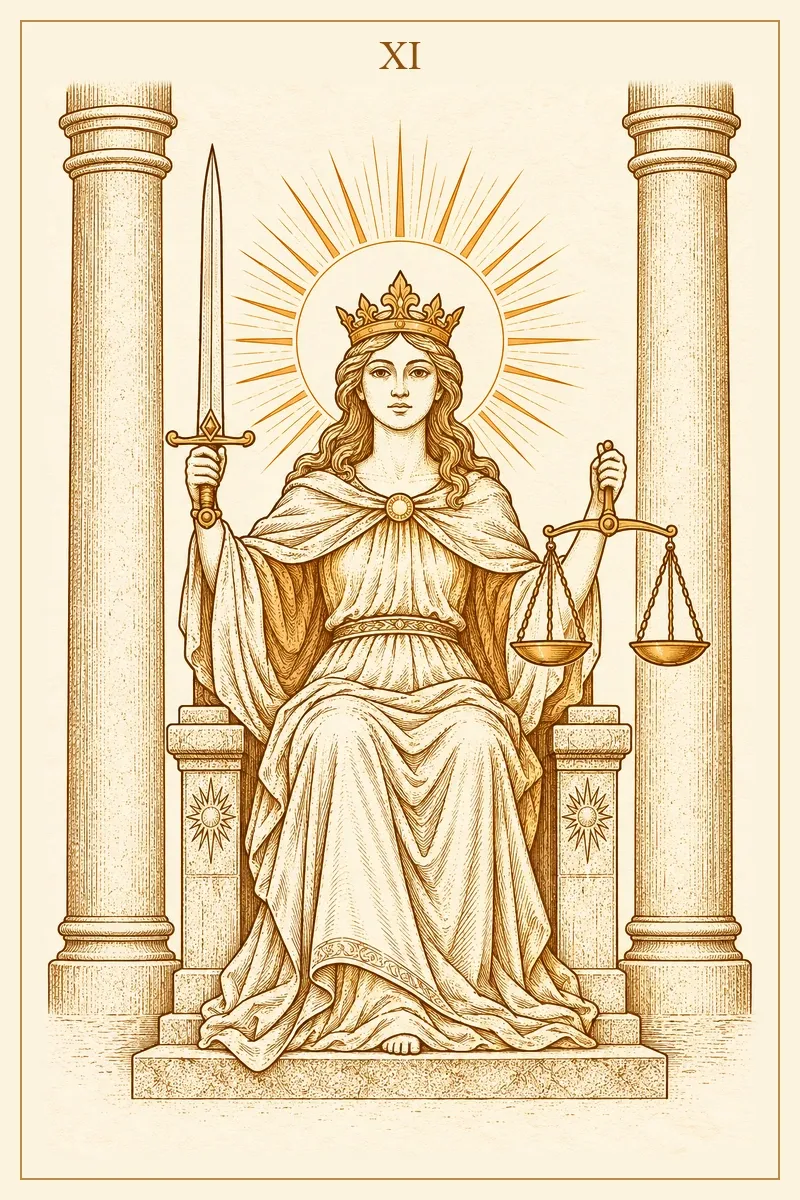
Justice sits crowned between two columns, a sword raised in one hand and balanced scales in the other. Upright, it is the card of clear terms: the client knows your price, your approach and your limits before they pay, and you keep the promises you made.
Reversed, Justice can point to vague pricing, surprise extra fees, or claims you cannot support, such as promising to "bring back" a partner. Those practices harm clients and the reader's own standing. Read the Justice tarot meaning for its themes of truth and accountability.
Ethics and scope: what a tarot reader does not do
Ethics are the part of professional reading a client cannot check in advance, which is why they matter so much. Here is a short list you can publish and keep to:
- No medical, legal or financial advice. You can note that a theme seems important and suggest the right professional. You do not diagnose, interpret symptoms, comment on a legal case or recommend investments.
- No predictions of death, illness or pregnancy. Decline these questions kindly, every time.
- Care around people who are not present. Keep the reading on the client's side of a relationship and do not claim to report what someone absent thinks or plans.
- Confidentiality. What a client tells you stays private. Never share a recognizable story online, even without a name.
- Informed consent. Explain your approach, your limits and your terms before the session begins.
- No fear-based selling. Never tell a client they are cursed or need paid work to remove bad luck.
- Safety first. If a client says something that suggests they or someone else is in danger, stop the reading and point them to local emergency services or a crisis line.
Some readers also choose not to read for minors, or only with a parent's knowledge; local rules may affect this as well. Whatever you decide, write it down so you apply it the same way to everyone.
Pricing your readings without overpromising
There is no correct price for a tarot reading, and no guarantee that readings will become a living. Fees vary with place, format and experience, and many readers keep other work. What you can control is how you set a price and how you present it.
Consider the time involved, including preparation, the session format, and what readers with similar experience charge where your clients are. Some readers start with a reduced practice rate while gathering feedback. Whatever you choose, keep these habits:
- State the full price and session length before booking, with no extras added once the session has started.
- Write a cancellation, lateness and refund policy, and apply it evenly.
- Charge for your time and care, never for an outcome. Do not advertise accuracy rates or promise results.
- Keep simple records of bookings and payments, and check your local rules on business registration and tax with a qualified advisor.
Caring for clients and for yourself
Client care continues after the cards are packed away. Keep notes only with consent, store them privately, and delete them when they are no longer needed. Do not message a client to "check in" unless they asked you to.
Care for yourself as well. Readings about grief, illness or a crisis can stay with you. Leave a gap between sessions, keep a short closing routine of your own, and have someone to talk to, such as a peer reader, a study group or a counselor.
Practical next steps toward reading professionally
- Read for ten people outside your close circle and ask each one what helped and what did not.
- Write your opening script, including the consent question, and use it every time.
- Write a one-paragraph scope statement: what you read on, what you decline and where you refer people.
- Choose one spread with named positions as your standard session layout.
- Draft your terms: length, price, cancellations, records and privacy.
- After each session, note one thing to keep and one thing to change.
Frequently Asked Questions
Do I need a certificate to become a professional tarot reader?
Usually not. In most places there is no license for tarot reading, and certificate courses are optional. They can build structure and confidence, but practice, feedback and a clear ethical approach matter more. Local business or consumer rules may still apply, so check them where you live.
How much should a beginner charge for a tarot reading?
There is no standard figure. Look at the time you spend, the format, and what readers with similar experience charge in your area or online niche. Publish the price before booking, keep it consistent, and review it as your sessions improve. Do not plan around a particular income from readings.
What should I do if I go blank during a paid reading?
Slow down and describe the image: who is in it, what they hold, where they look. Ask the client what stands out to them. Then read the card next to its neighbors. Saying "Let me sit with this card for a moment" is honest and professional.
Can tarot predict what will happen for my client?
Not in a fixed way. Tarot can help a client reflect on a situation, notice patterns and weigh options. It cannot confirm another person's thoughts, set a date or guarantee an outcome, and a professional reader is clear about that from the opening.
Should I read for friends and family once I go professional?
You can, but decide your terms in advance. Some readers keep family readings informal and free; others treat them like any session. Either works if you are consistent and the other person knows which kind of reading it is.
What if a client wants me to tell them what to do?
Explain that the cards can show what they may be missing, but the decision is theirs. Offer to look at each option in turn. If a client keeps asking for direction on a serious matter, suggest a counselor or the relevant professional.
If you would like to see a session structure from the client's side before you offer your own, you can try a reading on Veil Soul and notice how the named positions guide the questions.