Judgement is the card of a call you can no longer pretend not to hear. Upright, the Judgement tarot card means awakening, an honest reckoning with your past, and the decision to rise and answer: a second chance, a return, a forgiveness, or a vocation you finally take seriously. Reversed, it points to self-doubt, an inner verdict so harsh it keeps you lying still, or a call ignored because answering would change too much.
It is not a card of punishment. The figures on it are not being sentenced; they are getting up. What the card cannot do is report another person's decision, set a date, or guarantee how a choice turns out. It shows where a reckoning is already underway and asks what your answer will be.
At a glance:
- Upright: awakening, a clear call, reckoning, second chances, forgiveness, a decision you can stand behind.
- Reversed: self-doubt, a call ignored, relentless self-criticism, letting other people's verdicts decide for you.
- Number: twenty (XX), the second-to-last card of the Major Arcana.
- Element: Fire in the Golden Dawn system, with the Hebrew letter Shin; many modern readers add Pluto.
- Love: an honest conversation, a renewed bond, or an old relationship that asks to be settled.
- Yes or no: yes upright; reversed, not until you stop arguing with yourself.
Three tombs, one trumpet: what card XX shows
An angel with a long horn
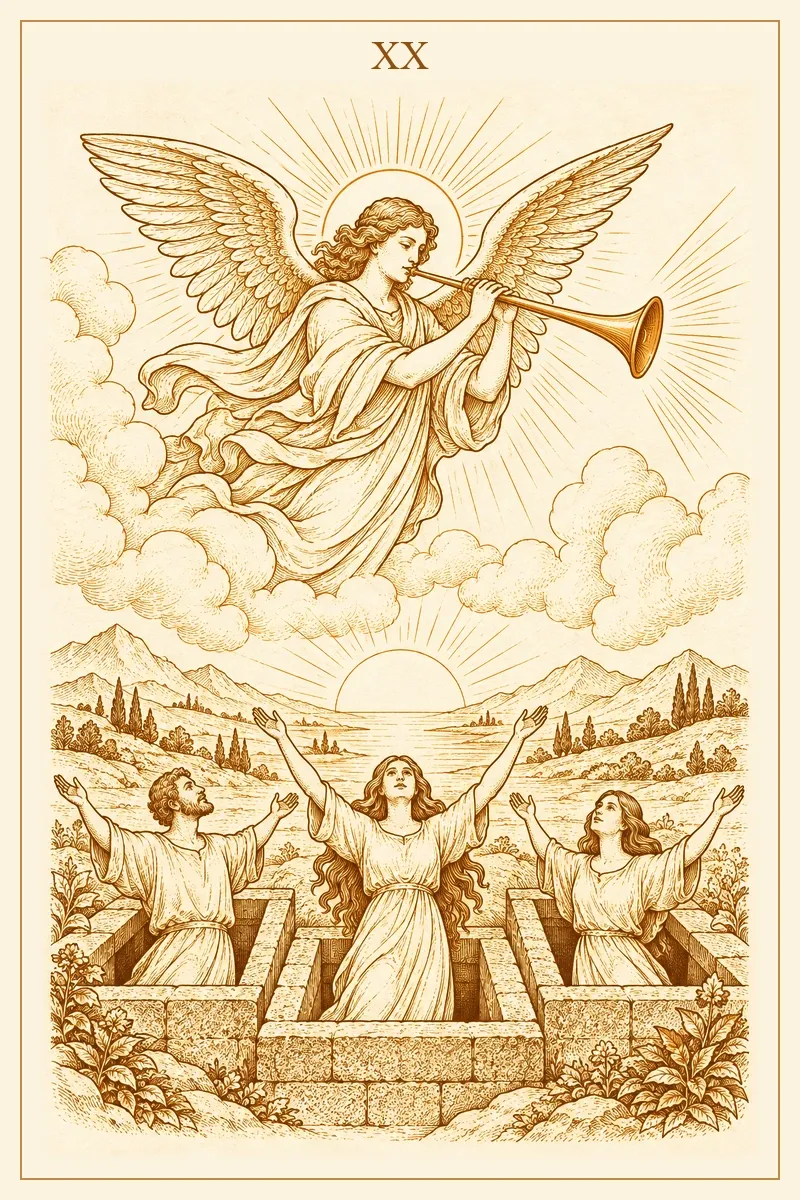
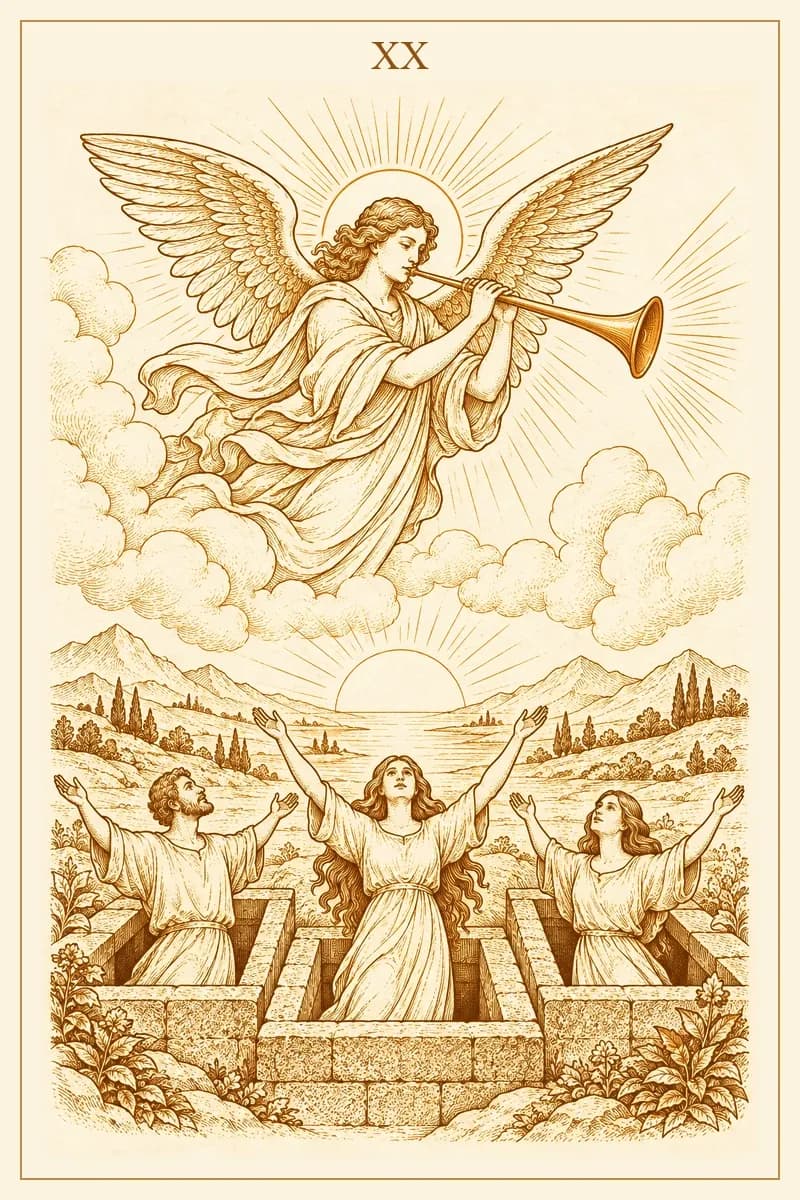
The upper half of the card belongs to a winged angel leaning out of a bank of cloud, haloed and curly-haired, robes caught by the wind, rays fanning out behind the wings. The angel holds a long, slender trumpet to its lips with both hands and points the bell out to the right, as if the sound is meant to travel past the edge of the card. Nothing hangs from the horn: no flag, no emblem. The call here is not a written rule with terms attached. It is a sound, and a sound means nothing until someone hears it and decides to move.
Three people standing up in stone
Below the clouds, three figures rise from three open tombs of square-cut stone: a bearded man on the left, a woman with long loose hair in the center, and a younger figure on the right. Each stands waist-deep in a separate stone box, arms lifted, face turned up. Nobody is being pulled out; each of them stands on their own legs. The tombs sit on dry ground among leafy plants and small flowers, so they read less like graves than like rooms someone has stayed in too long. The trumpet sounds for everyone, but each person answers it alone, from wherever they have been lying.
A sun half over the horizon
Between the clouds and the tombs lies a calm landscape: a still lake or bay, low hills and distant mountains, slim cypress trees, and a sun sitting half above the water line. Set against the figures below, that half-risen sun is the card's quiet promise. The day has started, but it is nowhere near noon. Rising is a process, and the picture catches its first minute.
Fire, the letter Shin and the step before The World
- Number: twenty, written XX.
- Element: Fire, in the Golden Dawn attributions; the card carries no zodiac sign or planet in that system.
- Hebrew letter: Shin, a letter often compared to three flames rising from one base.
- Modern planet: Pluto, a later addition that many contemporary readers use.
The Golden Dawn titled the card Spirit of the Primal Fire, and the fire meant there wakes and purifies rather than destroys. Pluto came in after the planet's discovery in 1930, when many readers gave the three outer planets to the three elemental trumps; its themes of descent and regeneration suit the open tombs. Some guides also tie the card to Scorpio because modern astrology gives Scorpio to Pluto. That link is a step removed from the traditional attribution, so treat it as optional.
The card's place in the sequence says as much. It follows The Sun, where a child in a flower crown rides a white horse with arms flung wide, the picture of joy that needs no explaining; the Sun card meaning reads it as clarity and vitality. Judgement asks what you will do with that clarity, because daylight also shows what you have been avoiding. After it comes The World, a dancing figure inside a laurel wreath with four winged creatures in the corners: a circle closed. Judgement is the threshold before that circle, the last decision the journey asks for, and the World card guide picks up from there.
Judgement upright: hearing the call and answering it
A reckoning that ends in a verdict you can live with
Upright, Judgement asks you to look at a whole stretch of your life at once, the good decisions and the regretted ones, and reach a conclusion that is neither harsh nor flattering, only accurate. It fits the stretch when a chapter has ended in fact but not yet in your head: after a job, a move, a breakup, a long family illness. The useful question is not "was I good enough?" but "what did that teach me, and what will I do differently now?" A verdict you can live with is one that lets you stand up.
Second chances, returns and things that come back
This is the card of things that come back for a second look: an old ambition, a course you dropped, a friend you lost touch with, a place you left. Its promise is not that the past will repeat but that you meet it changed. If an offer or a message has reappeared, weigh it as the person you are now, not the person who walked away.
Forgiveness, including the kind you owe yourself
Older readings call this card absolution. In practice that means setting down a grudge, an apology you are still waiting for, or a mistake you keep replaying. Forgiveness here does not mean pretending something was fine or reopening a door that should stay shut. It means the old event no longer decides what you do next, and very often the hardest person to release is yourself.
Awakening in ordinary clothes
Spiritually, Judgement describes seeing your life from slightly higher up and being unable to unsee it. A real awakening usually changes small daily things first: what you agree to, how you spend an evening, which voice in your head you believe.
Judgement reversed: when the trumpet goes unanswered
Doubt louder than the call
Reversed, the trumpet is still sounding; you have decided not to hear it, or you hear it and talk yourself out of moving. The change might cost money, status or approval, or answering and failing might feel worse than never answering. The card does not shame that fear. It points out that staying in the tomb is also a choice, with costs of its own.
The inner judge who never adjourns
A central reversed meaning is self-judgment that has stopped being useful. Reflection becomes a trial with no verdict: the same mistake replayed, the same charge read out every night, no sentence served and no release. If the voice in your head sounds like a prosecutor, close the case. Accountability means naming what happened and changing what you can, not punishing yourself forever.
Letting someone else hand down the verdict
Sometimes the reversal points outward: decisions made around what parents, a partner, a boss or a social circle would think, or an old label you still live by, such as "not the academic type." Occasionally it shows the opposite problem, a dramatic leap made in a rush to skip the slower work of understanding. Either way, the task is to separate other people's verdicts, and your own panic, from your actual evidence.
Judgement in love: honest reckonings and second chances
If you are single
For someone single, upright Judgement can follow a period of seeing old relationships clearly: the type you chose, the signals you ignored, the role you kept playing. It suggests you are ready to date as the person who learned that, which can change who you notice and who notices you.
Inside a relationship
For a couple, this is the card of the conversation that clears the air. Something half-said for months gets said properly, and the relationship either renews on more honest terms or both people see that it cannot. Upright, the tone leans toward renewal: forgiving an old hurt, recommitting with new agreements, seeing each other as you are now.
When an ex comes back
Judgement fits returns, so people hope for it when an ex gets in touch. Read it carefully. It asks whether both of you have done the reckoning, not only whether you miss each other, because a second chance built on the same unexamined pattern tends to end the same way. If the old issues have been named and worked on, the card supports trying again; if not, it asks for that conversation first.
Reversed in love
Reversed, watch for two opposite habits: clinging to a relationship that has ended in every way but name, or judging new people by old wounds until every small flaw looks like proof. Both keep you in the tomb, and naming which one is yours is the first step out.
Career and calling under card XX
Upright: the review, the return, the vocation
At work, Judgement can coincide with an evaluation: a performance review, an exam, a portfolio assessment. Upright, it suggests the evaluation is fair and past effort counts. It also fits returning to a field you left, finishing a qualification you abandoned, or admitting that your current career was chosen for reasons that no longer hold. If a call toward different work keeps sounding, give it a real hearing through research, a conversation with someone already doing the job, or a small test project. Judgement favors decisions made with your whole history in view, not leaps made to escape it.
Reversed: staying where you have stopped growing
Reversed, the card can describe staying in a role you have outgrown because starting over feels humiliating, or avoiding feedback for fear of what it will say. It can also point to a workplace where judgment is constant and nothing is ever enough; then the question is whether you have absorbed that standard as your own.
Money and the honest audit
With money, upright Judgement asks for an honest look at the whole picture: what comes in, what goes out, what is owed, and whether your spending reflects what you value. It can coincide with an old decision finally paying off, for better or worse. Face the numbers directly and, where the stakes are real, talk to a qualified professional; tarot gives no financial advice and cannot predict a market or a windfall. Reversed, it can describe avoidance, such as the unopened statement or the debt you round down in your head, or shame over a past mistake that blocks a clear decision now. The first step is the same either way: look at the actual figures once, calmly.
Is Judgement a yes or a no?
Upright, Judgement is generally a yes, especially to questions about returning, trying again, applying or speaking up. Its yes has a condition: it backs the plan that comes after honest review, not the impulse. Reversed, read it as not yet, leaning toward no, because doubt or unfinished business is blocking the decision. Try rewording the question to something the card can help with, such as "what am I still holding against myself here?" The guide to yes or no tarot readings explains how to word questions and weigh one card against several.
When does Judgement say it will happen?
What Judgement describes is a kind of timing rather than a date: things move once a reckoning has been reached, and its fire tends to speed events up after a long pause. Some readers link it to a deadline or anniversary that forces a decision, or to news from the past arriving at last. If you want to try timing systems such as suits mapped to seasons, the overview of how to read timing in tarot sets out the common methods and their limits. With Judgement, the most honest answer is often "when you answer."
Judgement beside Death, The Tower, The Fool and The High Priestess
Four pairings deserve a closer look, and each handles a different stage of the same rising.
Judgement and Death: the ending, then the getting up
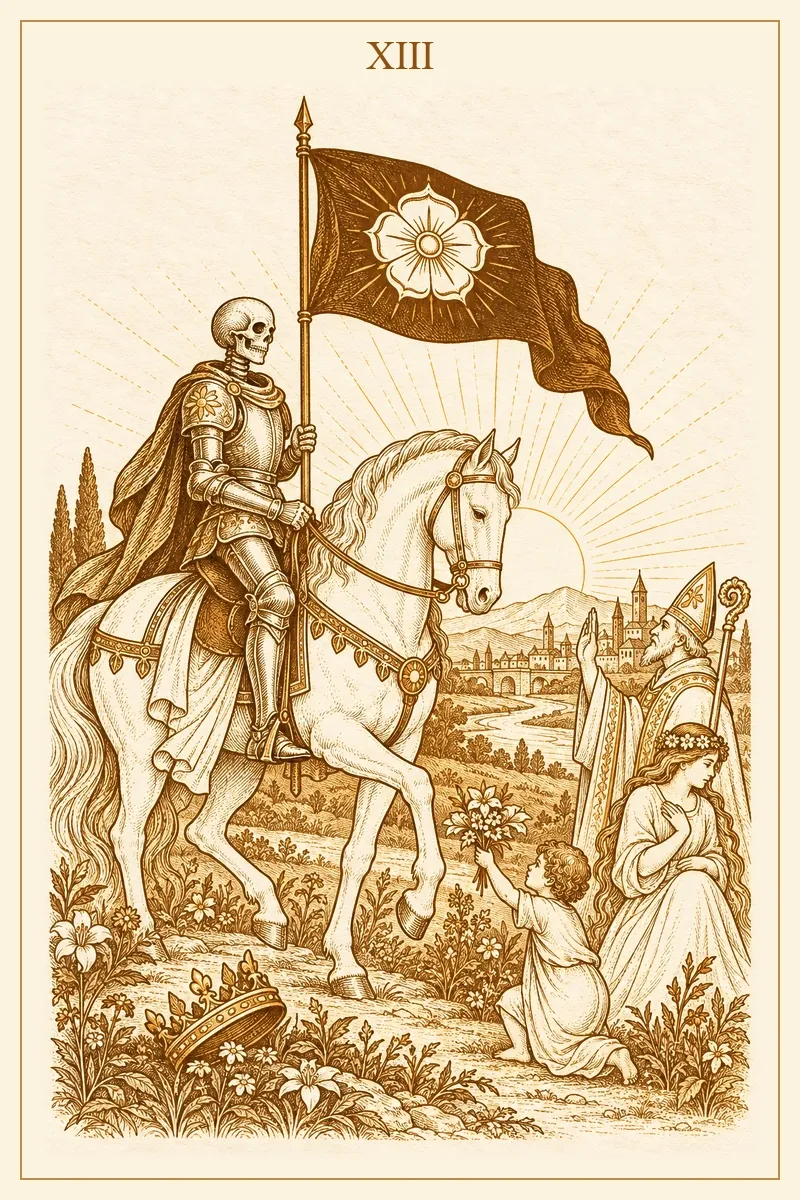
Death shows a skeleton in armor on a white horse, carrying a dark banner with a pale five-petaled rose, a crown fallen in the flowers while a bishop, a kneeling woman and a child with a bouquet meet it. It is the ending itself. Judgement is the moment afterward when you decide to stand up in the new landscape, so together they describe a full cycle of change. With Death in a past position and Judgement in the present, the grieving has done its work and a new decision is due. The Death tarot meaning explains why that card is about transformation far more often than literal loss.
Judgement and The Tower: the shock that wakes you
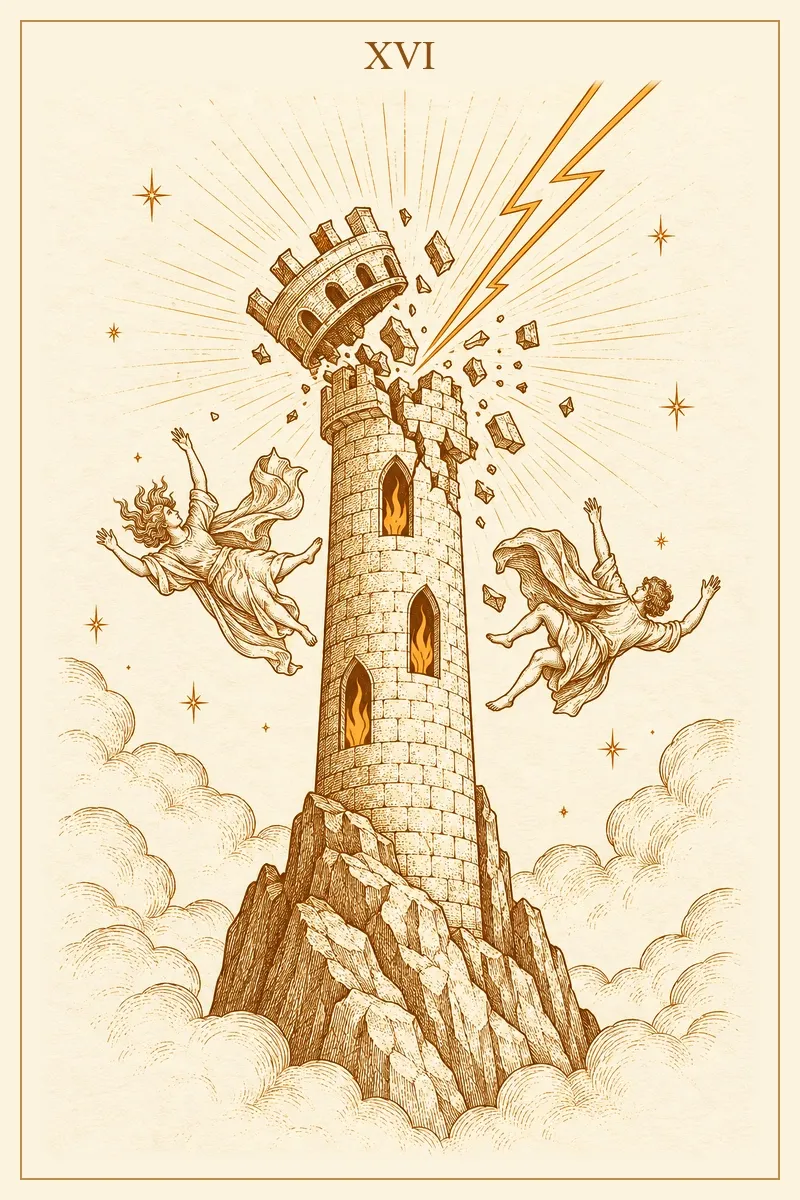
The Tower is a stone tower on a rocky peak above the clouds, its crowned top knocked off by lightning, flames in the windows, two people falling. Paired with Judgement, the upheaval becomes the wake-up call: the sudden layoff that makes you ask what work you actually want, the revelation that ends a pretense. The shock is not made pleasant, but it does not get the last word. The Tower card meaning covers the breakthrough side of that collapse.
Judgement and The Fool: from verdict to first step
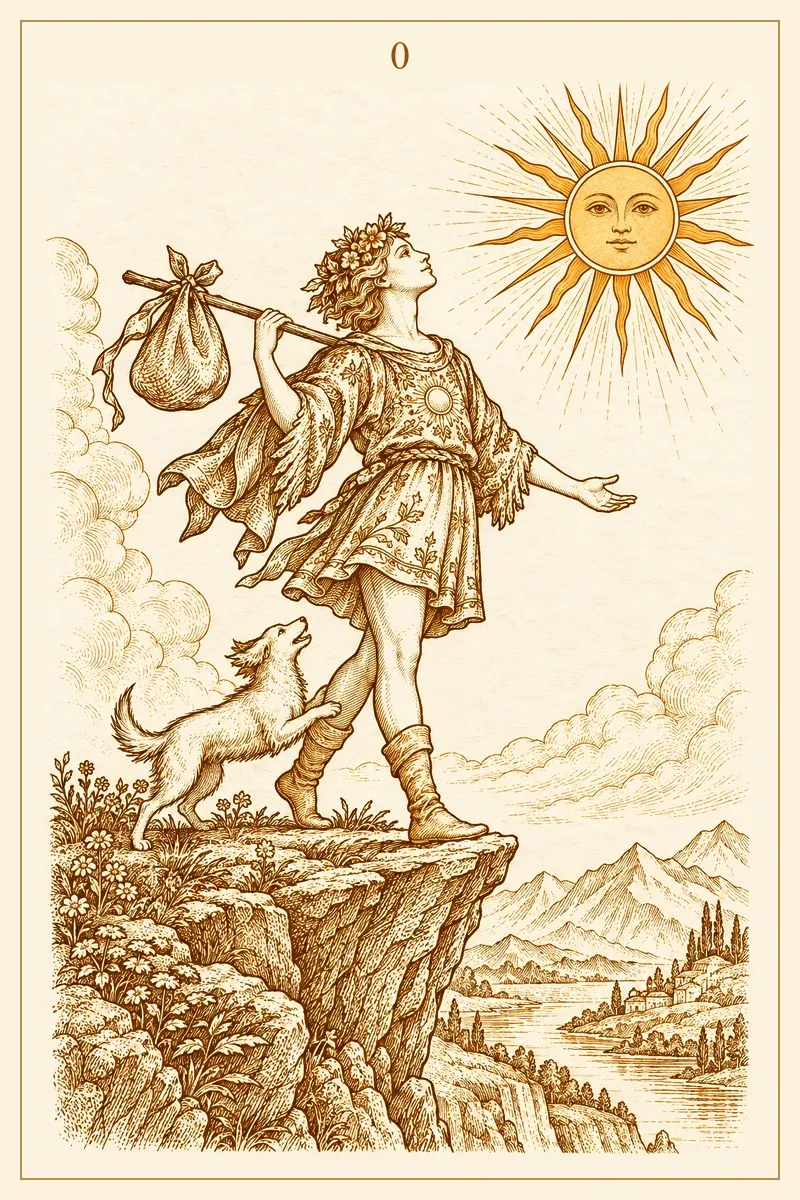
The Fool is a young traveler in a flower crown at a cliff edge, a bundle on a stick over one shoulder, face turned up to a sun with a calm human face while a white dog leaps at his leg. With Judgement, the reckoning turns straight into a fresh start: you carry what you learned and travel light. Reversed, either card can warn that the new beginning is really an escape from the review; the Fool card meaning covers how to tell a brave leap from a careless one.
Judgement and The High Priestess: the quiet voice and the loud one
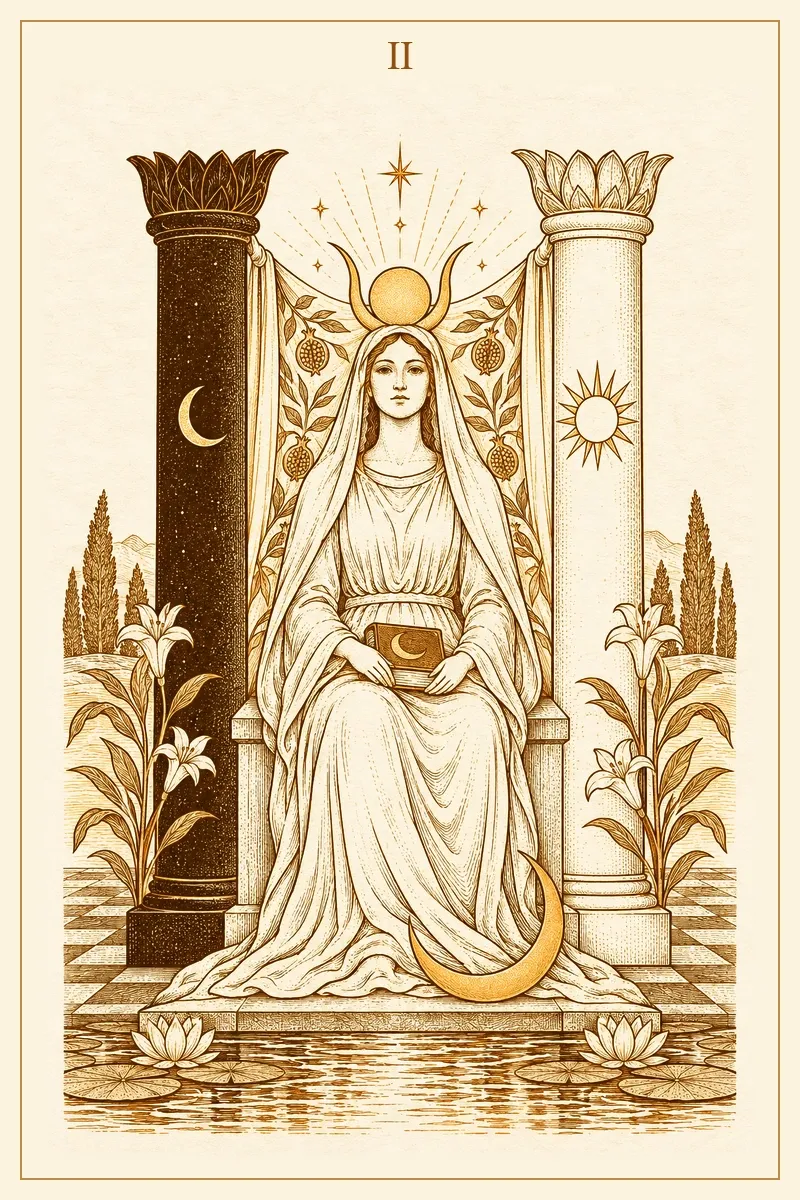
The High Priestess sits between a dark pillar marked with a crescent and a pale pillar marked with a sun, a book on her lap and a crescent moon at her feet above still water. She is what you know before you can explain it; Judgement is the moment that knowing becomes loud enough to act on. Together they say the call is coming from inside. The High Priestess guide goes deeper into that kind of inner knowing.
Other cards that shift its tone
- The Hermit: private reflection first, a public decision afterward.
- Six of Cups: the past returning through an old friend, a hometown or a childhood hope.
- The Star: renewal after a hard stretch, with hope that feels earned.
- Two of Swords: a call you refuse to look at, so the decision keeps stalling.
The Trumpet Spread: four positions for a call you keep hearing
This layout follows the picture on the card. Use it when Judgement has turned up in a reading, or when one particular change keeps returning to your mind. Write the call down first, in one plain sentence.
- The trumpet. What is actually calling me, underneath the way I usually describe it.
- The tomb. The story, habit or verdict I have been lying in.
- What rises with me. The strength or experience I already carry into the change.
- The first answer. One step I can take this week to respond.
Keep the fourth position small; treat it as one honest step, not a life plan. A reversed card here marks a block in that position rather than a bad omen.
Worked example: the certificate left one module short
The draw below is invented to show the positions working together. Picture someone who left a translation certificate eight years ago with one module unfinished, and who has just heard that the program now runs evening classes. The sentence at the top of the page reads: "I keep thinking about finishing the certificate."
The trumpet: Page of Cups. A youth in a feathered cap and a shell-patterned tunic stands by the sea, smiling at a fish leaping out of a gold cup. In the call position it shifted the question from a credential to delight: the person remembered enjoying the work itself, the small pleasure of finding exactly the right word.
The tomb: Eight of Swords. A blindfolded woman stands barefoot in shallow water, loosely bound, eight swords planted around her and an open gap in front. It named the verdict she had been living in: "I am someone who does not finish things." The swords looked like walls, but the gap was there, and most of that verdict traced back to one bad term and one teacher's remark.
What rises with me: Eight of Pentacles. A young craftsman carves a pentacle at his bench, six finished ones hung on a post beside him. This pointed to evidence against the old verdict: years of careful work in another job, finished every day. The skill of finishing was never missing; it had been used elsewhere.
The first answer: Three of Wands. A figure on a cliff beside three leafy staffs watches three ships under sail, the sun low over the sea. The step was modest and outward: request the current syllabus and ask whether old credits still count, then decide anything else after reading the reply.
The spread did not say "enroll" or "don't." It turned vague guilt into a clear call, named the story blocking it, found evidence against that story, and ended in one email. That is Judgement at its most practical: less fanfare than the trumpet suggests, and a real movement out of the tomb.
Frequently asked questions
Is Judgement a good card or a bad card?
Mostly hopeful, but demanding. It promises renewal on the condition that you face something honestly. Nobody on the card is being condemned.
What does Judgement reversed mean in a few words?
Self-doubt, a call left unanswered, or self-criticism that has become a sentence with no end. Now and then it means rushing a big change to avoid the reflection that should come first.
Does Judgement mean my ex is coming back?
It fits returns, yet it speaks about readiness rather than another person's plans. Whether both of you understand why it ended matters more than whether a message arrives.
Does Judgement predict a legal case or court decision?
No. Tarot can help you reflect on how you feel about a situation, but for anything legal, rely on a qualified professional. More broadly, a reading cannot confirm someone else's thoughts, set a date, or fix an outcome.
What is the difference between Judgement and Justice?
Justice is about fairness and cause and effect, weighed by an outside standard. Judgement is an inner reckoning and a call to rise. Justice asks whether something is fair; Judgement asks whether you are ready to answer.
Does the card's name mean I am about to be judged?
The title comes from the old image of the Last Judgment, in which the dead rise at a trumpet call. In a reading, though, the one judging is you, and the card shows people standing up after the verdict. Older English decks spelled the name with an e, and most decks keep that spelling.
Rising, one step at a time
Judgement does not ask you to become someone new overnight. It asks you to hear what has been calling, look honestly at the story that kept you lying still, and take one step that proves the story wrong.
- Write the call in one sentence, and under it the verdict that has been answering it. Read both aloud and notice which one sounds like you now.
- Choose one thing to forgive, in yourself or someone else, and decide what letting it go would change this week.
- Take one small outward action, such as an email, a question or an application, so the answer exists outside your head.
When you are ready to sit with your own question, you can start a reading and give Judgement's call a quiet place to be heard.