Ask people which tarot card frightens them most and they will usually say The Tower, with Death close behind. Six more cards complete the usual bad-news list, speaking of heartbreak, money strain, confusion, unhealthy ties and worry that keeps you up at night. All eight name a pressure point while there is still time to do something about it, which is why they are best read as early warnings rather than as sentences already passed.
That framing is also honest about what tarot can do. A card cannot guarantee that a particular event will happen, put a date on it or reveal what another person is planning. It can show you where a situation looks fragile, what you may be avoiding and which small step is still within reach.
Here is what each card usually warns about, and the first thing it asks of you:
- The Tower: a plan or belief that cannot hold; check the foundations before they give way.
- Death: a chapter that is ending; stop pouring energy into what is already finished.
- Ten of Swords: a painful low point; the worst is often behind you, so turn toward recovery.
- Three of Swords: a truth that will hurt; let yourself feel it instead of arguing with it.
- Five of Pentacles: strain on money or support; ask for help before the cold sets in.
- The Moon: missing or misleading information; verify before you decide.
- The Devil: a habit or tie with more hold on you than you admit; notice where the chain is loose.
- Nine of Swords: worry running ahead of the facts; write the fear down and test it when you are calm.
Bad news, a no and a warning are not the same
People often treat these three as one thing, yet they answer different questions. A no replies to a yes/no question: should I sign, will it work, is this the moment. If that is what you are asking, the guide to tarot cards that mean no sorts the firm answers from the softer ones. Bad news is broader. It describes a condition rather than a reply, and it can turn up in any reading, even one that only asked "What should I know this month?"
A warning is bad news that arrives early enough to be useful. A Five of Pentacles in a monthly reading does not cancel your plans; it suggests that your budget or support network deserves a look before the month gets expensive.
Why do some cards frighten people more than others? Mostly because of their pictures: lightning and falling figures on The Tower, a skeleton in armor on Death, ten blades in the Ten of Swords. Yet a dramatic picture does not mean a dramatic event. When one of these cards turns up, ask three things first. Which area of life does it touch? Has this already started, or is it still forming? What is the smallest action that would leave me better prepared?
Six warning cards and what each asks of you
These six appear most often when a reading "looks bad". Each is shown upright and reversed, in love, work and money, with the step it points toward.
The Tower: when a structure cannot hold
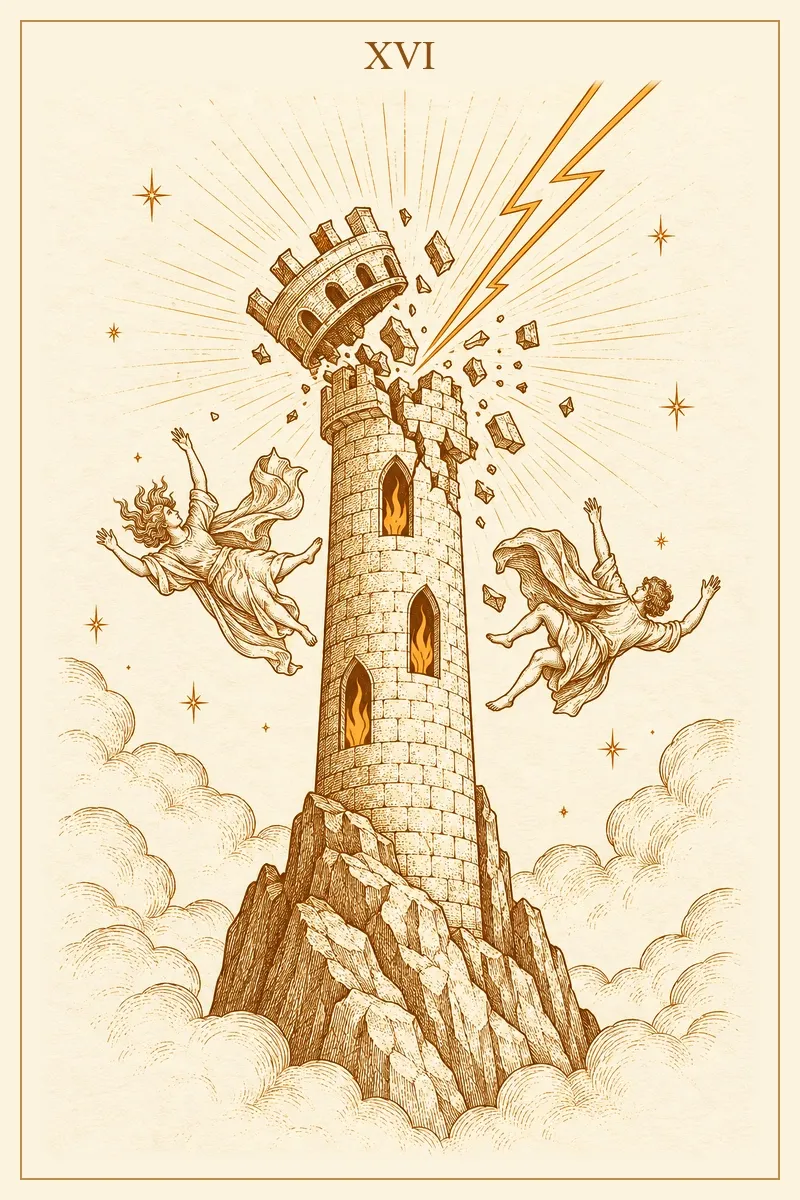
Upright, The Tower describes sudden change: a plan, belief or arrangement that looked solid gives way, often because it rested on something that was never quite true. What falls is usually what could not have lasted. The full Tower tarot meaning follows the card through its other contexts.
As a warning, the card asks where you rely on an assumption you have not tested. In love, that might be a disagreement you both keep stepping around. At work it can point to a restructure or a project built on optimistic numbers. With money, check anything that would hurt if it suddenly changed: a single source of income, a loan you have not read closely, a cushion thinner than it feels.
Reversed, The Tower often shows upheaval being held off, either because you are propping up a structure that wants to fall or because the shake-up is happening privately, as a change of mind. The response is the same either way: find the weak point and repair it on your own terms, before circumstances choose for you.
Death: when a chapter is closing
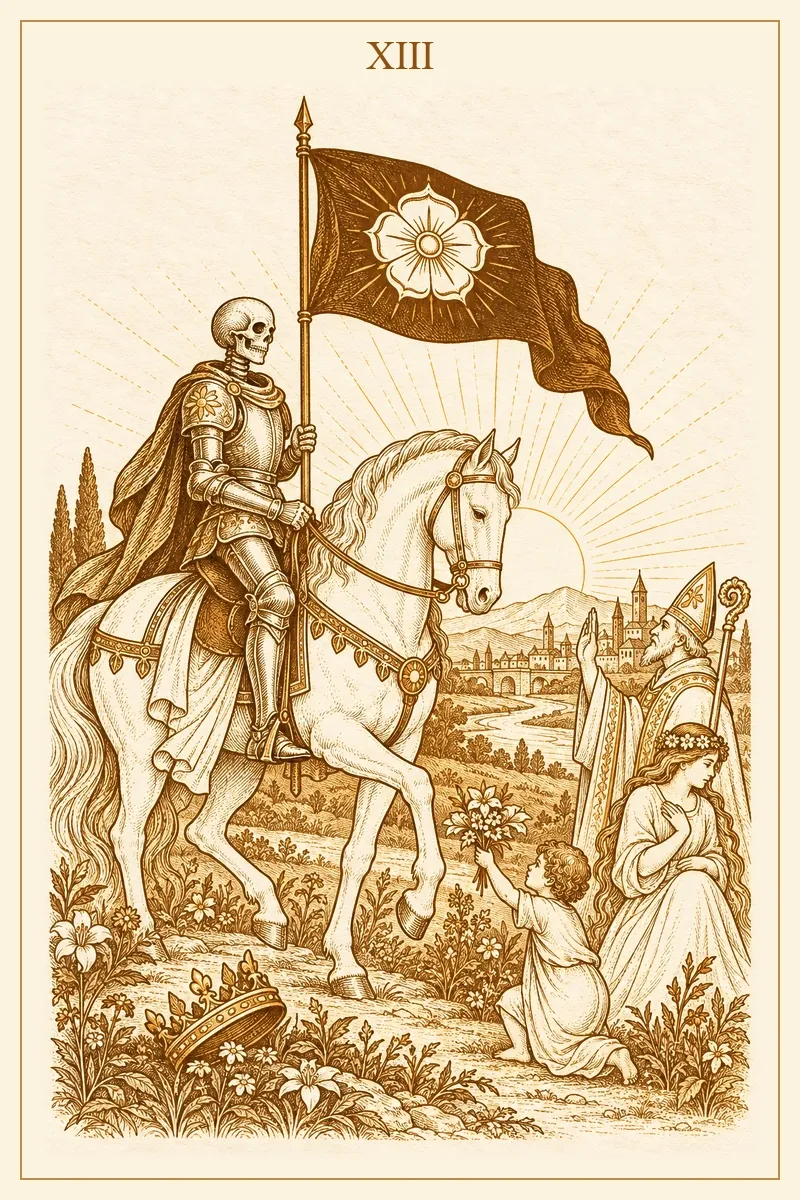
Death is one of the most misread cards in the deck. It stands for an ending that makes room for something else: a phase of life, a role, a version of a relationship or of yourself. It does not predict that anyone will die. Its warning concerns attachment, not danger. Our Death tarot card meaning explains the card's symbols, including the sun rising on the horizon.
In love, Death can mark the end of a relationship as you have known it, which may be a breakup or a move from early dating into something steadier. In career readings it often closes a job title or a professional identity you have outgrown. With money, it can describe a way of earning or spending that no longer fits your life.
Reversed, Death usually points to resistance: an ending that is overdue or dragged out because letting go feels frightening. Ask what you are keeping alive out of habit. Endings handled deliberately tend to be kinder than endings that arrive after years of avoidance.
Ten of Swords: when you have reached the bottom
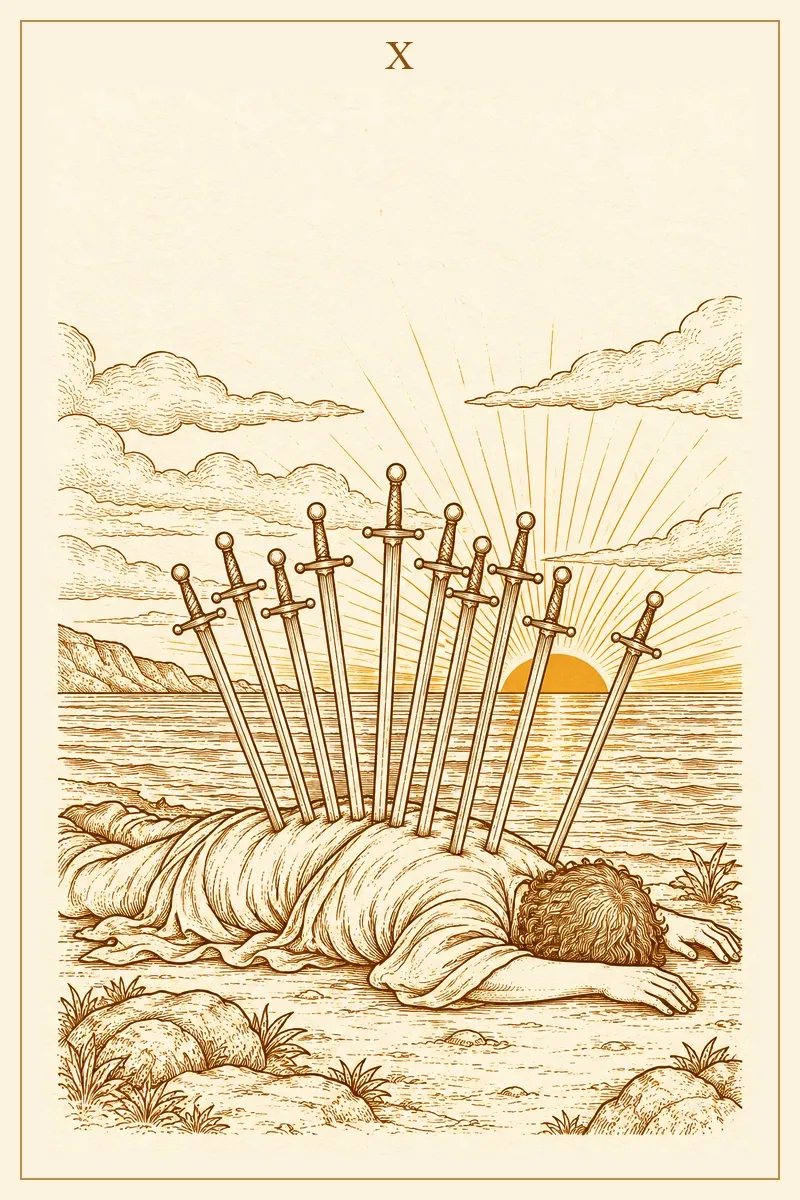
The Ten of Swords has the most violent picture in the deck, but its message is gentler than it looks. It describes a painful ending, exhaustion or betrayal that has already reached its lowest point. Notice the band of light along the horizon: this story cannot get any worse, so the next stage is recovery. The Ten of Swords tarot card meaning spends more time on that dawn.
As a warning, the card is usually about prolonging the end. In love, it can show someone replaying a breakup until the hurt becomes an identity. At work it may describe burnout that a weekend will not fix, or a failed project that keeps being revived. With money, it asks you to stop covering a loss with more money.
Reversed, it often describes getting back up: healing, energy returning, lessons absorbed. Occasionally it shows a refusal to accept that something is over. Either way, pick one thing that belongs to the recovery rather than to the crisis.
Three of Swords: when a truth is going to hurt
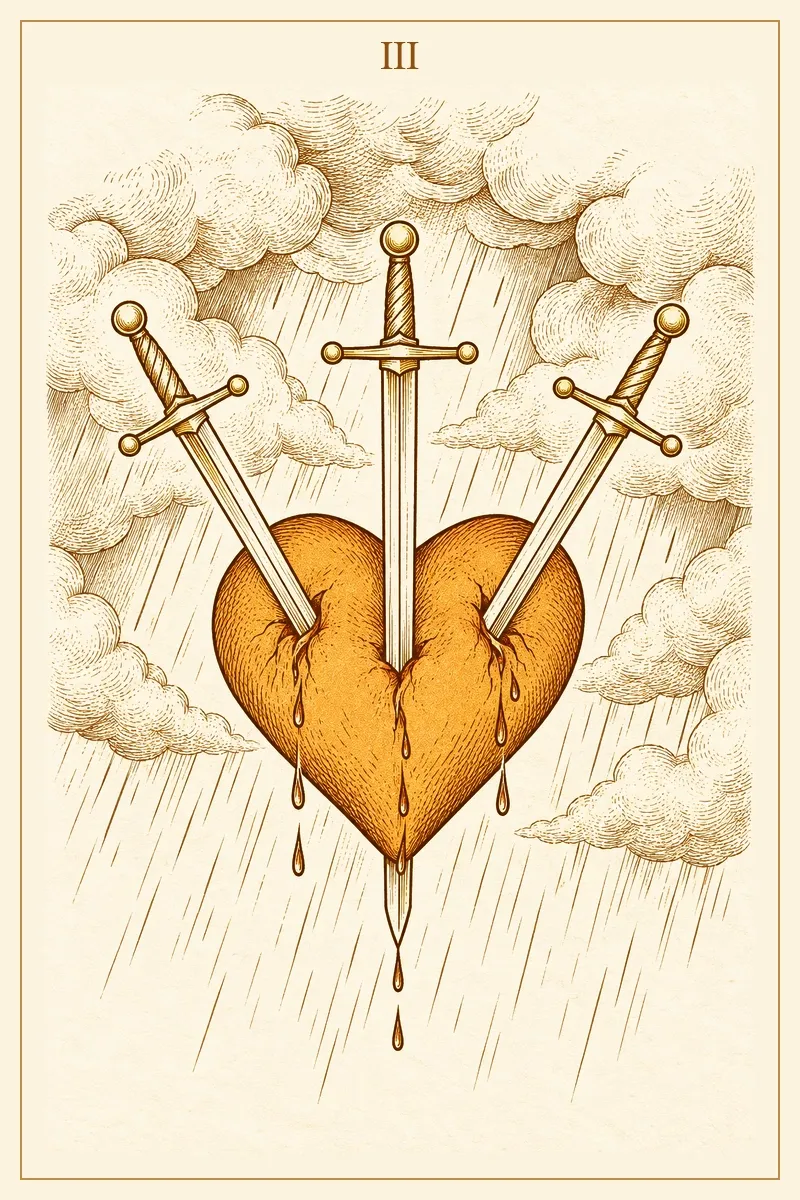
Upright, the Three of Swords is heartbreak, grief and a painful truth. It softens nothing, and that directness is its value. The heart in the picture is pierced but not broken apart, a fair description of most heartbreak: deeply painful, and survivable. Read the full Three of Swords tarot card meaning for both its grief and its healing.
In love, the warning is often about words that need to be spoken: a hurt nobody has named, or a disappointment one partner keeps swallowing. At work it can point to criticism that stings but contains something accurate. Nothing in the card proves betrayal; it shows that something painful needs honest attention.
Reversed, it tends to show healing in progress, or grief pushed down instead of felt. Either way, give the hurt a time and a place, whether a conversation, a journal page or an hour with a friend or counselor, rather than letting it leak into everything else.
Five of Pentacles: when support is running thin
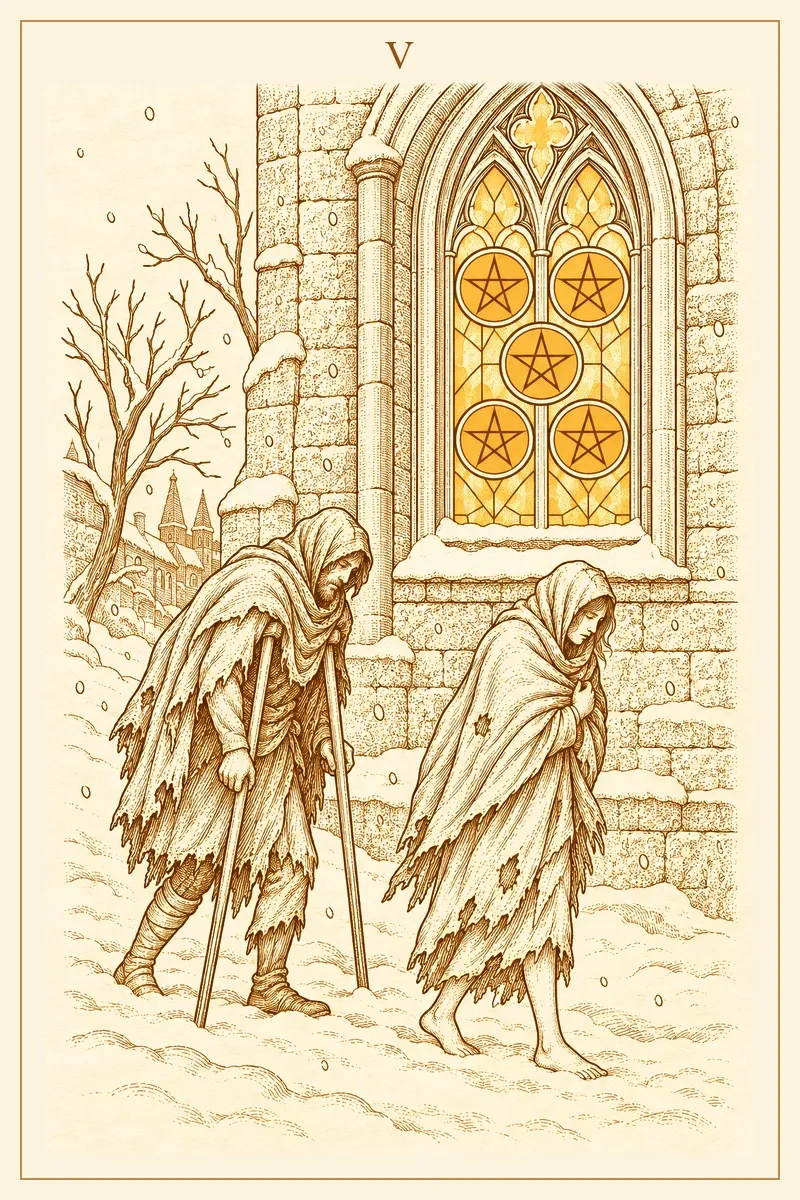
The Five of Pentacles shows two figures walking through snow past a lit church window they do not seem to notice. Upright, it describes hardship: money worries, a job loss or feeling left out in the cold. The warm window is its second message: help exists, and part of the difficulty is that the people struggling have stopped looking for it. The Five of Pentacles tarot card meaning covers both halves of that picture.
As an early warning, this is one of the most practical cards in the deck. In money readings, look at the numbers now: what comes in, what goes out, what would happen if one income stopped. In career, it can point to job insecurity worth preparing for. If health is on your mind, take the concern to a doctor; the card can prompt the appointment, but it knows nothing about your body.
Reversed, it usually shows recovery beginning or help being accepted. Its simplest advice is to ask: for a payment plan, a reference, a meal, a conversation. People are often more willing to help than we assume.
The Moon: when the facts are not all in
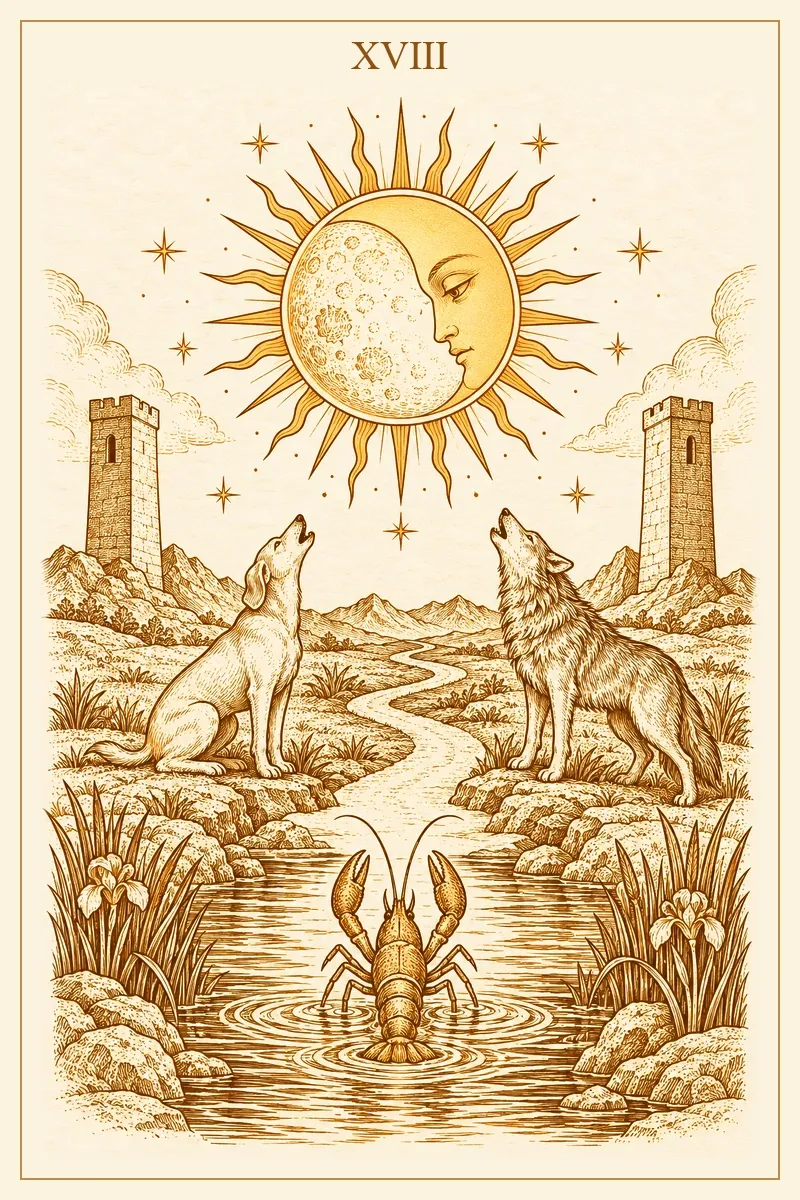
The Moon shows a path running between two towers under a pale moon, with a dog and a wolf howling and a crayfish climbing out of the water. Upright, it describes uncertainty and things not being what they seem. Often anxiety or wishful thinking is filling the gaps in what you know. The Moon tarot meaning explores its link with intuition and dreams.
In love, it warns against building a story out of fragments such as a delayed reply or a friend's guess. At work it can describe rumors or a decision being made with half the information. With money, read contracts closely and stay cautious about any offer that seems too good to question. The Moon is not evidence that someone is deceiving you; it asks you to slow down and collect facts.
Reversed, it often shows confusion lifting: a secret coming out or a fear losing its grip. When it is upright, postpone any irreversible decision until you have checked one or two key facts, by asking directly, rereading the document or simply sleeping on it.
The Devil, the Nine of Swords and other quieter warnings
Some cards carry a warning without the dramatic picture, so they are easy to skim past.
The Devil. Upright, it describes attachment that has turned into dependence: a habit, relationship, job or spending pattern that holds you more tightly than you would like. Yet the chains around the two figures' necks are loose enough to lift off, and that detail is the hope inside the warning. Reversed, it often marks the moment of release. The Devil tarot card meaning looks at its shadow side more closely.
Nine of Swords. Upright, it is anxiety in the small hours: someone sitting up in bed with their face in their hands. Its warning is usually about the worry rather than the event, because the fear may be louder than the facts. Reversed, worry may be easing, or being hidden from everyone else. The Nine of Swords tarot card meaning has more ways to work with sleepless worry; if anxiety has affected your sleep for weeks, a doctor or counselor is a better ally than any card.
Seven of Swords. Upright, it points to secrecy and someone getting away with something, sometimes another person and sometimes your own plan cutting a corner. Check terms, keep records and ask plain questions. Whether the card describes someone else or you is the main question in the Seven of Swords tarot card meaning. Reversed, a truth often surfaces.
Five of Cups. A cloaked figure mourns three spilled cups while two full ones stand behind. The warning concerns where your attention goes after a loss; reversed, the figure begins to turn around.
Eight of Swords. A blindfolded figure stands among swords that do not actually enclose her. The warning is about limits that live partly in your own thinking; reversed, the blindfold loosens.
How loud is the warning? Reading the context
The same card can be a footnote in one reading and the headline in another. Four things help you tell the difference.
- How many there are. One difficult card in an otherwise mild spread is a note about one area. Three or more in a five-card spread suggest a pattern worth slowing down for.
- Where it sits. In a past position it often describes what you are recovering from; in a present position, the current pressure; in a future position, where things are heading if nothing changes, which is exactly when a warning helps most.
- Whether it repeats. The same card across several readings usually means a theme has not been addressed. The article on a tarot card that keeps appearing shows how to work with a repeat without drawing over and over.
- Which way up it lands. A reversed warning card often softens toward recovery, delay or an inner version of the theme. Settle on how you treat reversals before shuffling, and stick with it for that reading.
What you asked matters too. A bad-news card in answer to "What do I need to watch this month?" is doing its job. The same card after an anxious question asked for the third time that evening is more likely to reflect your state of mind than your circumstances.
Warning cards beside hopeful ones
The cards around a warning often describe the way through. A few pairings are worth knowing:
- The Tower with The Star: upheaval followed by healing; hope returns once the dust settles.
- Death with Ace of Wands: an ending that makes room for fresh energy or a new project.
- Ten of Swords with Six of Swords: leaving the worst behind and moving toward calmer water.
- Five of Pentacles with Six of Pentacles: hardship met by generosity; support is there if you ask.
- The Moon with The Sun: confusion giving way to clarity.
Other pairs make a warning more specific. The Moon beside the Seven of Swords says to check facts before trusting a story. The Nine of Swords beside The Moon often describes anxiety feeding on itself, so rest comes before action. Read these as a sharper question, not a doubled threat. For the brighter side of the deck, the companion piece on tarot cards that mean good luck covers the cards people hope to see.
An early-warning spread in four positions
When a situation feels uneasy but you cannot say why, this spread turns a vague sense of trouble into something you can work with. Write down "What do I need to see clearly about this situation?", shuffle, and lay four cards in a row.
- The pressure point: what is asking for attention right now.
- The blind spot: what you may be missing, avoiding or misreading.
- Your influence: the part of the situation you can still shape.
- The first step: one action to take within the next week.
Read the first two cards as information, not judgment. A hard card in the blind spot is often the most valuable one in the spread, because it names what you have been looking away from. If the third or fourth card is also difficult, read it as the kind of effort required: a Ten of Swords in "your influence" may ask you to let an exhausted plan end so your energy can return.
Example: a Tower in a career reading
Question: "There is talk of a reorganization at my company. What do I need to see clearly about my job over the next three months?"
Cards drawn (all upright): The Tower in the pressure point, The Moon in the blind spot, Eight of Pentacles in your influence, and Page of Swords as the first step.
Reading: The Tower confirms that the structure around the job is under pressure. It does not say this person will be laid off; it says the current arrangement is unlikely to stay exactly as it is, and that relying on it unchanged would be the risky choice. The Moon adds that much of what they know is rumor.
The Eight of Pentacles shifts the focus to what is in their hands: their skills and a record of what they have delivered, useful whether they stay, change teams or look elsewhere. The Page of Swords suggests direct questions. A practical plan: ask their manager what is known and when more will be shared, bring their résumé up to date, and work out how many months of expenses their savings would cover.
The bad news is that change is likely. The early warning is that there is time to prepare for it with clear information rather than rumor.
Turning a warning into a plan
Whatever the card, a few steps help you move from a jolt of fear to something useful.
- Pause before you look anything up. Write down, in one sentence, the first fear the card raised.
- Rewrite the fear as a question. "I'm afraid I'll lose my job" becomes "What can I do this week to be better prepared at work?"
- Separate facts from guesses. Warning cards often point at the gap between what you know and what you assume.
- Choose one small action. A phone call, a budget check, an appointment. One completed step does more for anxiety than ten more cards.
- Bring in the right person. For health, legal or money decisions, a doctor, lawyer or financial advisor can tell you what no card can. For grief, a trusted friend or counselor is worth more than another spread.
- Set a date to look again. Note the card and your action in a journal and revisit them in two to four weeks.
If frightening cards keep stirring up more fear than insight, the guide to interpreting scary tarot cards without panicking offers grounding techniques for the moment itself.
Frequently asked questions
What is the scariest tarot card?
Most people name The Tower, because its lightning and falling figures look like disaster, with Death and the Ten of Swords close behind. In practice, many readers find The Moon or the Nine of Swords harder to work with, because confusion and anxiety are less visible than sudden change. A frightening image signals a strong experience, not a terrible outcome.
Does the Death card mean someone will die?
No. Death stands for endings and transformation: a phase, role or way of living that is finishing so another can begin. It is not a prediction of physical death, and no card can tell you about anyone's health or lifespan.
What should I do if I keep pulling bad-news cards?
Stop drawing for a while and look at what the cards have in common. Repeated warnings usually mean a theme is still waiting for attention, or that you are reading from a state of worry. Change the question from "Will this go wrong?" to "What can I do about this?" and wait until something in your life has actually shifted before you return to it.
Is a reversed warning card good news?
Not exactly, but it is often milder. Many readers see a reversed Tower, Ten of Swords or Five of Pentacles as recovery, delay or an inner version of the same theme. Read the reversal against the card's own meaning, and look at the guide to tarot reversals if you are still choosing a method.
Can I avoid bad outcomes by not doing a reading?
Skipping a reading does not change the situation; it only means meeting it without a chance to reflect first. If tarot leaves you more anxious than clear, taking a break is a healthy choice.
Can tarot tell me for certain that something bad will happen?
No. Tarot cannot confirm a future event, give a date or reveal what someone else intends. It reflects patterns and pressures as they look right now, and your choices can change them. For medical, legal or financial concerns, speak with a qualified professional.
Letting the warning do its work
Looking back, the cards with the hardest pictures often turn out to have been the most useful: The Tower that made you check a weak foundation, the Five of Pentacles that finally got you to ask for help. A warning is information arriving early, and early is when you still have the most choice.
When you feel steady enough to ask, try a calm tarot reading on Veil Soul and treat whatever card appears as the starting point for your next practical step.