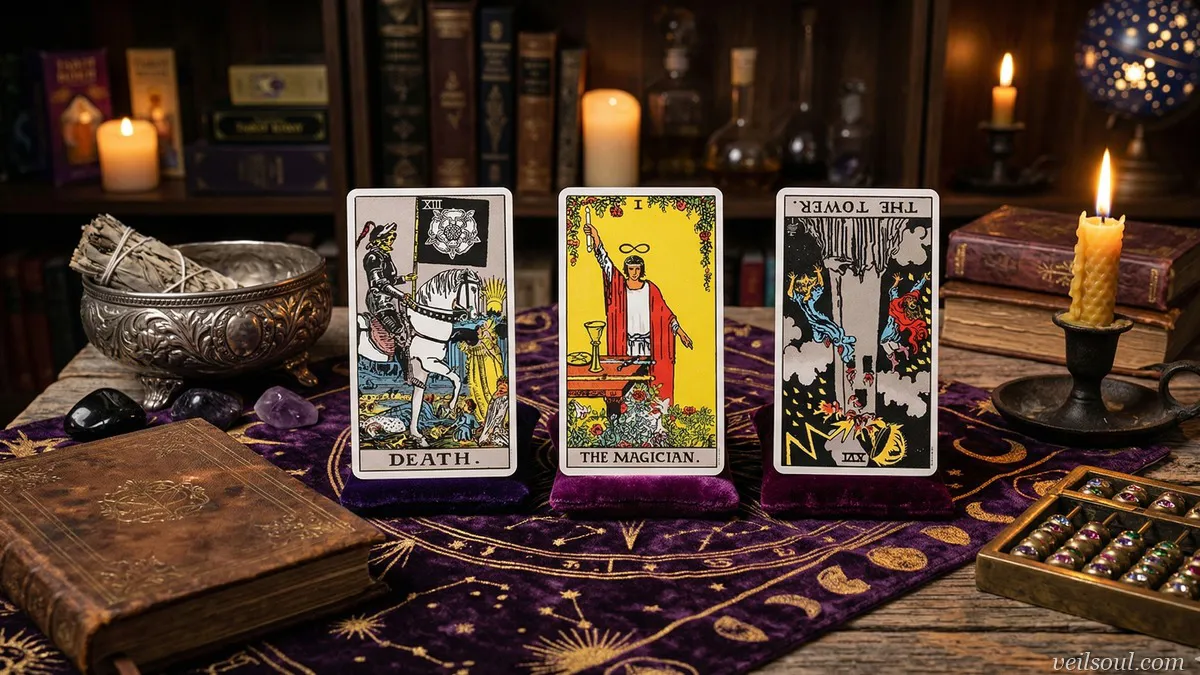
A reversed tarot card is one that comes out of the deck upside down. When you choose to read it that way, it does not flip the card into its opposite. It says the card's theme is still present but not flowing in its usual way: held back, turned inward, overdone, fading out, or halfway through a change. It is not a bad omen by default, and whether you read reversals at all is up to you; a deck read entirely upright is a complete practice.
A reversal adds detail; it does not add certainty. No card, upright or upside down, can confirm what another person is thinking, fix a date, or settle an outcome that still depends on choices. Treat a reversed card as a sharper question about your situation, and keep your own judgment in charge of the answer.
At a glance, here are six ways to read a card that lands on its head. Each one is explained below with card examples:
- Blocked or delayed: the energy is there but snagged on something.
- Turned inward: the theme is private, felt rather than shown.
- Too little or too much: the card's quality is underused or pushed past balance.
- Shadow side: the gift of the card has soured into its difficult form.
- Release or turning point: a hard pattern is loosening or ending.
- Lesson in progress: you are partway through learning what the card teaches.
Upside down on the table: what a reversal is
Mechanically, a reversal happens when the top of the image faces you as you turn the card over, so the figure stands on its head. Some readers let this happen by chance, through a shuffle that turns cards in both directions; others rotate part of the deck on purpose before shuffling so that both orientations can appear. The overview of shuffling methods for every reader describes the wash, or messy pile, shuffle, which mixes orientation naturally.
Reversed meanings are not a modern invention. French cartomancers of the late eighteenth century, Etteilla among them, already gave separate meanings to cards that appeared inverted, and A. E. Waite's 1910 handbook, The Pictorial Key to the Tarot, listed a reversed meaning for each of the 78 cards. At the same time, respected teachers and traditions have always worked with upright cards only. History supports both habits, so neither one is the single correct way.
What matters for interpretation is that a reversed card is the same card. The Sun reversed is still about warmth, clarity and vitality; the reversal changes how that energy is moving, not what the card is about. Thinking of it as "the same theme, a different direction" keeps a reading grounded and stops one inverted image from turning a calm question into a frightening one.
It also explains why a list of 78 alternative keywords tends to produce flat readings. A keyword such as "delay" might be right in one sense and wrong in five others. Learning a handful of lenses, and choosing the one that fits the question in front of you, gives a more precise reading than memorizing a second dictionary.
Six lenses for reading a reversed card
You do not need to commit to one lens for life. Each describes a different way energy can drift off its usual course, and in a single spread two reversed cards can call for two different lenses.
1. Blocked or delayed energy
Here the card's energy is present but meets resistance, like water behind a stone. The upright meaning is trying to come through and has not managed it yet. The Three of Pentacles reversed, read this way, describes a team with the skill to build something good whose communication keeps stalling, so plans never become shared work. The Knight of Wands reversed is bold momentum catching on something: a trip postponed, a launch pushed back, enthusiasm with no outlet.
This lens pairs well with the Aces. A reversed Ace can read as a beginning that has not broken the surface: the gift is real, but something is holding it under. Asking "what is in the way?" turns the card from a verdict into a diagnosis.
2. Turned inward
Upright cards tend to describe energy you can see: behavior, events, the reactions of other people. Through this lens, the reversed card shows the same energy moving privately, in thought, feeling or self-talk, before it has reached the outer world. The Queen of Pentacles upright is the generous host who keeps everyone fed and comfortable. Reversed, she can be that same care pointed back at yourself: rest, attention to your body, the nurture you usually hand out to others.
Neither version is the opposite of the other. The question this lens asks is simple and useful: what is happening for me privately that has not become visible yet? It is a gentle lens, and it suits readings about grief, creative work, or any stretch of life when you are quieter than usual.
3. Too little or too much
A reversed card can point to a deficit or an excess of its upright quality, and the surrounding cards decide which. Take the Knight of Swords. In deficit, it is the person who swallows what needs saying and dodges a necessary conversation. In excess, it is speed with no strategy, honesty used as a weapon, an argument pursued long past the point of usefulness.
This lens suits cards with strong, directional energy, such as The Chariot, the Knights, The Tower and The Sun. When one of them turns up reversed, ask whether its energy is missing or overflowing, and whether something that began as a strength has tipped into strain.
4. The shadow side
Every card has a gift and a shadow, and this lens reads the reversal as the shadow surfacing. The Emperor reversed becomes rigid control or authority used without care, the shadow of healthy structure. The Hierophant reversed can be tradition hardened into dogma, and The Empress reversed nurture that smothers instead of supporting. The Six of Cups reversed can show someone living in the past, using sweet memories to avoid the present.
This lens has real uses, but applied to every reversed card it makes each reading sound like a warning. Reach for it when the tone of the spread and the neighboring cards suggest that something has genuinely gone off balance, not as your starting assumption.
5. Release or turning point
Some reversals describe an energy leaving rather than arriving. This lens comes naturally with cards that are hard upright, because turning them around can mean the painful part is loosening. The Five of Cups reversed can mark the end of a grieving period, the moment you turn to see the two cups still standing. The Eight of Swords reversed can show the blindfold slipping and the realization that the swords around you were never a locked cage.
The Ten of Swords reversed fits here as well: recovery after a painful ending, the slow business of getting back on your feet. The lens is hopeful, but keep it honest. Release takes time, and a reversed card does not promise that the process is finished.
6. A lesson still in progress
The last lens treats the reversed card as an archetype you are in the middle of learning. Upright shows the energy in full; reversed shows the same energy as work under way. The Star reversed, read this way, is not "no hope" but the practice of rebuilding hope after a disappointment, still happening and not yet complete. The Tower reversed can describe the aftermath of an upheaval, when the rubble is being cleared and the real question is what to build next.
For someone in a hard season, this lens offers more dignity than the shadow lens does. It describes where they are on a path rather than what is wrong with them, and that tends to be the more useful map.
Picking the lens: four questions to ask in order
No rule chooses the lens for you, but a working sequence does help. When a reversed card appears, run through these questions and stop at the first one that clearly fits the situation:
- Is the energy present but private? Read it as turned inward.
- Is it present but stuck or late? Read it as blocked or delayed.
- Has it slipped out of balance? Decide between too little, too much and the shadow side.
- Is something ending, or am I partway through learning it? Read it as release or as a lesson in progress.
Sometimes two answers are partly true, and the reading can hold both. The goal is not a label but a concrete sentence about your situation: "my confidence is real but I have not shown it at work yet" says far more than "Queen of Wands reversed equals blocked."
The position in the spread helps as well. A reversed card in a "what is in the way" slot leans toward blocked energy, while the same card in "what I am learning" leans toward a lesson in progress. Say the position's name aloud before you pick a lens, and the choice tends to become clear.
Four reversed cards, read up close
These four cards show how the lenses play out in real questions. Each section compares upright and reversed, notes the lens that suits the card, and adds a love or work angle.
The Sun reversed: warmth behind a cloud
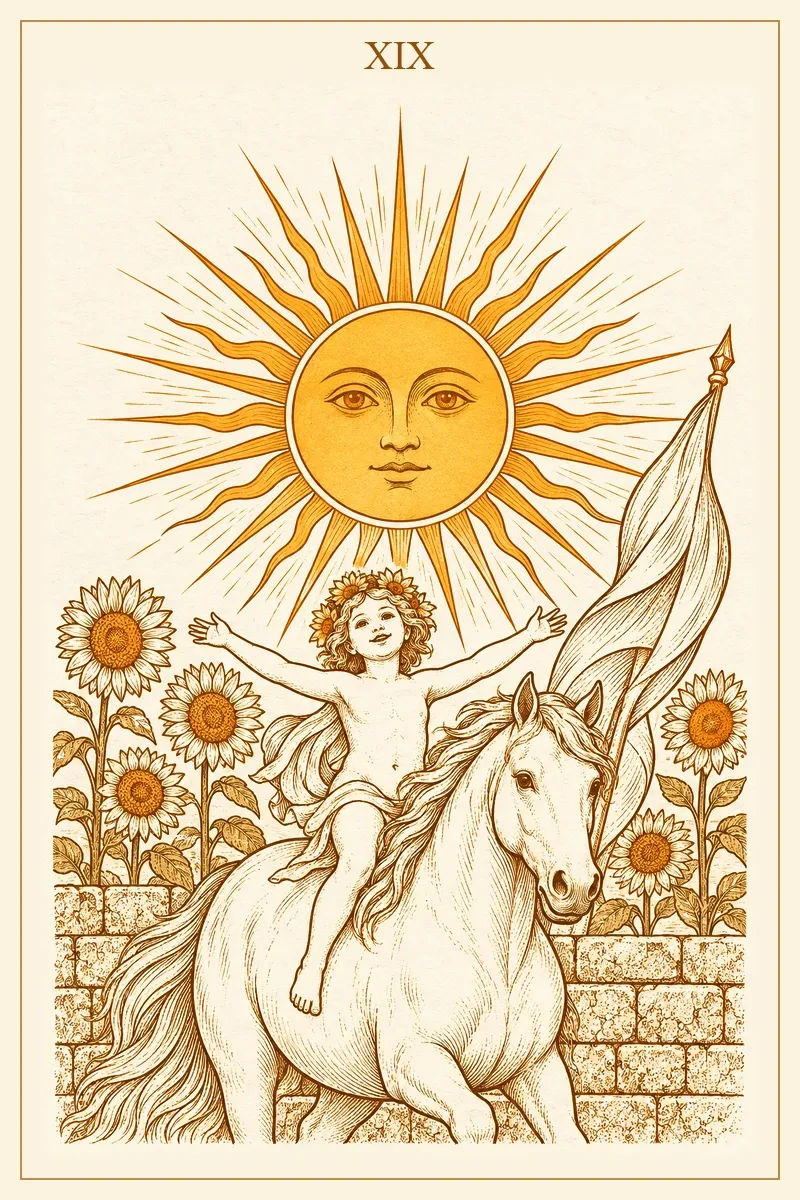
Upright, The Sun is joy, success, vitality and the confidence to be seen. Reversed, it does not cancel any of that. Through the blocked lens it is dimmed joy: good things happening that you cannot quite enjoy, perhaps because you are tired or waiting for the catch. Through the too-much lens it can be overexposure: forced cheerfulness, burning out by saying yes to everything, needing to look fine when you are not.
In a love reading, The Sun reversed can describe a relationship that is warm at heart but going through a flat stretch, where play and spontaneity need some attention. At work it may point to a success you have not let yourself celebrate. The inner child theme belongs here too: ask what would make you feel light again, and give that some room this week. The full Sun tarot meaning covers the card's upright themes in depth.
Ace of Cups reversed: love waiting to be received
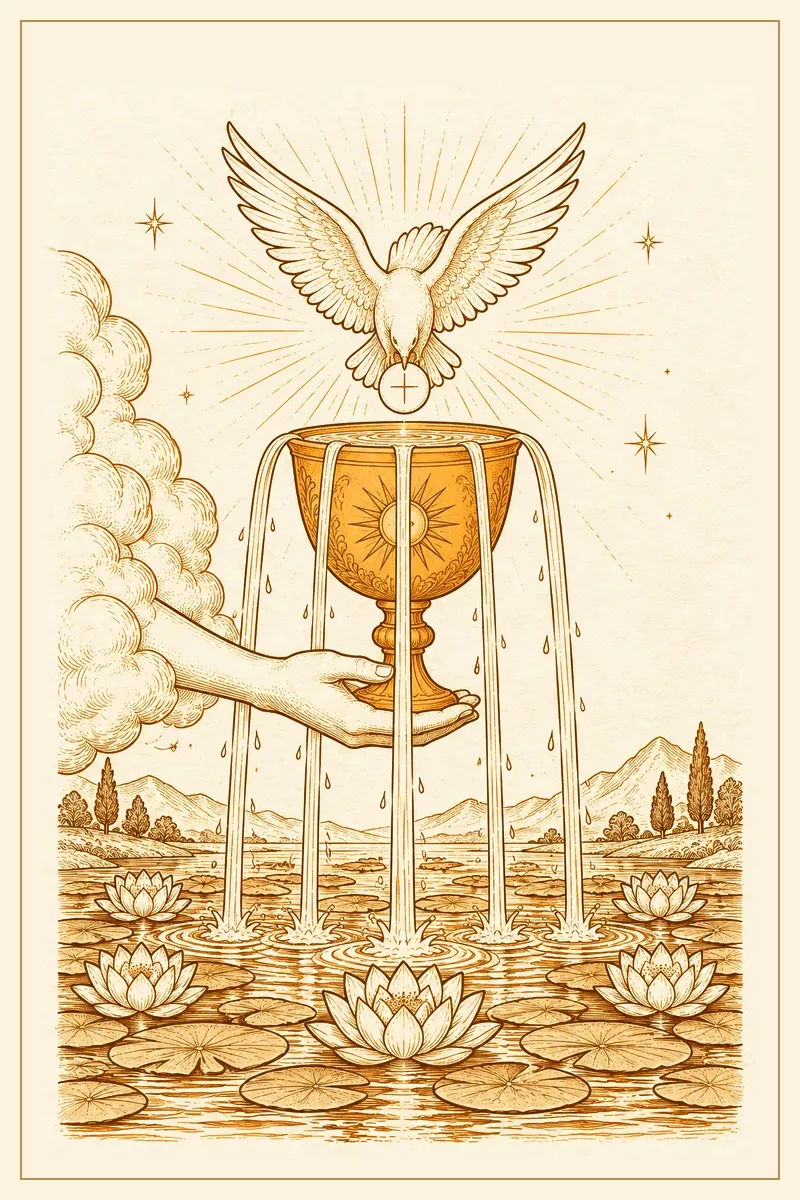
Upright, the Ace of Cups is an overflowing cup: new feeling, affection, compassion, an emotional fresh start. Reversed, the cup is still full; it is the receiving that has become difficult. Through the blocked lens it reads as love being offered while you are not yet open to it, or feelings kept below the surface because showing them feels risky.
Through the inward lens it can be a private emotional renewal, self-compassion growing before it is ready to be shared. In love, this reversal asks whether you are holding back from someone who is reaching toward you, or whether you need to refill your own cup before you can give. In a career question it might describe creative work that moves you but has not yet found an audience. You can read the upright side in the Ace of Cups tarot meaning.
Queen of Wands reversed: confidence built in private
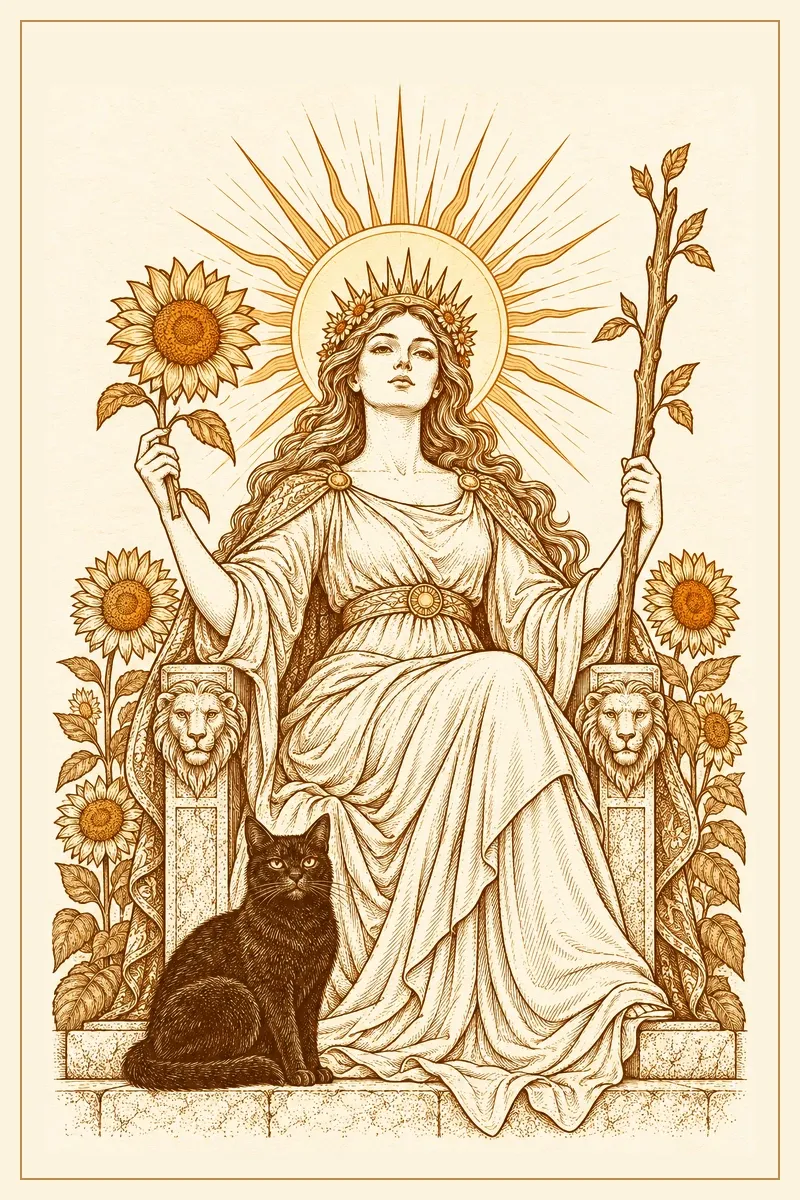
Upright, the Queen of Wands is outward warmth and charisma: someone who walks into a room and lifts it, who leads by example and is comfortable being noticed. Reversed through the inward lens, she is confidence being built quietly, real but not yet expressed. That is worth knowing if you are preparing for a new role or rebuilding after a setback.
Through the shadow lens, the same reversal can show jealousy, a short temper, or a need for attention that crowds others out. The surrounding cards will help you see which version is in play. In love, she can describe someone whose spark is present but guarded; at work, a leader who doubts herself more than her results suggest. The Queen of Wands tarot meaning goes deeper into her strengths.
Knight of Swords reversed: speed without direction
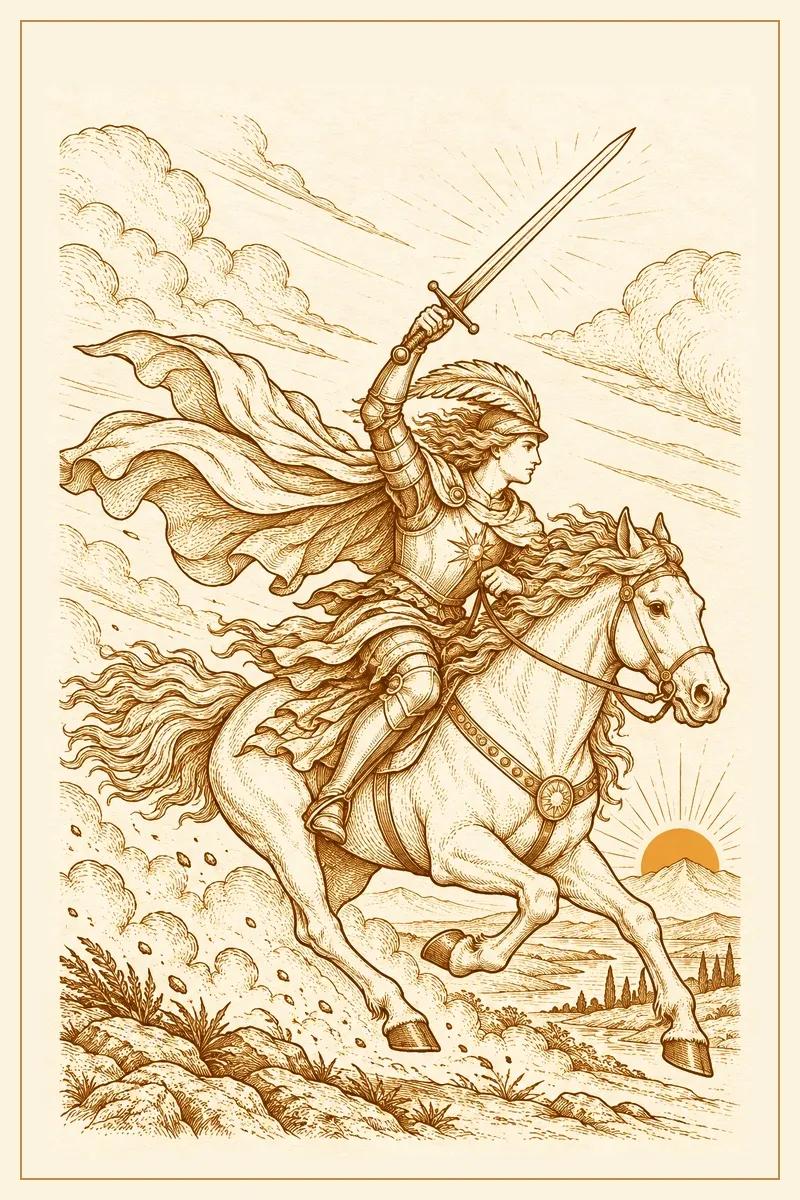
Upright, the Knight of Swords charges ahead with a clear idea and sharp words. Reversed, this is the card where the too-little-or-too-much lens earns its place. Deficient, it is the conversation you keep postponing, the opinion swallowed to avoid conflict. Excessive, it is all charge and no plan: harsh honesty, rash decisions, an email sent in the heat of the moment.
In a relationship question, the reversed Knight asks you to look at how disagreements are handled. Is someone avoiding them entirely, or turning every discussion into a battle? At work it can caution against rushing a project out before the thinking is done. Slow down long enough to decide what you actually want to say. For the card's upright drive, see the Knight of Swords tarot meaning.
A worked reading with two reversals
The question: "I have been offered the chance to lead my team's next project. What should I understand before I say yes?" The spread uses three positions: what is happening, what is in the way, and what would help. The cards drawn are the Three of Pentacles reversed, the Eight of Swords reversed and The Emperor upright.
What is happening: Three of Pentacles reversed. Upright, this card is skilled people building something together. Reversed in the first position, the blocked lens fits best: the team has the talent, but the way it talks has broken down. Meetings end without decisions, and people work side by side instead of together. That is the situation a new lead would inherit.
What is in the way: Eight of Swords reversed. In an obstacle slot, this reversal reads naturally as release. The thing holding the querent back, a belief that they are not senior enough to lead, is already loosening. They have started to notice that the restrictions lived mostly in their own head.
What would help: The Emperor upright. Clear structure. The advice is not to become authoritarian but to bring order: decide who owns which piece, set a regular check-in, write down what was agreed. That answers the stalled communication of the first card directly.
Read together, the spread does not say "take the job" or "turn it down." It says the role would mean repairing how the team works together, that the querent's self-doubt is already easing, and that structure is the tool they need. A sensible next step is a conversation with their manager about how much authority the lead role really carries, before deciding.
Notice that the two reversals used two different lenses, chosen by position. Had The Emperor come up reversed in the advice slot, the shadow lens would have deserved a look, as a caution against managing through control. If you want to practice this kind of reading on your own questions, the guide on how to read tarot for yourself walks through a full session.
Patterns when several cards land reversed
A single reversal is a detail; a cluster can describe the tone of a whole period. These patterns are not rules, but they are worth noticing:
- Several reversed Major Arcana: you may be crossing more than one big threshold at once, none of them complete. Patience suits this better than forcing a decision.
- Mostly reversed Cups: emotional life is largely internal right now, through grief, a creative incubation or a season of reserve.
- Mostly reversed Swords: thoughts are tangled and hard to put into words; a decision may be forming, or a truth has been seen but not yet spoken.
- Reversed court cards: either a particular person showing a less mature side, or your own relationship to that suit's area of life feeling unsteady.
- Reversed Aces: a beginning that has not surfaced yet, with the gift present and something holding it back.
A spread full of reversals does not mean everything is going wrong. It tends to point to transition, inner work or growth that is still under way. When nearly every card in a layout comes up upside down, the article on what it means when most cards are reversed looks at that situation on its own.
Should reversals be part of your practice?
Readers settle into three positions, and each one is defensible.
Reading every reversal
The case for it: an upside-down card is information, whether you see the orientation as meaningful in itself or simply as one more layer of detail. Reversals double the vocabulary from 78 messages to 156, give you a built-in way to talk about blocked or shadow energy, and draw the eye to exactly where tension sits in a spread.
Reading upright only
The case for it: every upright card already holds its full range. The Ten of Swords upright is difficult enough without a reversal to signal difficulty, and position plus neighboring cards supply the nuance. Learning 78 meanings is already a big task, and readers who work mainly from imagery find an inverted picture harder to read intuitively. Some decks are also built around other systems, such as elemental dignities, rather than reversals.
Reading reversals selectively
A middle path: lay every card upright by default, but pay close attention when a card flips naturally during the shuffle, or read a reversal only when its orientation clearly matches the situation. Reversals then become occasional signals rather than half the deck.
To choose, ask how you learn best, whether you read from keywords or from images, how comfortable you already are with the upright meanings, and what your deck was designed for. If you are new, reading upright for your first few months and adding reversals once the core meanings feel familiar is a sound plan. You can also experiment: one week with reversals, one week without, then notice which readings felt clearer. Developing that sense is part of building intuition for tarot reading, and your choice can change as your practice does.
If you decide to try them, start with one lens. Blocked or delayed energy is the easiest place to begin; use it consistently for a month before adding others. Keep reversals in your journal as well: note which cards came up reversed, which lens you used and how well it fit when you look back. Over time you will see which lenses suit which cards for you.
Frequently asked questions
Does a reversed card mean "no" in a yes-or-no reading?
Some readers treat an upright card as leaning yes and a reversed card as leaning no, but the card's own theme matters just as much. The Five of Cups reversed, for example, leans toward a hopeful answer even though it is upside down. Decide your method before you draw and keep to it for that reading.
Are reversed cards bad luck?
No. A reversal describes how a card's energy is moving, not a misfortune. Several cards, such as the Eight of Swords and the Ten of Swords, read more hopefully upside down than upright.
How do I make sure reversals can appear?
Shuffle in a way that turns cards in both directions, such as a wash on the table, and cut and rotate portions of the deck from time to time. Some readers deliberately turn half the deck upside down before a session, so that orientation does not drift toward upright by accident.
Do I need reversals to be a real tarot reader?
No. Skilled readers work without them. What matters is whether your readings are honest, clear and useful to the person asking.
Can I use different lenses in the same spread?
Yes, and the worked reading above does exactly that. Choose the lens card by card, guided by its position and the question, rather than one lens for the whole layout.
What if I cannot tell whether my cards are upside down?
Some decks use artwork that looks much the same either way up, especially on the numbered pip cards. With a deck like that, the decision has largely been made for you: read upright and let position and context carry the nuance.
Can a reversed card tell me what will happen?
No card can guarantee an outcome, reveal another person's mind or give you a date. A reversal points to where energy is stuck, private or changing, which is something you can reflect on and act on.
A sharper question, not a darker answer
The most useful way to hold a reversed card is as the card asking a more specific question. The Queen of Wands upright asks where your confidence shows; reversed, she asks what is happening to that confidence that nobody can see yet. Treat each reversal as an invitation to read with finer focus, and let it make your readings more honest rather than more ominous.
When you are ready to try the lenses on a question of your own, start a reading and take your time with whichever card turns up on its head.