Heartbreak, grief and a truth that hurts to hear: that is the Three of Swords tarot card meaning in one line. Upright, the card names a wound that has already landed, such as a breakup, a betrayal, a loss or words that cut, and it asks you to let the sorrow be real instead of arguing it away. Reversed, it shows that pain beginning to ease, or pain pushed underground where it keeps aching quietly.
It is one of the most feared cards in the deck, yet it is also one of the most honest. It does not decide that a relationship is finished, and it does not mean you did something wrong. Tarot cannot see into another person's mind, confirm what is coming, or put a date on your recovery. It can help you understand the shape of this hurt and decide how to look after yourself while it heals. Below you will find the picture, the upright and reversed meanings, love, work, money, yes or no, the cards that change it, a spread and a worked example.
The Three of Swords at a glance:
- Upright: heartbreak, grief, a painful truth, words that wound.
- Reversed: healing starting, forgiveness, or sorrow held in and not yet felt.
- Love: a breakup, a betrayal, or an earlier hurt that still shapes how you open up.
- Career: rejection, harsh criticism, a plan that fell through.
- Money: a loss or an unwelcome discovery that needs facing.
- Yes or no: usually no; reversed, closer to "not yet."
- Element and astrology: Air; Saturn in Libra, the Lord of Sorrow.
- Advice: name the hurt, feel it, then tend it one small step at a time.
A heart, three swords and the weather, but no person
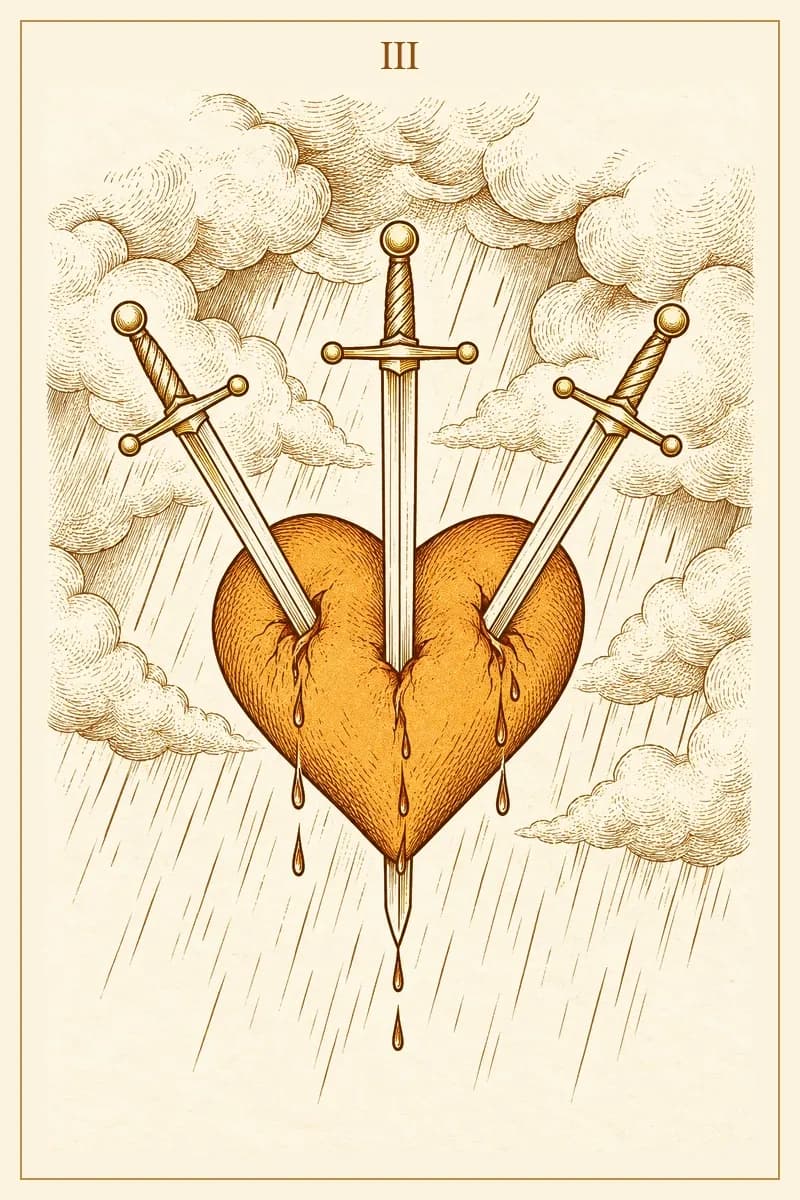
Most cards in the minor arcana show someone doing something. This one shows only a heart, three blades and a storm, and that emptiness is part of the message: the card is about the wound itself, not about who caused it.
Three of Swords: what the engraving shows
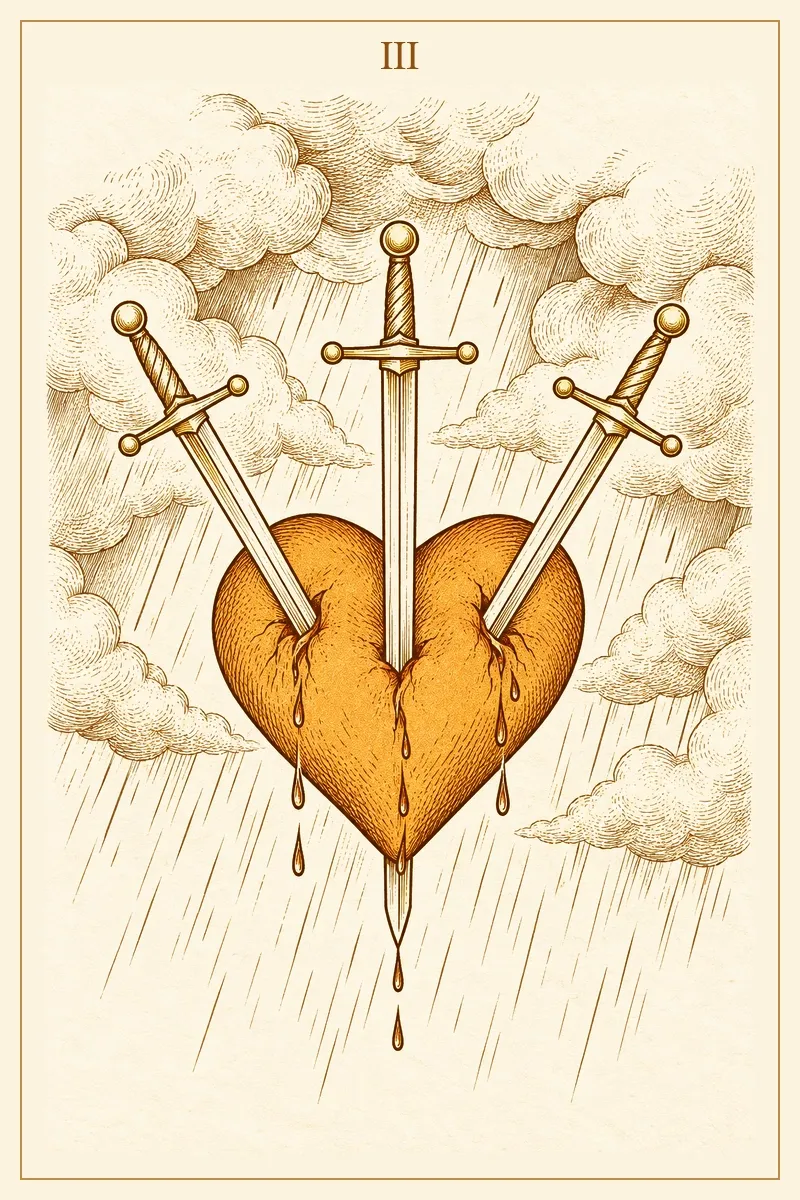
An amber-gold heart fills the center of the card. Three swords run through it: one comes straight down the middle and its point pushes out beneath the heart's lower tip, while the other two slant in from the upper left and upper right, so the three hilts open out above the heart like a fan. Small cracks spread from each place a blade enters, and drops fall from every wound. Banks of cloud crowd the top and both sides, fine rain slants across the cream background, and the Roman numeral III sits at the top. There is no ground, no horizon and no figure.
Read the parts one at a time. The heart is whatever you love and trust: a person, a plan, a picture of your future, or your own sense of being good enough. The swords belong to the suit of Air, which covers thoughts, words and truths, so the pain here arrives through something said, learned or finally understood. The three blades can be read as three routes by which a hurt reaches you: through what was done, through what was said, and through what you now have to admit to yourself.
The drops, the rain and the missing ground
The drops falling from the heart echo the rain falling from the clouds, as if the weather and the wound are grieving together. Tears belong in this picture; they are not a sign that you are coping badly. Rain also stops, and clouds move on; nothing in the image fixes the storm in place. Notice too that the heart is pierced but whole. Its shape still holds. That is the quiet hope inside the card: pain is not the same as being destroyed.
The missing ground matters as well. With nothing underfoot, the scene floats, which is close to how fresh grief feels: unmoored, outside ordinary time. The card does not ask you to find solid footing straight away. It asks you to admit that you are standing in the weather.
Lord of Sorrow: Saturn in Libra and what a three does in Swords
In the Golden Dawn system, the Three of Swords is called the Lord of Sorrow and is linked to Saturn in Libra. Libra is the sign of balance, fairness and partnership; Saturn is the planet of limits, time and consequence. Put together, they describe a moment when the scales come down hard: an imbalance that has been building is finally seen for what it is, and the consequence arrives. The pairing also hints at pace. Saturn works slowly, and sorrow of this kind tends to soften over weeks and months rather than days.
The number matters too. In the other suits, a three frequently describes growth through other people. In Swords, the third element is a truth that breaks a deadlock. The Two of Swords is a standoff in which a choice is kept on hold; the Three is what can happen when the facts you were avoiding finally reach the heart. If that earlier standoff sounds familiar, the Two of Swords tarot card meaning looks closely at the avoidance that comes before it.
Three of Swords upright: when the truth finally lands
Upright, the card says that something hurts and that the hurt makes sense. It does not soften the news or rush you toward the lesson. Its first message is permission: you are allowed to be sad about this.
Heartbreak and loss
The most familiar reading is a heartbreak: a relationship ending, a rejection, love that was not returned. The card also covers grief more widely, for a person, a pet, a friendship, a home or a hope you carried for years. What these share is attachment. The card appears because something mattered to you.
A painful truth, or words that cut
Sometimes the wound is information. A secret comes out, a decision is announced, or a friend says the thing you were afraid was true. The Three of Swords can also point to cruel or careless words, said to you or by you. In that case the card is less interested in what was said than in how deep the sentence went.
Grief that needs room
Upright, the card favors expression over endurance. Crying, writing it down, telling one trusted person, or skipping a plan to stay home are all ways of letting the rain fall. Keeping busy can help for an afternoon; as a long-term plan it tends to turn into the reversed card.
Three of Swords reversed: easing, or pushed out of sight
Reversed, the card has two quite different faces, and the surrounding cards and your own honesty decide which one you are holding.
The worst is passing
The first reading is relief. The sharpest part of the pain is behind you, the tears come less often, and you can talk about what happened without feeling the floor give way. Forgiveness may begin to feel possible, of the other person or of yourself, even if it is not finished. Scar tissue is still living tissue; it shows that your body has been at work.
Sorrow kept underground
The second reading is suppression. You may be telling yourself it did not really matter, filling every evening so there is no quiet, or turning the sadness into irritation at small things. The swords are still in the heart; you have simply stopped looking at them. This version can surface as tiredness, a short temper, or grief that returns at odd moments, such as a song playing in a shop.
Telling the two apart
Ask yourself one plain question: when I think about what happened, do I feel lighter than I did, or do I feel nothing at all? Lighter usually points to healing. Numbness, or a sharp swerve away from the memory, suggests sorrow that still needs a turn in the open. Neither answer is a failure. Both tell you what kind of care helps next.
Love readings: breakups, betrayal and the long way back
In a relationship
Inside a relationship, the upright card can describe a hurtful argument, a discovered lie or a hard conversation that changes how you see each other. It does not, by itself, prove infidelity, and it does not say the relationship must end. It says that something has been wounded and needs to be talked about directly. Couples who repair after a Three of Swords moment usually begin by naming the hurt plainly and listening without defending.
After a breakup
Here the card may simply be accurate: you are heartbroken. Rather than drawing card after card to learn whether they will come back, let this one stand as a description of where you are. Reversed after a breakup, it can show the ache loosening, or the temptation to skip the grief by rushing into contact, a rebound or a new plan. The guide to tarot for heartbreak has gentle spreads for the weeks that follow.
If you are single
For a single reader, the card frequently points backward, to an earlier hurt that still sets the distance you keep from new people. It can also describe the sting of a crush that did not work out. The advice is not to wait until you feel no pain at all before dating again, but to know which wound is speaking when you hesitate.
What it says about their feelings
When the question is how another person feels, the upright Three of Swords suggests hurt: they may feel let down, sad or wounded by what happened between you. Hurt and care can sit side by side, so the card does not mean they feel nothing. Reversed, their pain may be easing, or they may be holding it in and acting as if all is well. If it matters, ask them gently rather than guessing.
Work and money: setbacks that sting
Career
At work, upright, the card can describe a rejection after an interview, a promotion that went to someone else, a project that was shelved, or criticism delivered without care. It can also point to broken trust inside a team. Give the disappointment a day or two before you answer emails about it. Once the sting fades a little, sort the feedback into what is genuinely useful and what was simply unkind. Reversed, the lessons start to show and a next step begins to take shape, though you may still feel tender about the old role.
Money
With money, the card can point to a loss, an unexpected bill or the discovery that a shared budget was not as agreed. It is a prompt to look at the real numbers rather than the worst story about them, and to get qualified advice for anything legal or financial. Reversed, it can mark the start of rebuilding: the loss has been counted, and you can plan from what remains.
Body, rest and the spiritual side of sorrow
Grief is tiring. In a reading about wellbeing, the Three of Swords can reflect how heavily emotional pain is pressing on sleep, appetite and energy. It is a card about heartache, not a diagnosis, and it never replaces medical care: if you have chest pain, a racing heart or symptoms that worry you, contact a doctor or emergency services. What the card can do is remind you to treat sorrow as a real load and to plan your days around it with some kindness.
On the spiritual side, many readers see the Three of Swords as the heart cracked open. Loss can deepen compassion and make you gentler with other people's pain. That meaning belongs to later, though. While the wound is fresh, getting through the week is enough. Any wisdom arrives in its own time, and you do not owe anyone a lesson from your grief.
Yes, no or not yet with the Three of Swords
For a yes or no question, the upright card usually answers no, or "not in the way you hoped." If you asked whether to move toward something, it warns that the path is likely to hurt, or that it already involves a wound you have not dealt with. Reversed, the answer leans toward "not yet": heal first, then ask again. If you asked whether something painful is true, the upright card can mean that part of you already knows and is hoping the cards will say otherwise.
Pairings that show where the sorrow goes
The cards around the Three of Swords show whether the hurt is still opening, settling, or moving toward repair.
With The Star: healing after heartbreak
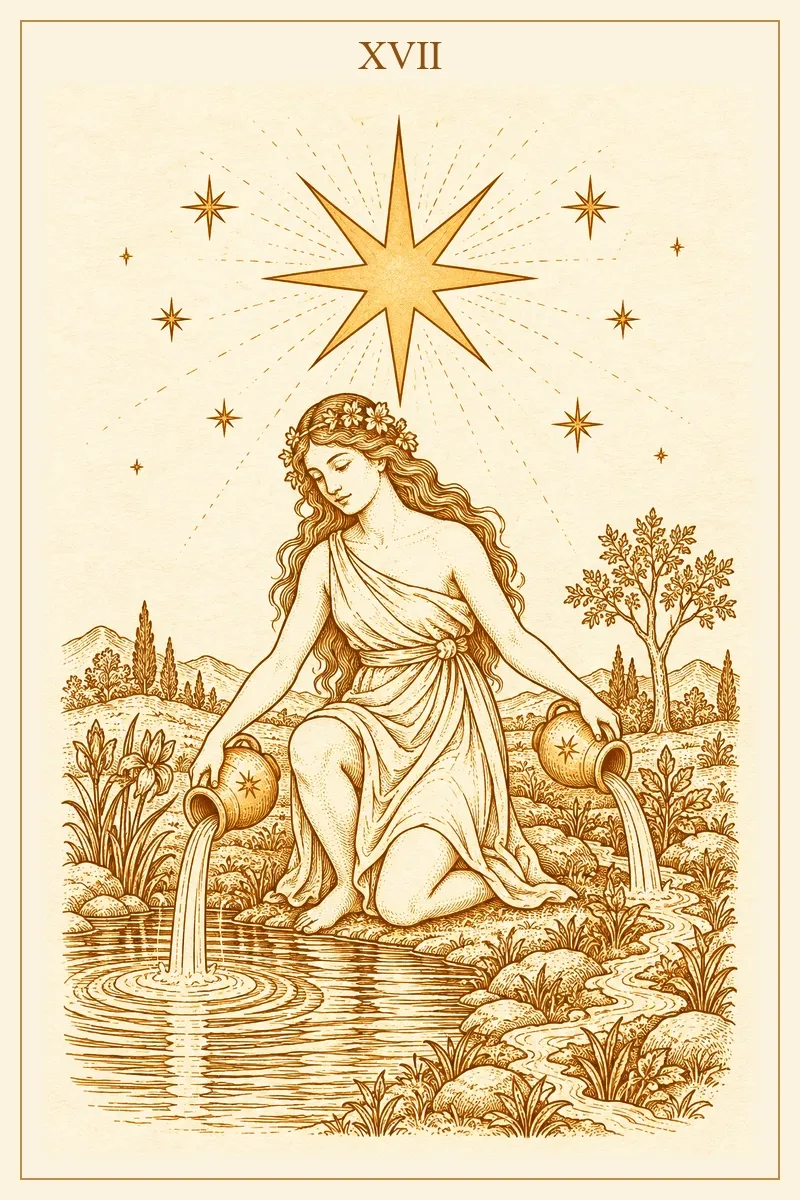
The Star beside the Three makes one of the kindest pairings in the deck. The wound is real, and recovery is already on its way, slowly and gently, through rest and renewed trust. For everything else this card can mean, read the full Star tarot card meaning.
With Death: an ending that is complete
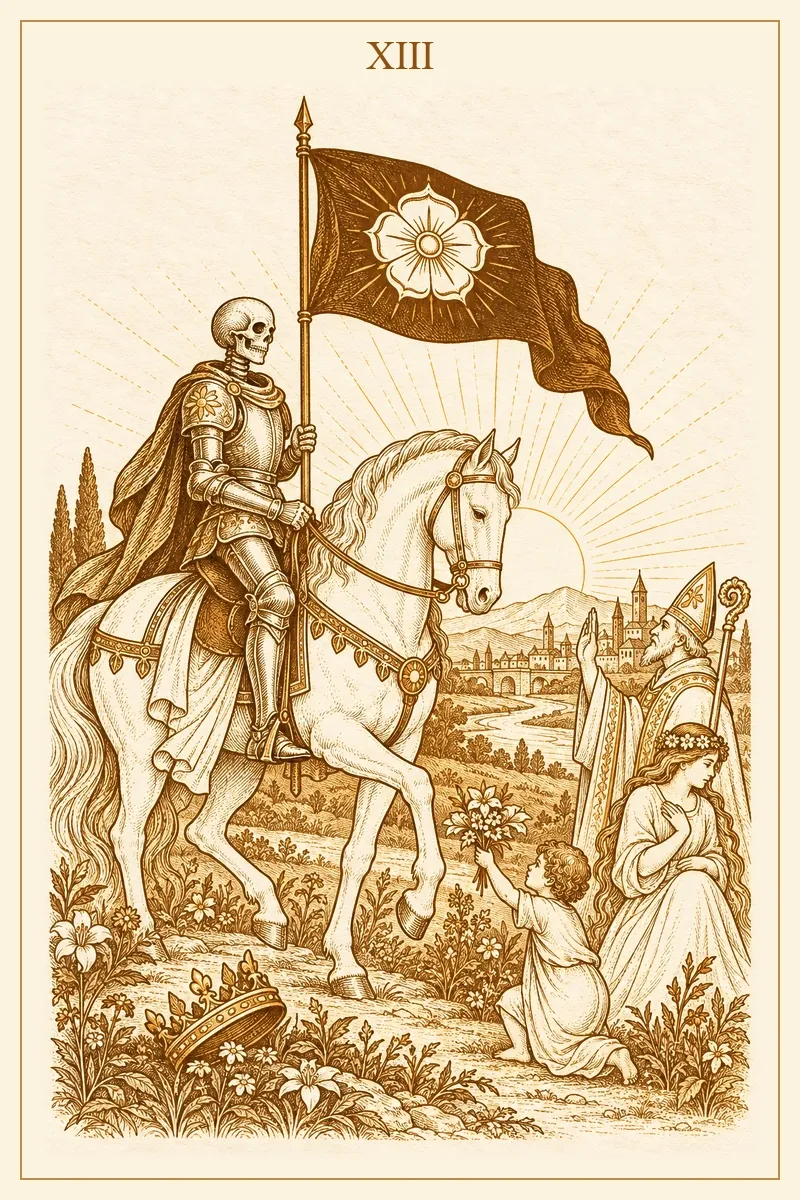
Together, Death and the Three describe a painful ending that is genuinely over. The advice is to grieve it fully rather than try to bring the old form back to life. Death speaks of transformation, not literal dying, as the Death tarot card meaning explains in depth.
With The Empress: comfort as medicine
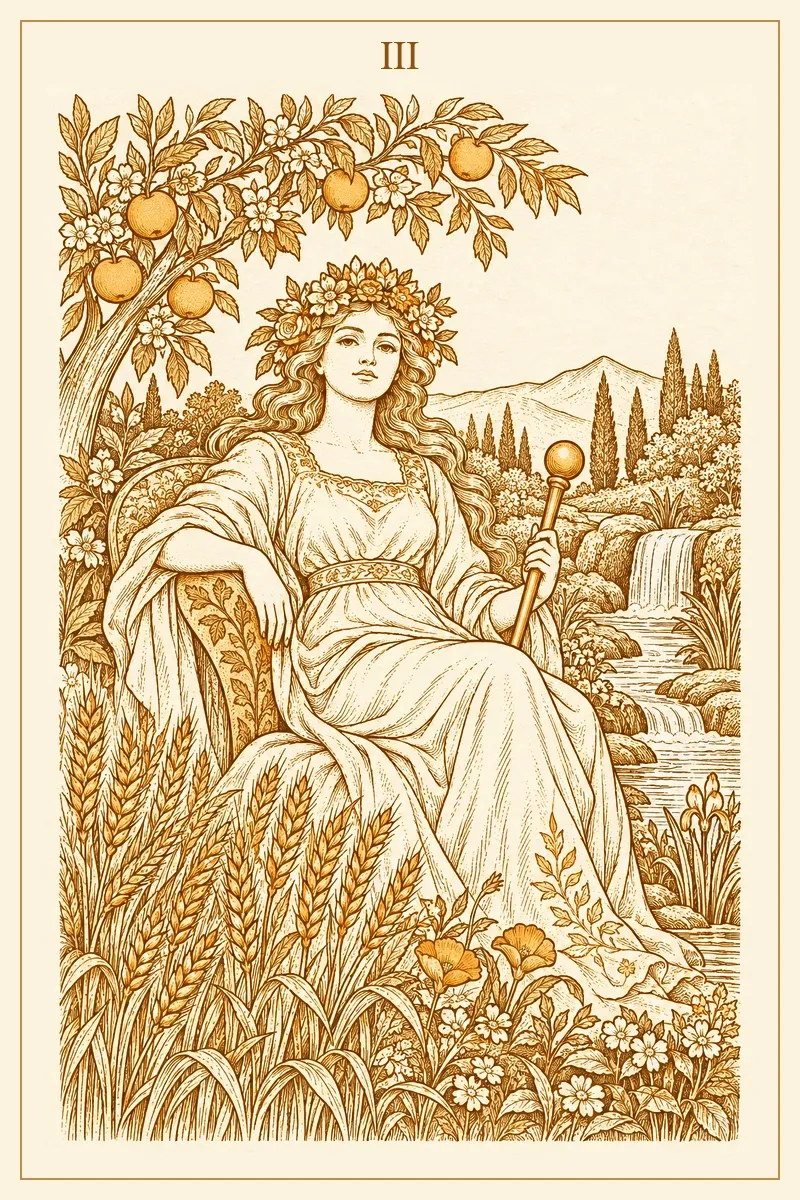
The Empress asks you to nurse the wound: meals that feed you, sleep, warm company, time outdoors. This pairing says that tenderness toward yourself is part of the treatment, not an indulgence. Her nurturing side is explored further in the Empress tarot card meaning.
With the Ten of Swords: the chapter is closed
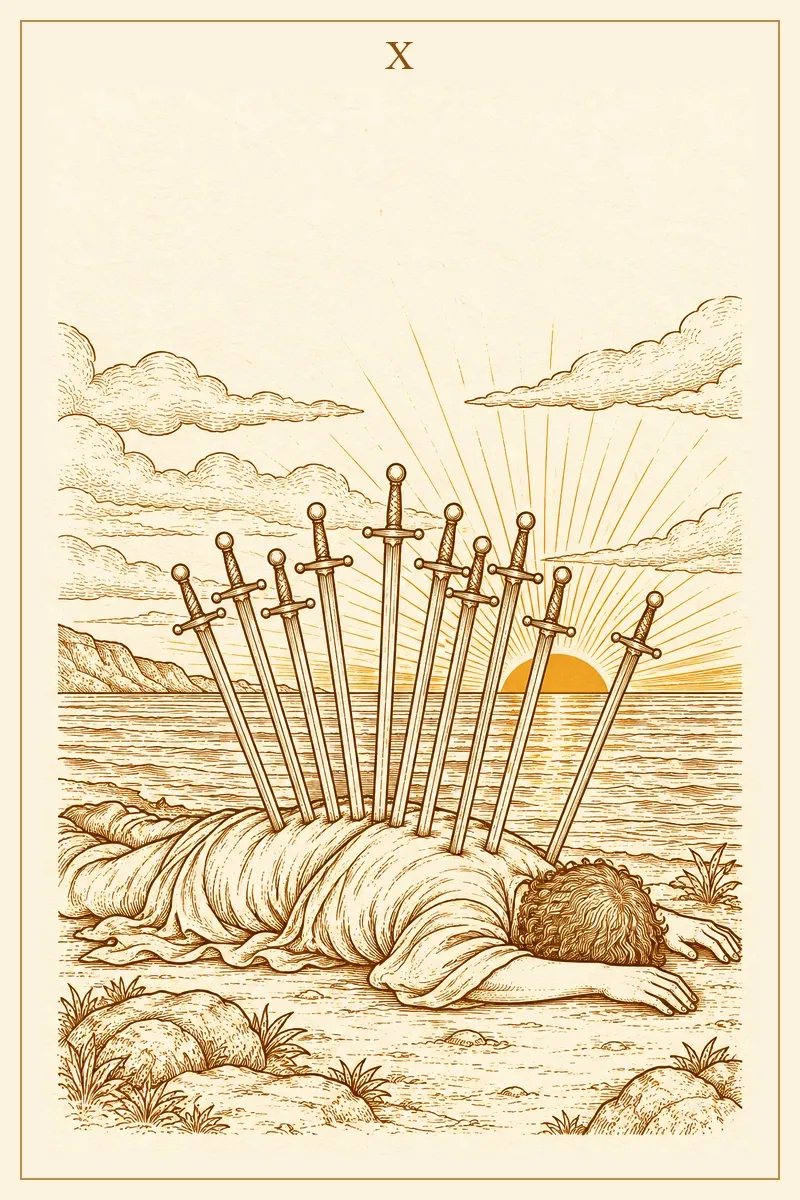
The Ten of Swords carries the Three's hurt to its end point. Together they can feel heavy, yet the message is that this chapter is over and nothing more needs to break; what is left is to begin again. The Ten of Swords tarot card meaning looks at that turning point in detail.
With the Ace of Cups: the heart opens again
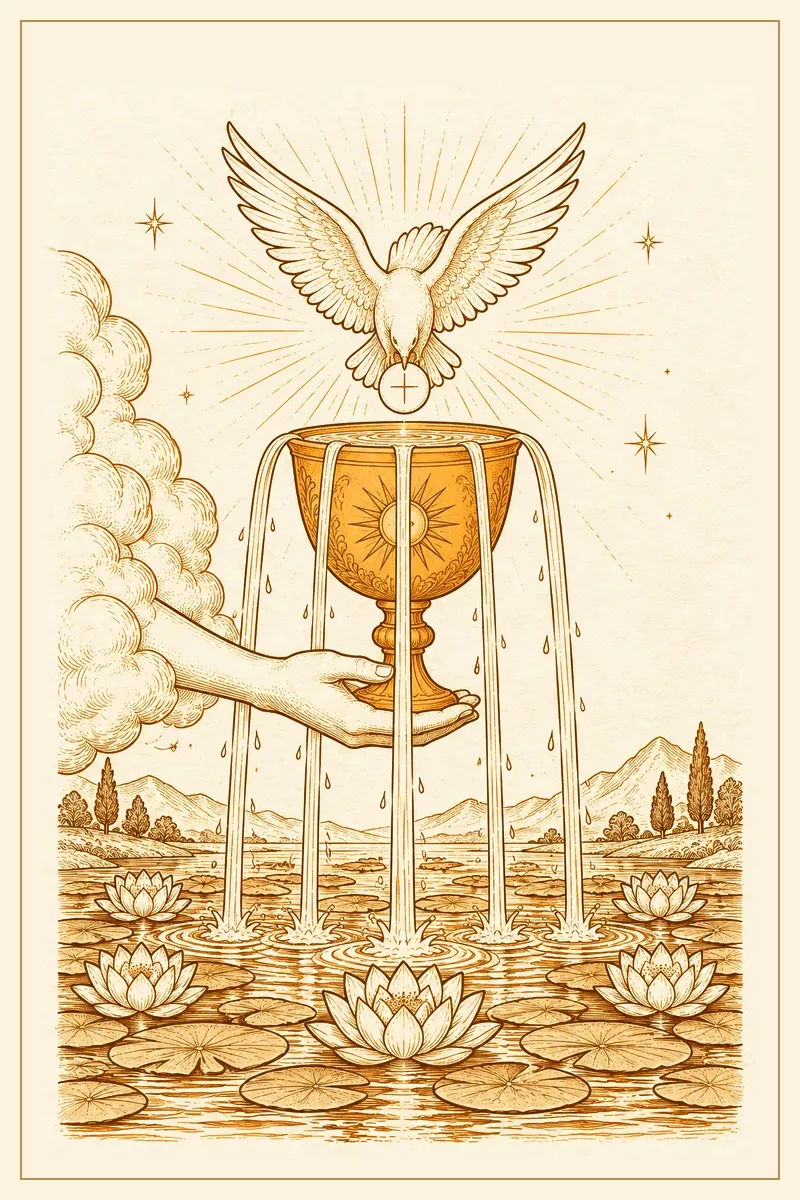
When the Ace of Cups follows the Three, feeling flows back in: new affection, a reconnection with joy, or simply the ability to love without bracing. It does not erase the scar; it shows that the heart still works. The Ace of Cups tarot card meaning tells the rest of its story.
Naming the sorrow: a four-card spread
This spread takes its positions from the card's own picture. Shuffle while holding the hurt in mind, then lay four cards in a row.
- The blade: the truth or event that cut.
- The heart: what it touched in you, the thing you valued.
- The cloud: the story you keep telling yourself about it.
- The rain: what helps the sorrow move this week.
Read the second card slowly; it can explain why something that looks small hurt so much. Treat the third as a thought to question, not a fact. Make the fourth card's answer concrete enough to act on before the weekend.
A worked example: a friendship that ended in silence
This example is invented to show how the spread works. A reader's closest friend from school has not replied to messages for two months. The question is: "Why does this hurt so much, and what can I do with it?"
The blade: Three of Swords upright. Drawing the card itself in this position is an unusually direct answer. The cut is the silence, and the realization that the friendship, at least as it was, has ended without a goodbye.
The heart: Six of Cups. The Six of Cups is a card of shared history and childhood memories. What was touched is not only the present friendship but years of being known by someone who remembers who you were at fifteen.
The cloud: Nine of Swords. The Nine of Swords points to worry in the small hours. The story on repeat is "I must have done something terrible." The card asks the reader to notice that this is a fear, not a finding.
The rain: Four of Swords. The Four of Swords recommends rest before action. Instead of sending a fifth message tonight, the reader decides to write an unsent letter, take a quiet weekend, and only then send one short, warm note that leaves the door open without asking for an explanation. The Four of Swords tarot card meaning covers that kind of recovery pause.
Taken together, the reading does not say whether the friend will return. It names the loss, shows why it runs deep, separates fear from fact, and offers one gentle next step.
Looking after yourself in a Three of Swords season
- Write one sentence that names exactly what hurt, without softening it.
- Tell one person you trust, even briefly.
- Let tears come when they come; they are not a setback.
- Keep the basics: water, food, a short walk, a regular bedtime.
- Delay big, irreversible decisions for a few weeks if you can.
- If the sorrow stays heavy for a long time, or you feel unsafe, reach out to a counselor, a grief support line or your doctor.
Some questions to sit with, in a journal or on a quiet walk:
- What exactly am I grieving: the person, the plan, or the version of me inside it?
- Where am I letting myself feel this, and where am I pushing it away?
- Which truth, however unwelcome, would help me start to heal?
- What has an earlier sorrow taught me about getting through this one?
Frequently asked questions
Is the Three of Swords always about romantic heartbreak?
No. Love is a common context, but the card covers any wound to the heart: grief for someone who died, a friendship ending, a family rift, a rejection at work, or a hard truth about yourself. Read it against the question you asked.
What does the Three of Swords reversed mean?
Either the pain is easing and healing has begun, or sorrow is being pushed down and kept out of sight. The deciding question is whether you feel lighter or simply numb when you think about what happened.
Is the Three of Swords a yes or a no?
Upright, it usually reads as no. Reversed, it leans toward not yet. In both cases the card suggests tending the wound before pushing for an outcome.
Is the Three of Swords proof that someone is cheating?
Not on its own. The card shows hurt, and betrayal is only one possible source. Tarot cannot see another person's private actions or thoughts, and it cannot confirm an event or a date; it reflects themes for you to explore. If you suspect something, an honest conversation, or support from a counselor, will tell you more than any spread.
How is the Three of Swords different from the Five of Cups and the Nine of Swords?
The Three of Swords is the moment of the cut: the news, the ending, the sharp truth. The Five of Cups is the mourning that follows, with attention fixed on what was lost. The Nine of Swords is the worry and replay that keeps you awake, which may or may not match what actually happened.
How long does the pain of the Three of Swords last?
Grief keeps no fixed timetable. The card's Saturn link suggests that sorrow of this kind softens over time rather than overnight, and the reversed card can show that the easing has already started. The pace depends on your support, your circumstances and how much room you give the grief.
Where the Three of Swords leaves you
The Three of Swords is the card nobody hopes to draw, yet the hurt it pictures is one most people know from their own lives. It does not dismiss suffering, and it does not promise a quick fix; it tells you that a pierced heart is still a heart. If you would like to look at your own situation with a few cards and one calm question, you can start a reading whenever you are ready.