Students get the most out of tarot when they treat it as a focus and planning tool: a short spread before an exam or a heavy study week can show where your attention is leaking, which approach to try next, and what kind of support you need. It cannot predict a grade, and it never stands in for the studying itself. If exam nerves are keeping you from sleeping, eating or getting through the day, please talk to a school counselor; a reading is a place to reflect, not a treatment for anxiety.
Here are the cards that appear most often in study and exam readings, and what each one usually asks of you:
- Page of Pentacles: curiosity and a beginner's patience with a new subject.
- Eight of Pentacles: steady practice; the repetition is working.
- Seven of Cups: scattered attention; choose one task before opening another.
- Nine of Wands: the tired last stretch; protect your rest so what you learned can settle.
- The Chariot: focus with a direction; one priority at a time.
- Ten of Wands: overload; something has to come off the pile.
- Eight of Swords: feeling trapped by pressure; you have more options than panic shows you.
- The Star: quiet hope and recovery the night before a test.
Study questions a deck can actually help with
The question shapes the reading more than any single card. "Will I pass chemistry?" puts the deck in the role of an examiner, and whatever card appears, you will either relax too early or panic for no reason. A better question points at something you can still change between now and the exam date.
Try swapping outcome questions for preparation questions:
- Instead of "Will I pass?", ask "What would help me prepare well for Thursday?"
- Instead of "Am I smart enough for this course?", ask "What is getting in the way of my focus right now?"
- Instead of "Should I quit?", ask "What do I need to understand about why this semester feels so heavy?"
- Instead of "Which topics will be on the exam?", ask "Where should my next three study sessions go?"
Write the question down before you shuffle and keep it short enough to fit on a sticky note. If you notice that the real question is about something larger, such as whether you chose the right program or whom you are studying for, write that one down too. It may deserve its own reading on a calmer day.
Five cards at the center of study readings
These five come up again and again when students ask about focus, exam prep and motivation, so each gets its upright and reversed reading here.
Page of Pentacles: the curious beginner
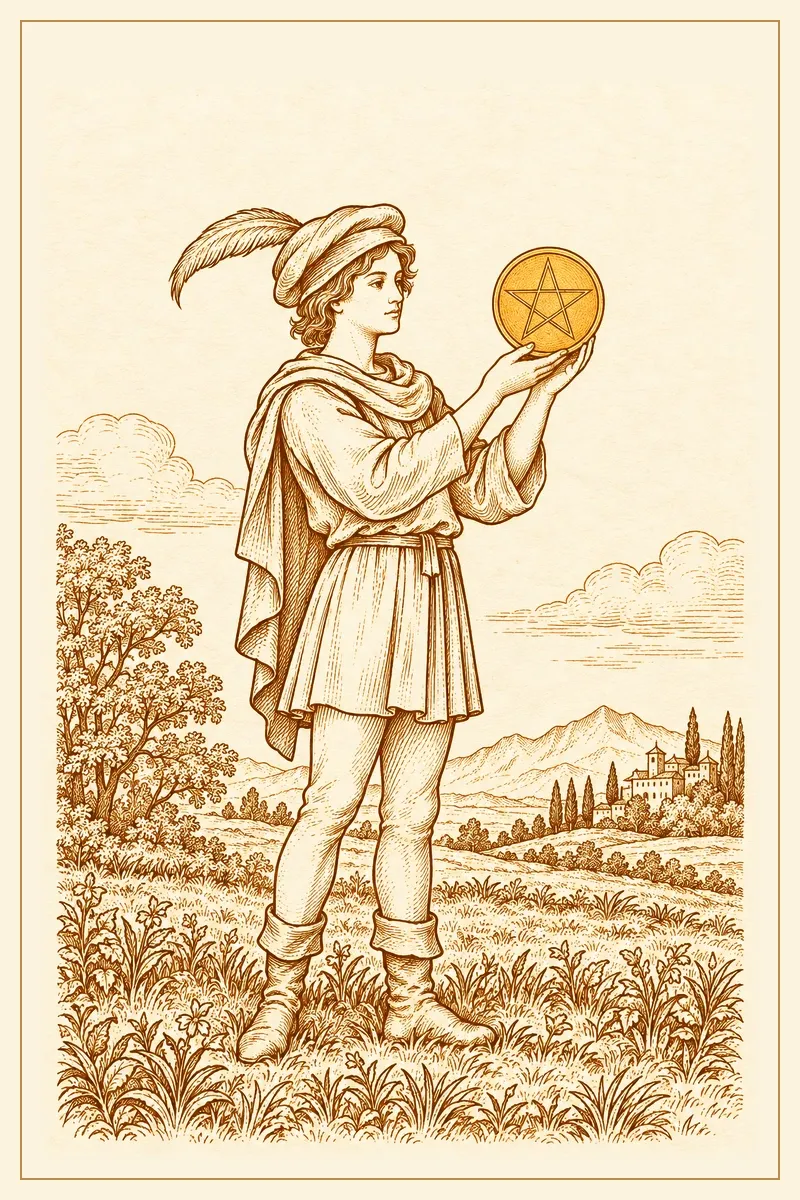
The young figure on this card stands in a flowering field and holds a single gold coin up in both hands, studying it as if it were the most interesting thing in the world. Nothing in the picture says he has mastered anything. He is simply paying attention. That is why so many readers call it the student card, and the full Page of Pentacles meaning traces the same thread of learning through work and money questions.
Upright in a study reading, the Page suggests that curiosity is your best resource right now. You do not have to feel like an expert to make progress; you have to keep looking closely. In practice that might mean starting a session with a question you genuinely want answered, working through one example slowly instead of skimming five, or explaining the idea to a friend to find the gaps.
Reversed, the Page can point to a stalled beginning. Perhaps you keep planning to start a subject and never do, or you have stopped asking questions because you feel behind. It can also describe studying only to prove you deserve your place, which drains the curiosity out of the work. The reversal asks for a smaller first step and permission to not know yet.
Eight of Pentacles: practice that compounds
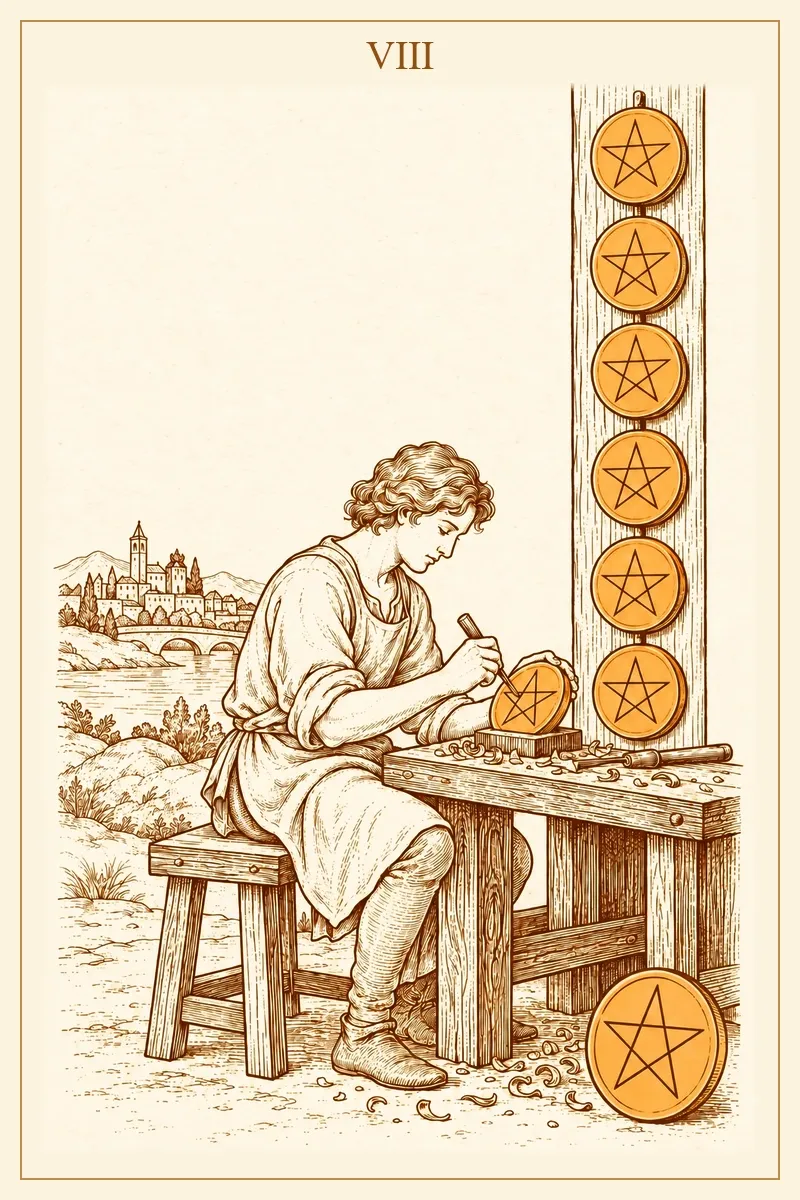
A craftsman sits at a wooden bench, carving a pentacle while six finished ones hang on the post beside him and another rests against the bench leg. The finished coins are not fancy; there are simply a lot of them. This is the card of repetition, drills and practice tests, and the Eight of Pentacles meaning post explores how it shows up in skills and careers too.
Upright, the Eight says your current method is working and needs time more than a new technique. Flashcards, practice exams, problem sets, language drills: anything that builds by repetition fits here. If you were tempted to switch to a shiny new study system, this card suggests staying with the one that is quietly producing results.
Reversed, the Eight can mean practice has turned mechanical. You might be rereading notes without testing yourself, or polishing a subject you already know while avoiding the one you do not. It can also point to perfectionism, such as rewriting the same notes until they look beautiful. The reversal invites you to check whether your effort is going to the part that will matter on the day.
Seven of Cups: too many tabs open
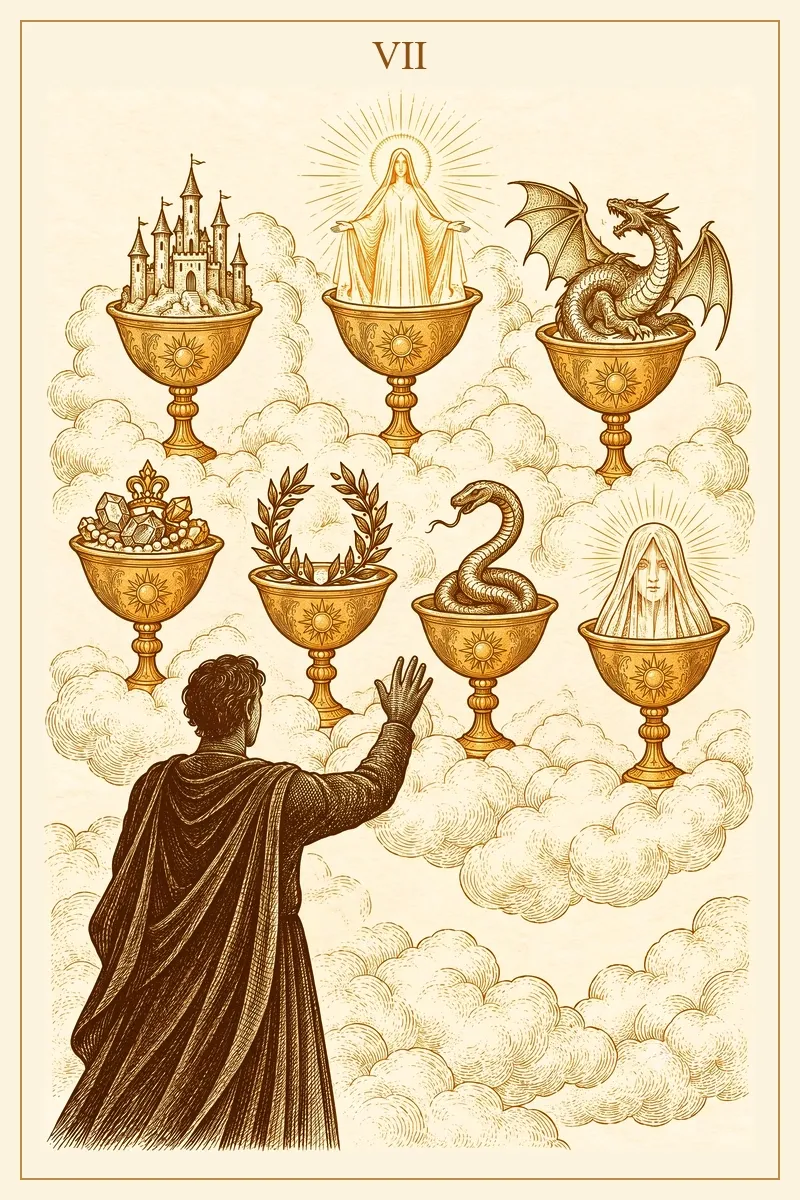
A cloaked figure, seen from behind, reaches toward seven gold cups floating in cloud. One holds a castle, one a glowing figure, one a dragon, one a pile of jewels, one a laurel wreath, one a snake and one a veiled head. Every cup is a different possibility, and none of them is within reach yet. For students, that is a familiar scene: five courses, a group chat, a part-time shift and three half-finished plans for how to study. The Seven of Cups meaning covers its choice-and-fantasy side in more depth.
Upright, this card describes scattered attention. You are not lazy; you are spreading yourself across too many options, which makes every session feel thin. The laurel wreath in one cup is a telling detail for students: a picture of success that is easy to daydream about and harder to work toward. The practical answer is to choose one task for the next block of time and close everything else.
Reversed, the Seven often shows the fog starting to lift. You are ready to drop a few options and commit to a plan. Sometimes it also warns that you are choosing based on what looks impressive rather than what you need, such as an elective picked for prestige rather than interest.
Nine of Wands: the tired last stretch
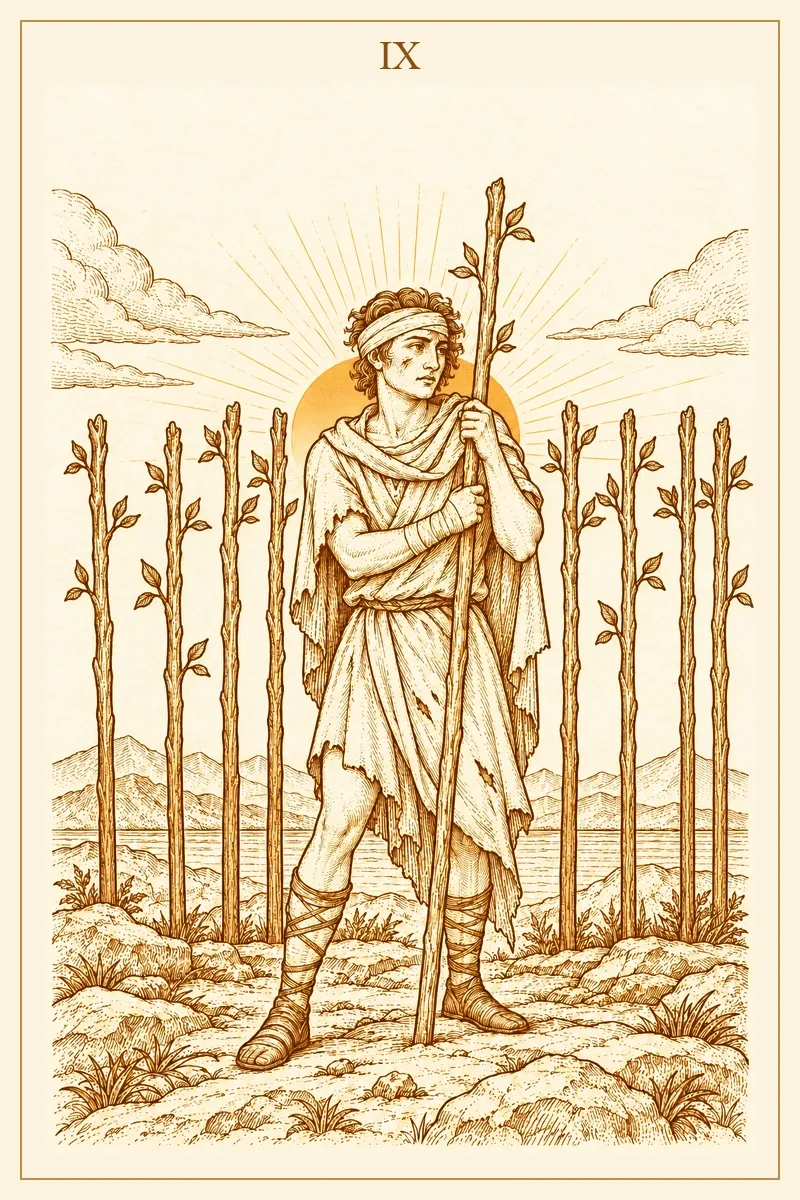
A young man with a bandaged head and a wrapped wrist grips a tall staff, with eight more wands planted in the ground on either side of him. He is still standing, still alert, and clearly worn out. In a study reading this is the card of the final weeks, when you have been pushing for a long time and the material has stopped going in. The Nine of Wands meaning explores the resilience side of the card as well.
Upright, the Nine says you are closer to the finish than it feels, and that your stamina is real. It also says your guard is up all the time. Constant vigilance, like checking the group chat for what everyone else has covered or rereading the syllabus at midnight, uses up energy you need for actual learning. Protecting sleep is part of the work here, not a reward after it.
Reversed, the Nine can describe running on empty: you have stopped absorbing anything and every new page feels like a threat. It may suggest stepping back for a day, asking a classmate or teacher for help with one topic, or letting go of a goal that was never realistic for this term.
A useful question with this card is "What can I stop defending?" Sometimes the answer is a subject you have already mastered and keep reviewing out of fear.
The Chariot: focus with a direction
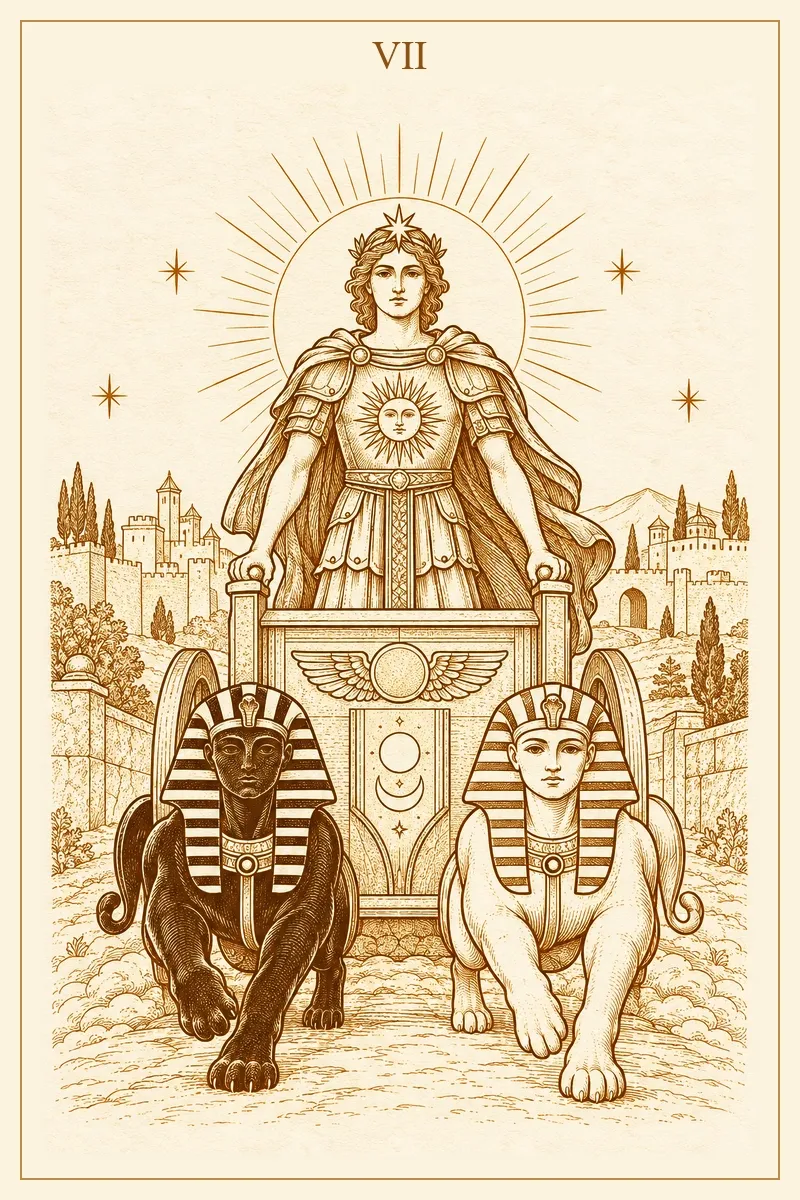
A crowned figure stands in a chariot with a sun on his chest, and two sphinxes, one dark and one light, crouch in front of it. His hands hold no reins; whatever moves the chariot comes from his will and his sense of direction, not from force. The Chariot meaning follows that theme of self-command into other areas of life.
Upright, the Chariot is the card of a focused study push: a clear goal, a schedule you actually follow, and the discipline to say no to distractions for a while. The two sphinxes suggest opposing pulls, such as rest and work or two competing subjects, which you can steer together instead of letting either take over.
Reversed, the Chariot can point to effort without a direction. You are busy all day and still feel you got nowhere, or you keep changing your plan every time someone mentions a different method. It can also show willpower being used as a substitute for rest.
Cards for choosing how to study this week
Some cards speak less to how you feel and more to the method that suits you right now. They often turn up in the "approach" position of a study spread.
- Knight of Pentacles: slow, steady and methodical. Upright, it favors a fixed routine, small daily blocks and careful review over all-nighters. Reversed, it can show a routine that has turned into a rut, or so much caution that you never move on to new material.
- Knight of Wands: momentum and enthusiasm. Upright, it suggests starting with the topic that excites you and riding that energy into harder material. Reversed, it warns about bursts of effort that burn out by Wednesday, or jumping between subjects before anything sticks.
- Page of Wands: eager exploration. Upright, try a new angle such as a video lecture, a study group or a hands-on project. Reversed, it can be restlessness, or a fresh start that keeps being postponed.
- Ace of Swords: a clear idea breaking through. Upright, it is the moment a concept finally makes sense, so write it down while it is sharp. Reversed, it can describe confusion or information overload, a hint to go back to basics.
- The High Priestess: knowledge you already hold. Upright, it suggests you know more than you trust; test yourself from memory before opening the book again. Reversed, it can show second-guessing every answer, or ignoring a quiet sense that a method is not working.
Pressure cards: overload, feeling trapped, choosing a path
These three describe the weight around studying rather than the studying itself; they show where the pressure comes from, which is the first step to easing it.
The Ten of Wands shows a man carrying an armful of wands toward a distant town, the bundle so large he cannot see past it. Upright, it is overcommitment: too many courses, clubs and work hours for one person to carry well. Reversed, it can show you finally setting something down, or the exhaustion of refusing to. Either way the question is the same: which single wand can you drop or hand to someone else this month?
The Eight of Swords shows a woman bound and blindfolded, standing in shallow water with swords planted around her, yet none of them touches her and the way in front of her is open. Upright, it describes feeling trapped by expectations, student loans, a major or the fear of failing. Reversed, it often means you are starting to see a way out. If exam stress feels like this card, the guide to tarot for anxiety offers gentle spreads for nights when your thoughts will not settle.
The Two of Wands shows a figure on a stone wall holding a small globe and looking out at the sea. It belongs to choices: which major, which elective, whether to study abroad, whether to take a gap year. Upright, it says both paths are real options and planning is the next step. Reversed, it can show fear of committing to either. If you are weighing a choice like this, the method in tarot for decision making helps you compare paths without asking the cards to choose for you.
Cards that speak to you, not the grade
The Sun upright is warmth and confidence: a reminder that your worth is not your grade point average, and that you are allowed to enjoy something you are good at. Reversed, it can show joy dimmed by comparison with classmates. The Fool upright says it is fine to be at the beginning without everything figured out; reversed, it can point to a leap taken without enough preparation, such as walking into a seminar without doing the reading. The Star upright brings calm hope after a hard stretch, the kind of quiet that lets you sleep before an exam. Reversed, it can show discouragement that needs a kind word and an early night more than another hour of review.
When Major Arcana crowd a homework question
Sometimes you ask about a midterm and the spread fills with big cards such as The Tower, Judgement or Death. Taken together, they rarely mean the exam will go badly. More often they suggest the real question is bigger than the exam: whether this program still fits, whether you are studying for yourself or for someone else, or how much of your identity rests on your results.
The Tower can point to a plan that has already cracked, such as a failed class or a change of program. Judgement often arrives with a call to reassess, perhaps a choice you have been avoiding. Death speaks of an ending that makes room for something new, such as leaving a subject behind. None of them is a verdict. If a cluster like this appears, put the study spread away for a day and give the bigger question its own time; a reading focused on tarot for self-discovery is a gentler place for it than a review session.
A five-card study spread for exam season
This spread works for exam prep, a heavy assignment week or a stuck stretch in a long project. Lay the cards in a row and read them in order. It takes about fifteen minutes, including notes.
- Where my focus is now: how you are actually showing up to your studies this week, not how you think you should be.
- What is blocking my progress: the real obstacle, which may be tiredness, fear, distraction or a missing piece of understanding.
- The approach to try this week: a method or attitude to test for the next few days, not a rule for the whole year.
- What to remember about myself: something true about you that is bigger than this exam.
- One step for the next 48 hours: a concrete action small enough to start today.
Read the fifth card last and turn it into a sentence that begins with a verb: "Email the teaching assistant," "Take one practice exam under timed conditions," "Go to bed before midnight on Wednesday." If you cannot find an action in it, choose the smallest step the first four cards point toward.
Worked example: two weeks before finals
Here is how the spread might run for a sophomore with three exams in fourteen days, one of them a biology final she is dreading. Her question: "What would help me prepare well for my finals?"
- Focus now: Seven of Cups. She admits she has been rotating among all three subjects every hour and finishing none.
- Block: Nine of Wands. She has been studying until two in the morning since midterms and is retaining very little.
- Approach: Knight of Pentacles. Slow, scheduled, steady.
- Remember: The Sun. Her worth does not rise or fall with one transcript.
- Next 48 hours: Eight of Pentacles. Practice, not more reading.
Read together, the cards tell a coherent story. The Seven of Cups and Nine of Wands describe hard work that cannot last: spread thin and short on sleep. The Knight of Pentacles suggests a calmer structure rather than more hours. She draws up a plan with two subjects a day, ninety-minute blocks and a hard stop at eleven at night. The Eight of Pentacles gives her the first action: one timed biology practice exam tomorrow morning, graded honestly, so she knows exactly which topics need work.
The Sun is the card she writes at the top of her plan. It reminds her that she is more than the result, which makes it easier to sit down to the practice exam she has been avoiding.
What the reading gave her was a pattern she had been too tired to notice and one change to make.
From cards to a realistic study plan
A reading is only useful if something on your calendar changes afterward. A few habits make that easier:
- Write the takeaway in one line. "Fewer subjects per day, more sleep" is enough. Put it where you study.
- Match each card to a block of time. A Chariot week might mean one subject per morning; a Nine of Wands week might mean two evenings off.
- Keep the daily check-in small. One card in the morning, with the question "What do I need from today's study session?", is plenty. The one-card daily draw explains how to keep that habit short and useful.
- Use the night before an exam for one card only. Ask "What attitude do I want to bring into the room tomorrow?" rather than "Will it go well?" The Star might say calm, the Chariot steady focus, the Eight of Pentacles trust in your practice. Then close the deck and go to sleep.
- Bring real people in. Office hours, study groups and a classmate who explains things well will do more for a hard topic than another reading.
Frequently asked questions
Can tarot predict my exam results?
No. Tarot can reflect your focus, your blocks and the approach that might help, but it cannot know a score, a passing grade or which questions will be set. A hopeful card is not a reason to skip studying, and a hard card is not a failed exam. If worry about exams is affecting your sleep, appetite or daily life, a school counselor can help in ways a deck cannot.
Is the Page of Pentacles always the student card?
It is the card most often linked with learning, because it pictures someone studying an object with full attention. But it is not the only one. The Page of Wands describes eager exploration, the Ace of Swords a moment of clarity and the Eight of Pentacles disciplined practice. Which one you draw can say something about the kind of learner you are being right now.
Should I pull a card before every exam?
One card for the attitude you want to bring is grounding. Drawing again and again for reassurance usually makes nerves worse, not better. If you catch yourself reshuffling until you get a card you like, the guide on too many tarot readings describes the signs and what to do instead. Close the deck and trust the preparation you have already done.
What if tarot tells me I'm in the wrong major?
The cards cannot declare a major wrong. If restless or unhappy cards keep appearing whenever you ask about your studies, treat that as information worth exploring. Talk to an academic advisor, look at what you enjoyed in past courses and ask whether the problem is the subject itself or how this term has gone.
I drew a frightening card the night before an exam. What now?
A single card is an image for reflection, not a forecast. The Tower might simply mean your plan for the morning needs a small change, and the Nine of Wands that you need sleep more than another hour of review. Pick one helpful meaning, write it down and put the deck away until the exam is over.
Before your next study session
If you would like to try the five-card spread with a calm space to write your notes, you can start a reading on Veil Soul and bring the one-line takeaway back to your desk.