Six cards carry most of the warning in a toxic relationship reading: The Devil (a bond that is hard to leave), the Five of Swords (conflict fought to win), the Seven of Cups (promises that never turn into plans), The Moon (unease you cannot prove), the Eight of Cups (a partner who has already checked out) and the Three of Swords (hurt that keeps returning in the same shape). None of them can diagnose a relationship, speak for your partner or tell you whether to stay. What they can do is put a shape around something you have already been feeling, and point at a behavior you can look for in an ordinary week.
One of these cards on its own is a question, not an alarm. A reading turns into a warning through repetition: the same theme in the position that describes how your partner acts, the same theme six weeks later, the same theme in a reading you did not really want to do. When that happens, the deck is handing back something you noticed some time ago and have been talking yourself out of.
Here is what each card tends to describe when a relationship is the subject, including four cards that show how long a pattern has been running:
- The Devil: a bond that feels impossible to leave, even when you can name what it costs you.
- Five of Swords: arguments fought to be won, where being right matters more than being close.
- Seven of Cups: a promised version of the relationship that never quite arrives.
- The Moon: unease you cannot evidence, and a story that keeps changing shape.
- Eight of Cups: someone who has left emotionally while still being in the room.
- Three of Swords: heartbreak that repeats instead of healing.
- Ten of Swords: a pattern that has already reached its lowest point.
- Eight of Swords: feeling trapped by a situation you still have some power to change.
- Nine of Swords: dread that keeps you awake more than anything that happened that day.
- Knight of Cups reversed: charm that comes in waves, and being courted rather than known.
Position and repetition do most of the work
Where a card lands tells you what it is describing. A hard card under "what I am carrying" describes your own state, and you can work with it. The same card under "how my partner treats me" describes a behavior, and behaviors belong to the person doing them. Under "where this is heading" it describes a direction, which can still be influenced by what you decide next.
Repetition tells you the rest. Shuffle tomorrow and a frightening card may well disappear, because a single draw catches a mood as much as anything else. A theme that survives three readings across two months, in different spreads, is describing the relationship rather than your afternoon. Note the date, the question and the cards each time, so the pattern becomes visible on paper instead of something you argue with yourself about at night.
Ask the question well, too. "Is he toxic?" invites a label and leaves you nowhere to go. "What is this relationship asking me to accept, and am I willing to accept it?" gives you a sentence you can test against the last two weeks of your life.
Six cards that describe an unhealthy dynamic
Each card below is read upright and reversed for a love question, with the behavior it points at and the question it hands you.
The Devil: a bond that feels impossible to leave
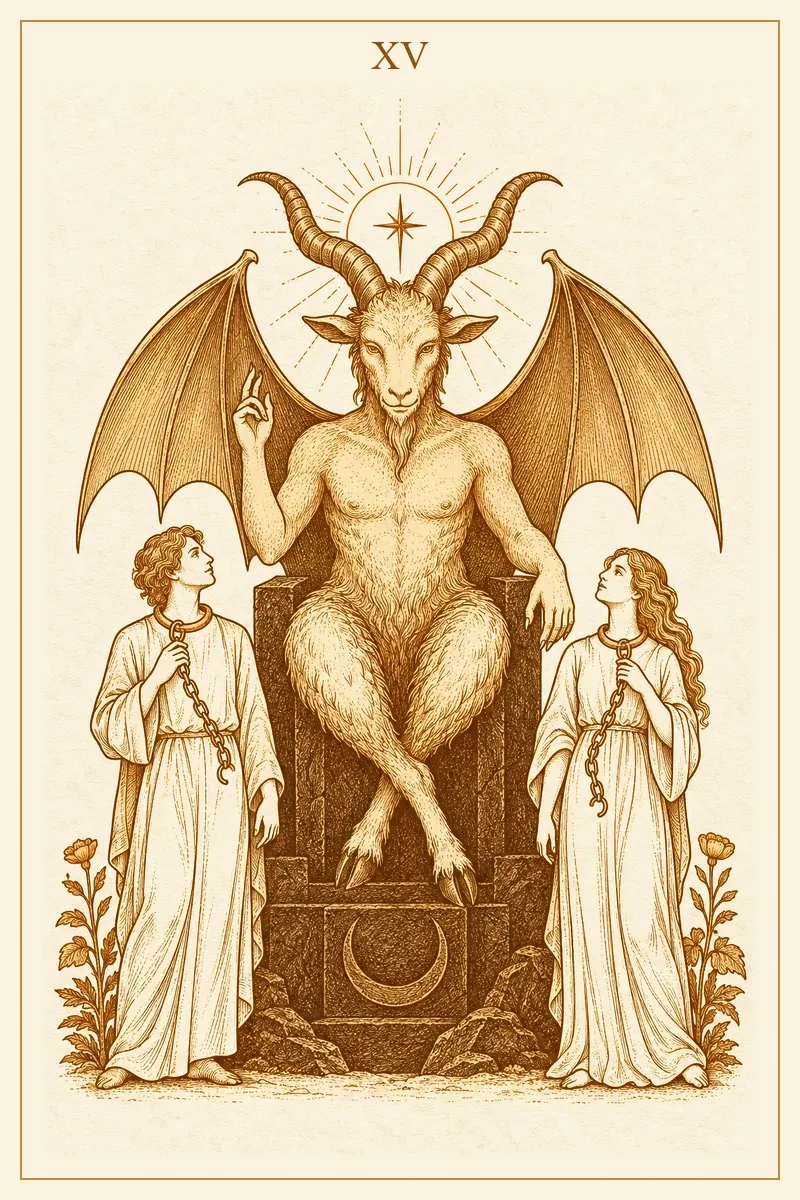
Upright, The Devil describes attachment that has become compulsion. You can list what the relationship costs you, you can hear yourself defending it, and you stay anyway. Intensity gets read as depth and jealousy as proof of love. Making up after a bad night feels better than an ordinary good day ever did, and that spike becomes the thing you are attached to. The card also covers quieter binds: financial dependence, a shared lease, a story about yourself that only this relationship confirms.
Reversed, it usually marks movement rather than worsening. Something has loosened: you said the first honest sentence out loud, or you noticed the mechanism you were inside and cannot quite unsee it. The full Devil tarot meaning covers the card's uses well outside romance.
The question here is two lists: what would it cost me to leave, and what is it costing me to stay? If the second is longer and you still cannot picture a first step, the obstacle is usually money, housing or fear rather than feelings.
Five of Swords: winning instead of repairing
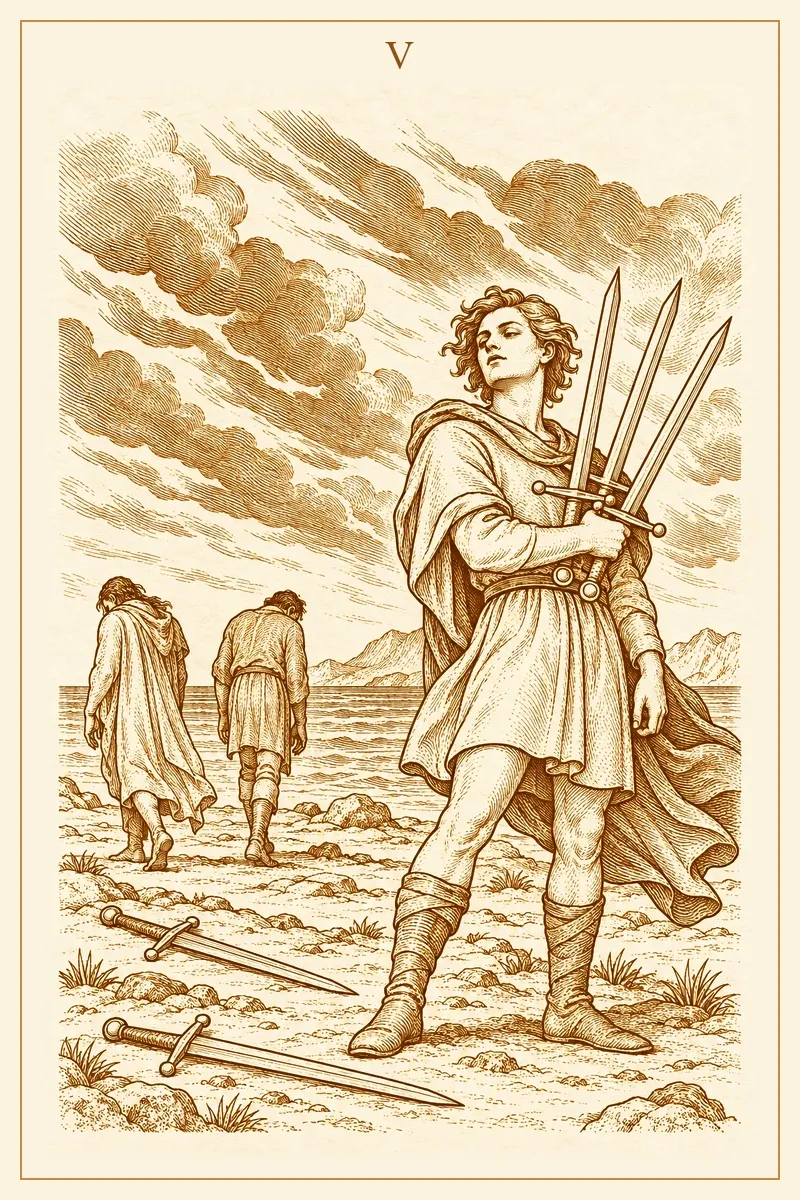
Upright, the Five of Swords describes conflict that has stopped being about resolution. Disagreements become contests, and old mistakes come back as ammunition. One person leaves every argument having proved a point; the other leaves apologizing for something they are not sure they did. The card fits cold, articulate conflict as well as shouting, and it often turns up where contempt has quietly replaced plain anger.
Reversed, it can point to a fight that has gone underground, where nobody raises their voice because nobody says anything true. It can also be the kinder reading: someone decides that being right is not worth the distance it buys. The Five of Swords tarot meaning follows the card into work and friendship as well.
Ask what happens after a conflict in your home. A healthy repair sounds like someone naming their part without being pushed. If repair only ever arrives as a gift or a change of subject, never as a sentence, the pattern has already set.
Seven of Cups: the relationship you were promised
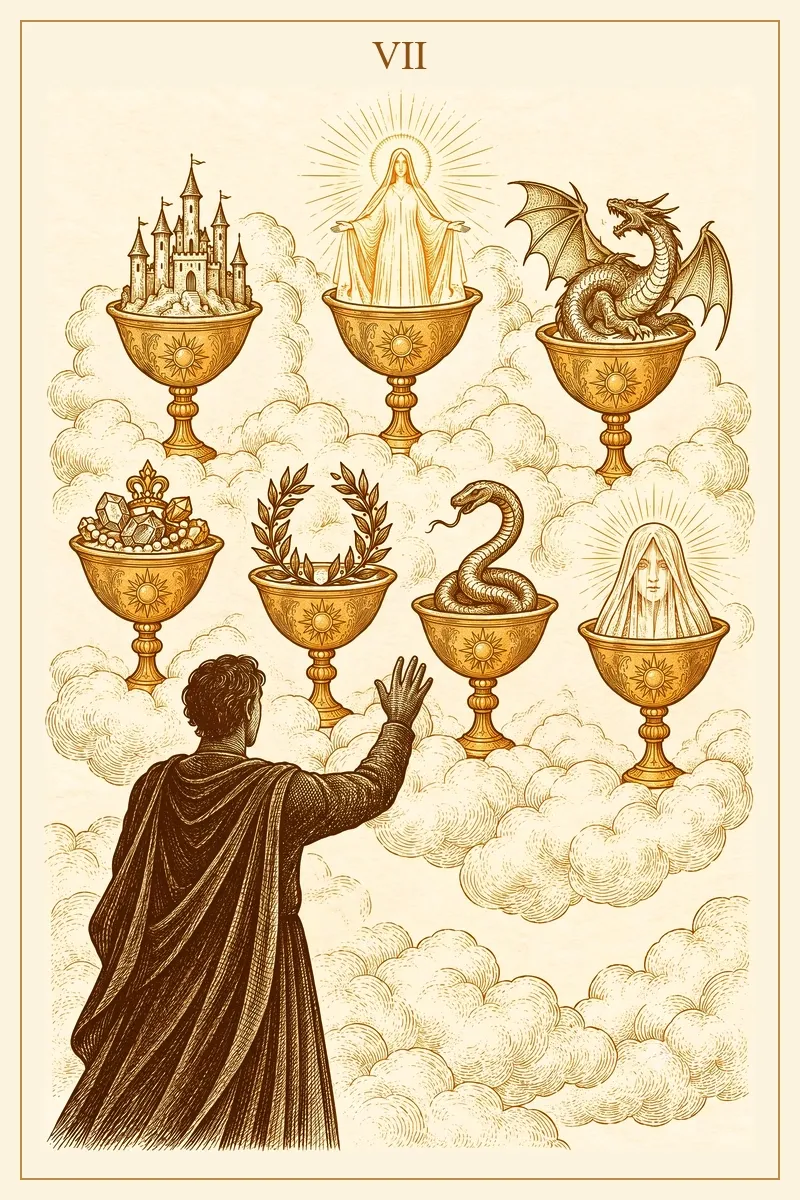
Upright, the Seven of Cups is an image held up in place of a reality. In a love reading it describes the gap between what someone says and what someone does: plans that are always about to start, the version of them you met in the first month, a shared future described in such detail that you forget none of it has happened. Overwhelming affection before the person could possibly know you belongs here too.
Reversed, the fog thins. You are choosing one real option over several imagined ones, or seeing the difference between a promise and a plan. The Seven of Cups tarot meaning explains why the card is as much about choice as about illusion.
The practical test is plain: write down three things your partner said they would do in the last three months and mark which ones happened. Words are information; a record of actions is better information.
The Moon: unease you cannot evidence
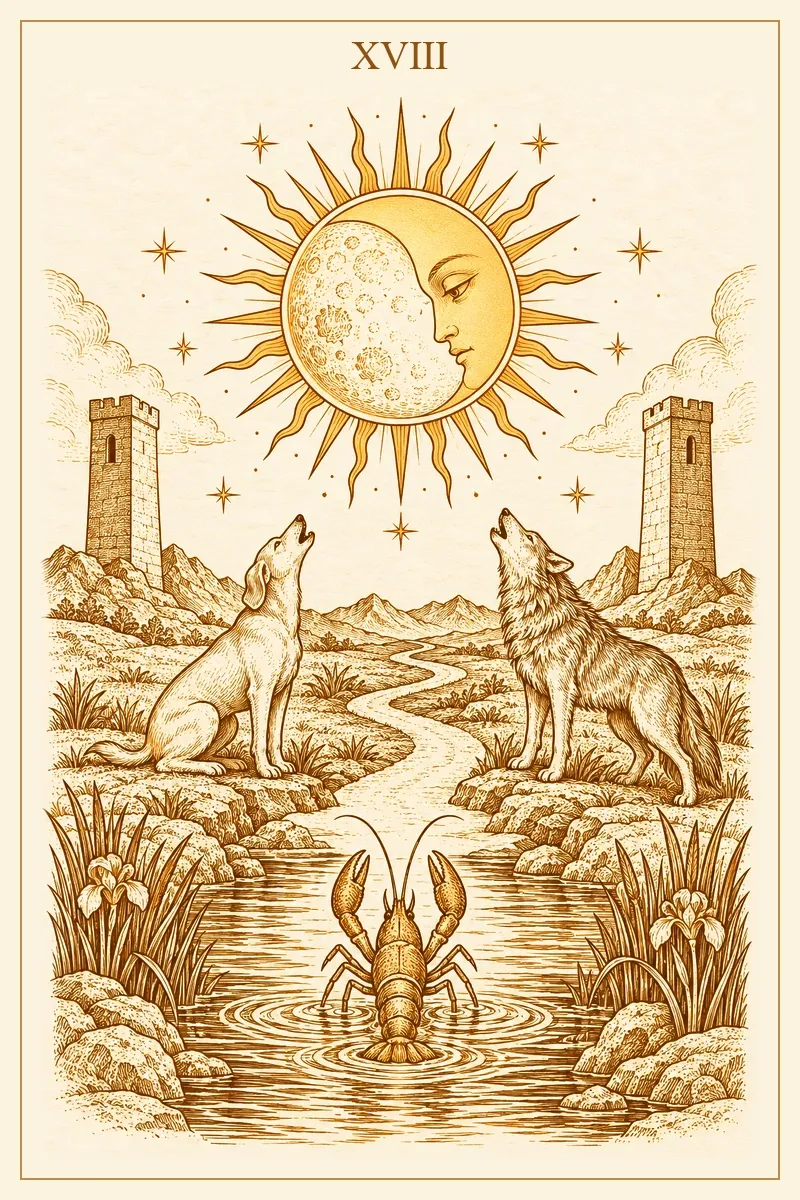
Upright, The Moon describes knowing something is off and having nothing you could present as proof. Details do not line up, and explanations keep moving. You replay conversations to check your own memory, and you have started apologizing for noticing things. The card accuses nobody. It says the picture you are working from is incomplete, and that your discomfort is data worth keeping rather than a flaw to correct.
Reversed, something usually surfaces: a half-truth that resolves, a fear that turns out to belong to an older relationship, or a conversation that finally lands. The Moon tarot meaning goes further into intuition and the card's gentler side.
Keep this card away from checking phones and tracking movements. Say plainly what you noticed and what you need, then listen to how the answer is given. If a direct question reliably ends with you being the one in trouble, that response is itself the answer.
Eight of Cups: someone who has already left
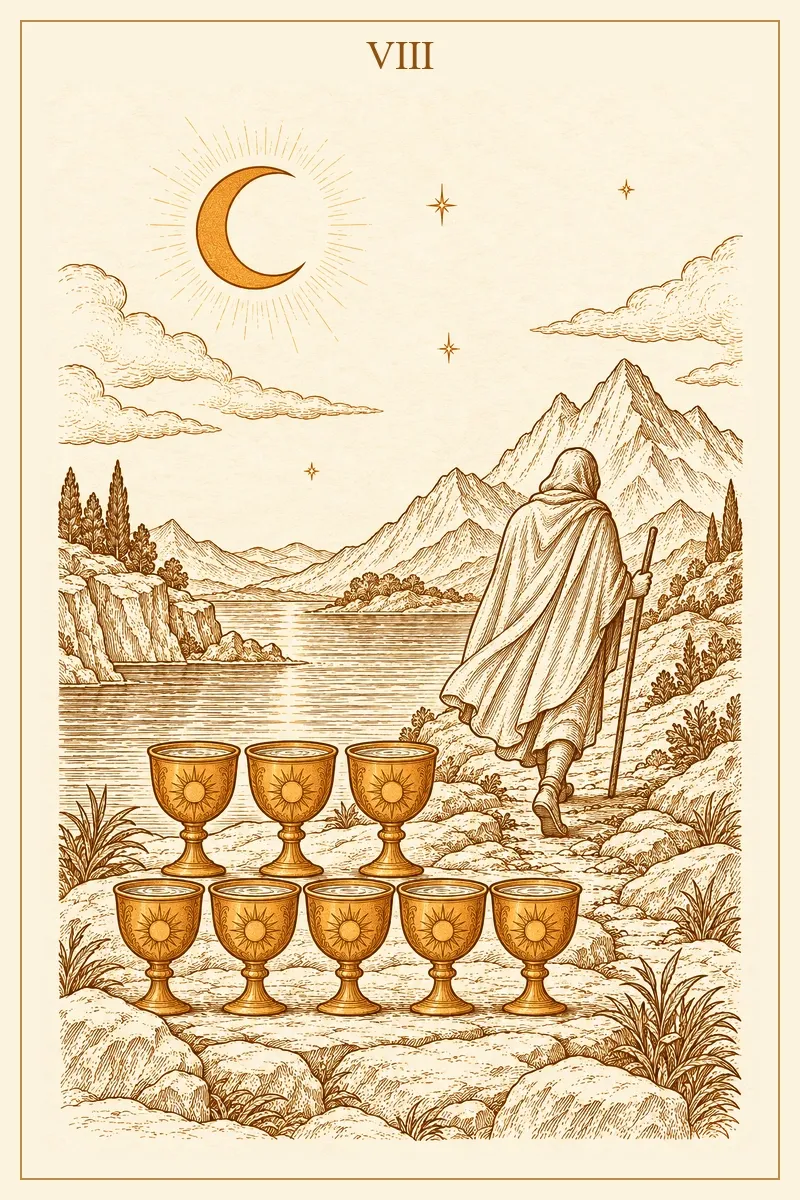
Upright, the Eight of Cups is the card of walking away from something that no longer nourishes anyone. In a position that describes your partner, it reads as a departure without a departure: still present, still polite, no longer invested, while you keep the relationship going for both of you. In a position that describes you, it is far more hopeful: the quiet recognition that you gave this everything you had and are allowed to stop.
Reversed, the card describes the loop of leaving and returning, the same conversation held four times with the same ending. That loop is exhausting, very common, and not a character flaw. The Eight of Cups tarot meaning is worth reading in full if this card keeps appearing for you.
If it lands in a partner position, resist the urge to try harder; effort cannot be supplied on behalf of two people. Decide what you would need to see this month to believe someone is still here: a plan they make, a repair they offer first.
Three of Swords: grief that keeps its shape
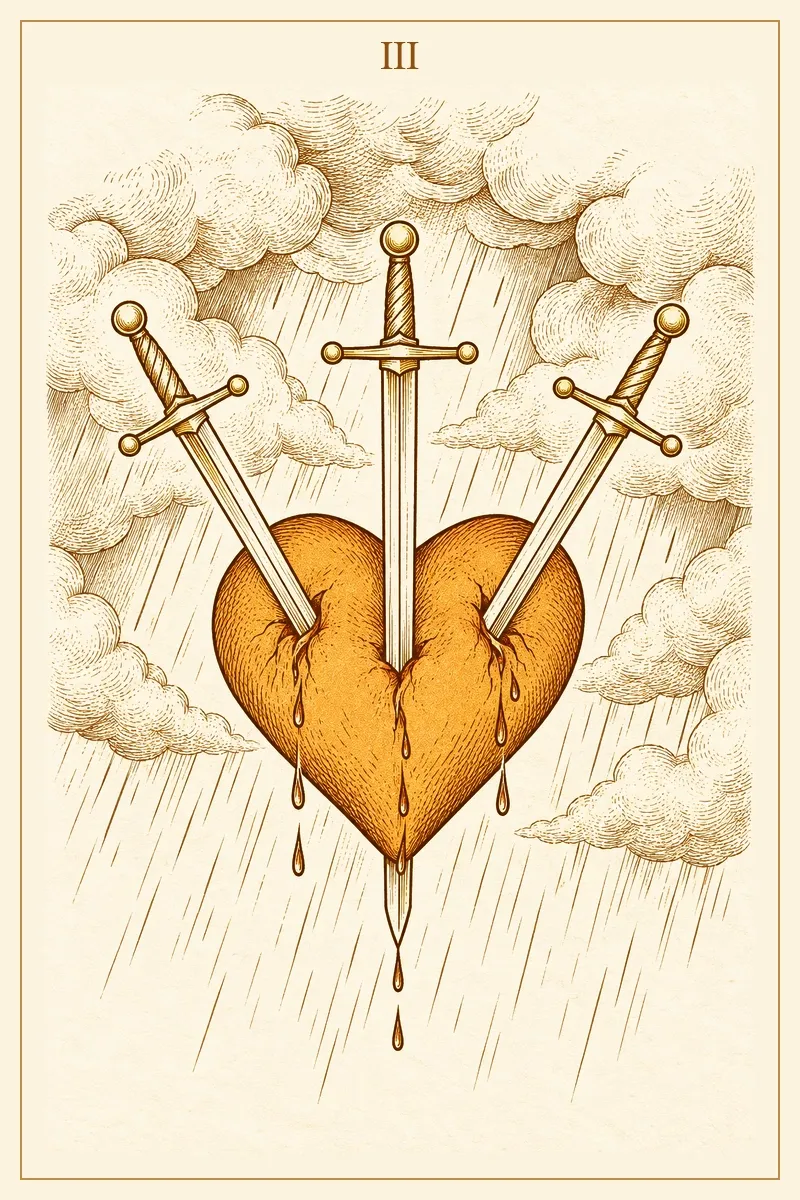
Upright, the Three of Swords is plain heartbreak: the words that cut, the truth that arrives badly, the loss you cannot argue with. One appearance is grief, and grief alone is not a sign of harm; many good relationships pass through it. The warning lies in repetition. When the same pain arrives in the same shape over and over, the hurt is not an accident inside the relationship but something it reliably produces.
Reversed, you may be healing slowly and unevenly, or managing the pain by going numb. If you notice you no longer expect much, name it. The Three of Swords tarot meaning is a gentler place to sit with this card.
Try this: describe the last three times you were hurt here, one sentence each, without guessing at anyone's intentions. If the sentences come out almost identical, you have found the pattern and no longer need the deck to confirm it.
Cards that show how long the pattern has run
Some cards say less about what is happening and more about how long it has been happening. They tend to appear late, for people who are already tired, and deserve a gentle reading.
The Ten of Swords gets read as catastrophe when it is closer to an ending that has already taken place. If you have been bracing for the worst for a year, it often means the bracing can stop; the Ten of Swords tarot meaning explains why endings and first light sit so close together in this card.
The Eight of Swords describes restriction that is partly external and partly held in place by the story you tell yourself. Write down what is genuinely fixed right now, such as a lease, a visa or caregiving, and what only feels fixed. The first list usually needs practical help from someone qualified. The second is where a reading can move something.
The Nine of Swords is the three in the morning version of the relationship, when dread is louder than the day's events; treat it as a sign that you need rest and someone to talk to, not as a forecast. The reversed Knight of Cups describes warmth offered as a performance: flowers after a cold week, poetry instead of an apology, being courted again and again without ever being known.
Painful is not the same as harmful
A reading full of intense cards is not automatically a reading about harm. The Tower can be a false assumption collapsing so something more honest can be built. Death can be one stage of a relationship ending while the relationship continues in a different form. These cards hurt; they do not necessarily harm.
What usually marks the difference is whether anything in the spread is moving. A couple working through a hard season tends to draw something alongside the difficulty: Strength, with its influence without force; Temperance, with its patience in blending two different things; The Star, with its sense that repair is available. None of them promises an outcome, but they suggest both people still have somewhere to put their effort.
Harmful dynamics tend to read as static: the same restriction, conflict or fog, reading after reading. If repair cards never appear across several readings, that absence is information in its own right. It also does not require a villain. People repeat what they learned and cause real damage without intending to, and understanding why does not oblige you to absorb the behavior while they work on it.
Pairs that sharpen a warning
Two cards together often say something neither says alone. Read a pair as a question, and check that question against something you have actually observed.
- The Devil with the Five of Swords: a bond held together by conflict, where the fights have become the main form of contact. Ask what the two of you would talk about in a week with no argument in it.
- The Seven of Cups with The Moon: a picture that does not match the facts and a reason the facts are hard to check. This is where people start doubting their own memory, so write things down close to when they happen.
- The Eight of Cups with the Three of Swords: someone preparing to leave a relationship that has hurt them repeatedly; the positions tell you whether that someone is your partner or you.
- The Devil with the Eight of Swords: the stuck pair. The most useful move is almost always practical, because practical constraints usually hold the door shut.
A five-card spread for an honest look at the dynamic
Use this spread for a clear account of what the relationship is doing now, not a prediction about whether it survives. Write the positions down before you shuffle, so an uncomfortable card cannot quietly change what a position was asking.
- What is actually happening between us. The dynamic underneath the story you usually tell about it.
- What I am putting in. Your contribution, including the parts you are not proud of and the parts you have stopped counting.
- What I am receiving. What the relationship gives you now, not what it gave you last year or has promised.
- Which direction this is moving. Whether the dynamic is slowly repairing, holding steady or wearing further in.
- My next honest step. Something inside your control: a sentence to say, a boundary to hold, a person to call.
Compare positions two and three deliberately; that comparison is the point of the spread. If position three keeps returning depleting cards such as the Five of Cups while position two keeps returning giving cards such as the Six of Pentacles, you have a question worth asking out loud. Our collection of love tarot spreads has shorter and longer layouts for the same subject.
Keep position five small. "Leave him" is not a next step; it is an outcome with twenty steps inside it. "Ask my sister whether I could stay for a weekend" is a next step, and a reading that produces one small doable thing has done its job.
Example: two years in, and always the one apologizing
Picture a reader asking: "What is really going on between us, and what do I need to do about it?" Two years together, and six months of apologizing without being sure what for. Five cards go into the positions above.
What is actually happening between us: Five of Swords. The relationship is organized around who is right. Most conversations now end with a winner, and she is rarely it.
What I am putting in: Six of Pentacles. She is giving, managing, smoothing things over, keeping an invisible ledger. The card is generous, and here it also asks whether generosity has turned into a way of buying calm.
What I am receiving: Five of Cups. Mostly disappointment and the memory of how it used to be: not cruelty every day, but a steady low-grade sense of loss.
Which direction this is moving: The Devil. Deeper in. Not a prophecy, a trajectory. She notices she has planned the next two years around keeping someone from becoming upset.
My next honest step: Eight of Cups. In her own position the card is permission rather than abandonment. The step is not necessarily to end the relationship; it is to stop pouring effort into a container she now sees clearly, and to spend some of that returned energy on one concrete thing.
What she takes away is not "the cards told me to break up." It is narrower and more useful: one sentence she has been avoiding, an end to apologizing in advance, and a conversation with someone outside the relationship. Whatever happens next, her answer will come from the relationship itself.
What to do once the cards are back in the box
Put the cards away before you make any decision. Write down the cards, the positions and one line about what each made you think of, then close the notebook until the images have faded and only the sentences remain.
Next, turn the reading into something observable. Pick the single behavior the spread kept pointing at and describe it so anyone could verify it: not "he is controlling" but "I checked three times this week whether a plan with my friends would be a problem." Observable sentences survive the next good day, which is usually when insight evaporates.
Say it out loud to one person who is not in the relationship. Isolation keeps an unhealthy dynamic in place; one friend who knows the facts changes more than any number of readings. If you feel afraid of your partner, cannot reach your own money, or have been hurt physically, please contact someone you trust or a local support service for abuse as soon as you can do so safely.
Then work on the boundary itself. Our guide to tarot for setting boundaries has a practice for turning a vague limit into a sentence you can say. Hold one small boundary and watch what follows: the response you get is better evidence than anything you will draw.
Frequently asked questions
Does The Devil always mean a toxic relationship?
No. The Devil appears for any attachment that has more power over you than you are comfortable with, including overwork, spending or a habit. In a love reading it points at a bond that is hard to leave, and whether that bond is harmful depends on the surrounding cards, its position and what you can describe from the last month. Repeated appearances alongside conflict or restriction cards are the pattern worth taking seriously.
Which single card is the strongest warning about a toxic boyfriend or partner?
The Devil, because it describes staying in something you can already see clearly, but a single strongest card is the wrong frame. The Five of Swords describes how the two of you fight, the Seven of Cups the gap between words and actions, The Moon being kept partly in the dark. A reading becomes a warning when two or three of them describe the same relationship at once.
Can a toxic relationship heal, according to the cards?
Nobody can answer that about another person's capacity to change. What a reading can show is whether anything is currently moving. When repair cards appear alongside the difficult ones and both people are doing visible work, there is something to build on. When the spread looks the same every time and change is always promised rather than seen, that is worth believing too.
What should I do first if my reading shows these cards?
Nothing dramatic. Breathe, write the spread down and leave it for a day. Then pick one observable thing the reading pointed at and one person you can say it to; decisions made in the first hour are usually driven by fear rather than information.
Can a bad mood make me draw toxic cards?
Your state shapes what you notice and how you interpret, which is most of a reading. If you suspect the mood is doing the work, wait several days and draw again on a calm afternoon with the same written question. A theme that survives both moods is telling you about the relationship; one that does not was telling you about the evening.
Can tarot tell me if my partner is lying or cheating?
It cannot. Tarot has no access to another person's thoughts, actions or intentions, and it cannot supply a date, a confession or a fact. The Moon can describe how uncertain you feel, which is worth knowing, but what comes next belongs to a conversation rather than another spread, and if a direct question does not feel safe to ask, that feeling is the most important thing the reading has shown you.
Love that does not ask you to disappear
A warning card is not a punishment and not a prediction. It describes a pattern at a moment when you were willing to look, which is the hardest part. Whatever you decide, decide it from information rather than from fear, and give yourself the patience you would give a friend telling you this same story.
When you want a quiet space to look at the pattern again, start a reading on Veil Soul with one clear question.