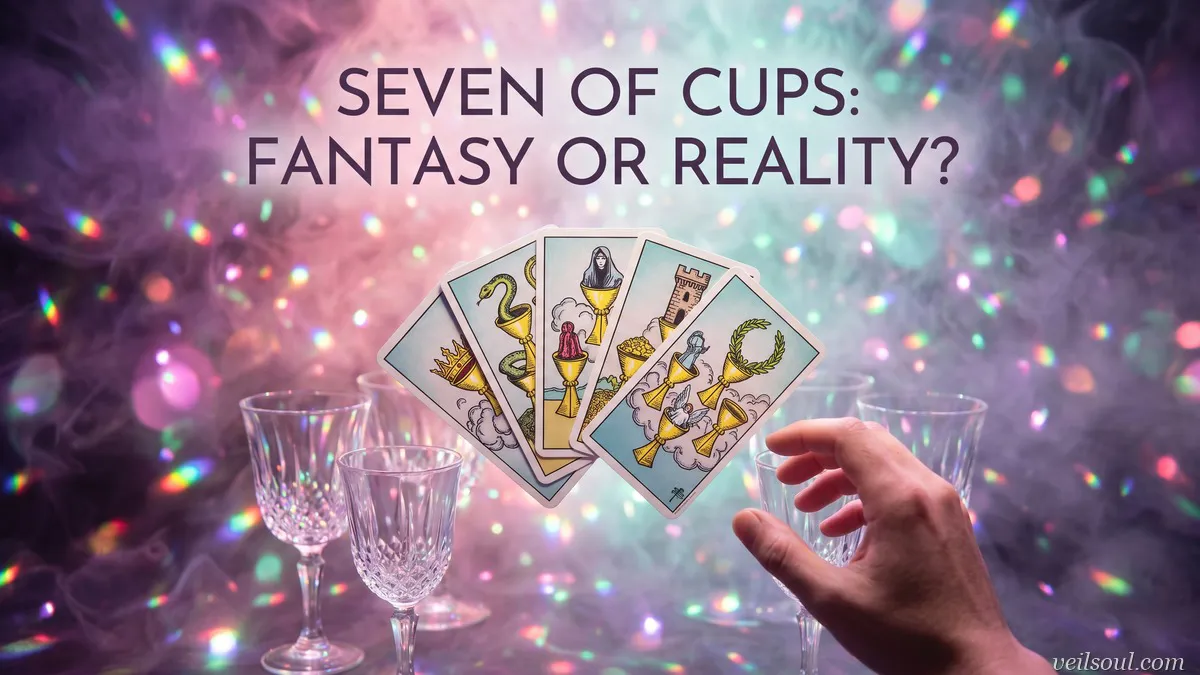
Seven cups float in a bank of cloud, and every one of them holds something you could want. That is the heart of the Seven of Cups upright: too many shining options, none of them tested against real life yet. Reversed, the usual reading is that the fog thins and one cup becomes solid enough to pick up — though the same reversal can describe someone who has quietly decided to stay inside the daydream, and the cards beside it are what tell you which.
In a love reading this card is almost never about a rival. It is about projection: the version of a person you have assembled out of hope and a few good evenings, or three half-open doors you are keeping half-open on purpose. In a yes-or-no question, upright it reads as not yet, because the question itself is still too vague to answer, and reversed it tips toward yes on one condition — that you can name the single option you are actually choosing.
Tarot cannot confirm what another person is thinking, hand you a date, or make a decision on your behalf. What this card does well is show you the shape of your own wanting clearly enough that choosing becomes possible again.
At a glance:
- Suit and element: Cups, water — feeling, imagination, longing.
- Astrology: Venus in Scorpio, the third decan of Scorpio in the Golden Dawn scheme.
- Older title: Lord of Illusionary Success.
- Upright: too many options, fantasy, projection, wishful thinking, scattered desire, a choice that has never met reality.
- Reversed: the fog clearing and one option becoming real — or doubling down on the fantasy and avoiding the choice.
- Yes or no: not yet when upright; usually yes when reversed, once you can name the option.
What the seven cups are actually offering
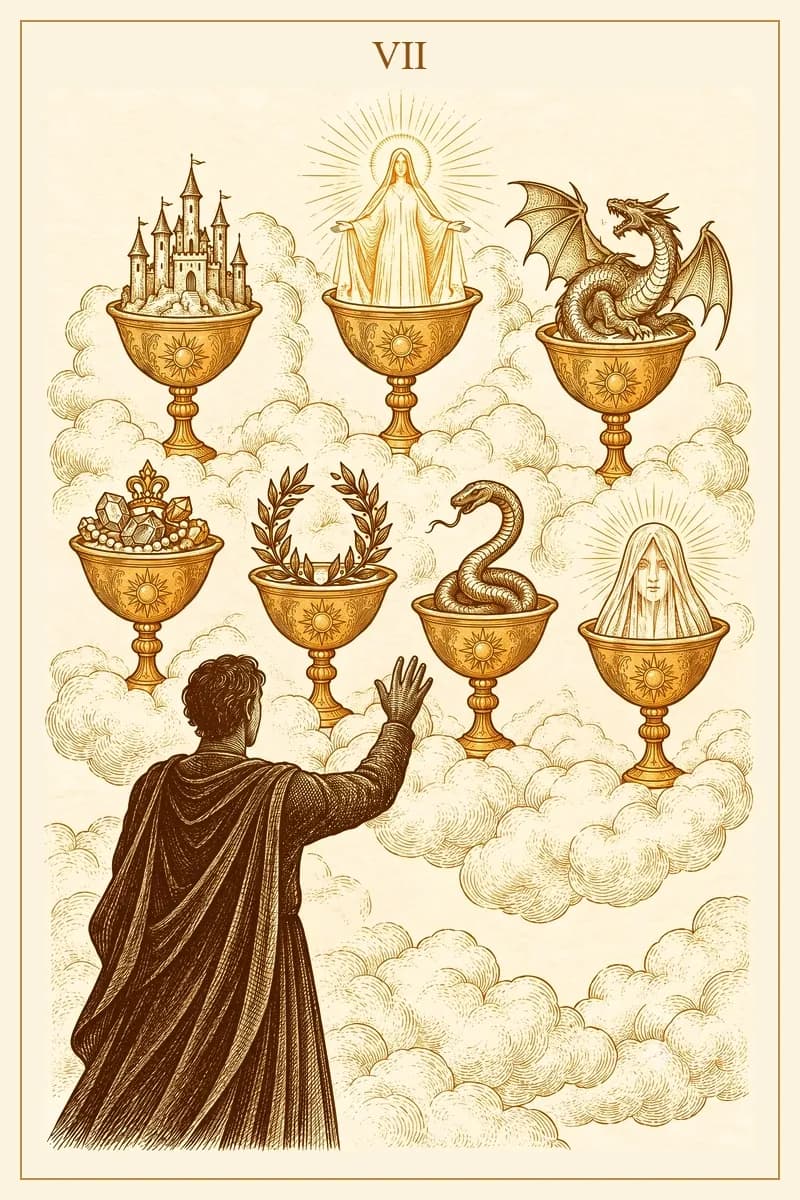
Seven of Cups: what the card shows
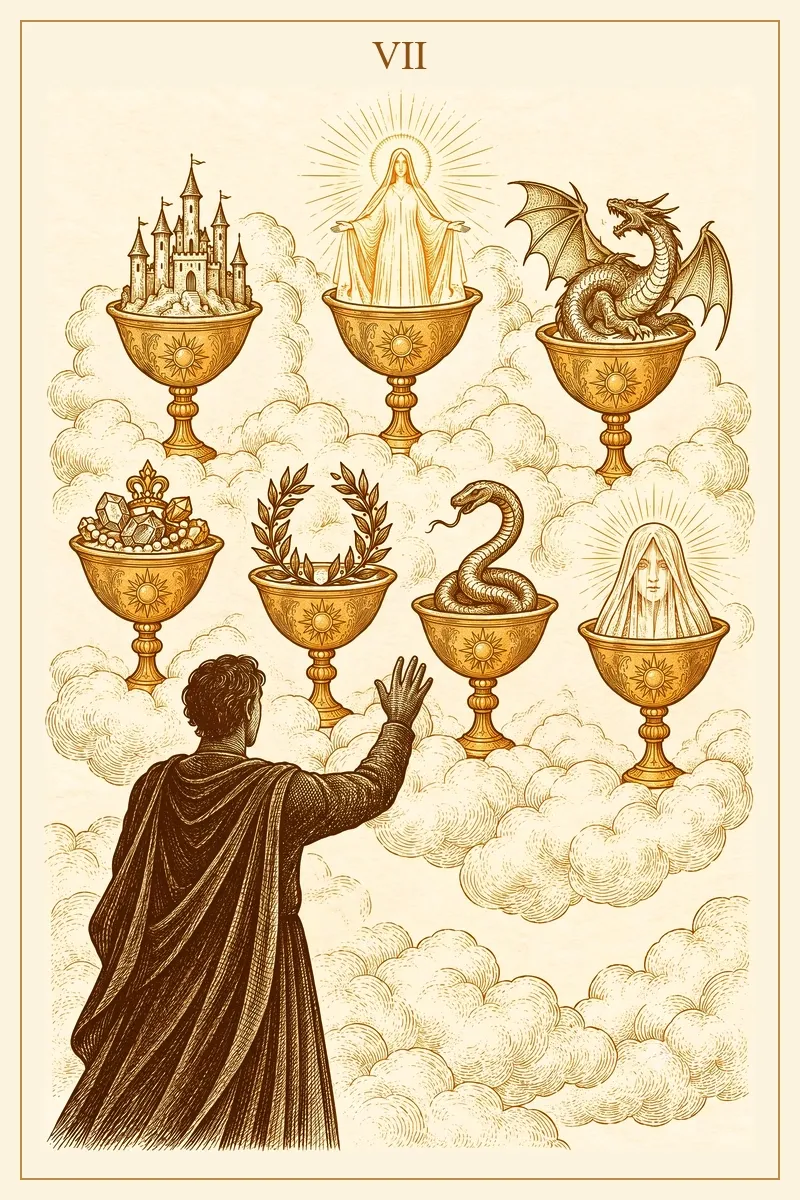
The Seven of Cups is drawn in fine gold line on cream, with the numeral VII at the top. A cloaked figure stands at the lower left, seen from behind, the only dark shape in the frame. One hand is lifted and open, fingers spread toward the cups; the other arm stays wrapped in the cloak. Nothing underneath the figure reads as ground.
Seven gold chalices hang in banks of engraved cloud. Each sits on a pedestal foot with a sun rosette on the bowl, so the cups are identical and only their contents differ. Three ride high, four float lower near the raised hand — the detail worth sitting with. It is open, not closed, and the nearest cup floats just past the fingertips. The figure is reaching and has taken nothing.
The seven visions, one by one
- A turreted castle with a flag on its tallest spire: status and ambition, the life that sounds good when described from outside.
- A radiant robed figure with open arms and rays behind the head: being loved, being seen, feeling spiritually complete.
- A winged dragon coiled in the bowl: the risk that excites you, or the fear you keep feeding attention.
- A heap of jewels, pearls and a small crown: money, and the recognition you believe money buys.
- A laurel wreath: winning, finishing, being proved right.
- A snake rising with its tongue out: knowledge and temptation in one shape, the thing you half suspect and have not checked.
- A veiled head with rays behind it: the option you cannot see clearly yet, often your own future self.
Why its older title is the Lord of Illusionary Success
Cups are the water suit, and water takes the shape of whatever contains it. Seven containers, seven shapes, and the feeling fills all of them equally well. In the Golden Dawn's scheme of decans, the Seven of Cups is given Venus in Scorpio, the last ten degrees of Scorpio, under the title Lord of Illusionary Success. Venus is desire and taste; Scorpio does very little by halves. Together they describe wanting that goes deep and fixes hard on an image. The word illusionary is not a verdict on your imagination — it is a note about location. The success is real and vivid, and so far it exists in your mind.
The number helps too. The seven of any suit is where a project meets doubt, and in Cups the doubt is this: is the thing you are working toward the thing you actually want? A spread made almost entirely of Cups cards makes that question louder still.
Upright Seven of Cups: everything looks possible, nothing is tested
Upright, the options have multiplied past the point where you can compare them honestly. Each one is still perfect, because each one is still imaginary; perfection is what unexamined plans have in common. In practice it looks like one of the following:
- Three or four plans kept alive at ten percent each, so that none can fail and none can start.
- A daydream returned to so often that it has begun to feel like a memory.
- A person, a job or a city carrying more meaning than any real person, job or city could hold.
- Research that has turned into a respectable way of postponing the decision.
- An offer that sounds a little too good and that nobody has checked.
- Wishful thinking standing in for a plan, with the date, the number and the first step all missing.
The card is not against imagination — those cups genuinely hold things worth having. The problem is the plural. A fantasy stays flawless because it has no details, so give one cup a budget, a date and the name of a person you would have to speak to, and within a week you will know whether you still want it.
Keep this card separate from the Four of Cups, which readers sometimes treat as the same mood. There, a cup is held out and nothing appeals; here, seven appeal and no hand closes around any of them. The first is apathy, the second appetite without aim.
Seven of Cups reversed: the fog lifts, or you move further in
Reversed, this card carries two established readings that point in opposite directions. Treating only the flattering one as correct is the quickest way to misread a spread.
The fog clears and one cup becomes real
This is the more frequent reading. One option quietly stops competing with the others, you stop weighing and start preparing, and the relief is specific: you are no longer carrying six unlived futures alongside the one you are living. The clearing is not always pleasant — the castle turns out to be an apartment with a long commute, the dream role the same work in a nicer building. Losing an illusion costs something, and it leaves your hands free.
The daydream gets a firmer grip
The second reading is avoidance made comfortable. The fantasy stops being a preview of a life and becomes the life itself: the move planned for four years, the long attachment to someone who has never been available, the course bought and never opened. The card is not scolding. It points out that the daydream is doing a job — usually protecting you from a decision with a real cost — and asks whether you want to keep paying for it.
How to tell which reversal you are holding
The cards around it settle this, not the reversal alone.
- Leaning toward clarity: decisive neighbors such as the Two of Wands with its chosen horizon, or the King of Swords stating a plain conclusion. Cards like these turn the reversal into a decision.
- Leaning toward deeper fog: the Devil and its comfortable bind, or the Eight of Cups reversed as a departure endlessly postponed. These say the fog is preferred to the choice.
- Your own evidence: ask what has been tested outside your head in the last two weeks — a message sent, a number written down, a conversation had. If the answer is nothing, read the second meaning, and read it kindly.
Seven of Cups in love: the person you imagine and the person in front of you
Upright in a love reading
Upright in love, the Seven of Cups points at the distance between a person and your picture of them. The picture is built from real material — something they said early on, an evening that went well — then extended far past the evidence. The feeling is genuine; the subject of it is partly invented.
It also describes the deliberately unresolved situation: two or three people held at a pleasant distance, a connection that never leaves the messaging stage, a relationship kept open-ended so that nothing has to be said out loud. If you are asking about one particular person, notice whose side of the table the card describes. It shows your hopes and blind spots, not their feelings.
Reversed in a love reading
Reversed in love, the glow fades, you see the person in ordinary daylight, and a decision becomes possible. Flaws included, that is a far better position to love someone from: you are finally in a relationship with a human being rather than an idea.
The second reversal reading matters here too. An ex steadily rewritten into a better partner than they were is the fantasy tightening rather than lifting. A simple test: can you describe one thing about them that genuinely irritates you? If no detail comes, you are still holding a picture. When the clear look leaves you wanting to go, the card for a considered departure is the Eight of Cups; when it leaves you wanting what you already have, that quieter contentment belongs to the Nine of Cups.
At work: seven open tabs and one real next step
In a career reading, the upright Seven of Cups is the professional version of browsing. Several directions are open — the retraining, the move abroad, the side project that could become the main one — and none has a calendar entry. It can also describe an employer's promises: a role sold on potential, equity and culture, with the hours and the salary left vague, is a cup held up in cloud.
Reversed at work, the fog usually clears into a choice you can defend: one application instead of nine, one skill practiced for three months instead of six courses started. The less comfortable reversal is a daydream used as an anesthetic — the business plan rewritten for the fifth year running while the job you dislike stays as it is.
Either way, the test is the same. Spend two hours on the least glamorous part of your favorite option: read the job description line by line, price the course, speak to one person who already does it. Enthusiasm that survives two boring hours is worth following.
Money: when the jewels in the cup might be glass
The cup of jewels is the one most directly about money, and those jewels float in cloud like everything else on the card. Upright, it often appears beside a financial story that depends on a best case: the return that assumes nothing goes wrong, the opportunity that has to be decided today, the plan that quietly needs three strokes of luck.
It can also describe scattered money rather than risky money: a budget that funds every version of you except the current one. Reversed, the numbers come back into focus and you can tell a workable plan from an exciting story about one. Tarot is a reflective tool and not financial advice, so treat a reading as a prompt to check the paperwork before money moves.
Energy, rest and the pull toward escape
In well-being questions, the upright Seven of Cups often shows the overwhelm of too much advice: three eating plans, a supplement shelf, two apps and a sleep protocol, none of them followed for longer than two weeks. The effort is real, the direction changes weekly, and the tiredness comes from the searching itself.
It can also point to escape as a habit used to avoid something easier to face directly. That pattern is worth naming, and a doctor or counselor is the right person to help with it, not a deck of cards. Reversed, the noise drops and one change survives — usually a dull one, like a regular bedtime or a postponed appointment.
Spiritual seeking that never quite lands
Spiritually, this card describes the collector: five traditions half-studied, a shelf of unfinished books, a practice begun each January. Each new path is genuinely moving for about three weeks, which is roughly the point at which it stops being interesting and starts asking something of you. It also marks spiritual language used around a feeling rather than through it — calling a resentment a lesson so it never has to be discussed.
Reversed, discernment arrives. You can tell growth that asks something of you from comfort that asks nothing, and stay with one practice long enough for it to become unremarkable. Depth tends to begin where a practice gets boring.
Yes, no, or not yet: answering with the Seven of Cups
Upright, read it as not yet. Older sources give a flat no, which is slightly unfair to the card. It is not refusing you; it is saying the question has not been asked properly yet. Several options are still in play, at least one of them imagined, so an answer now would be an answer about a fantasy.
Reversed, read it as a conditional yes. If the surrounding cards lean toward clarity, the fog has lifted and you may proceed — the yes applies to the one option you can name in a single sentence, not to all of them at once. If the surrounding cards lean toward avoidance, the honest answer is still no, because nothing has actually been decided.
The most useful move with this card in a yes-or-no spread is to rewrite the question. "Should I change careers?" invites seven cups. "Should I apply for the posting that closes on the fourteenth?" invites an answer. The Seven of Cups is unusually good at showing you that you asked a cloud.
What the neighboring cards do to the Seven of Cups
Its subject is how clearly you are seeing, so one neighbor turns seven options into a decision and another thickens the cloud.
With The Moon

The Moon beside the Seven of Cups makes the foggiest pair in the deck: one card holds the projections, the other everything you cannot see from where you stand. Together they ask you to postpone anything irreversible. Read them as a request for information rather than a warning of disaster, weighed against the Moon's own meaning.
With The Magician
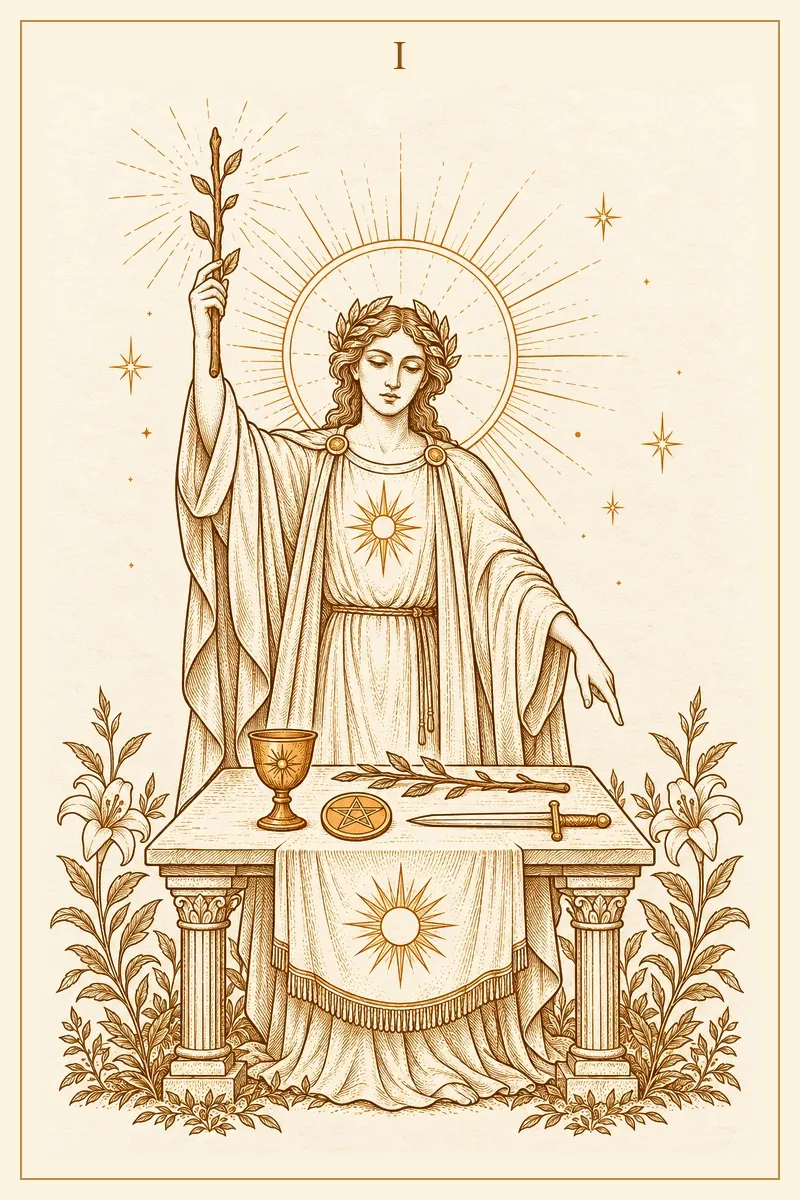
Where the Seven of Cups has seven visions and no hands on them, the Magician has one intention and every tool on the table. The capability is not in question here, only the aim: choose one cup, give it your whole attention, and the card of focused manifestation describes what follows.
With The Emperor

The Emperor brings structure, and structure is what fog cannot survive: a deadline, a budget, a criterion written down before you look again. If the Emperor's authority shows up as someone else's rules, check whether you are handing over a choice that belongs to you.
With the Four of Pentacles
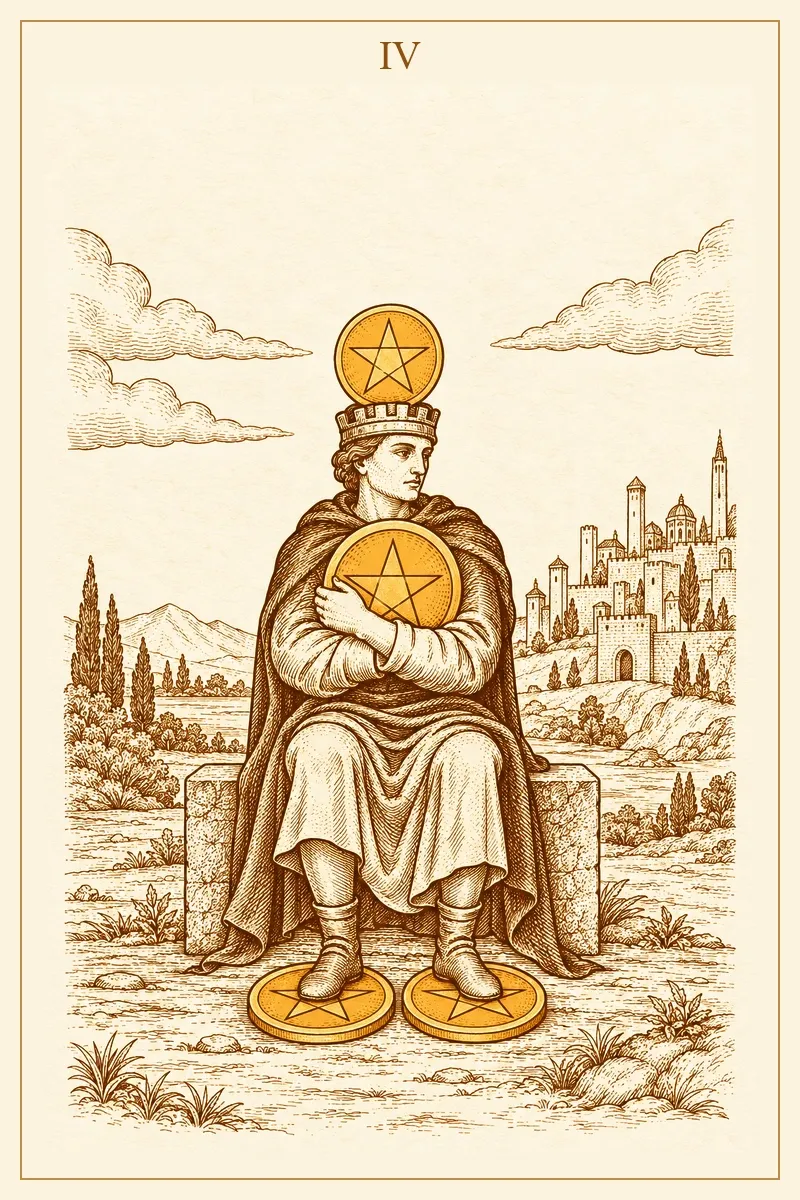
The Four of Pentacles explains why the choice is frozen. Fear of picking the wrong cup makes the current arrangement feel safe, so the options stay in the air where they cost nothing. Look at the grip in that card: name what you fear losing, and the decision usually loosens.
With the Ace of Wands

The Ace of Wands hints that one of the seven is real, so the task becomes identification rather than invention. Notice which option you talk about faster, then read the Ace of Wands meaning as the small first action that proves it.
Choose one cup: a four-card spread
Use this when you have turned over the same options for weeks. Shuffle with a written question in front of you and lay four cards left to right.
- The cup I keep looking at. The option carrying the most feeling, sensible or not.
- The cup I am avoiding. The option that would cost something real, which is often why it is still on the list.
- What is actually in the cup. What the appealing option would mean on an ordinary Wednesday.
- The first small test. One action this week that checks the picture against the world.
Read positions one and three as a pair first; the gap between them measures the fog. If position four is a Major Arcana card, scale it down: the position asks for something you can finish in a week. For a question with exactly two options, the two-path layout in our decision making spread suits it better.
A reading in practice: three plans and a daydream
Consider a reader who has spent a year rewriting three plans: a move to another city, a part-time return to study, and turning a weekend craft into a small business. Nothing has started. The question written before shuffling was narrow on purpose: What do I need to understand about the three plans I keep rewriting? Three cards came out — the Seven of Cups upright, the Eight of Cups reversed, and the Ace of Wands upright.
The first card named the situation without flattering it: three plans, each kept at the sketch stage, each still perfect. The rewriting was not preparation; it was a way of enjoying all three at once without risking any.
The Eight of Cups reversed gave a reason. That card upright is a departure; reversed, it is a departure endlessly delayed. She had left her situation emotionally and not practically, which is the condition that makes three imaginary plans comfortable.
The Ace of Wands changed the tone. In conversation it was obvious which plan had heat in it: she described the craft business in specifics and the other two in slogans. The move and the course went onto a list labeled "not this year", which is not the same as never, and the craft plan got one action for the week — price the materials for ten pieces and show them to two people who had offered to buy.
Five questions to answer before you choose
Write the answers down. A thought can stay vague; a written sentence cannot.
- Which of my options has a date, a number and a named person attached, and which have none of the three?
- What would my favorite option look like on an ordinary Wednesday afternoon?
- Which cup am I keeping in the air so that I never find out it was glass?
- If I had to drop two options tonight, which two would I miss least by Friday?
- What is the smallest test that would tell me something true within seven days?
Frequently asked questions
Is the Seven of Cups a bad card?
No. It is abundance held at the wrong distance. Every cup contains something worth wanting, and the only difficulty is that you are holding seven at once. The stage ends as soon as one option becomes concrete.
Is the Seven of Cups reversed a yes or a no?
Usually a qualified yes. The reversal most often means the confusion has cleared and you can act, so the answer holds for the single option you can state in one sentence. If the cards around it are foggy or avoidant rather than grounded, it is describing a retreat into the daydream and the honest answer stays no.
Does the Seven of Cups mean someone is lying to me?
Not on its own. It is far more often about self-deception than another person's deceit — the story you have built rather than one you were told. If deception is genuinely the question, look for cards that speak to concealment elsewhere in the spread, and treat even those as a prompt to verify something rather than proof.
Can the Seven of Cups tell me which option to take?
It cannot, and this is the honest limit of the practice. A deck has no access to another person's intentions, no calendar, and no authority over your life. A reading lays out what you are actually weighing, which is usually the part that has stayed blurry. The choice, and the responsibility for it, stay with you.
What does the Seven of Cups say about timing?
It is one of the weaker timing cards, which is itself the information: this is a period, not a date. Upright, the window has not opened because the decision has not been made. Reversed, things move as soon as one option is chosen, which puts the timing in your hands rather than in the cards.
How is it different from the Two of Swords?
Both describe a stalled decision, but the feeling is opposite. The Two of Swords is blindfolded with two options and no information, and it is tense. The Seven of Cups has plenty of information, most of it imagined, and it is pleasant. One stalls from fear, the other from appetite.
From seven cups to one honest next step
Imagination is not the problem this card raises. The problem is leaving everything in the air, where nothing can disappoint you and nothing can begin. The figure reaches with an open hand, and the only thing missing is the moment that hand closes around one cup.
Take one option, give it a date and a number, and see what remains standing. When you want the whole picture in one sitting, you can draw a free reading and begin with the cup you cannot stop looking at.