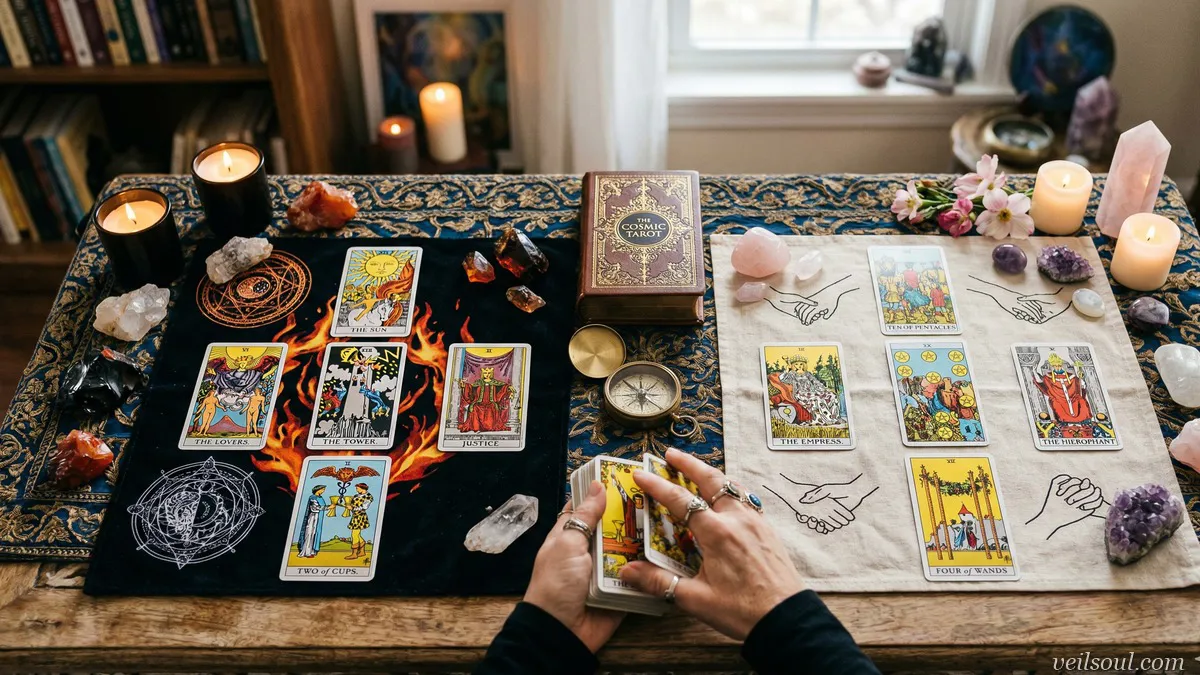
Love tarot spreads are fixed layouts in which every position asks one clear question about your love life, so the cards answer something specific instead of a vague “what about love?” The six below fit the situations a love reading is asked to help with: a one-card heart check-in, a three-card love spread, a relationship cross for a partnership you are in, a stay-or-go crossroads, a new-love spread for singles and early dating, and a reconciliation spread that keeps hope honest. Each comes with its named positions and what each position asks.
One limit before you begin: a spread can help you see your own feelings, choices and next steps more clearly, but it cannot read another person’s mind, confirm what they will do, or set a date for anything. Treat every position as a question to think with, not a verdict.
At a glance, here is what each layout is for:
- One-card heart check-in (1 card): a short look at what your heart needs today.
- Three-card love spread (3 cards): where you stand, what is alive between you, and your next step.
- Relationship cross (5 cards): the bond, what each of you brings, the root tension and what you can build.
- Stay-or-go crossroads (4 cards): what each path would ask of you when you feel torn.
- New-love spread (5 cards): for single seasons and early dating, from old baggage to a next step.
- Honest reconciliation spread (5 cards): what ended it, what has changed, and what you need either way.
Before you lay out the cards
Pick the spread by the size of the question, not by how impressive a big layout looks. A small question (“What do I want to remember before tonight’s date?”) deserves one or three cards; a tangled one (“Why do we keep having the same fight?”) deserves five. More positions give more detail, and also more room to get lost.
Write the positions on paper before you shuffle. When worry rises in the middle of a reading, it is tempting to reassign a position so that a card says what you hoped. Fixed positions keep you honest: the card in “what I bring” stays about you even when you would prefer it to be about them.
Decide in advance whether you read reversals. Upright-only is simpler. With reversals, read an upside-down card as the same theme turned inward, blocked or still forming, rather than as its opposite. Either approach works as long as you keep it consistent within one reading.
Finally, give the reading a container: one question, one layout, one sitting. Note the question, the date and the cards in a journal. Looking back weeks later at what actually happened teaches you more about your own reading habits than any list of meanings can.
Quick love spreads: one card and three cards
One-card heart check-in
Position 1: What does my heart need me to notice today? Use it on a quiet morning, before a date, or after a hard conversation. The single card is a mirror for your mood and needs, not a report on where the relationship is heading. Write one sentence about what the card brings up, then one small action it suggests: sending a kind message, resting instead of checking your phone, or asking for what you need in plain words.
If one card leaves you wanting more, resist pulling a second and a third to “clarify.” Carry it through the day and see what it points to. When you want to turn this into a steady habit across every part of life, love included, the guide to the one-card daily draw shows how to keep it simple.
Three-card love spread
- Position 1, where I stand: what I feel beneath the story I tell myself about this person or this relationship.
- Position 2, what is alive between us: the bond as it is right now, its warmth and its friction.
- Position 3, what I can do next: one step that is within my control.
Because every position stays close to you, this layout suits a partner, a crush or a relationship that has just ended. Notice what is missing: there is no “what they feel” card. If you want the other person in the picture, rename position 2 “what they have shown me” and fill it only with what they have said or done. If you are single, swap in three different questions: what I am carrying, what I am open to, and my next step.
Read the three as one sentence: “I feel ___, between us there is ___, so I can ___.” If the sentence will not come together, start again from position 2; it is the hinge that joins the other two. Once this layout feels familiar, our guide to three-card spreads has other position sets you can swap in.
Spreads for a relationship you are already in
Relationship cross (5 cards)
Lay the cards in a cross: one in the center, one on each side, one below and one above.
- Position 1, center, the bond as it stands: what holds the two of you together now.
- Position 2, left, what I bring: my habits, hopes and blind spots in this relationship.
- Position 3, right, what they show me: their words and actions as I experience them, not their hidden thoughts.
- Position 4, below, what lies underneath: the root need or tension that feeds the surface issues.
- Position 5, above, what we can build toward: a direction both of you could choose.
The left and right cards are the heart of this spread. Read them side by side before anything else: are you pulling in one direction, or pushing past each other? Then move to the card below, because the root explains why the two sides look the way they do. The top card is a possibility you can work toward, not a forecast of where you will end up.
Position 3 needs discipline. If the card there suggests coldness, ask yourself which of their actions you have actually seen that match it. If you cannot name one, write “unknown” and treat the card as a question to raise kindly, not as a fact about them. For a regular routine you can share with a partner, the relationship check-in spread sets out five positions built for a calm talk together.
Stay-or-go crossroads (4 cards)
- Position 1, the real knot: what this indecision is actually about, beneath the arguments.
- Position 2, what staying would ask of me: the effort, change or acceptance that staying would need.
- Position 3, what leaving would ask of me: the grief, courage or practical steps that leaving would need.
- Position 4, what I need either way: the need that stays true whichever path I take.
This layout asks what each path costs and offers, rather than which one is “right.” Positions 2 and 3 are not a contest between a good card and a bad card; both paths carry weight. Give position 4 the most attention. When the need it names is honesty, rest or respect, you can ask which path gives you more of it, and whether it can be met inside this relationship at all.
A spread is not the place to weigh danger. If you are afraid of your partner, feel controlled or threatened, or cannot say no safely, put the cards away and reach out to someone you trust or a local support service first. For big choices beyond love, the decision-making spread uses a two-paths layout you can adapt.
A spread for new love and single seasons
New-love spread (5 cards)
- Position 1, what I am carrying from before: a hope, hurt or habit left over from past relationships.
- Position 2, what I want to feel with someone: the emotional quality I am looking for, beyond a checklist.
- Position 3, what I am offering now: how I show up in dating and connection at the moment.
- Position 4, a sign of a good fit: something to look for in a person or in the first few dates.
- Position 5, my next step: one action toward meeting people or pacing a new connection.
Reach for this spread when you are single and thinking about love, or when something new has just begun. It helps you notice what you bring, what you hope for, and what would tell you that a person is good for you.
In early dating, change position 4 to “what I have seen so far” and fill it with their actual behavior: do they keep plans, listen, and respect a no? That stops a hopeful card from writing a story the dates have not earned yet. If you are moving through a longer single season, tarot for singles offers more prompts for that stretch of time.
An honest spread for reconciliation
Honest reconciliation spread (5 cards)
- Position 1, what ended it, as I understand it now: the cause, seen with some distance.
- Position 2, what I have learned or changed since: real change, not only missing them.
- Position 3, what would need to be different: the conditions a new start would require.
- Position 4, what I actually know of their position: only what they have said or done.
- Position 5, what I need, whether or not we reconnect: the need I can care for on my own.
Wanting to get back together is human. This spread keeps that wish honest by asking what has changed before asking whether to try again. If position 2 shows little growth and position 3 asks for a lot, the story is not over, but you can see where the work would have to begin.
Position 4 protects both of you. If they have asked for space or said no, the card there cannot overrule them, and no reading is a reason to keep contacting someone who has stepped away. Position 5 is the one to act on today, because it belongs to you; if the breakup still aches, the healing spread for heartbreak gives that need a layout of its own. When you want to know which cards readers link with a return, the guide to signs of reconciliation in tarot treats them with the same care.
Worked example: reading the relationship cross
What follows is an illustration, not a real reading. Imagine someone two years into a relationship who feels that small disagreements keep turning into cold silences. They choose the relationship cross and write down the question: “What would help us argue less and listen more?”
The cards fall like this:
- Center, the bond: Two of Cups, upright.
- Left, what I bring: Knight of Swords, upright.
- Right, what they show me: Four of Cups, upright.
- Below, what lies underneath: Ten of Wands, upright.
- Above, what we can build toward: Temperance, upright.
The center card is reassuring and specific. As the Two of Cups meaning sets out, the card describes mutual care and exchange, so the bond itself is not the problem. That matters, because it changes the question from “Are we failing?” to “What gets in the way of something that works?”
The side cards answer that. Knight of Swords in “what I bring” points to speed and sharp words: rushing to make a point, arguing to win rather than to understand. Four of Cups in “what they show me” pictures a young man seated under a tree with his arms folded and his eyes lowered, while a hand from a cloud holds out one more cup. Read with discipline, it describes what the querent has seen: a partner who withdraws and does not take in what is offered. It does not prove that the partner has stopped caring. Side by side, the two cards sketch a loop in which one person pushes, the other pulls back, and the pushing grows sharper.
Ten of Wands below adds the reason underneath: both people may be carrying too much, from work, family or plain tiredness, so arguments start when nobody has energy left to listen. Temperance above shows a direction. On the card a winged figure stands with one foot in a stream and pours water from one gold cup into another, a picture of pacing and blending. As a goal, it points to slower, shorter conversations held when both people have something in reserve.
The useful outcome is a plan the querent can carry out alone: notice the urge to rush in, pause before replying, and suggest leaving hard topics for a calm evening rather than late at night. They might also ask, gently, “When I bring something up, what makes you go quiet?” The answer will say more about the partner than the Four of Cups ever could.
How to phrase a love question
The wording of your question shapes everything a spread can show. Questions that demand a fixed outcome or someone else’s private thoughts leave the cards nowhere useful to go. Questions about your own feelings, choices and next steps give every position something real to answer.
- Instead of “Does he love me?”, ask “What do I need to understand about how I feel in this relationship?”
- Instead of “Will she come back?”, ask “What would help me heal, whatever she decides?”
- Instead of “When will I meet my soulmate?”, ask “What can I do to be more open to the kind of love I want?”
- Instead of “Is he cheating?”, ask “What am I noticing that I need to raise directly?”
- Instead of “Will we get married?”, ask “What do we need to talk about before a bigger commitment?”
Keep one topic per reading, and add a name or a time frame if it helps you focus (“over the next month,” “with Sam”). If you are stuck for words, the Veil Soul question library has love questions ready to use, and our guide to asking effective tarot questions explains the open-question method in more depth.
Reading love spreads with care
Love readings touch real people who are not at the table. A few habits keep them respectful.
- Read your side, not their mind. Positions about another person describe how they appear to you. Do not present a card as proof of what someone thinks, feels or plans, and do not use a reading to test, pressure or monitor them.
- Leave outcomes open. A hopeful card is not a promise that a relationship will work out, and a hard card is not a sentence that it will end; both describe a moment that choices can still change.
- Ask before reading for someone else. When a friend wants a love reading, read with their consent and about their own choices, never about the inner life of a third person who did not agree to be read.
- Do not redraw until you like the answer. If a reading unsettles you, write it down and wait a few days before asking again; a calmer mind reads more clearly.
- Put safety first. Fear, control or threats in a relationship call for human help, not more cards.
If your question is really about another person’s feelings, the guide to reading tarot for love answers shows how to explore it without treating the cards as a window into someone else’s heart.
Frequently asked questions
Which love tarot spread is best for beginners?
Start with the three-card love spread. Its positions are easy to remember, every card stays close to your own feelings and choices, and it fits a crush, a partner or a breakup. Once you can read three cards as one sentence, the five-card layouts feel far less crowded.
Can a love spread tell me how someone feels about me?
No spread can confirm another person’s feelings, intentions or future actions; that is the limit of tarot in any love reading. What a position like “what they show me” can do is help you look closely at the words and actions you have witnessed, and find a question you could ask them directly.
How many cards should a love reading use?
Match the number to the question. One card suits a daily check-in, three cards suit a single clear issue, and four or five suit a tangled situation with several sides. Beyond five, a love reading can become hard to hold in mind, so add a position only when it asks something the others do not.
Can I use these spreads for a friend?
Yes, with their consent and with the positions adjusted to their situation. Keep the focus on their feelings and choices, read gently, and let them decide what the cards mean for them.
What if the cards seem to contradict each other?
A contradiction is information. A warm center card beside a tense side card can mean the bond is sound while one habit causes trouble. Put both truths into a single sentence, then look at the “underneath” or “need” position for what links them.
Should I read reversed cards in love spreads?
You can, as long as you read them the same way each time. A reversed card in a love position can show a feeling that is held back, unspoken or still forming. It does not flip the card into bad news. If reversals make you anxious, read upright only until the layouts feel familiar.
Can I make my own love spread?
Yes. Write down what you want to understand, turn each part into one open question about you or the relationship, and keep any position about the other person tied to what you have observed. Try the layout a few times and adjust the wording until every position earns its place.
Begin with one spread
Choose the layout that fits the question you are carrying today, write its positions down and give the cards one quiet sitting. Then take what you notice into a real conversation or a small step of your own. When you are ready, start a love reading and let the first card set the tone.