Tarot helps you set boundaries by laying three things out where you can see them: where your time and energy are leaking, which limit would protect them, and how to say that limit without cruelty or apology. The cards most closely tied to boundaries are The Emperor for structure, the Queen of Swords for clear words, Justice for fairness that includes you, and Strength for staying firm while staying kind.
A reading cannot tell you how another person will react, whether they will respect what you ask, or make a risky situation safe. What it can do is slow you down long enough to notice the yes you did not mean, name the need underneath it, and rehearse a sentence you can say out loud. Treat each card as a mirror for your own choices, not a verdict on anyone else.
At a glance, these are the cards worth knowing for boundary questions:
- The Emperor: rules, structure and the right to have standards.
- Queen of Swords: honest, direct words delivered without cruelty.
- Justice: fairness that counts your needs as well as theirs.
- Strength: calm, patient firmness that does not need to shout.
- Nine of Pentacles: self-sufficiency and a life you are allowed to protect.
- Ten of Wands: carrying more than your share; a sign that something must be put down.
- Two of Cups reversed: giving and receiving out of balance.
- Six of Cups reversed: old family roles that still decide your answers.
- Queen of Cups reversed: absorbing everyone's feelings until none are left for you.
- The Devil: a pattern you stay in out of fear or habit.
- The Chariot: steady direction once you have decided.
- Seven of Wands: standing your ground when someone pushes back.
- Nine of Wands: a tired but protective guard; check that it has not turned into suspicion.
- Four of Pentacles: a limit that has hardened into a wall.
A limit, a request and a wall are not the same thing
A boundary is a decision about what you will do, not a rule about what someone else must do. “Please stop calling after ten” is a request; “I put my phone on silent at ten” is a boundary, because it stays in your hands whether or not the other person agrees. When a card points at a limit, ask which action of yours it describes.
A wall is the opposite failure. It shuts people out wholesale so you never have to say anything difficult. Tarot can help you find the middle ground, a gate rather than a wall, with a clear sense of who and what may come through, and when.
Boundary trouble has roots: a habit of keeping the peace, a fear of conflict, a family role learned young, or a belief that your needs count for less. A spread cannot pull them out, but it can set them on the table to look at one by one.
Six cards that teach you to hold a line
Read each of these six in its position; a single card is a prompt, not a ruling.
The Emperor: permission to have standards

Upright, The Emperor stands for order, protection and a structure that holds under pressure. In a boundary reading he says you are allowed to have rules about your own time, body, money and home. If you draw him while deciding whether to say no, ask what the steadiest, least apologetic version of your answer would sound like. The full Emperor tarot meaning covers his other sides, including leadership and fatherhood.
Reversed, the card can point two ways: too little structure, with no routine, no clear hours and every request answered the moment it arrives; or too much, a limit so rigid, or a person so controlling, that the structure has become a cage. If someone else's rules are running your life, the reversal asks where your own authority went.
Queen of Swords: saying it plainly and kindly
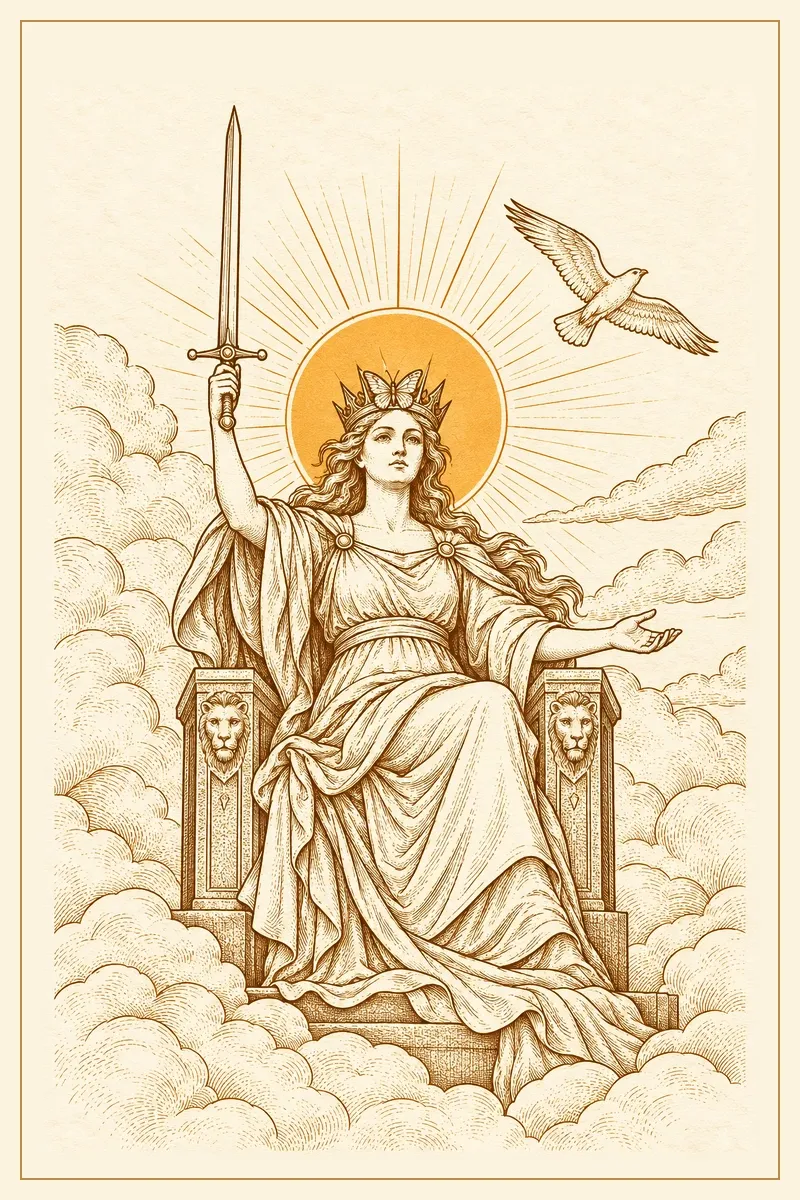
The Queen of Swords knows from experience what she will and will not accept, and she says so without decoration. Upright, she is the card of the clean sentence: “I can't take that on this week.” “I'm not willing to discuss my weight.” No long explanation, no excuses, no sarcasm. Her clarity is a form of respect for herself and for the listener. You can read more in the full Queen of Swords tarot card meaning.
Reversed, she can show words turning cold or cutting: a boundary delivered as a punishment, or held back so long that it finally comes out as anger. She may also describe the opposite problem, where you know exactly what you think but cannot get the words out. Either way, write the sentence before the conversation, read it aloud, and remove anything that is there to wound or to apologize.
Justice: fairness that includes you
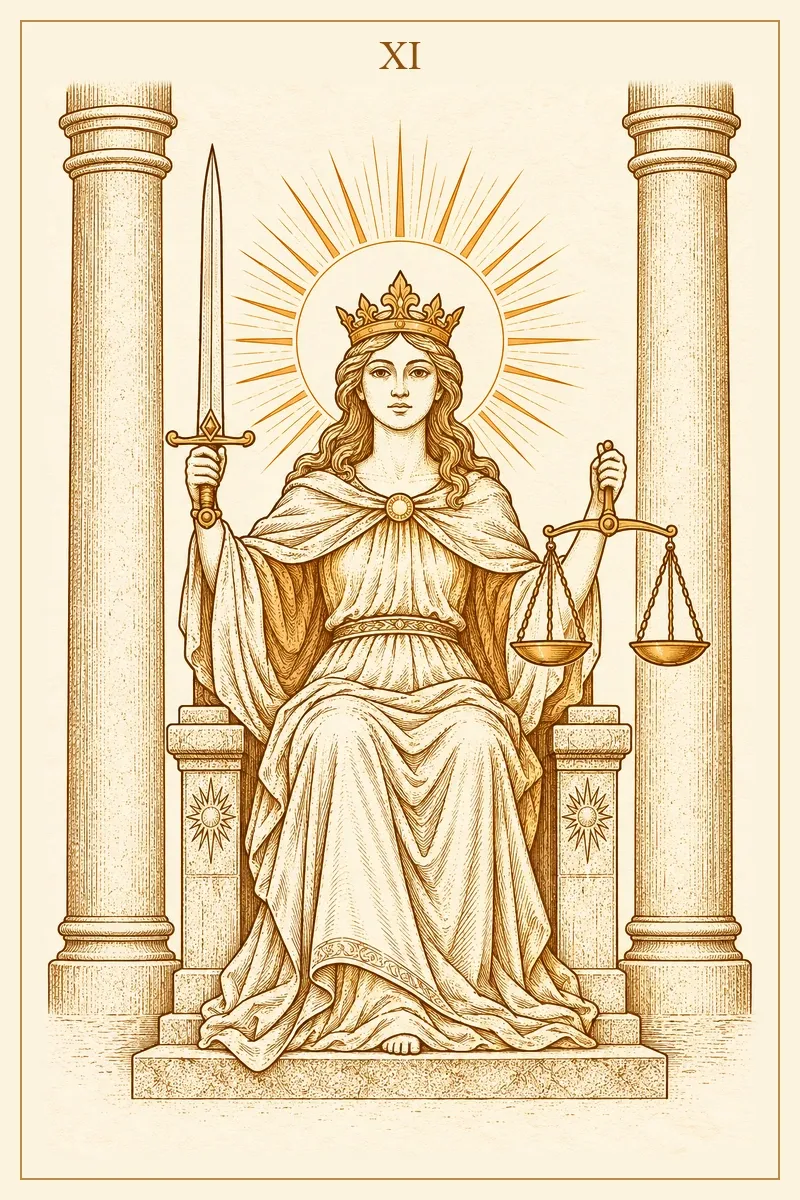
Justice weighs both sides of the scale. Upright, it reminds you that fairness is not only about what you owe others; it is also about what you owe yourself. If you are doing three people's share of the housework, covering a colleague's deadlines or lending money that never comes back, Justice asks you to put the facts on the table and look at them honestly. The full Justice tarot meaning explains its links to truth and accountability.
Reversed, the card can point to an imbalance you have stopped noticing, or to a habit of excusing someone's behavior because confronting it feels unfair to them. It can also ask whether you have been holding others to limits you never actually told them about. A boundary has to be stated before it is fair to expect anyone to keep it.
Strength: firm without force
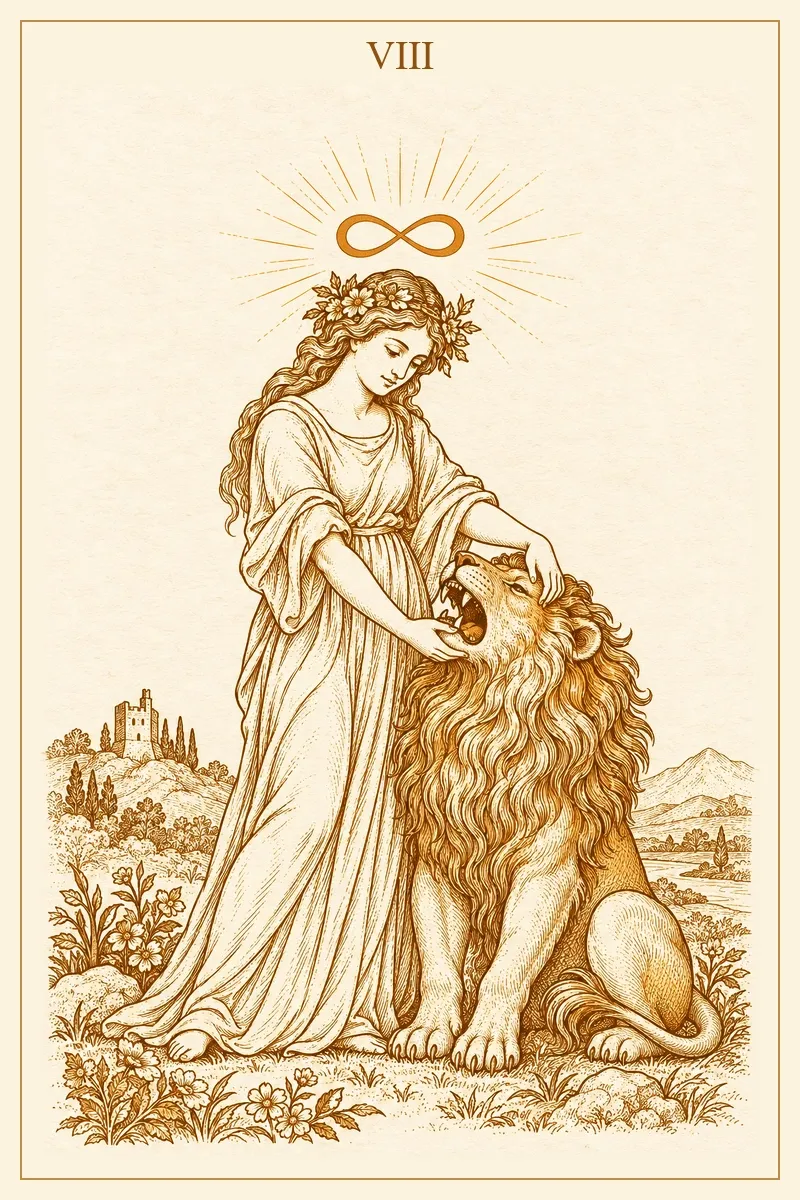
Strength pairs a person with a lion that is calmed by patience rather than force. Upright, it tells you that a boundary can be held kindly. You can listen to someone's disappointment, acknowledge it, and still keep your answer. For more on the card, see the full Strength tarot meaning.
Reversed, Strength can describe the moment your nerve fails: you rehearse the no, then hear yourself say yes. It may also show frustration bursting out after too long without any limit. A script, a pause, a friend to talk to first or a night's sleep before you reply can help you stay steady.
Nine of Pentacles: a life you are allowed to protect
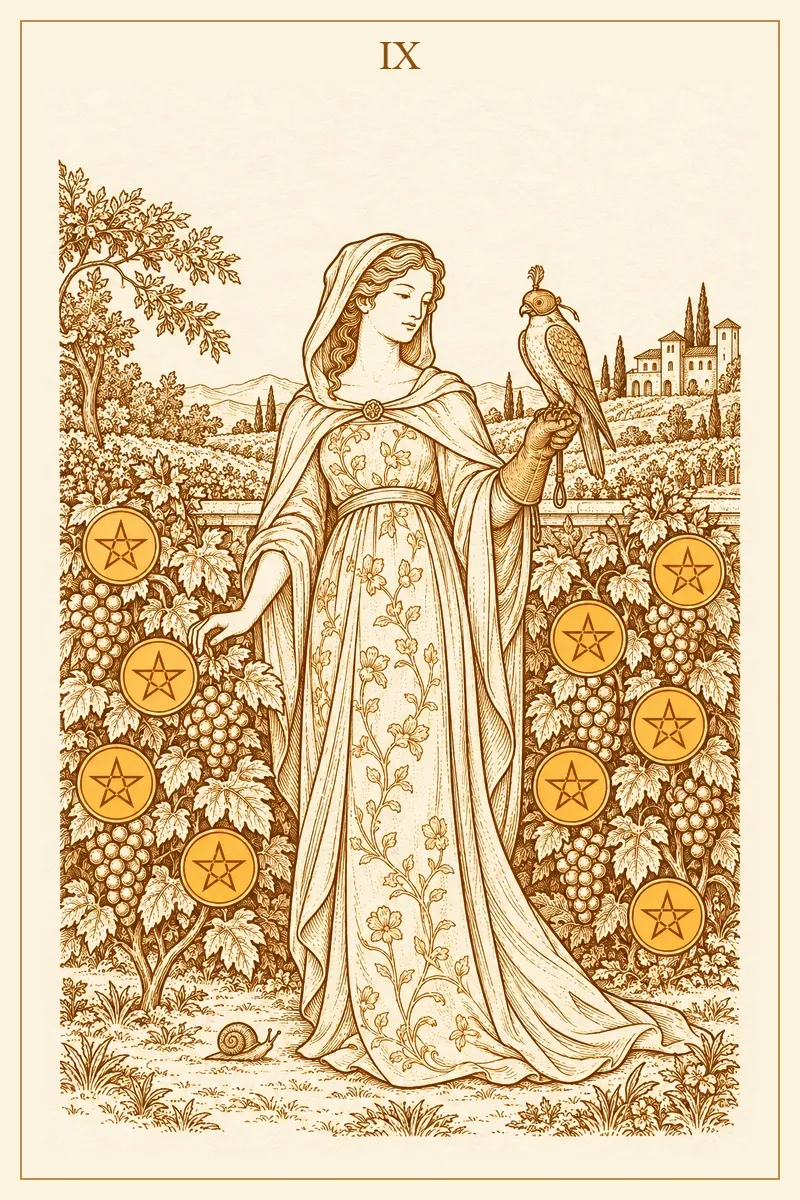
The Nine of Pentacles shows someone at ease in a garden they tended themselves. Upright, it describes self-sufficiency, quiet pleasure and a life arranged around what you value. In a boundary reading, it reminds you that protecting your rest, savings, hobbies and solitude is not selfish; these are the things that keep you well enough to show up for anyone else. The full Nine of Pentacles meaning goes deeper into its themes of independence.
Reversed, the card may point to independence that has slipped: relying on someone who takes advantage of that reliance, or working so hard to prove your worth that there is no time left to enjoy what you have built. It can also ask whether your sense of value rests on being needed.
Ten of Wands: the load that was never all yours
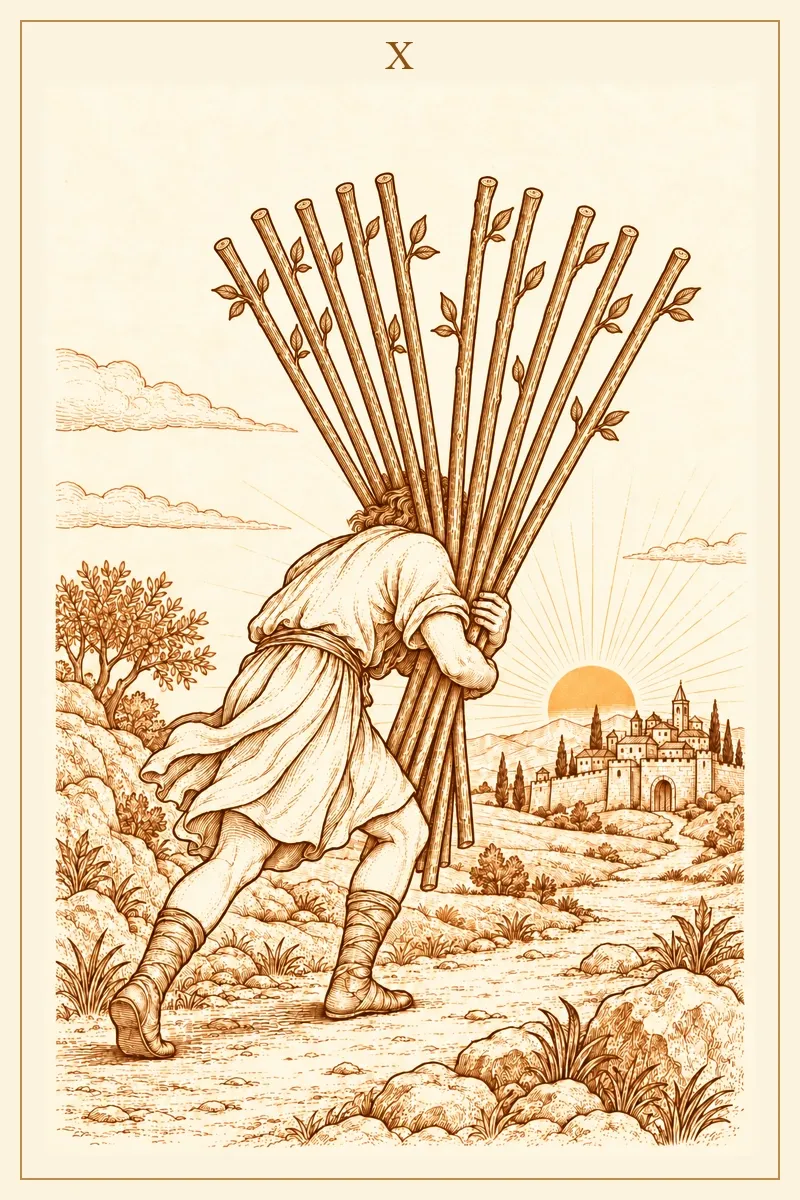
The Ten of Wands shows a person bent under a bundle of staffs. Upright, it is the plainest picture of overcommitment in the deck: one more favor, one more project, one more person's problem, until the weight shapes your days. The card does not shame you for carrying it; it asks which of these wands were ever yours. The full Ten of Wands meaning covers its work and money readings as well.
Reversed, it can show the load starting to come down: delegating, declining, handing a task back. It can also describe the point where carrying everything has become unsustainable and something is about to drop whether you choose it or not. Choosing is the kinder option.
Here is a useful exercise. List every responsibility the card brings to mind, then mark each as mine, shared or someone else's. The third column is where your boundaries begin.
Cards that show where your limits are slipping
Some cards in a boundary reading describe the leak rather than the repair. They are not bad news; they show you where to look first.
- Two of Cups reversed: a relationship where giving and receiving have fallen out of balance. One person keeps reaching out while the other keeps taking. Ask what you would stop doing if you trusted the relationship to survive the change.
- Six of Cups reversed: old roles from childhood or a past relationship that still shape your answers: the peacemaker, the responsible one, the child who never complained. The reversal can also mean you are ready to step out of that role.
- Queen of Cups reversed: taking in everyone's moods until you cannot tell which feelings are your own. Ask where a little emotional distance would help you stay kind.
- The Devil: a pattern you know is costing you, held in place by guilt, fear or habit. On this card each figure holds the end of their own chain; what would you do if you believed you could let it go?
When one of these appears, do not rush to fix the other person. Start with the one action that belongs to you: a shorter phone call, a request you decline, a topic you will no longer discuss.
Cards for keeping a boundary once you have said it
Setting a boundary takes one conversation; keeping it takes many small moments. These four cards speak to that part.
- The Chariot: willpower and direction. Once you have decided, the Chariot asks you to keep moving rather than reopening the question every time someone frowns.
- Seven of Wands: defending your position from higher ground. Pushback after a new limit does not mean the limit was wrong; you can stand where you are without explaining yourself again.
- Nine of Wands: weary and bandaged, but still on guard. Upright, it honors resilience. Reversed or in a fearful position, it may ask whether old hurt has made you brace against people who mean no harm.
- Four of Pentacles: holding on tightly. A boundary that protects you is healthy; one that keeps everyone out, or tries to control what others do, has become a wall. This card helps you notice the difference.
Reading boundaries in love, work, family and money
Love. In a relationship, a boundary protects the parts of you that existed before the partnership: friendships, time alone, your body, your opinions. If The Emperor or the Queen of Swords lands, ask what you have stopped saying to avoid an argument. If the Two of Cups or Queen of Cups appears reversed, ask whether you are managing your partner's feelings at the cost of your own. A boundary is not a test of their love; it is information that helps them care for you well.
Work. Work boundaries are about time and scope: when you can be reached, what is part of your job and what is not. The Ten of Wands and Justice are the most practical cards here. Write down your actual hours and your actual tasks, then compare them with what you agreed to. A specific line, such as “I answer messages sent after six the next morning,” lasts longer than a general wish to be less available.
Family. Family boundaries carry history. The Six of Cups reversed and The Emperor can point to rules you inherited about loyalty, obligation and who gets to decide. You can love your family and still choose how long you stay, which subjects you discuss and how much help you offer. Start with the smallest change you can keep, and allow the first few attempts to feel awkward.
Money. Lending, gifting and sharing costs are boundary questions too. Justice and the Nine of Pentacles ask what you can give without resentment and what you need to keep for your own stability. Before you lend or cosign, write down what you could afford to lose. For debt or contracts, a qualified advisor is the right source.
Two spreads for drawing a limit
Pick the spread that matches the size of the question. The five-card layout suits an ongoing pattern; the three-card one suits a single request you need to answer soon. Write your question down before you shuffle so the positions stay fixed.
The Energy Check (five cards)
- Where I'm leaking energy: the situation or relationship draining you most right now.
- Why I allow this: the belief or fear holding the pattern in place.
- What boundary is needed: the specific limit that would protect your energy.
- How to communicate it: the tone and approach most likely to land with compassion.
- What becomes possible: what opens up when this limit is honored.
Read positions two and three together. The belief in position two explains why the limit in position three feels hard, and naming it lightens it.
The Yes/No Compass (three cards)
Use this layout when someone asks something of you and you are not sure how to answer.
- What saying yes costs me: the time, energy or emotional price of agreeing.
- What saying no protects: what you keep or gain by declining.
- My truest answer: what you would choose if guilt and obligation were not steering.
The third card is not a command. If it surprises you, sit with it for a day before you reply. “Not this time” or a smaller yes is also an answer.
Worked example: the colleague who keeps handing over tasks
Here is an invented example. Mara is a designer. For months a senior colleague has handed her his late requests on Friday afternoons, and she has finished them over the weekend. Her question: “What boundary do I need at work, and how do I say it?” She lays out the Energy Check.
- Where I'm leaking energy: Ten of Wands. No surprise. The weekend work is the bundle she is carrying, and the card asks how much of it was ever hers.
- Why I allow this: Six of Cups reversed. Mara recognizes an old role: the dependable child who never caused trouble. Saying no to someone senior feels like breaking a family rule.
- What boundary is needed: The Emperor. A structure, not a mood. She decides that requests arriving after Thursday at noon go into the following week's plan.
- How to communicate it: Queen of Swords reversed. A caution. Mara notices she has been rehearsing a sharp speech about fairness. The reversal suggests dropping the edge and keeping the message short and factual.
- What becomes possible: Nine of Pentacles. Weekends that belong to her again, and the energy to do her own projects well.
Read together, the spread shows Mara that the pattern rests on an old role, that the fix is a clear rule rather than a confrontation, and that her tone matters. She writes: “From now on, anything that reaches me after Thursday noon I'll schedule for the following week. If something is truly urgent, let's ask our manager to set the priorities.” She sends it on a Tuesday, when nothing is pending, so it reads as a plan rather than a reaction.
Two weeks later a Friday request arrives, and she replies with the date she can start it. The colleague grumbles; she holds her position, a Seven of Wands moment she was ready for. That evening she notes how it felt, guilt included, to compare with next time.
Daily habits that stop a new limit from slipping
- A morning question. During your morning tarot routine, ask, “What do I need to protect today?” Let the card point to one place where you will watch your limits.
- An Emperor pause. Before a difficult conversation, set The Emperor in front of you and use one of these tarot meditation techniques for a few slow breaths. He does not apologize for having standards, and you can borrow that steadiness.
- An evening review. In your tarot journal, note one moment you honored a boundary and one moment you let it slide. Write both without judgment; the second is information, not failure.
- A Queen of Swords breath. When a request arrives, wait before answering. “Let me check and get back to you” buys time for your real answer.
Journal prompts for the yes you did not mean
- Where am I saying yes out of guilt rather than real willingness?
- What would change if I gave myself the same consideration I give others?
- What is the worst that could realistically happen if I said no? Write it down and read it back.
- Who in my life keeps healthy boundaries, and what do they do that I could try?
- If the Queen of Swords were living my week, what would she change first?
Pushback, guilt and the deeper work
Expect some resistance. People who are used to your automatic yes may be surprised, hurt or annoyed when it changes. That reaction does not prove the boundary is wrong; it shows the old arrangement suited them. Stay kind, repeat your sentence once, and resist the urge to justify it at length.
Guilt is normal too, especially at first. It means you did something unfamiliar, not something bad. If guilt and fear keep pulling you back, shadow work with tarot can help you explore why saying no feels dangerous, and our post on tarot for self-doubt looks at the inner critic that insists your needs come last. Self-trust grows with practice, and the exercises for building confidence with tarot pair well with boundary work.
Start small. One limit you keep for a month, such as not answering work email after eight, does more for your self-respect than a dramatic declaration abandoned within a week.
Safety comes before any reading. If setting a boundary with someone feels physically or emotionally unsafe, or if a person punishes you for saying no, please reach out to a trained counselor, a local support line or someone you trust.
Frequently asked questions
Which tarot card represents boundaries?
The Emperor is the card most closely tied to boundaries, since it stands for structure and the right to set rules for your own life. The Queen of Swords follows for the words that carry a limit, with Justice and Strength adding fairness and calm. No card means “boundary” in every spread; the position and your question decide.
Can tarot tell me whether someone will respect my boundary?
No. Tarot cannot read another person's mind, guarantee a reaction or predict an outcome. What a reading can do is clarify your need and how to say it. How someone responds is their choice, and that response is the real information.
What does The Emperor reversed mean for boundaries?
It can point to too little structure, where nothing protects your time, or to rules that have become rigid or controlling, possibly someone else's. Look at the position and ask which of the two describes your situation.
How do I know if a boundary has turned into a wall?
Ask whether the limit protects you or controls someone else, and whether it still lets the right people in. The Four of Pentacles or the Nine of Wands is a good prompt for this question. A healthy boundary fits in one calm sentence and can change when circumstances do.
Can I use tarot to decide whether to cut someone off?
Tarot can help you see the pattern, your feelings and your options, but the decision is yours. Use the Yes/No Compass to weigh the costs, talk with people you trust, and if the relationship involves harm, seek professional support rather than relying on cards.
A limit you can keep
Every boundary you keep tells you that your time and energy matter. The right to take up space is not something you have to earn. When you want a quiet place to ask the cards about a specific request or relationship, you can begin a reading with Veil Soul.