Strictly speaking, no: a tarot card cannot be wrong. A card is an image with a wide range of meanings rather than a statement of fact, so there is nothing inside it to be true or false. What can be wrong is the reading built on top of it — a question too broad to answer, an interpretation bent by hope or dread, a deadline you added yourself, or a theme that arrived in a shape you were not watching for. And when people ask whether tarot readings are accurate, the fair answer is that a reading is accurate the way a careful description is accurate: it can name what is already in motion around your question, and it cannot confirm what another person privately thinks, fix a date, or decide an outcome for you.
That distinction matters, because the feeling of a missed reading is real. You braced for a change that never came, or sat through a session that seemed to describe somebody else's life, and afterward the whole practice looks like guesswork in careful packaging. Looking at where the reading actually broke is more useful, and the break usually sits somewhere you can repair.
At a glance, here is what usually goes wrong. The first five are repairable in your own practice; the last two are conditions under which a reading is better set aside:
- The question was too broad: a vague question can only produce an answer you have no way to check.
- Hope or dread did the interpreting: you took the meaning you needed and left the rest of the card's range unread.
- The deadline was yours: the cards described movement, and the month it had to happen in was your addition.
- The shape surprised you: the theme did show up, just not as the scene you had pictured.
- You changed course: you acted on what you saw, and the difficulty never arrived.
- The reading happened mid-storm: panic and grief get reflected back louder than the situation.
- You asked until the answer changed: repeated pulls on one question make noise, not clarity.
Two different things get called "wrong"
When somebody says a reading was wrong, they usually mean one of two things, and the two have almost nothing in common. The first is an interpretation error: the card was read as one thing when the situation was about another. The second is a forecast that did not come true, where a card was treated as a prediction and the event did not happen on schedule. Only the first is a mistake in reading.
Interpretation errors are ordinary and fixable. Every card holds a cluster of related meanings, and a reader picks the ones that fit the question, the position and the person in front of them. Pick the wrong branch and the reading drifts, while the card stays exactly as useful as it was. You can go back, read the other branches, and see whether one describes your situation better.
Forecast complaints are different, because the expectation underneath them was never realistic. No spread can confirm that a specific person will call you in March. Treat a card as a schedule and it will disappoint you, not because the card is unreliable, but because you asked a picture to behave like a calendar. So the useful question about a disappointing reading is not "were the cards right?" but "which of these two complaints do I have?" If it is the first, the fix is re-reading. If it is the second, the fix is changing the question.
Five honest reasons a reading misses the mark
Most disappointing readings come down to one of five causes, and all five are things you can learn to notice in your own practice once you know their shape.
1. The question was too broad to answer
"What does my future hold?" cannot be answered by any method, tarot included, because nothing in the answer can be checked against anything. The narrower version does real work: "What should I weigh before I accept this offer?" gives the cards a specific decision to describe, and gives you a way to tell afterward whether the description was good.
There is a subtler version of this. Sometimes you ask the respectable question instead of the one you actually care about: you want to know whether to leave, so you ask about your career direction, and the gap between the two reads as inaccuracy. Writing the real question down before you shuffle, even if you never say it aloud, removes most of that gap. For a fuller method, our guide to asking effective tarot questions shows how to tighten a question without narrowing it into a yes-or-no trap.
2. Hope or dread did the interpreting
This is a very common source of readings that later look wrong, and it is strongest when you read for yourself. You want The Lovers to mean that your feelings are returned, so that is the meaning you keep, and the card's other register — a choice that has to line up with your own values — goes unread. Nothing in the card misled you. You stopped reading at the part you wanted.
Dread works the same way in reverse: a difficult image lands, you fill in a worst case within seconds, then spend the rest of the reading hunting for confirmation. The practical counter is to force the full range into the open. Name two meanings for each card before you choose between them, and say why the one you picked fits this question better than the one you dropped. If you cannot give a reason, you are not interpreting; you are voting.
3. The deadline was yours, not the deck's
Tarot is weakest at timing, and a great many "wrong" readings are really arguments about a clock. The Ace of Wands can describe a genuine creative opening without saying one word about when it opens. If you decided it meant this month and it turned up five months later, the card held and your deadline did not.
Two weeks is not enough time to evaluate most spreads, and a verdict delivered that fast tends to stop you watching for the very thing you asked about. Writing the spread down helps most here, because memory quietly edits readings to match whatever happened; our guide on how to keep a tarot journal shows what to record so a reading can be checked honestly later. Suits and numbers can still give you a sense of pace, and pace is far more readable than a date.
4. The theme arrived in a shape you did not picture
A reading can be accurate about what is happening and completely unlike the scene you imagined while reading it. You draw a card about painful honesty and brace for a breakup; what arrives is a friend telling you something true about a pattern you had been avoiding. The theme was right. The cast and the setting were your own invention.
Abundance is the classic case. The Empress gets read as money by default, and when the bank balance does not move the reading looks like a miss — while the actual growth showed up as a creative project finding its feet. When you review an old spread, put each card's theme into plain language first, with no scene attached: an ending, pressure released, support arriving. Then ask where that description has already turned up.
5. You changed course after the reading
This is the best kind of wrong reading, and it gets miscounted constantly. The cards described a difficulty you were heading toward. You saw it, changed something, and the difficulty did not arrive. The reading did not fail; it did exactly the job a reflective reading is for.
Say the Five of Cups raised the possibility of a loss you would grieve, and you took the hint, had the conversation you had been putting off, and the relationship held. There is no way to prove the alternative timeline, which is why this cause is so easy to overlook. Write down what you change after a reading; six months later, that note is the difference between "the cards were wrong" and "I did something about it."
Five cards most often declared wrong
Some cards get accused far more often than others, almost always because their picture promises more drama than their meaning delivers. Upright and reversed are not good and bad here; a reversal usually means the same theme turned inward, slowed down, or left unresolved.
Death: the change you did not count as change
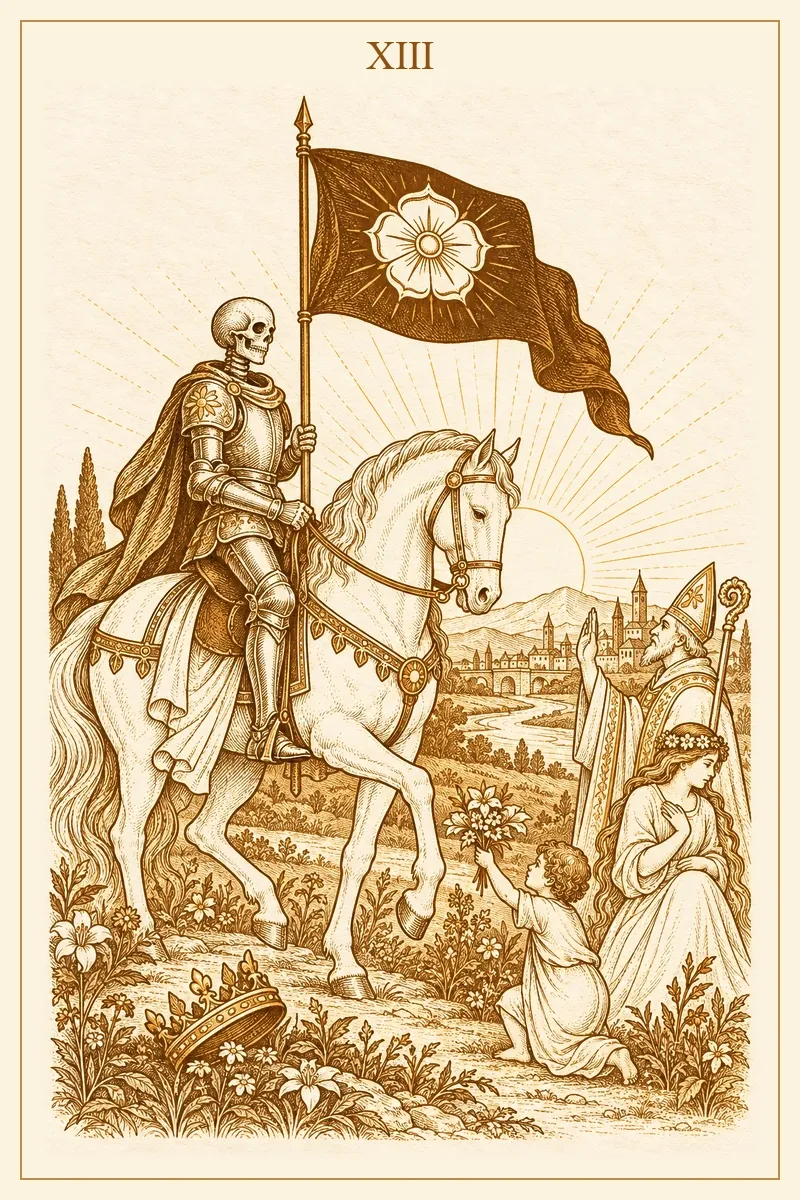
Upright, Death describes something reaching its end so that something else has room: a role you have outgrown, a version of a relationship, an identity you no longer defend. Reversed, it often points to an ending you are holding open — a resignation unsent, a goodbye rehearsed but never said.
It gets declared wrong when the reader is watching for a dramatic event. Nobody left, nobody died, nothing collapsed, while the thing that ended was quieter: you stopped defending a position, or stopped hoping for a particular apology. A good test is to ask what you have stopped doing since the reading without ever deciding to. For this card's full range beyond endings, see the Death tarot card meaning.
The Tower: disruption that often arrives as paperwork
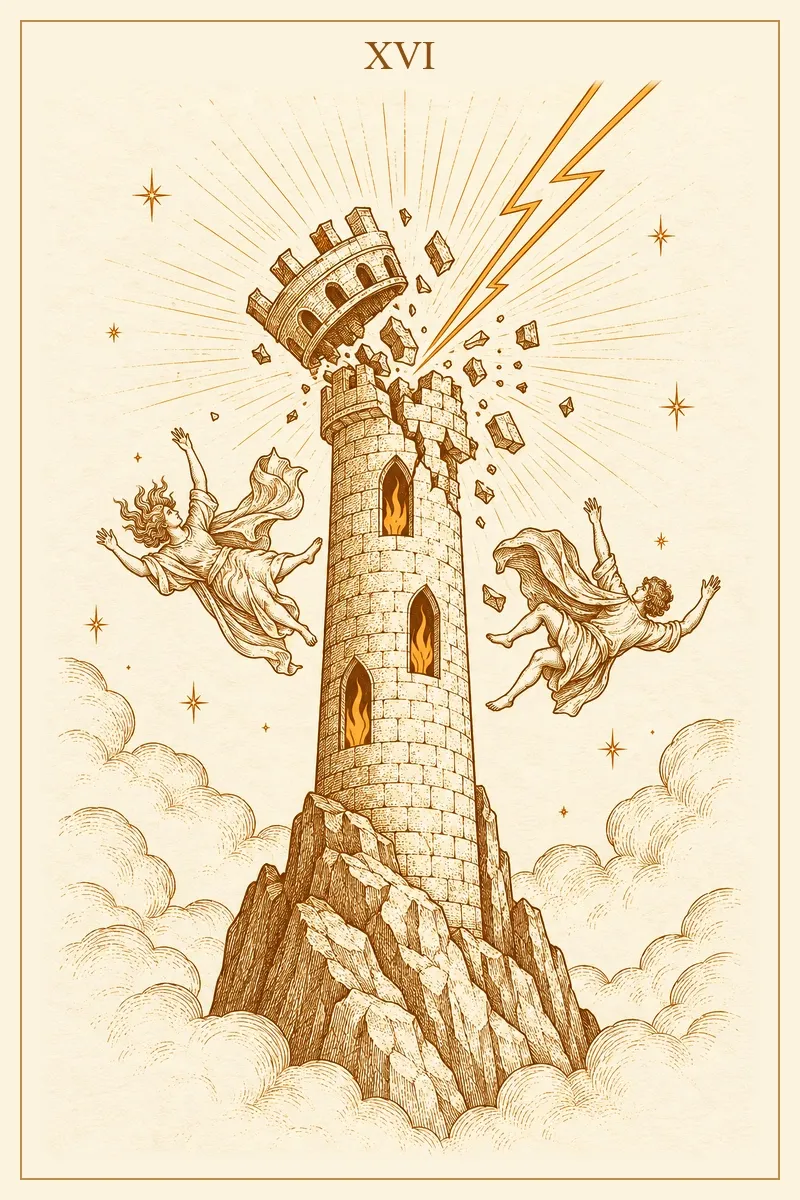
Upright, The Tower describes a structure that cannot hold, coming apart faster than you would choose, and the clarity that follows it. Reversed, it tends to describe the same pressure contained or postponed: a crack you have patched, or a disruption that has happened and is still settling.
The misreading is scale. People prepare for catastrophe and get a restructure, a lease not renewed, or a conversation that ends an arrangement everyone had outgrown. The disruption was real and the aftermath was genuinely clarifying; it simply arrived by email rather than by lightning. The Tower tarot card meaning covers how to tell a collapse from a correction, which is the distinction most Tower readings need.
Three of Swords: pain that is not always romantic
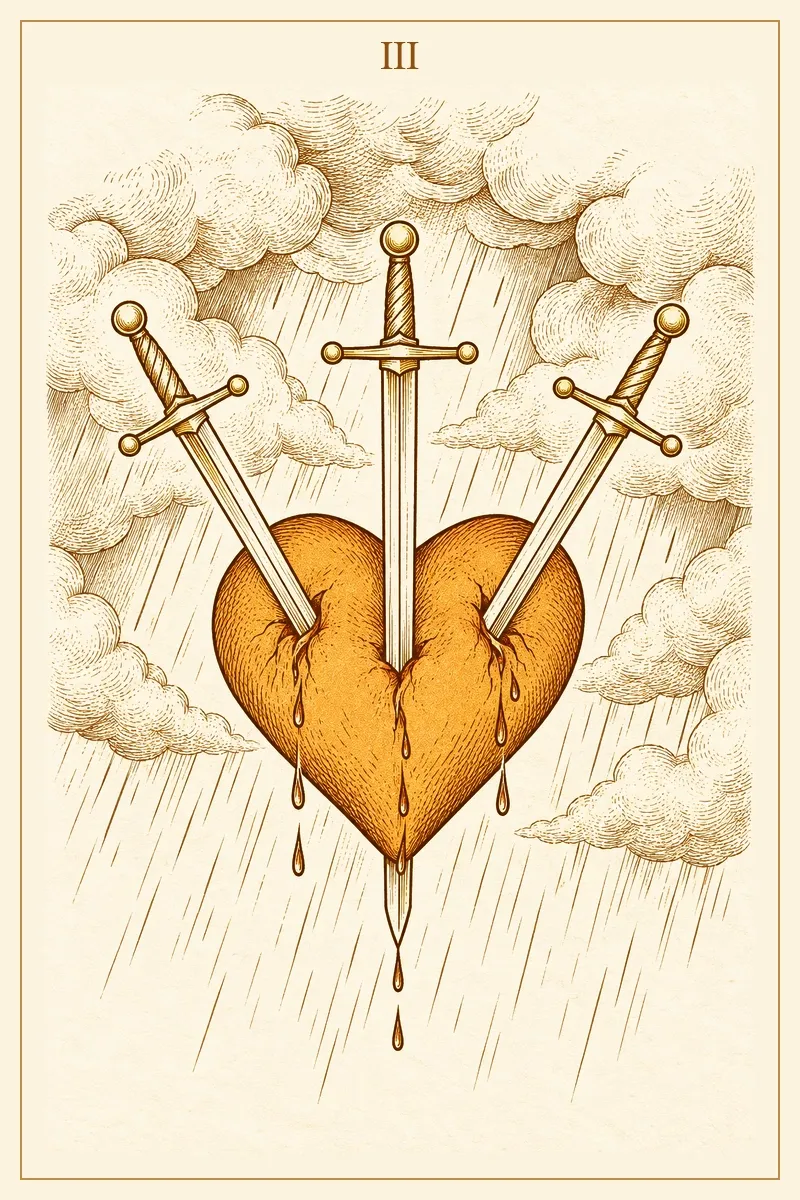
Upright, the Three of Swords describes a clean, specific hurt — the kind that comes from information rather than from confusion. Reversed, it more often describes grief being carried: a recovery that is underway but slow, or a hurt you keep returning to because it has never been spoken about.
Almost everyone reads it as heartbreak first, which is why it gets called wrong so often. The relationship stayed intact and the pain came from somewhere else: a diagnosis, a piece of feedback, a family member saying the quiet thing out loud. The card was describing the cut, not its source. The Three of Swords tarot card meaning goes through the non-romantic readings people tend to overlook.
Wheel of Fortune: a turn with no date attached
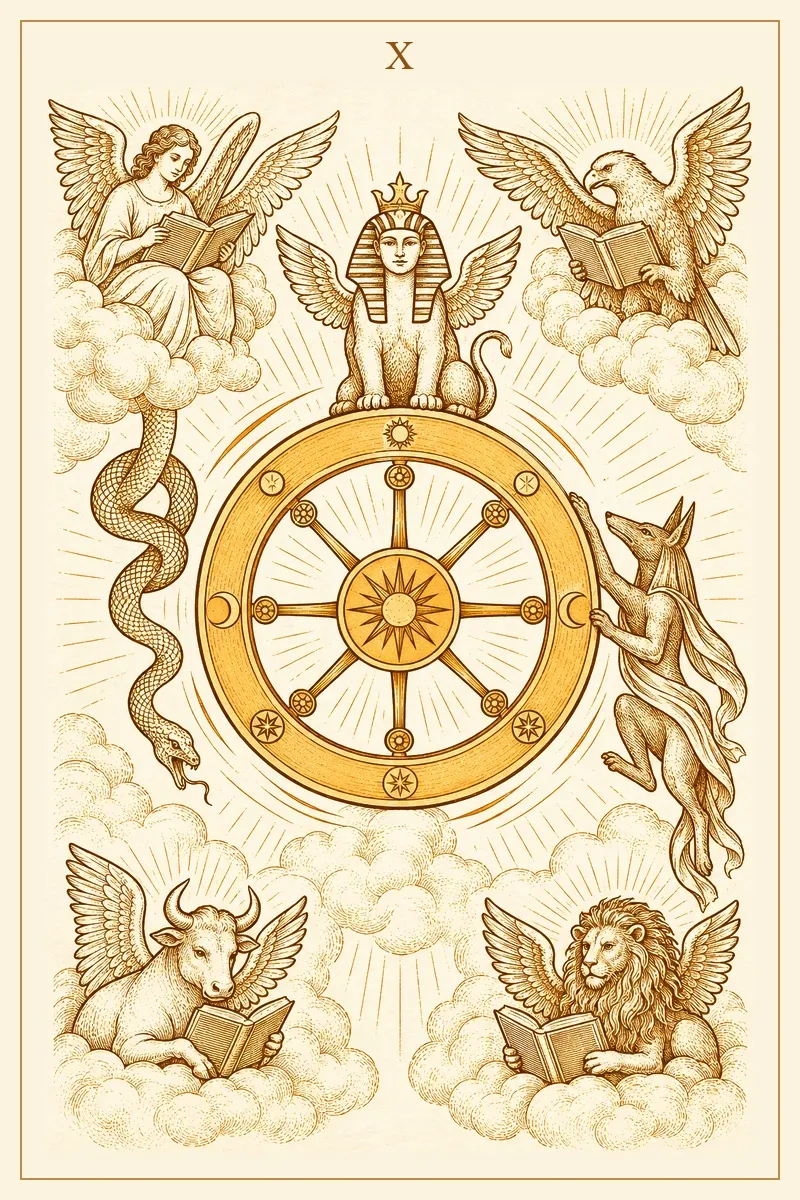
Upright, Wheel of Fortune describes a cycle moving, circumstances shifting around you, and a change that is not entirely yours to steer. Reversed, it usually describes resistance to that movement, or a stretch where the wheel seems stuck and the same month keeps repeating itself.
This card gets declared wrong for one reason above all: it says that something turns, and says nothing about when. A reader hears "change is coming," waits a few weeks, sees the same desk and the same commute, and closes the file — and the turn often arrives months later, long after that verdict. Set a review point rather than a deadline. The Wheel of Fortune tarot card meaning is worth reading for how to describe a cycle without inventing a date for it.
The Star: read as a promise, written as an instruction
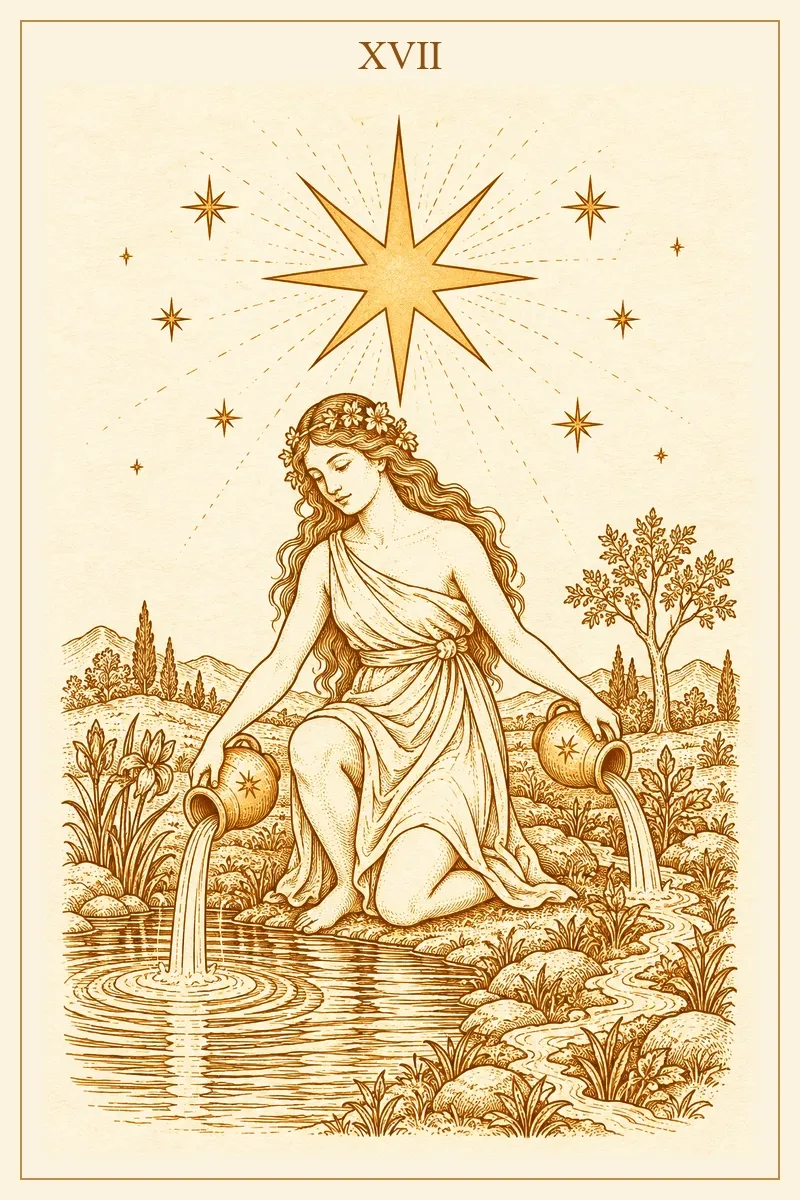
Upright, The Star describes hope that has become workable again, and the slow repair that follows a hard stretch. Reversed, it often points to hope you cannot quite reach yet, or a recovery stalled by exhaustion rather than by circumstance.
Its most common misreading is positional. In an outcome position it can describe relief ahead; in an advice position, or one asking what is required of you, the same card describes something you do. Read a prescription as a prediction and you will wait for healing to arrive on its own, then conclude that the reading lied. The Star tarot card meaning is useful here, because its advice and outcome readings pull in genuinely different directions.
Worked example: the transfer that arrived eight months late
Here is an illustrative case, invented but very ordinary, written out so you can see where the judgment went wrong rather than where the cards did. The question was "What is shifting in my work over the next year?" Three cards came up: Wheel of Fortune for what is already moving, the Eight of Pentacles for what this person's own effort is doing, and the Page of Pentacles for what a next step might look like.
The reading given at the time was reasonable. A cycle is turning and is not entirely under their control; steady, unglamorous competence is accumulating; and the opening, when it comes, is likely to look small and practical rather than like a promotion with a brass band. Nothing in those three cards names a month.
Two weeks later, nothing had changed. At four weeks, nothing. The reading got written off as a miss, and they stopped paying attention to it, which is the part that actually cost something. Eight months on, an internal transfer came up, exactly the kind of small practical opening the third card had described.
Scored honestly, that reading was accurate about direction, texture and the kind of opportunity involved, and silent about timing, which is what it should have been. The error was a verdict delivered at two weeks on a question about a year. For the wider version of this problem, our piece on why a tarot reading does not make sense covers the other common sources of a reading that will not come into focus.
The second look: five cards for re-reading an old spread
This spread is not for a new question. It is for a specific reading you still think was wrong. Pull up your notes or your photograph of the original spread first, then draw five fresh cards to read beside it.
- What I actually asked. This card describes the question as the reading received it, which is often not the question you remember asking.
- What I wanted to hear. Naming your preferred answer out loud is what stops it from quietly doing the interpreting.
- What the original cards were describing. Read this one as a plain theme with no scene attached to it.
- Where it may already have happened. This is the position that most often changes someone's mind about an old reading.
- What is still open. The part of the question that has not resolved yet, and that you can still act on.
Read positions one and two together before you touch three; if they disagree, you have found your answer without needing the rest. Keep the original spread visible, because the point is comparison rather than a fresh verdict. Reading your own old spreads this way is one of the fastest routes to better interpretation, which our guide to reading tarot for yourself goes into properly.
When a reading genuinely is unreliable
In the interest of honesty: some readings really are not worth much, and it is better to know which ones. These three conditions produce readings you can reasonably set aside.
A reader who sells certainty
Specific names, dates and guaranteed events delivered without hesitation are a performance, not a reading. So are statements vague enough to fit anyone, leading questions that mine you for details, and any suggestion that you are cursed and the cure costs money. A reader working honestly says "the cards suggest" and admits when a card is ambiguous. No ethical reader will tell you what a medical test will show, how a court will rule, or what to do with your money; a reading is not advice from a doctor, a lawyer or a financial counselor.
A reading taken in the middle of a storm
When you are panicking, grieving or furious, a reading will often reflect the storm accurately and tell you very little about the situation. A spread drawn at three in the morning after a breakup can capture your despair perfectly and still be useless as a description of the relationship. That is not inaccuracy; it is a mirror doing its job on whatever is in front of it. The fix is unglamorous: wait. The cards keep, and a reading taken two days later will usually be far more usable.
The same question asked until it answers differently
Draw five times on one question in one sitting and you will get five different answers, which teaches you only that you can keep drawing. Each new pull dilutes the first, and by the fourth you are shopping rather than reading. If that pattern sounds familiar, our guide on the signs of doing too many tarot readings covers how to tell over-reading from a healthy practice. A fresh reading with a rewritten question after a week is reasonable; pulling again ten minutes later because you disliked the first card is not.
Frequently asked questions
Are tarot readings accurate?
A reading can be accurate as a description and is not reliable as a forecast. It can name the pressures around a question, the part you are playing, and the direction things are leaning, and readers often find that part strikingly recognizable. It cannot tell you what another person is thinking, give you a date, or settle an outcome that still depends on choices nobody has made yet. Judge a reading by whether its description fits, not by whether a predicted scene happened on time.
If a reading felt wrong, should I pull again for a better answer?
Not straight away. Pulling again within minutes teaches you that uncomfortable answers are negotiable, and the uncomfortable reading is often the one worth keeping. Sit with it for a week, then draw again with a rewritten, narrower question rather than the same one.
Can a reader curse me with a bad reading?
No. A deck is printed card stock, and a reading has no power to cause harm, luck or illness. If anybody tells you a card has put something on you and offers to remove it for a fee, that is a sales technique and you can walk away.
Should I trust online or app readings?
A randomized digital draw can be just as reflective as a physical shuffle; what matters is the quality of the interpretation, not the mechanism. A careful online reading is worth more than a careless one across a table. If you want to know what a good session feels like from the inside, our walkthrough of your first tarot reading sets out what to expect.
How do I tell whether a reader is any good?
A good reader asks about your context without fishing for facts to feed back to you, offers nuance instead of absolutes, says when a card is ambiguous, and never builds dependency or fear. You should leave with a clearer sense of your own options. Discomfort is allowed; being frightened into booking again is not.
How long should I wait before deciding a reading was wrong?
Give it at least three months, and longer if the question covered a year. Write the spread down on the day so that you are checking your notes and not your memory. Doing this regularly also sharpens your instincts, which is the core of our guide to building tarot intuition.
Before you put the deck away
Can tarot cards be wrong? The cards themselves, no — they are images, and they reflect. The question you asked, the lens you looked through, the deadline you imposed and the single meaning you settled on can all be wrong, and all four are yours to adjust. That is better news than it sounds, because a disappointing reading is usually recoverable rather than evidence that the whole practice is empty.
The most honest sentence a reader can say is "I may be reading this incorrectly" — not because the cards are unreliable, but because human perception is. Hold your interpretations a little loosely, write them down, and check them later. If you would like a calm, unhurried reading with a clear question behind it, you can start a reading with Veil Soul whenever you are ready.