
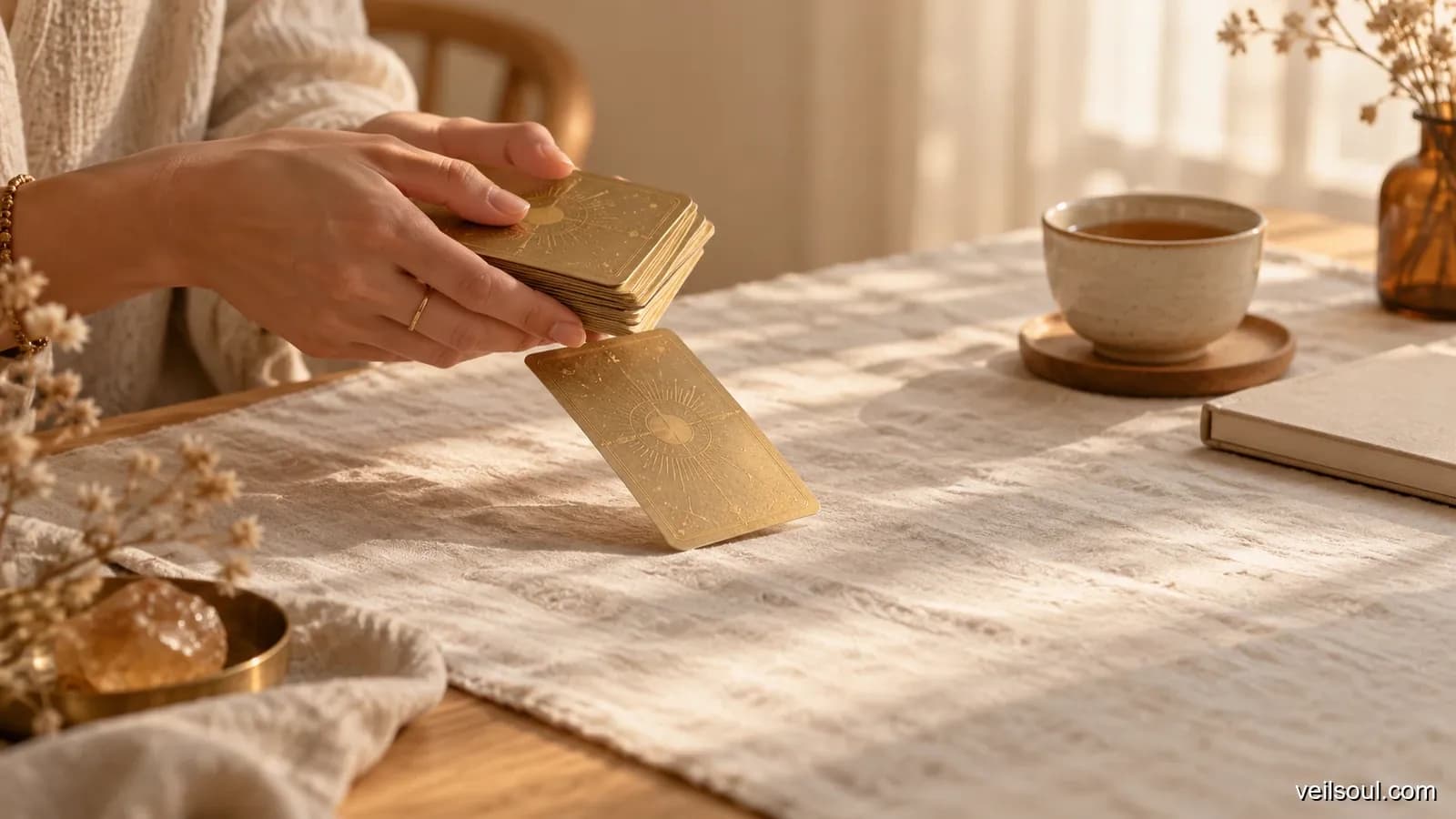
If a tarot card falls out while you shuffle, it does not have one fixed meaning. It may be a card worth considering alongside your question, or it may simply have slipped from your hands. Pause, note what fell and how it relates to the question, then use a rule you chose before the reading to decide whether to read it or return it to the deck.
Readers often call a fallen card a jumper card. Some treat it as an extra piece of context; others return every accidental card and draw only from a planned spread. Both approaches can support a thoughtful reading. A fallen card cannot confirm another person's private thoughts or guarantee an event. The useful question is whether examining it helps you name something concrete without making you fearful or forcing a conclusion.
What can a card falling out mean?
At the most literal level, one card was loose enough to leave the deck. New cards can be slippery, older cards can catch on an uneven edge, and a quick shuffle can send several cards across the table. Those ordinary causes matter. They prevent a small accident from becoming a verdict about your future.
Within a reading, a fallen card can still become a useful prompt. If you were asking how to approach a difficult conversation and a card depicting withdrawal falls out, you might ask what you are avoiding. That question can be valuable even if the card slipped for a mechanical reason. Tarot works best here as a structured way to notice thoughts, feelings and options rather than as proof that an outside force made the card move.
You also have permission to ignore the card. If your practice is to reshuffle anything that falls, the reading is not spoiled. A consistent method makes it easier to compare what different cards suggest and harder to rewrite the rules because one image feels exciting or alarming.
Does a jumper have to be an urgent sign?
No. The word “jumper” describes how the card reached you. Its value comes from the question it helps you ask. Notice the theme, compare it with the planned spread, and choose the interpretation that fits observable details of your situation.
Notice the difference between an invitation and a command. “What does this image bring up for me?” invites reflection. “This fell out, so I must end the relationship today” turns a random event into a rule for a life decision. If the stakes are high, use what you learn to frame a conversation or gather real information before acting.
Set a jumper rule before you shuffle
Decide in advance what you will count. You might read a single card that leaves your hands cleanly, place it beside the spread, and return any larger spill. You might read only cards that land face up. You might put all fallen cards back. None of these methods is the official tarot rule. The value lies in choosing one before you know which card it is.
A simple starting rule is: stop when one card falls; look at it once; write down its name and your question; then decide whether it adds context. If two or more cards scatter because the deck slips, gather them and continue. If one card repeatedly flies out because its corner is bent, repair or replace the deck rather than treating the damaged edge as a special message.
Include orientation in your rule. Some readers use the way a card lands. Others read every jumper upright because a falling card can rotate unpredictably. Either is reasonable if you apply it consistently. Set the rule before a difficult card appears; otherwise it is tempting to choose whichever orientation feels more reassuring.
Finally, give yourself a stopping point. One jumper may be interesting. Repeatedly shuffling until a preferred card appears usually makes the reading less clear. When you have enough material to consider your question, begin the planned draw or close the session.
How to read one card that falls out
First, check what happened. Did one card separate from an otherwise steady shuffle, or did the whole deck slip? Was it face up, face down, upright or reversed according to the rule you chose? You do not need to reconstruct the exact angle of a card that bounced across the floor. A quick observation is enough.
Second, read the card in relation to the question already in front of you. Start with its broad theme, then name one ordinary situation where that theme might show up. If you are asking about a new project, a card about patience may point to testing an idea before expanding it. A useful follow-up is to choose one low-cost test and one result that would make you adjust the plan.
Third, decide where to place it. A card that falls before the spread can sit above it as a context card: a theme to keep in mind, not a replacement for every position. A card that falls during a spread can be set beside the position you were shuffling for and read as a possible nuance. If it does not help, return it to the deck and keep the planned positions intact.
Fourth, test the interpretation against the rest of the reading. Suppose The Moon falls before a conversation spread. You might examine uncertainty, mixed signals or an assumption you have not checked. If the later cards emphasize direct communication, the practical next step is to ask a clear question. Write down what you know, what you infer, and the one question you still need to ask.
Write down your first interpretation in a sentence. Then write one alternative that is less dramatic. This small exercise keeps you from making the jumper carry every worry in the room. A useful reading leaves you with a manageable action, such as clarifying an expectation, naming a feeling or waiting for more information.
What if several tarot cards fall out together?
Several cards on the floor are often a shuffle problem. New glossy decks, a stack too wide for your hands, or a rushed overhand shuffle can release a packet at once. Before interpreting a cluster, ask whether your hands simply lost their grip. There is no need to turn every spill into a complex spread.
If your preselected rule allows multiple jumpers and the cards fell as a small, distinct group, read them with a limit. Two cards can suggest a tension or sequence: what is present and what may help. Three can suggest a situation, an obstacle and a possible response. Give the positions names before you turn the cards over if they landed face down. This protects the reading from being rearranged to fit a preferred story.
Look for connections without pretending that matching suits prove an outcome. Two Cups cards may draw your attention to feelings or relationships; two Swords cards may invite you to examine information and choices. Numbers can help you compare stages of a process, but an ascending sequence is not a timer. If the cards seem unrelated, choose the one that directly illuminates the original question or put the group back.
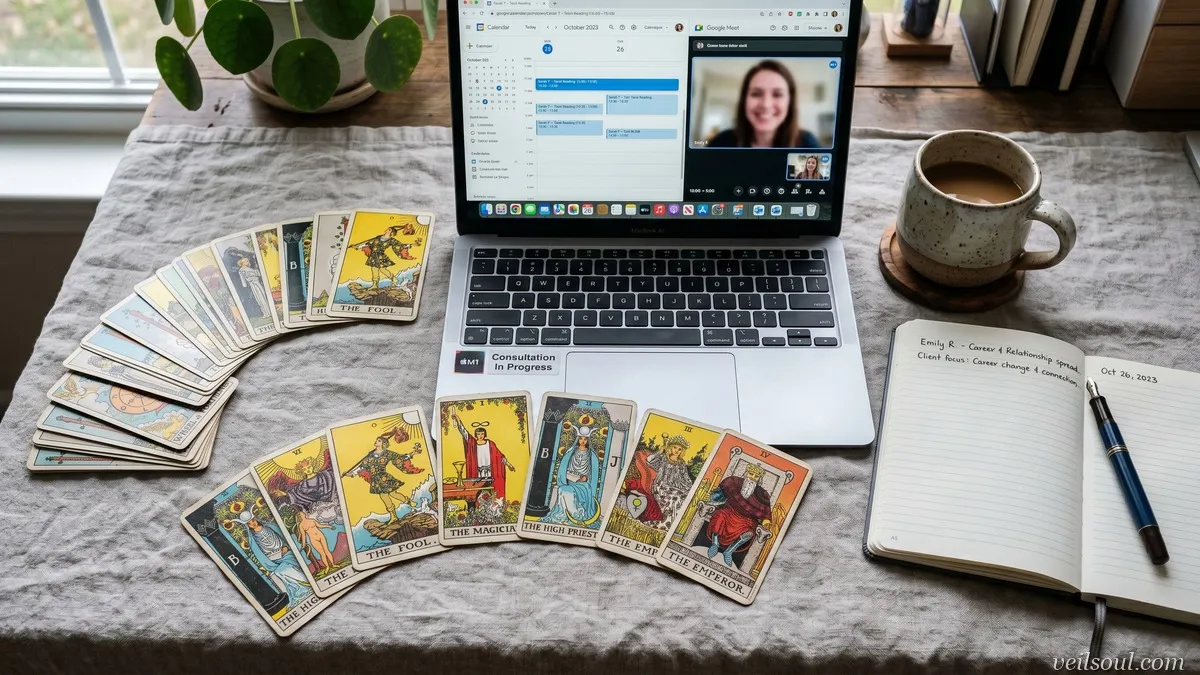
For example, imagine three cards fall while you are considering a job change: Eight of Cups, Justice and Temperance. You could read them as dissatisfaction, a need to weigh evidence fairly and a measured transition. That is a prompt to list what is missing, compare actual terms and plan a conversation. You could then compare the actual terms of staying and leaving, name what support you need, and choose a manageable pace for the next step.
When four, five or ten cards spill, stop. You do not owe every fallen card a separate interpretation. Square the deck, shuffle more slowly, and return to the question. A reading becomes clearer when each card has a purpose rather than when you collect the largest possible pile.
Why do some cards seem to fall out more often?
Readers sometimes notice that the same few cards jump again and again. There is usually a physical reason worth checking first. The cards you returned last after a reading sit at the top or bottom of the deck, at the edges of your shuffle, where they slip more easily. A new deck stays stiff and glossy until it has been handled for a while. A card with a bent corner, a slightly different finish or an edge that has absorbed moisture catches on its neighbors. Even the way you hold the deck can favor one side.
To test it, return the cards to the middle of the deck after each reading instead of the top, and shuffle more slowly for a few days. If the same card still jumps, you have a more interesting pattern to note in your journal. If it stops, you have learned something about your deck, and that is useful too.
Examples for love, work and timing questions
Love: If Two of Cups falls while you ask how to reconnect with a partner, consider reciprocity. Are both people making space for an honest exchange? An upright reading might emphasize a willingness to meet each other; a reversed reading, if you use reversals, might prompt you to ask where expectations differ or one person is carrying too much of the conversation. Neither orientation proves what your partner feels. The next step could be an open question about what each of you needs.
If you are asking about someone you have not spoken with, resist using a jumper as access to their private thoughts. The card can describe your hopes, uncertainty or the kind of relationship you want to build. An honest invitation to talk, paired with respect for the other person's answer, gives the reflection a practical place to go. This can be especially helpful when you are tempted to reshuffle for reassurance.
Work: The Eight of Cups falling during a career reading can invite you to identify what has stopped feeling worthwhile. In an upright position, you might examine whether effort and reward still align. Reversed, you might examine hesitation or the possibility that an old reason for staying deserves another look. Set the card beside a written comparison of contract terms, responsibilities, available support and the practical costs of each choice.
A jumper can also point toward a smaller next step than the dramatic one its image suggests. If you feel dissatisfied, the useful action may be to speak with a colleague, ask about a role change or make a list of conditions under which you would stay. Reflection is most useful when it makes choices more precise.
Timing: For a timing question, use the card to examine pace and readiness. Temperance, for example, may invite you to integrate what you have learned before taking the next step. Mark real deadlines on a calendar, ask for the information you need, and define the next observable milestone. If the project depends on someone else, agree on a check-in date with them and review the plan when new information arrives.
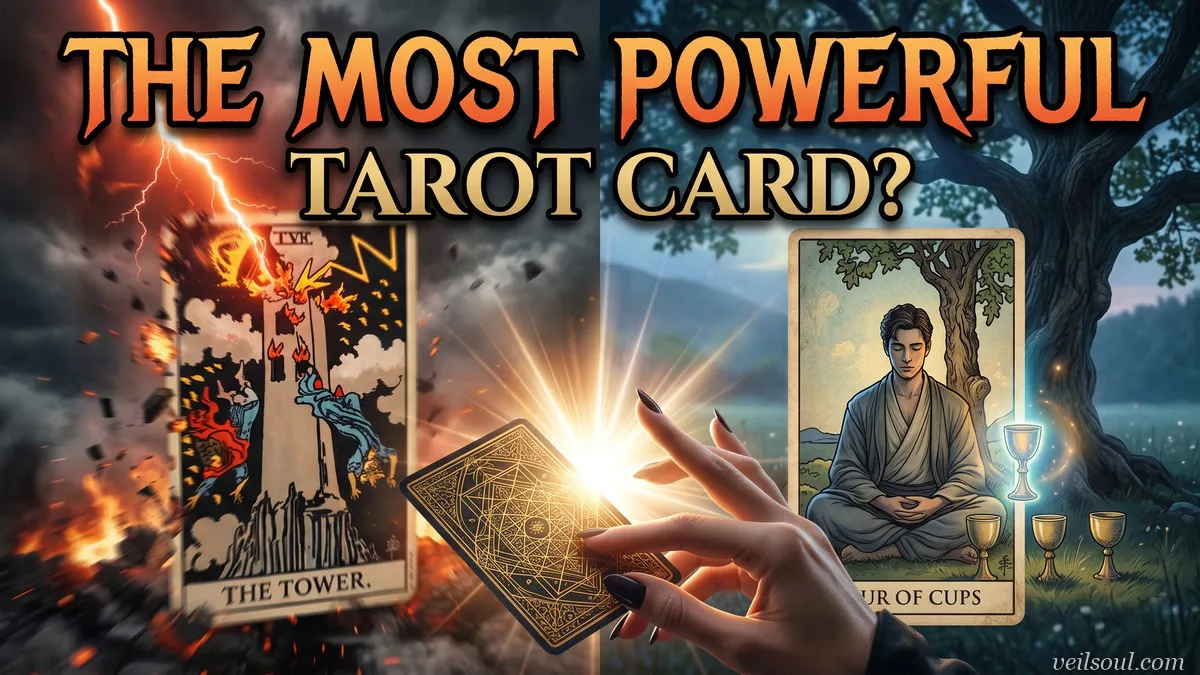
A difficult image: If The Tower falls out, take a breath. Its theme can be a disruption of assumptions or an unstable structure becoming visible. Ask which assumption in your situation deserves testing, whether a fragile plan needs more support, and who could help you respond with care. If nothing fits, put the card back. You do not have to invent a crisis to justify its appearance.
Upright, reversed, face down and cards on the floor
A card that lands face up gives you an immediate image; a face-down card leaves a choice. You may turn it over and read it under your preselected rule, set it aside until after the spread, or return it unseen. The point is to make the choice based on your method, not on a fear that the hidden card must be more powerful.
Reversals add another layer, but the physical movement of a falling card makes orientation less stable than a carefully placed draw. If your deck rotates in your hands or the card bounces, its final direction may say more about the table than the theme. You can still use reversals if they help you reflect, but keep the interpretation flexible: delayed, internalized, blocked or reconsidered are possibilities, not automatic negatives.
Consider the Moon upright as uncertainty that is ready to be explored, and reversed as uncertainty you are beginning to name. These are example prompts, not rules that apply to every reading. The surrounding cards and the actual question matter more than a rigid upright-good, reversed-bad division.
If a card lands under a chair or across the room, there is no special floor meaning you must decode. Retrieve it, check for damage, and resume. A useful practice should still work on a crowded table, with a slippery deck, or on a day when your hands feel clumsy.
When to put the card back and keep reading
Return a card without guilt when it falls because the deck slipped, when several cards drop every time you shuffle, or when the same bent card keeps escaping. You can also return it when you are practicing a shuffle, when you are tired, or when the fallen card distracts from a question that was already clear. Those are reasonable boundaries.
Notice your state of mind. If one dramatic card sends you into a loop of repeated readings, pause the session; our guide to reading frequency can help you set a workable interval. Put the deck away, drink water, and come back when you can ask a grounded question. Reassurance seeking can make every new card feel more urgent and less useful. You do not have to keep reading until the deck feels safe.
A non-resonant card does not need a forced story. If you cannot connect it to the question after a brief look, record it as “fell out; not used” or simply return it. An interpretation that requires inventing another person's motives or ignoring known facts is less helpful than acknowledging uncertainty.
The same principle applies when a card appears more than once. For a longer comparison across sessions, see our guide to a card that keeps appearing. Check whether its edge catches during shuffling. If it is physically sound, you may compare the contexts in which it appeared; avoid treating repetition as proof of a destined event. Repeated themes can be a useful journal prompt, especially if you write down what changed between readings.
A simple practice for your next reading
Begin with one open question, such as “What would help me approach this conversation with care?” Decide your jumper rule and place the deck on a stable surface. Shuffle at a pace you can control. If one card falls, pause and write its name, orientation and first impression before you search for a meaning.
Ask three questions: What theme does this card suggest? What real fact supports or challenges that reading? What small next step is within my control? If you use a spread, continue with its planned positions and compare the jumper with those cards only after you have read each position on its own terms.
Close the reading with one sentence you could act on or revisit. “I will ask for clarification tomorrow” is more useful than “something terrible is coming.” If no useful sentence emerges, the card can go back into the deck. Tarot does not need to make every accident significant in order to be meaningful.
Frequently asked questions
Should I keep every card that falls out?
No. Many readers use only one cleanly fallen card or return all fallen cards. Choose a rule before shuffling and keep it through that reading. If your hands drop the whole deck, gather the cards and start again.
What if the same card falls out twice?
Check whether a bent corner or shuffle pattern is making it slip. If the card is sound, note the theme and compare the two moments; our guide to pulling the same card twice walks through that comparison. Even when a card repeats, tarot cannot confirm a future event or a person's private thoughts; use the pattern to sharpen your question rather than settle it.
Do I read the card upright or reversed?
Use the orientation rule you chose before drawing. If the card bounced or you cannot tell how it landed, read it upright, read both possibilities, or set it aside. Do not let an uncertain angle dictate a major decision.
Can I read only jumper cards?
You can, but a planned one or three card spread often gives a beginner clearer positions and a natural stopping point. A structured layout such as the Celtic Cross spread offers named positions for a fuller question. If you prefer freeform reading, decide in advance how many cards you will use and what each will help you examine.
What about online tarot readings?
An online reading has no physical shuffle, so there is no jumper in the same sense: the cards that are drawn are the reading. If you like the idea of a context card, you can create one on purpose. Before your spread, draw a single card for “the theme I should keep in mind” and read it beside the other positions.
A tarot card falling out is a moment to pause. Notice it, use a consistent rule, and ask whether it helps you think more clearly about the question you brought to the table. Let the interpretation lead to one grounded next step you can check or discuss.
If you would like a structured place to explore your own question, try a free reading on Veil Soul and note what the spread helps you see.