You build tarot intuition the way you build an ear for a language: short daily drills that sharpen what you notice, a habit of writing your first impression down before you look anything up, and an honest record that shows you afterward which impressions held up. That intuition is not a gift handed to a lucky few but quick pattern recognition, grown from attention and feedback.
Be clear about the ceiling, though: a sharper intuition does not let the cards confirm what another person is thinking, name a date or guarantee an outcome. It gives you a more attentive, more honest read of your own situation.
At a glance, the practice this guide sets out looks like this:
- Blind pull: sense a face-down card before you turn it, then compare.
- Thirty-second gaze: look at one card until you find three details you had missed.
- Card conversation: ask a card one question and write its answer without editing.
- Body check: notice where a card lands in your body before you interpret it.
- Dream note: keep a card by the bed and write down what is left in the morning.
- Hunch log: date every impression and check it again a week later.
- Hunch-sorting spread: separate the hunch from what hope and fear add to it.
What tarot intuition actually is
Tarot intuition is the part of a reading that arrives before you can explain it: the sense that a card feels heavy, that one figure is turning away from the next card, that a detail in the corner matters today. It is not supernatural. Your mind has read faces, rooms and tones of voice your whole life, and it assembles impressions faster than you can put them into sentences. Tarot cards, crowded with figures and objects, give that fast assembly something specific to work on.
Knowledge and intuition do different jobs, and a good reading needs both. Take the Three of Swords. Memory tells you the card stands for heartbreak and grief. Looking at it in a real reading, you might notice that three swords pierce a single heart under heavy rain clouds, and that drops fall from the heart into the rain below. Intuition is what turns that into something specific: this is about the conversation you keep replaying, not the event itself. The meaning gives you the territory; your impression tells you where in that territory you are standing.
If you want the step-by-step method for reading a picture before its definition, our guide on how to read tarot intuitively without memorizing every card covers it in detail. This guide is about the training around it: the drills and checks that make your impressions more trustworthy.
Hunch, hope or fear: learning to tell them apart
Getting impressions is the easy part. The hard part is sorting the useful ones from the loud ones, because hope and fear also arrive fast, also feel certain, and also like to borrow intuition's voice.
- Hope flatters you. It shows up exactly where you already wanted to go, it hurries you past details, and it feels like relief.
- Fear loops. It jumps to the worst case, repeats itself with rising volume, and makes your body tense before you have looked at the whole spread.
- A hunch is quieter and more specific. It points at one detail, it can be inconvenient, and it stays the same when you come back to it an hour later.
Two simple checks help. First, name your mood before you shuffle and write it in one word: tired, hopeful, braced, restless. If an impression matches that word exactly, hold it lightly. Second, ask whether the impression is specific enough to test. "Something is wrong" cannot be checked; "I have not asked about the second-year rent" can. A useful hunch points to something you could look at, ask about or try.
Six drills for a daily practice
None of these takes longer than ten minutes. Pick one or two a day rather than all six, and keep a notebook beside the deck: an impression you do not write down quietly rewrites itself by evening.
1. The blind pull
Shuffle, draw one card and leave it face down. Before turning it, close your eyes and note a color, a temperature or weight (light, heavy, warm, cool), and any word or image that flashes up. Write them down, then turn the card and compare. Do not score yourself; notice what kind of signal you get and how it relates to the picture.
2. The thirty-second gaze
Set a timer for thirty seconds and look at a single card without thinking about its meaning. Let your eye travel over the edges, the sky, the hands and the ground. When the timer ends, write down three things you noticed for the first time. A reader who has seen more of a card has more to recognize when it turns up in a spread.
3. The card conversation
Choose a card and imagine the main figure sitting across the table from you. Ask one question, such as "What do you want me to notice this week?", and write the answer in the figure's voice for two minutes without stopping or correcting. It can feel silly at first. That is fine: the exercise moves the editor in your head aside long enough for a more personal line to come through.
4. The body check
After you turn a card, close your eyes and scan from your head to your feet. Where does something shift? A tight jaw, a warm chest, a drop in the stomach, heavier shoulders. Write the location and the sensation in a few words before you think about the card's meaning. Over a few weeks you may find one sensation that travels with your clearest impressions.
5. The dream note
Before sleep, place a card face up on your nightstand and look at it for a minute. Keep a notebook within reach and, on waking, write down any dream fragment, mood or image before you check your phone. The link to the card does not need to be obvious. The drill trains you to catch faint material before it fades, the same skill you use when a half-formed impression flickers during a reading.
6. The hunch log
This is the drill that makes the other five count. Every time you record an impression, add the date and one line saying what it seems to point at. A week later, read it again and mark it: held up, missed, or still unclear. You are not collecting proof that tarot works; you are learning which of your own signals deserve trust and under what conditions.
Five cards that teach the inner voice
Any card can train intuition, but some cards are about intuition itself: listening, uncertainty, illusion, avoidance and empathy. Spend a week with each of these five, in the card conversation drill or as a card propped on your desk.
The High Priestess: quiet knowing
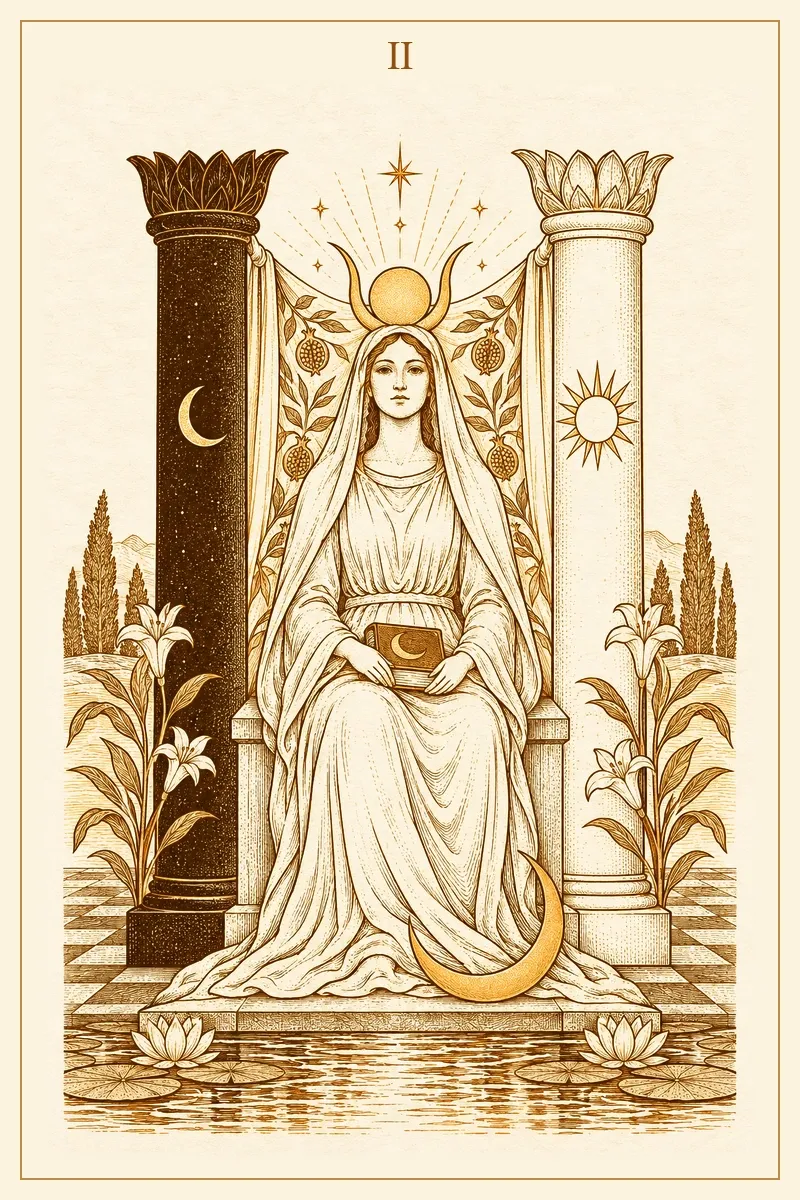
The High Priestess sits between two pillars, one dark with a crescent moon and one pale with a sun, a closed book with a crescent on its cover resting in her lap. Lilies grow on either side, and still water with lotus leaves lies at her feet. The book stays shut, and she looks straight out with a calm, unhurried face.
Upright, she stands for knowledge that comes through stillness and patience rather than argument. As a teacher, she asks you to wait a moment longer before you speak in a reading. Reversed, she can point to an inner voice you have been talking over, or to secrets and second-guessing that cloud what you already sense. The full High Priestess tarot meaning covers love and career.
The Moon: working with uncertainty
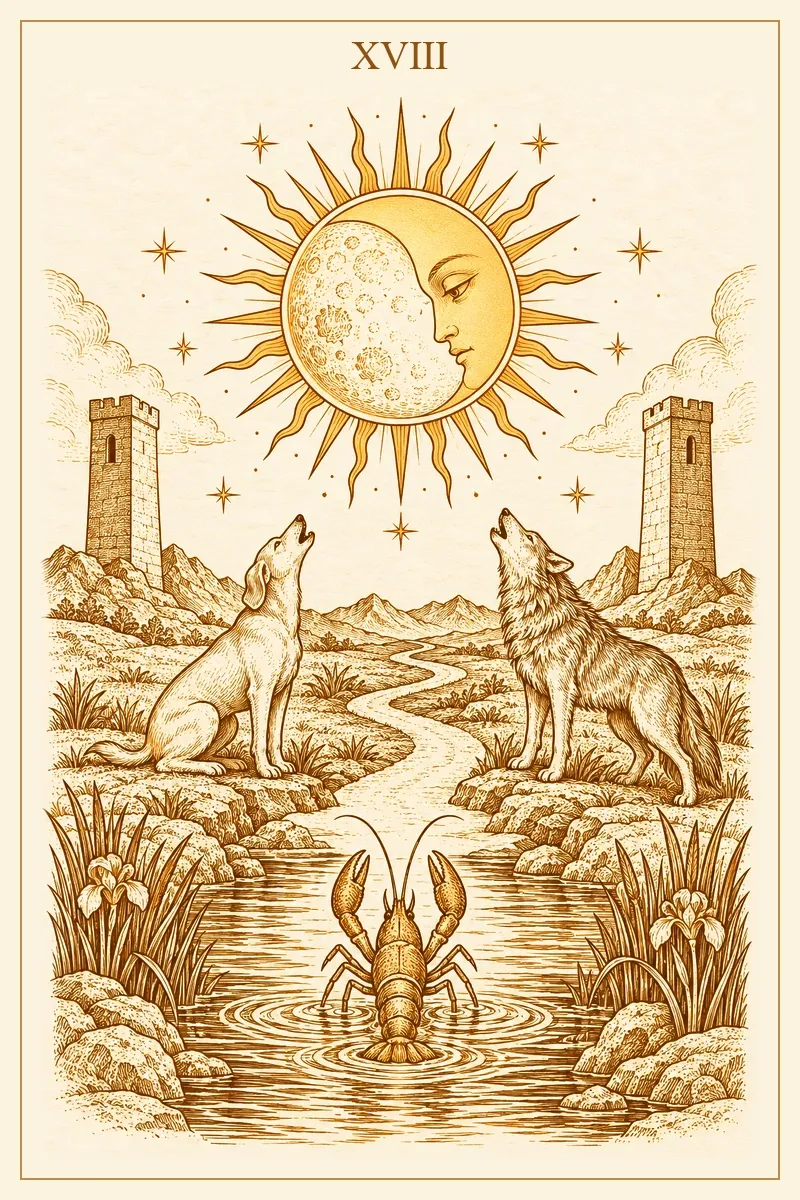
The Moon shows a calm face in profile inside a ring of sun rays, above a dog and a wolf howling on either side of a winding path. Two towers stand at the edges, and a crayfish climbs out of a pool where the path begins. The road disappears into the hills.
Upright, The Moon is the half-light where intuition and imagination are hard to tell apart: dreams, unease, things not yet clear. It suits the hunch, hope and fear sort, because it asks you to tell the tame dog's howl from the wild wolf's. Reversed, it can mean confusion beginning to lift, or a fear you have let grow larger than the facts. The Moon tarot card meaning covers its other sides.
Seven of Cups: wishful thinking in disguise
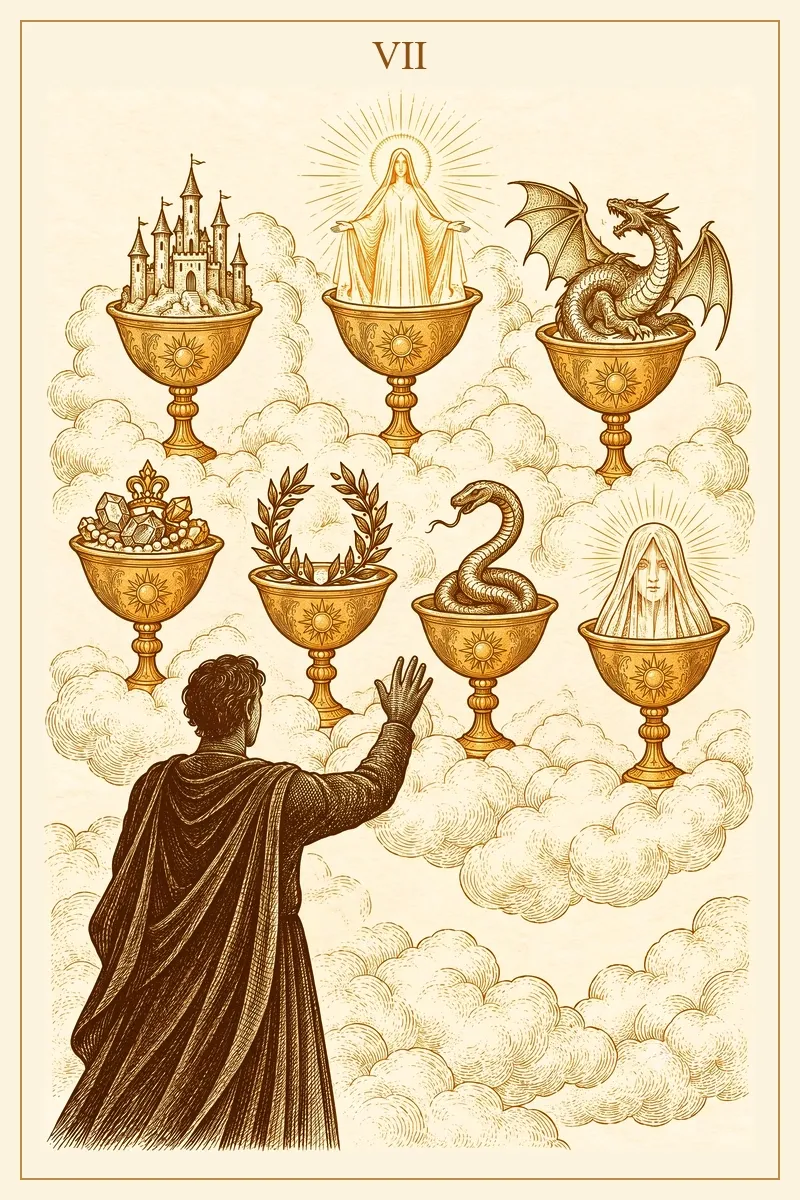
In the Seven of Cups, a man in a dark cloak, seen from behind, reaches one open hand toward seven gold cups resting on clouds. Each holds something different: a castle, a radiant veiled figure with open arms, a dragon, a heap of jewels and a crown, a laurel wreath, a coiled snake, and a pale veiled head.
This is the card of options that all look possible, and of fantasies that feel like guidance. Upright, it warns that hope can dress itself up as intuition; the question is which cup you could actually hold. Reversed, it can mark the moment you see through an illusion and choose. The Seven of Cups meaning explores choices in more depth.
Two of Swords: an impression you refuse to look at
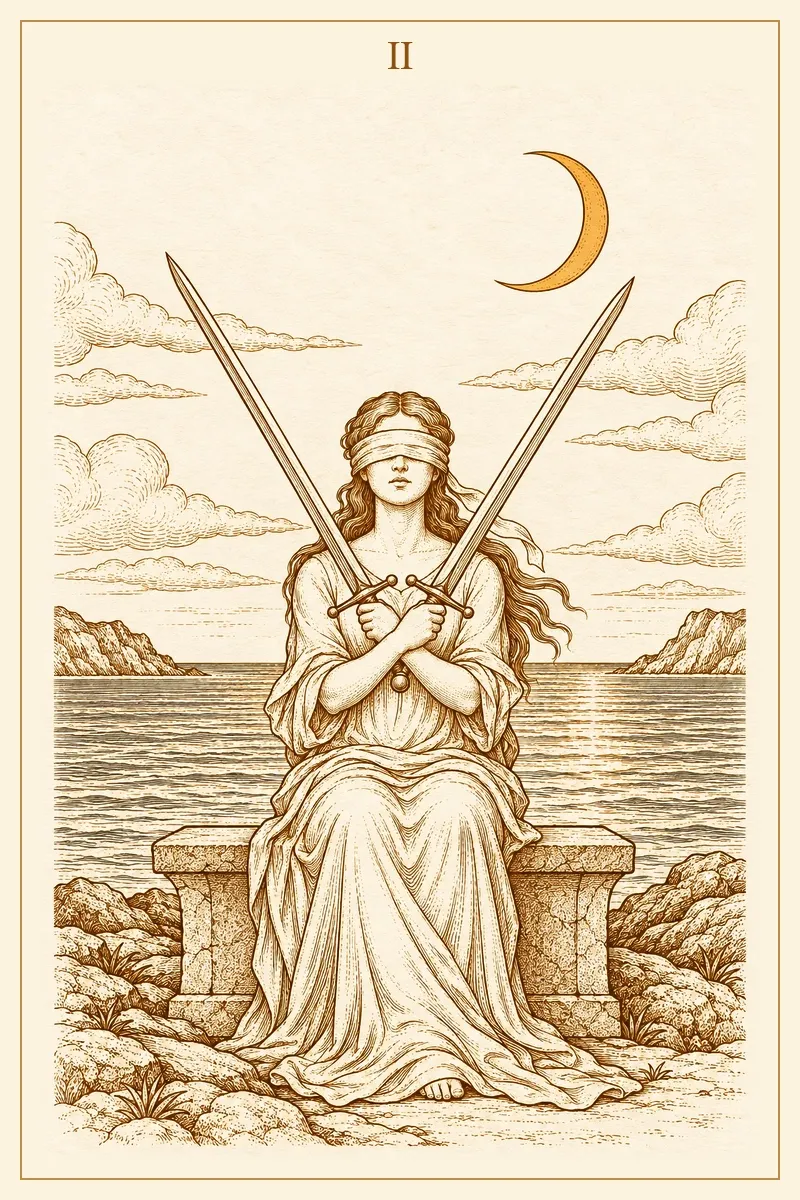
The Two of Swords shows a blindfolded woman seated on a stone bench by the sea, arms crossed over her chest, each hand holding a long sword upright so the blades fan out in a wide V above her shoulders. A crescent moon hangs in the sky, and rocky headlands close in the water behind her.
Upright, this is a stalemate kept in place by not looking: a decision postponed, feelings held at arm's length. For intuition practice, it names the moment you sense something but keep the blindfold on, because seeing it would require a choice. Reversed, the blindfold starts to slip, and information you have avoided comes into view, sometimes all at once. The Two of Swords meaning looks at it in love and work questions.
Queen of Cups: reading feeling with care
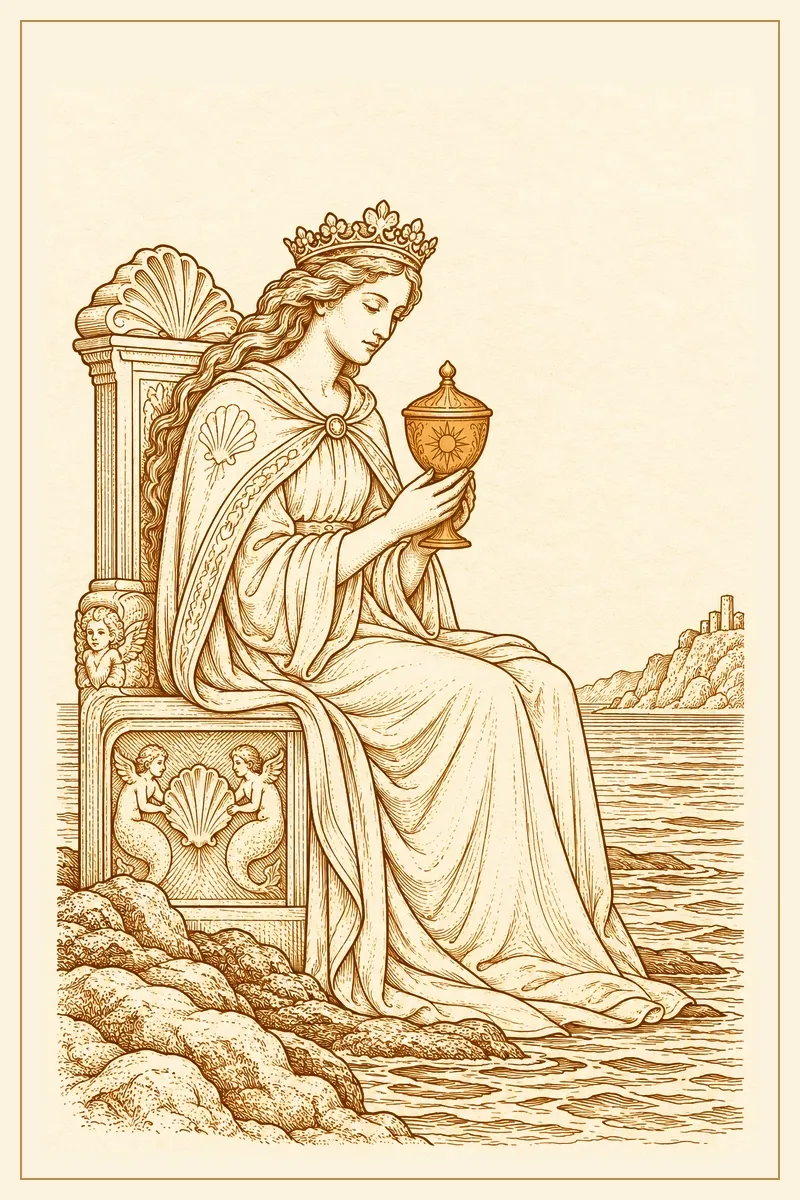
The Queen of Cups sits on a throne carved with shells and small winged figures, at the very edge of the sea, with water washing around the hem of her robe. She holds a lidded gold cup in both hands and looks down at it, absorbed.
Upright, she is emotional intelligence: empathy, attunement, the ability to stay with a feeling without being swept away by it. She shows the receptive side of intuition, which reads others kindly and keeps its own center. Reversed, she can mean absorbing everyone's moods until your own signal disappears, or shutting feeling out entirely. The Queen of Cups meaning covers her in relationships and work.
Mindset shifts that let impressions through
Notice the first impression, then test it
Your first reaction to a card, in the second before analysis begins, is the rawest material you will get. Write it down even when it disagrees with the textbook meaning. Trusting it does not mean obeying it; it means checking it against the rest of the spread.
Say "I am not sure yet"
Intuition arrives as a vague sense more than a finished sentence. Forcing it into a neat conclusion too early lets whatever you already believed take its place. "I am not sure what this means yet" is an honest place to stand, and the impression can sharpen while you keep looking.
Let go of being right
Fear of being wrong is the quickest way to silence intuition, because it sends you back to safe, memorized lines. Give yourself permission to miss. A wrong impression reviewed honestly in your hunch log teaches you more than a right one you never examined. The guide to common tarot beginner mistakes shows how this fear shapes other habits too.
Work with your own channel
Some people see images, some feel emotions or body sensations, some hear a word, and some simply know. No channel is better than another. Build on the one your impressions come through.
Before, during and after a reading
Before you shuffle
- Take three slow breaths to move from busy thinking into looking.
- Write your mood in one word, so you can spot it later if it colors the reading.
- State the question in one open sentence: "What do I need to see about this?" rather than "Will this happen?"
While the cards are on the table
- Look at each card for at least ten seconds before you say anything.
- Notice which card your eye goes to first, and ask why.
- If a card brings up a stray memory or phrase, write it down. It may connect later.
- Look at the gaps between cards: where does the story flow, and where does it snag?
Once the reading is done
- Sit quietly for a minute. A last thought that arrives now deserves a line of its own.
- Mark which insights came from memorized meanings and which came from impressions.
- Choose one small action, and add the reading to your hunch log for a later check.
These steps work the same whether you read for a friend or for yourself; for the self-reading version, with its particular traps, see how to read tarot for yourself.
The hunch-sorting spread
Use this five-card spread when you have a hunch about a real situation and cannot tell whether to trust it. Write the positions down before you shuffle so you do not rename them to suit the cards.
- The hunch as it arrived: what the feeling is really about.
- What hope is adding: the part of the picture your wishes are painting.
- What fear is adding: the part your worries are painting.
- What I already know: facts, details or memories you have not weighed yet.
- One small test: an action this week that would show whether the hunch holds.
Lay the cards in a row and read positions two and three before you come back to position one. Once hope and fear have been named, the original hunch is easier to hear on its own. If you struggle to phrase the question, the question library has open wordings to start from.
A worked example: a lease that feels wrong
Here is the spread on a hypothetical question. Mia has a lease ready to sign for an apartment she liked, but something keeps nagging at her. Her question: "What is the uneasy feeling about this apartment trying to tell me?" Her mood word before shuffling: restless.
1. The hunch as it arrived: Eight of Cups. A hooded, cloaked figure with a staff walks away over rocky ground toward a lake and mountains, leaving eight gold cups set in two neat rows behind. The cups are not broken, only left. Mia's first impression: the apartment is not bad, but getting it means walking away from something else. The move would take her far from the friends she sees every week.
2. What hope is adding: Four of Wands. Two figures in wreaths, hers of flowers and his of leaves, raise bouquets under garlands strung between four leafy staves, a castle behind them. Hope is painting the housewarming party, and no party is mentioned in the lease.
3. What fear is adding: Nine of Swords. A figure sits up in bed with her face in her hands, nine swords hanging in a row in the night sky above her under a crescent moon, a candle burning on the nightstand. Mia notices that none of the swords touches the person in the bed. Fear is adding the three-in-the-morning scenarios: hidden damp, a terrible landlord, regret. They are loud, but none of them is specific.
4. What I already know: Page of Pentacles. A young figure in a feathered cap stands in a field, holding up a gold pentacle and studying it closely. It asks her to read the fine print, and Mia admits she skimmed the clause about the rent increase after the first year and never asked about it.
5. One small test: Page of Swords. A young figure stands on a rocky rise with a sword raised, cloak blown back, looking back over one shoulder while the sun rises behind him. The test is to ask the sharp, direct question: email the landlord about the increase, and try the trip to her friends' neighborhood once before deciding.
Read together, the spread does not say "sign" or "do not sign". It separates a specific hunch (distance from friends, an unread clause) from a loud, general fear and a pleasant hope. Mia now has two concrete things to check, and the decision stays hers. The hunch goes in her log with a date.
When your intuition goes quiet
Some days impressions come freely; other days the cards feel like ink on paper. That is normal. Tiredness, stress, illness and a crowded mind all turn the volume down. On quiet days, try this:
- Lean on traditional meanings; they are a safety net, not a failure.
- Draw a single card instead of a full spread.
- Do the thirty-second gaze rather than a reading, so you still practice looking.
- Rest and come back tomorrow; nothing has been lost.
A four-week practice plan
If you like structure, this plan builds the habits in order. Ten minutes a day is enough, and a skipped day changes nothing.
- Week 1, noticing: a blind pull each morning, written in the hunch log before you turn the card. Check meanings only in the evening.
- Week 2, looking and feeling: add the thirty-second gaze and the body check on alternate days. Note which channel gives you the clearest signal.
- Week 3, listening: hold a card conversation with one of the five teaching cards each day, and try the dream note twice.
- Week 4, testing: run the hunch-sorting spread on one real question, then read your whole log back and mark each entry held, missed or unclear.
At the end of the month, look for patterns in your marks rather than a score: which kind of impression held up, and which arrived when you were tired or anxious.
Frequently asked questions
Is tarot intuition the same as psychic ability?
No. Tarot intuition, as this guide uses the word, is fast pattern recognition: your mind linking what it sees in the cards to what you know about the situation. It needs no special gift and can be trained like any skill of attention.
How long does it take to build tarot intuition?
There is no fixed timeline, and anyone promising one is guessing. Short regular practice and an honest log are what move it, and reading the log back after a month shows what has changed.
How do I know whether it is intuition or wishful thinking?
Write your mood before you read, and ask whether the impression is specific enough to test. Hope flatters and hurries; fear loops and exaggerates; a hunch is quieter and points at something you could check.
Should I stop learning the traditional meanings?
No. Traditional meanings give your impressions a shared language and a safety net on quiet days. Look first, note your impression, then compare it with the meaning.
What if my impression contradicts the card's meaning?
Write both down. Sometimes your eye has caught a detail the keyword leaves out; sometimes your mood is painting the card. Your hunch log will show you which it was, and both outcomes teach you something.
Can a strong intuition tell me what someone else thinks or what will happen?
No reading can confirm another person's private thoughts, fix a date or promise an outcome, however clear your impression feels. Intuition helps you read your own situation more honestly. For medical, legal or financial questions, speak with a qualified professional.
Trusting a voice you have trained
Building tarot intuition is slow, ordinary work: a card, a notebook, a few minutes and an honest look back. Over time the cards start to speak in a language that is recognizably yours, and you learn when that language can be trusted. When you want a quiet place to practice, start a reading with Veil Soul and note your first impression before you open any meaning.