
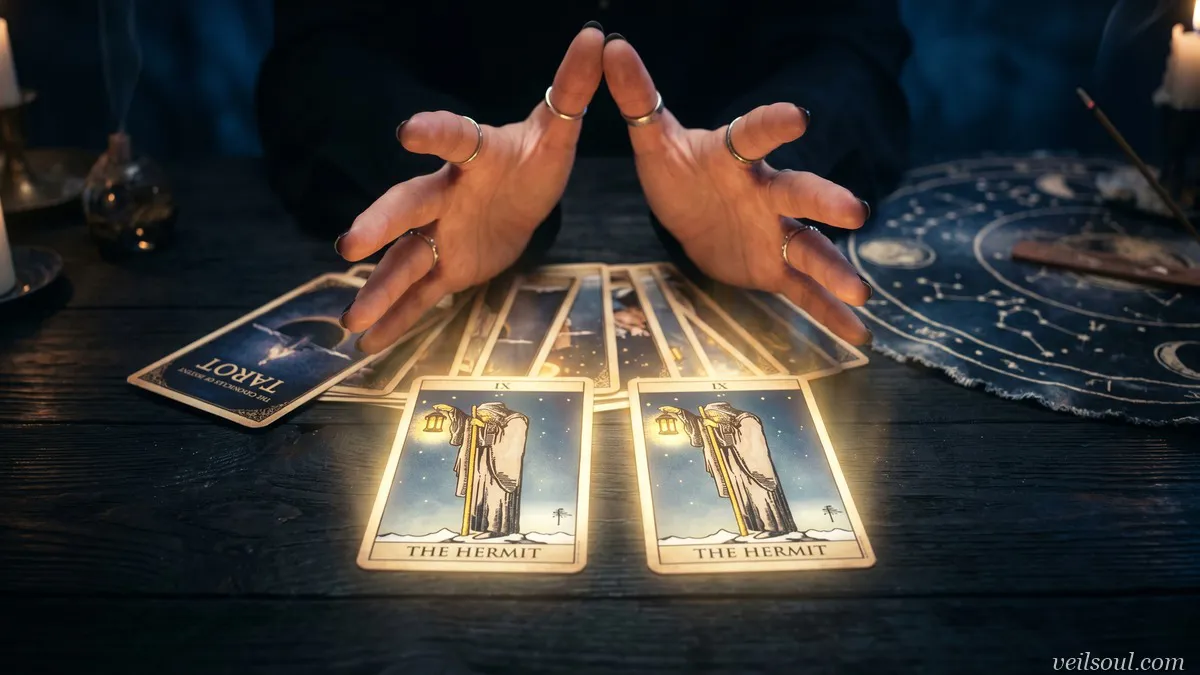
Pulling the same tarot card twice can be a useful invitation to revisit a theme, but it does not prove that a prediction is urgent or inevitable. First check how you drew: a card can reappear after you put it back and reshuffle, while one physical card cannot occupy two positions in a single spread unless the deck contains a duplicate. Then read the card against each question and position before deciding whether the repetition matters to you.
A second appearance often catches our attention because we are looking for a pattern. You can honor that attention without surrendering your judgment to it. The most useful question is not “What is the deck forcing me to do?” but “What does this image help me notice, and what evidence do I have in my life?”
In short:
- Check how it happened: after putting the card back, in a later reading, or through a shuffle habit.
- Compare the two contexts: the question, position and orientation each time.
- Name one shared theme and test it against what is actually happening.
- Choose one small action and revisit the question after it, not after another draw.
First, check what actually happened
If you returned the card to a 78-card deck, mixed the whole deck, and drew again, a repeat is possible by chance. Under the simple assumption that every card is equally likely on the second draw, the chance of getting that particular card is one in 78, about 1.28%. That calculation describes one specified draw after replacement; it does not tell you how many repeats you should expect across a month of readings, and it does not establish a supernatural cause. Uneven shuffling, clumped cards, and looking for memorable coincidences can also affect what you observe.
If the card never went back into the deck, check whether you accidentally used two copies, counted a photograph or digital result as part of the physical spread, or meant that the card appeared again in a later reading. A single physical card cannot be drawn twice without replacement. Naming the method matters because “twice in one reading” may describe several different events, each worth reading differently. If a card slipped out during the shuffle, that is a different event again; our guide to cards falling out explains how to handle a jumper before mixing it back in.
Perhaps you asked a question, drew a card, returned it, and asked a clearer question. Perhaps you finished a spread, then reshuffled for a separate clarifier. Perhaps you saw the card on Monday and again on Friday. Record which happened before reaching for meaning. A precise account prevents a striking coincidence from becoming a vague rule that you feel pressured to obey.
Orientation matters too. If you use reversals, note whether the card landed upright or reversed on each draw. If you do not use reversals, you need not introduce them because of the repeat. Your reading method is a choice you make in advance, not a rule the card imposes after it appears.
The same card after replacement in one session
When a card returns after you put it back and reshuffle, it can be helpful to treat the second appearance as a prompt to compare contexts. What was the first question? What changed in the second? Which position did each draw occupy? A card about a challenge may suggest a different reflection from the same card drawn for a resource. Repetition draws your eye to the shared symbol; position tells you where to look.
Imagine drawing Two of Cups for “What is supporting this conversation?” and drawing it again after replacement for “What should I pay attention to?” The card may invite you to consider mutuality: are both people able to speak and listen? The practical follow-up might be to ask an open question and hear the answer. Notice whether the exchange feels reciprocal, and whether you leave enough room for a response you did not expect.
If the same card lands in “challenge” and then “advice,” avoid a formula such as “the obstacle is the solution.” Ask what aspect of the card changes with the position. A card linked to patience can describe a difficulty with waiting in one place and a manageable pace in another. The theme remains similar, but the task differs. Write a sentence for each position; then write one sentence connecting them. If the connection feels forced, leave it open.
Repeating the exact same question until you receive a more comfortable card often makes the reading less clear. You may instead set the cards down, note what feels unresolved, and return later with a question about a choice you can actually make. There is no universal rule that two pulls end the inquiry; a pause is simply useful when repeated draws are feeding worry rather than insight.
A repeat across days or different questions
A card that appears in separate readings can become a thread in a reading journal. Compare dates, questions, positions, orientation, and what was happening at the time. Did the card arise in similar situations, or are you connecting unrelated events because the image is memorable? Both possibilities deserve a fair look. A pattern becomes more informative when you keep the quiet, unremarkable draws in the record as well as the dramatic ones.
For example, Eight of Pentacles might appear in a reading about work and later in one about learning a skill. Its familiar theme of practice and craft may fit both contexts, but the specific next step differs: in one case, ask for feedback on a draft; in the other, schedule a short practice session. The common thread is observable effort: what you practice, whose feedback you seek, and how you adjust your next attempt. Comparing those details makes the two readings more informative than merely counting the repeat.
Another week may bring a very different pair of questions. A card with a theme of rest might relate to time away from work in one reading and a quieter approach to a disagreement in another. Resist the urge to force both events into one grand explanation. You can write “possible shared theme: pace” and test that idea against lived facts. Tarot works best here as a structured prompt for reflection, with ordinary observation doing the checking.
Frequency alone does not measure urgency. If you draw daily, you create more opportunities to see any card again. If you repeatedly ask about the same situation, repeated imagery can also reflect the narrow range of questions on your mind. A useful journal includes the number of readings and the questions you asked, not only the card that stood out. After a few entries, you may discover a theme, a shuffle habit, or simply a coincidence that felt personal. For a broader pattern over many readings, see why the same card keeps appearing.
Example: Five of Cups twice
Five of Cups often draws attention to disappointment and the difficulty of seeing what remains while focused on what has been lost. Start with the first position. In a “present” place, the card may help name grief or frustration. In an “advice” place after replacement, it may ask how to acknowledge that feeling while noticing support or options that still exist.
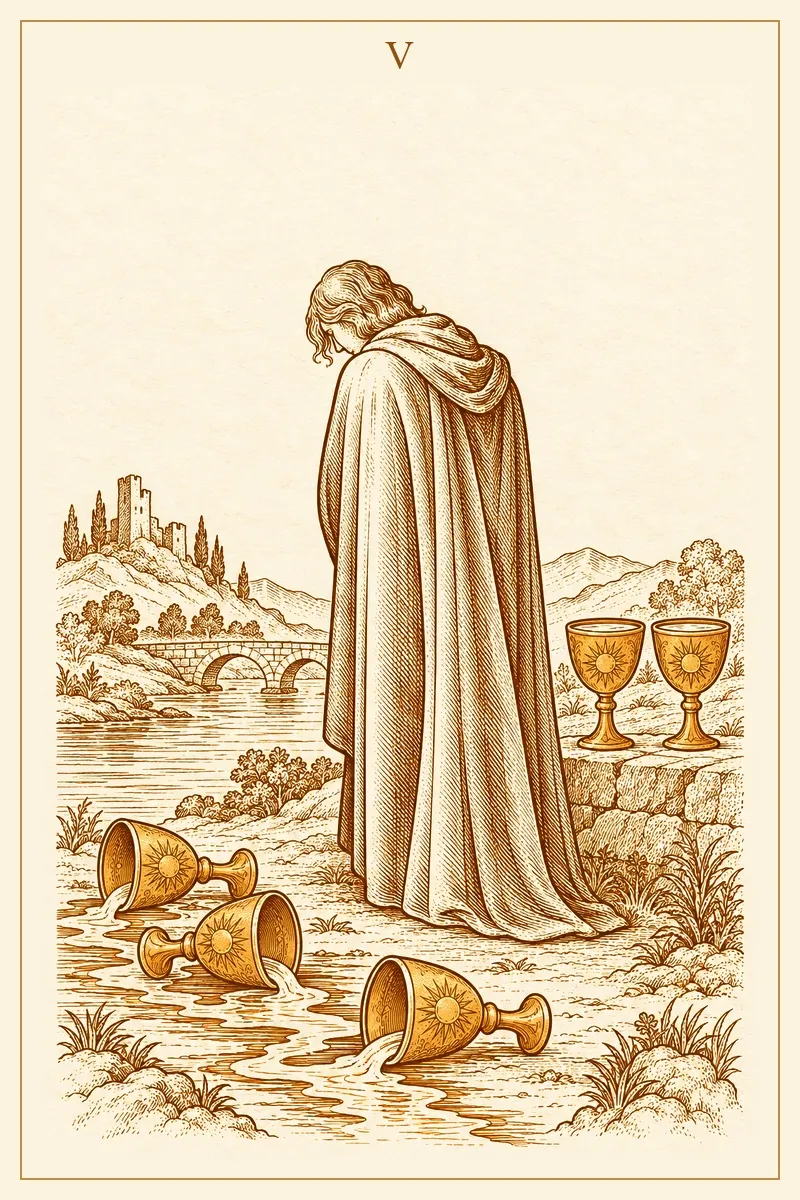
In a relationship reading, this could mean recognizing a hurt before deciding how to talk about it. The visible next step could be writing down what happened and what you would like to ask the other person. The conversation may clarify whether the hurt can be repaired, what each person needs, and whether the same pattern has happened before. If the question concerns work, the same image might help distinguish a missed opportunity from the skills, people, or routes still available to you.
Notice how the second draw can make your interpretation more precise without making it louder. One reader may need room to feel disappointed; another may need to check whether a setback has become the only fact they are considering. Both readings are possible, and the spread position and real context help decide which is useful. If neither fits, do not invent an event to satisfy the image. Keep the card as a question, not a verdict.
What if it is upright once and reversed once?
If your practice includes reversals, two orientations offer two lenses on one theme. Strength upright may suggest steady courage, patience, or a gentle way of meeting difficulty. Reversed, it may prompt reflection on self-doubt, strained control, or where compassion toward yourself is difficult. The position then helps you decide which side of the theme to explore first.
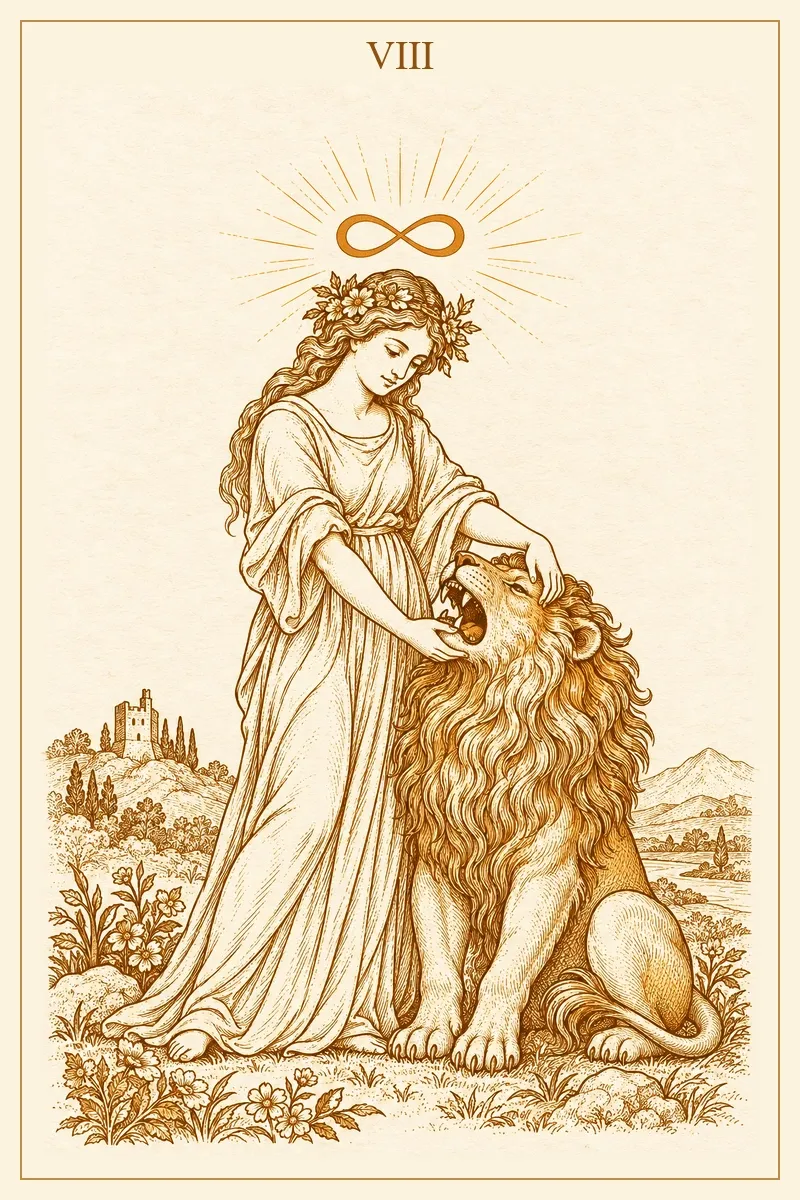
Suppose Strength appears upright for “What resource do I have?” and reversed after reshuffling for “What gets in the way?” You might consider whether you can be patient with someone else but are harsh with yourself. That is a testable reflection: can you identify an actual conversation, habit, or expectation that illustrates it? If so, one modest experiment might be to use the same calm wording with yourself that you would offer a friend. If not, look at a different reading of the card.
The reverse order does not automatically mean a blockage has been removed. It may simply show that the two questions emphasized different sides of the same image. Deck handling can turn a card around, and some readers do not use orientation at all. State your method clearly in your notes. Write down which interpretation fits the question, and revisit it after you have more context.
When comparing any upright and reversed pair, keep three columns in mind: the shared theme, the distinct position, and the evidence outside the cards. The shared theme might be confidence. The positions might be “current pattern” and “support.” The evidence might be a recent choice you made despite nerves. A reading becomes more useful when these pieces are explicit, because you can disagree with an interpretation and revise it without fearing that you have ignored a command.
A grounded way to work with the repeat
Start by recording the mechanics: date, deck, whether you replaced the card, how you shuffled, the question, position, and orientation. This takes less than a minute and separates what happened from what you infer. If your cards stick together or you tend to split the deck at the same spot, notice that too. A mechanical explanation does not make your reflection worthless; it simply keeps the story accurate.
Next, describe the card in plain language before looking up a meaning. Choose two details you actually see and write why they caught your eye. You might notice a figure turned away, an object held carefully, or a path in the background. Then consult a card guide if it helps. A guide is a vocabulary, not a substitute for the question you brought. This step also protects against forcing every repeated card into a single generic meaning. If you want more practice with question wording and card positions, use our self-reading guide alongside your notes.
Now compare the readings in two sentences: “In the first position, this could point to…” and “In the second, it could point to….” Add a third sentence that starts “A shared theme might be….” Keep “might” if the connection is uncertain. Ask whether the theme is already visible in your actions, conversations, or circumstances. If you cannot name any evidence, leave the interpretation provisional.
Choose a small action within your control. With Eight of Pentacles, that might be practicing one skill for twenty minutes. With Two of Cups, it could be listening more carefully in a conversation. With Five of Cups, it could be naming a disappointment and identifying one source of support. A small action gives you something real to observe; the card does not need to dictate a life decision. If the matter concerns health, law, or money, use appropriate qualified advice for the decision itself.
Finally, decide when to revisit the question. You might wait until a conversation happens, a deadline passes, or you have tried the action you chose. This is more useful than drawing repeatedly in search of certainty. If a card keeps appearing, your notes will show whether the same issue is still active, the question has changed, or the repeat is simply part of normal variation in many draws.
When to pause the reading
A repeated card is not always the most useful thing to focus on. If you notice yourself checking the deck again and again because you fear a particular outcome, the next helpful step may be to put the deck away. Name the concrete uncertainty: Are you waiting for someone to answer a message? Do you need information about an application, appointment, or conversation? Write down how you could learn more: a direct question, a date to follow up, or one action you can take while you wait.
Sometimes the card feels important because its imagery is vivid. Sometimes a difficult week makes any repeated symbol feel charged. Neither reaction is a failure of reading. Notice the feeling, then ask what has changed outside the cards. If nothing has changed, a fresh draw may not add much. If something has changed, a fresh question could be useful, especially one about your own options rather than another person's private thoughts.
You can also decide that the repeat means nothing beyond chance. That is a valid conclusion. Reflection is optional, and your safety, relationships, and obligations do not depend on finding a hidden message in a shuffle. When a reading helps you describe a concern and make a measured choice, it has done useful work. When it leaves you more frightened or dependent on the next card, stopping is a thoughtful choice.
Journal example: comparing two positions
A short journal entry can make this concrete. Record “Tuesday: Eight of Pentacles, current situation, work question” and “Friday: Eight of Pentacles, advice, learning question.” Then separate your interpretation from those observations: “Possible shared theme: practice.” Try one action in each setting and review it after a week. If the connection does not help, discard it. The value of the exercise is in clearer questions and observable choices, not in proving that the repeat had a hidden cause.
Common questions about drawing the same card twice
Does it mean the first reading was wrong?
No. A repeat by itself cannot validate or invalidate a reading. Compare the questions and positions, and consider whether the first interpretation was broad. You may refine it, or you may decide that the first answer remains sufficient. Readings are interpretive tools; a second card is more context, not an automatic correction. Our guide to whether tarot cards can be wrong explores how to review an interpretation against what actually happened.
Does a reversed repeat cancel the upright card?
No. If you read reversals, the orientation may invite a different angle on the same theme. It does not erase the earlier draw. Look at each card’s position and the question asked at that moment. If you do not read reversals, record the physical orientation if you wish, but you are free to keep your usual method.
Should I worry if the repeated card is Death or The Tower?
No card can establish that harm is about to happen. Death is commonly read through endings and transition, while The Tower often asks about disruption or a structure that needs examination. Repetition is not “double danger.” If the image stirs fear, pause the reading and look at the actual situation with support from people you trust. You are allowed to set the cards aside.
What if I keep drawing it all week?
Write down every draw, including the cards that do not repeat, and note how often you are reading. Ask whether your questions keep circling the same concern. If the card remains useful, choose one grounded action and check what changes. If it stops helping or increases anxiety, take a break. The repeat is not a deadline, and it does not obligate you to continue pulling.
The clearest takeaway is simple: notice the repeat, verify how it happened, compare the two contexts, and choose one useful next step. Try a free reading on Veil Soul to work through your own question with a spread.