The chakra tarot spread lays seven cards in a vertical column, one for each chakra from the root at the base of the spine to the crown at the top of the head, and asks one question about that area of your life. Many readers call it a chakra alignment spread: you read the cards from the bottom up, then look at the column as a whole to see where your energy pools and where it runs thin. It is a reflective check-in, not a diagnosis or a treatment. The cards can help you notice patterns in how you feel and act, but they cannot assess your health, confirm what another person thinks, or promise an outcome.
Because each position asks a different question, the spread is useful when something feels off and you cannot yet say where. Seven cards rarely name a problem outright; they show which part of your life is asking for attention this month.
These are the seven positions and the question each one asks:
- 1. Root: Where do I feel steady, and where do I feel unsafe?
- 2. Sacral: Where am I letting myself feel, enjoy and create?
- 3. Solar plexus: Where am I acting on my own choices?
- 4. Heart: Where am I open to giving and receiving care?
- 5. Throat: What am I saying, and what am I holding back?
- 6. Third eye: What am I seeing clearly, and what am I avoiding?
- 7. Crown: What gives my days a sense of meaning?
Chakras and tarot: a modern pairing
The chakras come from South Asian yogic and tantric traditions, where they describe centers along the subtle body. The tidy seven-center model most people know today, with a rainbow running from red at the root to violet at the crown, took shape in Western books during the twentieth century. Tarot has a separate history: it began as a card game in fifteenth-century Italy and gathered its esoteric meanings in France and England much later. Matching the two systems is a modern convention among contemporary readers, not historical tarot doctrine.
That does not make the spread less useful. The chakra column walks you through the layers of an ordinary life, from rent and sleep to friendships and purpose, in a fixed order, and that alone helps you ask better questions. You do not need to hold any belief about energy bodies to use it. If the language of chakras does not suit you, read each position as the life theme it names and leave the rest aside.
Some readers like to note which suit tends to echo each center: Pentacles for the root, Cups for the sacral and the heart, Wands for the solar plexus, Swords for the throat and the third eye, and the Major Arcana for the crown. Treat this as a loose hint, not a rule.
Laying out the seven-card column
Choose a quiet ten or fifteen minutes and a clear surface long enough for seven cards placed end to end. Before you shuffle, write one line about what prompted the reading, such as "I feel scattered this month" or "I want to see where I am running low." The spread is built to survey, not to decide, so a broad question works better than a yes-or-no one.
- Shuffle while you think about the whole of your life rather than one problem.
- Place the first card at the bottom for the root, then build upward: sacral, solar plexus, heart, throat, third eye, and the crown card at the top.
- Turn the cards over one at a time from the base, and write a few words for each before you look at the next.
- When all seven are face up, step back and take in the column as one picture before you study any single card in depth.
Reversals are optional. If you read them, treat a reversed card as energy that is turned inward, delayed or harder to reach in that center, not as a warning. If you do not, read every card upright and let the position carry the nuance. Either way, decide before you shuffle so you are not choosing a method after you see the cards.
If you repeat the spread every month or with each new moon, keep your notes in one place. A simple tarot journal for tracking your readings makes it easy to see whether the same center keeps drawing heavy cards over several months, which is often more telling than any single reading.
The seven positions, root to crown
Each position below gives its question, its theme, and examples of cards that suggest a full or a thin center. The examples are starting points, not fixed answers.
Position 1: Root (Muladhara)
Question: Where do I feel steady, and where do I feel unsafe? The root covers the practical ground under your feet: home, money, food, sleep, routines and the sense that you belong somewhere. A settled card here, such as the Ten of Pentacles, points to a base you can lean on. A card about worry, scarcity or holding on too tight suggests that security, or the fear of losing it, is taking more of your attention than you realize. Read this position first and kindly; the other centers are harder to work with when the base feels shaky.
Position 2: Sacral (Svadhisthana)
Question: Where am I letting myself feel, enjoy and create? The sacral position is about pleasure, play, emotional flow and making things for the joy of it. The Ace of Cups here suggests that feeling is available and fresh. A withdrawn or bored card hints that you have put enjoyment on hold, perhaps because life seems too serious to allow it.
Position 3: Solar plexus (Manipura)
Question: Where am I acting on my own choices? This center holds will, confidence and the ability to decide. The Emperor here suggests clear authority over your own life. A card of conflict, hesitation or many competing voices suggests your decisions are being shaped by other people's opinions, or by a fear of getting it wrong. Ask where you are waiting for permission you do not actually need.
Position 4: Heart (Anahata)
Question: Where am I open to giving and receiving care? The heart sits in the middle of the column, with three centers below and three above, so it often acts as the bridge between practical life and inner life. The Star here can show a hopeful, open heart after a hard season. The Three of Swords points to grief or hurt that still needs room. Neither card says how anyone else feels about you; both describe how open you are at the moment.
Position 5: Throat (Vishuddha)
Question: What am I saying, and what am I holding back? The throat governs honest expression: asking for help, setting limits, saying no, or naming what you want. The Queen of Swords here suggests clear, direct speech that is kind without being vague. A card of restriction or silence suggests something important is going unsaid, sometimes because you have decided in advance that nobody would listen.
Position 6: Third eye (Ajna)
Question: What am I seeing clearly, and what am I avoiding? This position concerns intuition, perspective and honest perception of yourself and your situation. A card of quiet knowing suggests your instincts are worth trusting right now. The Seven of Cups here often shows the opposite of blindness: too many possibilities, wishes and what-ifs, with none clear enough to act on.
Position 7: Crown (Sahasrara)
Question: What gives my days a sense of meaning? The crown is about purpose, faith, wonder and the feeling of being part of something larger, whatever that means to you. The World here suggests a sense of completion and fit. A card of solitude or retreat suggests meaning is easier to find in quiet than in company at present. A card of disconnection asks what you used to find meaningful and have stopped making time for.
Reading the whole column
Look at the seven cards as one picture, the way you would read a weather map rather than a single forecast. Four patterns matter most: where energy pools, where it runs thin, how the lower and upper halves compare, and what the heart is doing between them.
Where energy pools
Energy pools where cards are busy, intense or crowded: Major Arcana, court cards, high numbers, or several cards of one suit gathered together. Pooling does not always mean strength. A crowded third eye can mean overthinking, and a crowded root can mean all your attention is going to bills and logistics. Ask whether the busiest center is nourishing you or simply absorbing your time.
Where it runs thin
A center runs thin when its card is quiet, withdrawn, stalled or reversed: a Four that rests or refuses, an Eight that feels stuck, a reversed Ace whose fresh start has not yet arrived. Thin is not broken. It describes an area that is getting less of you than it needs. Often a thin center sits right next to a pooled one, which hints that the busy area is drawing energy away from its neighbor.
Weight at the base or weight at the top
If the heavier or harder cards gather in the lower three positions, practical and emotional foundations need care before anything else. If the weight sits in the upper three positions, you may be living mostly in your head, planning, analyzing or searching for meaning while the body and daily life go unattended. Grounding, movement and plain routines tend to help.
The heart between
Because the heart sits in the middle, its card colors how the two halves connect. A guarded heart card can explain why practical security and inner insight feel unrelated, as if two halves of your life are not talking to each other. When the heart card is the hardest in the column, start there.
Five cards that often clarify a center
These five cards speak especially clearly in particular positions, and each shows a distinct way a center can hold or withhold energy. The notes read them in a chakra position; the linked meaning posts cover each card in full.
Four of Pentacles in the root
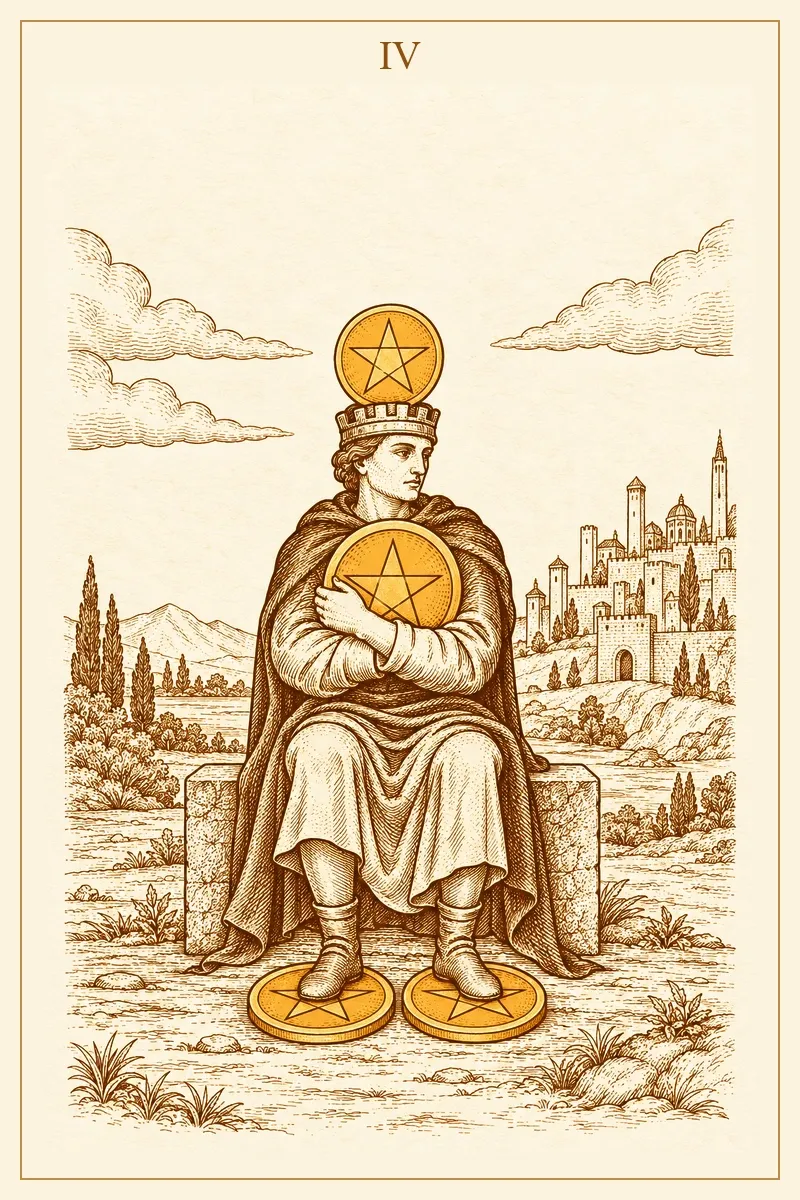
The Four of Pentacles shows a crowned man seated on a stone block, hugging one coin to his chest, with another balanced on his crown and one under each foot, while a walled town rises behind him. In the root position, upright, it describes security held very tightly: savings guarded, routines kept rigid, change resisted because it feels unsafe. That can be wise for a season, yet it can keep you from resting in the safety you already have. Reversed, it may show the grip loosening, sometimes by choice and sometimes because circumstances force it. The full Four of Pentacles meaning explores the card's money and relationship angles.
Four of Cups in the sacral
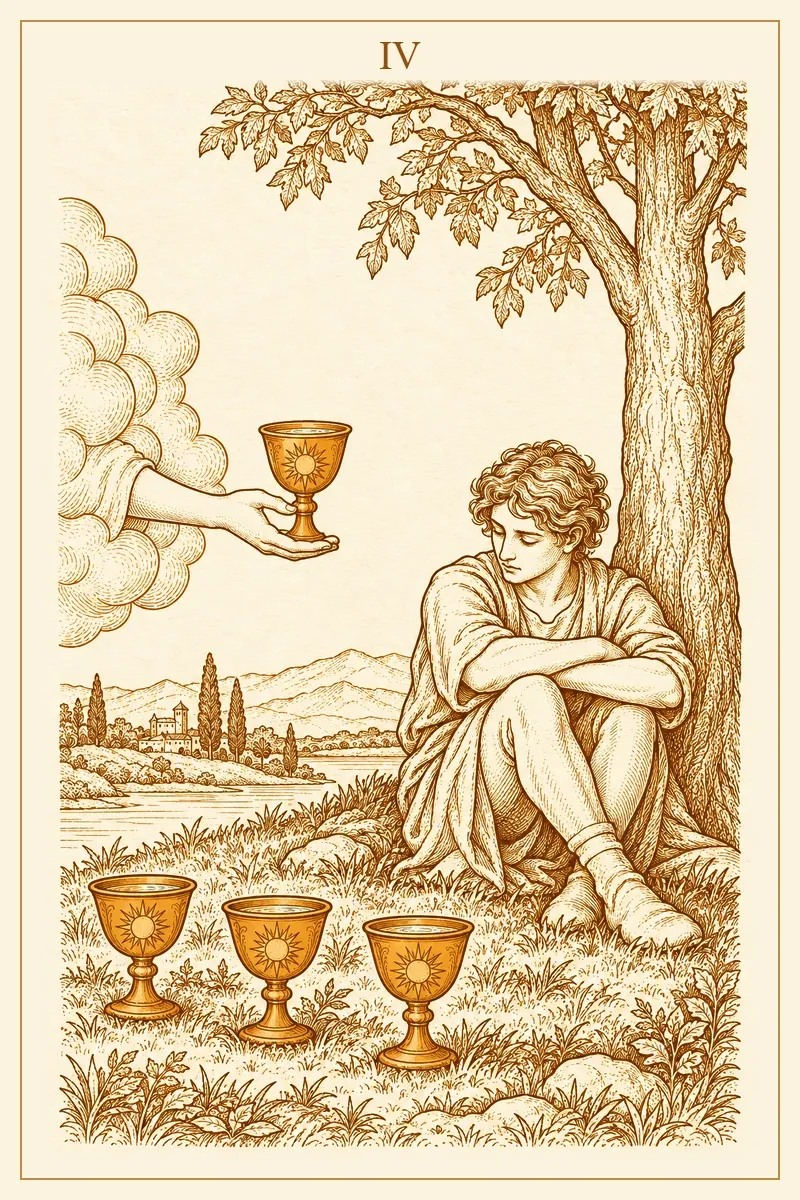
The Four of Cups shows a young man sitting under a tree, arms folded over his knees and eyes lowered toward three cups in the grass, while a hand reaching out of a cloud offers a fourth. In the sacral position, upright, it describes pleasure that is available but not taken: invitations declined, hobbies left untouched, a flat mood that makes everything seem unremarkable. Reversed, it can show interest returning, as if you are finally ready to look up. Ask what offer you have stopped noticing. You can read more in the Four of Cups tarot meaning, including how it reads in love.
Eight of Swords in the throat
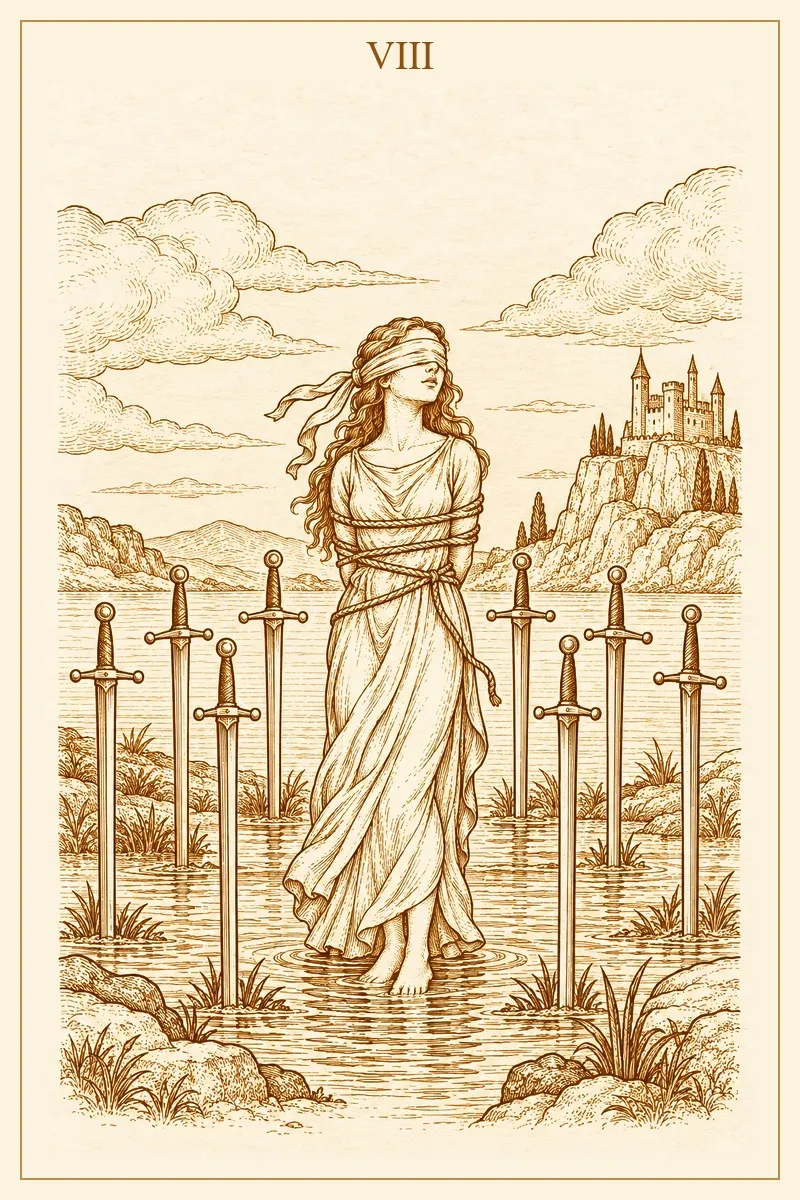
The Eight of Swords shows a blindfolded woman, bound with rope, standing barefoot in shallow water with eight swords planted around her, four on each side, and open water ahead. The end of the rope hangs loose. In the throat position, upright, it suggests you feel unable to speak, often because you expect a bad response, while the way out may be less blocked than it seems. Reversed, the blindfold is starting to slip: you are noticing that one honest sentence is possible after all. The Eight of Swords meaning covers how the card reads in career and love questions.
The High Priestess in the third eye
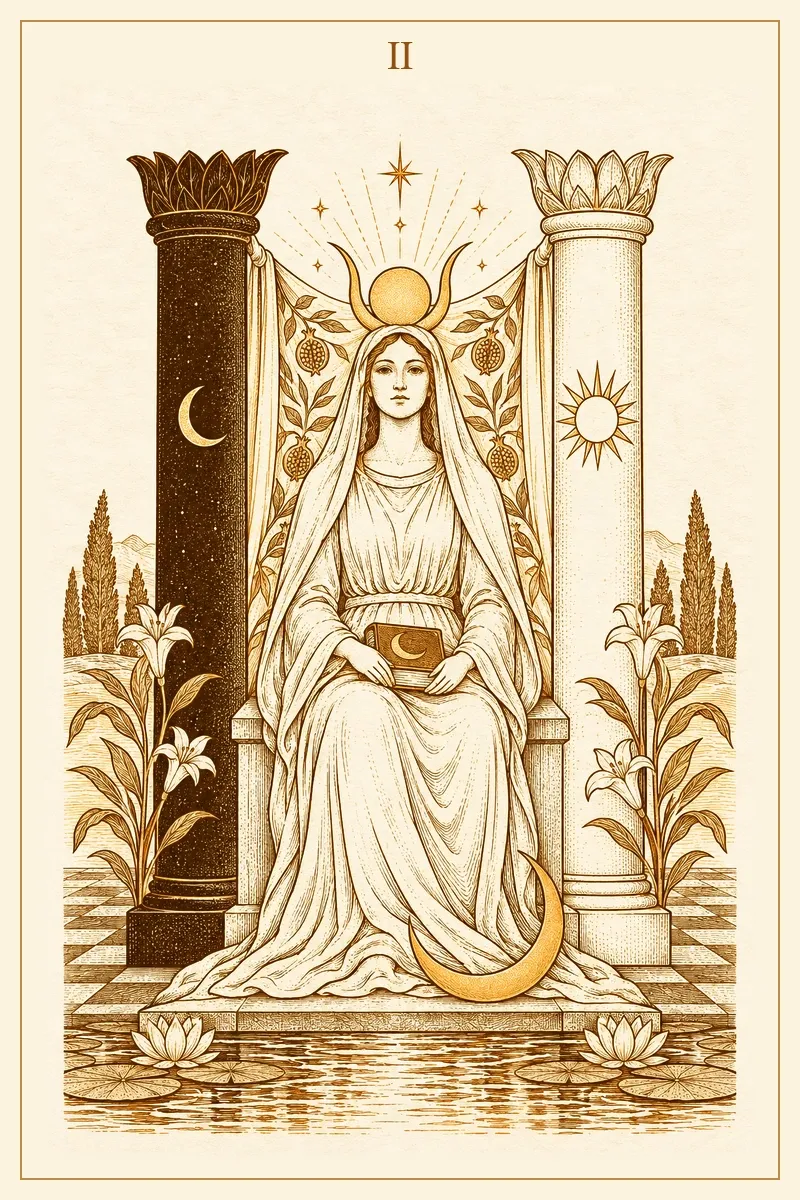
The High Priestess sits between a dark pillar marked with a crescent moon and a pale pillar marked with a sun, a closed book resting in her lap and a crescent moon at her feet, with still water and lotus leaves before the throne. In the third eye position, upright, she suggests quiet knowing: you already sense something, even if you cannot yet explain it. Reversed, she can mean you are second-guessing that sense or drowning it out with other people's views. The High Priestess tarot meaning explains her wider role in readings.
The Hermit in the crown
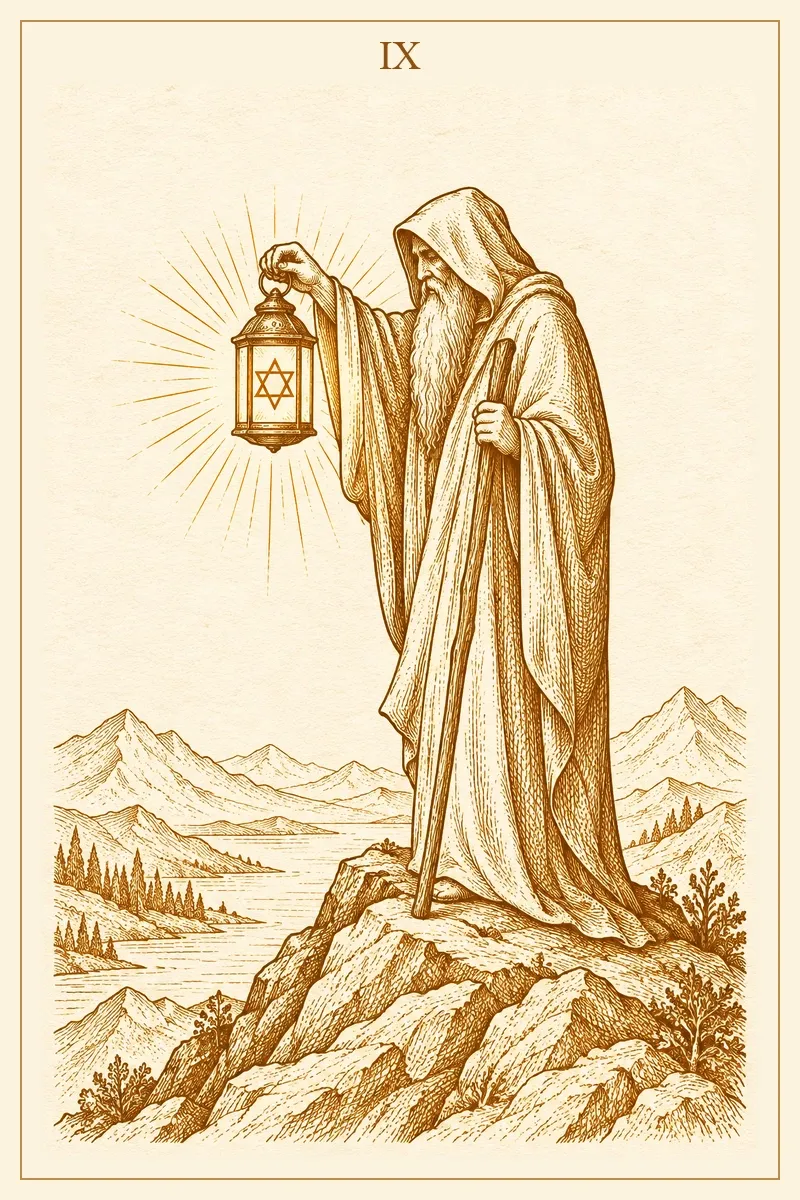
The Hermit stands on a rocky peak in a hooded robe, a staff in one hand, raising a lantern that holds a six-pointed star, with mountains and a lake far below. In the crown position, upright, he suggests meaning is easier to find alone right now: a long walk, a quiet weekend, a stretch with fewer conversations. Reversed, solitude may have tipped into isolation, and the next step toward meaning could involve other people again. For a fuller picture, see the complete Hermit tarot meaning.
A worked example: one column, read from the base up
This is an illustrative reading that shows the method; it is not a real person's story. Someone feels busy but unproductive and asks: "Where is my energy gathering, and where is it running thin this month?" They shuffle, agree beforehand to read reversals, and lay seven cards.
The seven cards drawn
- Root: Ten of Pentacles, upright.
- Sacral: Page of Cups, upright.
- Solar plexus: Five of Wands, upright.
- Heart: Six of Cups, upright.
- Throat: Two of Swords, upright.
- Third eye: Seven of Cups, upright.
- Crown: Four of Swords, reversed.
Where it pools and where it thins
The base is solid. The Ten of Pentacles says home, family and money are not where the trouble lies, which is useful to know because this person had been worrying about them. The Page of Cups in the sacral position is light but alive: a small creative curiosity that deserves a little time. The heart card, the Six of Cups, shows warmth with familiar people and a pull toward old comforts, a quiet source of support.
The energy pools in two places. The Five of Wands at the solar plexus shows effort scattered among competing demands, with every voice given an equal vote. Its full Five of Wands meaning describes this kind of friction in work and group settings. Higher up, the Seven of Cups at the third eye shows a head full of options, none chosen. Between those two busy centers, the throat runs thin. The Two of Swords points to a decision held in silence, perhaps to avoid upsetting someone, and that silence keeps the options multiplying above it. At the top, the reversed Four of Swords suggests rest has been skipped, so meaning is hard to hear over the noise.
What the reading suggests doing
The pattern is a loud middle and a quiet throat. The reader takes away three small steps: write down every option the Seven of Cups is holding and cross out all but two; tell one trusted, familiar person, as the Six of Cups suggests, which option they lean toward; and protect one genuinely restful evening this week. If the column keeps pointing at one decision, a Celtic Cross spread focused on that choice can look at it in more depth.
Gentle practices for each center
These are small, ordinary actions, not cures. Choose one for the center that ran thinnest in your reading and try it for a week, then notice whether your next column looks different.
- Root: Tend one practical base this week: cook a simple meal from scratch, sort one drawer of paperwork, or keep a regular bedtime for five nights.
- Sacral: Make something with no purpose and no audience: a quick sketch, a song in the kitchen, a new recipe just to see how it tastes. Let it be imperfect.
- Solar plexus: Make one small decision today without asking anyone, such as what to eat, which route to walk or which task comes first. Notice how it feels to choose and let the choice stand.
- Heart: Offer or accept one small kindness, and practice everyday forgiveness, including of yourself. If an older hurt keeps coming back, the guide to tarot for forgiveness and releasing resentment offers a slower way to work with it.
- Throat: Say one true sentence you would normally swallow, kindly and plainly: "I need help with this," "I'd rather not," "I see it differently." Writing it down first is fine.
- Third eye: Reduce input for a day: fewer headlines, less scrolling, one long walk without a podcast.
- Crown: Spend ten minutes in stillness without a phone, watching clouds, sitting in a park, or trying one of these tarot meditation techniques with a single card. Meaning often returns through attention rather than effort.
Frequently asked questions
Do I need to know about chakras to use this spread?
No. Knowing the theme of each position is enough: safety at the root, feeling at the sacral, choice at the solar plexus, care at the heart, voice at the throat, insight at the third eye and meaning at the crown. Keep the seven questions beside you while you read. If you want to explore what the cards show about you more broadly, the guide to tarot for self-discovery pairs well with this spread.
Can the chakra spread tell me what is wrong with my body?
No. The chakra spread is a tool for reflection, not diagnosis or treatment. It cannot identify an illness, assess your mental health, confirm another person's feelings or predict an outcome. If you notice symptoms or ongoing distress, speak with a doctor or counselor; a reading can sit alongside that care, never in place of it.
How often should I lay the chakra spread?
Once a month works well for most people: often enough to notice change, far enough apart for change to happen. Laying it daily tends to produce noise rather than insight, since the themes it covers shift over weeks, not hours.
What if all seven cards look positive?
Enjoy it, then look for the quietest card. Even in a bright column, one center will usually feel slightly less lively than the rest. Treat it as a place for gentle upkeep rather than a problem.
Should I use reversed cards in a chakra reading?
Either approach works. Reversals add detail, showing energy that is turned inward, delayed or harder to reach, but they also double the number of meanings to hold in mind. Newer readers often find it easier to read upright only and let each position guide the nuance.
Can I add crystals or colored cloths to the spread?
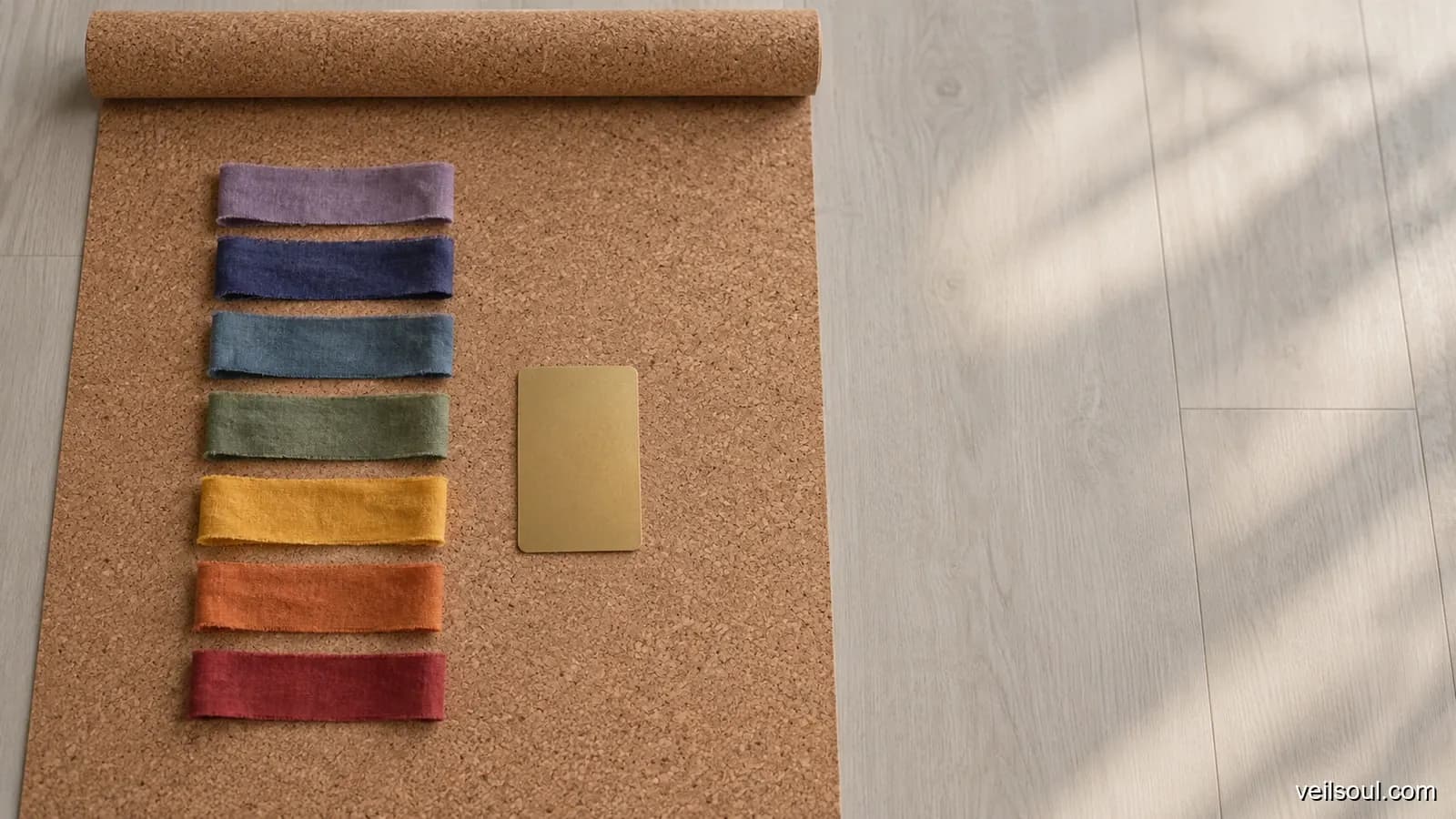
You can, if they help you focus. Some readers place a small stone or a strip of colored fabric beside each position as a visual cue. These objects do not change what the cards say; they make the column easier to take in at a glance and can turn the reading into a calm ritual.
Carrying the column into your week
The value of a chakra reading lies less in the seven cards than in the one small change you make afterward. Pick the center that ran thinnest, choose one practice, and check in again next month. When you are ready to lay a column of your own, start a reading with Veil Soul and keep the seven questions close.