
Lay six cards in a tall diamond and you have the career crossroads tarot spread: a layout for the point where you can feel your work needs to change but cannot yet say which way. The six positions ask where you stand now, what fulfills you, what is quietly steering the choice, what to release, what to embrace, and which direction the whole picture leans. Use it as a tarot spread for a career decision or a career change when the problem is not two offers on the table but a fork you cannot read.
The spread will not tell you which job to accept, whether a company will hire you, or the month to hand in your notice. Tarot cannot see an employer's plans or promise an outcome. What it can do is separate a tangled question into threads: tiredness a vacation would fix, a values problem no new employer would fix, and an appetite for something you have not yet admitted wanting.
Here is the layout in order, top card first:
- 1. Where you stand now: the honest state of your working life today.
- 2. What fulfills you: the kind of work that makes time disappear.
- 3. The hidden factor: an expectation, fear or loyalty steering you unseen.
- 4. What to release: a belief, habit or attachment the next chapter has no room for.
- 5. What to embrace: the attitude or skill the next chapter asks of you.
- 6. The direction: where the reading as a whole leans, not a fixed destination.
A fork with no signposts: when to use this layout
Some career questions are narrow: should I accept this offer, will this promotion come through. Those suit a smaller draw. The crossroads layout is for the foggier version that sounds like "I don't even know what I want anymore." You may have stayed in one role long enough that the dissatisfaction has become background noise. You may have been laid off and found that the obvious next step, the same job somewhere else, leaves you cold. Or a door has opened, perhaps a management track or a chance to retrain, and you cannot tell whether your hesitation is wisdom or fear.
In each case several questions are knotted together. Is the problem the job, the field, the workload, a manager, money, or something in you that has changed? The spread gives each thread its own position, so no single card has to carry the whole answer. It is less useful when the numbers alone settle the decision, and it is no substitute for help in a crisis: if work stress is affecting your health or sleep, talk to a doctor, counselor or someone you trust first.
Laying the diamond: question, shuffle, placement
Write your question down before you shuffle. Keep it open and first-person: "What is this crossroads in my working life really about?" Avoid wording that hands the decision to the deck, such as "Should I leave?"
Place card 1 at the top. Cards 2 and 3 sit side by side below it, 2 on the left and 3 on the right. Cards 4 and 5 sit below those in the same way, and card 6 goes at the bottom, centered. The left side holds what is yours to keep or let go, the right side holds what is pressing on you or calling to you, and the center line runs from where you are to where the reading points. If you read reversals, treat a reversed card as the same theme blocked, delayed or turned inward rather than its opposite.
The six positions, from top to bottom
Each position comes with an example card and a note on reversals. The examples are illustrations; any card can land anywhere.
Position 1: where you stand now
The honest picture, not the version you give at family dinners. The Eight of Cups here, a cloaked traveler leaving eight cups in two neat rows and walking toward mountains under a crescent moon, says part of you has already left even though you still do the work well. Reversed, it can mean circling back to a job you have outgrown because leaving feels like wasting the years you put in. If The Tower lands here, the change may already have been made for you through a layoff or restructure, and the rest of the spread is about rebuilding on your own terms.
Position 2: what fulfills you
Not what you are good at or what pays best, but the work that makes hours pass unnoticed. Confusing those is how capable people end up successful and flat. The Ace of Wands, a hand reaching from a cloud with a leafing wand above a river valley, says you come alive at the start of things: the first sketch, the new project before it becomes routine. Reversed, the spark is damped by burnout or by a role that never lets you begin anything. The Empress here points elsewhere, to tending and growing people, teams or products over time.
Position 3: the hidden factor
This position can be the most revealing in the layout. The Emperor, a crowned and armored ruler on a stone throne carved with rams' heads, may point to a parent's or mentor's idea of a respectable career, or to your own wish for authority pursued in place of meaning. Reversed, it can describe a rigid hierarchy whose rules have shaped your sense of what is possible. A hidden factor is rarely a villain. It is usually a loyalty or an old promise that made sense once and has not been revisited.
Position 4: what to release
Every next chapter asks you to put something down. Death is on theme already, but its details sharpen the message: an armored skeleton rides a white horse under a black banner, and a crown lies in the grass. What may need to go is an attachment to status, a title, or the way people introduce you. Reversed, it suggests an ending that has happened inside you but keeps being postponed outwardly.
Position 5: what to embrace
The counterweight to position 4. The Page of Cups, a young figure in a shell-patterned tunic at the shoreline with a fish leaping out of their cup, asks for a beginner's openness: be willing to be new and a little clumsy at something, and to be surprised by what interests you. Reversed, it shows the fear of looking foolish that stops an experienced person from trying what they cannot excel at immediately.
Position 6: the direction
Not a verdict, but where the reading leans if you take the other five cards seriously. The Star, a woman kneeling at a pool and pouring water from two jugs beneath a large eight-pointed star, points toward work that restores something, in you and in the people you serve. Reversed, it says rest comes before any big move. The Nine of Pentacles in this position leans toward independence: your own practice, your own hours, skills you have cultivated long enough to stand on.
Reading across the diamond
Once you have one sentence for each card, read them in pairs.
Positions 2 and 3, the fault line. Card 2 shows what feeds you; card 3 shows whose definition of success you have been working toward. When they agree, the crossroads is probably practical: timing, money, logistics. When they pull apart, you have found the source of the restlessness, and no change of employer will settle it until you decide which voice gets the final say.
Positions 4 and 5, the trade. Read them as one sentence: "To move on, I let go of ___ and take up ___." If both cards are heavy, plan for a longer runway. If position 4 is hard and position 5 hopeful, the cost comes first and the reward later.
Positions 1 and 6, the arc. Is the movement from tired to restored, from stuck to curious, from crowded to independent? That arc is usually more useful than any single card.
The suits. Pentacles keep returning to money, security and skill; Cups to meaning and working relationships; Wands to drive and creativity; Swords to decisions and the stories you tell yourself. Several Major Arcana suggest the crossroads touches your sense of who you are, not just your schedule.
Five cards that read differently at a career fork
These five are easy to misread at a career fork if you carry their love or general meanings straight across.
The Lovers: values before titles
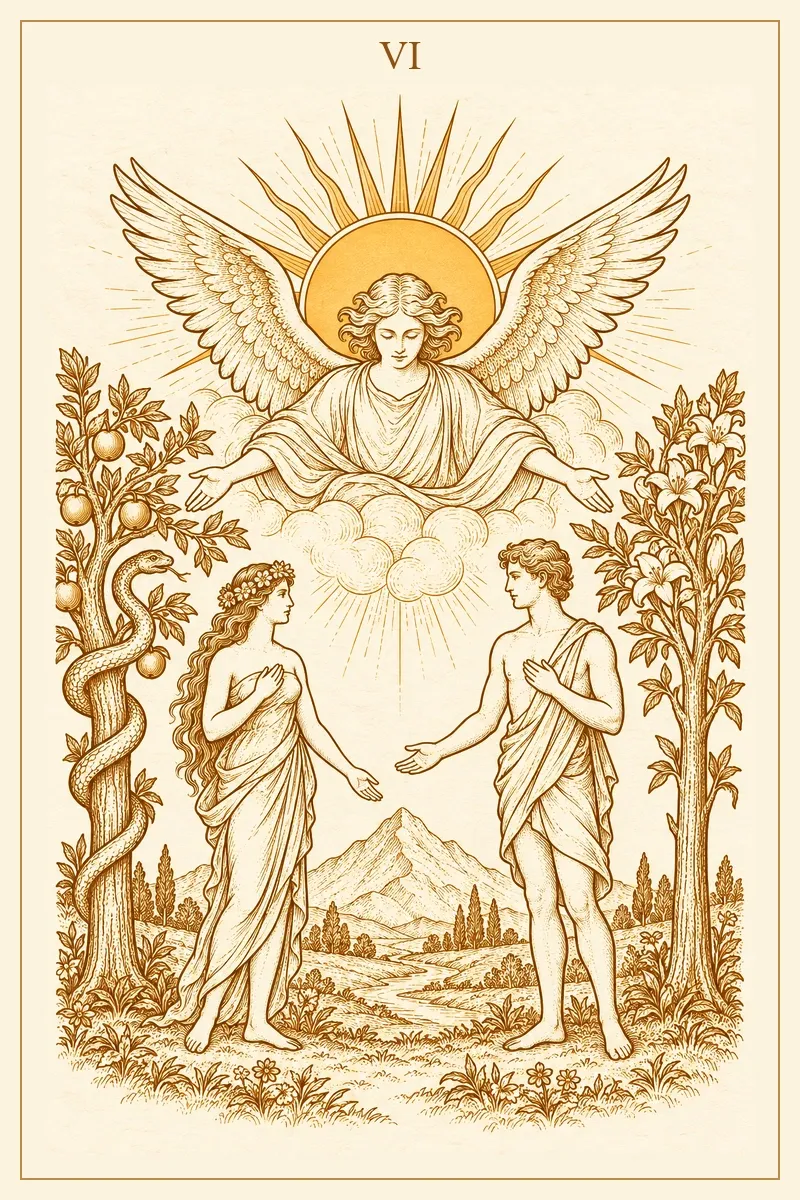
The Lovers shows two figures in a garden with a mountain between them, a serpent coiled around the tree on one side, and a winged figure above them haloed by the sun. At a fork it is a card of alignment: does this work express what you value, or only what you can do? Upright, the choice in front of you is really a values question, and the right path is the one you could explain without embarrassment to the person you most respect. In position 2 it can mean that meaningful collaboration fulfills you more than solo achievement.
Reversed, it points to a split: a job that pays for one life while you want another, or a choice made to please someone else. The full Lovers tarot meaning covers its love and partnership sides.
The Devil: golden handcuffs
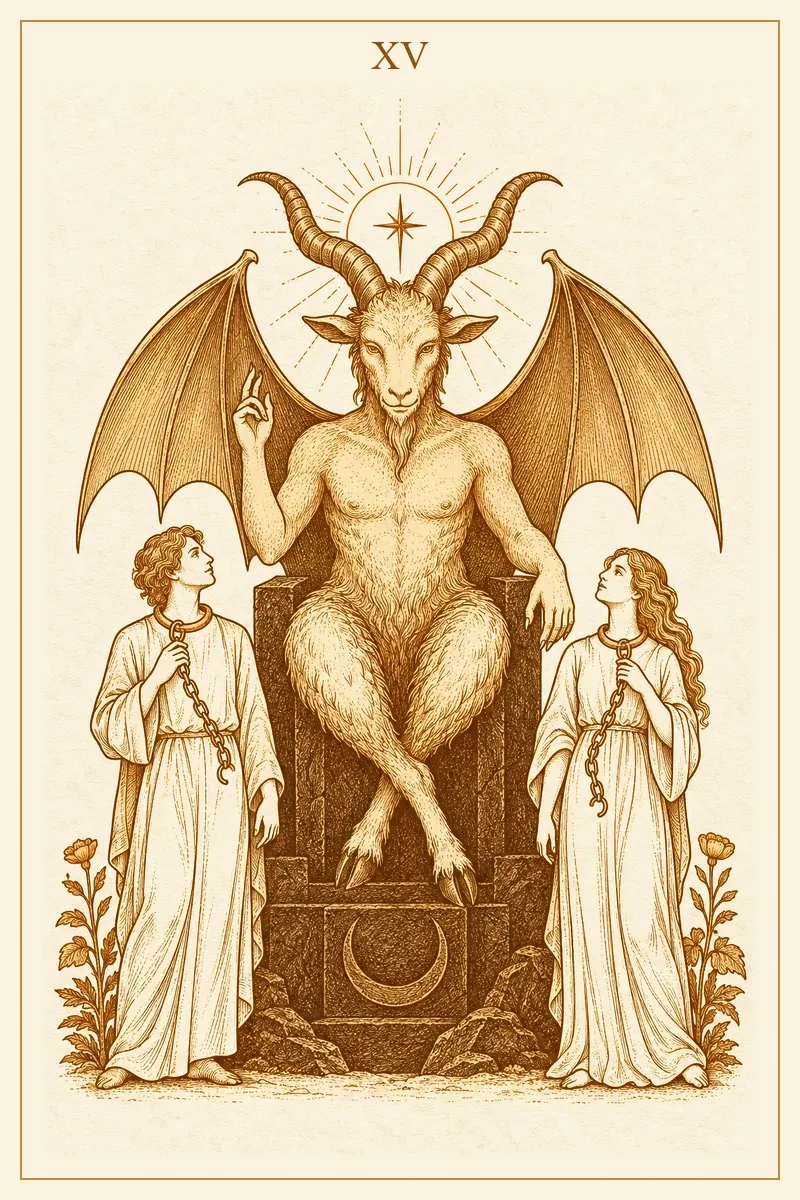
The Devil pictures the trap many people describe at a crossroads. A horned, bat-winged figure sits on a dark block marked with a crescent, and two robed figures stand beside it, each with a chain at the neck that they hold in their own hand. Look closely and the chains are fastened to nothing. In career terms this is the salary, the bonus or the prestige that keeps you in work that is slowly hollowing you out. Upright, it asks you to name the chain precisely; often it can be loosened with a plan rather than a dramatic exit.
Reversed, the grip is easing, because you can now see the bind clearly. The card can also describe overwork that has become compulsive. The Devil tarot meaning goes further into attachment and release.
The Hierophant: whose rules are you following?
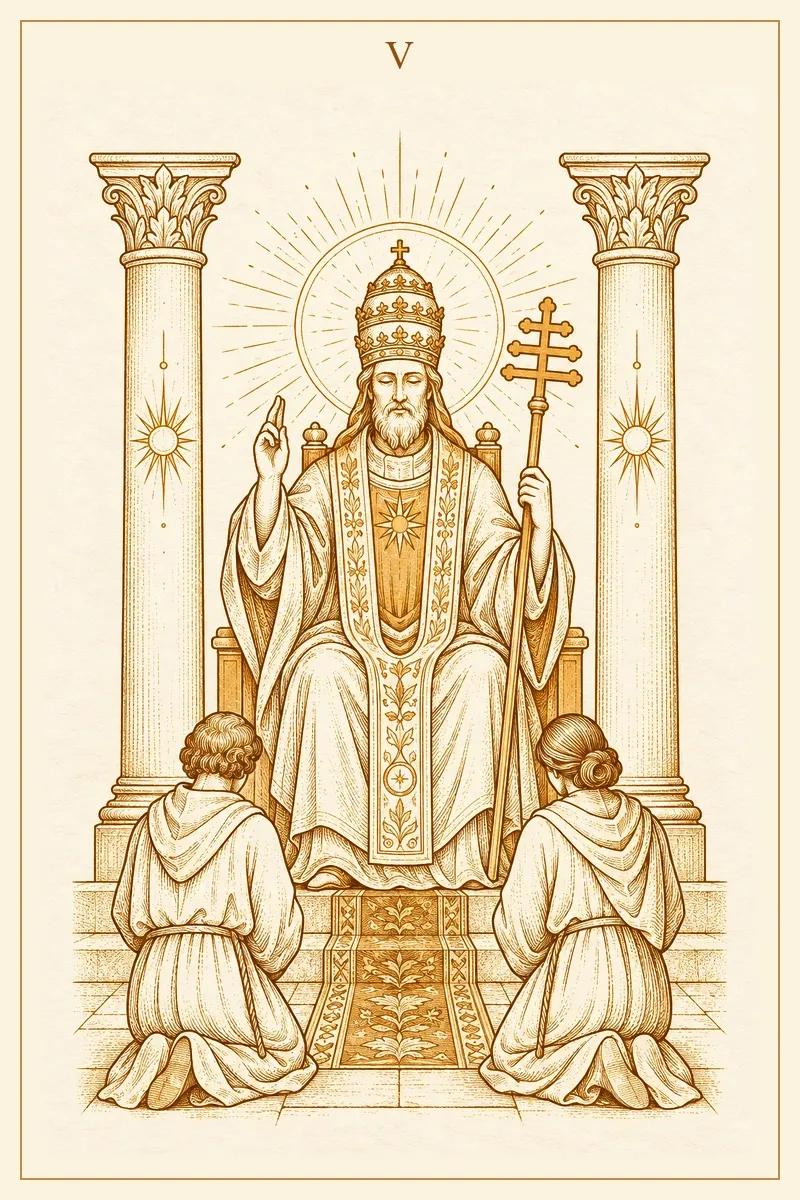
The Hierophant sits between two columns in a triple crown, one hand raised in blessing and a triple-barred staff in the other, while two figures kneel before him. At work he stands for institutions, credentials, mentors and the accepted route: the family profession, the degree you were expected to use. Upright, that can be good news, since a formal training path or a respected mentor may be the support you need. In position 3, though, he often names an inherited rule about what a proper career looks like and asks whether it is still yours.
Reversed, he suggests an unconventional route, or the discomfort of questioning a tradition you grew up inside. The Hierophant tarot meaning explores his other sides.
Wheel of Fortune: a turn you do not control
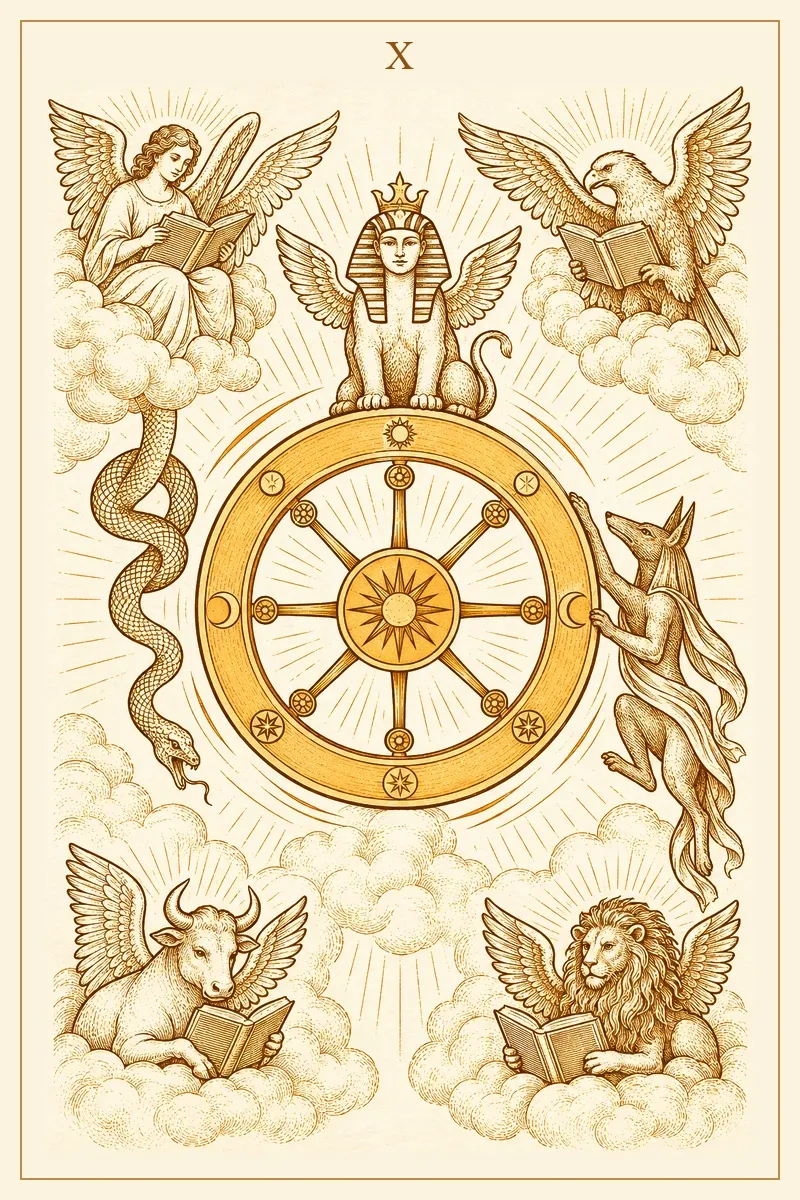
The Wheel of Fortune shows a golden wheel with a sun at its hub, a crowned sphinx on top, a serpent sliding down one side and a jackal-headed figure climbing the other, with four winged creatures reading in the corners. In a career reading it points to circumstances moving independently of your plans: a restructure, a market shift, a chance meeting. Upright, a turn in your favor is possible if you stay alert, though the opening may not look like the one you were waiting for.
Reversed, the cycle is on a downswing, and preparing may be wiser than forcing a jump. Neither direction is permanent. The Wheel of Fortune tarot meaning covers its cycles in detail.
Ten of Pentacles: building something that lasts
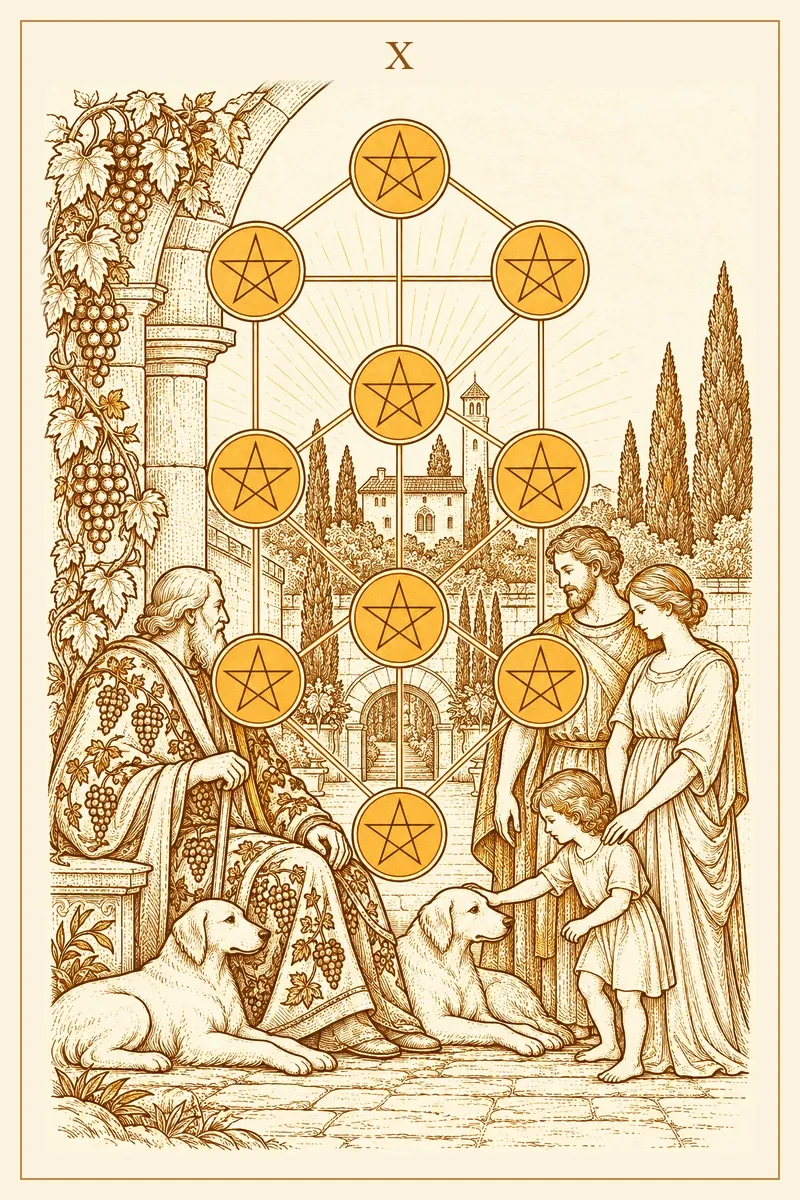
The Ten of Pentacles shows an old man in a grape-patterned robe seated under a vine-covered arch with two dogs, a couple and a small child nearby, and a villa beyond, with ten pentacles arranged in a branching pattern over the scene. At a career fork it shifts the question from income to legacy: are you building something that will still matter in twenty years? Upright in position 6, it leans toward stability, a long-term institution, or a family business worth investing in.
Reversed, it can show family pressure about money, a long-term plan that no longer feels secure, or security that has become a cage. The Ten of Pentacles tarot meaning adds its money and family readings.
Worked example: a management offer and a workbench
Imagine an events coordinator, eight years at the same hotel, who has just been offered the operations manager post. On weekends she restores old furniture and has started selling a few pieces. Her question: "I have been offered a promotion I am not sure I want. What is this crossroads really about?"
The cards: 1, Four of Cups. 2, Eight of Pentacles. 3, Six of Wands reversed. 4, Ten of Wands. 5, Page of Pentacles. 6, Two of Wands.
Where she stands: a young man sits under a tree with his arms crossed and three cups in the grass, while a hand from a cloud offers a fourth. The offer is in the picture, and he is not looking at it. Her honest state is not excitement but a closed, flat feeling she has been calling tiredness.
What fulfills her: a craftsman at his bench carving a pentacle, finished ones hanging on a post beside him. The parts of her job that still feed her are the hands-on ones, and the management role would remove most of them.
The hidden factor: a rider on a white horse lifting a staff topped with a laurel wreath, followers with staves around him, upside down. Recognition is steering. Part of her wants the promotion because declining might look unambitious, and a title would answer the relatives who ask when she will get a "real" job.
What to release: a figure bent under a bundle of ten staves. She is the colleague who says yes to every extra task, and the habit itself needs to go, whichever path she takes.
What to embrace: a young student holding up a single coin and studying it. A restoration course, or simply tracking what her weekend sales earn, would turn a hobby into information.
The direction: a man on a battlement with a small globe in one hand, one staff fixed to the wall and another in his grip. This is planning from a secure base, not a leap.
Read as a whole: the fault line is craft against recognition. The trade is "I let go of carrying everything and take up learning one thing well." The arc runs from a closed stance to an open, planning one. Her next steps might be to ask for a week to consider the offer, to ask what a typical day as operations manager involves, and to enroll in one evening course so the craft path has real numbers behind it. The cards did not decide anything; they showed her what she was deciding.
When the fork already has two named roads
Sometimes the crossroads is concrete: a job in another city against staying, or retraining against a promotion. Draw positions 1 to 4 as usual, since they belong to you whichever road you take. Then draw positions 5 and 6 twice, once per road, labeled before you shuffle. You end up with eight cards: a shared core and two short branches.
Compare each branch with card 2. The road whose cards echo what fulfills you deserves a serious look, even if it is the less comfortable one. If neither connects, the choice may be between two compromises, and a third option is worth searching for. When you mainly need to weigh two specific options side by side, a dedicated two-path decision spread lays them out in parallel.
Untangling who you are from what you do
The hardest crossroads readings belong to people whose identity and job title have fused. We rarely say "I practice law"; we say "I am a lawyer." When that "I am" stops fitting, the question feels larger than a job search, because it is. Positions 2 and 3 meet this directly: card 2 speaks for the part of you that exists without a title, and card 3 often shows whose idea of a worthwhile career you have been living by.
Try this: finish the sentence "I am someone who ___" five times without mentioning your profession, employer or role. The answers that come easily are your anchors. They survive any change of job and make a better foundation for the next chapter than a résumé does. Hold your six cards up against those sentences and notice which cards agree.
Turning the diamond into next steps
- Write one sentence per card, then one for the whole spread, and keep the page as a record of what you knew at this moment.
- Choose one experiment you can start within 30 days that tests position 5: a conversation with someone doing the work you are curious about, a short course, a small side project.
- Put position 4 in practical terms. If it is overcommitment, decide which task you will hand back this week.
- Check the practical ground. Look at savings, contract terms and notice period before any big move, and take money questions to a qualified advisor.
- Set a date to revisit. Four to six weeks later, lay the spread again with the same question and compare the arc.
Frequently asked questions
How is this different from the career tarot spreads guide?
The broader guide to career tarot spreads gathers seven layouts for specific work questions such as promotions, pay negotiations and launching a business. This spread is for one situation: you sense your working life needs to change and cannot yet say how. Use the specific layouts for specific decisions, and this one when the direction itself is unclear.
Can this spread tell me which job to take, or when to make the move?
No. Tarot cannot see an employer's decision, guarantee that a new path will work, or fix a date. It helps you sort what you want from what you fear and what others expect, so the decision you make with real conversations and numbers is a clearer one.
What if most of my cards are Pentacles?
Then the crossroads is mainly about money, security and practical skill right now, which is a legitimate place to start. You may need steadier financial ground before deeper questions of purpose feel safe to ask. These tarot cards for money and financial success can help you read what each one points to.
Can I use it if I'm content at work but something feels missing?
Yes, and it may be most useful then, before a vague gap hardens into feeling trapped. The spread often names the gap as growth, creative expression, recognition or a values mismatch, and some of those can be met inside your current role.
Should I lay it before or after updating my résumé?
Before. A résumé describes what you have done; the spread is about what you want to do next. Let the reading shape which experiences you emphasize.
Do reversed cards make the reading negative?
No. A reversal here usually shows a theme that is blocked, delayed or turned inward. A reversed card in position 5, for example, often names the hesitation you will need to work through to take up what it offers.
How often should I lay this spread for the same decision?
Once, then give it time. Repeating the question the same day tends to produce noise rather than clarity. Act on one step and come back after four to six weeks, when something real has changed.
Standing at the fork, one step at a time
Six cards will not hand you a job title or a five-year plan. They can show you what kind of work lets you be the person you want to be, and what has been standing between you and it. Take the one step the reading makes clearest, then let the next one show itself. When you are ready to put your own question to the cards, you can begin a calm career reading with Veil Soul.