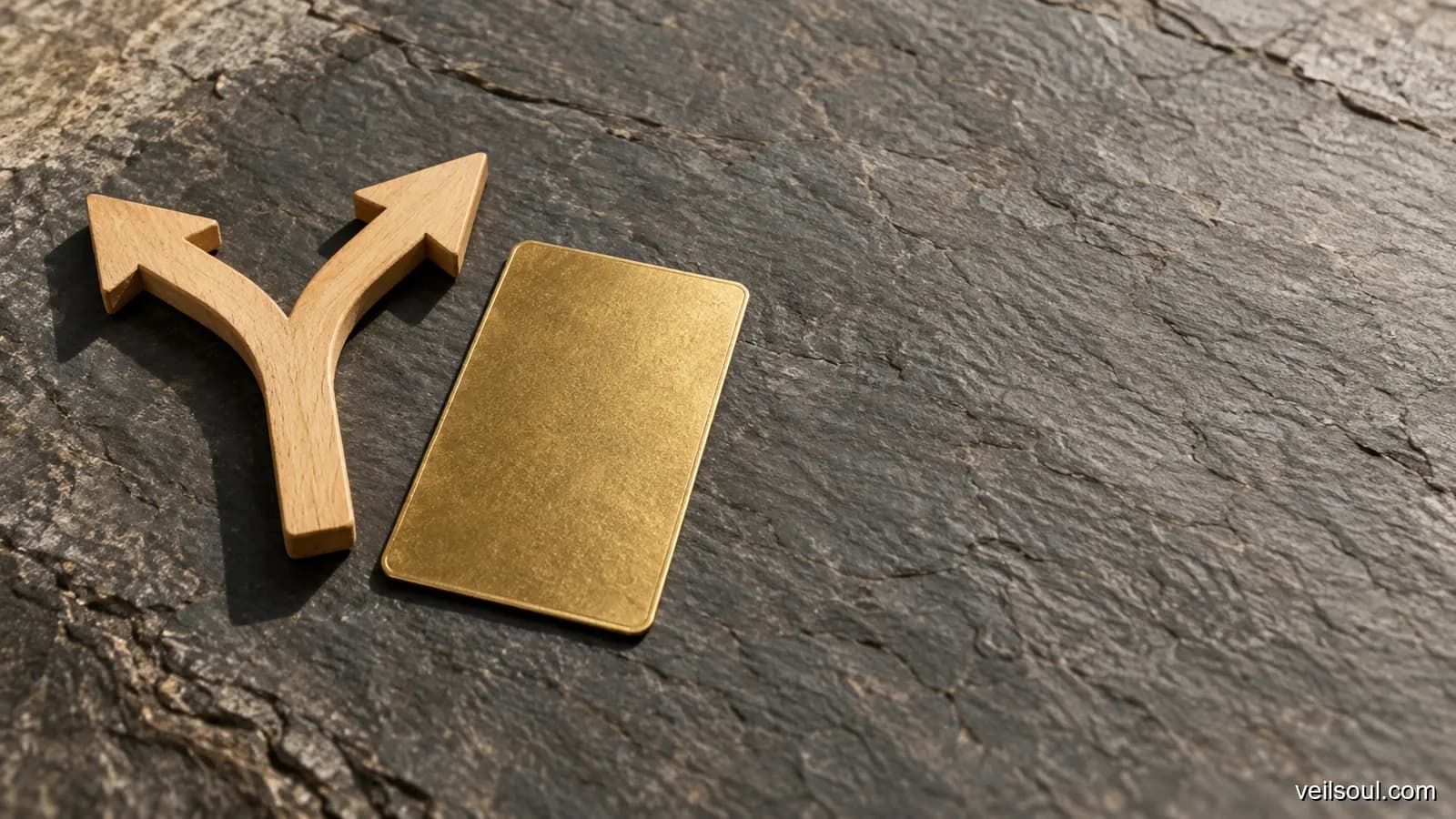
A decision making tarot spread works best when it puts both options on the table at once, so you can compare them card against card instead of reading each one in isolation. The Two Paths spread does that with seven cards: a root card for what the choice is really about, then three cards for each option showing how it begins, what it asks of you and where it tends to lead if you commit. It will not choose for you, and it cannot promise how either option turns out; what it gives you is a clearer picture of what each road costs and offers, so the choice you make is a considered one.
That last point matters when you are torn. A pros-and-cons list measures what can be counted, such as salary, rent or commute time. It struggles with the things that keep you awake at night: dread, relief, the pull of an option you cannot quite justify. Treat the cards as a mirror for your own priorities, then check what they raise against facts and against the people your decision affects.
At a glance, here is the layout, set out like a Y or a fork in the road:
- 1. The root: what this decision is really about, underneath the stated options.
- 2. Path A, the start: how the first weeks of option A are likely to feel.
- 3. Path A, the cost: what option A asks you to give up or face.
- 4. Path A, the direction: where option A tends to lead if you commit fully.
- 5. Path B, the start: how the first weeks of option B are likely to feel.
- 6. Path B, the cost: what option B asks you to give up or face.
- 7. Path B, the direction: where option B tends to lead if you commit fully.
Lay card 1 at the bottom center, then cards 2, 3 and 4 in a column rising to the left and cards 5, 6 and 7 in a column rising to the right. The two columns branch from the root like a road splitting in two.
Before you shuffle: name both options
Much of the clarity in a decision reading is won before a single card is turned. A fuzzy question ("What should I do with my life?") produces a fuzzy spread, because no position has anything concrete to describe. Spend five minutes on the setup.
First, write each option as an action you could actually take this month. "Path A: accept the offer from the design studio and give notice by Friday. Path B: stay in my current role and ask my manager for the lead position." Specific verbs keep the cards anchored. If one option is "do nothing," name what nothing looks like in practice: staying in the apartment, keeping the current schedule, not sending the message.
Second, decide which option is A and which is B before you shuffle, and do not swap them afterward. It sounds obvious, yet it is tempting to reassign the columns once you see which side holds the friendlier cards.
Third, set a time frame. "Over the next six months" gives the start and direction positions a shared horizon, so you compare like with like.
Finally, notice what you are hoping to see. If you already lean toward one path, say so out loud. That is not a flaw in the reading; it is information. When the cards land, you will be able to tell whether you are reading them or reading your hope into them. The broader guide to tarot for decision making shows how to turn a vague dilemma into a question the cards can actually answer.
The seven positions, card by card
Each position asks its own question. The examples below show how a single card shifts meaning depending on where it falls, which is the skill this spread trains.
Position 1: the root of the choice
The root sits beneath both paths because it describes something that travels with you whichever way you go. Ask: what is this decision really about? The answer can differ from the question you wrote down. Someone weighing a move from Tokyo to Osaka might draw The Devil here. The card points away from geography and toward attachment: a habit, a relationship or a fear that would follow them to either city. The useful question then becomes "what am I tied to, and do I want to keep it?" rather than "which city?"
Read the root first and keep it in view while you read the paths. A later section looks closely at several root cards that can reframe a decision on their own.
Positions 2 and 5: how each path begins
The start cards describe the first stretch of each road: the mood, pace and practical demands of the first weeks or months. A hard start does not make a path wrong. The Tower in position 2 says that option A begins with upheaval: a structure you rely on gives way, and the early weeks feel unsettled. What the card asks is whether you have the support and reserves to get through a rough opening.
Compare the two start cards directly. If option A opens with the Ace of Wands, a spark of new energy and eagerness, while option B opens with the Four of Swords, a pause for rest and recovery, you are looking at a path that begins with momentum against one that begins with breathing room. Neither is better in the abstract. The right one depends on whether you are depleted or restless right now.
Positions 3 and 6: what each path asks of you
Every option has a price, and these two positions name it. They are the most honest part of the spread, because they describe what you would trade away. The Five of Cups in position 3 says option A involves grief or disappointment: something will be lost, and you will feel it. The card also holds a reminder that not everything is spilled. The loss is real, and it can be carried.
When you compare the two cost cards, ask which price you can afford at this point in your life, not which one sounds smaller. A cost you can carry now may be heavier in a year, and the reverse is also true. Timing is part of a sound choice.
Positions 4 and 7: where each path tends to lead
The direction cards describe where each road points if you walk it with commitment, without spending the whole journey looking back at the fork. They are not fixed outcomes. They describe a trajectory that your later choices, other people and plain luck will keep shaping. Read them as "where this is heading if I give it a fair try" rather than "what will happen."
One question helps more than any other here: which version of yourself would you rather become on the way there? A direction card can look appealing and still describe a person you do not want to be. Another can look modest and describe a life that fits.
Reading the two paths side by side
Resist reading path A from bottom to top and then path B. Read across instead: position 2 against position 5, then 3 against 6, then 4 against 7. The contrast between paired cards carries most of the meaning in this spread.
Start with the beginnings and notice your body's response as you look at each. Note it down as evidence, not as an order. Then move to the costs and be strict with yourself, because it is easy to wave away the cost on the path you already prefer. Finally, read the directions and ask the question above about who you become.
A few patterns help you weigh the pairs:
- Major against minor. A Major Arcana card in one column and only minor cards in the other can mark the path with the larger life theme, the one that may reshape more than the practical details.
- Suit clues. Wands point to drive and ambition, Cups to feelings and relationships, Swords to thinking, conflict and hard truths, Pentacles to money, work and the body. A path heavy in one suit tells you which part of life it will press on.
- Reversals. A reversed card in this spread describes friction, delay or an inner block within that stage, not a verdict on the path. Several reversals in one column suggest the option needs more preparation before you take it, rather than that it is closed for good.
Root cards that reframe the decision
Any card can sit in position 1, but a few cards change the conversation so sharply from the root that they are worth knowing in advance. Each one below includes how to read it upright and reversed.
Two of Swords: the information you are not looking at
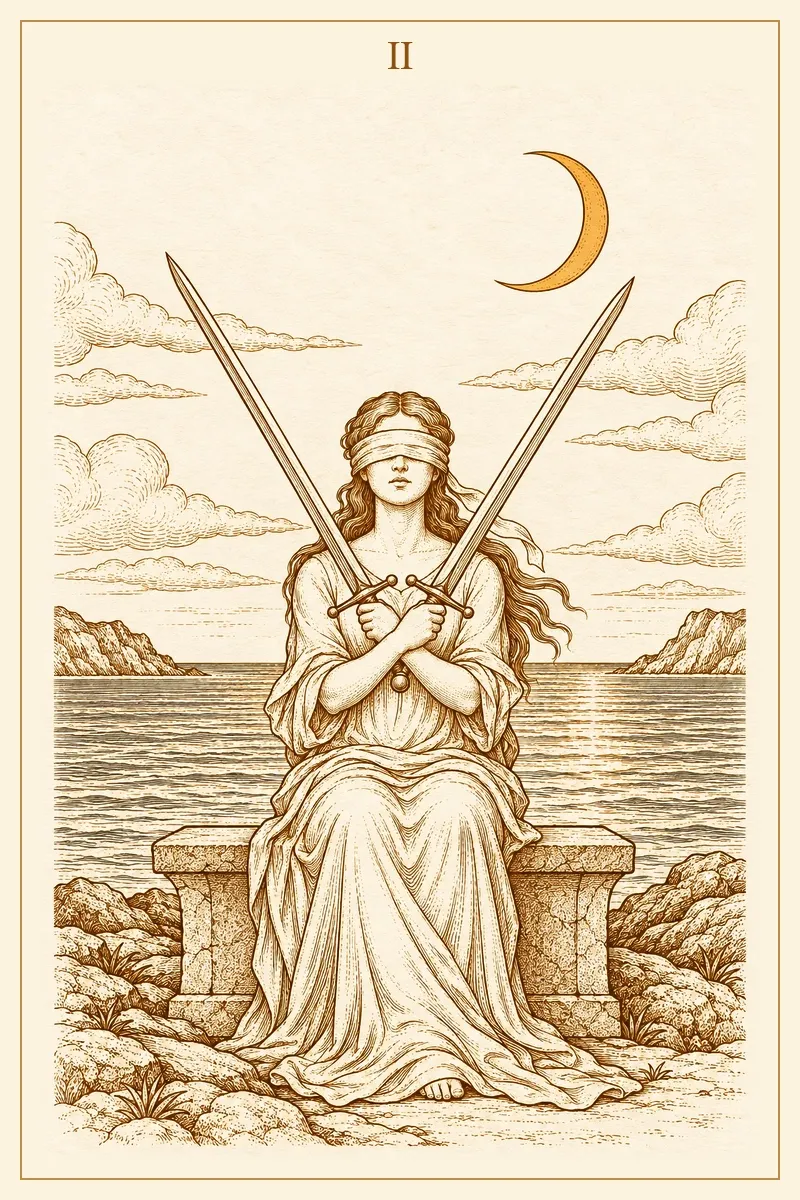
A blindfolded woman sits on a stone bench by the sea, two swords crossed over her chest, a thin crescent moon above her. As a root card, the Two of Swords says the stalemate is partly self-imposed. You may already hold the information that would settle this, and the deadlock is protecting you from acting on it. Ask: what am I refusing to look at? The full Two of Swords tarot meaning explores how this card balances calm against avoidance.
Reversed, the blindfold starts to loosen. The facts are arriving whether you want them or not, and the decision may be forced on you if you wait much longer. That is a reason to choose deliberately while you still have room to do so.
The Moon: fear in the driver's seat
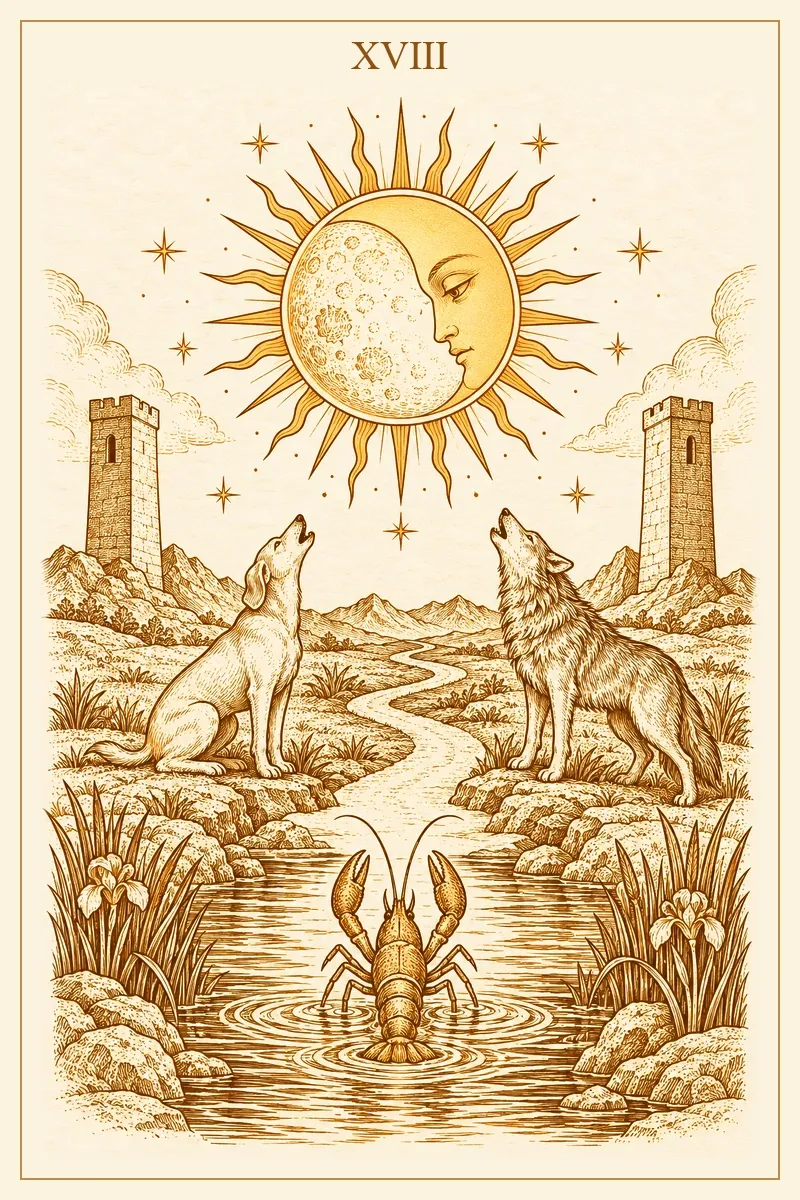
Between two towers, a dog and a wolf howl toward a calm moon face ringed by golden rays, while a crayfish climbs out of a pool onto a winding path. The Moon as the root says fear and uncertainty are steering this decision more than values or facts. That does not make the fear foolish; it makes it worth naming. Write down exactly what you are afraid of on each path, then sort which fears are about real risks and which are about the unknown. You can read more in The Moon tarot meaning.
Reversed, the fog is lifting. Something that looked threatening is coming into focus, and it may turn out smaller than it seemed. Give yourself a few days for the clearer picture to settle before you decide.
The Lovers: a choice about values
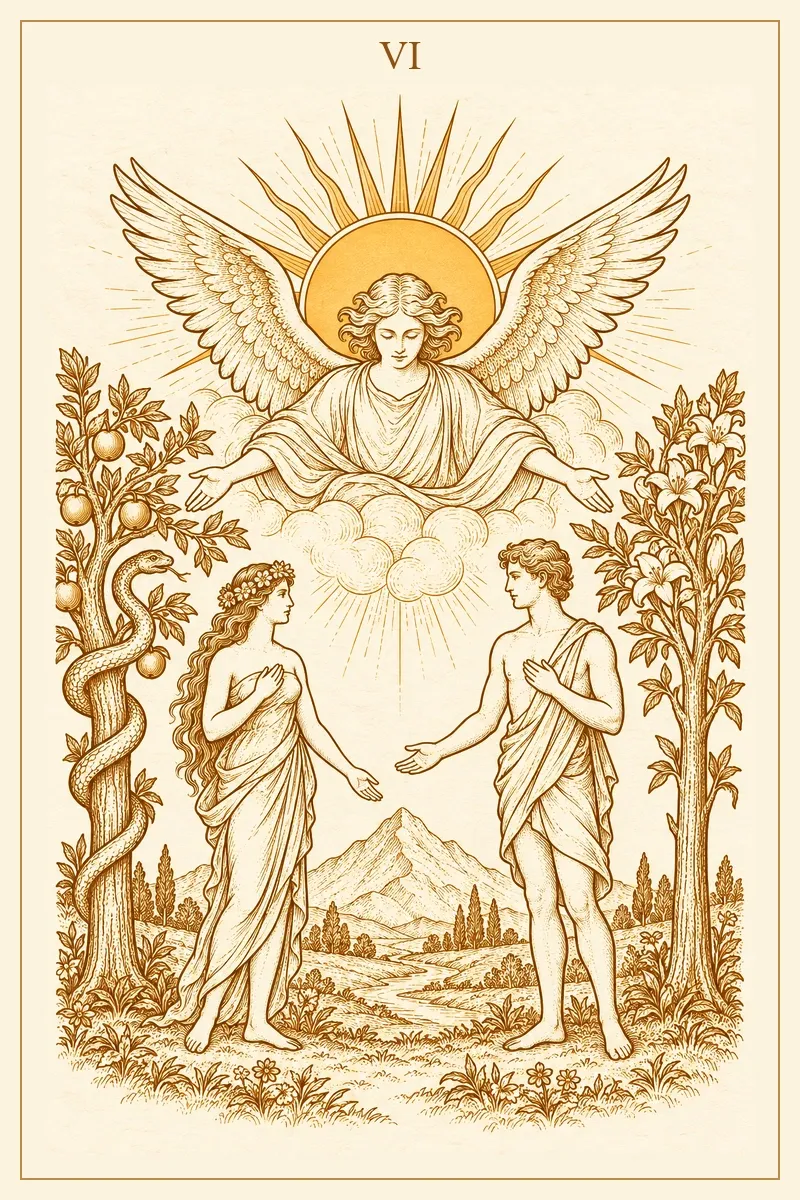
Two figures face each other beneath an angel and a rising sun, with a tree wrapped by a serpent on one side and a flowering tree on the other. Unless your question is about romance, The Lovers in the root is about alignment: which path fits what you care about most, rather than what is convenient or what others expect. Try ranking your three most important values before reading the paths, then see which column serves them. The Lovers tarot meaning goes deeper into the card as a card of choice.
Reversed, the card points to a split between what you say you value and what you are doing, or to a choice shaped mainly by pleasing someone else. Ask whose voice is loudest in this decision.
Wheel of Fortune: a decision with its own momentum
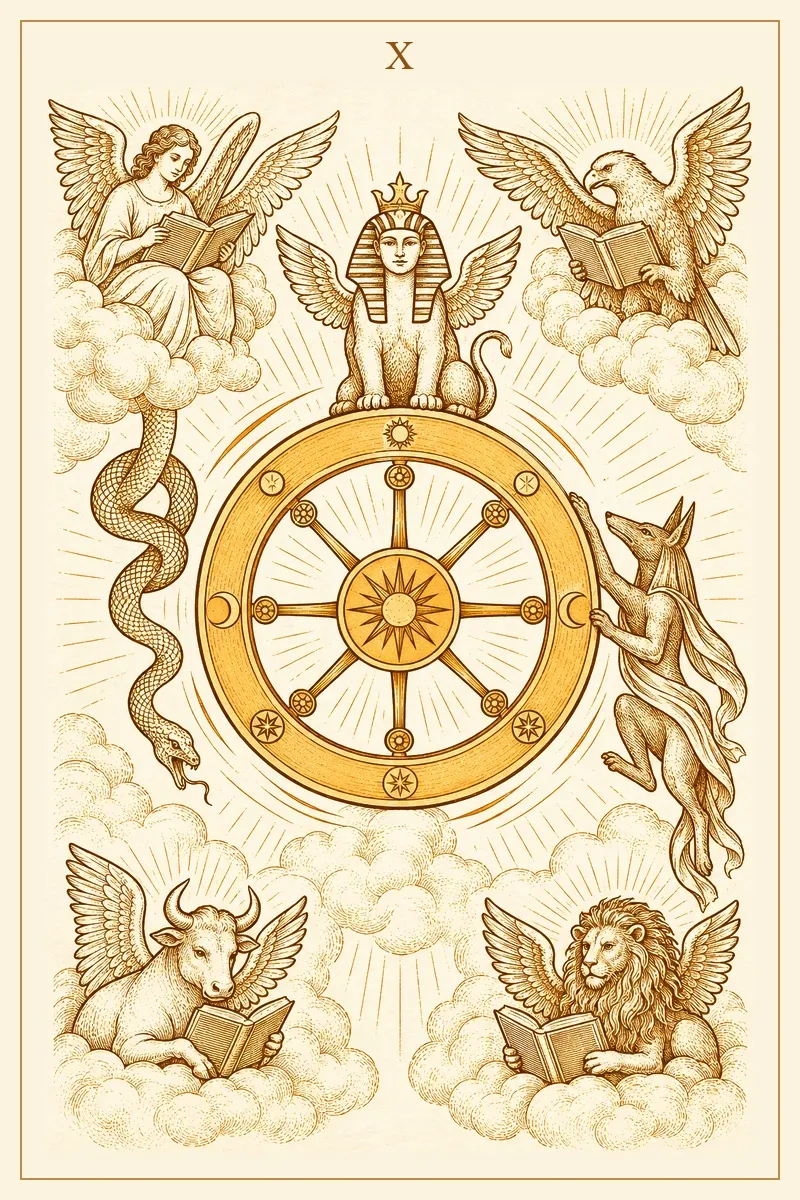
A golden wheel turns among clouds with a sphinx seated on top, a serpent sliding down one side and a jackal-headed figure rising on the other, while four winged creatures read in the corners. The Wheel of Fortune as the root says circumstances are already moving, and part of this decision is out of your hands. Both paths may be workable; what matters is that you get on board rather than freeze. See the Wheel of Fortune tarot meaning for the card's themes of cycles and turning points.
Reversed, the timing feels off or a setback is in play. Look for what you can control, such as preparation, savings and conversations, and stop trying to force the rest.
The Hermit: the answer needs quiet first
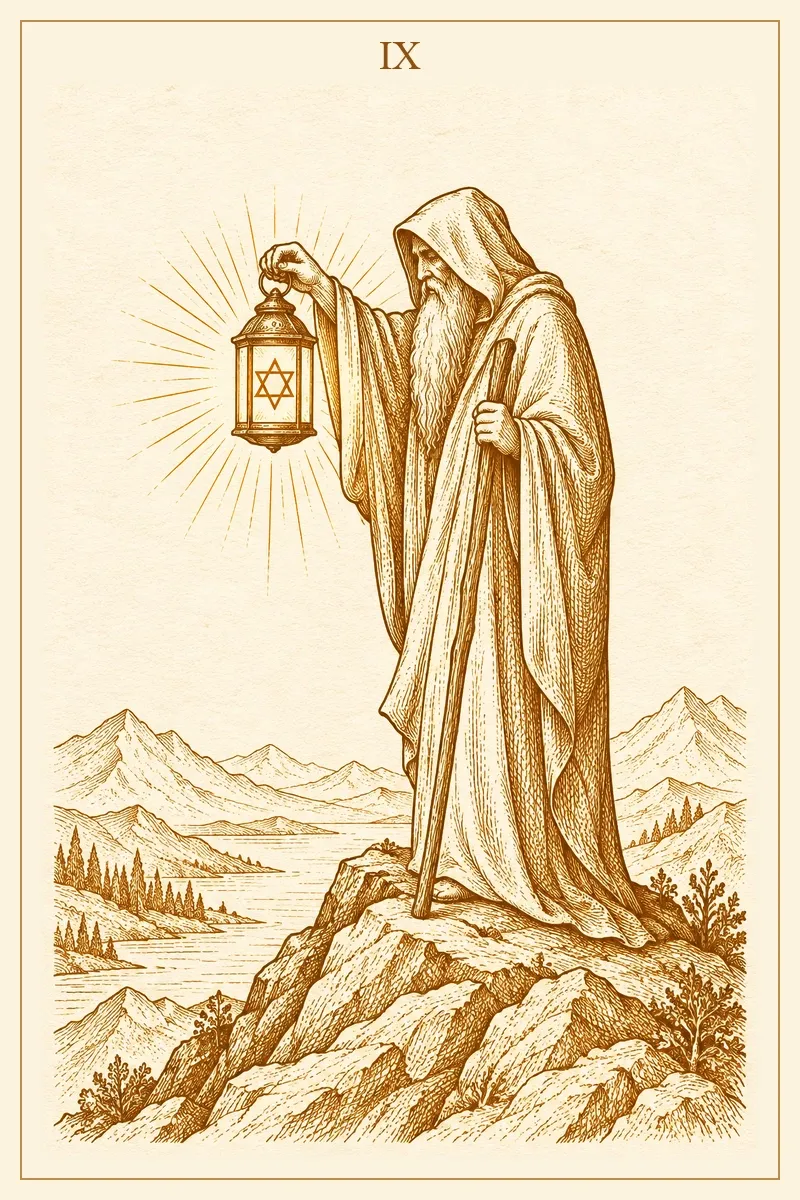
A hooded figure stands alone on a rocky peak, holding up a lantern with a star inside and leaning on a staff. The Hermit in the root says the decision depends on something you have not yet worked out on your own. Picture someone choosing whether to propose now or wait a year: if both paths show warm cards and the root is The Hermit, the timing matters less than whether they feel settled in themselves. Time alone, journaling or a few sessions with a counselor may matter more than the choice itself. The Hermit tarot meaning covers its call for reflection.
Reversed, the card can point to isolation that has gone on too long, or to avoiding advice you need. Ask one trusted person to listen before you decide.
A worked example: two job offers
Here is how the spread reads in practice. Imagine a reader with two offers on the table. Path A is a stable role at a large company with good benefits. Path B is a riskier role at a young startup doing work that excites them. Their time frame is the next year.
- Root: Two of Wands, planning and the pull between a known base and a wider world.
- Path A, start: Ten of Pentacles, security, structure and long-term stability.
- Path A, cost: Four of Cups, boredom and a nagging sense of "is this it?"
- Path A, direction: Nine of Pentacles, comfort and independence earned over time.
- Path B, start: The Fool, a leap into the unfamiliar.
- Path B, cost: Seven of Wands, defending your position under steady pressure.
- Path B, direction: The Star, renewed hope and a sense of purpose.
The root sets the frame. The Two of Wands is a planning card: the reader is not choosing between safety and chaos so much as deciding how far beyond familiar ground they want to reach. That shifts the question from "which offer is better?" to "how much expansion do I want this year?"
Reading across, the starts contrast settled order with a leap. The costs are the honest heart of it. Path A asks for patience with routine; the Four of Cups suggests the reader may feel restless or flat inside the security. Path B asks for stamina; the Seven of Wands describes a job where they will keep defending their ideas and their seat at the table. The directions differ in kind: the Nine of Pentacles points to material comfort and self-reliance, The Star to meaning and renewed energy.
Neither column reads as a warning sign. What the spread lays out is a trade: steadiness with a risk of boredom, or meaning with a risk of exhaustion. The reader can now test each cost against facts. For path B, they might ask the startup how long its funding lasts and what an ordinary week looks like. For path A, they might ask the company how people grow into new roles, since the Four of Cups cost would weigh less in a job with room to move. Whatever they choose, they now know which price they are agreeing to pay.
When both paths look the same
Sometimes the two columns come out strikingly similar: warm cards on both sides, or difficult cards on both. That is not a failed reading. It sends you back to the root, and to one of three possibilities.
- The options matter less than the worry. Both roads lead somewhere workable, and the real burden is the fear of choosing wrong. In that case, pick the path you can begin soonest and stop spending energy on the comparison.
- The question is aimed at the wrong thing. The spread may be answering a different question from the one you asked. Read the root again, write down the question it suggests, and consider laying a new spread for that question on another day.
- A third option is hiding. Draw one extra card and ask, "What am I not considering?" The answer might be negotiating instead of leaving, combining parts of both options, or waiting for one missing piece of information before deciding.
Variations for other kinds of choices
The two-column layout adapts to a wide range of decisions with small changes.
Doing something or not doing it. When there is only one real option, make path A "I do it" and path B "I don't." Choosing not to act has its own start, cost and direction, and seeing the cost of standing still laid out as clearly as the cost of change can be the most useful part of the reading.
Three options. Add a third column of three cards beside the other two, sharing the same root. Beyond three, the layout gets crowded and the comparison loses its edge. With four or five options, narrow the list first. A quick pull of one or two cards per option, like the layouts in five simple tarot spreads for beginners, can help you find the two or three finalists worth a full layout.
A move or relocation. If the choice is about where to live, a dedicated layout such as the should I move tarot spread adds positions for home, community and practical logistics that the Two Paths spread does not cover.
After the reading: from cards to a choice
A decision reading earns its keep only when it leads somewhere. These steps help turn what you saw into a choice you can stand behind.
- Write one sentence per path. Summarize each column as start, cost and direction in plain words: "Path A: a calm start, a risk of boredom, comfort later."
- Test each cost card against a fact. For every cost position, find one thing you can check in the real world: a number, a conversation, a contract clause. The card raises the question; the fact answers it.
- Leave the layout alone for the rest of the day. If the result is uncomfortable, sit with it. A second spread laid out an hour later tends to show your hopes more than the choice itself.
- Try the coin toss, then watch your reaction. Assign path A to heads and path B to tails, then flip. The coin decides nothing; the flicker of relief or disappointment you feel when it lands is what you are listening for.
- Set a decision date. Give yourself a window of a few days to a week, depending on the stakes, and write the date down. A deadline helps you act before what you saw in the reading gets buried under daily noise.
Frequently asked questions
Can a tarot spread tell me which option is right?
No. A spread cannot know how either option will turn out, what other people will decide, or what the future holds for certain. It helps you see your own priorities, fears and blind spots more clearly. Combine what the cards raise with facts and timing, and for legal, medical or financial decisions, with advice from a qualified professional.
Can I use this spread for more than two options?
Yes, up to three. Add a third column with the same three positions. For more options, narrow them down first with a short pull per option, then bring the finalists to the full layout.
What if I am deciding whether to do something at all?
Treat doing it as path A and not doing it as path B. Staying where you are is still a choice, and the spread shows what the status quo costs as clearly as it shows what change costs.
Can I lay the spread again if I dislike the result?
Wait at least a few days, and use the time to notice why the answer bothers you. If something real has changed, such as new information or a different offer, a fresh spread makes sense. Redrawing only because the first result was uncomfortable tends to blur the picture rather than clear it.
What if the path I fear has the better direction card?
Then take the fear seriously and look at it closely. A direction card you resist can point to growth that asks you to become someone you are not yet sure you can be. Ask what support, skills or time would make that path feel possible, and whether you could build them first.
Letting one path go
The hardest moment in a decision can arrive after the cards are clear. Every choice includes a quiet agreement to release the other road, and no layout softens that. What the Two Paths spread can do is let you make that agreement with your eyes open: you know what you are taking on, what you are paying, and who you hope to become on the way.
If you are standing at a fork right now, you can lay out your own reading with Veil Soul and compare your two paths at your own pace.