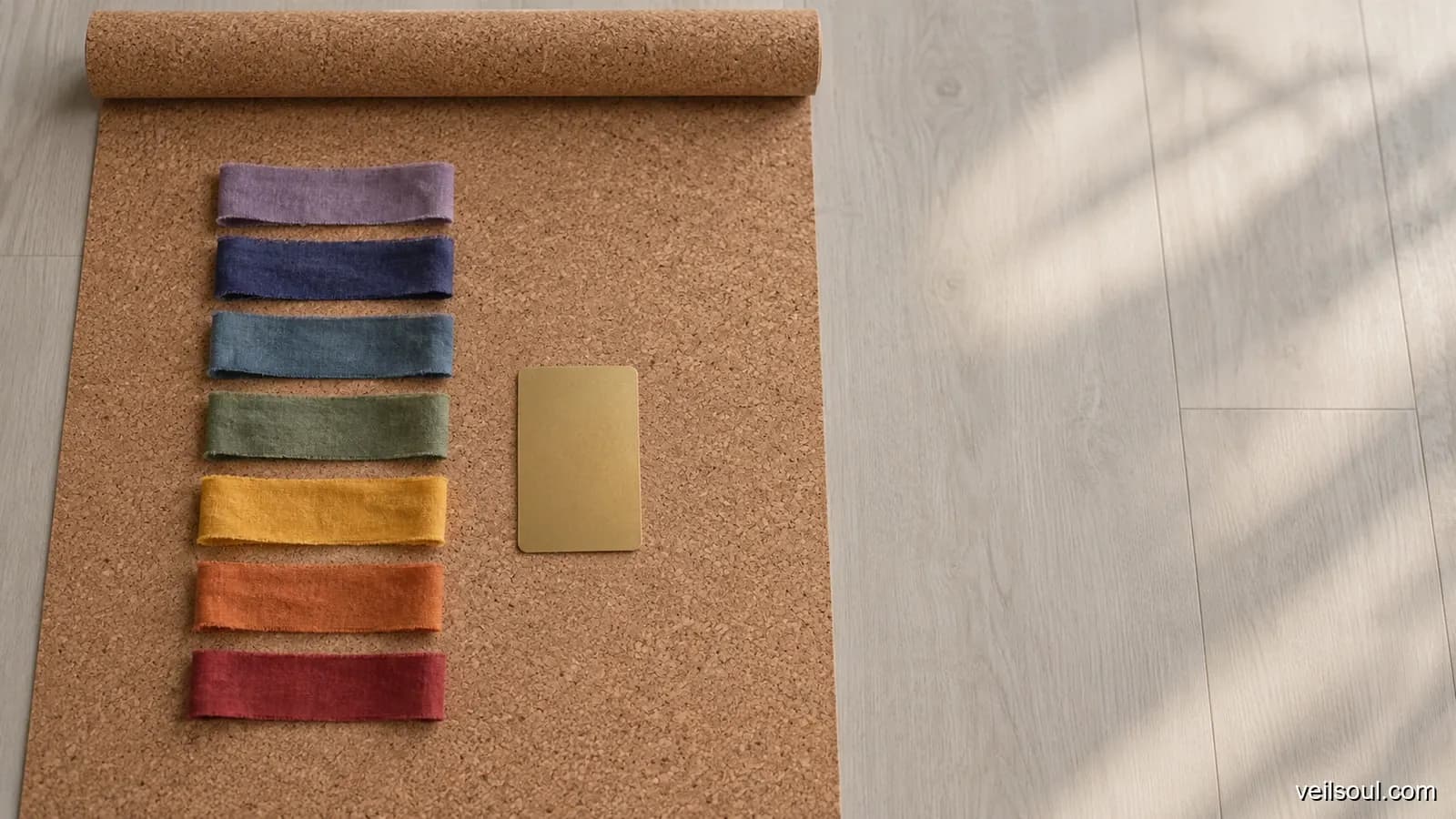
A manifestation tarot spread is a six-card layout that turns a wish into a plan. Three cards look inward at what you say you want, what quietly blocks it and what you want underneath; three look outward at what already supports you, the action that is yours to take and the season you are in. Lay the cards in two rows of three, read the top row first, and finish by choosing one step you can take this week. Tarot works here as a mirror for intention and effort: it cannot draw money, health or a particular person to you, confirm what anyone else will do, or name the date something arrives.
It suits any goal you can put in one sentence, from a savings target to a creative project or a new habit, and is less useful for outcomes that rest entirely on someone else's choice.
The six positions at a glance:
- 1. The Surface Desire: the goal as you would say it out loud.
- 2. The Block: the inner habit, fear or belief that keeps the goal at arm's length.
- 3. The Hidden Desire: the feeling or freedom you hope the goal will bring.
- 4. The Supportive Energy: skills, people and resources already on your side.
- 5. The Required Action: one concrete step within your control.
- 6. The Timeline Energy: a season for planting, tending or harvesting, never a date.
Setting up the spread before you shuffle
Start with a sentence, not a mood. "I want more abundance" gives the cards nothing to push against; "I want to save a three-month cushion by next summer" or "I want to finish the first draft of my novel" does. Write the sentence at the top of a page, then underline the verb. If there is no verb you control, rewrite it until there is.
Lay the cards in two rows. The top row (positions 1, 2 and 3, left to right) is the inner landscape: the stated goal, the snag and the deeper wish. The bottom row (positions 4, 5 and 6) is the outer path: support, action and timing. Read them in that order: jump to the action card before you understand the hidden desire, and you may work hard toward a version of the goal that would not satisfy you.
Many readers like to lay this spread at the start of a lunar cycle, and the monthly practice in new moon intention setting with tarot pairs naturally with it. A new moon is not required, though. A quiet morning, a fresh notebook page and twenty unhurried minutes work just as well.
Decide before shuffling whether you read reversals. If you do, a reversed card shows the same theme blocked, hidden or overdone. If you do not, read a card's harder side in the Block position and its supportive side elsewhere. Either way, choose before you see a card you dislike.
The six positions and how to read them
Each position below has a job, a way to read an upright and a reversed card, a sample question to write beside it, and one example card. The examples are illustrations, not the only cards that fit.
Position 1: The Surface Desire
This card describes the goal as you currently hold it, the version you would tell a friend. It shows the shape your wish has taken so far and, sometimes, the borrowed language you use for it.
Upright, the card usually confirms that the goal is clear and that you know what you are asking for. Reversed, it can suggest the goal is vague, inherited from someone else's expectations, or more about appearances than about your daily life. A reversal here simply tells you to rewrite the intention sentence before going further.
Sample question: "What do I believe I want, in plain words?" If the Ten of Pentacles lands here, the stated goal may be long-term security, a home or something to pass on to family. Ask whether that picture is yours or one you grew up being shown.
Position 2: The Block
The Block is the most honest card in the layout. It points to an internal pattern rather than an outside obstacle: a fear of being seen, a habit of starting over, a belief that rest must be earned, a quiet comfort in wanting that feels safer than the risk of having.
Upright, the card names the pattern directly. Reversed, it may show a block that is already loosening, or one hidden so well that it shows up as procrastination or busywork. Either way, a block you can name is a block you can work with.
Sample question: "What do I do, or avoid, that keeps this goal at a distance?" The Devil here often points to attachment to the familiar: a routine, a spending habit or a self-image that feels safer than change. Reversed, it can show the grip relaxing, and the next step is to notice what you are ready to set down.
Position 3: The Hidden Desire
A goal is usually a container for a feeling. Someone who asks for a promotion may want recognition or more say over their days; someone who wants a bigger savings balance may want to stop flinching when a bill arrives. The hidden desire is that feeling.
Upright, the card shows the need underneath in a form you can feed directly, often more simply than the surface goal suggests. Reversed, it may show a need you have been denying yourself, or one you have been trying to meet in a way that keeps backfiring.
Sample question: "What do I hope to feel once this is real?" The Sun here suggests the deeper wish is plain joy and energy, feeling alive and visible without apology. Joy can be practiced this week, long before any larger goal arrives.
Position 4: The Supportive Energy
This card shows what is already working for you: a skill, a relationship, savings, time, a place, a habit you have kept for years without noticing. You rarely start from nothing.
Upright, the card highlights a resource to lean on. Reversed, it can show support that exists but is underused, or one you are draining by giving more than you receive.
Sample question: "What is already growing that I can tend?" The Empress here points to nurture and steady growth: a body of work, a circle of people who already know you, or a home that feeds you. Reversed, she may ask whether care for yourself has slipped to the bottom of the list.
Position 5: The Required Action
This card answers "what do I actually do?" and the answer should be small enough to start within a few days. If the card seems to call for something large, look for its first visible step.
Upright, the action is usually direct: practice, ask, apply, publish, save, rest. Reversed, the card may describe an action you are overdoing, such as research that never turns into a first attempt, or one you keep postponing because it feels exposed.
Sample question: "What is one step within my control this week?" The Eight of Pentacles here asks for steady practice: thirty minutes on the skill your goal depends on, repeated until it feels ordinary. Reversed, it can warn against perfectionism, or against repetitive work that no longer teaches you anything.
Position 6: The Timeline Energy
This position describes the kind of season you are in, not a date, so your expectations match the work. Planting seasons ask for small starts and patience. Growing seasons ask for tending and honest checks. Harvest seasons ask you to gather, celebrate and decide what comes next.
Upright, read the card's pace: quick cards suggest momentum, slow cards suggest patience. Reversed, it can point to impatience, an old plan that needs adjusting, or a season you are trying to skip.
Sample question: "What pace fits this goal right now?" The Seven of Pentacles here describes a growing season: the seeds are in, the fruit is not ripe, and the job is to check what is working and adjust. Reversed, it may ask whether you are pouring effort into something that has stopped giving anything back.
Cards that often appear in manifestation work
Any card can land in any position, but a handful turn up often when the question is about bringing a goal into the world. Here is how five of them read in this spread.
The Magician: using what is already on your table
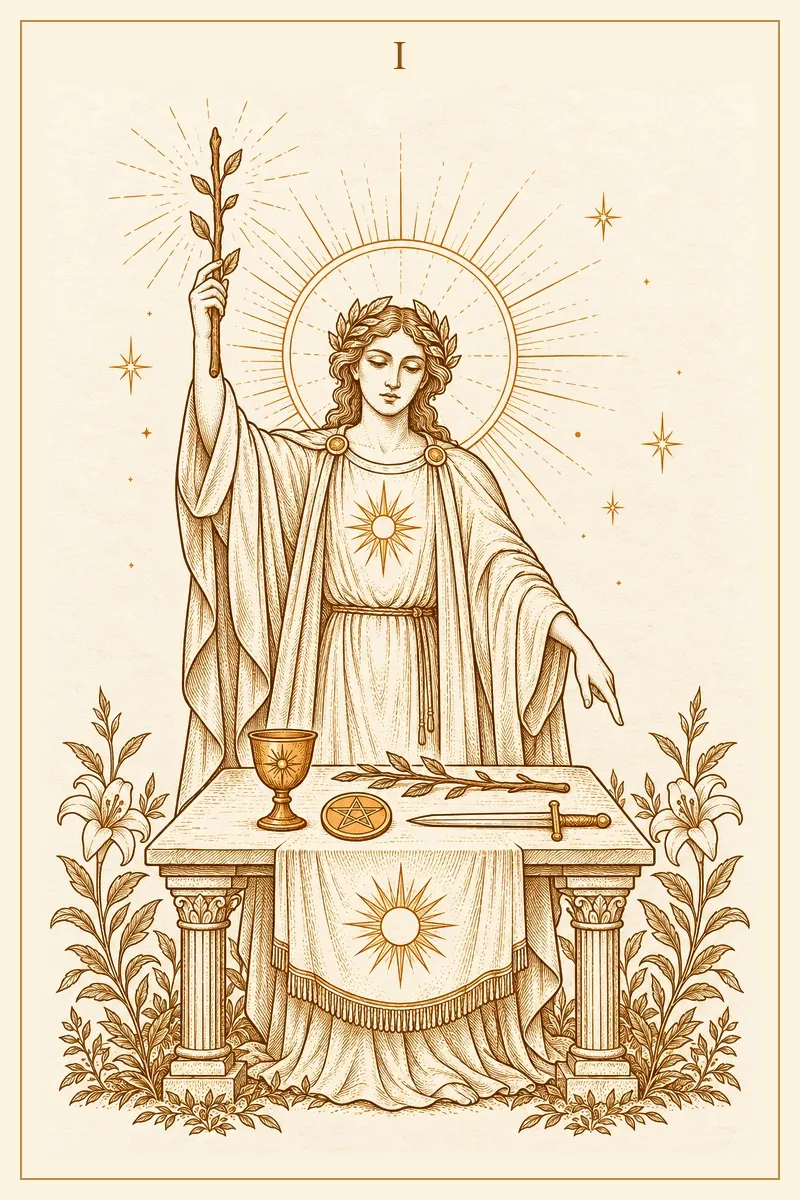
The Magician is the card most people link with manifestation, and the image shows why. A laurel-crowned figure raises a leafy wand with one hand and points toward the ground with the other, while a cup, a pentacle, a branch and a sword lie on the table below. Everything needed is already laid out. The card is about joining intention to skill, not about conjuring something from thin air.
Upright, The Magician says you have enough tools to begin. In the Required Action position, it asks you to stop gathering resources and use them. In Supportive Energy, it names your own focus and resourcefulness as the asset. Reversed, it can show scattered effort, skills left unused, or a plan that promises more than it can deliver; ask whose permission you are still waiting for. The full Magician tarot meaning covers love, career and money readings in more depth.
Ace of Pentacles: a seed you can hold
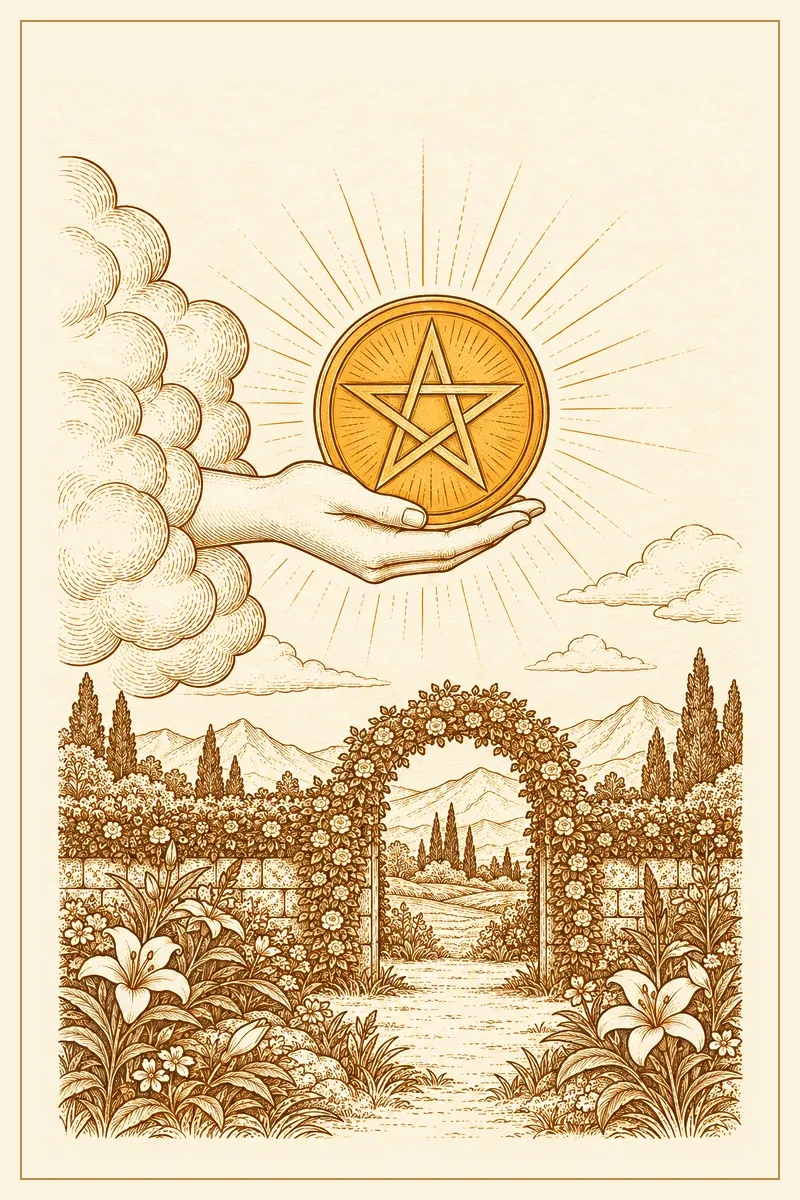
In the Ace of Pentacles, a hand reaches out of a cloud holding a golden pentacle, and below it a garden path runs through an arch of flowers toward distant mountains. It is the card of a concrete opening: a job lead, a first client, a small sum to start with, a plan you can touch.
Upright, it suggests the beginning is practical and within reach. In Required Action it asks for the first tangible step, such as opening the savings account or sending the proposal. Reversed, it can point to an opportunity you are not yet ready to use, a plan that skipped the groundwork, or a start delayed by waiting for perfect conditions. It does not promise money; it shows where a real beginning could be. More detail is in the Ace of Pentacles meaning.
Nine of Cups: the wish and what it is for
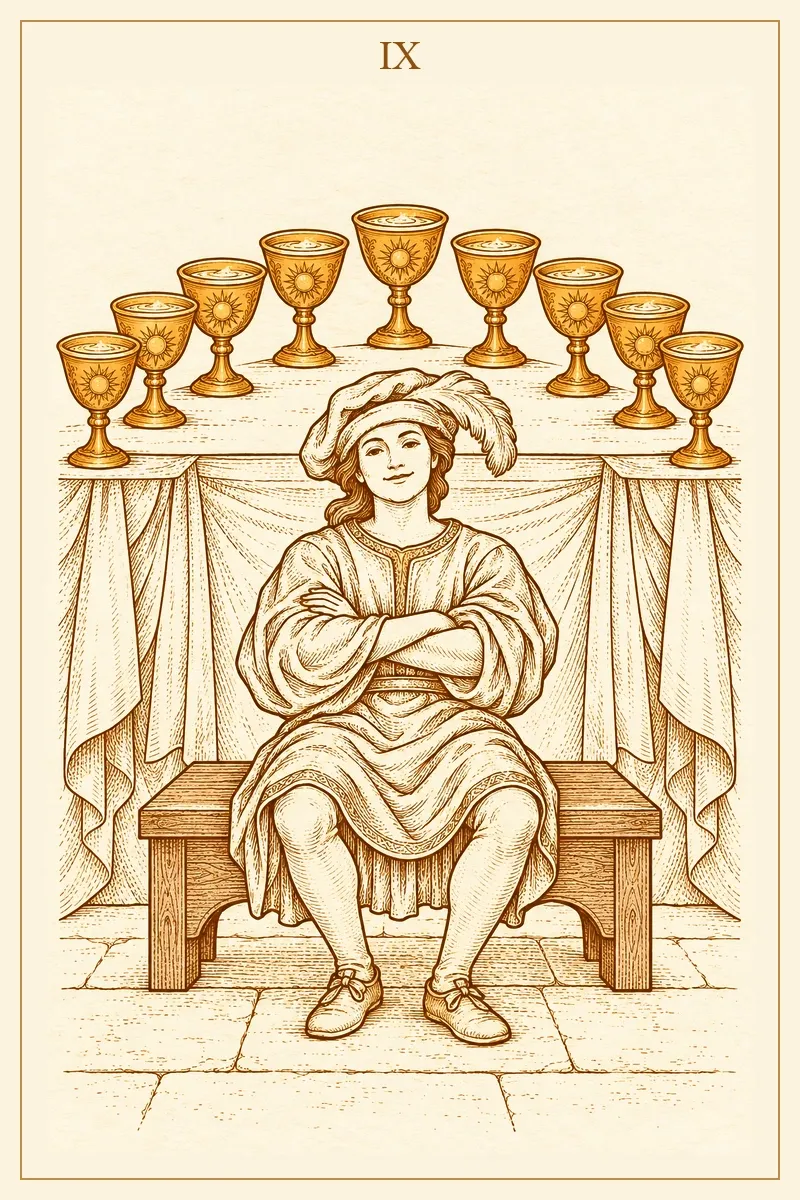
The Nine of Cups is often called the wish card. A smiling figure in a feathered cap sits on a wooden bench with arms crossed, nine golden cups arranged in an arc on the draped table behind. The pose is satisfied, almost smug, and that is part of the card's question: is the wish about contentment, or about being seen to have it?
Upright, it confirms that a goal is clear and that reaching it would bring real satisfaction. In the Hidden Desire position, it can say the deeper wish is simply to feel at ease with what you have. Reversed, it may show a wish that would not satisfy you once granted, an appetite for more that crowds out enjoyment, or a goal chosen for display. Read the Nine of Cups tarot meaning for its love and career angles.
The Star: hope that needs tending
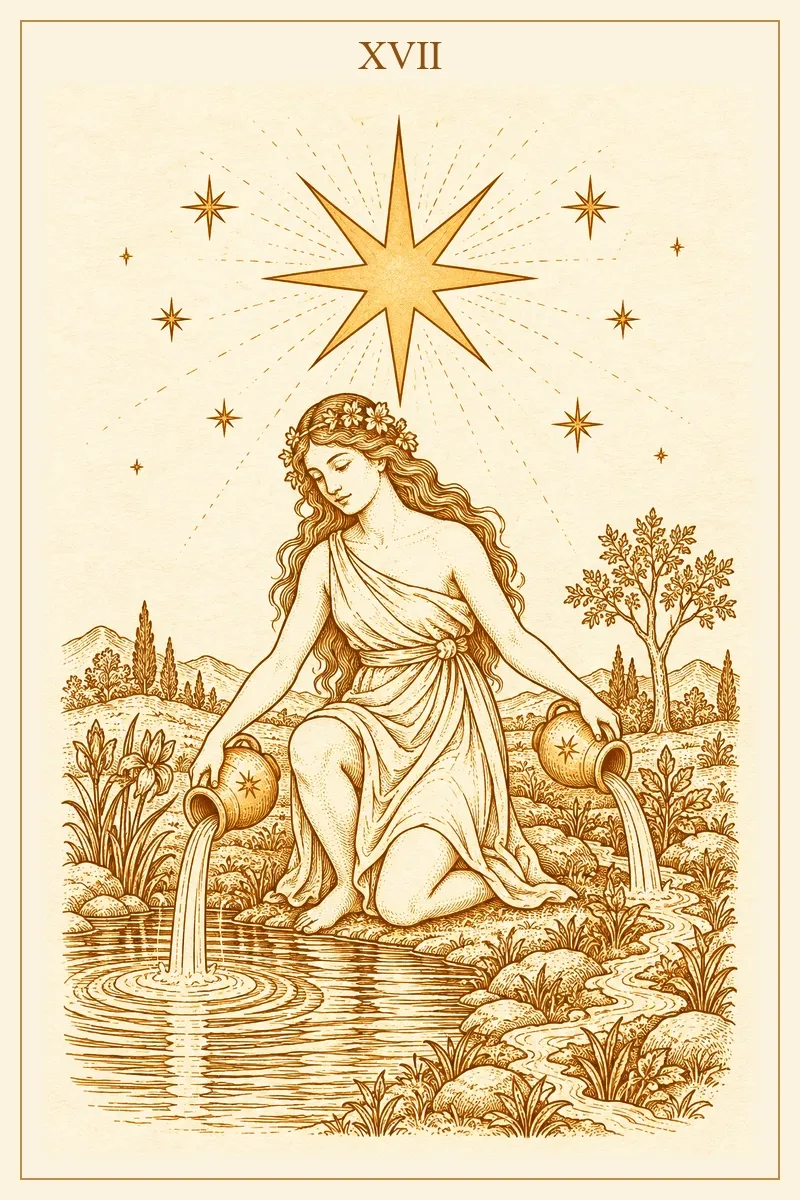
In The Star, a woman with flowers in her hair kneels at the edge of a pool and pours water from two jugs, one into the pool and one onto the land, beneath a large eight-pointed star and a scatter of smaller ones. The card speaks of renewal after a hard stretch: quiet hope, generosity and a sense of direction.
Upright, The Star often appears when an intention is sincere and gently paced. In the Hidden Desire position, it can show that what you want underneath is to believe in your own future again. Reversed, it may point to discouragement, or to giving so much that nothing is left to pour; then the action is replenishment before ambition. The full Star tarot meaning explains its reversals in more depth.
Three of Wands: looking past the first step
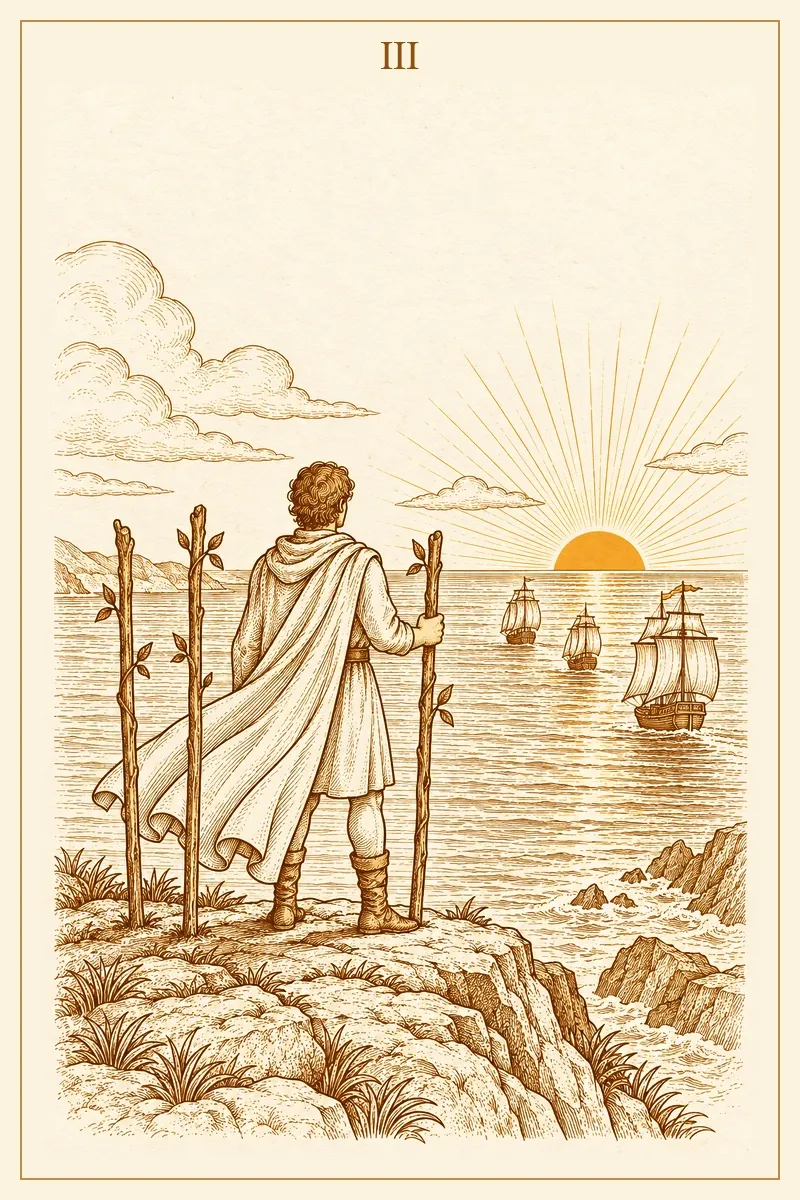
The Three of Wands shows a cloaked figure on a cliff with their back turned, one hand on a staff and two more staffs planted nearby, watching ships cross the sea toward a low sun. Work has been sent out, and the card asks you to look ahead and prepare for what comes back.
Upright, it suggests expansion: a project ready for a wider audience, a plan worth stretching beyond your usual circle. In Timeline Energy, it describes a season in which early efforts begin to return. Reversed, it may show delays, plans kept too small, or frustration that results are slower than hoped; ask whether you have actually sent anything out yet. See the Three of Wands meaning for more context.
A worked example: a side income from illustration
The reading below is a made-up example that shows the method. Imagine someone who draws in the evenings and writes this intention: "I want to earn a steady side income from my illustration within a year."
- Surface Desire: Ace of Pentacles, upright. The goal is concrete and material, and the card agrees it is a reasonable seed. Nothing to rewrite yet.
- The Block: Seven of Cups, upright. Too many options: a shop, commissions, a course, stickers, a newsletter. The block is not a lack of talent but a refusal to choose, because choosing means some ideas will not happen.
- Hidden Desire: The Star, upright. Beneath the income goal is a wish to trust that the work is worth sharing. Money is the measure this person picked, but hope and recognition are what they are missing.
- Supportive Energy: Page of Pentacles, upright. A learner's steadiness. They have drawn most evenings for years, and that habit is the asset.
- Required Action: The Magician, reversed. The tools are on the table but unused: a finished portfolio sits in a folder no one has seen. The action is to stop polishing and put three pieces in front of real people.
- Timeline Energy: Two of Wands, upright. A planning season, standing at the edge of the familiar. Not harvest yet; the next few weeks are for choosing a direction.
Read together, the top row says the goal is sound, the snag is indecision, and the deeper wish is to feel the work matters. The bottom row says the habit is already in place, the action is visibility rather than more preparation, and the season is early. The reader picks one path from the Seven of Cups list, commissions, and writes the step: "By Sunday, post three finished pieces and tell one person who has praised my work before that I am taking a commission."
The reading promised no clients, figure or date. It turned a vague wish into one choice and one visible action, with a reason to check back in a month instead of a reason to wait.
Intention and action, not magic
Manifestation is sometimes described as thinking a thing into being. This spread takes a plainer view: you get clearer about what you want, you notice what is in the way, and you act. The cards help with the first two by giving you images to think with. The third part is yours.
That framing keeps the spread honest. It cannot bring a specific amount of money, heal an illness, or make a particular person return or fall in love. When a goal involves health, debt or legal matters, use the reading to sort out your questions and then take them to a qualified professional. When a goal involves someone else's feelings, the spread can show what you want and what you can offer, but the other person's choice stays theirs.
It also keeps the spread kind. If an intention does not come about, that does not mean you wanted it wrongly or were not positive enough; circumstances, timing and other people shape every outcome. A good reading leaves you with more agency and less blame.
The shadow side, read without fear
Some cards in this spread can feel like a refusal. They are more useful read as a redirection: a sign that the plan needs a different foundation, a pause or a new goal.
- The Tower: a structure the goal rests on is not sound, such as a budget that only works on paper or a plan built to please someone else. Rebuild that part first.
- The Hanged Man: pushing harder will not help right now. Pause, look at the goal from another angle, and let the next step come from that new view.
- Death: especially in the Surface Desire position, the goal itself may be ending. What you wanted a year ago may not be what you want now, and letting it go makes room for a truer one.
Manifestation culture has a shadow of its own: pressure to stay positive can turn into self-blame. If the spread leaves you more anxious, or you find yourself drawing it daily for reassurance, put the cards away for a while. A clear intention survives a pause.
After the reading: turning cards into a plan
- Write the hidden desire in one sentence. Not the card name, but what it means for you: "What I actually want is to feel ___." Keep the sentence somewhere you will see it.
- Choose one action from Position 5 and give it a day. Make it small enough to finish within 72 hours. Thirty minutes of practice counts, and so does one honest email, one transfer into savings or one evening of real rest.
- Answer the Block with a counter-habit. If the block is indecision, set a deadline for choosing. If it is fear of being seen, share one thing with one trusted person first.
- Record the spread. Note the date, the intention sentence, the six cards and the step you chose. A simple tarot journal makes it easy to compare this reading with the next one.
- Set a check-in date, not a deadline for the universe. About a month out, look at what you did, what changed and whether the intention still fits. Folding the check-in into a monthly ritual like the ones in new moon tarot rituals gives the spread a steady rhythm.
Frequently asked questions
Can tarot make something manifest?
No. Tarot cannot bring money, health, a job or a person to you, and it cannot confirm another person's thoughts, a date or an outcome. What this spread can do is show your goal more clearly, bring up what gets in its way and point to an action you control. Any change comes from that action and from circumstances the cards do not decide.
Can I do a manifestation spread for someone else?
You can lay it with a friend, but let them write their own intention sentence and choose their own step. Reading it about someone who has not asked tends to become a reading about your hopes for them.
Can I use this spread to manifest a specific person?
The spread works best when the goal is something you can act on. "I want this person to love me" depends on someone else's choice. Try "I want to feel loved and chosen" or "I want to tell this person honestly how I feel," and read the cards as a guide to your side of it.
What if the hidden desire contradicts the surface desire?
That is often the most useful result. It suggests you have been working toward a goal that would not give you what you need. Spend a few days with the Position 3 card before acting. The prompts in tarot for self-discovery can help you put the deeper wish into words.
Does this spread work for money goals?
Yes, as long as you treat it as planning rather than a promise. A money goal often sits on top of a need for safety or freedom, and the spread may point to a step such as building a budget, asking for a rate review or learning a skill. It is not financial advice; for big decisions, talk to a qualified advisor.
How often should I repeat the spread for the same goal?
About once a month is plenty. Drawing again before you have acted tends to give you new images for the same unanswered question. Between readings, revisit your Position 5 card and ask whether you have taken the step it suggested.
What if most of the cards are reversed?
Read it as a sign that the intention needs inner work before outer action, not as a no. Rewrite the intention sentence, check whether the goal is truly yours, and choose a smaller step. Then lay the spread again at your next check-in.
Start with one honest sentence
Six cards will not decide your future, but they can help you see what you want, what stands in the way and what to do on Monday. When you are ready, write your intention first and begin a reading with Veil Soul, keeping the step you choose small enough to actually take.