
A birthday tarot spread is a reading you lay on or near your birthday to look at your personal year: the twelve months from this birthday to the next, rather than January to December. The usual shape is thirteen cards — one in the center for the keynote of the year, and twelve in a ring around it, one for each month, beginning with the month you turn. What it gives you is a shape for the year ahead: where it starts, where it is likely to ask something hard of you, and what you may be carrying when the same date comes around again.
It will not tell you what is going to happen. Tarot cannot name a date, confirm what another person is thinking, or promise how anything turns out, and a reading stretched across twelve months is the last place to expect that kind of certainty. What thirteen cards can do is hand you twelve prompts timed to the stretch of life you are actually in, with one idea at the center about what holds them together.
The birthday framing does real work here. A year that begins on your birthday is a solar return, and most people already take stock on that date without being asked to. The spread gives that private stocktaking a structure and a record you can return to.
Here is what each part of the layout is for, before you shuffle anything:
- The keynote (center): what this year is for, and the lens the other twelve cards are read through.
- The Threshold (your birthday month): the energy you walk in with.
- Months two to six: how the year builds, what tests it early, and where it finds its footing.
- The Midpoint Mirror (month seven): the half-year check, sitting directly across the circle from the month you turn.
- Months eight to eleven: the turn, the steady work, what you set down and what you gather.
- The Doorway (month twelve): what you will be holding when your next birthday arrives.
When to lay the cards around your birthday
The morning of your birthday, before the day fills with messages and plans, is the cleanest time to do it. Give it half an hour and somewhere you will not be interrupted.
The week on either side works just as well. If your birthday falls on a workday, or in the middle of a trip, or on a day you would rather spend with people than with cards, lay the spread the weekend before or the weekend after. The reading is anchored to the turn of your personal year, not to one sunrise.
If you like precision you can wait for the solar return itself, the moment the sun reaches the position it held at your birth, which lands within a day of your birthday. Treat that as a nice touch rather than a requirement; nothing in tarot depends on astronomical timing.
Two situations come up often. If your birthday passed months ago and you only now want the reading, lay it anyway, start the ring at the current month and run it to the month before your next birthday; you simply have a shorter year to map. And if the frame you actually plan by is budgets, school terms and work quarters, the year ahead spread runs January to December and does a similar job on the calendar's clock.
One thing to avoid: laying this spread at the end of a long birthday, tired and hoping the cards will say something cheering. That is when a difficult card lands hardest and gets read least fairly.
The Birthday Wheel: thirteen named positions
Shuffle while you hold one plain question — "what is this year for?" is enough — and deal thirteen cards face down. Twelve go in a ring like the numbers on a clock, with the month you turn at the top and the rest running clockwise. The thirteenth goes in the middle. Turn the middle card first, then work around the ring from the top.
Naming the positions matters more than the shape. Unnamed months tempt you to read each card as a forecast; named positions keep you reading one year with twelve stages.
- The Keynote (center). What the whole year is for. If this year had one job, what would it be?
- The Threshold (your birthday month). The energy you step in with, including what is still carried from last year.
- The First Push (month two). Where the momentum wants to go once the birthday is over.
- The Early Test (month three). The first real friction, usually small and usually revealing.
- The Ground (month four). What steadies you when the opening enthusiasm wears off.
- The Opening (month five). A door, an invitation, a chance you did not plan for.
- The Build (month six). The unglamorous middle work that needs repetition rather than inspiration.
- The Midpoint Mirror (month seven). Directly across the circle from the Threshold, reflecting the birthday month back at you half a year later.
- The Turn (month eight). Where the year changes direction or deepens.
- What You Set Down (month nine). The habit, obligation or story that gets left behind.
- The Gathering (month ten). What the year has produced, even if it is small.
- The Quiet (month eleven). The slowing before the circle closes, where something wants rest rather than a decision.
- The Doorway (month twelve). What you hand to the version of yourself who sits down next birthday.
Count the ring from your birthday month, never from January. Born in April, your Threshold is April, your Midpoint Mirror is October and your Doorway is the following March.
Reading the keynote card at the center
Turn the keynote over before you look at a single month, and sit with it for a minute without reaching for a meaning. The center card names the year's subject and sets the register everything else is read in. Ordinary Minor Arcana months under a Major Arcana keynote describe a year where small events carry large weight; the same ring under a Minor keynote describes a year of practical housekeeping, which is not a lesser year.
Read the keynote as a job rather than a label. The Hermit at the center is not "a lonely year"; it is a year that asks you to make decisions with less noise around them. The Empress is not abundance handed to you; it is a year of tending something until it grows. Two of Pentacles is a year of load-balancing, where the skill being asked for is choosing what not to do.
Three questions make most keynotes readable. What verb is this card doing — building, releasing, waiting, choosing, repairing? What part of life does its suit point at: Cups to feeling and relationships, Pentacles to work, money and body, Swords to thought and speech, Wands to drive and projects? And what would cooperating with it look like, rather than arguing with it?
A reversed keynote usually means the same subject approached from the inside, or more slowly than you would like. Read it as the card with the brakes on, not as its opposite.
Once the keynote is clear it changes how every month reads. Four of Swords in month four under a Hermit keynote is the year doing what it said it would do; the same card under a keynote about building warns that you are running low on fuel.
Letting the month cards talk to each other
A single month card rarely says much alone. The information sits in the relationships, and four of them are worth finding before you interpret anything individually.
Arcs of three. Read the months in threes and the year tells four short stories instead of twelve one-liners. Rising energy across a trio — a Page, then a Knight, then a Queen of one suit — says that area of life is maturing quickly, and a falling trio says something is winding down.
Cards across the circle. Any month can be read against the one six places away, and opposite pairs often show a question asked early and answered late. Start with the Threshold and the Midpoint Mirror, because together they tell you what half a year is meant to change.
Where the Major Arcana cluster. Count the trumps. One or two is an ordinary year with two significant months; five or more is a year of real movement, and wherever they bunch is where the weather is. A quarter with no trumps is a quarter you can plan in normally.
Suits and repeated numbers. A run of Pentacles through the final quarter points to work and money taking the end of your year, while Cups spread evenly suggest relationships are the through-line rather than one month's event. Repeated numbers — three fives, or fours in months one, five and nine — mark the same lesson arriving at intervals until you answer it.
Then read the Threshold and the Doorway together as one sentence: the year starts here and ends there. If you remember nothing else, remember that sentence, and allow yourself to stop after twenty minutes. The spread has twelve months to be understood in.
Worked example: a birthday reading with room in the year
Suppose someone turns thirty-nine next week. Her youngest has just started school, she has four hours a day back that she has not had in six years, and she is wary of filling them with other people's needs. Her question before shuffling: what is this year for, now that there is time in it again? Four of the thirteen cards carried the reading.
Temperance at the center: a year for mixing, not for one grand decision
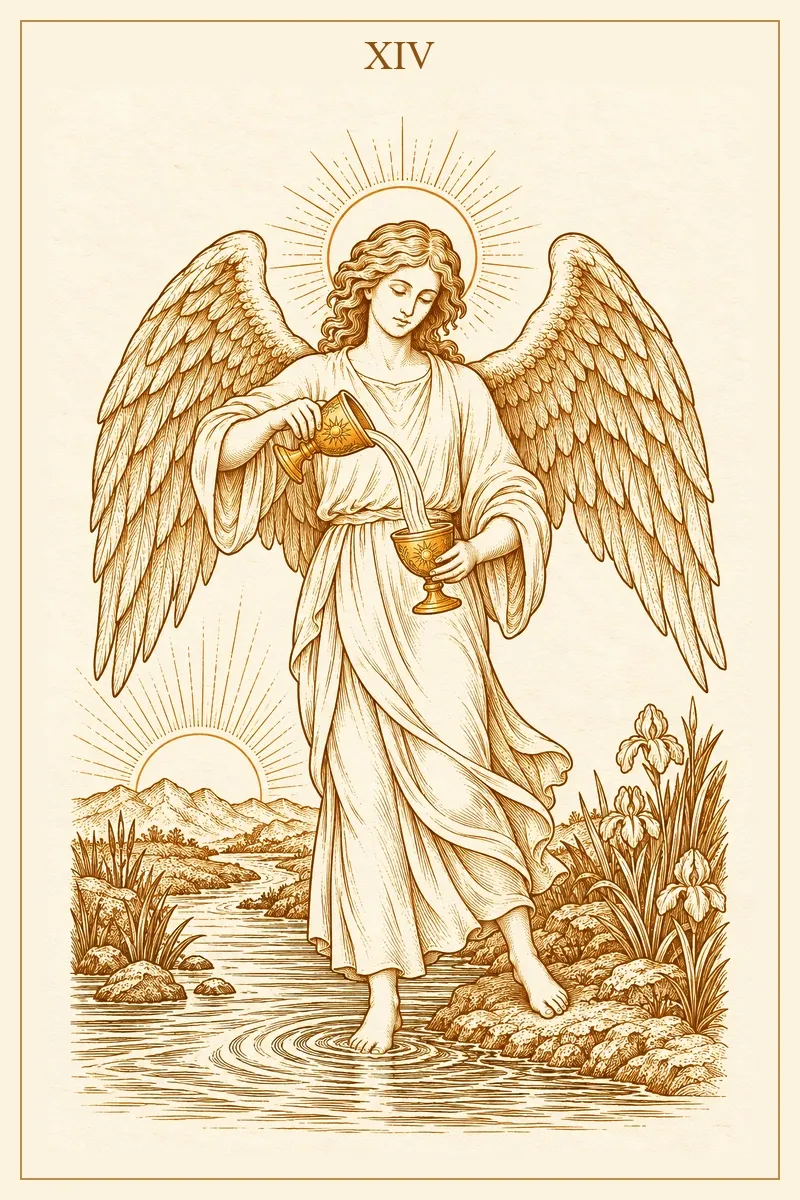
Temperance as the keynote describes proportion: two things combined in the right amounts, patiently, with adjustments along the way. It is not a card of launches. Read against her question, those four hours are not there to fund one dramatic new direction; they are there to be blended into a life that already exists, in doses small enough to keep. The full range of the card is set out in the Temperance card guide, but as a keynote the practical version is enough: pace it, test it, adjust it.
The Threshold: Eight of Pentacles in the birthday month
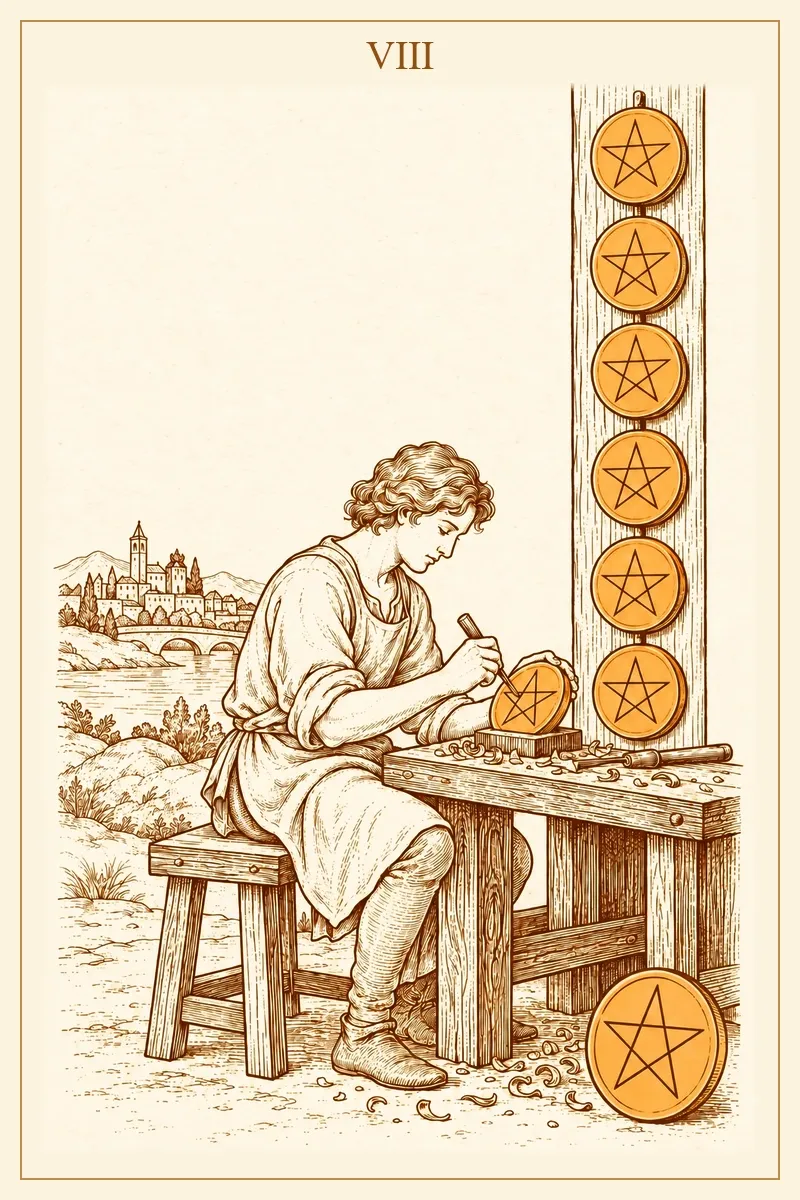
Eight of Pentacles in the first position sets the opening tone as practice rather than planning: someone at a bench repeating a craft until it becomes reliable. For her it suggested beginning the very first month with something regular and modest, two mornings a week on one skill, instead of researching options until the time quietly disappears again. The Eight of Pentacles meaning leans the same way whatever question you bring it: repetition is the point.
The Midpoint Mirror: Five of Cups at month seven
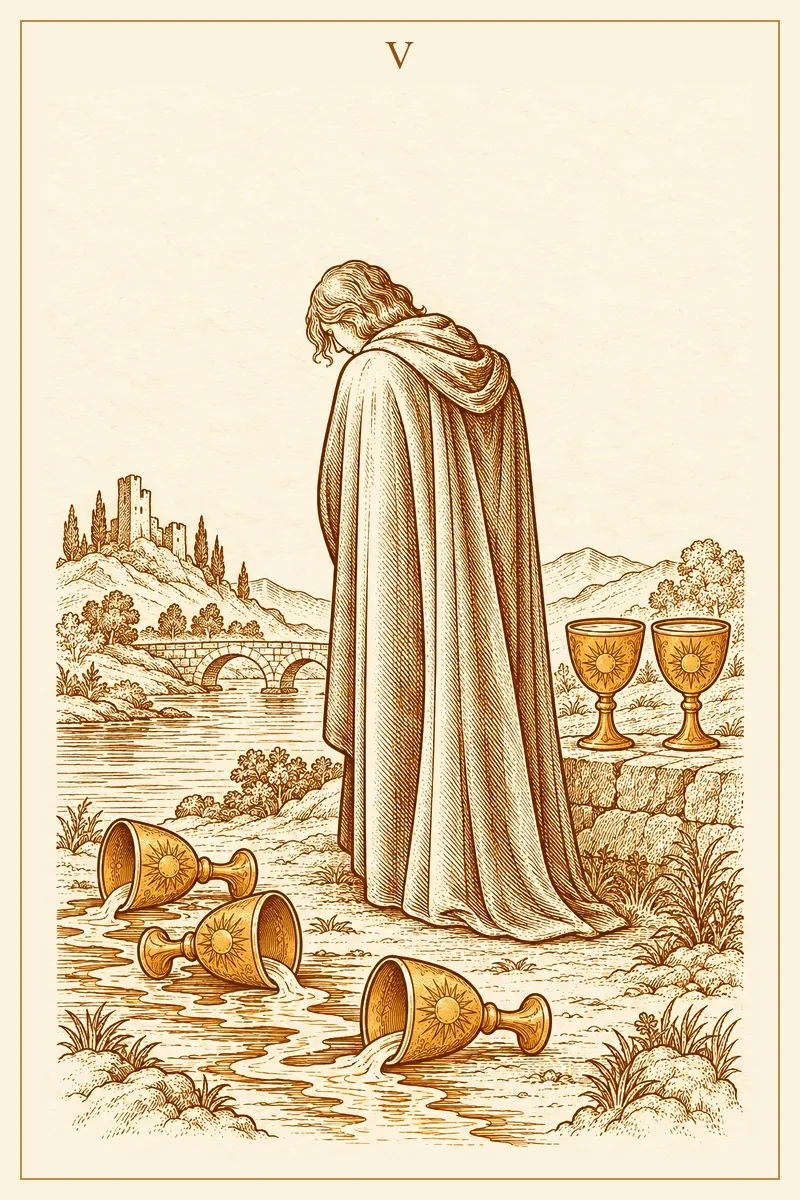
Five of Cups directly across from the Threshold is the hardest card in the ring, and it sits in a telling place. Half a year in, it says there will be grief in the mirror: a real sense of what the last six years cost, which tends to surface once life gets easier rather than while it is hard. Read as a mirror rather than a prediction it is practical, because she now knows that a flat, mournful stretch around month seven belongs to the year's shape rather than proving the year failed. Our guide to the Five of Cups dwells on the two cups still standing behind the figure, and that is the detail to carry into that month.
The Doorway: Six of Wands going into the next birthday
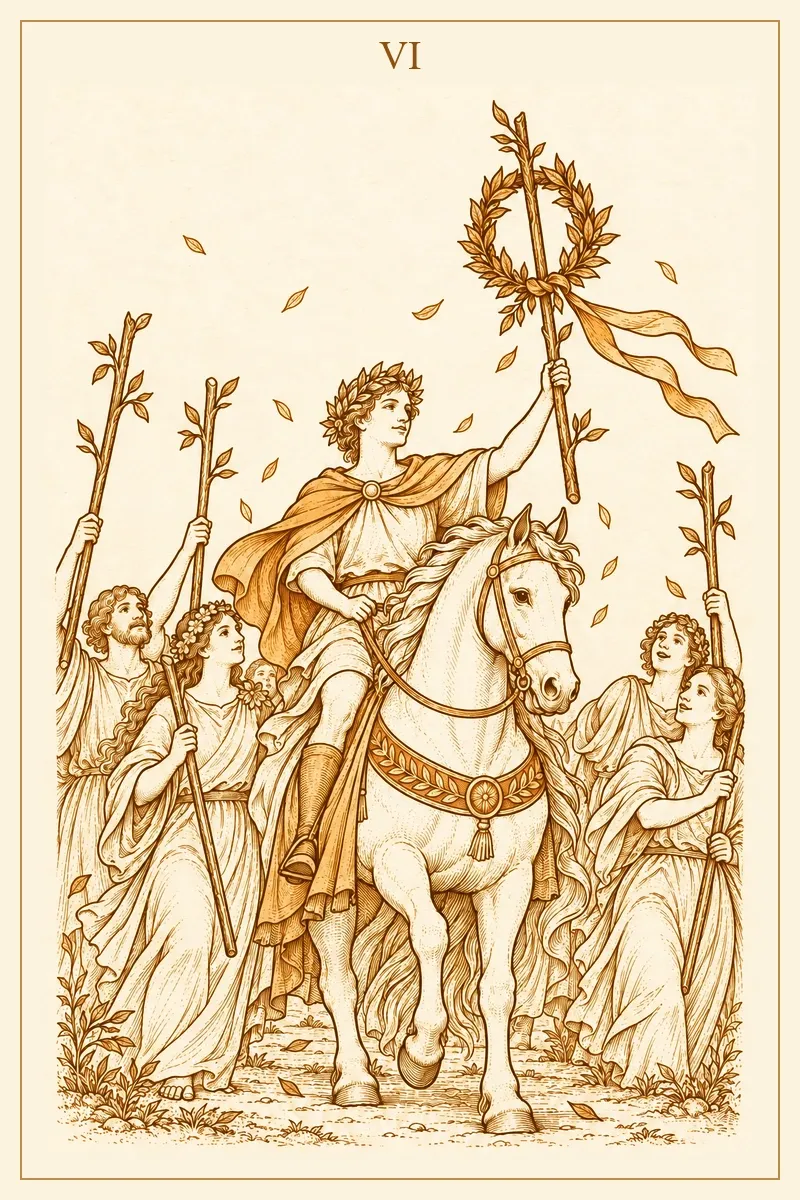
Six of Wands in the twelfth position says she arrives at forty with something visible to show and with other people noticing it. Under a Temperance keynote that recognition is modest and earned, the result of small regular amounts rather than one bold move. The Six of Wands meaning is worth reading beside the Threshold card: Eight of Pentacles at the start and Six of Wands at the end make one sentence about practice turning into standing.
The rest of the ring supported that sentence. Four of Swords at month four said the first flush of energy would need a deliberate pause before it burned out, and Three of Pentacles at month ten brought other people into the work. As one story it reads: start small and regular, rest before you have to, expect a sad patch at the halfway mark, let people in near the end, arrive at your next birthday with something real. All of it is a plan she can hold loosely.
When a hard card lands on one of your months
It will happen. In thirteen cards the odds of drawing nothing uncomfortable are small, and a ring with no difficult cards would be a poor description of any twelve months. The first rule is simple: do not reshuffle. A card you flinch from usually carries the most information, and replacing it trains you to read for comfort.
Read the neighbors before you read the card. The month before shows what leads in, the month after what comes out. A sharp card between two gentle ones describes a short disruption; a sharp card at the end of a run of pressure is more often the release than the catastrophe. Three of Swords followed by The Star is a different year from Three of Swords followed by Ten of Swords, and that difference is the reason for laying twelve cards instead of one.
Then translate the card into a condition rather than an event. The Tower in month five is not "something will collapse in five months"; it is "around then, something you have been holding upright may stop being holdable, and the year would rather you knew now." That version is honest, it is usable, and it does not ask you to spend four months bracing.
Two practical moves help. Write one line for that month now — what you would want to be true for yourself if the hard thing arrives — and keep it where you will find it. Then set a small support in advance: a lighter work week, a conversation already booked, money not spent that month. Preparing for weather is not the same as expecting disaster.
If a card frightens you enough that you cannot stop thinking about it, that is information about your current state rather than about the year. Put the spread away and come back to it in a week.
A five-card birthday spread when thirteen is too many
Thirteen cards are a lot to hold, and a year is a long time to interpret in one sitting. A shorter birthday reading gives you most of the value with none of the strain, and it suits a first birthday spread or a year you know you will not revisit monthly.
Lay five cards in a row, left to right:
- The keynote. What this year is for.
- What I bring in. The unfinished business, skill or mood arriving from last year.
- What this year asks me to practice. The thing to repeat rather than to achieve.
- What to put down. What the year works better without.
- What I will be glad of next birthday. The outcome worth aiming at, held lightly.
Read it in two passes: the first three cards for the shape of the year, then the last two as a pair, because what you put down usually funds what you are glad of. If even five feels like too much, three will carry a birthday honestly — keynote, practice, put down — and three-card readings are the easiest layout to return to each month without ceremony.
You can also run the short version most years and the full wheel every fifth one. Repetition is what makes any birthday reading valuable; the size of the layout matters far less than doing it again.
What to do in the weeks after you lay the spread
The reading is only half the practice. What turns a birthday spread into something you still value in March is the small amount of work you do in the first two weeks.
- Record the ring before you break it up. Photograph the layout and also write the thirteen cards as a numbered list, because a photograph alone is hard to search later.
- Write one line per month. Not an interpretation, a question. "Month seven: what am I actually sad about?" will be more useful then than a paragraph of analysis written today.
- Pick one action for the first month. One, small, scheduled this week. A year-long reading that produces no change in its opening month usually produces none at all.
- Set a check-in on the first of each month. Thirty seconds: read that month's line, then note in a sentence how the energy actually showed up.
- Re-read the whole thing before your next birthday. A week ahead, go back through the twelve lines and mark what landed, what did not and what you misread. That review is where reading skill grows.
When one month raises a question too big for a single card — a decision about a job, a relationship at a crossroads — do not squeeze the answer out of the birthday spread. Lay a separate reading when the month arrives. The Celtic Cross is the usual choice when one situation needs depth, and it sits alongside the annual wheel rather than competing with it.
Frequently asked questions
Can I do a birthday spread on a day that is not my birthday?
Yes. The birthday is the natural anchor, but the days around it work just as well, and so does any date that genuinely marks a personal turn: an anniversary of sobriety, a move, the start of a chapter you chose. If you miss your birthday by a week or two, lay it late rather than skipping the year.
What if I do not know my birth time?
It makes no difference. Birth time matters for an astrological chart, where the angles depend on the hour, while a birthday tarot spread responds to the question you bring and the date you bring it on.
Should I read reversals in a birthday spread?
Use whatever you already use. If reversals are part of your practice, keep them here; a reversed month card usually means the energy is internal, delayed or resisted rather than absent. If you do not read them, a thirteen-card annual spread is a poor place to start. Our guide to reversals is the place to settle that question on a quieter day.
What if the keynote card is the same as last year's?
Read it as a second pass rather than a repeat. The first year with a card introduces its subject; the second asks for something you did not do the first time, and you will read it differently having lived twelve months with that theme. Compare the two rings rather than the two center cards, because what changed around the card is usually the answer.
Can I redo the spread in the middle of the year?
You can, though relaying the whole wheel tends to erase the value of the first one. A better mid-year move is a short check-in of three cards — where I am, what I have been avoiding, what the rest of the year needs — read beside the original ring. Keep the birthday spread as the fixed reference and let smaller readings move around it.
Can I lay a birthday spread for someone else as a gift?
Only if they have asked for one. A year-long reading delivered unrequested puts your interpretation in someone's head for twelve months, and a difficult card sits heavily with a person who did not choose to receive it. If they do want it, read it with them rather than handing over a finished verdict.
Can the spread tell me what will actually happen this year?
No, and it is worth being plain about that. Tarot does not deliver dates, outcomes or other people's intentions; what it offers is a structured way of thinking about your own situation. Treat every month card as a question to carry rather than an event to wait for, and keep medical, legal and financial decisions with the people qualified to advise on them.
One year, read one month at a time
A birthday spread is not a forecast you receive. It is a conversation you start with yourself on the one date that belongs to you: thirteen cards, a center that names what the year is for, and twelve months you will meet one at a time, each already holding a question you wrote in advance.
When your birthday comes around, give yourself the quiet half hour. If you would like to sit with a few cards before then, you can start a reading with Veil Soul whenever the question feels ready.