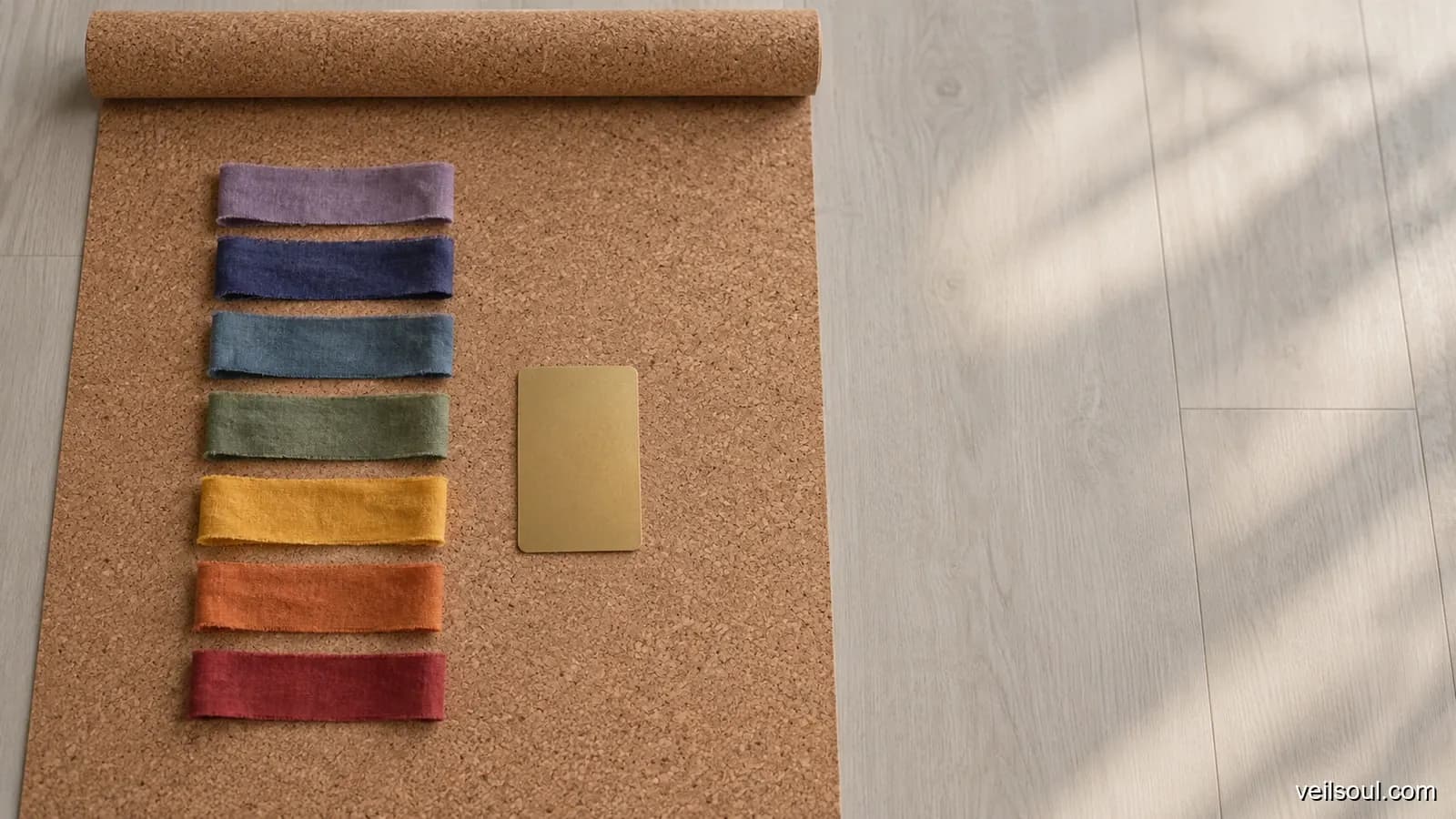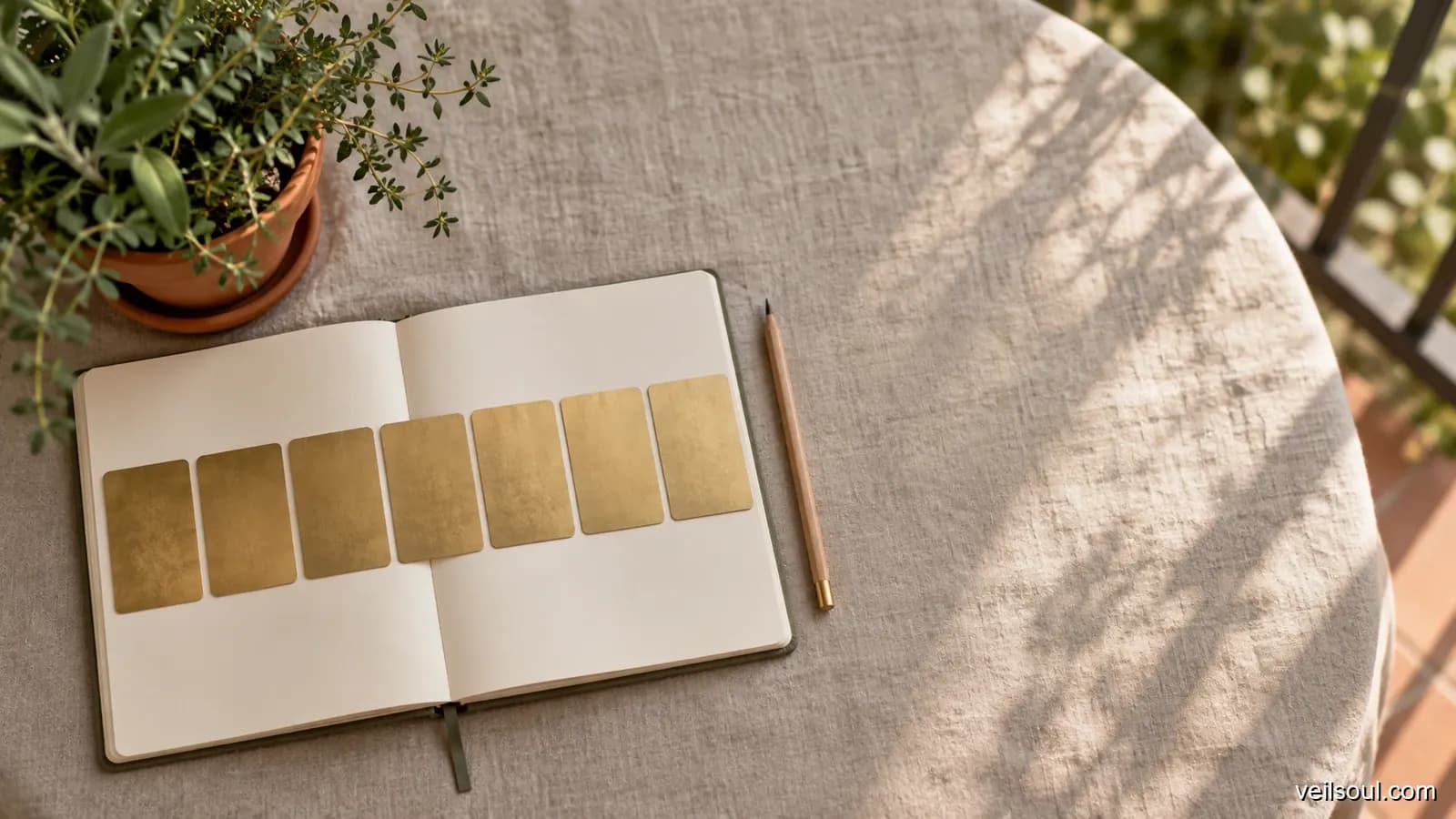
A weekly tarot spread is seven cards laid in a row, one for each day from Monday to Sunday, drawn once on Sunday evening or Monday morning. Each card names the quality of its day, such as focus, friction, rest or connection, so you can plan your energy around the week instead of bracing for it. Tarot cannot tell you what will happen on Thursday or what anyone else will decide; it gives you a lens for the days you are about to live, and the choices stay yours.
The layout below gives every day a named role, so a card on Wednesday reads differently from the same card on Saturday. You will also find how to read the row as one week, how to handle a hard card on a busy day, a three-card version for crowded weeks, a complete example week, and a short way to check back on Friday and Sunday.
The seven positions at a glance:
- Monday, the Opening: how to start the week and what to put first.
- Tuesday, the Workload: where effort and attention will be needed.
- Wednesday, the Midweek Check: what to adjust before the week runs on autopilot.
- Thursday, the Pressure Point: where strain or a deadline is most likely to collect.
- Friday, the Finish: what to complete, hand off or let go.
- Saturday, the Refill: what actually restores you.
- Sunday, the Reset: what to carry forward and what to leave behind.
Before you shuffle: timing, question and setup
Choose one regular moment and keep it. Sunday evening suits many people because the weekend has slowed them down while the week is already close enough to picture. Monday morning works too, though by then the week is moving and the reading can feel more like triage than planning. The habit matters more than the day: drawing at the same time each week makes your notes comparable, and most of the learning comes from comparing them.
Spend two minutes with your calendar first and mark the fixed points: a deadline, an appointment, a visit, a long shift. That gives you enough context to recognize what a card might be pointing at when it lands beside one of them. Then write one question at the top of the page. "What does this week need me to know?" is a good default. "What will happen this week?" tends to turn every difficult image into a threat. With a clear focus, narrow it: "How can I meet this week's deadline with less strain?"
Shuffle the way you normally do and lay seven cards from left to right. If you like, draw one extra card first and place it above the row as a theme card for the whole week. The Empress as a theme suggests a week where care, comfort and steady growth deserve room, even on busy days. Reversed, she can point to a week where you give a lot and refill little, so schedule some nourishment on purpose.
If your week does not run Monday to Sunday, shift the row. Someone working Thursday to Sunday can start on their own first day and keep the same roles. What matters is that the Opening card sits at the start of your week and the Reset card on the day you breathe out.
Seven named positions for the week ahead
Without roles, you end up reading seven unrelated one-card draws. With them, the same card shifts its emphasis depending on where it sits, and the row starts to describe a sequence you can plan around.
Monday: the Opening
This card describes the best way into the week: the tone to begin in and the task to put first. An Ace favors starting something fresh over finishing leftovers; a Page suggests learning, asking questions or taking a small first step. A heavy card does not ruin the week. It tells you to begin gently, clear one obstacle early and keep Monday lighter than you would like.
Tuesday: the Workload
This position shows where effort will be needed and how to spend it. Pentacles favor steady, practical work; Wands favor momentum and getting things started; Swords point to decisions, emails and the risk of overthinking. Cups suggest the day's work is partly emotional, such as a colleague who needs support or a conversation that sets the tone.
Wednesday: the Midweek Check
The middle of the week is the moment to correct course before habits take over, so read this card as a question: what needs adjusting? A card about connection may suggest reaching out to someone. A card about stagnation may mean something on your list is not moving and needs a decision. A reversal here often points to whatever you have been putting off since Monday.
Thursday: the Pressure Point
Many weeks peak on Thursday, when deadlines bunch up and patience runs thin. A strong card here says you have the resources. A tense card says to prepare the day before, protect your sleep and leave some slack in the schedule. If your real deadline falls on another day, read this card as the week's main stress point anyway.
Friday: the Finish
Friday shows what to complete, hand off, celebrate or release before the weekend. Tens and Sixes sit comfortably here, since they speak of completion and recognition. A card about unfinished business suggests writing yourself a short handover note, so you do not carry the week around all weekend.
Saturday: the Refill
This position asks what genuinely restores you, which is not always what you assume. A social card may say that seeing friends refills you this week; a quiet card may ask for a slower day than you planned. If a demanding card lands here, check whether the weekend is already overbooked.
Sunday: the Reset
The last card shows what to carry forward and what to leave behind. Next Sunday, set it beside the new row and see whether the thread continues. Read it again once the week is over, because the Reset card often makes the most sense in hindsight.
Daily themes, not daily predictions
The most common mistake is reading each card as an event: "Three of Cups on Wednesday means a party on Wednesday." Read it instead as the quality that day can carry. Three of Cups upright in the Midweek Check suggests connection, shared joy and friendship: book the team lunch, call the friend you keep meaning to call, or ask a colleague to share part of the load. Reversed, it can point to social overcommitment, gossip or feeling left out, so Wednesday might be a day to step back from the group chat rather than into it.
The Hermit on a weekday works the same way. It does not mean you will be alone; it means that day benefits from solitude, focus and fewer inputs, so block an hour with notifications off or take the long way home. Reversed, it can warn that useful withdrawal is tipping into isolation, so make one deliberate contact that day.
Reading for themes has a practical payoff. Move flexible tasks toward the days whose cards support them: the difficult conversation to a day with a clear, honest card, the creative work to a day with some fire in it, the admin to a steady Pentacles day. Even when you cannot change what is on a day, you can usually change how you approach it.
Reading the seven cards as one week
Before you interpret any single day, look at the whole row for a minute. The pattern often says more than any one card and keeps a single difficult image in proportion. The guide on connecting several tarot cards into one story goes deeper into how neighboring cards shape each other.
- Suit balance. Three or more Swords suggests a mentally demanding week of decisions, messages and a busy mind, so plan breaks and keep evenings light. Several Cups mean feelings will sit close to the surface. Pentacles point to a practical week about money, body, home and steady tasks. Wands point to energy and new starts; give that fire a real project rather than paperwork.
- Major Arcana count. One or two Majors in seven cards is ordinary. Three or more suggest the week touches something bigger than its schedule, such as a decision about direction or a lesson you keep meeting. Treat those days as anchors and keep the others flexible.
- The arc. A heavy start that lightens means front-loading effort; a calm start that builds means saving energy for later. A dip in the middle tells you which day needs extra care.
- Repeated numbers. Two or three cards of one number tint the whole week. Twos suggest choices and balance, Fives friction to work through, Eights movement and effort, Tens completion.
- Court cards. A Page, Knight, Queen or King often describes a role you are asked to play that day, or a person whose style will matter.
- Reversals. If you read them, notice where they cluster. Several early in the week may mean you are starting tired; several near the end may mean you are squeezing too much in before the weekend.
Hard cards on the calendar
Not every row will be full of cards like The Sun. Difficult cards are often the most useful, because they show you where to put your care. Here are four that tend to alarm people when they land on a specific day.
The Tower: leave room for change
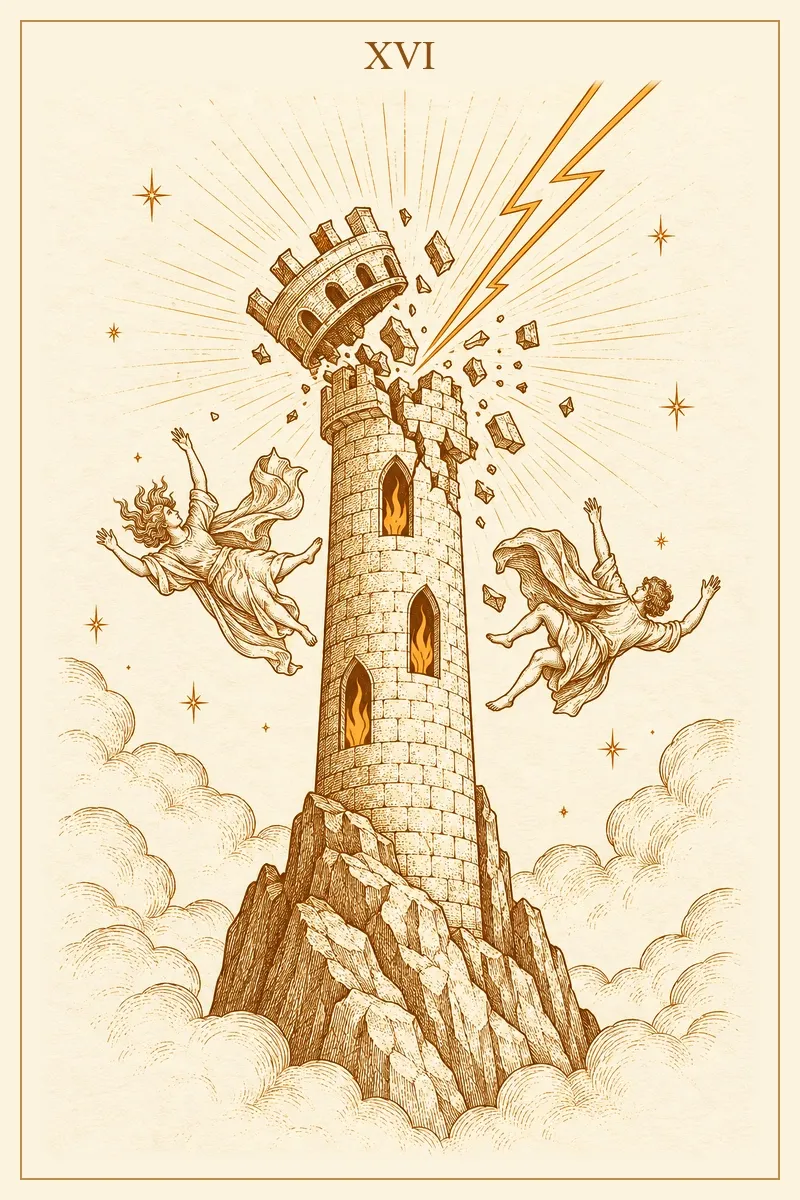
The Tower upright describes sudden change, a revelation, or a structure that turns out to be less stable than it looked. On a weekly row it suggests a day when plans may shift, news may arrive or a truth you have been sidestepping becomes hard to ignore. Keep that day loosely scheduled, avoid stacking critical tasks on it and have a fallback for anything that depends on other people. What falls apart was often already cracked. The full Tower tarot meaning covers the card's other angles.
Reversed, The Tower often points to change you are resisting, an upheaval happening inside rather than around you, or a disruption postponed for now. Ask what you are holding together through sheer effort, and whether one small change on your own terms would help.
Nine of Swords: protect the night before
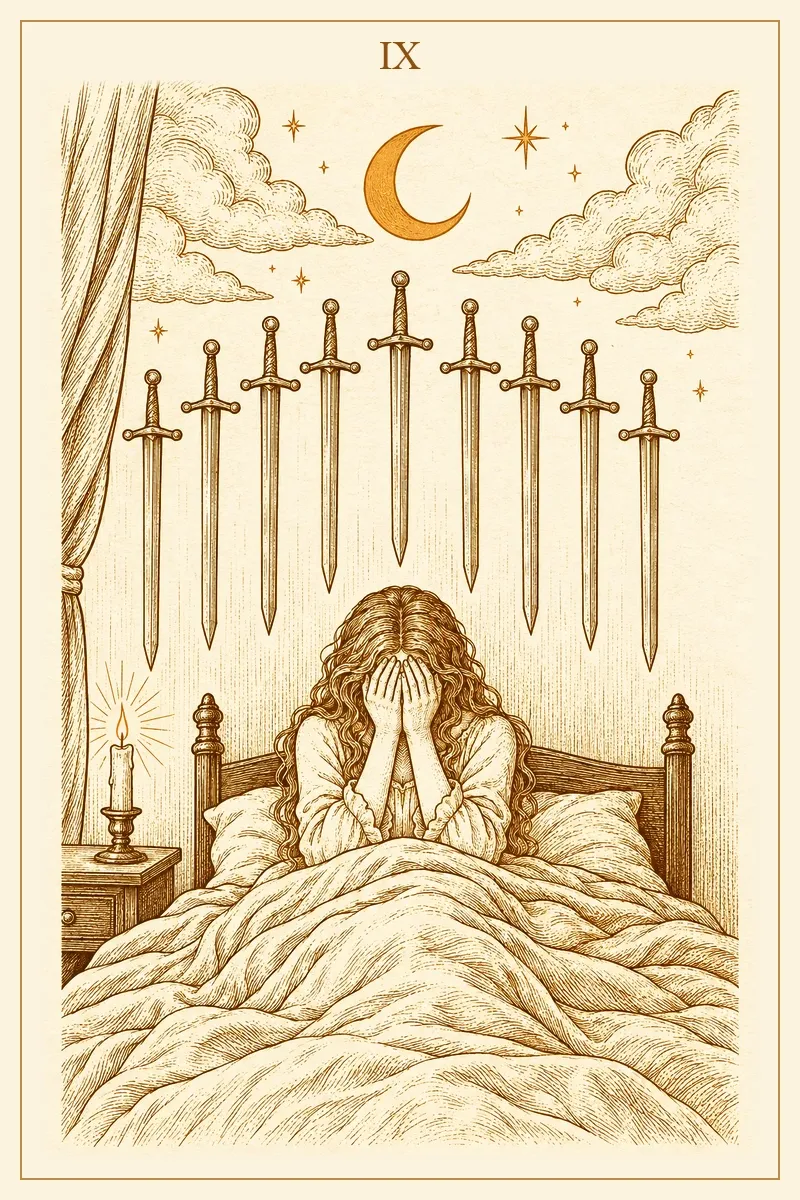
Nine of Swords upright is the card of worry, sleepless nights and worst-case thinking. In a weekly spread it often lands on the very day you are already dreading, and its message is usually that the fear weighs more than the day will. Practical answers work best: go to bed earlier the night before, prepare in advance, keep the day free of extra demands and line up one person to talk to. The Nine of Swords tarot meaning explains the card's full range.
Reversed, it can mean the worry is starting to ease, or that it has gone quiet without being dealt with. If anxiety keeps you awake week after week, that deserves real support from the people around you or a professional, not only a card.
Ten of Swords: let something finish
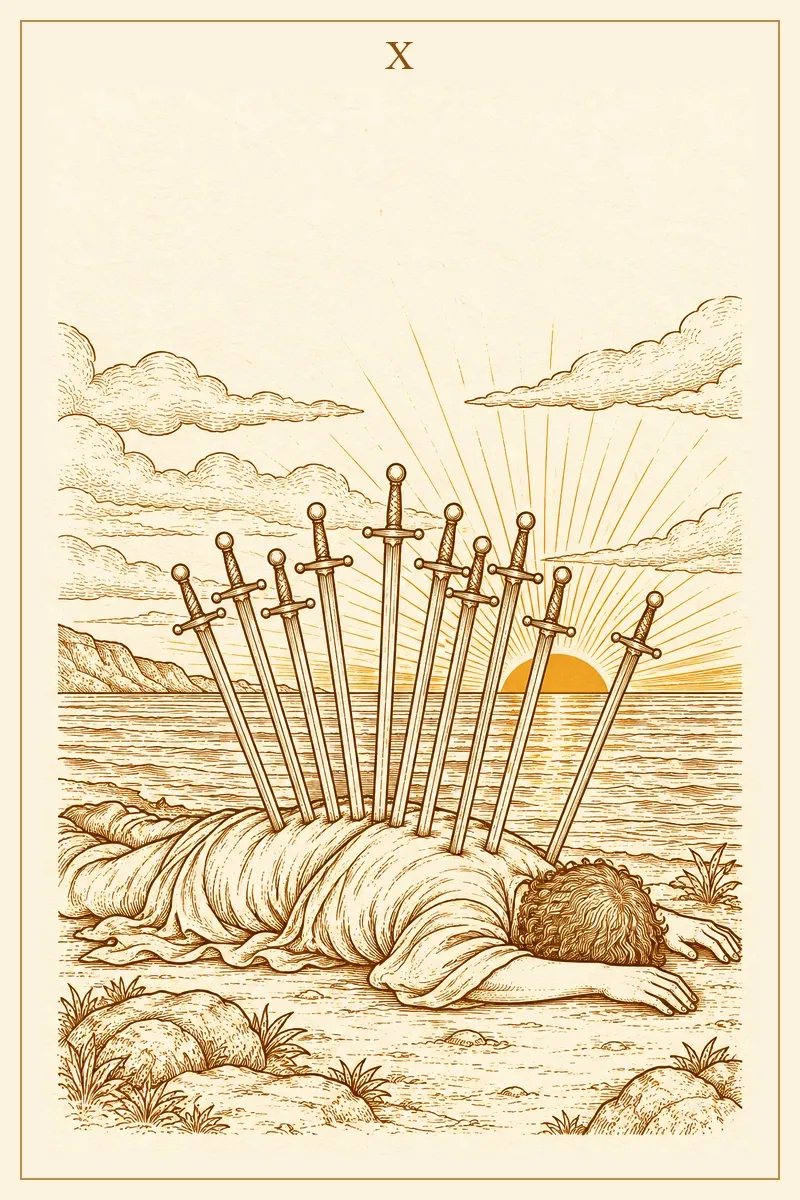
Ten of Swords upright marks an ending that has been coming for a while: a project wrapping up badly, a situation reaching its limit, the last round of a long conflict. Ten is the number of completion, and the traditional image shows light breaking on the horizon. On a weekly row, it marks the day to stop pushing something that is already over. The Ten of Swords tarot meaning looks at how this kind of ending turns toward recovery.
Reversed, it often describes recovery after a low point, or the opposite: dragging out an ending you will not accept. Notice which one you are doing, and plan something restorative for the day after.
Three of Swords: an honest, painful truth
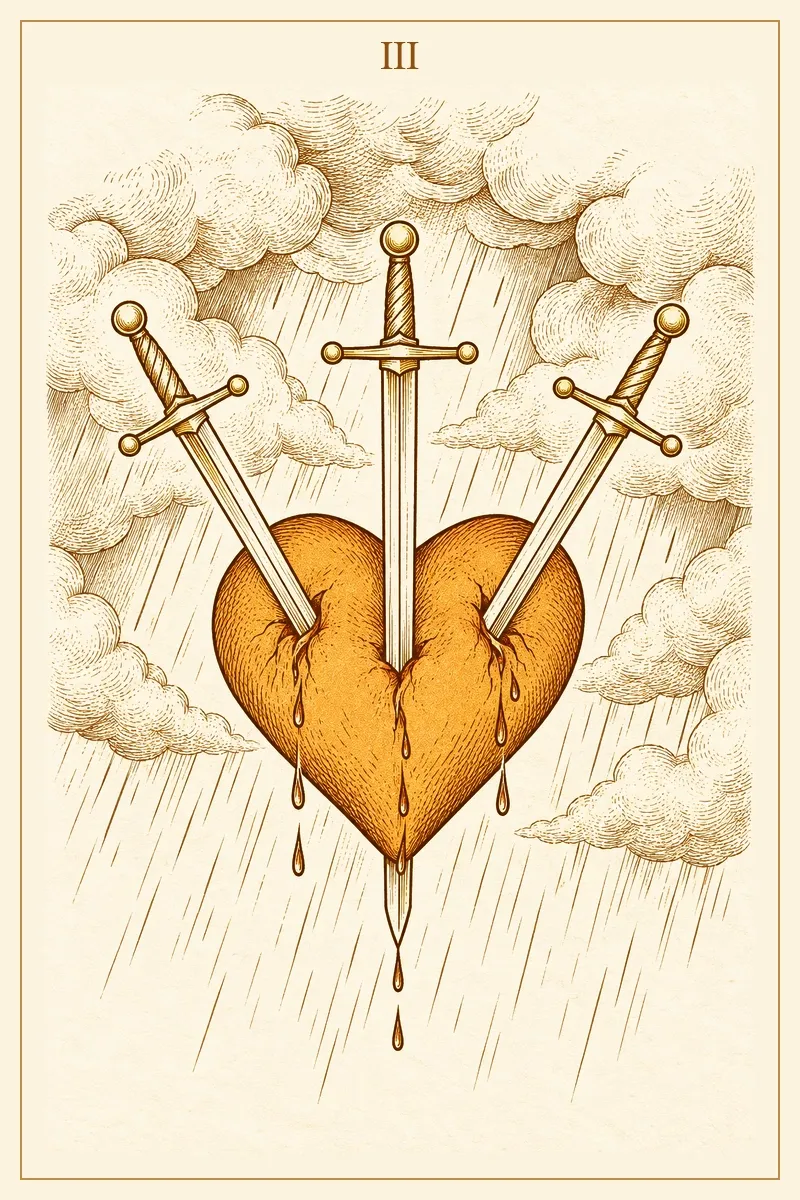
Three of Swords upright points to hurt, grief or a truth that stings: a disappointing message, a hard conversation, a realization you had hoped to avoid. On a weekly row it is a reason to be gentle with yourself that day, not to brace for disaster. Leave space to feel what comes up and hold off on big decisions for a few hours. The Three of Swords tarot meaning explores heartbreak and how it heals.
Reversed, it can suggest healing from an old hurt, or pushing grief down to keep going. If it lands near the weekend, the Refill or Reset day may be a good moment to let the feeling out.
A three-card version for busy weeks
Some weeks, seven cards are too much to hold. The three-card version keeps the shape of the week in three blocks and takes about five minutes:
- Early week (Monday and Tuesday): how to start and what to tackle first.
- Midweek (Wednesday and Thursday): where to adjust and where pressure may collect.
- Weekend run-in (Friday to Sunday): how to finish, rest and reset.
Read the three as a short story. Say you draw Eight of Pentacles for the early week, then Five of Wands for midweek and Six of Cups for the weekend run-in: start with focused, careful work, expect some friction or competing opinions in the middle, and spend the weekend somewhere simple and familiar, with family or old friends. The guide to three-card spreads shows other position sets you can swap in.
If your week does not divide into blocks, such as a trip or a family visit, use three roles instead: focus (what to put first), watch (what is likely to drain you) and support (what or who will help).
Example week: a deadline on Thursday
The reader has a report due on Thursday afternoon, a friend's birthday dinner on Wednesday evening and a quiet weekend planned. On Sunday evening she wrote "What does this week need me to know?" and drew these cards, all upright:
- Monday, the Opening: Page of Pentacles
- Tuesday, the Workload: Two of Swords
- Wednesday, the Midweek Check: Three of Cups
- Thursday, the Pressure Point: Nine of Swords
- Friday, the Finish: Six of Wands
- Saturday, the Refill: Four of Swords
- Sunday, the Reset: The Star
The whole week first. Three Swords (the Two, Nine and Four) say this week lives mostly in the head: a decision, some worry and a real need for rest. The only Major, The Star, sits on Sunday, so the week ends somewhere more hopeful than it starts. The arc runs from a careful start through midweek tension to recognition and calm, and the single Cups card falls on the evening of the dinner.
Monday. Page of Pentacles as the Opening suggests beginning like a student: reread the brief, list what the report actually needs and ask the one question she has been unsure about.
Tuesday. Two of Swords in the Workload position points to a decision being avoided, in her case a choice between two structures for the report. The card says to make it on Tuesday instead of keeping both open until Thursday.
Wednesday. Three of Cups matches the dinner, but the more useful reading is that connection is a resource this week, not a distraction. She kept the dinner and asked a colleague to read her draft that afternoon.
Thursday. Nine of Swords names the worry about the deadline. Her plan: finish the draft on Wednesday morning, set a firm bedtime that night and keep Thursday morning for final checks only.
Friday. Six of Wands as the Finish suggests recognition for good work, a nudge to present the result properly rather than send it off quietly.
Saturday. Four of Swords as the Refill is a clear call for rest: sleep, a slow morning, nothing to fix.
Sunday. The Star as the Reset brings hope and renewal. It suggests closing the week by noting what went well and choosing one hopeful intention for the next.
On Friday she checked back. The report went in on time. Tuesday's decision took until Wednesday morning, which is useful to know for next time. Thursday was tense early on and fine by lunch, much as the Nine of Swords had suggested: the dread was bigger than the day.
Checking back on Friday and Sunday
The forecast is only half the practice. The other half is looking back, because that is how you learn what the cards tend to mean for you. Keep it short enough that you will actually do it.
Each evening, one line. Under that day's card, write: "The card was ___, and the day felt like ___." Do not force a match; some days have nothing to do with their card, and noting that honestly is part of the practice.
Friday, a five-minute check. Which card fit best? Which did I misread, and how? Did I do anything differently because of a card, and did it help? If the Refill card asked for rest and Saturday is packed, there is still time to change the weekend.
Sunday, close one week and open the next. Before you draw the new row, mark each day of last week "fit," "partly" or "no fit," and note one thing you learned about yourself rather than about the cards.
Once a month, look for repeats. Cards, suits or numbers that keep turning up often matter more than any single week. If Eight of Cups, the card of walking away from what no longer fulfills you, appears again and again, its message may concern your life more than your week. A tarot journal for tracking your readings makes these patterns far easier to spot, on paper or in an app.
Frequently asked questions
Can a weekly tarot spread tell me exactly what will happen each day?
No. Tarot cannot confirm an event, a date, an outcome, or what another person is thinking or planning. A weekly spread is a way to reflect on the days ahead and decide how you want to meet them. When a card seems to "come true," it has usually described a theme you were already close to, which is still worth knowing.
Should I use the full deck or only the Major Arcana?
Use all 78 cards. The Minor Arcana describe the everyday texture a weekly spread needs: tasks, conversations, moods and small decisions. Two of Cups on Wednesday says something specific about a mutual connection that day. The Lovers on the same day speaks about values and a meaningful choice, which is true but often too broad to plan a single day around.
Can I do a weekly spread if I already pull a daily card?
Yes, and the two work well together: the weekly spread gives you the overview on Sunday, and a card each morning lets you zoom in on one day. If you are building a regular habit, the guide on how to read tarot for yourself covers the basics of reading your own cards honestly.
What if every card in my weekly spread looks difficult?
It usually describes a demanding stretch rather than a doomed one. Read the row as a list of places to be kind to yourself: lighten what you can, rest before Monday, ask for help early and keep the weekend clear. Find the least heavy card and treat its day as your anchor.
What if the same card shows up week after week?
Take it seriously as a theme and write down what was going on each time it appeared. Five of Cups, for example, traditionally shows a figure looking at spilled cups while two full ones still stand behind them. If it keeps coming back, ask what you are still grieving and what is still there for you.
Should I read reversed cards in a weekly spread?
That is your choice, as long as you decide before you shuffle and stay consistent. Reversals add detail: a blocked, delayed or inward version of the card's theme. If the weekly practice is new to you, reading everything upright for the first month keeps it simple.
A weekly spread works best as a short ritual you come back to, not a verdict you wait under: seven cards on Sunday, a line each evening, a quick look back on Friday. When you are ready to lay out your own week, you can start a reading with Veil Soul and keep the cards beside your plans.