Air is the element of the mind in tarot, and the suit that carries it is Swords. All fourteen Swords cards belong to air, from the Ace to the King, and three Major Arcana cards come with them through the air signs: The Lovers for Gemini, Justice for Libra and The Star for Aquarius. The Fool stands beside them as air in its loosest form, a mind before experience has narrowed it.
Air is what you think, name, say and decide. When a spread fills with it, the cards describe the mental weather around your situation rather than the situation itself: the sentence you keep rehearsing, the conversation that has not happened, the choice you turn over at midnight. That is also where they stop. Air can show how you are thinking about someone; it cannot report what that person thinks, fix the date of a conversation, or decide anything on your behalf.
The air element at a glance:
- Suit: Swords, called Blades in some decks and matched with spades in playing cards; fourteen cards about thought, speech and decision.
- Air signs: Gemini (mutable), Libra (cardinal), Aquarius (fixed).
- The Lovers: Gemini; a choice made with your eyes open, not a promise of romance.
- Justice: Libra; evidence weighed and consequences accepted.
- The Star: Aquarius; the wide, quiet view that returns after a hard stretch.
- The Fool: elemental air; a mind that has not fixed its opinion yet.
- Ace of Swords: the root of air; one clear thought cutting through fog.
- Nine of Swords: air turned on itself; worry rehearsed in the dark.
- King of Swords: air of air; judgment that stays fair when it is inconvenient.
Swords, breath and the blade
Most modern decks follow the Golden Dawn's table of suit and element, in which Swords take air, Wands fire, Cups water and Pentacles earth. The pairing is easier to feel than to prove. A blade separates one thing from another, and so does a thought: naming something divides it from everything it is not.
Air is also breath, and breath becomes speech. That is the other half of the suit. Swords cards arrive around words: what was said, what was heard differently, what has gone unsaid for months.
A minority of readers swap the two active suits, reading Swords as fire because a blade is forged in flame and Wands as air because a cut branch whistles when it moves. Both systems can be read well; what matters is holding one of them steady for a whole reading, since elemental pairs only help when the deck and the reader agree. Older correspondence tables also place air in the east and at first light, while the seasonal labels differ from book to book.
Four Major Arcana cards that run on air
In the same system each zodiac sign holds one trump, so the three air signs bring their cards with them. Each shows the element in a different temper: Gemini gathers, Libra weighs, Aquarius imagines. The Fool joins them for another reason, having been given to air as an element rather than to any sign.
The Lovers: Gemini and the choice made awake
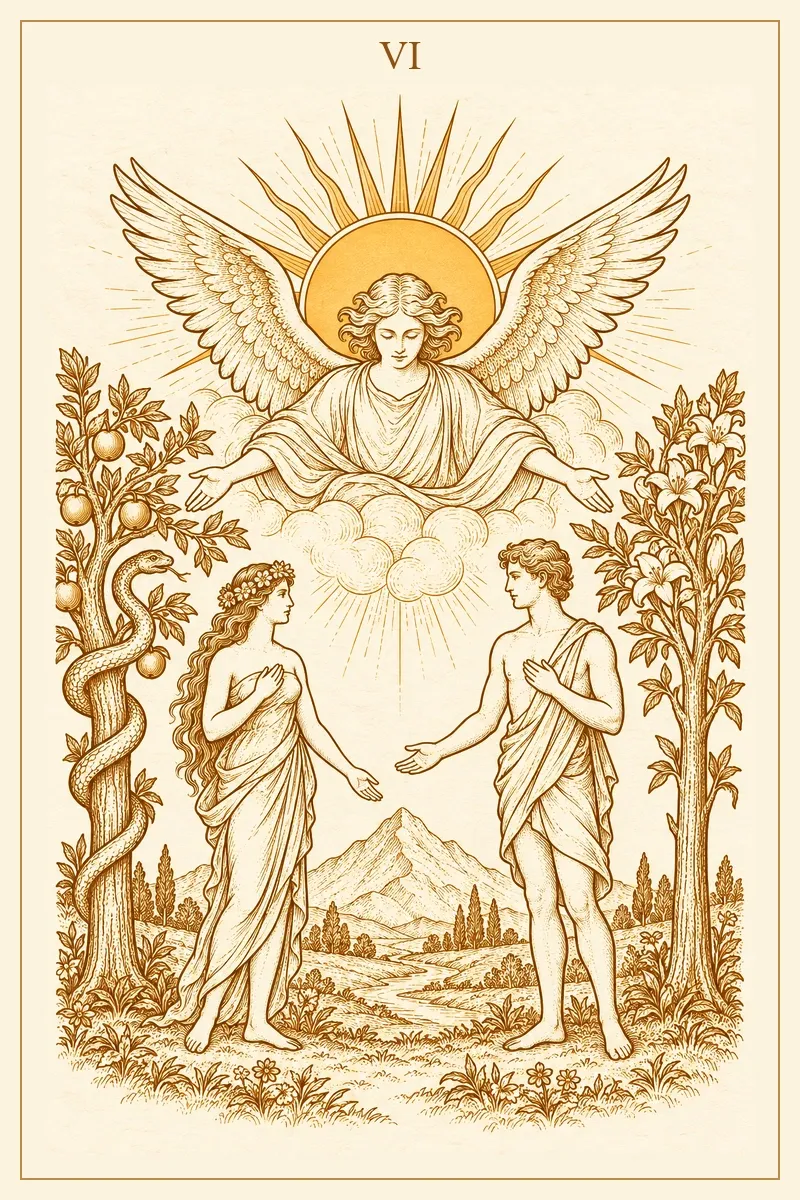
Upright, The Lovers is less about romance than about a decision taken with your eyes open. Two possibilities stand there fully formed, both with something real to lose, and the card asks which one matches the person you want to be. Gemini, the mutable air sign, is comfortable holding both at once, which is a gift until it becomes a way of never choosing.
Reversed, it describes the drift: telling each side what it wants to hear, letting a deadline choose for you, or picking the option that avoids the hardest conversation. The fuller account of upright and reversed sits in the guide to The Lovers tarot card meaning.
Justice: Libra and the weight of what you know
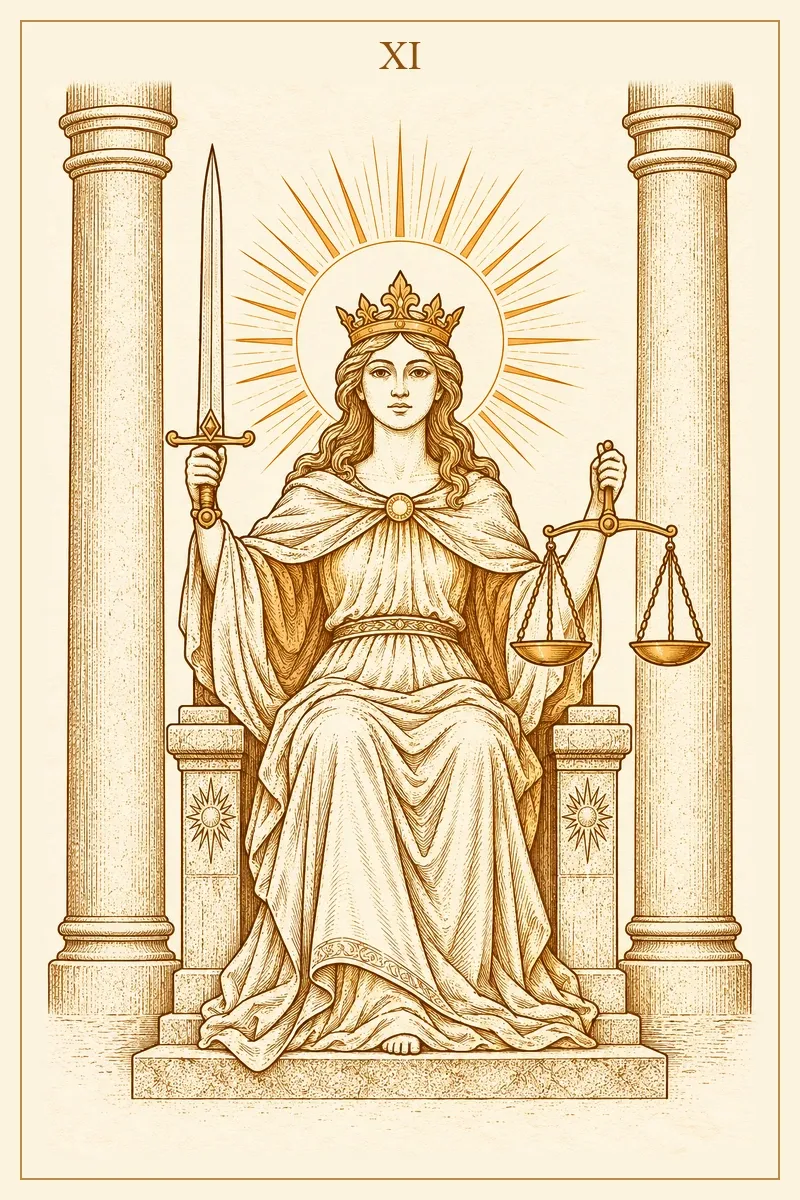
Justice is the most procedural card in the deck, and that is its kindness. Upright, it asks you to lay out what is actually known, separate it from what you have assumed, and accept that choices carry consequences whether or not they feel fair. Libra is cardinal air, the sign that opens a season by setting terms, and this card wants them said plainly before anyone acts.
Reversed, it points to a verdict reached before the evidence was read: your own bias, a story told by one party only, or a decision delayed so long that the delay became the decision. When a reading turns formal, the Justice card's full meaning helps you tell a principled decision from a punishing one.
The Star: Aquarius and the long view
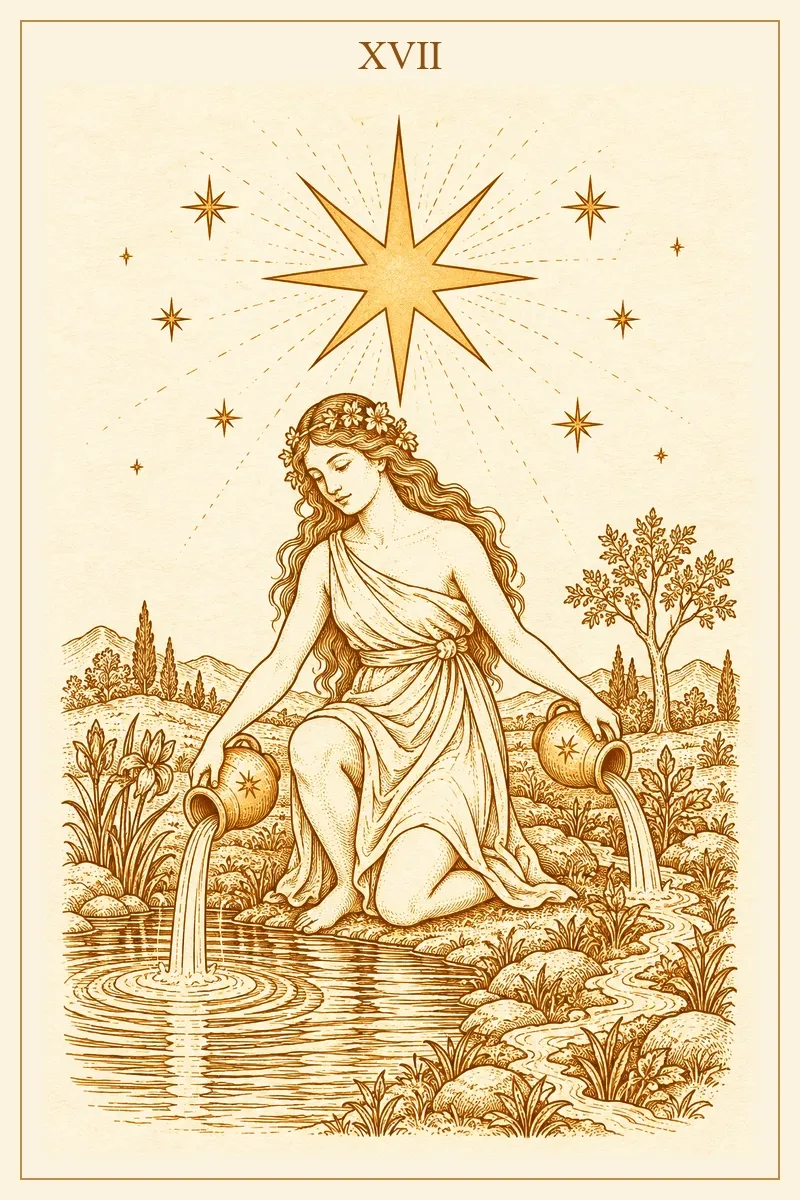
The Star is air at its calmest. Upright, it arrives after something difficult and gives back perspective: the situation has not changed, but you can see past the end of it again. Aquarius is fixed air, the sign that holds one idea steadily for years, and the card carries that patience. It favors hope with a shape, a plan you could describe to a friend in two sentences.
Reversed, the vision stays in the sky. You may picture the better version of your life in detail and have taken no step toward it, or the distance that once gave perspective has become a way of not being present. Read next to The Star's upright and reversed meanings, it usually asks for one small dated commitment.
The Fool: air before it has an opinion
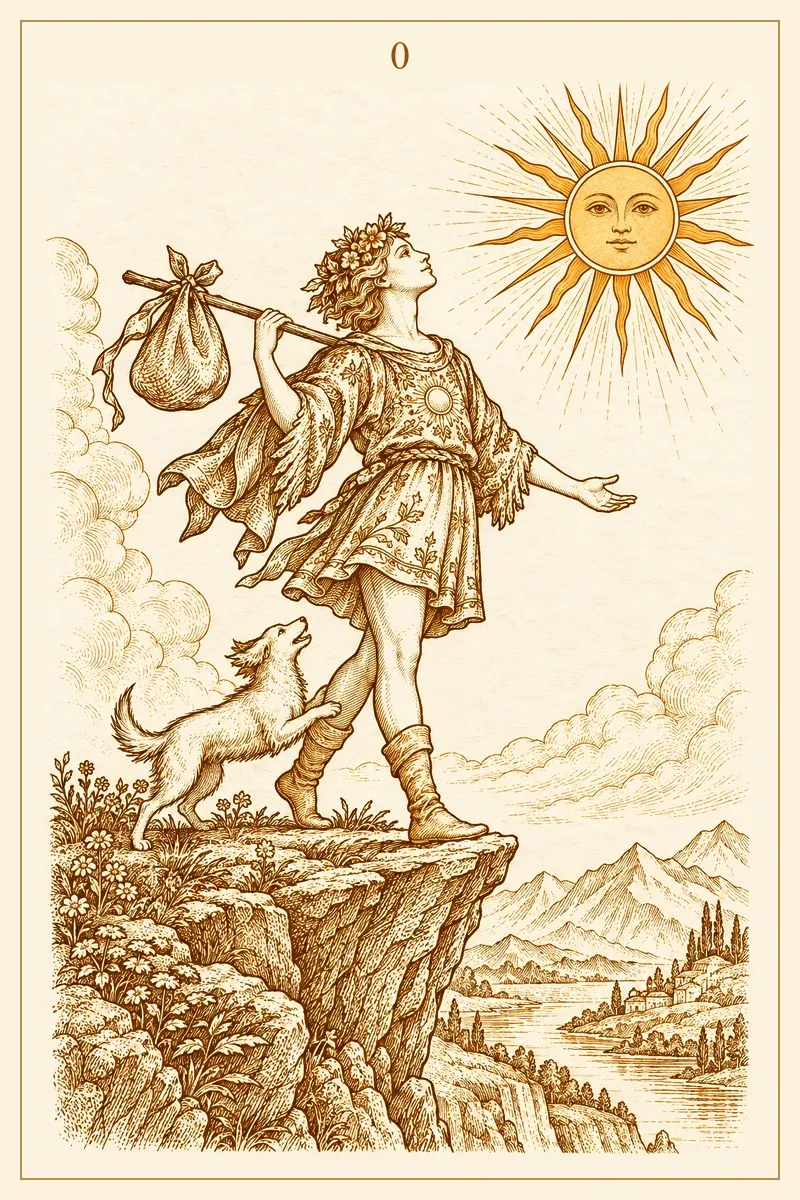
Of the Major Arcana, The Fool is the card given to air itself: the mind before experience has told it what is possible, curious, unattached, willing to ask the question everyone else agreed to stop asking. Upright, it says the situation is more open than it feels, and that beginning badly is still beginning.
Reversed, the same freedom turns careless. A leap is taken without checking what lies under it, or novelty gets chosen because the current thing has become boring. The notes in The Fool tarot card meaning help here, because this card rewards a reader who can tell openness from avoidance.
The Swords, Ace to Ten: one long thought in ten steps
The numbered Swords read well as a sequence: a thought arrives, it has to be decided, it costs something, it needs rest, it turns into conflict, it moves, it goes sideways, it traps, it torments, and at last it ends. The Golden Dawn splits the nine cards after the Ace among the air signs in three runs of three, and those groups hold up as reading units.
Ace of Swords: the root of air
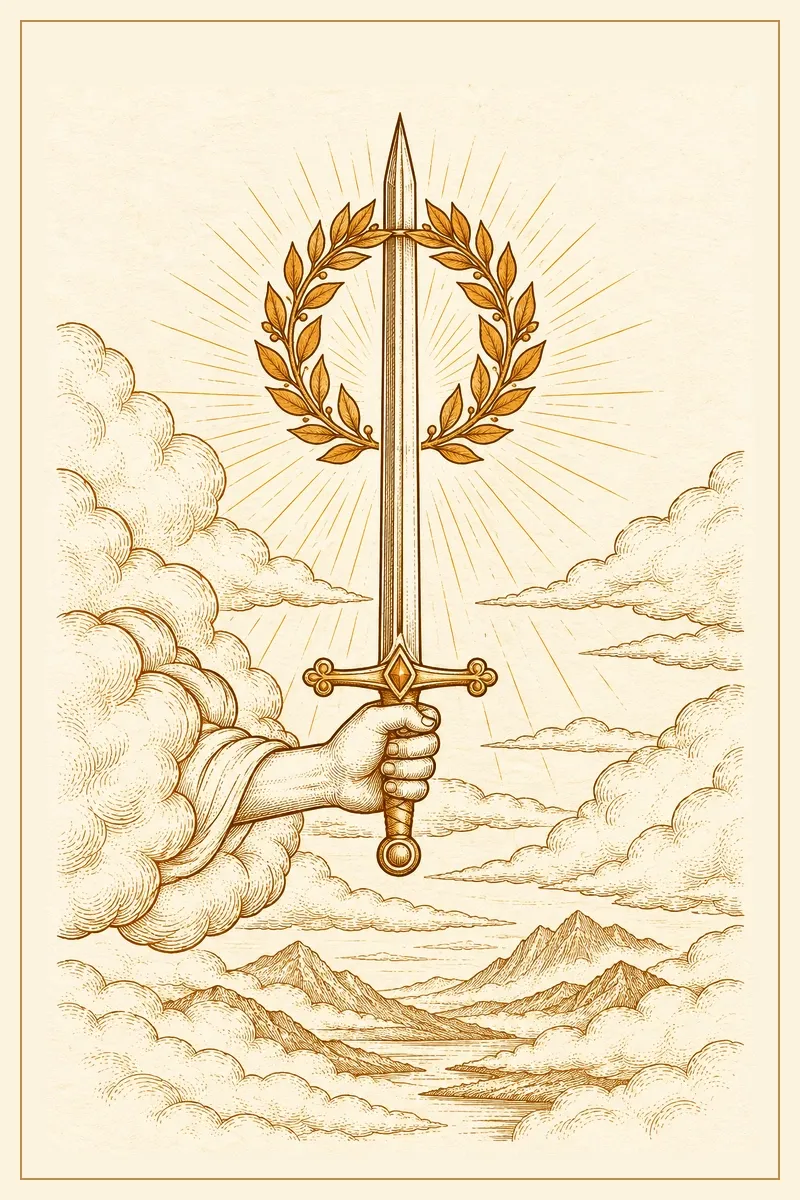
The Ace of Swords is the whole element pressed into one card: a single clear thought that makes the rest of the situation legible. It is the thing you finally say plainly, or the moment a confusing week turns into one decision. Aces are offers rather than outcomes, so this one describes clarity that is available to you, not clarity you already have.
Reversed, the blade is there and the handling is off: a truth delivered so bluntly nobody can hear it, an insight kept to yourself, or cleverness used to win an exchange rather than understand it. The Ace of Swords card meaning covers that double edge; in practice the reversed Ace asks what the clarity is for, and whom it serves.
Two, Three and Four of Swords: the Libra run
Libra's three cards are about balance under strain. The Two of Swords is the stalemate you are maintaining: blindfolded, arms crossed, two options held at exactly equal weight so nothing has to be given up. It is rarely about having no information; it is about not wanting to look at what you have.
The Three of Swords is the fact that hurts once you do look, a grief that is accurate rather than cruel, because nothing is being invented and something is being faced. The Four of Swords is what comes next: quiet, sleep, a pause with no decisions in it, and the only card in the suit that lets a mind recover. If this run turns up together in a question about a relationship, the Libra tarot guide fills in how the sign postpones its own needs in the name of fairness.
Five, Six and Seven of Swords: the Aquarius run
Aquarius takes the cards about distance and strategy. The Five of Swords is a win that costs more than it returns: the argument you were right in, after which the room is colder. Ask what you wanted from the exchange, whether that was agreement, an apology, or simply to stop feeling small.
The Six of Swords moves you toward calmer water, though something stays behind: you leave a conversation, a job or a version of a relationship with the blades still aboard. The Seven of Swords is the mind going around instead of through, whether that shows up as tact, strategy, a partial account or an outright deception. Before you read it as a lie told to you, check whether the half-told story is yours. The Aquarius tarot guide shows the same detachment at its best, as the ability to see a situation from outside your own stake in it.
Eight, Nine and Ten of Swords: the Gemini run
Gemini holds the hardest three, which surprises readers who expect the talkative sign to carry light cards. The Eight of Swords is a trap built out of conclusions: the blindfold is yours, the blades are not touching you, and a step out appears as soon as one belief is tested against a fact. The Nine of Swords is the night version of the same mind, rehearsing the worst available interpretation at three in the morning, when nothing can be checked and nobody can be called.
The Ten of Swords ends it. Something is genuinely over, whether a story you told about yourself or an arrangement that stopped working years ago, and the relief in the picture is real: an ending you can see beats a dread you cannot. For how a quick, twin-minded sign produces this run, see the Gemini tarot guide.
The Swords court: four tempers of one mind
Each court rank carries an element of its own, so the four Swords people show air mixed with fire, water, earth and air again. In the common modern mapping, Knights are fire, Queens water, Kings air and Pages earth; some readers swap the Knight and the King, so treat the layer as a tool rather than a rule.
Page and Knight of Swords: air that moves fast
The Page of Swords is earth of air, the point where an idea first has to touch the ground: study, a first draft, watchfulness, a question asked without diplomacy. At its best it is the student who keeps asking why; at its worst it is secondhand information passed along as fact.
The Knight of Swords is fire of air: argument at full speed, a message sent before the feeling has settled, brilliance that arrives without warning and leaves without finishing. In a question about conflict he often describes the pace rather than the person, and slowing the exchange by a day changes what is possible inside it.
Queen and King of Swords: air that has learned manners
The Queen of Swords is water of air, clarity with a life behind it. She says the true thing in a way the other person can survive hearing, which is harder than bluntness, and she reads like someone who has already paid for her honesty once. Reversed, the warmth drains out and only the edge is left.
The King of Swords is air of air, the most concentrated form of the element in the court: standards, structure, a judgment that holds even when it costs him something. Reversed, the same authority becomes rules used as a weapon, or a mind so committed to being right that new information cannot reach it.
Air beside fire, water and earth
Readers who use elemental dignities let neighboring cards strengthen or weaken each other. Air is friendly with fire, so Swords beside Wands often mean a plan and the energy to act on it have finally met. Air is contrary to earth, so Swords beside Pentacles mark the gap between a theory and what a budget, a body or a calendar will allow. The earth element guide reads that tension from the other side, and the fire element guide explains what Wands bring to it.
Air and water are neutral but mismatched in tempo: Swords want the situation named now, Cups want it felt first, and a spread holding both often says the conversation is moving at the wrong speed for someone in it. The water element guide is the companion piece for that half.
What is missing matters too. No Cups: you have not asked what anyone, including you, actually wants. No Pentacles: nothing has been tested against money, time or health. No Wands: the thinking has not yet cost you a single action.
Air in love, work, money and timing
The element behaves differently depending on what you asked, and one card can be practical in a work question and painful in a love one.
Love: the conversation, not the feeling
In relationship questions, Swords rarely describe how much two people care. They describe what is being said, misheard or withheld: an apology that never landed, a boundary nobody has stated, a story one person has rehearsed alone. A Swords-heavy love reading asks you to move the matter into a sentence you are willing to say out loud, leaving room for an answer you did not script.
Work and study: the argument under the task
At work, air shows up as clarity about scope, credit and the thing everyone is careful not to name; the suit is good at diagnosing meetings. In study or a job search, these cards favor the person who writes the plan down, asks the direct question and finishes a draft instead of perfecting one.
Money and paperwork: what you avoid by not looking
Air readings about money are less about the amount than about avoidance: the statement you have not opened, the subscription you keep meaning to cancel, the price you never asked for. Swords are good at facing numbers and poor at predicting them, so read them as a prompt to look, and take anything binding to a qualified adviser.
Timing: the quickest element
Traditionally air moves fastest, in days and weeks rather than seasons, which is why Swords are often read as near-term. That speaks to pace, not to dates: a decision can land in an afternoon while the conversation it requires waits a month for a decent moment. Set your own check-in instead of asking the deck for a day.
The four winds spread
This layout suits a question you have been thinking about for too long. Shuffle with the question written out in one sentence, then lay four cards in a row from left to right.
- The weather: what is actually happening, in terms someone else could confirm.
- The wind: the story my mind keeps telling about it.
- The window: the sentence that needs saying, and to whom.
- The clear sky: what becomes simple once it has been said.
Read the first two as a pair before you touch the rest; the distance between them is the point of an air spread. If position three holds a court card, it may be naming the person to speak to, or the manner to speak in. If position four looks heavier than you hoped, it is saying the clear sky arrives after something has been given up.
A worked example: the message that keeps getting rewritten
Suppose someone has drafted the same message four times. A friend borrowed money a year ago, has not mentioned it since, and the friendship has grown careful. The question taken to the spread is this: what do I need to say here, and what am I adding to it?
The weather holds the Two of Swords, so nothing has been said by either side and the stalemate is mutual and actively maintained. The wind brings the Nine of Swords, which puts the loudest part of the problem in the rehearsals rather than the friendship: a year of imagined replies, none of them tested. The window gives the Queen of Swords, who would say it plainly, without the four paragraphs of apology the drafts keep adding. The clear sky shows the Six of Swords, a quieter friendship on the other side with something left behind.
The next step is small and concrete: cut the message to two sentences, name the amount, and ask when it would be workable to settle it. The cards did not say whether the friend will answer well, and they cannot. What they did was separate a real debt from a year of invented dialogue, which is what made the real one speakable.
Steps after an air-heavy reading
Air settles once it is given something to do. After a spread full of Swords, one of these usually helps more than a second draw:
- Write two short lists, one of what you know and one of what you have concluded. Most of the weight sits in the second.
- Take the sentence the reading pointed at and say it out loud once before you say it to anybody.
- Give the decision a deadline, even an arbitrary one, because air without a boundary circles.
- Sleep on it and move your body; thinking you cannot finish at midnight is often finished on a walk.
- Hand anything medical, legal or contractual to a qualified professional; a reading can help you find the question, not answer it.
Frequently asked questions
What element is the suit of Swords?
Swords is the air suit. Every card in it, from the Ace through the four court cards, is read as air: thought, language, truth-telling and decision. The pairing comes from the Golden Dawn correspondences that most modern decks still follow.
What does the air element mean in a tarot reading?
It means the cards are pointing at your thinking rather than your circumstances: what you believe about a situation, what has been said about it, and what you decided without noticing. Air is most useful when you let it separate a fact from the interpretation you wrapped around it.
Which tarot cards are air cards?
The fourteen Swords, plus The Lovers for Gemini, Justice for Libra and The Star for Aquarius among the trumps. The Fool is given to air as an element rather than to a sign. Inside the court, the King of Swords is air of air, the most concentrated air card in the deck.
Are Swords air or fire?
Most decks and most readers treat Swords as air and Wands as fire. A smaller tradition swaps them, reasoning that a sword is made in a forge while a wand is wood that moves with the wind. Neither is wrong, but mixing them inside one reading makes elemental pairs meaningless, so pick the system your deck's book uses.
Why is The Fool an air card when it has no suit?
The trumps were given elements and planets as well as signs, and The Fool received air itself, the element before it belongs to anything. That is why the card reads as openness, beginnings and a mind not yet committed, rather than as the thinking style of one sign.
Is a Swords-heavy reading bad news?
No. The suit is blunt rather than cruel, and its hardest images, the bound figure and the sleepless night and the ten blades, describe states of mind that change once they are named. A run of Swords usually means the way through is honest thinking and one difficult conversation.
Can air cards tell me what someone is thinking?
They cannot. A card can show how you are holding a relationship in your mind and which question you have been walking around, but another person's thoughts reach you only if they choose to say them. The same goes for dates: air suggests a quick pace, never a day on the calendar.
Let the air move
Air is the one element you read by what it moves: the sentence you keep editing, the choice you keep weighing, the clarity that arrives the moment you finally say something plainly. Take the Swords as an invitation to think honestly rather than as a verdict, and they turn into the most practical suit in the deck.
When you want a quiet half hour to find the sentence, try a reading and see which part of the weather is yours to change.