Clarity is the upright meaning of the Ace of Swords in tarot: the moment something becomes clear, whether that is a fact you can finally name, a decision that cuts one way, or words that say exactly what they mean. Reversed, that clarity is either still hidden in fog or turned into an edge that wounds, so the card asks you to check what you know before you act on it. It reflects how you are thinking about a situation; it cannot confirm what another person believes, fix a date, or promise how things end.
- Upright: a clear insight, the truth said plainly, a clean decision, a new idea with a sharp outline.
- Reversed: missing information, words used to win rather than to understand, a mind that keeps cutting without deciding.
- Yes or no: upright leans yes, on the condition that you act on the facts; reversed says not yet.
- In love: the honest conversation you have been circling, and the risk of saying it too sharply.
- Money and work: look at the actual numbers, read the terms, name the problem out loud.
- Element: Air. In the Golden Dawn system it is the Root of the Powers of Air.
A sword through a laurel wreath: reading the card's picture
The hand that comes out of the cloud
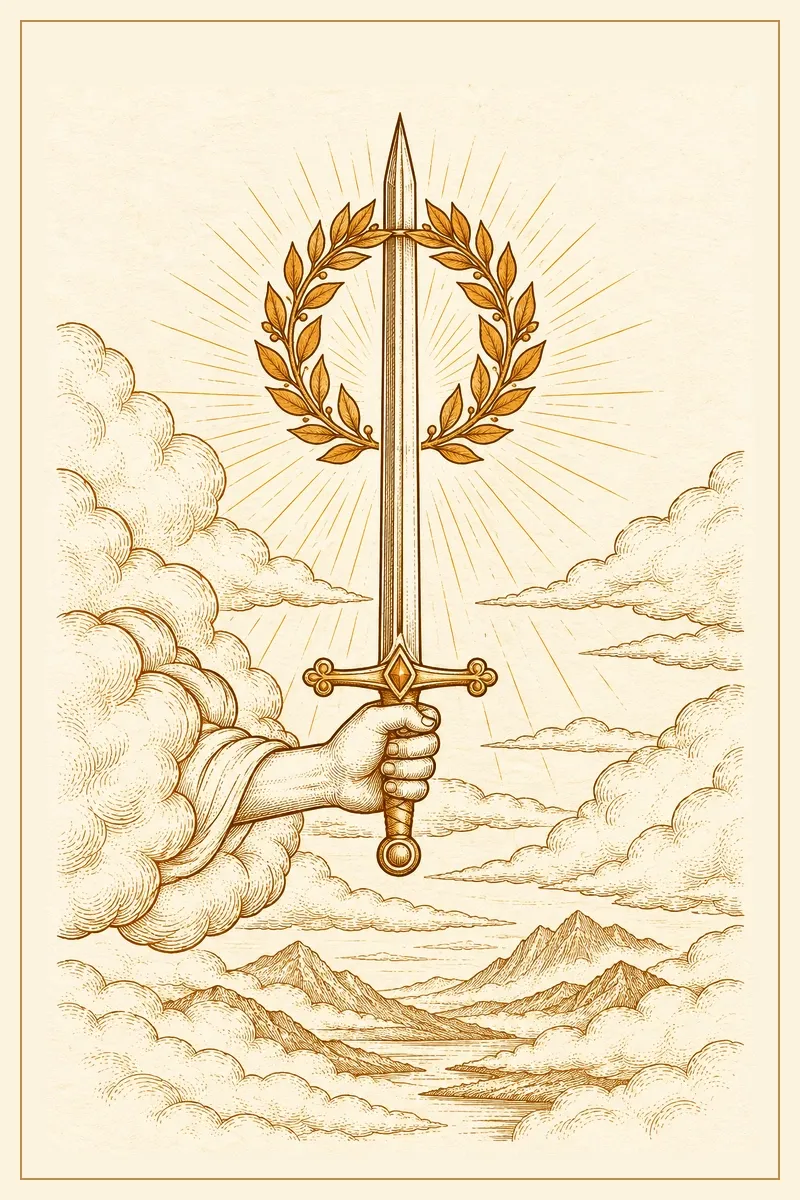
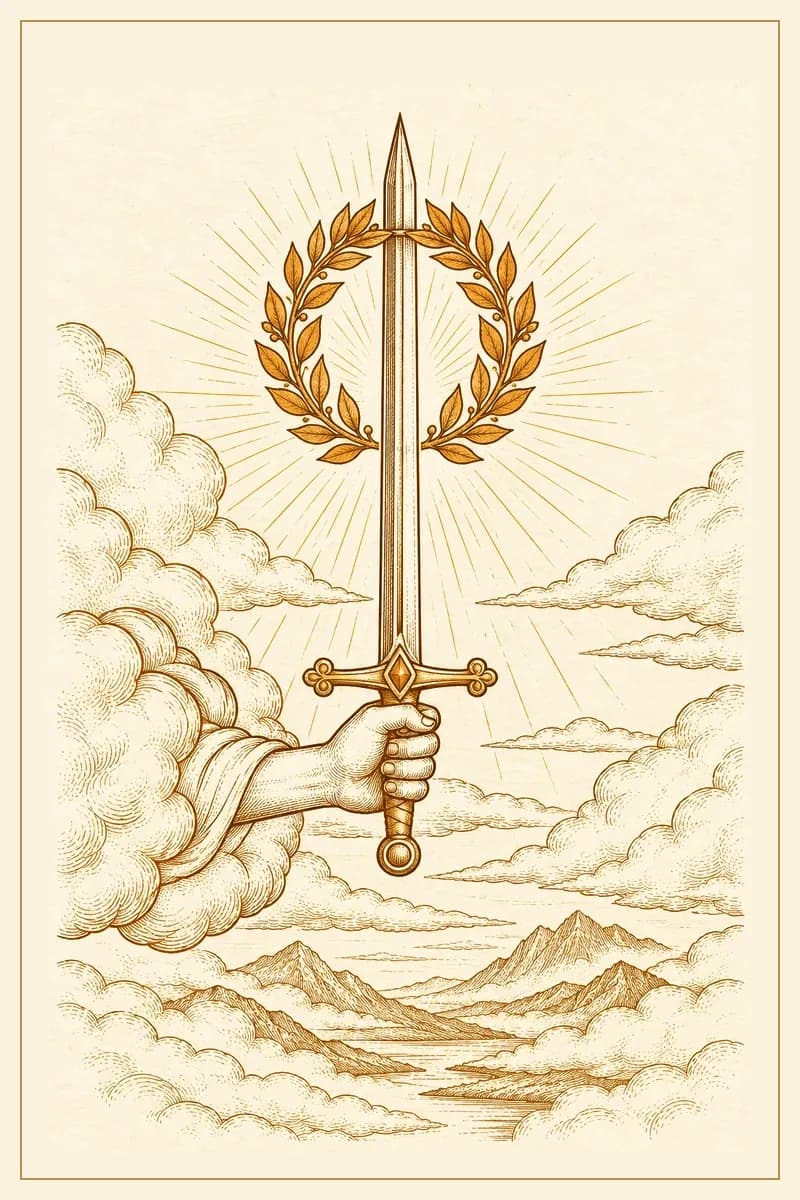
A bank of cloud fills the left edge of the card, and from it a single arm reaches out, wrapped at the wrist in a loose fold of cloth. The hand closes around the grip of a long, straight sword and holds it upright, point to the sky. There is no figure and no face. The whole card is one gesture.
A hand from a cloud is the old way tarot shows something arriving as a gift, and sudden understanding feels like that: you did the thinking, yet the clear sentence lands all at once. The grip is firm and the blade vertical. Clarity in this card is a straight line. Even the hilt is plain: a crossguard with three-lobed tips and a small diamond-shaped stone, a round pommel. A working tool, not a trophy.
The wreath, the rays and the point
High on the blade, a laurel wreath circles the sword, and fine golden rays fan out behind it. Laurel crowned winners and poets, so the wreath says that something has been won, and won with the mind and with words. Older Waite-Smith style designs set a crown on the sword's tip and scatter drops of light around it. Here the crown is gone and the wreath remains, which moves the emphasis from authority to achievement: the reward of seeing clearly is the clarity itself, not power over anyone. The point still rises above the wreath: past being right, toward what you will do now that you know.
Mountains and a river far below
Well beneath the hand, low peaks rise out of soft clouds and a river winds between them, small and distant, seen from above. That is the view the Ace gives you: high enough to see the shape of the whole problem. It is also a gentle warning: from that height real life looks tidy, and clarity has to come back down to the valley to be useful.
Root of the Powers of Air: the Ace's place in the deck
Swords belong to Air, the element of thought, language and judgment. In the Golden Dawn system that shaped many modern decks, each Ace is the root of its element, and this one carries the title Root of the Powers of Air. The Aces are linked to Kether, the first point on the Tree of Life, which is why they read as pure potential rather than a finished event. This overview of the Air element in tarot follows the idea through the whole suit.
Two points about astrology are worth getting right. The Golden Dawn gives the Ace of Swords no single zodiac sign or planet: the numbered cards from Two to Ten carry the decans, while the Aces stand above that scheme, each assigned a whole quarter of the heavens. The link you will see between this card and Gemini, Libra and Aquarius is a modern association through the element, and the same goes for tying it to Mercury.
Ace of Swords upright: the moment a thing becomes clear
A fact you can finally name
Upright, the card marks the point where vague unease turns into a statement you can write down. "The budget does not cover the second phase." "I am staying in this job because I am afraid, not because I like it." The fact may have been in plain sight for weeks; what changes is that you let yourself say it. Relief and responsibility arrive together.
A decision that cuts one way
A sword divides. Upright, the Ace supports choosing one option and letting the others go, instead of keeping every door half open. If you have been gathering information for a long time, you probably have enough to decide the next step, though not necessarily the whole route.
Words that mean exactly what they say
Air is also speech. The Ace favors the email that states its request in the first line, the apology without a "but", the contract term you ask to have rewritten because you do not understand it. It can also mark a new idea with a sharp outline: for a student, the click when a concept finally makes sense. Write it down while it is clear.
Ace of Swords reversed: a blade in fog, or a blade turned outward
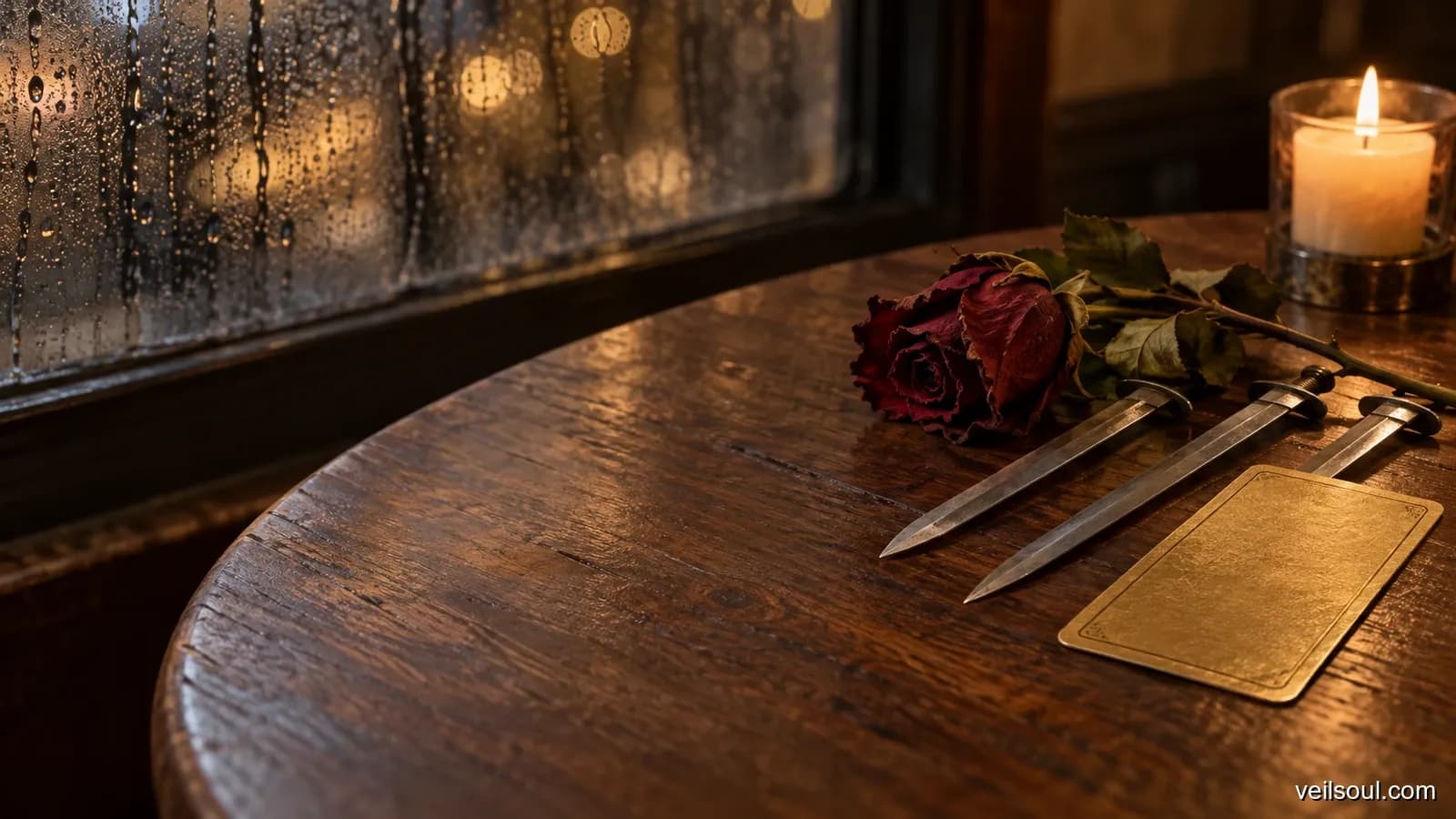
Upside down, the sword points into the ground and the cloud seems to swallow the hand. The reversed card covers three different situations; the work is finding which one is yours.
Clarity that has not arrived yet
Information is missing or contradictory, or you are deciding while tired, rushed or upset. A decision made in fog is a guess; find the missing piece first: ask the question, read the document, sleep on it.
Sharp words used to win
The truth may be perfectly clear, but it is being swung at someone: a remark built to sting, an argument kept going to score a point, a "just being honest" that is really a punishment. It can describe you or the person you are dealing with. Either way, ask whether the aim is to be understood or to win.
A mind that keeps cutting at nothing
The mind keeps slicing the same situation into finer pieces without reaching a decision, and every new angle produces three more questions. The remedy is not more thought but less: a walk, a night's sleep, a view from someone outside it.
Telling the three apart
Is there a specific fact I do not have? Then it is fog; go and get it. Do I want to say something mainly so the other person feels it? Then it is the turned blade; wait and rephrase. Have I gone over this three times without anything new? Then it is the restless mind; stop for today.
The Ace of Swords in the present, past, future and advice positions
An Ace is a moment rather than a long condition, so its position in a spread changes its job noticeably.
- Present: the clarity is available now. Something you already know is the key, even if you have not said it aloud. Reversed: you are deciding with too little information, or arguing more than listening.
- Past: a realization or a hard conversation that set things in motion. The present may still be running on that decision.
- Future or outcome: the fog is likely to lift if you keep asking good questions; the card does not say what the answer will be. Reversed: expect to double-check before committing.
- Advice: tell the truth simply, decide one thing, put the idea into words. Reversed: do not send the sharp reply tonight.
The past, present and future spread is a simple place to practice this, because the Ace changes so clearly from one slot to the next.
Is the Ace of Swords a yes or a no? Love questions included
Upright, the Ace of Swords leans yes, of a particular kind: yes, if you act on what is actually true. "Should I tell them how I feel?" Yes, said clearly and without pressure. It rewards accuracy, not luck.
Reversed, it reads as not yet. Something is unclear, unspoken or misread. In a love question such as "Should I message them?" or "Will we get back together?", a reversed Ace means "not until the misunderstanding is named". Clear that first and ask again later. This guide to yes or no tarot readings explains how single-card answers work and where they stop.
On timing, Swords are traditionally quick and an Ace is a beginning: read it as "soon after you take the first concrete step", never as a date.
Love under the Ace of Swords: the conversation you have been circling
Single, and tired of guessing
For someone single, the Ace can point to a clear look at what you want, separated from what you think you should want: the realization that you keep choosing people who are unavailable, or a short, plain list of what you need. Honest early messages fit this card better than playing it cool.
In a relationship: saying the thing plainly
Between partners, the upright Ace describes a conversation that clears the air: naming the issue you both work around, saying what you need without a long preamble. "I feel lonely on weekends when you work late" lands better than "You never make time for me". Reversed, it warns of a needed talk avoided until it comes out as an attack, or a fight where both people argue to win. The repair starts with a question before a point.
What the other person may be thinking
If you asked about someone's feelings, read the card as how the situation looks. Upright, the relationship is being thought about clearly, perhaps more with the head than the heart: they may be weighing things or preparing to say something direct. Reversed, it suggests mixed signals or a reluctance to say what they think. After a breakup, upright points to an honest talk about what went wrong, reversed to a story still tangled in different memories. In every case the most reliable step is to ask in plain words and listen to the answer.
Work and money: decisions that need a clean edge
At work
The Ace favors naming the problem, writing the clear proposal, raising the risk early and choosing one priority. Reversed: unclear instructions, rumors standing in for information, a meeting where everyone talks and nothing is decided. Ask for the decision in writing.
Money: a clear look at the numbers
In money questions the card asks for facts over feelings: open the statement you have been avoiding, list what comes in and goes out, read the terms before signing. It supports decisions on accurate figures and promises no gain. Reversed, it points to incomplete information, unclear fees or a choice driven by worry; slow down and, for anything large, ask a qualified person. Tarot is no substitute for financial advice.
Health questions: a clearer question, not a diagnosis
The Ace of Swords does not diagnose anything, predict a result, or point to a procedure. In a reading about well-being it can reflect the wish for a straight answer and the value of preparing for a conversation with a professional, such as writing your questions down. Reversed, it can mirror a mind overloaded with search results and conflicting advice. Stepping away from the screen and taking concerns to a doctor or other qualified person is the sensible reading of that card.
Major Arcana that sharpen or test the Ace
With Justice: a fact meets a fair process
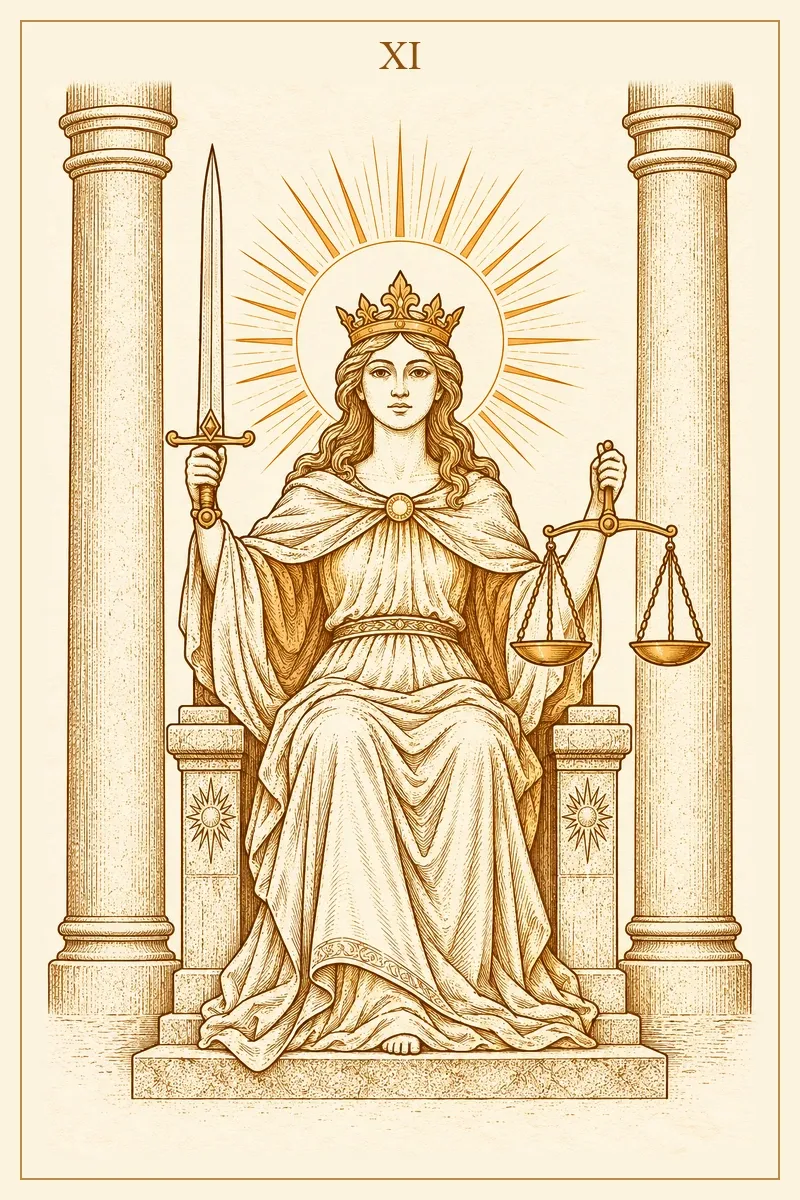
On the Justice card a crowned woman sits between two stone columns, a raised sword in one hand and balanced scales in the other. Beside the Ace the sword appears twice: the insight, then the weighing. Together they suggest a matter settled on evidence or a decision you can defend because you looked at both sides. The full Justice tarot meaning explains how the scales add accountability to the Ace's clarity.
With The High Priestess: what you know before you can prove it
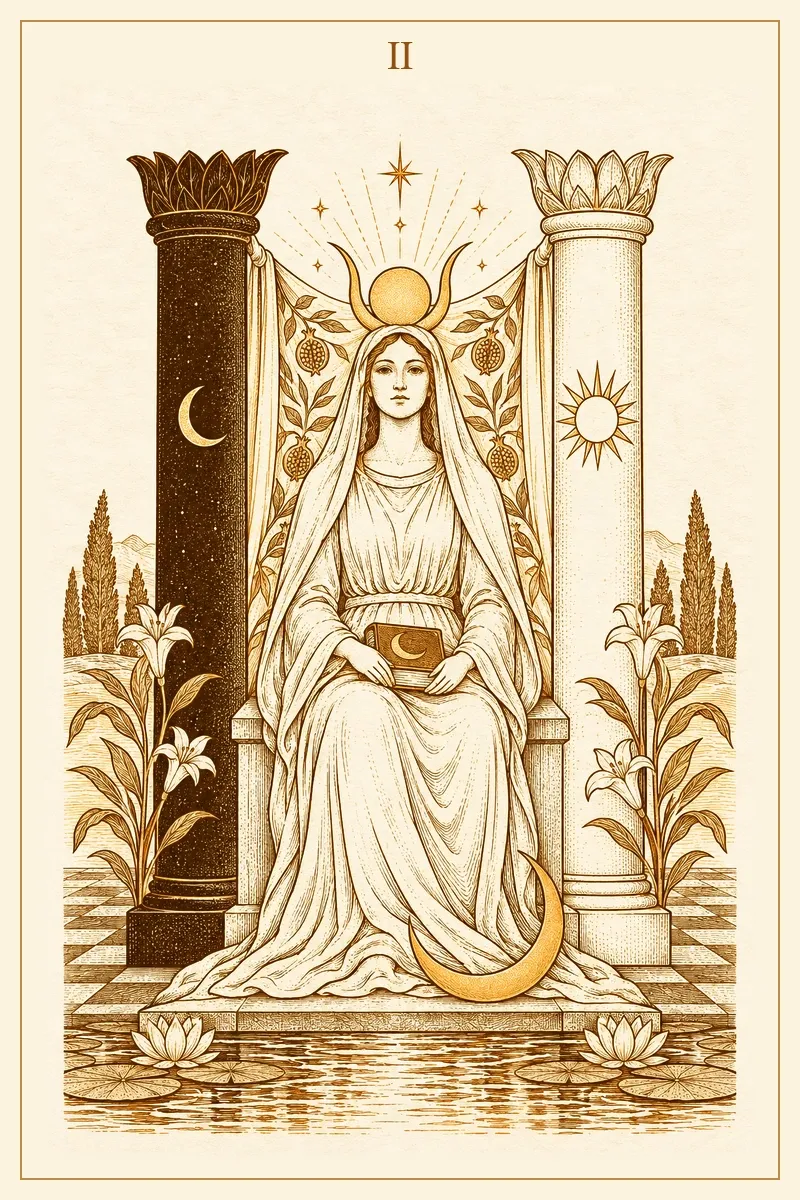
The High Priestess sits between a dark and a pale pillar, a book in her lap and a crescent moon at her feet, lotus flowers on the water below. She is the knowing that comes before words. With the Ace, a quiet intuition finally finds a clear sentence. If the two seem to disagree, give the intuition time before acting on the logic; this guide to The High Priestess goes deeper into that inner voice.
With The Tower: a truth that knocks the crown off
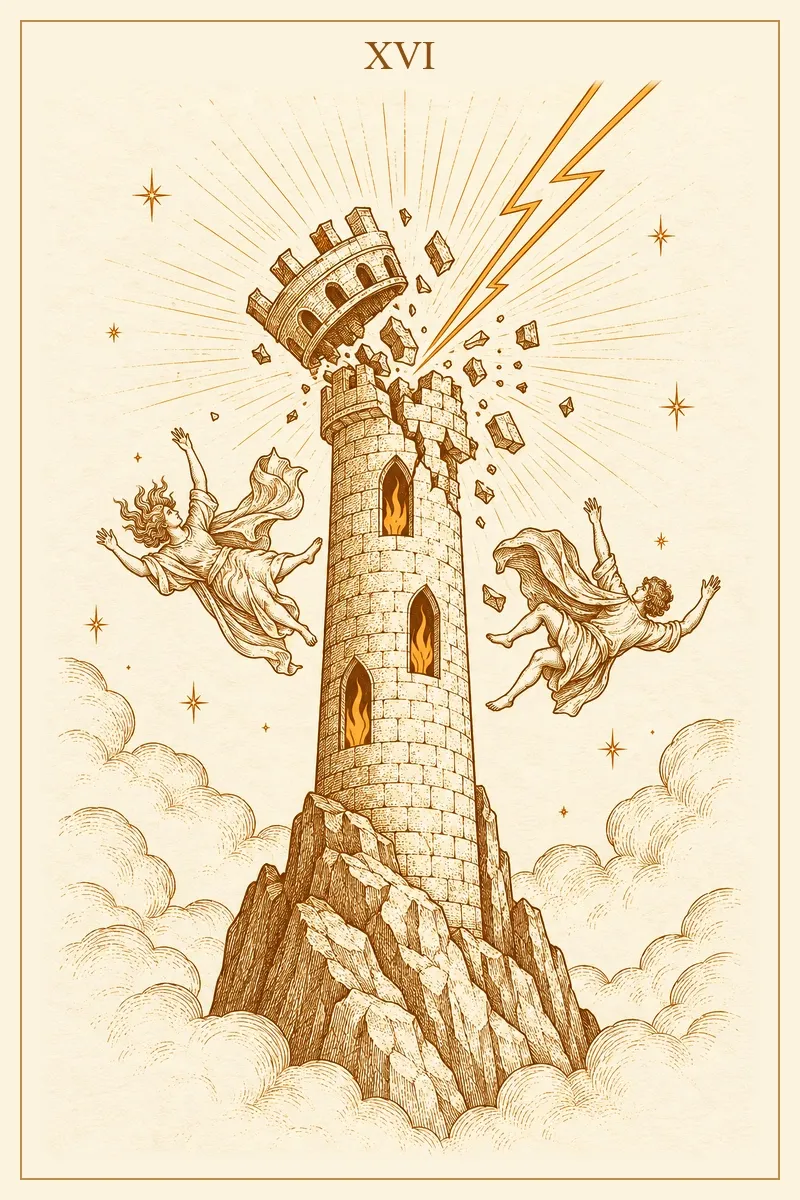
On The Tower, lightning strikes a stone tower on a rock, its crown-shaped top breaks away, bricks fly and two figures fall. Paired with the Ace, a fact comes out that shakes a structure: a revelation at work, a story that no longer holds. It is jolting, but you cannot rebuild on something you now know is false. The Tower meaning covers the collapse and what follows it.
What the next Swords do with the blade: the Two and the Three
Two of Swords: the blade crossed and the eyes covered
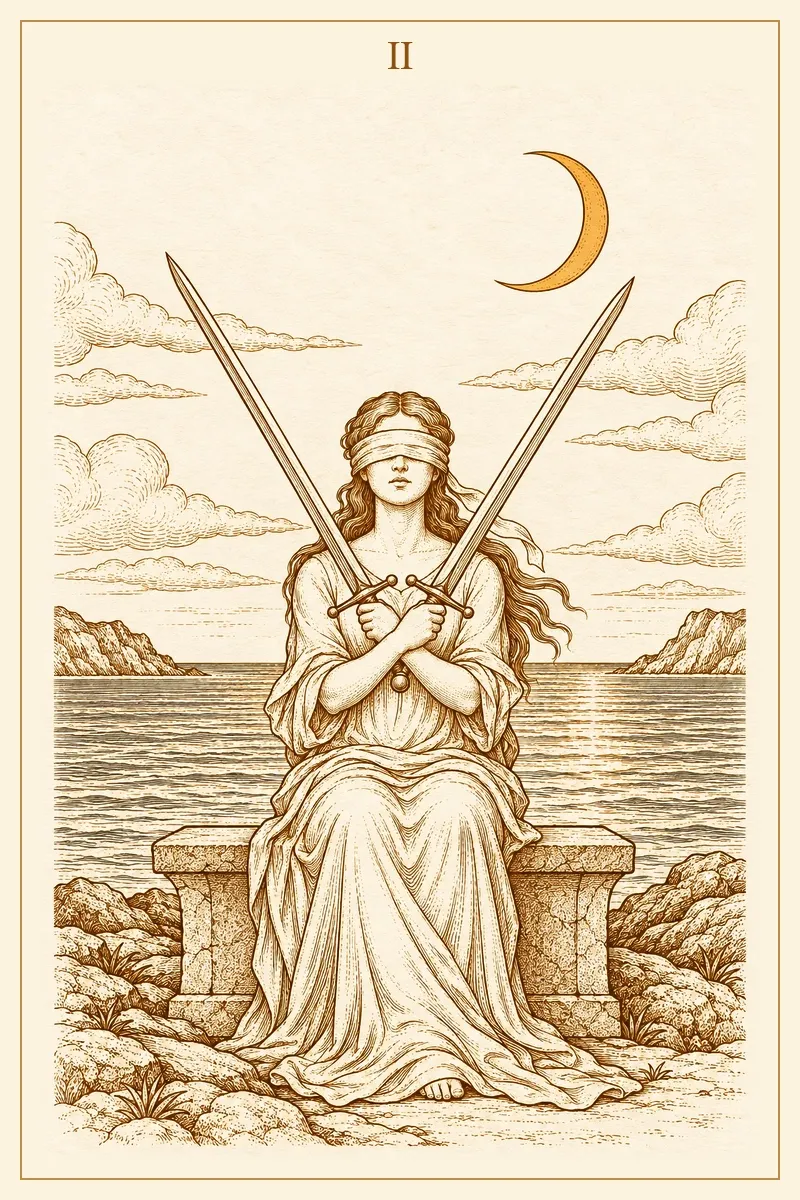
On the Two of Swords, a blindfolded woman sits on a stone bench by the sea, arms crossed over her chest, a sword in each hand, a crescent moon above. The Ace held one sword and saw clearly; the Two holds two and chooses not to look. Beside the Ace, it describes a decision that is clear in principle but is being put off. The Two of Swords meaning explains when that pause protects you and when it only delays.
Three of Swords: when the clear truth hurts
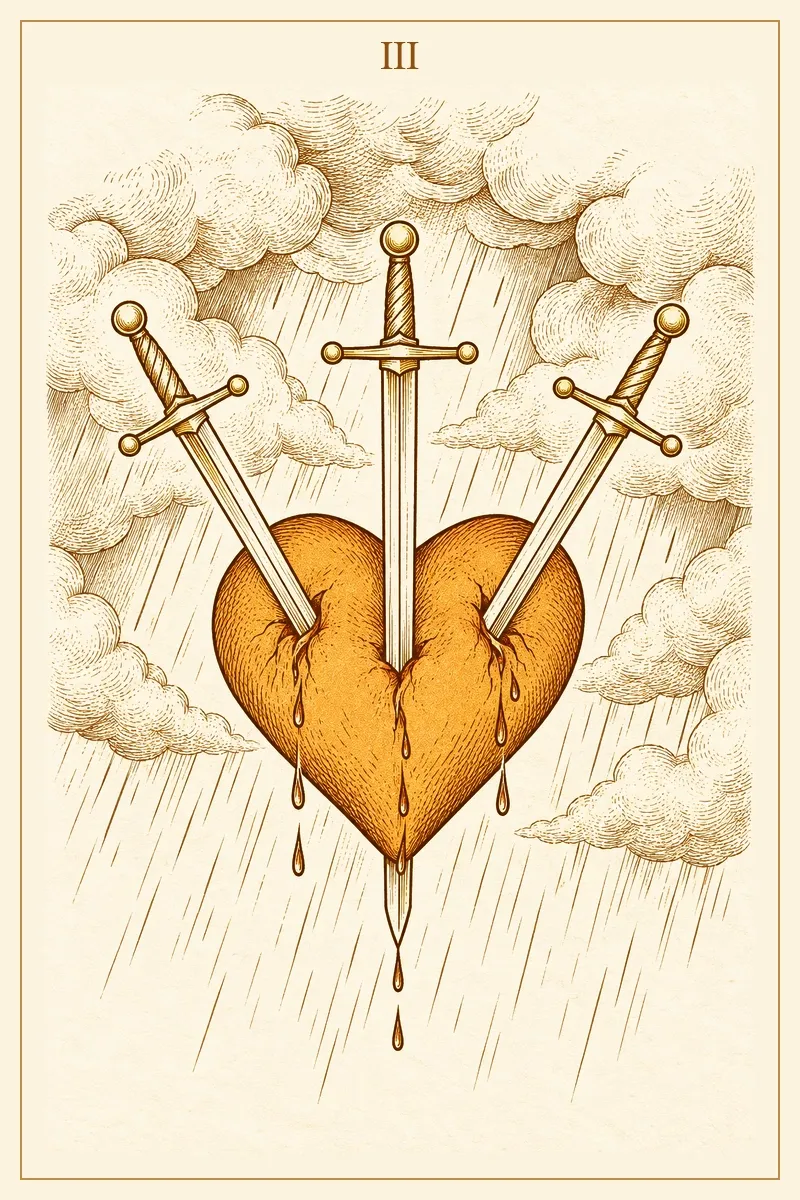
The Three of Swords shows a golden heart pierced by three swords under rain clouds. Next to the Ace, the truth that has come out is painful: a confession, a rejection, an honest word that stings. The pairing does not say the truth was wrong to tell; it says grief is part of the price of seeing clearly, and it heals better when acknowledged. The Three of Swords tarot meaning shows how to read that hurt without assuming it is permanent.
One Ace among four: how this beginning differs
- Ace of Wands: a leafing branch held from a cloud, a spark of drive. Beside the Ace of Swords, a clear idea meets the energy to start it, a strong pairing for launching a project.
- Ace of Cups: an overflowing golden cup, a beginning in feeling. With the Ace of Swords, honesty and tenderness arrive together: you can say how you feel and say it clearly.
- Ace of Pentacles: a beginning in money, body and practical life. Paired with the Ace of Swords, a clear plan meets a concrete resource.
The Ace of Swords is the beginning that starts in the head: understanding first, action and feeling later.
The whetstone spread: four cards for seeing one thing plainly
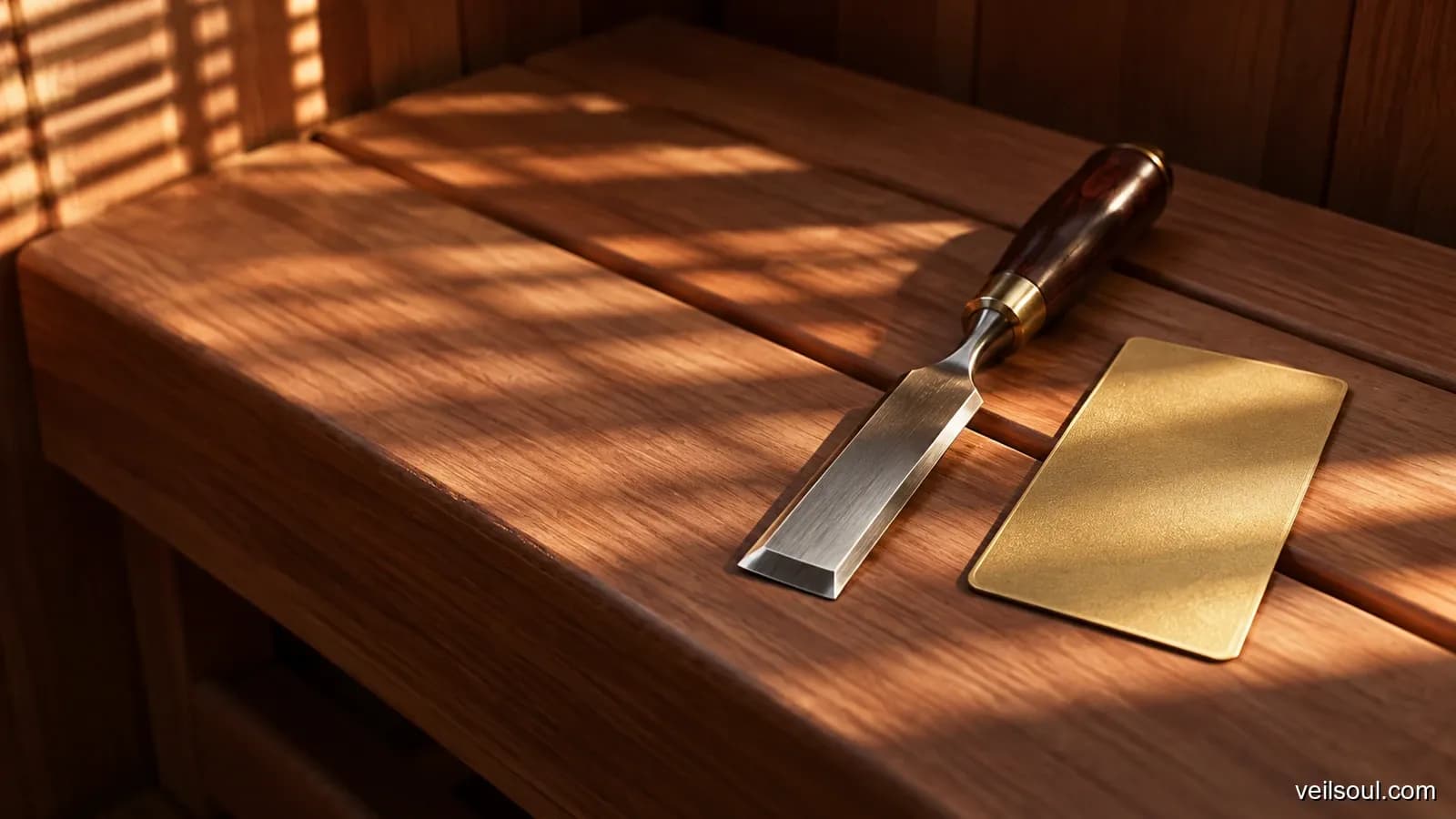
A whetstone does not create a blade; it removes what dulls it. This spread does the same for a question you feel muddled about. Shuffle while holding one concrete situation in mind, then lay four cards in a row.
- The fog: what is blurring your view right now.
- The fact: what is true and checkable, even if you have not said it.
- The edge: what acting on it may cost, and what you fear it will cost.
- The clean cut: one action that would make the situation clearer this week.
A hypothetical reading: a deadline nobody wants to question
This is an invented example, not a real client. A project coordinator suspects a launch date cannot hold and asks: "Should I tell my manager the date is not realistic?"
In the fog position she draws the Seven of Cups: a cloaked figure reaching toward seven golden cups on clouds, each holding a different vision, from a castle to a dragon to a snake. She has been picturing every possible reaction, and the pictures have crowded out the question.
In the fact position, the Ace of Swords upright. She already has the numbers: the testing schedule does not fit before the date. The card adds no new information; it says what she has is enough.
In the edge position, the Five of Swords reversed. Upright it shows a young man gathering swords while two others walk away toward the sea, a contest with a winner and losers. Reversed, it suggests the feared fight is bigger in her head than it is likely to be, and that the way through is to drop win-or-lose framing: she is not trying to prove anyone wrong.
In the clean-cut position, the Page of Swords upright: a young figure striding over rough ground, sword raised, cloak blowing, alert to everything. The step is small: ask for a short meeting, bring the schedule, and open with a question ("Can we look at the testing window together?") rather than a verdict.
Reading the four as one sentence
Together: "I have been scaring myself with imagined reactions; the facts are clear; the conflict I fear is mostly my framing; one curious conversation is next." It does not predict what the manager will say. It turns a knot of worry into one doable action, which is the Ace's whole job.
Keeping the edge clean: small practices for the week
- Write the one sentence. Finish "The thing I already know is..." in one sentence. If you cannot, the card may be asking for more information first.
- Split fact from story. List what you could prove to a stranger and what you are assuming. Act on the first list.
- Sleep on sharp messages. Draft the hard text, then wait until morning. If it still says what you mean, send it; if it mostly says how angry you are, rewrite it.
And three questions to sit with, on paper if that helps: What truth have I been avoiding that would make things simpler if I faced it? Where do I need more clarity before deciding, and where am I using "more information" as a reason to wait? What idea keeps asking for my attention, and what would its first draft look like?
Frequently asked questions
Is the Ace of Swords a good card?
Mostly, yes. It brings clarity, honesty and a fresh start in thinking. It can feel hard only because clarity sometimes shows what you hoped not to see.
What does the Ace of Swords reversed mean in one line?
Clarity that is blocked or misused: missing information, sharp words used to wound, or a mind going in circles. Find out which applies, then gather facts, soften your words, or rest.
Can the Ace of Swords tell me whether someone is lying or what they really think?
No. Tarot reflects your situation and your own thinking; it cannot read another person's mind, confirm a lie, or guarantee an outcome. What the Ace can do is encourage you to ask directly and to notice what you already know.
Does the Ace of Swords mean surgery or a medical result?
No. A card cannot diagnose, predict test results, or point to a procedure. In a health question, treat it as a prompt to get reliable information from a qualified professional.
How is the Ace of Swords different from Justice and the King of Swords?
The Ace is the first spark of clarity, a single moment. Justice is the fair weighing of that clarity, with consequences. The King of Swords is a person, or a way of acting, that has mastered clear thinking and uses it with authority: beginning, judgment, mastery.
Setting the sword down for now
The Ace of Swords is not asking you to be harsh or to have every answer. It asks for one clear sentence, said kindly, and one decision you can stand behind. If you would like to see where this card falls in your own situation, you can draw a reading on your question and look at the Ace in its position. To explore further, browse the tarot questions other readers start from or the full list of 78 card meanings.