A full moon tarot spread is a short reading you lay out on or near the night of the full moon to see what the past few weeks have brought to a peak, and to choose one thing you are ready to set down. The six-card layout below uses two rows: the top row looks at what has come into view, and the bottom row names what to release, what stays, and how to look after yourself as the moon wanes. With a pen, a notebook and a small slip of paper, the whole ritual fits into about forty minutes.
You do not need to follow astrology for this to be useful; here the full moon is simply a date that asks you to pause. The cards will not tell you how a situation ends, what someone else is thinking, or when a change will arrive. What they give you is images and words for what you already half know, so you can decide what to do with it.
At a glance, the six positions are:
- 1. What has come to fullness: the feeling, pattern or situation that peaked this month.
- 2. What I have been carrying: the weight that has grown heaviest.
- 3. The truth I can accept now: something you know in your head and are ready to feel.
- 4. What I release tonight: the one thing to put down.
- 5. What stays when I let go: what is left, and what has room to grow.
- 6. Care for the waning weeks: one practical way to look after yourself.
Why the full moon suits a release reading
One simple way to keep a moon practice is to split the month in two. The new moon is the dark, quiet start and a natural point to name intentions; the full moon is the bright midpoint, when whatever you began or endured is fully visible. If you already work with new moon intention setting, this spread is its counterpart. Instead of asking what to plant, it asks what has grown, what has grown too heavy, and what you can stop holding.
Most of the value lies in the structure. A fixed evening roughly once a month gives you a check-in that does not wait for a crisis, and naming a single release keeps the practice small enough to repeat. The bright moon is a fitting metaphor as well: what sat in shadow, including habits and resentments you would rather not look at, is easier to see.
For the symbolic and astrological side, the wider guide to full moon tarot practices covers that ground. This piece stays practical: one layout, one evening, one release.
The six positions, row by row
Shuffle, then lay the cards in two rows of three, left to right. Read the top row as a short story before you turn to the bottom row, because a release only makes sense once you know what the light has shown.
Top row: what the light shows
- 1. What has come to fullness. Whatever reached its peak in the past few weeks: a project, a feeling, a pattern in a relationship, a tiredness you kept postponing. What has become impossible to ignore?
- 2. What I have been carrying. This is the load: a responsibility, a worry, an unspoken feeling, a role you took on for someone else. A heavy card here is not a judgment; it lets you measure the weight.
- 3. The truth I can accept now. Some things we understand intellectually long before we accept them emotionally. This card bridges that gap. Read it as a sentence that begins, "I already know that…"
Bottom row: what you set down
- 4. What I release tonight. The center of the spread. It may name a grudge, a story you tell about yourself, a level of control, or a commitment that has run its course. Keep it to one thing, stated as specifically as you can.
- 5. What stays when I let go. Releasing makes room rather than leaving you empty. This card shows what remains steady, or what can grow in the space.
- 6. Care for the waning weeks. As the moon shrinks back toward the next new moon, this card suggests one concrete form of care: rest, a conversation, a boundary, a walk, time with friends, or support from a professional.
Positions 2 and 4 belong together. The first describes the weight; the second shows which part of it you can put down tonight. You might carry a whole household's needs and release only the belief that you must manage it all alone. That smaller release still counts.
Setting up the evening
What to have on the table
- Your deck. Some readers like to cleanse the deck at the full moon first; it is optional.
- A notebook for the six cards and your first reactions. A dated entry becomes a record you can look back on, and a simple tarot journal layout works well for it.
- A small slip of paper and a pen for the release sentence.
- A candle, if you like one, plus a fireproof bowl or a sink if you plan to burn the paper. Tearing the paper into pieces works just as well.
- A view of the moon, if you have one. Clouds or a city sky change nothing about the reading.
Forty minutes, step by step
- Arrive (3 minutes). Leave your phone in another room. Take five slow breaths, each exhale longer than the inhale, and notice where you hold tension.
- Look back (3 minutes). Without analyzing, jot three words for the past month. Busy, lonely, hopeful, stretched: whatever is true.
- Shuffle and lay out (5 minutes). Hold the deck and ask a plain question, such as "What has this month shown me, and what am I ready to set down?" Shuffle until you feel like stopping, then lay out two rows of three.
- Read the top row (10 minutes). Read each card, then sum up the three in one written sentence about where you are.
- Read the bottom row (10 minutes). Spend most of this time on card 4. Ask what it wants you to stop doing, believing or holding, and be honest about the part you grip hardest.
- Write the release (3 minutes). On the slip of paper, write one specific sentence: "I release the need to answer every message the same day" rather than "I release stress." Read it aloud once, then burn it safely in the bowl or tear it up.
- Commit to card 6 (3 minutes). Turn card 6 into one action for the coming week, for example: "On Sunday I will switch my phone off by nine." Write it under the reading.
- Close (a minute or two). Put the cards away, blow out any candle, and sit quietly for a moment.
Cards for the top row: what has come to light
Any card can land in any position. The two below are worth knowing in advance because their imagery speaks directly to fullness and weight; treat each reading as a starting point.
The Moon: half-seen things in a brighter light
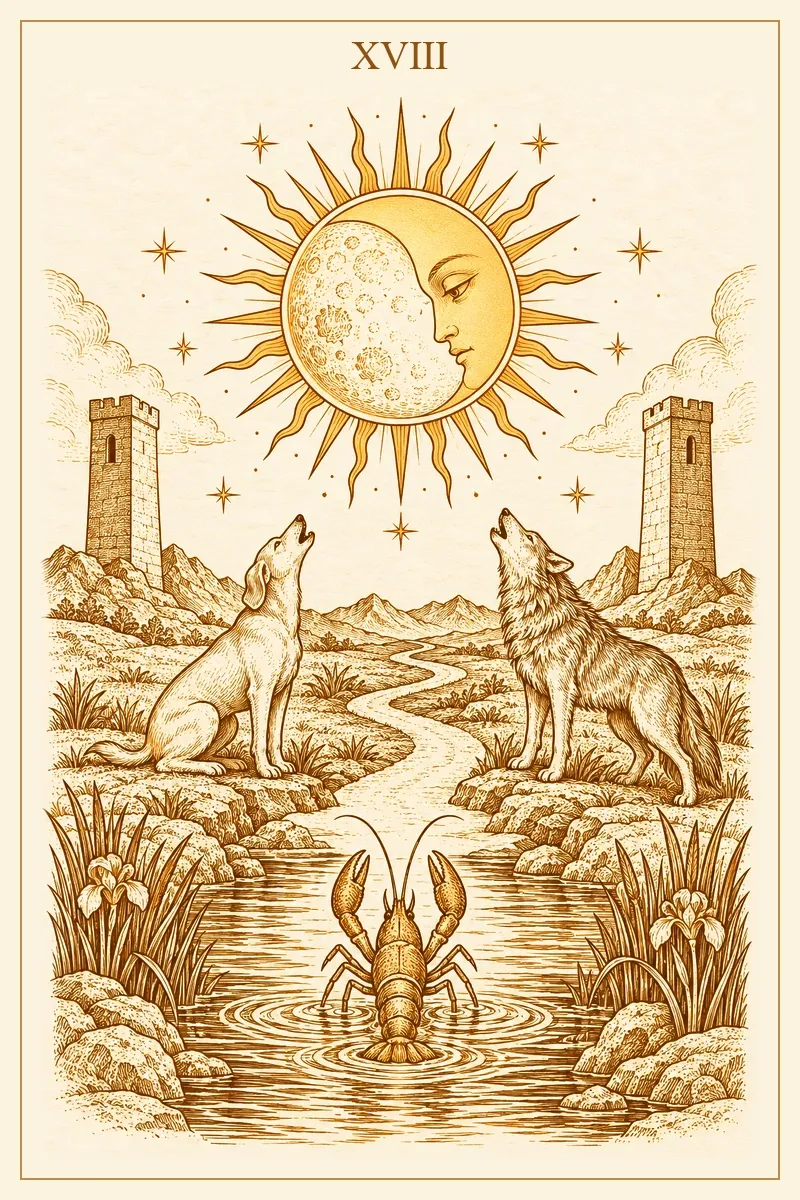
The Moon shows a moon face set inside a rayed disk above two towers, with a dog and a wolf calling up at it and a crayfish climbing out of a pool onto a winding path. Upright, it describes uncertainty, dreams, intuition, and fears that have not yet taken a clear shape. Drawing it at the full moon is a coincidence of names, not a louder message.
In position 1, The Moon suggests that what peaked this month is a mood rather than an event: an unease you could not explain, a recurring dream, a sense that something in a relationship does not add up. The useful question is what you fear might be true, and what evidence you actually have. Reversed, the card can show the fog beginning to lift, or a worry pushed down so far that it leaks out as restlessness. For the full range of upright and reversed meanings, see The Moon tarot meaning.
Ten of Wands: the load at its heaviest
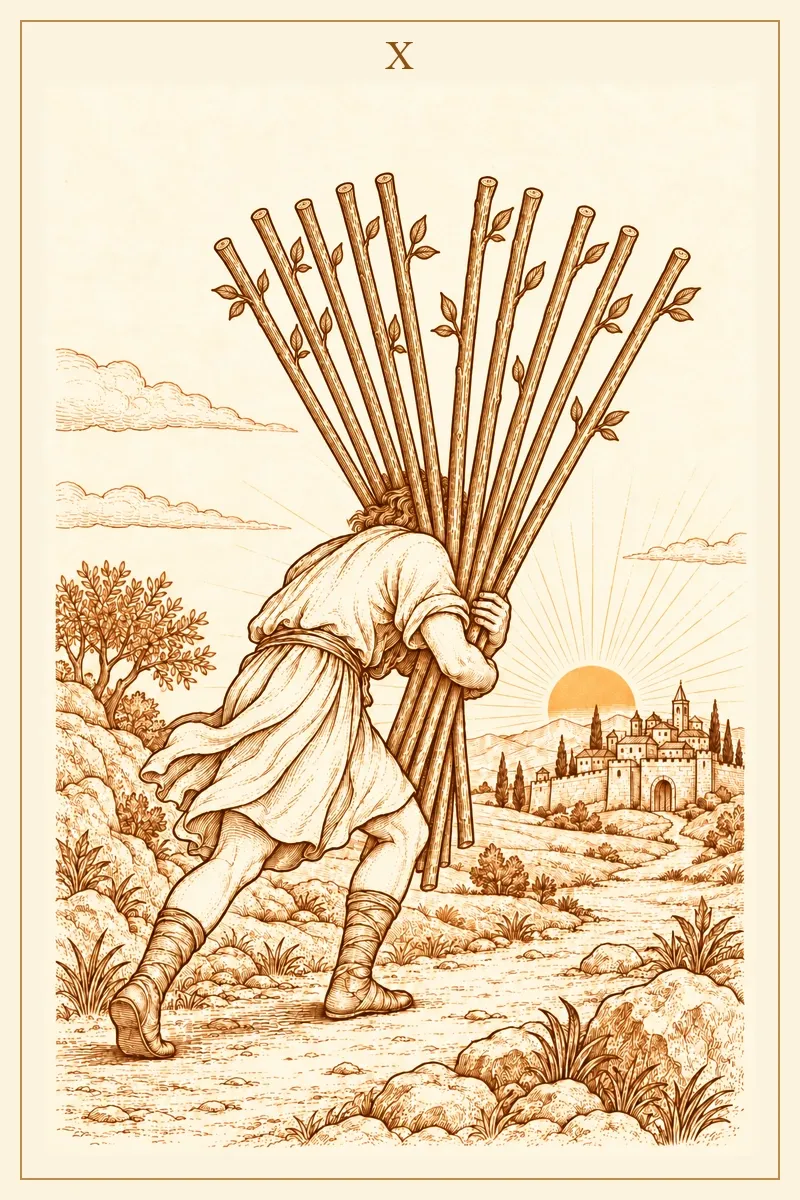
The Ten of Wands shows a figure bent forward, arms wrapped around ten leafy staffs, walking toward a town on a hill while the sun sits low on the horizon. Upright, it means overcommitment: you said yes to everything, and every yes is now in your arms. Reversed, it can mean you have started putting part of the load down, or that the weight has grown so large that something is slipping from your grip.
In position 2, this card is close to a literal answer. List what you are carrying, one staff at a time. Which tasks belong to you, which belong to someone else, and which did you pick up because nobody asked? The Ten of Wands tarot meaning goes further into how the card reads in love and career.
Cards for the release row: what you can set down
The bottom row is where the evening slows down. These three cards describe different kinds of letting go: walking away, closing a chapter, and refilling afterward.
Eight of Cups: walking on under a crescent
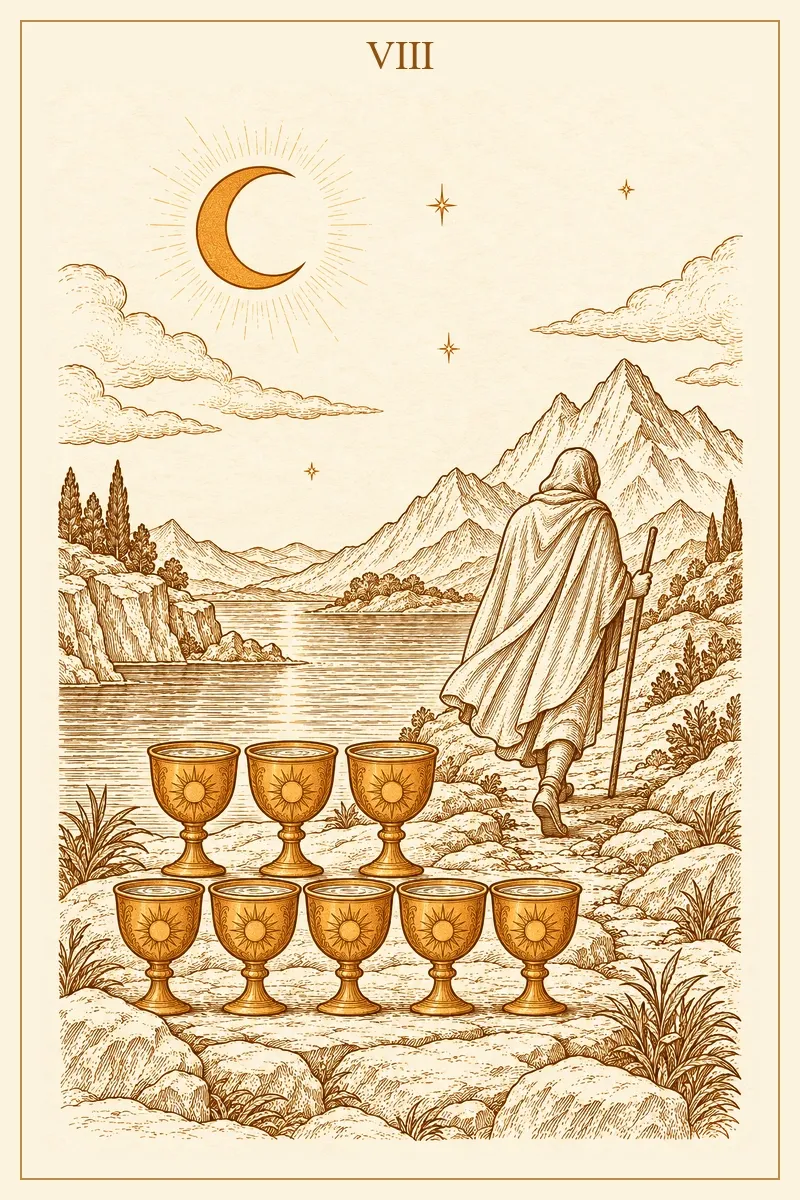
In the Eight of Cups, eight golden cups stand in two rows, three stacked on five, while a cloaked traveler with a staff walks along the water toward the mountains under a crescent moon. Nothing is broken; the cups are intact. The traveler leaves anyway, because what they hold is no longer enough.
Upright in position 4, the card asks you to release something that still looks fine from the outside: a routine, a friendship that only runs one way, a goal you no longer want but keep chasing because you have invested in it. Reversed, it can describe the fear of leaving or staying put out of habit, and then the release may be the excuse rather than the situation itself. You do not have to leave anything tonight; naming what you would walk away from is a start. The Eight of Cups tarot meaning explores the card in relationships and work.
Death: an ending that clears ground
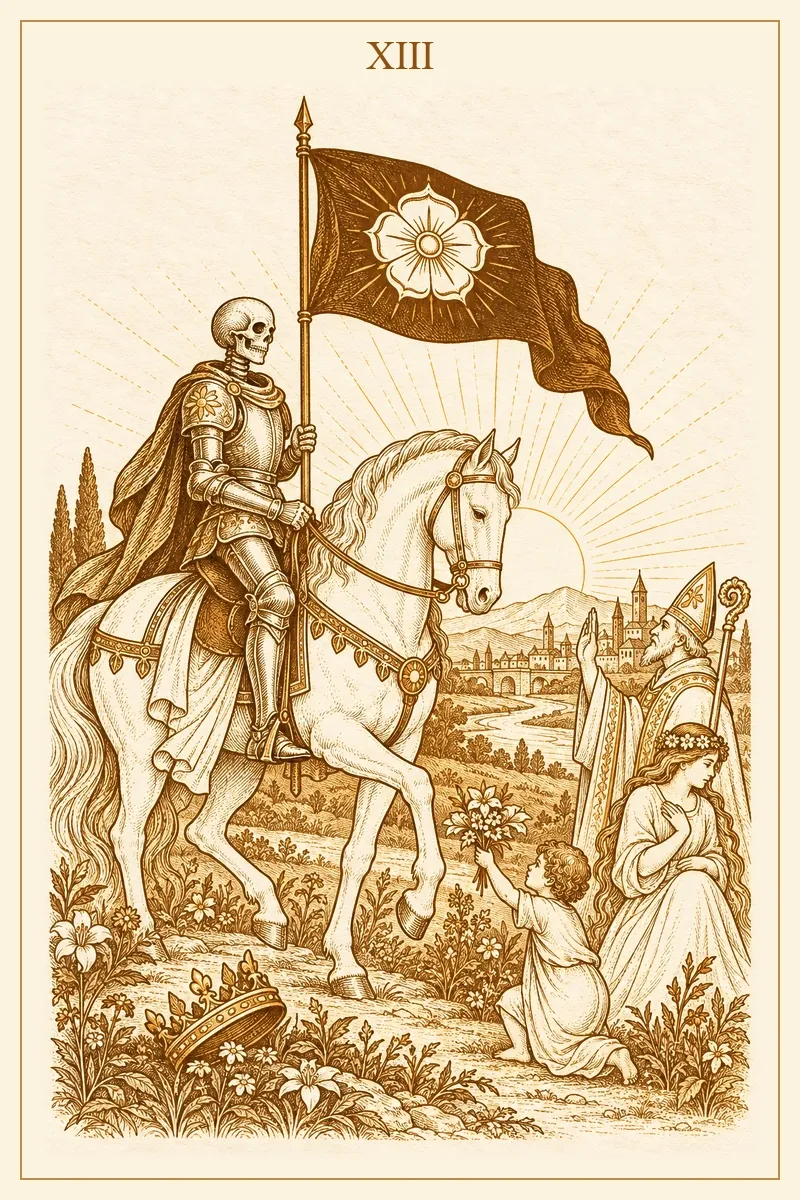
Death shows an armored skeleton on a white horse, carrying a dark banner marked with a white rose. A crown lies on the ground, a child holds out flowers, a woman kneels, a bishop stands near, and a sun rises behind. The card speaks of endings and transitions, never of anyone's literal death.
In the release row, Death is the clearest card you can draw: something has finished, and the ritual asks you to admit it. That might be a self you have outgrown, or a hope for a relationship that has already ended. Upright, it supports a clean close. Reversed, it describes resistance, holding on to a chapter after it has ended, which makes the transition slower and harder than it needs to be. In position 3, Death reads as a truth to accept: this is over, and part of you already knows it. The Death tarot meaning covers the card's many shades.
The Star: what pours back in
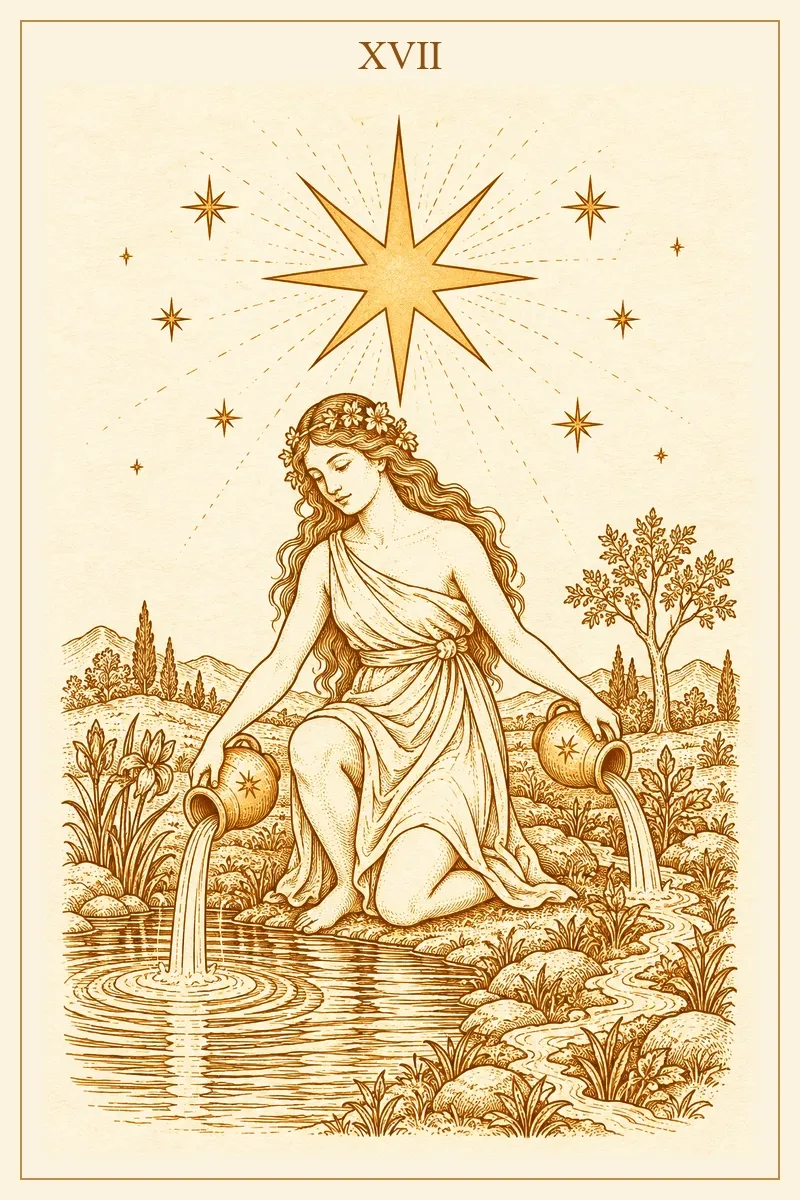
The Star shows a woman kneeling under a large eight-pointed star and a scatter of smaller ones, pouring water from one jug into a pool and from the other onto the bank. It is the card of hope, healing and quiet renewal after a hard stretch.
In position 5 or 6, The Star answers what remains once you let go: a calmer, more generous version of you, and the slow return of energy. As care for the waning weeks, it points to gentle things rather than big plans: sleep, time outdoors, an honest talk with someone you trust. Reversed, it can show discouragement or a sense of being cut off from hope, and then card 6 is a reminder to refill before you give anything more away. Read The Star tarot meaning for its fuller story.
A worked example: a month of saying yes
This is an illustrative reading, not a real person's. Imagine someone who spent the month covering for a colleague, helping a friend move and agreeing to every family request. They ask the opening question above, and six cards fall.
1. What has come to fullness: Seven of Pentacles. Patient effort, and a pause to judge whether it is paying off. The peak is a question: is anything of their own growing?
2. What I have been carrying: Nine of Wands. Guarded tiredness. The weight is less the tasks than the constant bracing for the next request.
3. The truth I can accept now: Queen of Swords. Clear speech and honest limits. The truth they already know is that they can say no plainly and kindly, without a long justification.
Read together, the top row says: "I am worn down from staying on guard, and I may speak plainly about what I can give."
4. What I release tonight: Four of Pentacles. A tight grip, here on control rather than money: the belief that everything falls apart unless they hold it together. Their release sentence becomes, "I release the belief that I have to be the one who always says yes."
5. What stays when I let go: Three of Cups. Friendship and shared celebration. What remains are the relationships that give back, like the friend who would gladly share a meal rather than ask another favor.
6. Care for the waning weeks: Four of Swords. Rest and recovery. The commitment they write down: "For the next two weeks, Wednesday evening stays empty."
Notice what the reading did not do. It did not decide whether the colleague is taking advantage, and it did not predict how the family will react to a no. It offered a sentence to release and one small change to test before the next new moon.
When the question is about love, work or money
The positions stay the same whatever the topic. What changes is how you phrase the opening question and what you look for in card 4.
Love and relationships
Ask about your own side: "What has this month shown me about how I love?" Card 4 might point to checking someone's messages, comparing a partner with an ex, or waiting for a person to change. If you are single, the release may be an old story about why love keeps missing you. Keep the question on your side of the story: what you are holding while you wait, and which part of it you could set down.
Work and career
The top row works like a monthly review written for yourself rather than for a manager. Card 4 may name perfectionism, a task you could hand over, or the hope of praise from someone who rarely gives it. Card 6 then becomes something you can schedule: asking for feedback, blocking a focus morning, taking the day off you postponed.
Money and practical life
Keep the release personal and behavioral: impulse buying when you are tired, avoiding your bank statements, a story that you are "bad with money." The cards can show the feeling behind a pattern, but they are not financial advice; big decisions belong with real numbers and, where it helps, a qualified advisor.
When a hard card lands in the release row
Sometimes card 4 looks frightening. The Tower in that position does not announce a disaster; it asks you to release the effort of propping up a structure that is already cracking, whether that is a plan, an image of yourself or an arrangement that no longer fits.
A bright card in the release row can be just as puzzling. If The Sun appears in position 4, you are hardly being asked to release joy. It may be asking you to let go of hiding your happiness, of the pressure to keep everything positive, or of waiting for permission to enjoy something you have already earned.
A reversed card in position 4 can be read as "release whatever keeps this card upside down": the delay, the fear, the habit of turning away. If a card makes no sense at all, write your first impression and let it sit for a few days rather than redrawing at once, or place one clarifying card beside it.
After the reading: the waning weeks
These prompts carry the reading into the two weeks that follow:
- What surprised me most in tonight's cards?
- When I wrote my release sentence, what happened in my body?
- If I truly put this down, what becomes possible next month?
- What from the past month am I grateful for?
- What do I want to carry into the next cycle on purpose?
Check in with card 6 a week later and note whether you kept the small commitment. At the next new moon, look back at card 5 before you set intentions, since what stayed is a good foundation to build on. After several months, read your release sentences in a row; where one keeps returning, the exercises in tarot for letting go give that work more time.
A release ritual is a form of self-care, not therapy. If the reading brings up grief, heartbreak or old trauma that feels too big to hold alone, a counselor or other mental health professional can help, and the cards can sit alongside that support. The gentler approach in tarot for grief and loss is written with those heavier seasons in mind.
Frequently asked questions
Do I have to read on the exact night of the full moon?
No. The moon looks nearly full for a couple of nights around its peak, so the evening before or after works just as well. What matters more is choosing a time when you will not be rushed or interrupted.
Do I need a candle, crystals or moonlight?
None of them is required. A candle can mark the start and end, but the reading needs only your deck, a pen and some quiet. Leave out anything that feels like a performance.
How is a full moon spread different from a new moon spread?
A new moon spread looks forward and asks what to begin. A full moon spread looks at what has already grown and asks what to keep and what to release. Used together across a month, they form a simple loop: set an intention, review it at its peak, let go of what got in the way.
Can a full moon spread predict what will happen next month?
No. Tarot cannot confirm an outcome, a date or another person's thoughts, and the full moon does not change that. Card 6 describes care you can choose, not an event that will happen to you. Read the spread as a mirror for your choices.
What if the card in the release position feels wrong?
Sit with it before dismissing it. Ask what part of the card's meaning you would least like to apply to yourself; that part is often the one worth a closer look. If it still does not fit after a few days, write down what you believe you need to release and treat the card as a question to return to.
Can I do this spread with a friend or partner?
Yes. Each person draws their own six cards, reads quietly first, then shares only what they want to. Avoid interpreting the other person's release card for them.
A small promise until the next new moon
The full moon offers a regular moment to see what is full and to open your hand around one thing. Copy your release sentence into your notebook, keep the card 6 commitment small, and check on both when the moon turns new again. When you would like a calm, guided look at a question of your own, you can start a reading with Veil Soul whenever the time feels right.