Rough water behind, smooth water ahead: the Six of Swords is the tarot card of moving on from a hard season, slowly and with help. Upright, the Six of Swords meaning is transition: you are leaving a painful situation for calmer ground, carrying its lessons with you, and the relief arrives gradually rather than all at once. Reversed, the crossing stalls: you stay tied to the dock, try to carry too much, or turn back toward the trouble you meant to leave.
In love, the card usually speaks of healing after a breakup or of a couple choosing a quieter phase together; as a yes-or-no answer it leans yes, especially when the question is whether to leave or change something. Tarot can help you see where you stand in that crossing. It cannot read another person's mind, set a date for relief or decide an outcome; it can show you what you are leaving, what you are bringing, and what might help you push off.
- Upright keywords: transition, moving on, recovery under way, leaving for something steadier, travel or relocation, accepting help.
- Reversed keywords: resisting change, unfinished business, carrying too much, a delayed departure, returning to an old situation.
- Love: healing after heartbreak, a calmer chapter for a couple; reversed, the pull of an ex or an old pattern.
- Yes or no: upright, yes, with gradual results; reversed, not yet.
- Element and astrology: Air; Mercury in Aquarius, the second decan of Aquarius (10 to 20 degrees).
- Golden Dawn title: Lord of Earned Success.
- Number and sphere: six, linked to Tiphareth, Beauty, the balancing center of the Tree of Life.
A pole, a boat and six upright blades: the crossing on the card
The ferryman and two passengers
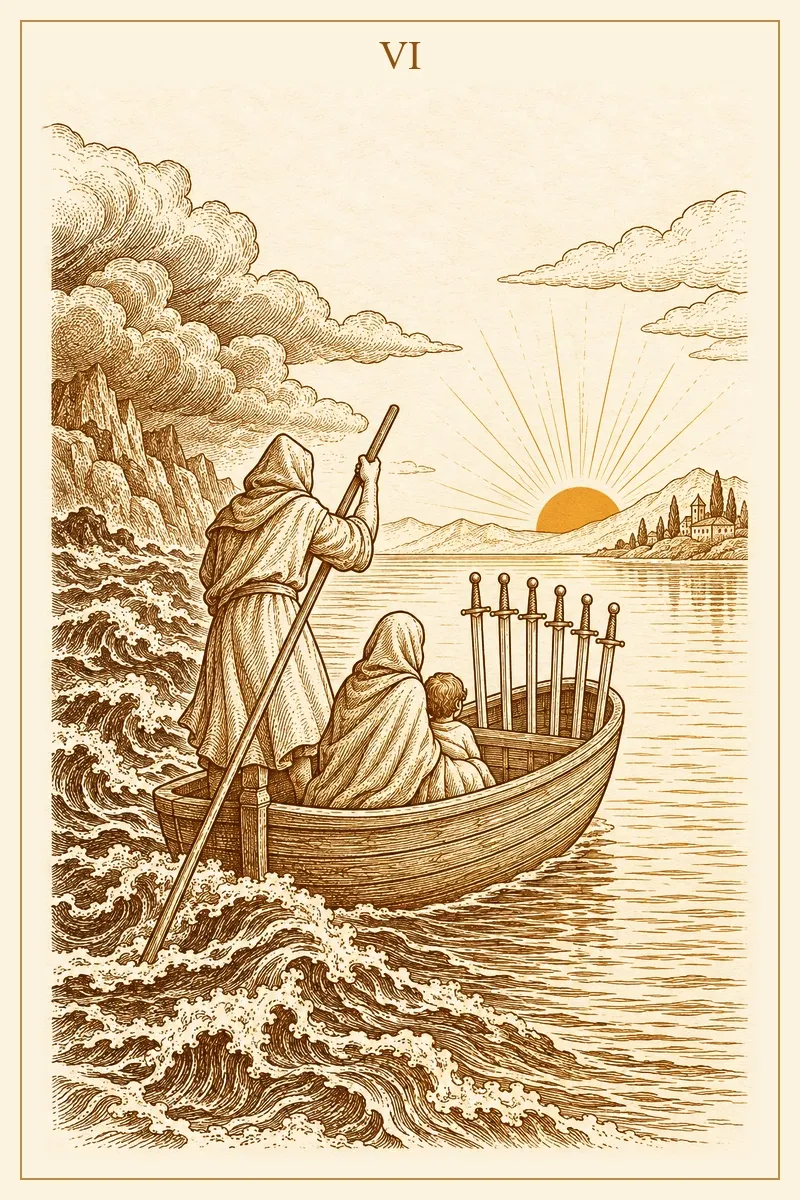
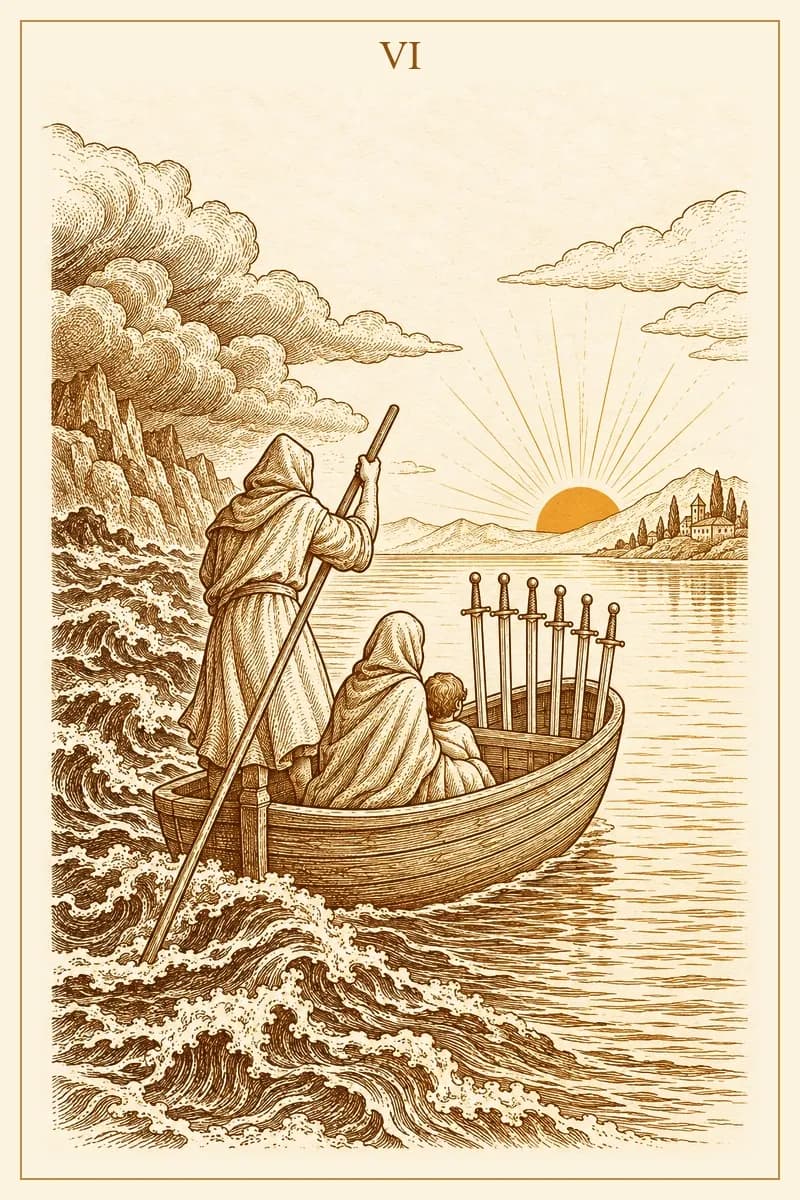
The card shows a wooden boat in the middle of a crossing, seen from behind. At the stern stands a hooded figure in a long robe tied at the waist with a cord, leaning on a tall pole that reaches down into the water. There are no oars and no sail; the boat moves because one person keeps pushing. In the middle of the boat sits a second figure wrapped in a heavy hooded cloak, and pressed close against that figure's side is a small child. All three face the same way, toward the far shore, and none of them looks back at the water they are leaving.
Readers often see the ferryman as whatever carries you when you cannot carry yourself: a friend, a counselor, a routine, or simply time. The cloaked passenger is the part of you that is tired and grieving, the child the part still curious about what comes next. Nobody asks the passengers to row; accepting help is allowed.
Six swords standing in the bow
Six swords stand upright in a row near the front of the boat, hilts up and blades down, evenly spaced like a short fence. In the suit of thought, words and painful truths, those blades are what you take with you from the hard season: the memory of what happened, the lessons it taught, the sentences you still replay. They are stowed, not raised for a fight, and though they add weight, the boat floats and keeps moving. The past comes along on this trip; it does not have to sink you.
Waves on the left, still water and a town on the right
On the left, behind the ferryman, the sea churns in foaming waves under heavy, rolling clouds, with a jagged rocky cliff rising out of the spray. The pole is planted on that side, pushing away from it. On the right, the water flattens into long smooth lines, a gold sun sits low over soft hills, and on the far shore a small town with a tower and slender cypress trees waits in the light. The sun is the only solid gold in the engraving, and it lies ahead of the boat.
The boat is still nearer the waves than the town. That is the honest center of the card: the worst is behind you, but you can still see it and feel the motion.
Six of Swords upright: the slow way out of a hard season
Upright, the Six of Swords says a transition is under way and heading somewhere better. The decision to leave has usually been made, out loud or quietly, and the card describes the passage that follows: the weeks of packing, adjusting, sleeping badly and then a little better. It is one of the most hopeful cards in the Swords suit precisely because it is so unglamorous. Things improve because you keep moving.
What the crossing often looks like
- Leaving a relationship, job or living situation that has been wearing you down.
- The first stretch of recovery after a loss, a conflict or a long period of stress.
- A literal journey: a move, a relocation for work, a trip that gives you distance.
- Letting a person, a professional or a routine help carry you for a while.
Why the mood is quiet rather than triumphant
A card of improvement that looks this subdued surprises some readers, yet the restraint is accurate. Moving on often feels like grief and relief at once, and the card leaves room for both. If you draw it and feel sad rather than hopeful, you have not read it wrong; you are in the middle of the water, which is where a real transition is lived. You do not need the whole destination mapped, only the direction.
Six of Swords reversed: moored, overloaded or turning back
When the Six of Swords appears upside down, picture the boat stuck at the edge of the rough water. The need to move on remains, but something interrupts the crossing. Your situation usually shows which of three readings fits.
Still tied to the dock
If you have not left yet, the reversal is a departure you keep postponing. You know the situation hurts, yet fear of the unknown, practical worries or simple habit keep you in place, sometimes with a quiet hope that staying a little longer will fix it. The card does not scold; it names the delay so you can see what it is costing you.
Carrying more than the boat can hold
If you have left but feel stuck, the reading is about weight. You brought every sword with you and keep turning them over: the argument replayed in your head, the resentment, the story of who was to blame. The mind is still back on the rough side. Ask which of those blades you actually need to keep.
Turning back to the rough side
If you are thinking of going back, the reversal is a return: to an ex, to the job you swore you would never take again, to an old pattern you thought you had outgrown. Some people go back for good reasons. The reversed Six simply asks whether anything has really changed on that shore, or only your memory of it has softened.
Six of Swords yes or no: yes, if the question is about leaving
For a yes-or-no question, the upright Six of Swords leans toward yes. It is strongest when the question is about change: Should I leave? Should I take the move? Will this get easier? The answer is a gradual yes, the kind that comes true over weeks of steady effort rather than overnight.
Reversed, the answer is closer to "not yet." Something still needs to be settled, decided or set down before the move can work. Our guide on how to do a yes or no tarot reading shows how to phrase a question so a card like this one answers clearly. As for timing, the card describes a process rather than a date.
Six of Swords in love: leaving, healing, or crossing together
In love readings the Six of Swords is about recovery in one form or another; what that looks like depends on where you are.
After a breakup
If you are healing from an ending, the card says the worst of the heartbreak is behind you even if it does not feel finished. The sharp pain of the Three of Swords, the card of a heart pierced by three blades, is giving way to something duller and more bearable. Our Three of Swords meaning guide covers that earlier wound. Upright, the Six advises distance: fewer late-night messages, less checking their profile, more time with people who make you feel steady. You are not forgetting; you are making space to breathe.
In a relationship going through a hard patch
For a couple, the card can describe two people choosing to move past a difficult period together: both in the same boat, carrying the swords of old arguments but pointed at the same shore. That might mean counseling, a change of city, a new routine, or a long honest talk that finally clears the air.
Single and slowly opening up
If you are single, the card suggests you are coming out of a guarded phase. New love is possible, though the card cares more about you reaching steady ground first. A connection that begins in this season tends to feel gentle and unhurried.
Reversed in love: the ex and the old pattern
Reversed, the Six of Swords often points to someone who cannot quite leave. Attachment or loneliness keeps you circling a relationship that has run its course, or you return to an ex, or recreate the same dynamic with someone new. Ask what you are hoping will be different, and what evidence you have for it.
What the card suggests about their feelings
When the question is how someone feels about you, the Six of Swords often shows a person who is tired, cautious or moving on from something themselves. Their feelings may be sincere but quiet, and they may need distance before they can offer more. Reversed, it can show someone still tied to a past relationship. Weigh this against what the person actually says and does.
Where you sit in the boat: the card in each spread position
- Past: you have already made a real move away from difficulty, and the present grows out of that departure.
- Present: the boat is in open water. Expect gradual progress alongside some lingering sadness.
- Future or outcome: a transition toward something calmer, which asks you to leave something behind.
- Advice: put distance between yourself and the conflict, and let someone help carry you.
- Obstacle: reluctance to leave, or so many old thoughts that you cannot settle into the new situation.
Work, relocation and money on the far shore
Leaving a job or changing teams
In career readings the upright Six of Swords often shows a move away from a stressful role: a new job, a transfer, a different team or a step back from a draining environment. The new place may not be perfect, but it is better than the one you are leaving. Reversed, a transfer falls through or you are tempted back to a role you already outgrew; the advice is patience and a clearer plan.
Moving house, moving cities, travel
Because the picture is a literal journey across water, the card is linked with travel and relocation. It can point to a move that is part of a larger healing, such as moving out after a separation or returning to a hometown. Reversed, travel plans get postponed or a move feels harder than expected.
Money: steadier, not sudden
Financially, the upright Six suggests gradual improvement after a strained period: debts shrink, spending settles, choices favor stability over quick gains. Reversed, old habits or old debts resurface. Tarot is a tool for reflection, not financial advice; for real money decisions, a qualified professional is the right guide.
Rest and recovery
In wellbeing readings the card is gentle: slow recovery, a routine that helps over time, or the decision to seek support. It never replaces medical care. Reversed, it may show a setback or resistance to helpful changes; treat that as a cue to talk to someone you trust or a professional.
Lord of Earned Success: Mercury in Aquarius and the number six
In the Golden Dawn system, the Six of Swords is titled Lord of Earned Success. The phrase fits the picture: not luck but effort, one push of the pole at a time. Astrologically the card belongs to Mercury in Aquarius, the second decan of Aquarius. Mercury rules thought, travel and messengers; Aquarius brings a detached, wide view, the ability to step back from personal pain and see the larger picture. The Aquarius tarot guide walks through the other cards tied to that sign.
Sixes correspond to Tiphareth, the sphere of Beauty and balance at the center of the Tree of Life, and across the suits they bring relief after the strain of the fives. For Swords that relief is mental: the thoughts calm down enough for you to move. Spiritually, the card reads as a pilgrimage rather than a holiday; reversed, it can mean insisting everything is fine while carrying pain you have not looked at.
Between the Five and the Seven: the crossing inside the Swords story
Just before this card comes the Five of Swords, where a young man holds three swords after a fight, two more lying on the ground at his feet, while two defeated figures walk away toward the sea under a wind-streaked sky. That card of conflict and hollow victory is explored in our Five of Swords meaning guide. The Six is what happens when someone decides the fight is not worth staying for and gets into a boat.
Right after it comes the Seven of Swords, in which a figure slips away from a camp of tents carrying five swords and leaving two in the ground. Where the Six moves openly and with help, the Seven moves alone and in secret; the Seven of Swords meaning guide covers what that costs. Together the three show three ways of handling trouble: fight it, leave it honestly, or slip out unseen.
Cards that bring the boat to shore
With The World: arrival
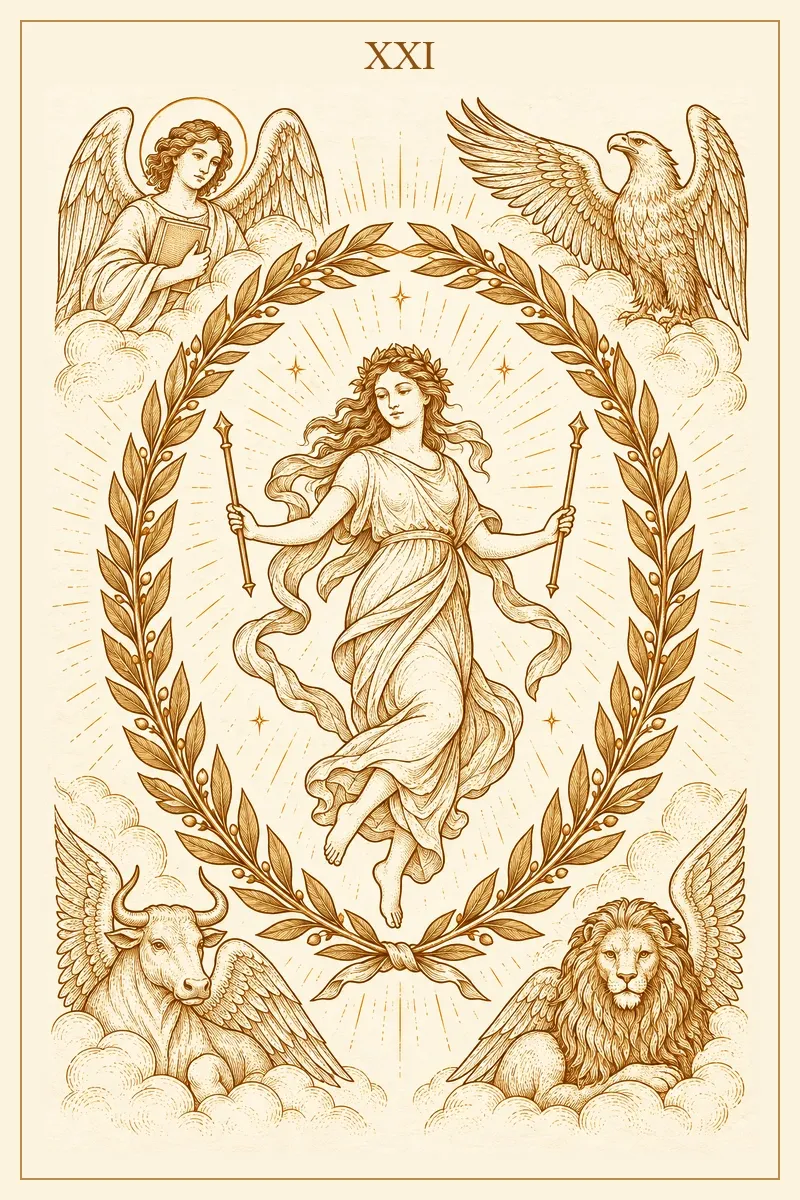
The World shows a dancer inside a laurel wreath, a wand in each hand, with an angel, an eagle, a bull and a lion in the corners. Beside the Six of Swords it describes a transition that reaches its destination: the move completes and the peace you were traveling toward becomes ordinary life. Our World meaning guide explains that sense of wholeness.
With Wheel of Fortune: the tide turning
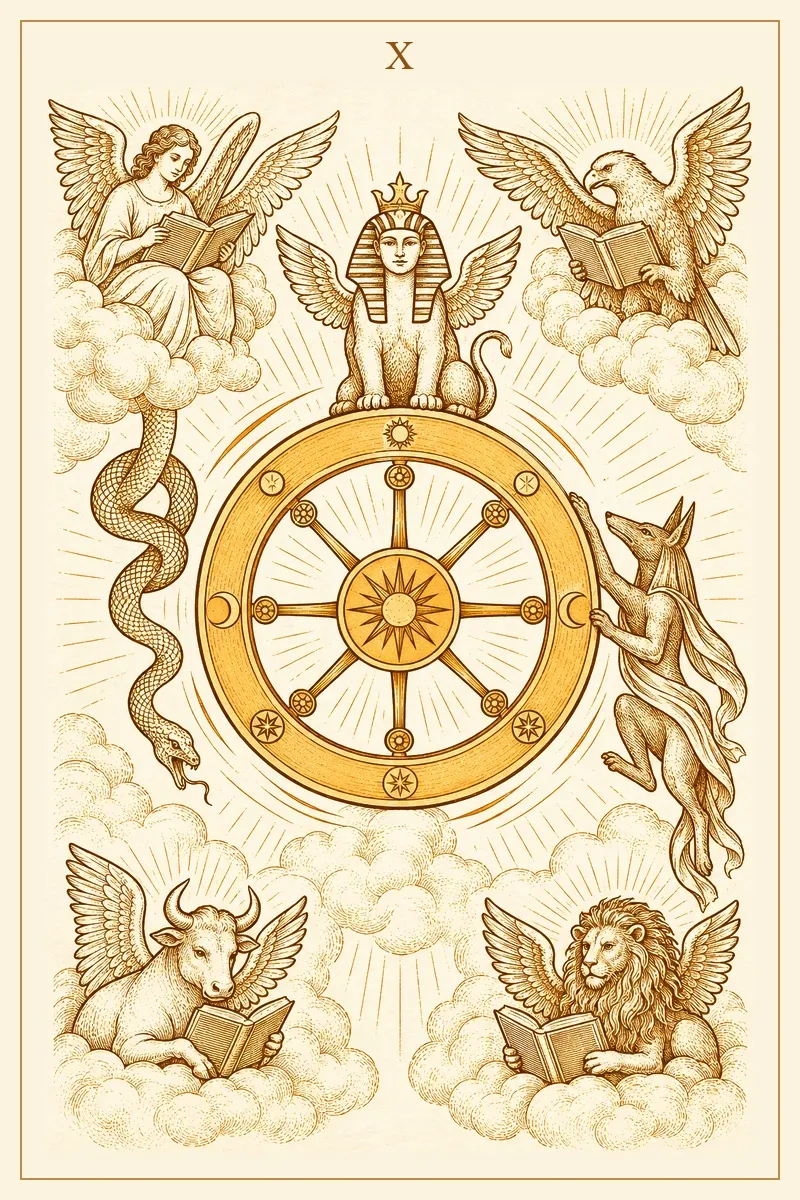
The golden Wheel of Fortune turns with a sphinx on top, a snake sliding down one side and a jackal-headed figure rising on the other. Paired with the Six, it suggests your move is part of a larger cycle shifting in your favor. The Wheel of Fortune guide looks at cycles and turning points.
With the Three of Cups: friends on the far shore
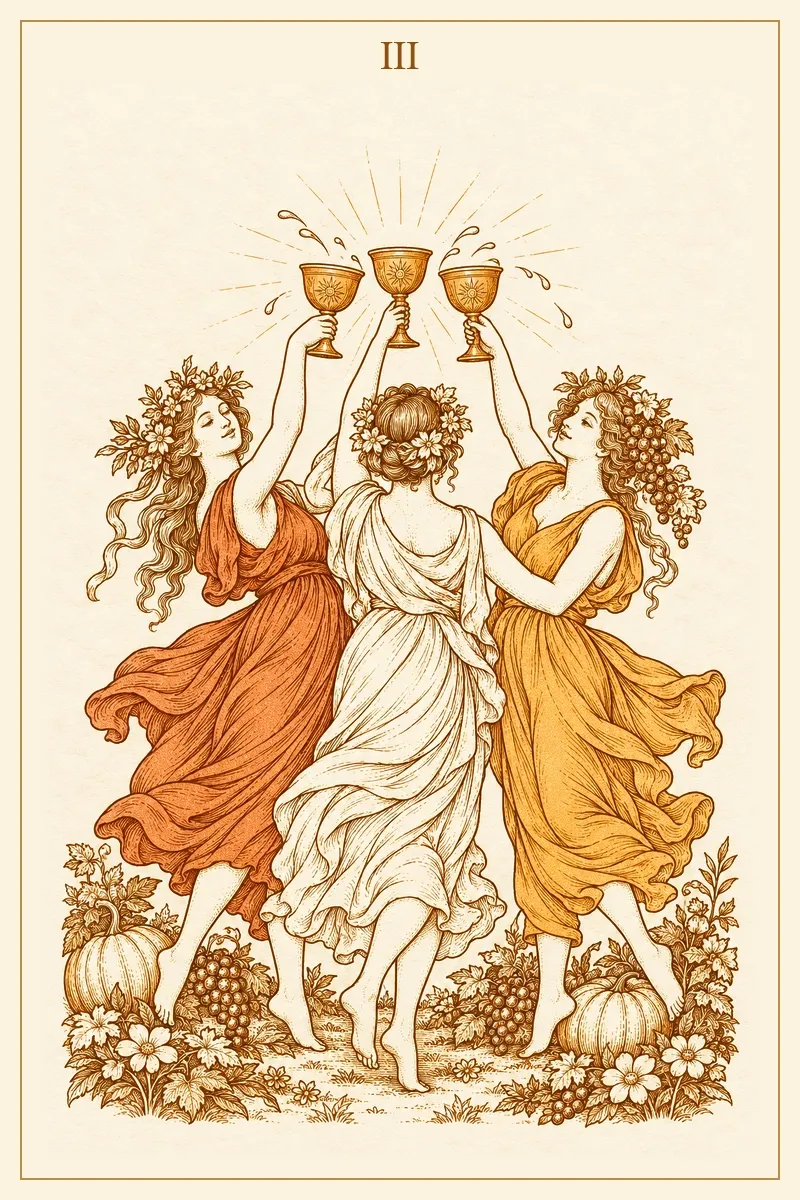
In the Three of Cups, three women in red, white and gold dresses raise golden cups together. Beside the Six of Swords, it says the lonely part of the journey ends in company: a new circle, old friends, or a community where the boat lands. The Three of Cups meaning guide looks at that joy of celebrating together.
Cards that change the course
With The Moon: crossing in the fog

The Moon shows a crescent face set inside a rayed sun, two towers, a dog and a wolf howling, and a crayfish climbing out of a pool. With the Six of Swords, it describes a move made without a clear view of the destination; anxiety may fill in the gaps. Keep going, check facts as they appear, and do not let worst-case imaginings steer the boat. The Moon meaning guide covers that kind of uncertainty.
With The Fool: from leaving to beginning
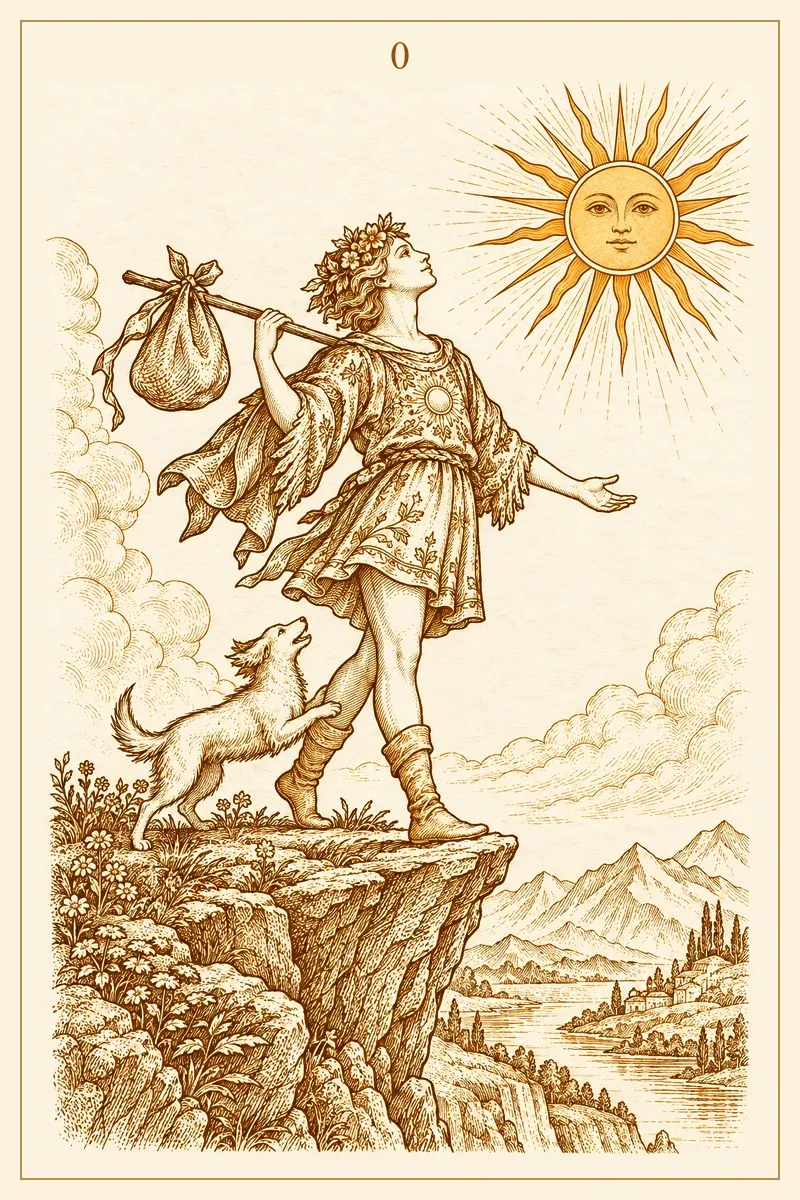
The Fool is a young traveler at a cliff edge, a bundle over one shoulder and a small white dog at his heels, looking up at a sun with a face. Next to the Six, what began as an escape turns into an adventure, and grief about leaving gives way to curiosity. Our Fool meaning guide explores that spirit of fresh starts.
The Ferry spread: four positions for leaving well
This four-card layout follows the parts of the picture. Shuffle while thinking about the change in front of you, then lay the cards from left to right.
- The rough water: what you are leaving, and why it no longer works.
- The swords in the bow: what you are carrying with you, a lesson worth keeping or a weight worth setting down.
- The pole: what or who can help move you forward.
- The far shore: what the next stage needs from you when you arrive.
Read the first and fourth cards together, where you come from and where you are going, then the second and third as the work of the crossing.
A sample reading: a transfer to another city
Imagine someone offered a transfer to another city after two exhausting years on a team full of conflict. After drawing the Six of Swords, they lay out the Ferry spread and ask, "What do I need to know about leaving for the new position?"
- The rough water: Ten of Wands. Burnout: too many responsibilities carried for too long.
- The swords in the bow: Two of Swords. An unmade decision, perhaps about a personal relationship tied to the old city.
- The pole: Queen of Pentacles. Practical, grounded support: a colleague, a relative or good routines.
- The far shore: Four of Swords. Rest first, before proving anything.
Read together, the cards suggest the move is about recovery more than ambition. The Ten of Wands confirms the old situation has been heavy and leaving makes sense. The Two of Swords in the bow is the warning: an avoided choice will travel along unless it is faced, and could make the new city feel less fresh than hoped. The Queen of Pentacles points to steady, practical help during the move, and the Four of Swords says the first task on arrival is to rest, not to impress. A sensible next step: settle the open question before leaving, then plan the first weeks with room for quiet.
Frequently asked questions
Is the Six of Swords a good or bad card?
Mostly good, though not cheerful. It describes relief after difficulty and a move toward something steadier. The sadness in the image is real, but the direction is positive.
Does the Six of Swords always mean travel?
No. It can point to a literal move or trip, especially when the question is about relocation, but more often it describes an emotional or mental transition.
What does the Six of Swords reversed mean?
Usually a transition that stalls: you delay leaving, carry too many old thoughts with you, or return to a situation you had left. In love it can show the pull of an ex. Sometimes it simply means a journey is postponed for practical reasons.
How is the Six of Swords different from the Eight of Cups?
The Eight of Cups is the choice to walk away from something emotionally unfulfilling. The Six of Swords is the passage after a decision like that: the journey itself, often with help, toward a calmer mind. One is about deciding to go; the other is about going.
Can the Six of Swords tell me when things will get better?
It suggests gradual improvement, not a date. Tarot cannot predict timing with certainty, read what someone else will decide, or guarantee an outcome. It works best as a mirror for what you can do now: keep moving, accept support, set down what you do not need.
Pushing off from the rough side
If there is a change in front of you and you would like to see what you are carrying into it, you can start a tarot reading with Veil Soul and lay out your own crossing, one card at a time.