The Six of Cups means something sweet arriving from the past: a memory, a person, or a kindness offered with nothing expected back. Upright, the Six of Cups points to nostalgia, reunion, innocence and plain generosity, and it tends to appear when an old connection resurfaces or when a situation asks you to wear less armor than usual. Reversed, that warmth stops circulating: you may be living inside an edited past, or, read the other way, finally setting it down.
In love it is one of the softest cards in the deck: someone from earlier in your story returns to view, or a couple remembers the easy version of themselves. It cannot tell you whether a particular person will write, what they privately intend, or when. Read it as a question about your own history, then check the answer against what people say and do.
- Upright keywords: nostalgia, childhood, reunion, innocence, generosity, a gift freely given.
- Reversed keywords: idealizing the past, living backward, naivety; or the healthier reading, an old attachment loosening.
- In love: an ex or old friend reappearing, first-love tenderness, a couple returning to what made them laugh at the start.
- Yes or no: a warm yes upright, especially for revisiting and reconnecting; reversed, "not that way" rather than no.
- Element, suit and number: Water; Cups; six, where the suit rebalances after the loss of the Five.
- Astrology and title: the second decan of Scorpio, Sun as sub-ruler; in the Golden Dawn system, the Lord of Pleasure.
Two children, six lilies and a cup passed across a garden
The cup that changes hands
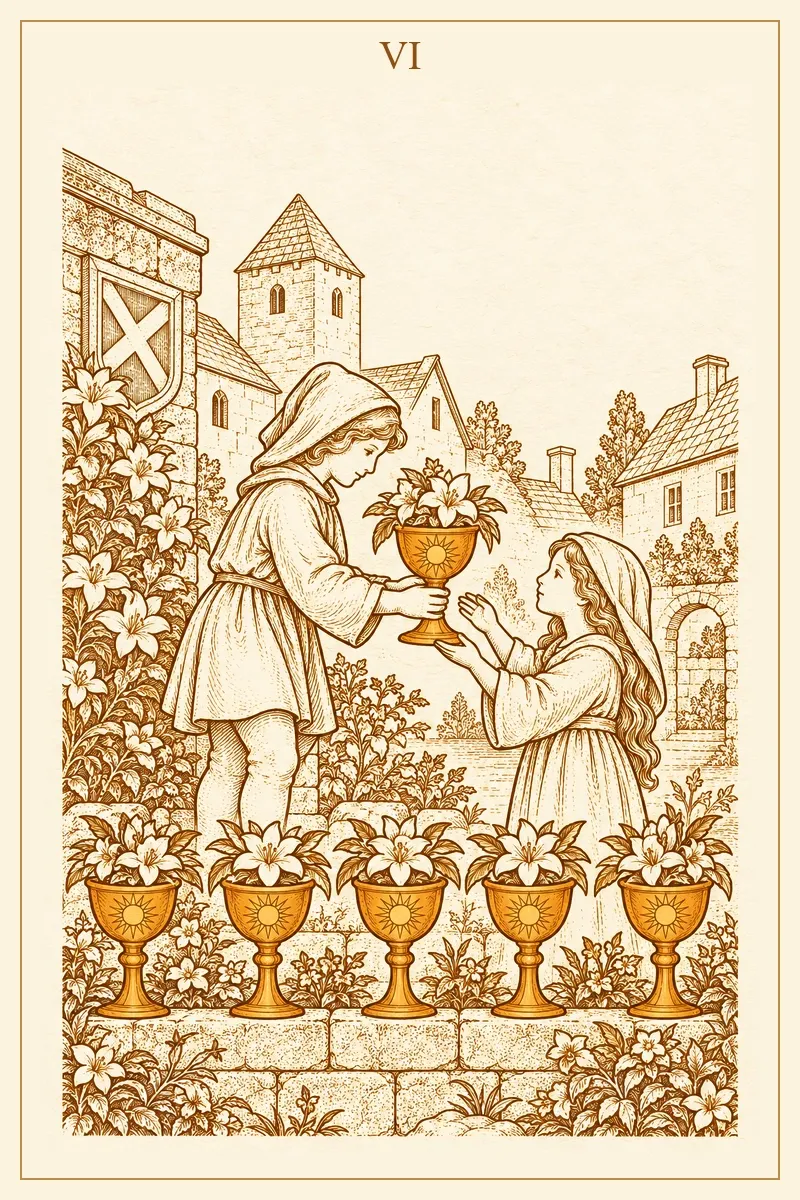
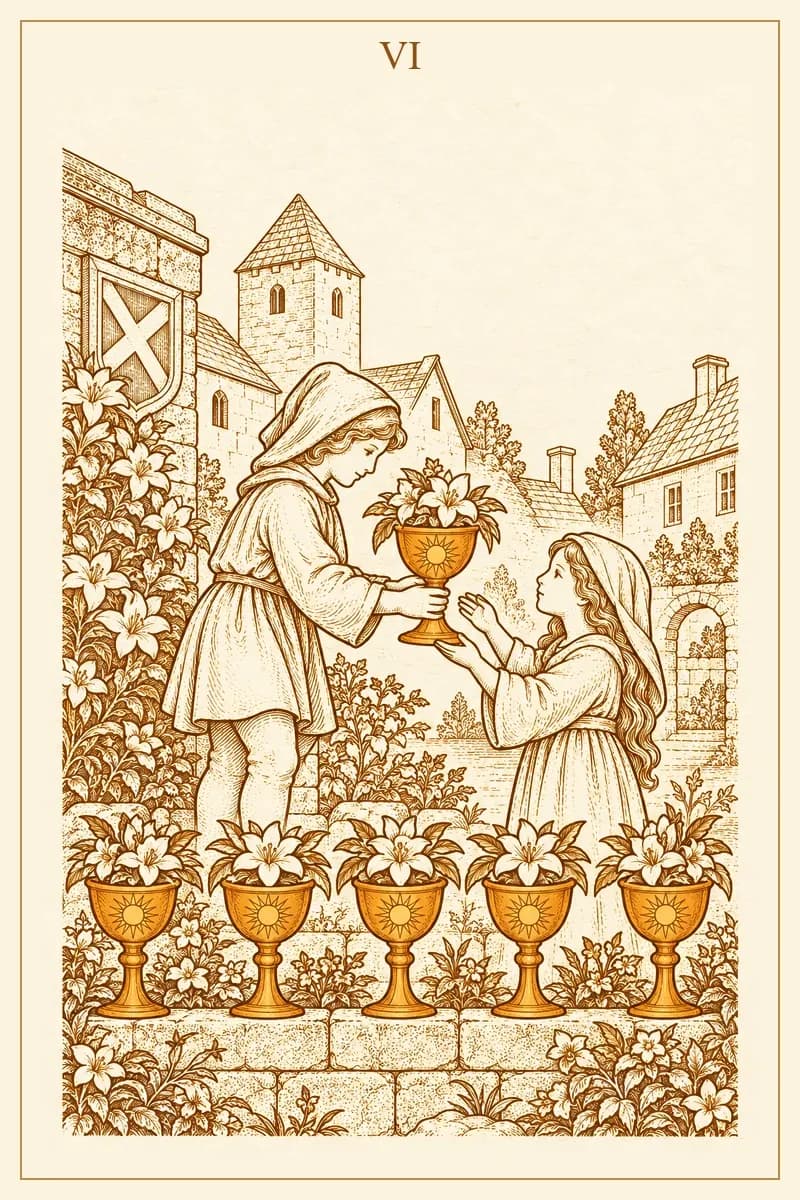
The card is engraved in gold line on cream. In a walled village garden, an older child in a hooded tunic leans forward and holds out a gold chalice filled past its rim with white lilies. A smaller child, long-haired and veiled, lifts both palms to receive it, open rather than grasping. The older child's face is turned down toward the cup rather than up toward the other child: the gift is what is being watched, not the thanks. Nobody is counting, and nobody is owed.
Five cups set down, and the gate left open
Along a low ledge in the foreground stand five more chalices, each stamped with a sun rosette, each holding the same lilies. Read them as what you have already been given: kindnesses, the houses you grew up in, the people who taught you things. Behind them sits the rest of the village: a stone tower, cottage gables, a wall carrying a shield marked with a diagonal cross. Lilies fill the beds on every side, so the garden and the gift are made of the same thing. On the right an arched gateway stands open, because the card is set in the past but not sealed inside it.
Sun in Scorpio: why the gentlest Cup sits in the deepest sign
This is a Water card, and Water is the element of feeling, memory and attachment. Its number is six, which across every suit marks the point where a system settles after the Five's disruption. The Five of Cups stood over spilled cups and would not turn around; the Six turns around, finds cups still standing, and gives one away.
In the Golden Dawn correspondences the card takes the second decan of Scorpio, roughly ten to twenty degrees, with the Sun as sub-ruler, and the title Lord of Pleasure. Scorpio is depth and what we refuse to release; the Sun is daylight and simple gladness. Put sunlight into Scorpio's water and you get this card: something long submerged brought up and found to be kind. It sits after the grief of the Five and before the Seven of Cups, where imagination stops recovering a past and starts manufacturing futures.
Six of Cups upright: a kindness that arrives with no bill attached
Memory as a resource, not a hiding place
Upright, the card asks what your own history still has to offer. Not as an escape, as a supply. Somewhere behind you are the things that reliably made you feel like yourself: a kind of music, a way of spending a Saturday, a friendship where you never had to perform. This reading is common when somebody is worn down by something adult and complicated. One simple old pleasure can restore enough of you to face that honestly.
Generosity with nothing attached
The second meaning is the gesture itself. In readings about family, friendship or work, this card often marks the person who does something kind without converting it into leverage. It runs the other way too, and asks whether you can receive. Some people find an unearned kindness uncomfortable and immediately offer something back to level the ledger. The child in the picture simply opens both hands. If a friend has offered help and you keep deflecting it politely, the card is pointing there.
Reunion, and what it usually looks like in practice
Reunion is the headline meaning, and it helps to know what it tends to look like. In practice it is rarely cinematic: a cousin you lost touch with, a former colleague who remembers you for a job, a weekend back in your hometown. Sometimes it is not a person but a place, a half-learned language, or an instrument at the back of a cupboard. The card describes a doorway, not an arrival.
Six of Cups reversed: the room you keep the past in
Reversed, this is not a cruel card, but a direct one: the warmth does not vanish, it stops moving. Four readings are worth testing, and the last is good news.
Living in a room you have stopped redecorating
Most often, the past has quietly become where you live rather than somewhere you visit. The signs are ordinary: you tell the same three stories, your best years get described in the past tense, and a former job carries more of your identity than anything happening this month. The card asks what the present would have to offer before you let it compete.
A memory remembered kinder than the original
Memory is a storyteller, and it flatters. This reversal turns up when a current, ordinary, real thing is measured against a past quietly improved in the retelling: a relationship remembered without its arguments, a city remembered without its rent. Write down three unpleasant details from the period you are idealizing. If they come easily, the memory is honest. If you have to work for them, the comparison is not a fair one.
Innocence that has turned into avoidance
The card's innocence can also tip into a refusal to take up the part of your life that needs you to be the adult: leaving every difficult arrangement to a partner, avoiding money entirely, or treating "I'm just not good at that" as a permanent fact. Read this gently: the pattern was usually learned young and for good reasons, and the card marks it as a present-day cost, not a character flaw.
The other reversal: the past finally loosening
The fourth reading is the one people miss: the cup is being set down rather than clutched. It shows up when a long grief eases, when an ex stops being the reference point for everyone new, or when a month passes without rehearsing an old argument. Check the neighbors: Eight of Cups or Death support real movement, while Four of Cups suggests you are still sitting with it.
Six of Cups love meaning: the ex who messages, the couple who forgot their beginning
In love readings this is a card people hope for and easily misread. Genuinely warm and genuinely about the past, it describes a feeling reliably and a future poorly.
If you are single
Upright, it most often describes contact from somebody already in your story: an ex, a long-ago crush, a friend the timing was never right for. It can also describe a new person who feels oddly familiar, as though you skipped the awkward first three weeks. Both share one quality, and it is safety; this is not the lightning of the Ace of Wands. Two questions make it useful. If this person came back, what would actually be different? And are you drawn to them, or to who you were with them?
If you are in a relationship
For couples the card points backward on purpose, asking you to recover something that worked early and has been crowded out: the walks, the terrible film nights, the running joke, the two of you before logistics. Treat it as an instruction rather than a mood, and put one old habit in the calendar this month. It can also mean the past entering from outside: meeting families, a move back to a hometown, or a conversation about childhood that finally explains your partner to you.
Six of Cups reversed in love
Reversed, the comparison problem comes first: a current partner measured against somebody remembered at their best. The card asks for a fair test, using events rather than feelings. It also covers the returning ex who is not offering a return, because a person can enjoy your company, miss the familiarity and still want nothing to change. Ask what is being proposed in words, and weigh that above the warmth. When the one coming back is the one who hurt you, our guide to reading tarot through heartbreak is steadier ground.
Work, money and the dream you had at nine
Outside love the card keeps its shape: something from earlier returns, and the question is whether to pick it up. In career readings that often means a former employer, a past colleague who puts your name forward, an industry you left, or a skill you shelved years ago. It is also the card of what you wanted to be at nine, not as destiny but as data: that answer usually encodes something real about how you like to spend a day.
Upright it leans toward yes on going back, with one condition: return to the thing, not to the time. A role you once held is a new job with familiar furniture, and the people, the pay and the pressures have all moved on. Reversed, it warns about the mirror image: measuring a current role against one that memory has been generous to, or defending a way of working the field has already passed.
With money the card appears around family: a gift, help from a relative, something inherited, or money that moves between generations with feelings attached. It is also the card of giving without calculating, worth keeping proportionate to what you have. Reversed, it can mark an arrangement with family that both sides have outgrown, or a habit formed when your circumstances were different. Whether an investment will pay is not a question tarot can answer; take that to someone qualified.
Body, home and the part of you that is still eight
In readings about health and daily well-being, this card points at play. Many adults stop moving for fun and start moving for a result, which is far easier to abandon in a hard week. Find the physical thing you liked before it had a purpose, whether that is swimming, dancing in the kitchen or being outside in weather, and do that instead of the thing you keep not doing.
Reversed especially, it can surface patterns learned at home: how your household handled food, rest, worry or illness, and how much still runs by default. Noticing a pattern is useful; treating one is not a card's work, and anything that persists belongs with a doctor or a counselor. In a reflective reading the card argues for a beginner's mind, and a framework you were raised inside may simply no longer fit.
Answering a yes-or-no question with the Six of Cups
Upright, treat this as a warm and specific yes. It answers "should I reach out?" and "should I go back?" with a yes. It is less convincing about speed or competition, where the answer is closer to "yes, and gentler and slower than you had in mind".
Reversed, read it as "not that way" rather than a flat refusal: it rejects the route, and the route is almost always backward. A yes-or-no draw is also a format that tempts people to repeat it until it cooperates. If you disliked the answer, the useful move is not a second card but writing the question in one sentence to see whether a card can answer it at all.
Four cards that decide which past is being remembered
Pairs sharpen this card quickly, because the Six of Cups says "the past" without saying which past or what it wants from you. The card beside it usually does.
With The Moon: a memory you have never looked at straight on

Beside The Moon, the memory is not clear and may not be accurate. This pairing often marks something from early life that shapes the present while staying half-remembered: a feeling with no event attached, or a reaction larger than its cause. Slow down and treat it as unfinished rather than as evidence. The full Moon tarot meaning covers its wider territory of dreams and uncertainty.
With the Five of Cups: grief and sweetness in the same breath
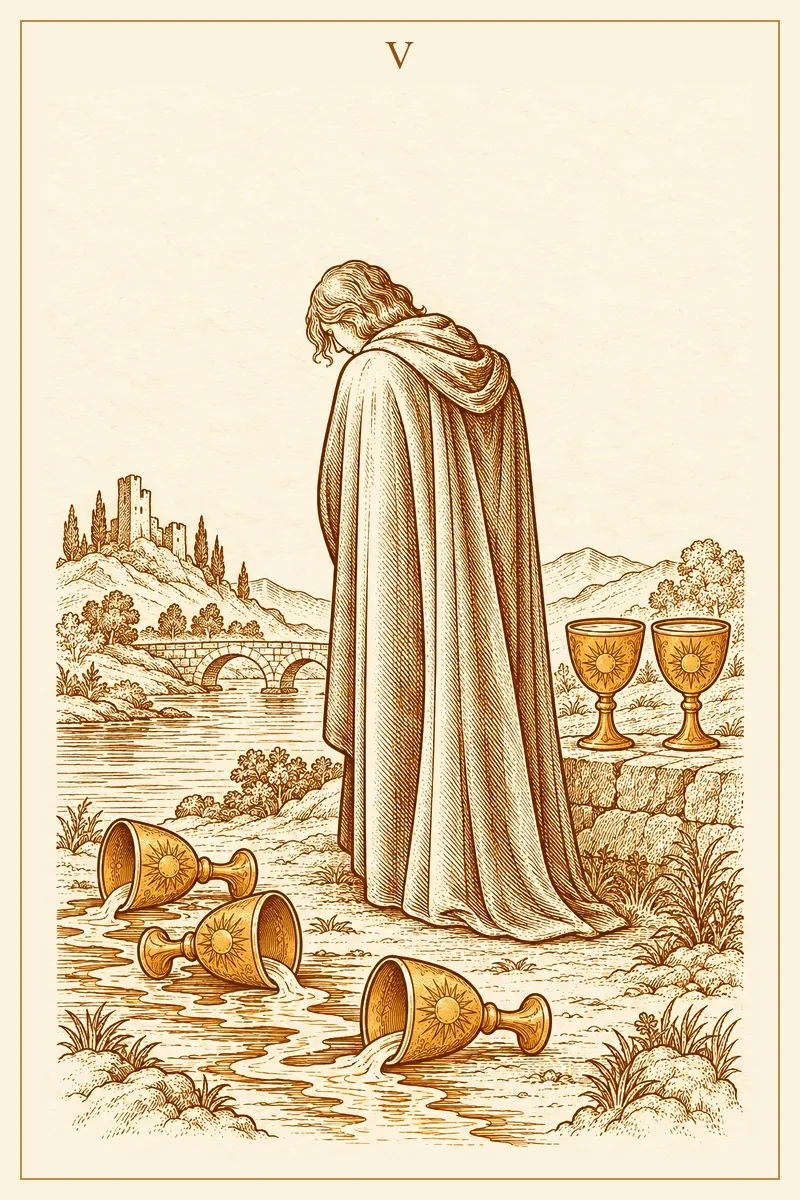
These two are neighbors in the suit and read well together: missing something and being grateful for it at the same moment. The pairing shows up around anniversaries, around a death, and around relationships that ended well. Do not choose between the feelings: the sweetness and the loss are one attachment seen from two sides. Read it alongside the Five of Cups and its work with what was spilled.
With the Eight of Cups: the walk away from the village
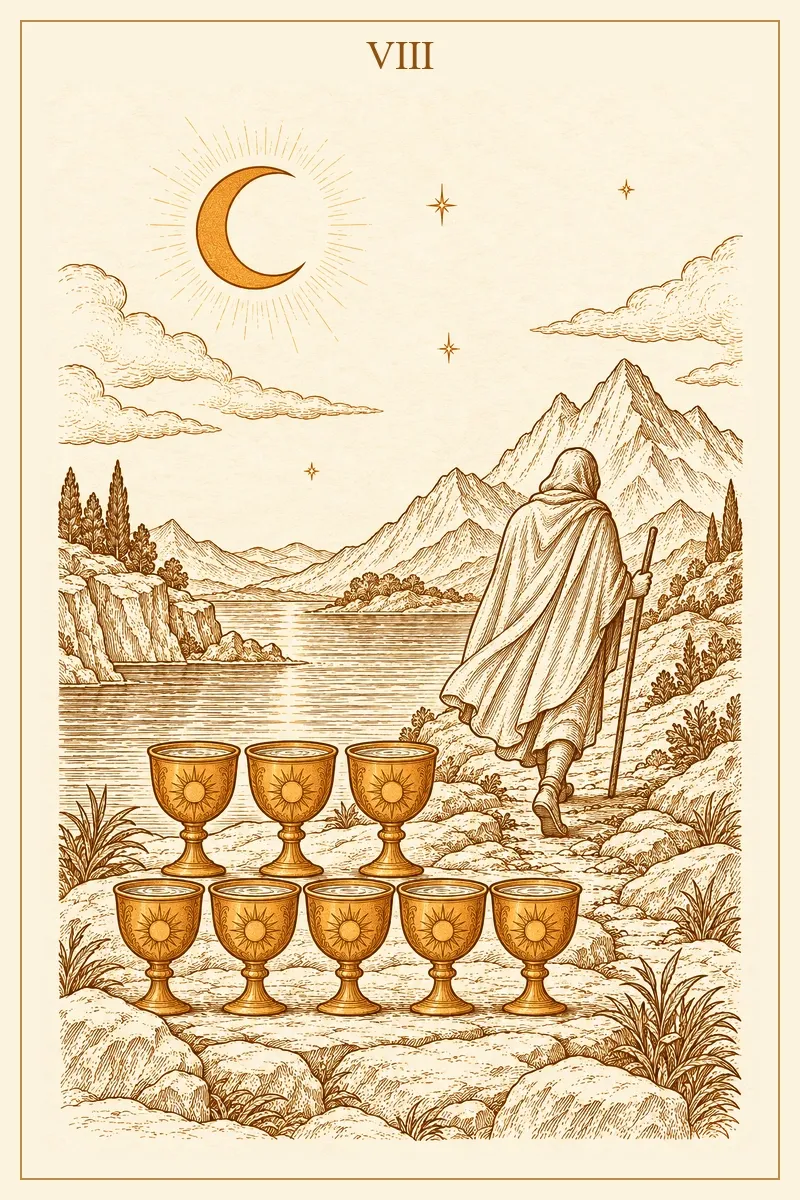
This is the hardest and most honest pairing the card has. The Eight is the figure who leaves a stack of cups to find what the stack cannot give. Beside the Six it describes a decision to stop returning: leaving a hometown, a family role, or a story about yourself that was accurate at nineteen. It is not a verdict against the past; it says the past was real and still worth loving, and you are going anyway. The Eight of Cups meaning follows that departure further.
With The Empress: family, care and the house behind the children
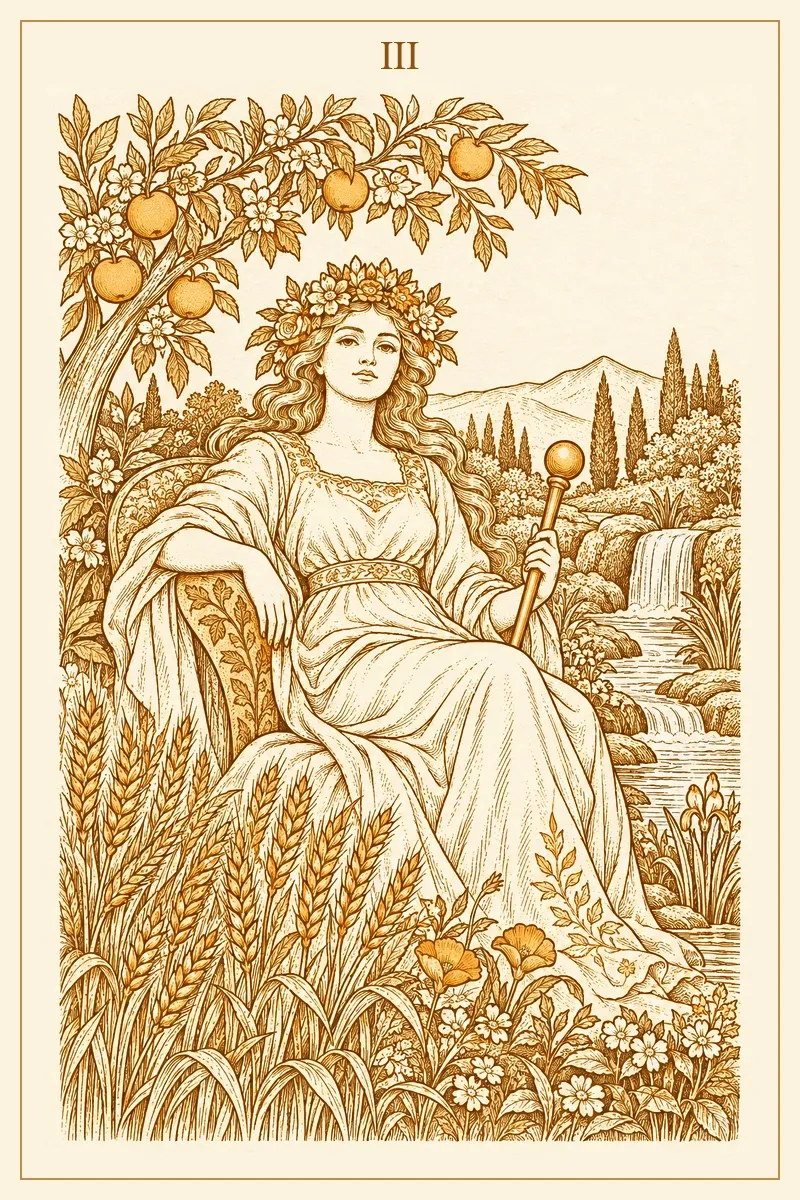
With The Empress the card turns domestic: family warmth, being fed and looked after, a home that makes comfort rather than tension, and sometimes the presence of children, though no card confirms a pregnancy and that belongs with a test and a doctor. In a reading about your own capacity it can mean mothering yourself in the plain sense. The Empress tarot meaning covers her creative side too.
Two more pairings work without a picture. With The World the card becomes a full circle, a return to where you began carrying what the journey taught you. With The Fool the childlike quality stops facing backward: the same openness, aimed at something that has not happened yet.
The Visiting Hours spread: four cards for a memory that keeps coming back
Use this when something from the past has your attention and you cannot tell whether it is calling you or simply loud. Write the question in one sentence first, and keep the positions fixed so a disappointing card does not get reassigned to a friendlier slot.
- 1. What is actually being remembered. As specific as you can make it: a person, a period, a place, a version of yourself.
- 2. What it gave me that I still need. A quality, a kind of safety, or a way of spending time.
- 3. What it costs me to keep going back. Attention, hope, comparison, or a present-day option you are quietly declining.
- 4. What I can bring into this month. One action inside your control, small enough to finish within a week.
Positions two and four are the working pair: the second names something you can have again in a different form, and the fourth is where that becomes a plan. If the third draws a heavy card, it is naming a cost you had not counted. For a wider view of how a past, a present and a next step sit together, the past, present and future spread works the same logic over a longer arc.
A reading in practice: a message after nine years
The question is "What do I need to understand about Dani getting back in touch?" Dani is a school friend who left after a falling-out and has just sent a long, warm message.
One, what is happening: Six of Cups, upright. The contact is sincere and made of memory. Dani is reaching for the friendship as it was, which is a feeling rather than a plan.
Two, what is underneath: Five of Cups, upright. The falling-out has not been processed by either person. Warmth is being offered in place of the conversation, quite possibly without Dani noticing.
Three, the useful next step: Page of Cups, upright. Something small, sincere and a little awkward: not a verdict on the friendship, not a list of grievances, but one honest sentence that leaves room for the old thing.
Notice what the spread did not do. It did not say whether the friendship will be restored, what Dani wants, or whether the message deserves trust. It found a sincere approach, an unfinished injury underneath, and a step small enough to take: a reply that welcomes the warmth and names the falling-out in one line.
Four things to do after a Six of Cups reading
- Take one cup off the ledge. Schedule a single old pleasure this week: the activity itself, not a plan to feel more nostalgic.
- Send the message you have been drafting for a year. A short note costs very little; send it without expecting anything back.
- Give something away unrecorded. Something small, to somebody who cannot repay it, and do not mention it afterward.
- Name what you want the past to supply. Safety, ease, being known without explaining yourself? Then ask where in your present life that could be built instead.
If the reading left you with too many possible versions of the story instead of one clear memory, the Seven of Cups describes that fog and the way out of it.
Frequently asked questions
Does the Six of Cups mean an ex is coming back?
It often turns up when somebody from earlier in your life is in the picture. It cannot confirm that a particular person will contact you, tell you what they are thinking, or give you a date. Treat it as a description of your relationship with the past, then look at what they have actually done lately.
Is the Six of Cups reversed always negative?
No. The reversal has two faces. One is stuckness: idealizing, comparing, living backward. The other is release, with an attachment loosening and your attention returning to the present. The surrounding cards and your honest answer to "does this still take up room?" will tell you which.
Is the Six of Cups a yes or a no?
Upright it is a yes, particularly for reconnecting, revisiting and accepting something kind. Reversed it reads as "not backward" rather than as a refusal, because the goal may still be available even when the route you planned is not.
What does the Six of Cups mean for love?
For single readers it usually describes contact from somebody already known, or a new person who feels immediately familiar and safe. For couples it asks you to recover something that worked early on. Reversed, it warns about weighing a real present relationship against an edited memory.
Can the Six of Cups tell me when something will happen?
No card can. Timing systems exist, readers disagree about them, and a date assigned after the event always sounds more precise than it was. This card describes a condition, not a schedule. If you need a time, set your own check-in a month from now.
Visit the past, but do not move back in
The Six of Cups is one of the kinder cards to draw. It says your history is not only a source of regret, and that some of it is a row of full cups you are allowed to pick up. The caution is the one the picture gives: the gate at the edge of that garden stands open, and the card works best when the past is somewhere you walk into and out of again.
If a specific memory or person came to mind, sit with it for a few minutes and try a reading when you are ready to be honest about what you want from them.