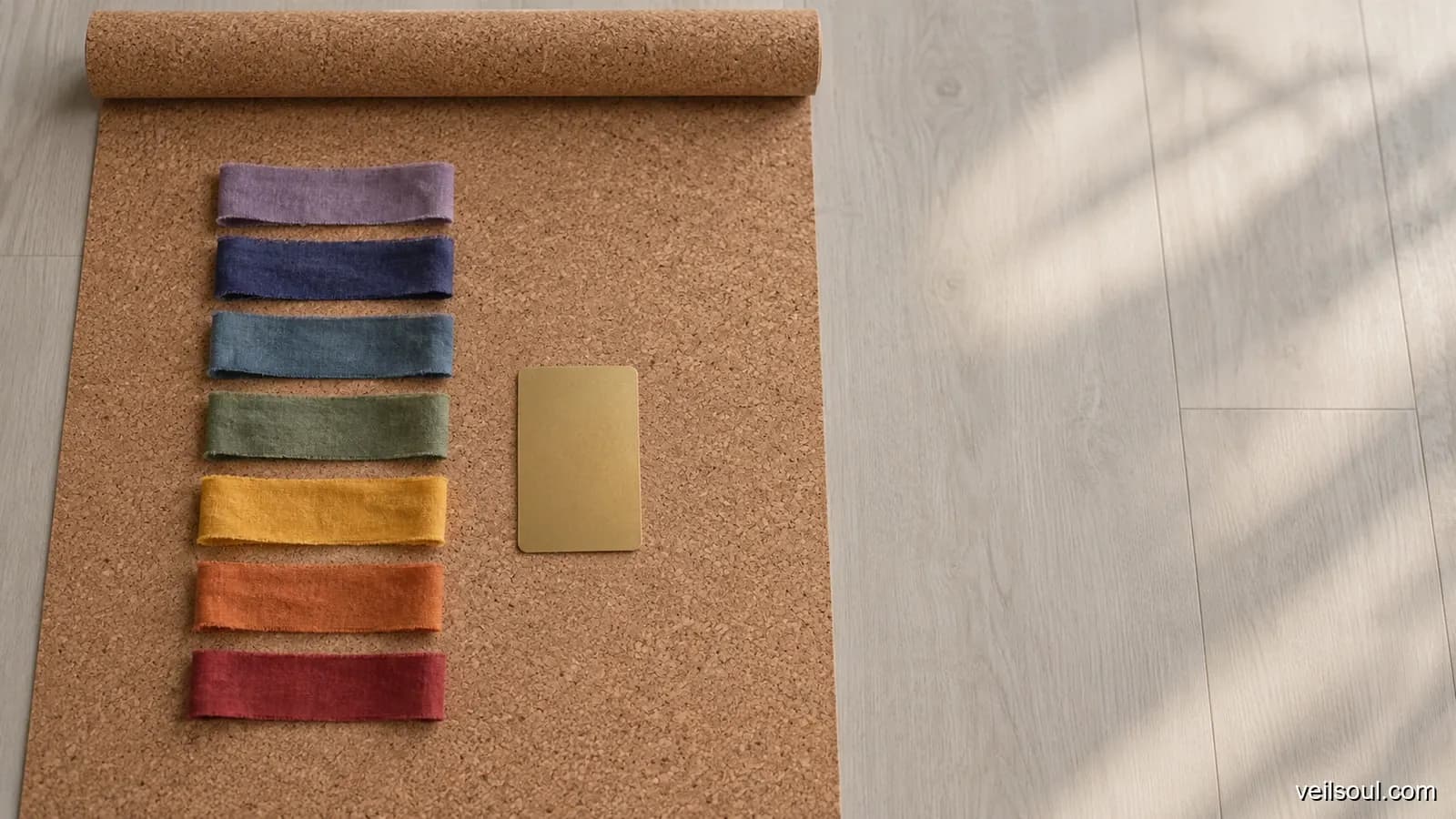
A forgiveness tarot spread is a five-card layout for one specific hurt: what the wound actually was, what you have been carrying since, what release would cost you, what opens if you set it down, and the smallest step you could take this week. It does not tell you to forgive. It maps the ground around that decision so you can make it with your eyes open, at your own speed.
The same five positions work whether the person you need to forgive is someone else or yourself, and the self-forgiveness version is usually the harder reading, because there is nobody to be angry at except the one holding the cards. What no reading can do is confirm that the other person feels remorse, change what happened, or name the date your chest stops tightening when their name comes up.
At a glance, the five positions ask:
- 1. The Wound: what happened, stated plainly.
- 2. What You Still Carry: what the hurt hardened into — a belief, a habit, a guard.
- 3. What Release Would Cost: what you would have to give up to put it down.
- 4. What Opens: what becomes available on the other side of the weight.
- 5. The First Step: one small move toward calmer water.
Name one wound before you shuffle
This spread needs a single hurt, written in one sentence, before a card comes off the deck. Not "my family," not "that whole year" — one event, or one repeated pattern, you could describe to a stranger in twenty seconds. Ask a vague question and the reading answers vaguely, and then the deck takes the blame for a question that was never sharp.
If more than one name surfaces while you write that sentence, keep the one your body reacted to first and leave the rest for another day. Three wounds in one spread blur into a general mood, and a general mood is exactly what you have been carrying already.
Be honest, too, about what you are after, because forgiveness, reconciliation and an apology are three separate things and only the first is yours to decide. You can loosen your grip on a hurt and never speak to the person again. You can also keep a relationship running with something in it unforgiven. This layout works on the grip; for the wider question of what forgiveness is and is not, the guide to tarot for forgiveness covers that ground, and this page stays with the spread.
How the five cards are laid out
Deal five cards in a diagonal that steps down from upper left to lower right, each one slightly below and right of the last, like a hand uncurling finger by finger. Read it top to bottom: the first card is what you are gripping, the last is the direction your hand could open toward.
Lay all five face down in order, then turn them one at a time from the top. That is not ceremony. Position 1 often lands hard, and seeing all five at once makes it tempting to skip ahead to position 4 for relief. Let each card say its piece before the next one answers it.
On a thin day, deal positions 1, 2 and 5 and leave the middle pair until you have more room. The short version still works. What it drops is the cost question, which is the part most readers need and most readers avoid.
The five positions, read one at a time
Every position below has the same shape: what it asks, how an upright card tends to read there, how a reversal tends to read there, and how the position changes when the person being forgiven is you. The cards named are examples of what often lands in that spot, not a list to hope for.
Position 1 — The Wound
What happened, as your body remembers it rather than as you tell it. This position wants an accurate picture, not a verdict. Readers are often surprised by how small and specific the card turns out to be: one sentence someone said, rather than the years of context around it.
Upright usually means you can still see the wound clearly — the Three of Swords for a clean, piercing hurt, the Five of Cups for a loss you are still turned toward, the Ten of Swords for something that finished a version of your life.
Reversed suggests the picture is blurred: the event is buried, the memory has been edited, or this hurt is standing in for an older one. The Moon reversed here is best answered with a question rather than an interpretation — what part of this have I not let myself look at straight on?
Forgiving yourself turns this position into "what I did," often the first honest look at it without softening or exaggeration. Both distortions do the same job: they hide the real size of the thing.
Position 2 — What You Still Carry
Not the original wound but what it became. Hurts calcify. They turn into rules such as "never need anyone," into a tone of voice, into a flinch. This is usually the most practical card in the spread, because the event itself cannot be changed, while what you carry shows up in behavior that can.
Upright names the guard plainly — the Four of Pentacles for a closed posture built after being open and hurt, the Nine of Swords for the replaying that starts at one in the morning, the Eight of Swords for feeling bound by something you half built yourself.
Reversed often means the grip is already loosening, or that it is leaking out sideways at people who had nothing to do with it. A reversal here is worth checking against the last month: who has been getting the sharp version of you?
Forgiving yourself makes this the punishment position — the ways you have been collecting evidence against your own character. The sentence is almost always longer than the crime.
Position 3 — What Release Would Cost
The position most forgiveness advice skips, and the reason the other four rarely move on their own. People hold on for reasons. Until the reason is named out loud, release is a performance you can keep up for about a week.
Upright tends to name the cost directly — The Tower for a life built around being the one who was wronged, Justice for an account you would have to close unpaid, the Two of Swords for the comfort of not deciding at all.
Reversed usually says the cost is smaller than you fear, or that it is already being paid in another currency: energy, sleep, the people kept at arm's length. Judgement reversed in this seat often means you are still waiting for a verdict that is not coming.
Forgiving yourself makes the cost strange but real — the guilt has been proof of your conscience. Setting it down means trusting that you are decent without the evidence of your own suffering.
Position 4 — What Opens
Not a promise. A possibility that your current spending makes unaffordable. Carrying a grudge is not free; it runs in the background all day, and this card describes what the freed capacity could go toward.
Upright points to what becomes available — The Star for a quiet return of hope, The Sun for ease that no longer has to be managed, Temperance for proportion coming back, the Ace of Cups for feeling something again without bracing first.
Reversed is not a refusal. It usually means the opening is real but conditional: it needs something from you first, often a boundary or a conversation you have been postponing.
Forgiving yourself tends to produce the gentlest card in the spread here, and the hardest one to accept. Notice if you argue with it. That argument is the position 3 cost, showing up again in a different seat.
Position 5 — The First Step
Not "forgive them." That instruction is too large to act on. This card asks for the smallest real move: one degree of turning, not a destination.
Upright gives you something you can do — the Six of Swords for changing direction and taking the memories along, the Eight of Cups for walking out of a conversation you keep rehearsing, the Page of Cups for letting yourself feel something new about it.
Reversed usually means the first step is internal and unglamorous: stop telling the story for a month, stop checking their profile, stop rehearsing the speech. Nothing visible happens. Something still changes.
Forgiving yourself often lands on a step that involves another person — saying the thing out loud to someone safe, or making the small repair that is still available. If what you are setting down is a plan or a season rather than a person, the approaches in tarot for letting go fit that shape better.
Worked example: a brother you stopped calling
Here is the spread read end to end, so the method is visible rather than described. The question: "What am I still carrying from the fight with my brother, and what would it take to put it down?" One wound, one sentence, eight years old, reversals in play. Five cards dealt in the diagonal and turned one at a time.
Position 1 — Three of Swords
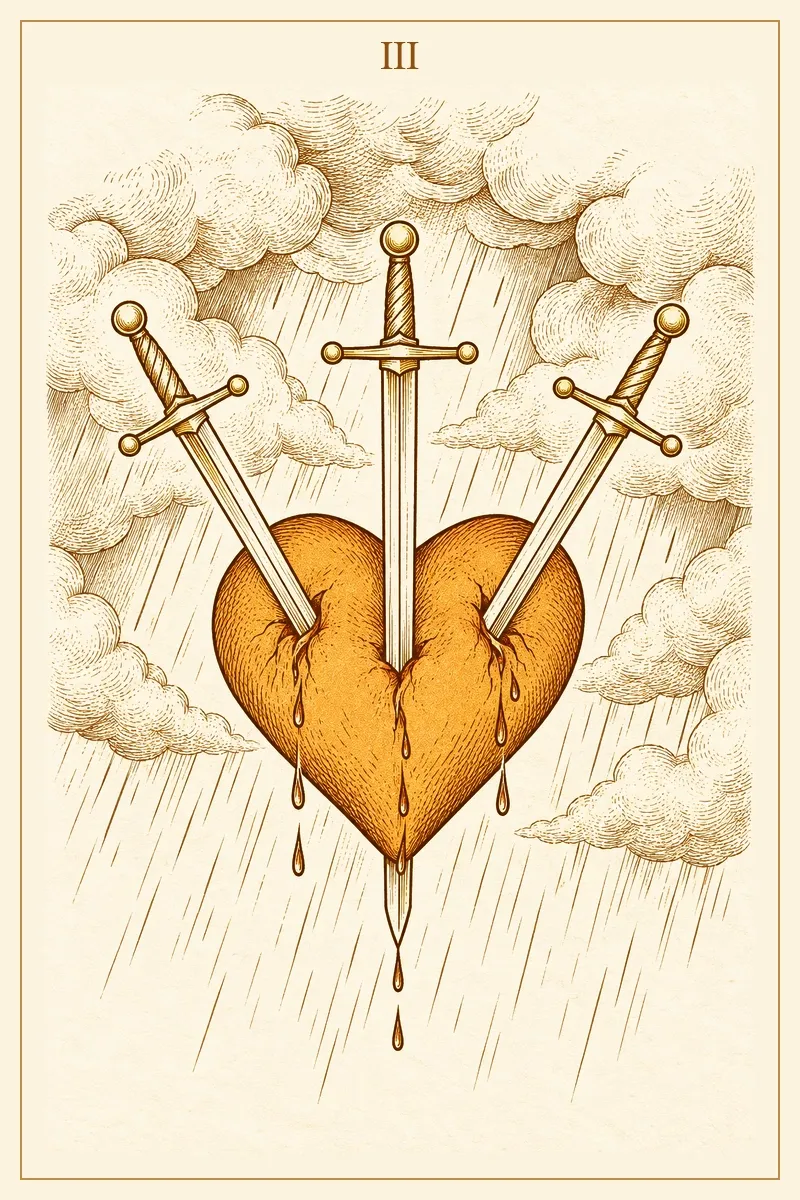
Upright in the wound position, and about as literal as this spread gets: a hurt that went straight through and registered as pain rather than inconvenience. What is useful here is the specificity. Not "my brother is difficult" but one sentence, said once, that landed. Written out, it takes nine words. Eight years of silence have been built on nine words, and seeing that on paper already moves something. How the card reads away from this position is covered in the Three of Swords meaning.
Position 2 — Nine of Swords
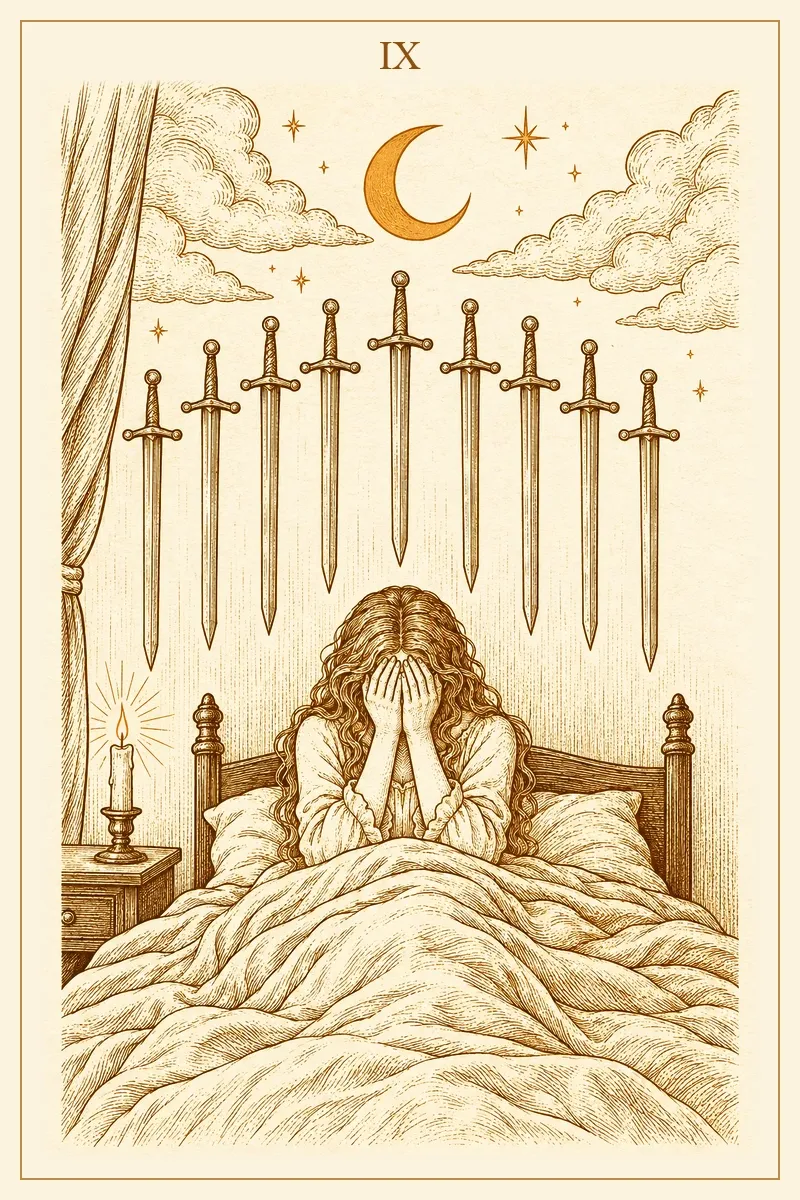
Upright, and it moves the reading out of the past and into the present. The wound was one evening; this card is what has happened every evening since — the argument rerun, better lines each time, an audience that never arrives. The useful question is not "why do I still think about it" but "when." If the answer is at night and alone, the carrying has become a habit with a time slot, and habits with time slots can be interrupted. The Nine of Swords meaning goes further into the anxiety side of the card.
Position 3 — Judgement reversed
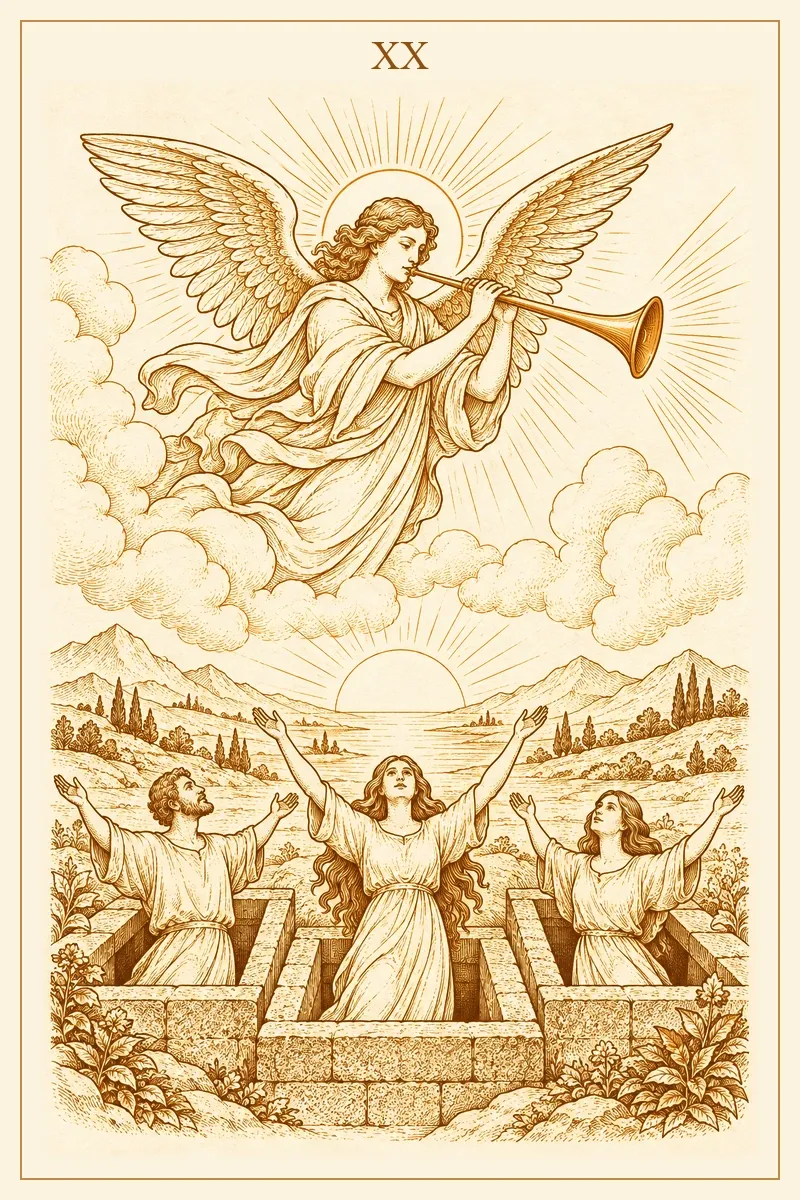
Reversed in the cost position, and the hinge of the whole reading. Upright, this card is about rising when you are called. Reversed here, it says the cost of forgiving is giving up the verdict: the settled, satisfying fact of having been in the right. Eight years of silence were the price of that verdict, and dropping it raises a question nobody wants — what was the silence for? The honest answer is that it was for the time it took to be ready, which is not the same as nothing. The Judgement tarot meaning has more on the card's wider sense of a call you can still answer.
Position 4 — The Sun

Upright, and notably plain after the first three. What opens is not a reunion scene; it is ordinary ease — a family gathering you could attend without planning an exit, a name you could hear without bracing. The card makes no promise that the brother changes. It describes what becomes available to the reader whether or not he does, and that distinction is the entire value of this position. The Sun tarot meaning covers how it reads when it follows difficult cards.
Position 5 — Six of Swords
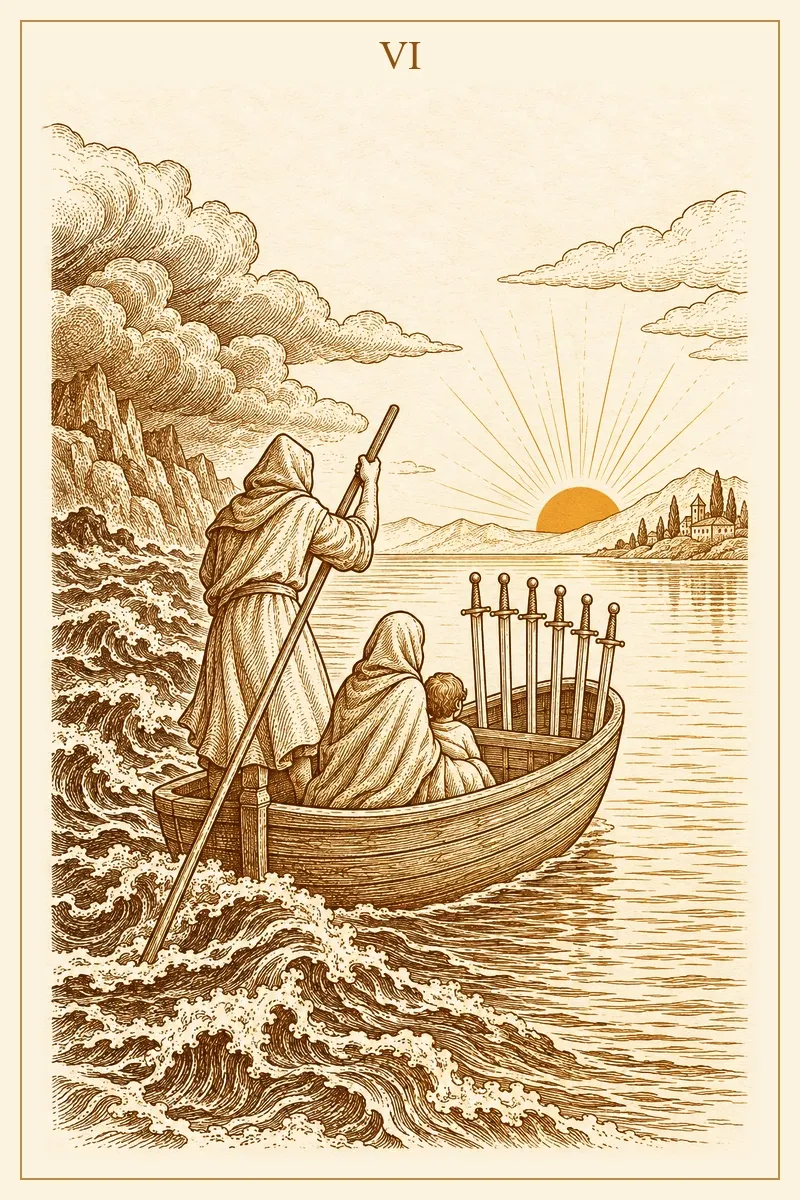
Upright, and modest, which is correct. The first step is not a phone call. It is stopping the rehearsal: when the argument starts replaying, name it as a rerun and set it down, the way you would a book you have already read. The swords travel in the boat — the memory and what it taught both stay — but the direction changes. A check-in six weeks out, not a decision. The Six of Swords meaning describes that crossing in other contexts.
Read as a whole, the spread says something the reader already half knew: the silence is no longer about the brother, it is about the verdict. That is not an instruction to forgive. It is a far more useful piece of information, because the verdict belongs to the person holding the cards and the brother does not.
When the person you need to forgive is yourself
Self-forgiveness readings use the same five positions and feel completely different, because the usual move — putting distance between yourself and the person who hurt you — is unavailable. The same hands lay the cards and read them.
Two things tend to go wrong. The first is reading position 1 as a confession. The position asks what happened, not how bad you are, and if the card arrives and you immediately start arguing your case, you have left the reading and gone into court. The second is skipping position 3, because the cost of self-forgiveness sounds absurd said out loud: you would have to stop being the person who feels terrible about it. Absurd, and usually accurate.
One practical adjustment is to read positions 1 to 3 in one sitting and leave 4 and 5 for the next day. Self-forgiveness readings that run straight to the hopeful cards tend to produce a brightness that is gone by evening. A night in between makes position 4 something you consider rather than something you grab.
If a real repair is still available — an apology you could make, a debt you could settle — the spread is not a substitute for it, and position 5 will usually point straight at it.
How long release takes, and how to pace it
Tarot cannot date this, and a reading that gives you a month is telling you a story. What the spread can do is set a pace you are able to keep.
A workable rhythm is to lay it once, then leave six weeks before laying it again on the same wound. Six weeks is long enough for position 5 to have been attempted or ignored, and both of those are information. Re-reading the same hurt every few days is not diligence; it is the replaying from position 2 wearing a deck.
Expect the work to be uneven rather than linear. Anniversaries, a shared song, a message from a mutual friend: these reopen a wound that was closing, and the reopening is neither failure nor proof that the reading was wrong. The question on a day like that is a small one — is this the wound, or is this the habit of carrying it? The first deserves care. The second can be put down again.
If nothing has shifted in three months, the honest conclusion may be that a deck is not the right tool. Sustained anger that organizes your days is worth taking to a counselor.
After the reading: the smallest step you can take
Five things worth doing in the week after you lay these cards, in roughly this order:
- Write position 1 as one sentence. Not a paragraph. The compression does the work, and you can reread it later without the whole story attached.
- Say position 3 out loud. "Forgiving this would cost me ___." A cost you have spoken is much harder to pretend away than one you have only thought.
- Turn position 2 face down and leave the other four up. You are not erasing anything. You are choosing what you look at first.
- Keep position 5 where you will see it. Propped on a shelf, tucked in a notebook, photographed on your phone. It marks a direction, not a task.
- Set a check-in date six weeks out. Write the date down. On that day you ask one question: has anything here become lighter, heavier or quieter?
None of that requires contacting anyone. Contact is a separate decision with its own risks, and it belongs in a conversation with people who know your situation, not in a five-card layout.
Frequently asked questions
What if I am not ready to forgive?
Then do not. The spread does not require it; the decision stays yours and the cards only show the landscape around it. Finding out that you are not ready is a legitimate result, and premature forgiveness tends to be a performance that collapses at the next reminder. Lay the cards, write down what you saw, and come back when something has moved.
Can I use this spread for small resentments, not just deep wounds?
Yes, and it is good practice. The colleague who took credit, the friend who forgot, the small slights that gather like sand in a pocket: each is weightless alone and heavy together. The mechanism of holding on is the same at any size, so running the spread on something minor teaches you how your own grip works before you bring it to something that matters more.
What if the reading leaves me feeling worse?
That is common and often part of the work: looking at something honestly stings before it helps. Let the feeling move rather than managing it away, since managing it away is what buried the wound in the first place. If it stays overwhelming for days, or if it raises something you have never spoken about, that is a signal to talk to someone qualified rather than to draw more cards.
Can the cards tell me whether the other person regrets it?
No. A reading reflects your own situation back to you; it cannot report another person's private thoughts, confirm remorse or predict an apology. The only source for whether someone is sorry is that person. What the spread can show you is what you are carrying while you wait for an answer that may never arrive.
Does forgiving mean I have to see them again?
No. Release and reconciliation are separate decisions, and this layout only addresses the first. Plenty of readings end with someone holding far less weight and keeping exactly the same distance, especially where the harm was serious or is still ongoing. Position 4 describes what opens in your life, not what you owe the other person in access.
How is this different from a shadow work spread?
Shadow work explores the parts of yourself you have disowned, and its aim is integration; this spread has a narrower job — one wound, one weight, one possible opening. They overlap, since an old unforgiven hurt often becomes shadow material, and a reading that keeps circling back to your own patterns rather than the other person's may be better served by shadow work with tarot.
What the cards leave you holding
Five cards stepping down like a hand opening: the wound, what it became, what it costs, what could be, one step. Nothing in that sequence is an instruction. What it gives you is an accurate inventory of something you have been carrying without ever weighing it, and an inventory is where any real decision starts.
When you are ready to lay it, you can draw a free reading with Veil Soul and take the five positions one at a time.