The heart of reading tarot for yourself is one habit: before you draw, write down the answer you hope for and the answer you dread, then read the cards as if a friend had laid them out and asked for your view. Shuffle with a single written question, lay out one to five cards, describe each picture before you look up a meaning, and finish with one sentence and one small action.
A self tarot reading is a reflection tool. It cannot tell you what another person thinks or feels, fix a date, or promise how something will turn out. What it can do is put your situation in front of you as a set of pictures, so you can look at it from one step outside your own head.
The whole practice at a glance:
- Set aside ten minutes: one surface, one deck, a notebook, nothing urgent waiting.
- Write three lines: your question, the answer you hope for, the answer you fear.
- Shuffle and draw: any method you can repeat calmly, one to five cards.
- Describe first: say what each picture shows before you name its meaning.
- Add the tradition: check the card's usual meaning and see where it meets your description.
- Read the whole: sum the cards up in one plain sentence.
- Close it: choose one action, note the date, and put the deck away.
What changes when you are the one asking
There is an old saying that you should never read tarot for yourself. It has no basis beyond custom. Reading for yourself is a natural way to learn the cards, and it has real advantages: you know the whole background of your question without explaining it, you can be completely frank because nobody is listening, and the deck is there whenever the question comes up.
The difficulty is real too. When you read for a friend, you sit across the table from their situation. When you read for yourself, you sit inside it. Your hopes lean on every hopeful card, and your worries lean on every hard one. A bright card can look like a promise because you want one; a heavy card can look like a sentence because you already expected the worst. Neither reading is about the card. Both are about the reader.
Self-reading does not ask you to be objective about your own life. It asks you to notice which way you are leaning, so you can correct for it, and that starts before the first card turns over.
The two lines to write before you shuffle
Under your question, write two more lines: "What I hope the cards say" and "What I am afraid they will say." Keep each to one sentence and write the true version, not the polite one. If you hope a project will succeed without any more effort from you, write that. If you fear you have already ruined something, write that too.
These lines do two jobs. They take the pressure off the cards: once your hope is on paper, you can spot it when a card seems to repeat it word for word and ask whether the card says that or you are reading your own sentence into it. They also show the shape of the question. A loud fear line beside a faint hope line may mean the question is about worry rather than events.
The question itself matters as much. Open questions that start with "what" or "how" leave a self reading more room than yes-or-no questions, and questions about your own choices work better than questions about other people. The guide to asking effective tarot questions shows how to turn a vague question into a workable one.
Then use the friend's chair. When the cards are down, imagine that a friend you like has drawn this exact spread for this exact question and asked what you see. You would be kinder to them than you are to yourself, and also more direct. Read from that chair, and you will hear what the cards suggest with less of your own noise in it.
A self reading, step by step
These seven steps take ten to twenty minutes. Follow them in order at first; with practice they become one motion.
1. Give it ten unhurried minutes
Clear one surface, silence your phone, and keep a notebook and pen within reach. A cloth and a lamp you like are welcome but optional, and a corner you can leave set up makes it easier to come back. For a self reading, the real requirement is that nobody needs you for the next quarter hour.
2. Write the question and your two lines
Write the question in full, with the date above it, and the hope and fear lines underneath. Writing it down keeps the question from drifting into an easier one halfway through.
3. Shuffle and draw
Use any shuffling method your hands can repeat without strain, with the question loosely in mind. Stop when it feels finished, then draw from the top, cut into three piles and draw from the one you pick, or fan the deck face-down and choose by hand. If a card jumps out mid-shuffle, decide before you begin whether such cards count, so you are not choosing based on what one shows.
4. Describe before you define
Turn the cards over and spend a full minute on each before you think about its meaning. Say, aloud or on paper, who is in the picture, what they are doing, where they are looking, what the light is like, and what feeling the scene leaves you with. This first description belongs only to you, so write it down before any book has a say.
5. Add the traditional meaning
Now bring in the usual meaning of each card, from your deck's booklet, your own notes or the card meanings library, and compare it with your description. Where the two overlap, you have the core of that card's message for this question. Where they disagree, your description may be catching something specific to your situation, or it may be your hope or fear line talking. Check it against those two sentences.
6. Read the cards as one answer
If you drew more than one card, read each in its position first, then look across them. Does the row tell a story from left to right? Does one suit or number repeat? Do two cards pull in opposite directions? Tension between cards is not a mistake; it can mark the exact point you are undecided about. Finish with one plain sentence that sums up the whole reading.
7. Close the reading
Choose one small action the reading suggests, something you could do this week. Write it under your sentence, put the cards back, and stop. A record of the date, question, cards and action is enough to start a tarot journal, which lets you see later how your interpretations have changed.
A five-card layout for hope and fear
Any spread works for a self reading, and the layouts in five simple spreads for beginners are good practice. The five-card layout we use here is built for reading about yourself: it gives your hope and your fear their own positions, so they stay out of the cards that describe your situation.
- What I hope for: the wish behind the question, seen honestly.
- What I fear: the worry behind the question, seen without drama.
- What is in front of me: the situation as it stands today.
- What I keep out of view: something I am not looking at, and the card that can change how the rest reads.
- One step this week: a practical move within my control.
Lay one and two side by side at the top, three in the center, four below it and five at the bottom. Read one and two against the lines you wrote: do the cards agree with your sentences, soften them, or point at something underneath? Read three and four together, since the card out of view can explain why the card in front of you looks the way it does. Keep position five small; if its step would take more than a week, break it down.
A hypothetical reading: the paintbrushes in the drawer
To show the spread in motion, here is an invented example. Imagine someone who painted for years, stopped when work got busy, and has not picked up a brush in a long while. Their question: "What keeps me from going back to painting, and what would help me start again?" Their hope line: "That I am still an artist and only need time." Their fear line: "That whatever I had is gone."
What I hope for: Three of Wands. A figure in a long cloak stands on a cliff edge with two staffs planted beside him, holding a third, watching three ships sail toward a rising sun. The hope here is about arrival: the finished canvases, the show on a wall, the ships coming in. Reading from the friend's chair, the reader notices that this hope is about results, not about the act of painting at all.
What I fear: Nine of Wands. A young man with a bandaged head grips one staff and glances sideways, eight more staffs standing in a row behind him. He is wary, not beaten. The fear the card points to is not "the talent is gone" but "I will get hurt again," perhaps by criticism. That is a different fear from the one written on the page, and a more workable one.
What is in front of me: Four of Cups. Someone sits under a tree with arms folded over their knees, eyes on three cups in the grass, while a hand reaches out of a cloud to offer a fourth. The offer is right there and unnoticed. In this imagined case, the reader thinks of a friend's standing invitation to a Sunday sketch group and a free evening each week that goes to scrolling.
What I keep out of view: Page of Pentacles. A young person in a feathered cap stands in a field holding a single pentacle up close, studying it. This is the beginner's card: curiosity, patience, small steps. What the reader has been avoiding is not painting but being a beginner again, making clumsy studies after years of feeling competent.
One step this week: Eight of Pentacles. A craftsman sits at a workbench carving a pentacle, six finished ones hung on a post beside him and wood shavings on the ground. The step is repetition, not a masterpiece: two twenty-minute sessions of small studies this week, with no plan to show anyone.
The one-sentence reading: "I keep waiting for the ships when the work is at the bench." Notice what the reading did not do. It did not confirm the fear line, and it did not flatter the hope line either. It moved the question from "am I still good enough?" to "am I willing to practice?", which is a question the reader can actually answer this week.
Six cards that test your honesty
Any card can be hard to read on your own question, but these six carry a particular charge for self-readers, because they invite wishful thinking or look frightening when the stakes are personal.
The High Priestess
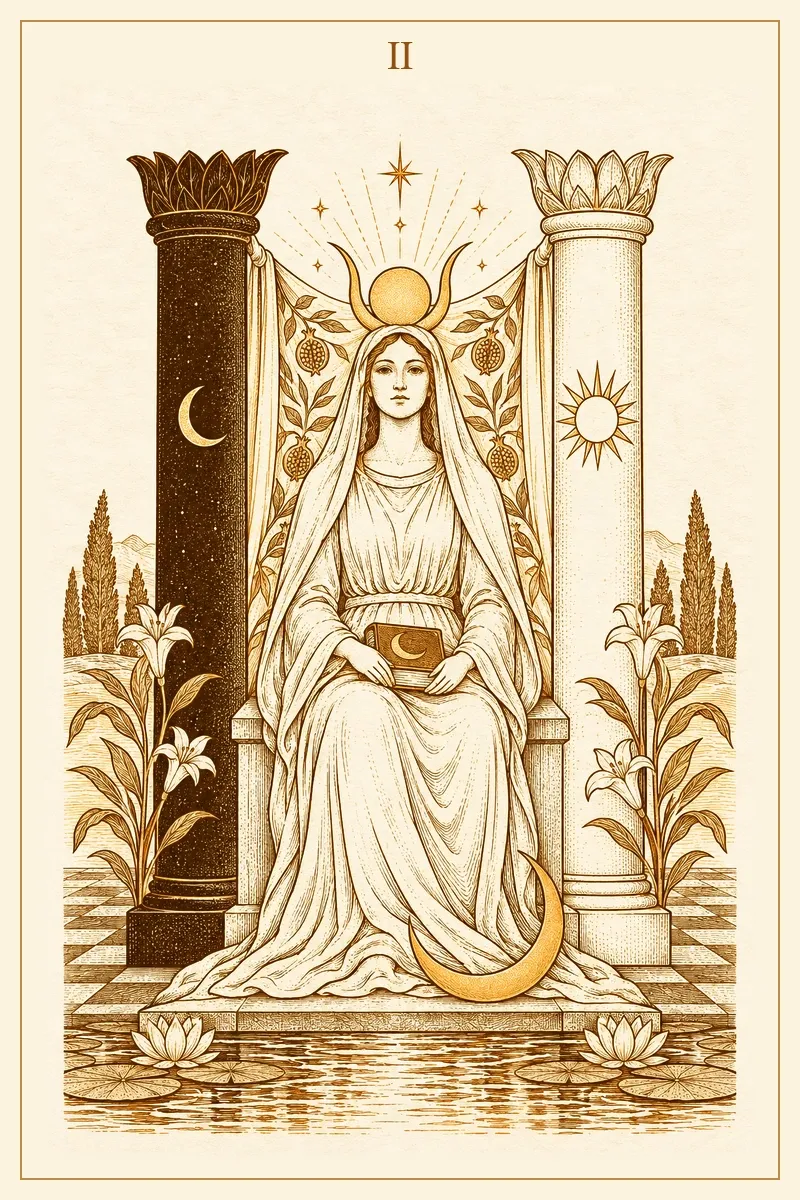
The High Priestess sits between a dark pillar marked with a crescent and a pale one marked with a sun, a closed book on her lap and a veil of pomegranates behind her. In a self reading she can be saying that you already know more than you are admitting. Rather than looking for an answer outside, ask what you noticed and set aside. Reversed, she can point to ignoring your own judgment or keeping a secret from yourself. Her full meaning is in the guide to The High Priestess tarot meaning.
The Moon
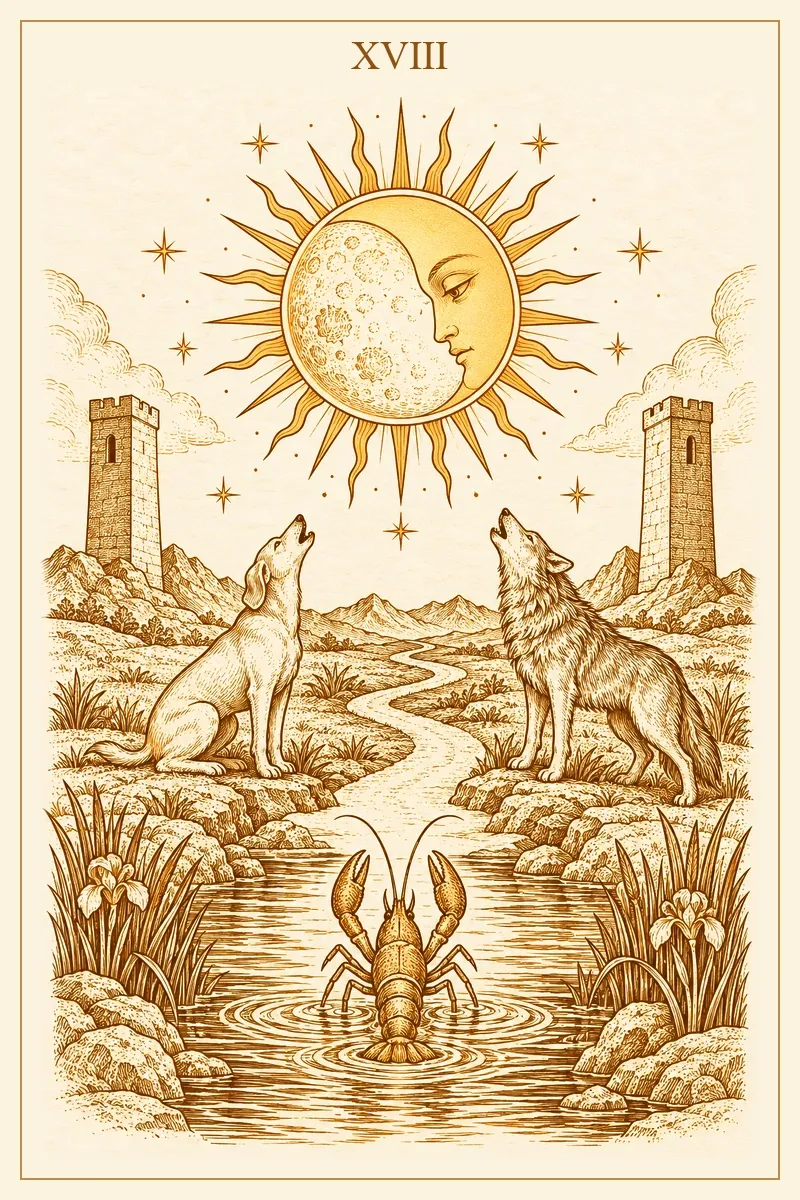
The Moon shows a face in the moon ringed with rays, a dog and a wolf howling at it from either side of a winding path, two towers in the distance, and a crayfish climbing out of a pool. For a self-reader it is a direct prompt to check your fear line: are you reacting to what is there, or to what you imagine might be? Reversed, it suggests confusion beginning to clear. The guide to The Moon tarot meaning covers its other angles.
Seven of Cups
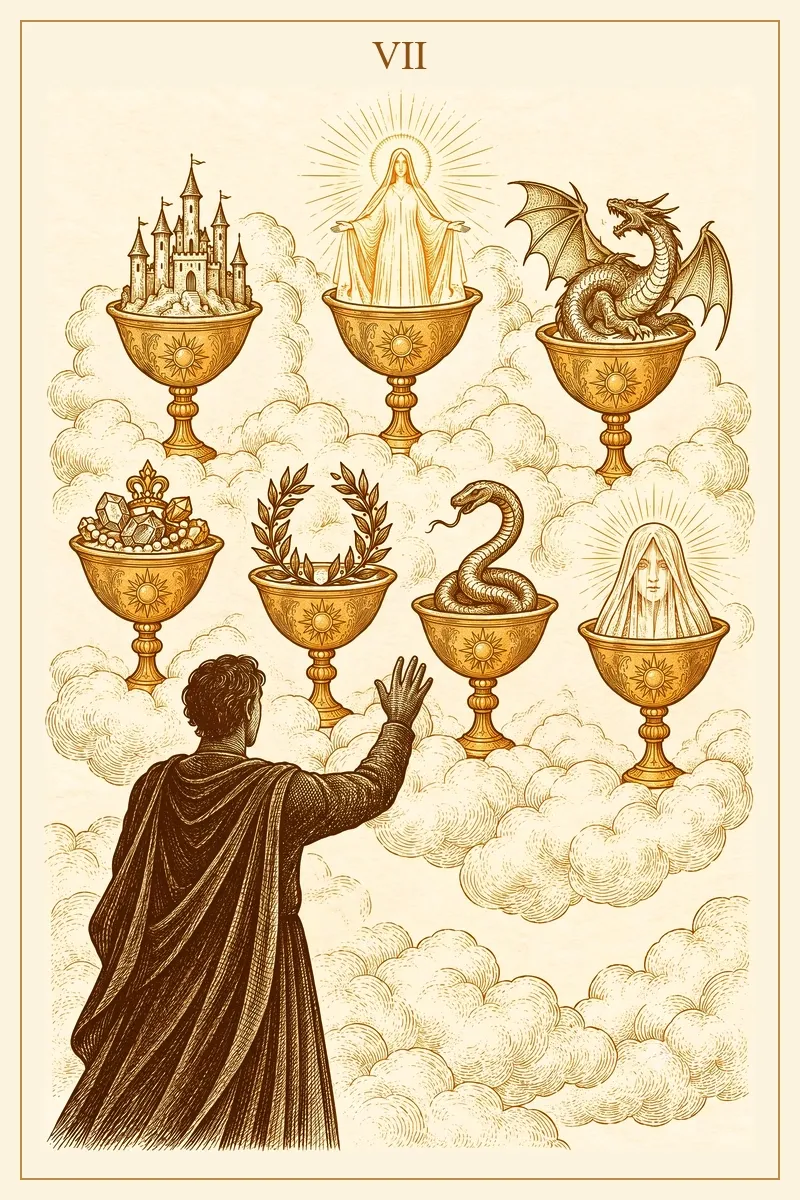
In the Seven of Cups, a cloaked figure seen from behind raises a hand toward seven golden cups floating on clouds: a castle, a radiant figure, jewels and a crown, a laurel wreath, a dragon, a snake and a veiled face. It is the hope line made visible. In your own reading, ask which cup you are reaching for and whether it is a real option or a daydream. Reversed, it can mean the fog of choices is lifting and one option is becoming clear.
Two of Swords
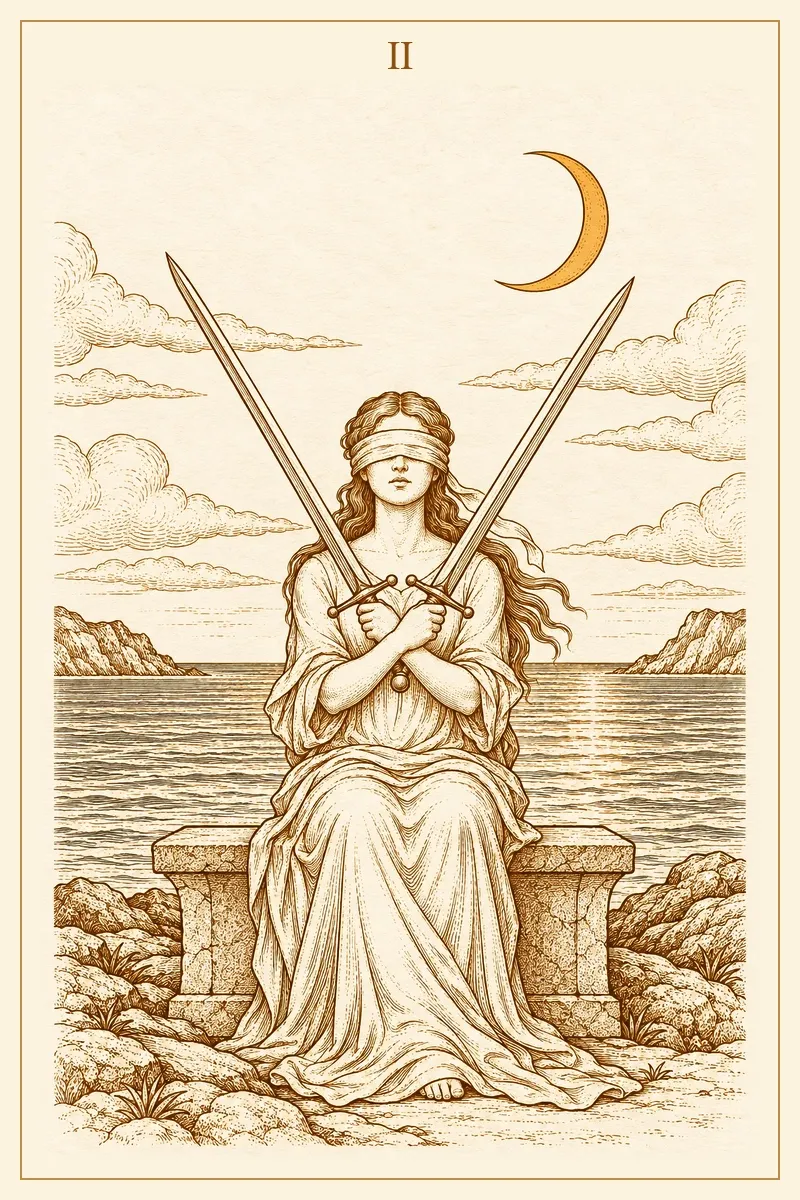
The Two of Swords shows a blindfolded woman on a stone bench by the sea, two swords crossed over her chest and a crescent moon overhead. She has chosen not to look. In a self reading this card asks whether you are avoiding the question you actually asked, perhaps by keeping it vague enough that no answer can land. Reversed, it can describe the blindfold slipping and a decision you can no longer postpone.
Death
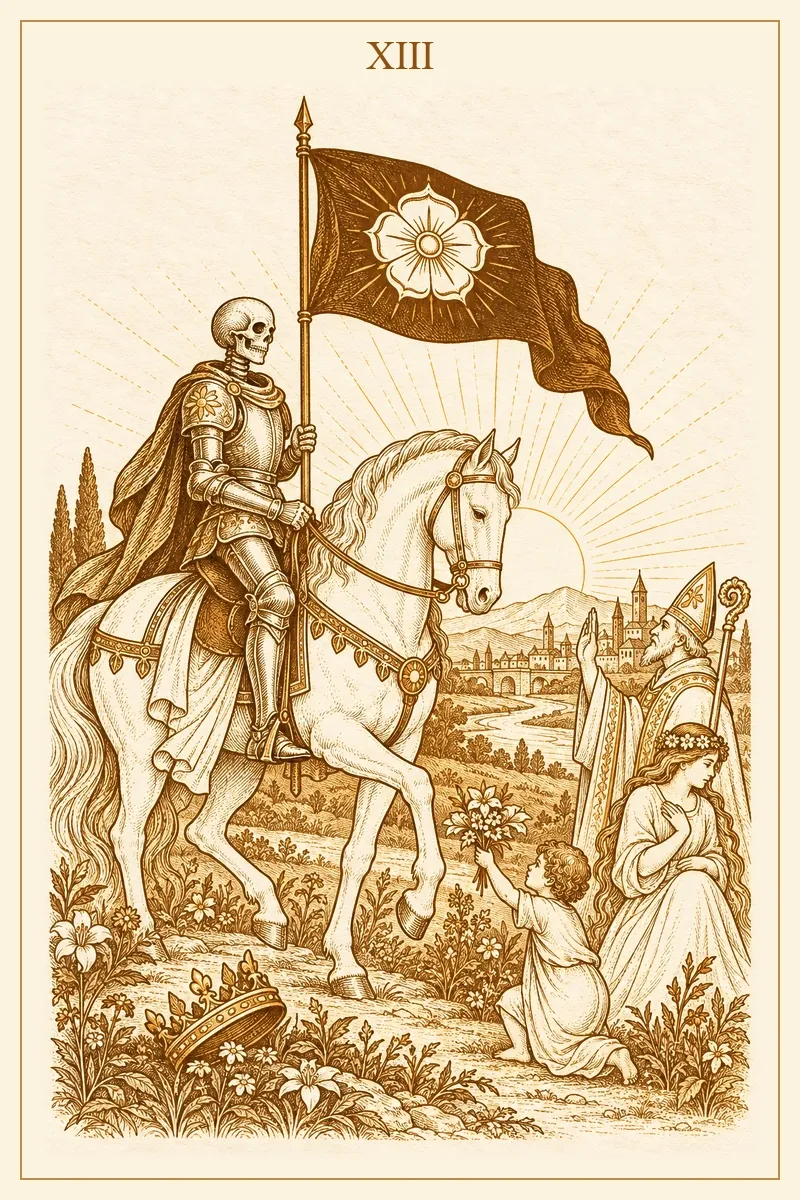
Death shows an armored skeleton riding a white horse under a dark banner with a white rose. A crown lies in the flowers, a child holds up a bouquet, a bishop raises a hand, and the sun sits low over a town on a river. Drawn for yourself, it can jolt you, but it describes an ending that makes room for something else, not a physical death. Ask what is already finishing in your situation. Reversed, it can describe holding on to something that has run its course. The guide to Death tarot meaning goes further.
The Tower
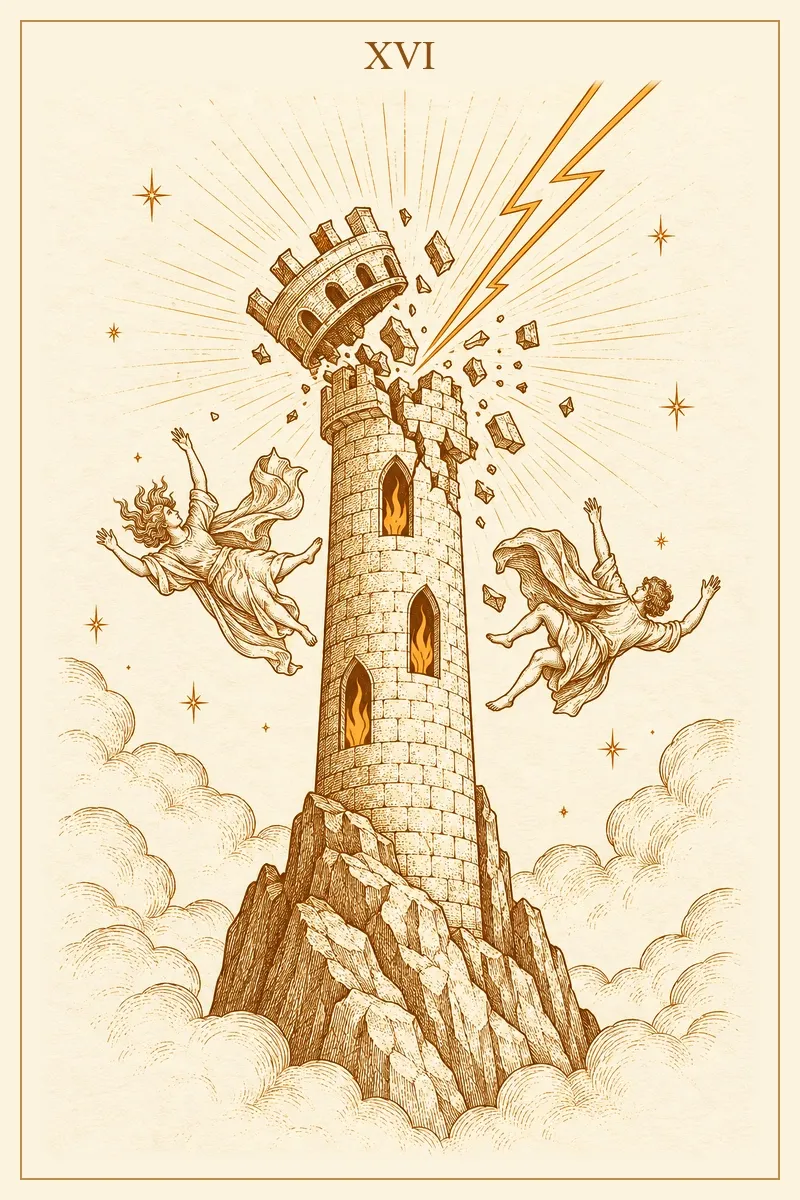
The Tower shows lightning knocking the crowned top off a stone tower on a rocky peak, flames in three windows and two figures falling through the air. It is sudden change and the end of a structure that could not hold. In your own reading it asks what belief or arrangement is shaky, and whether you would rather take it apart deliberately than wait. Reversed, it can mean a change you are resisting or one that is unfolding more slowly. Love and career angles are in The Tower tarot meaning.
When the reading pushes back
Self-readings do not run smoothly every time. Here are the snags you may meet, and a calm way through each.
You cannot stay neutral. You are not supposed to. Go back to your hope and fear lines and ask which one is coloring your interpretation. Then read the cards once more from the friend's chair.
You drew a card you did not want. Before you react, describe the picture in plain words. A card that frightens you in the first second can read very differently after a minute of looking. Ask what it is helping you see or prepare for, not what disaster it predicts.
The same card keeps coming back. Rather than reshuffling until it goes away, give it its own session. Journal about the card for a week and note where its theme shows up in your days.
The reading makes no sense. Write it down and leave it. Some readings become clear after a day or a week, when the situation moves. If nothing clicks after that, the question may have been too broad; rewrite it and ask on another day.
You want to draw again right away. Check that impulse against your hope line: are you after a clearer answer, or a nicer one? One reading per question is a sound rule, with a new reading only when something in your situation has actually changed.
Questions about someone else
A personal question can easily involve someone else: a partner, a parent, a colleague, an ex. You can read about those relationships, but the reading is clearest when the question stays on your side of them. "What does she really think of me?" hands the whole reading to someone who is not at the table. "What do I want from this friendship, and what can I offer?" is a question you can work with, and its answers lead to things you can do.
If you find yourself reading again and again about one person, especially late at night, treat that as information: it may be time to talk to them, or to give the feeling some room away from the deck.
Building a habit you can keep
A self-reading practice grows through repetition more than intensity. Pick one of these rhythms, or combine them:
- A single card in the morning: one draw, one sentence, one minute, to build familiarity with the deck.
- A weekly three-card check-in: last week's lesson, this week's focus, one thing to watch for.
- A monthly longer reading: the hope-and-fear layout above or another five-card spread for bigger questions about direction and goals.
Whatever rhythm you pick, keep the two lines. The more you write down your hopes and fears, the sooner you recognize their voices in the cards, and that is what keeps a self reading from turning into a mirror of your wishes.
Frequently asked questions
Is it bad luck to read tarot for yourself?
No. It is a superstition handed down by custom, with no reasoning behind it, and reading for yourself is a natural way to learn a deck. The real caution is that your own hopes and fears can tilt the interpretation, so name them first.
How do I stop seeing only what I want to see?
Write the hope line before you shuffle, describe each picture before you look up its meaning, and read the spread from the friend's chair. If your interpretation matches your hope line word for word, read it again and look for anything you skipped.
Can I read tarot for myself about love or another person?
Yes, as long as the question is about your part. A reading cannot confirm what someone else thinks or feels, give a date, or guarantee an outcome. It can help you see what you want, what you are afraid of, and what you could do next.
How many cards should I use when I read for myself?
Start with one to three. A single card is enough for a daily check-in, three covers a wide range of questions, and five, such as the hope-and-fear layout in this guide, suits a question with more layers. Larger spreads are easier once you are comfortable connecting cards.
Should I read reversed cards in my own readings?
That is your choice; decide before you shuffle and stay consistent. Reversals add nuance and can point to energy that is blocked, delayed or turned inward. The guide to tarot reversals sets out the main ways to read them.
Is it okay to draw again if I don't understand the answer?
Draw one clarifying card if a specific card confuses you, but avoid reshuffling the whole question. Repeated draws blur the message rather than sharpen it. If the urge to keep drawing stays, put the deck away and come back on another day.
Both chairs at the same table
Reading tarot for yourself means sitting in both chairs at once, the one who asks and the one who answers. Writing down your hope and fear, describing before you define and reading from a friend's seat are what let both chairs do their work.
When you are ready to try it, start a reading with your question and your two lines, and see what the cards put in front of you.