No, tarot cannot foretell fixed events, and it is not accurate in the way a calendar or a lab result is accurate. What a reading can do is show the likely direction of a situation given how things stand today, and help you notice what you already sense but have not yet put into words. Used that way, the cards are a reflection tool for the future you are walking toward, not a verdict on the one you will get.
That answer disappoints some people and relieves others. If you came here because a card in a "future" position has been sitting in your chest for days, the relief is the important part: nothing a card shows is sealed. If you came here as a skeptic, the reflection framing is also the plainest account of what happens when someone lays out cards and starts talking about their life.
In short:
- What tarot cannot do: name a date, confirm another person's private thoughts, or guarantee an outcome.
- What it can do: describe momentum, the likely next chapter if nothing changes, and the choices that are still open.
- Why it feels accurate: you recognize your own situation in open symbols, and you bring knowledge to the reading that you had not yet said out loud.
- How to use a "future" card: as a forecast you can respond to, the way you respond to a weather report.
Forecast, not prophecy: what a reading measures
A useful comparison is a navigation app. It looks at your current position, speed and route and says you will arrive in forty minutes. That estimate is honest and often right, yet it only holds while the conditions hold. Take a different exit, stop for gas or hit a road closure, and the arrival time changes. The app was not wrong; it was describing the present projected forward.
A tarot reading does something similar with the inner and practical sides of a situation: your habits, your fears, the conversations you are avoiding, the effort you are or are not putting in. The cards in a spread give those forces a shape you can look at. When a reader says "this is where it is going," the honest version of that sentence always carries an unspoken clause: if the things that are true now stay true.
This is also where the limits belong, stated plainly once. A reading cannot tell you the day something will happen, it cannot see inside someone else's mind, and it cannot promise a result. It works with what you bring to it, and what it gives back is a picture you can act on. Health, legal and money decisions still need the people trained to advise on them.
How to read a card in the "future" position
Many spreads include a position labeled future, outcome or "what comes next." The best-known one, the three-card layout in our guide to the past, present and future tarot spread, puts it last, after the cards that describe where you came from and where you stand. Read in order, the future card continues the story the first two cards started; it is not a separate message from somewhere else.
Three habits make that position more useful.
- Read it as "likely, if nothing changes." Say the sentence out loud: "If I keep doing what I am doing, this is the kind of situation I am moving toward." A hopeful card then shows momentum worth protecting; a hard card shows something worth adjusting while there is still room to adjust it.
- Link it to the present card. Ask what in the present position produces the future one. If the present card shows avoidance and the future card shows conflict, the reading is pointing at a cause, and causes are something you can work with.
- Keep the time horizon short. A future card speaks most clearly about the next few weeks or the next stage of a situation. The further out you push it, the more choices, yours and other people's, stand between now and then.
When the future looks difficult, it also helps to add a fourth card in a position called "what I can change" or "advice." That small addition turns the layout from a forecast into a plan, and it keeps you from walking away with only the hardest card in your memory.
Why readings can feel strikingly accurate
People who doubt tarot are often surprised by how personal a reading feels, and people who love it sometimes take that feeling as proof that the future was seen. There are fair, everyday explanations for that sense of accuracy, and none of them makes the experience less valuable.
Recognition. Tarot images are open. A figure walking away, a structure breaking, a door opening: each fits dozens of situations, and your mind quickly finds the one it belongs to in your life. That click of recognition is real, but it is your own knowledge doing the matching, which is exactly why the reading feels as if it knows you.
Open questions. A good reading rarely hands you facts. It asks what you are holding on to, what has already ended, what you are not saying. Open questions invite you to fill in the specifics, and the specifics you supply are accurate because they come from you.
What you already know. You know your relationship, your workplace and your own patterns far better than any deck does. Often you have noticed the warning signs of a situation weeks before you admit them. A card that names that knowledge can feel like a prediction when the event arrives, but the information was already in the room.
Patterns already in motion. Some outcomes are simply likely. If a project has no budget and no owner, it will probably stall. When a reading points at the stall and the stall happens, the cards described a trend, the way a forecaster describes a storm front that is already moving.
Memory that favors hits. Most of us remember the reading that matched and forget the three that did not. That is not a flaw in you; it is how memory works for anything we care about. Keeping a short written record of readings and what followed is the simplest way to see how often a card really matched, and the guide on why a tarot reading can miss the mark covers the other side of that record.
None of this rules out a deeper meaning for those who believe in one, but it leads every reader to the same practical point: a reading is most accurate about the present, and its view of the future is only as stable as the present stays.
Fate, free will and the space between
Readers have argued about fate for as long as tarot has been read, and you do not have to settle the question to read well. It does help to know the three common positions, because each changes how a reading sounds.
- The fate view holds that some events are set, and that a reading glimpses part of a path already laid down. People who hold it often still read for preparation: if a storm is coming, you can bring an umbrella.
- The free-will view holds that nothing is fixed, and that a reading mirrors decisions you are still making. Here the future card describes a possibility you can strengthen or step away from.
- The momentum view sits between them: the present has weight and direction, so some outcomes are more likely than others, yet choices can bend the line. Most modern readers, and this article, work from here.
Whichever view feels right to you, the practical step after a reading is the same. Ask what you can do, influence or prepare for, and accept that some things, like another person's decisions or a company's budget, are not yours to steer.
Cards often read as fate or turning points
A few Major Arcana cards carry most of the anxiety in "future" questions because they look like destiny or upheaval. Each has a fuller meaning than its reputation, and each reads differently in a future position than people expect.
Wheel of Fortune: the card most tied to fate
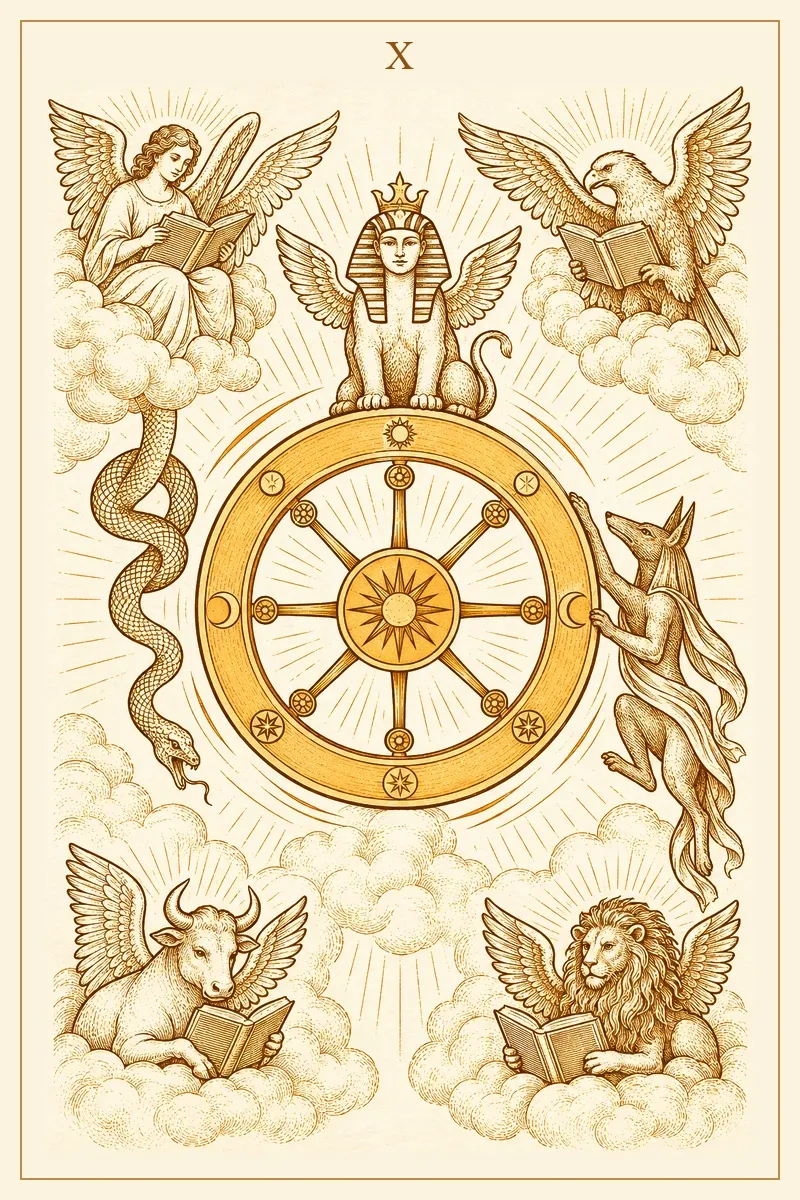
The Wheel of Fortune shows a great golden wheel with a sun at its hub, a crowned sphinx seated on top, a serpent sliding down one side and a jackal-headed figure climbing the other, while four winged creatures read from open books in the corners. It is the card readers most often connect with fate, and it describes cycles: things rise, things fall, and the turning is larger than any one person.
Upright in a future position, it usually suggests a turn in circumstances, often one you did not plan. The useful reading is less "luck is coming" and more "conditions are about to shift, so stay flexible enough to use the shift." Reversed, it can point to resisting a change that is already underway, or to repeating the same cycle because the lesson of the last one has not landed yet. The full Wheel of Fortune tarot meaning covers its love and career readings in depth.
The Tower: sudden change that clears false ground
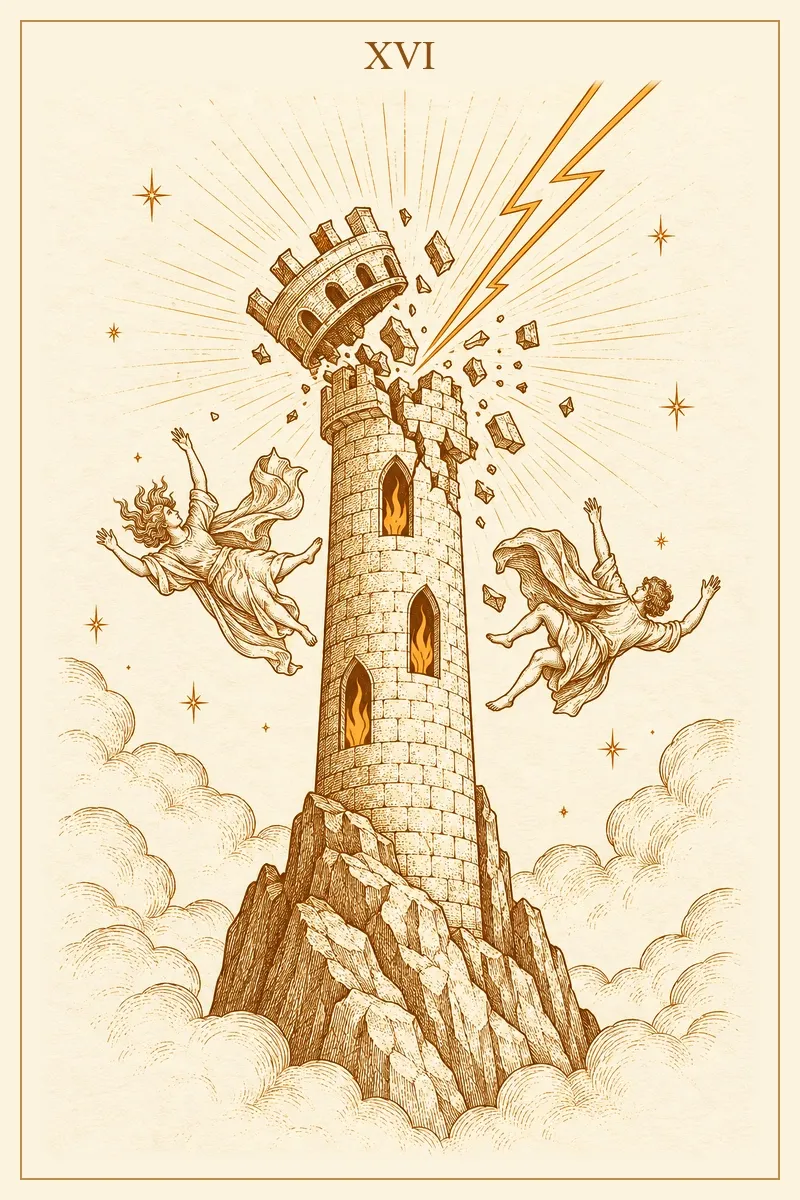
In The Tower, a bolt of lightning knocks the crown-shaped top off a stone tower standing on a rocky peak above the clouds; flames show in its windows and two figures fall through the air. Few cards frighten people more in a future position, and few are misread as often.
Upright, The Tower describes a structure that cannot hold: a plan built on a false assumption, a role you have outgrown, a silence that is about to break. In a future position it says that if the weak point stays as it is, something will give. That is a reason to inspect the foundations now, not to wait for disaster. Reversed, it can describe a collapse you are holding off by force, or a slower, more private dismantling. The full Tower tarot meaning goes through each context.
Death: an ending that makes room
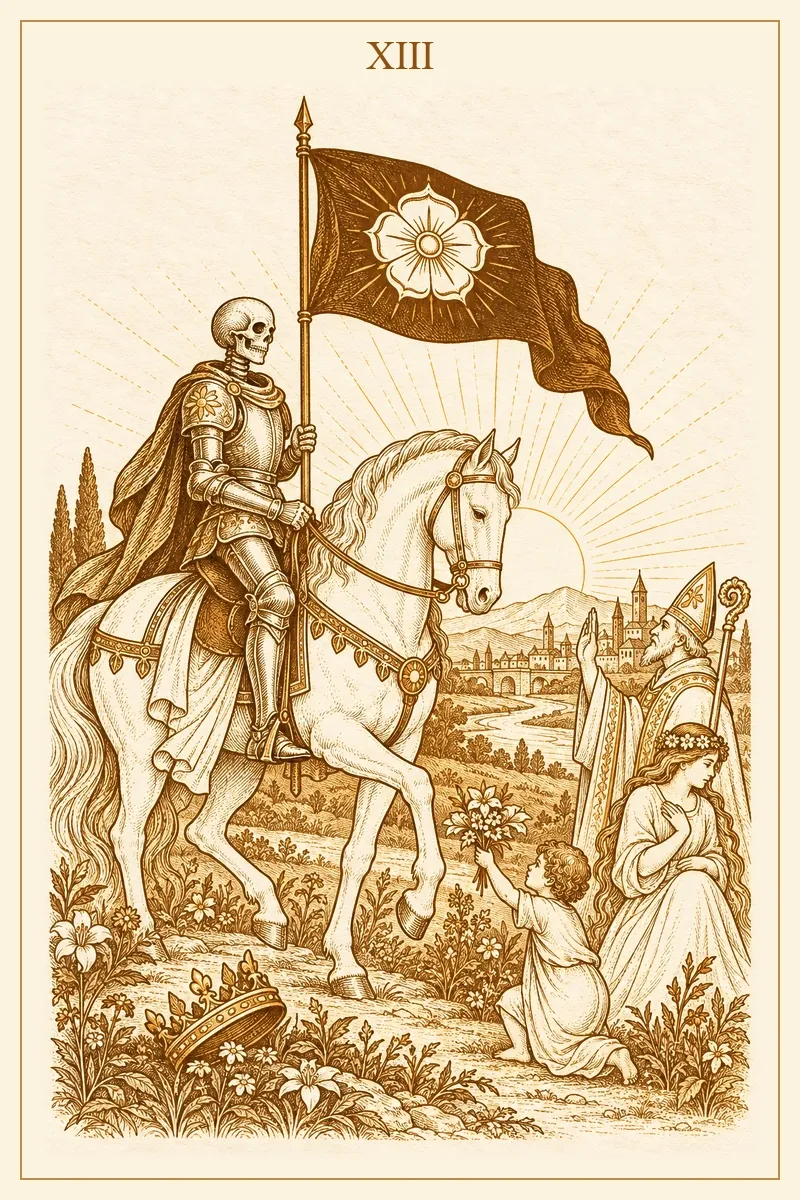
Death shows a skeleton in armor riding a white horse and carrying a dark banner marked with a white rose. A crown lies fallen among the flowers, a child offers a bouquet, a woman kneels, a bishop raises his hand, and beyond them a sun sits low between the hills and a distant town. Everyone on the card meets the same rider; the sun on the horizon is the detail that says the day goes on.
The card almost never refers to physical death. Upright in a future position, it points to an ending that is already due: a phase, a habit, a relationship in its old form. Reversed, it often describes clinging to what has finished, which makes the transition longer and harder than it needs to be. Our Death tarot meaning explains its upright and reversed readings in more detail.
Judgement: a call you can answer or ignore
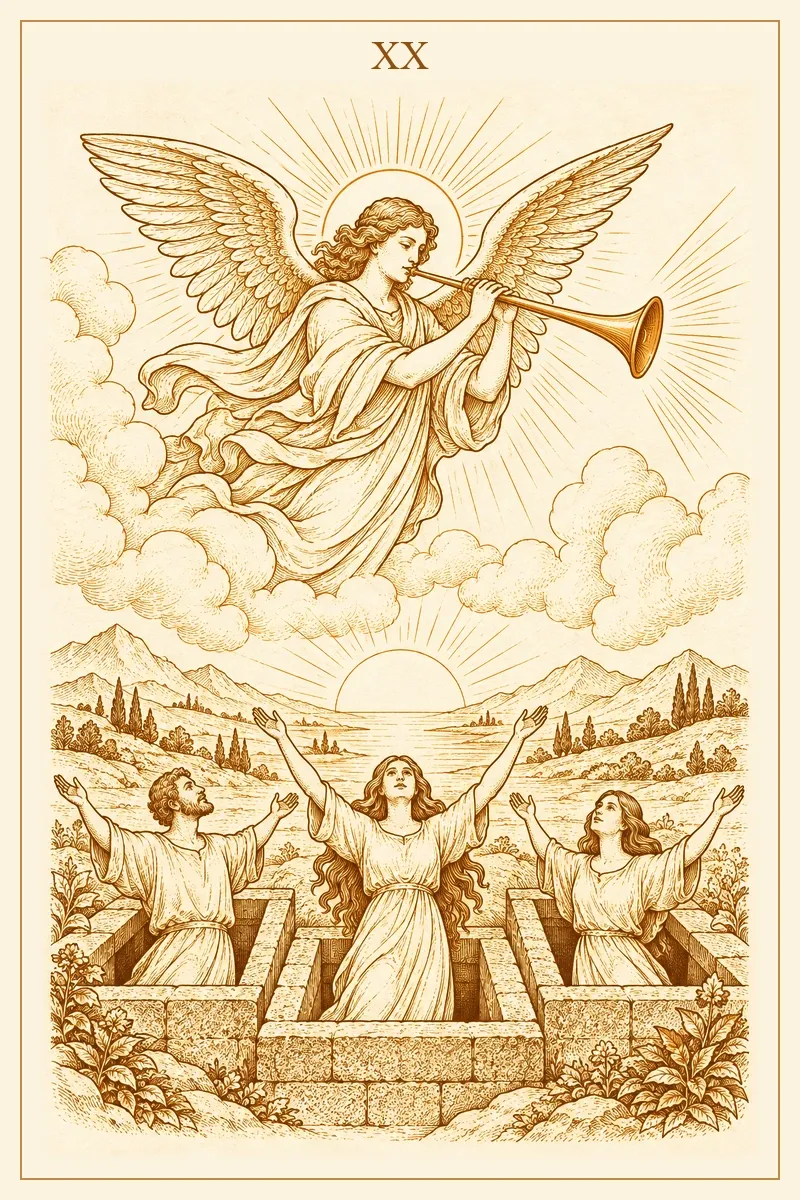
In Judgement, a winged angel in the clouds blows a long trumpet while three figures rise from stone tombs below, arms lifted toward the sound, with mountains and a sun on the horizon behind them. It is a card of reckoning and renewal: looking honestly at the past and answering a call toward the next version of yourself.
In a future position, Judgement rarely describes something done to you. Upright, it suggests a moment when a decision you have postponed will ask to be made, often with a clear sense of what is right. Reversed, it can describe self-criticism that blocks the answer, or a call you keep letting ring. Unlike a sealed fate, this card depends on a response. The full Judgement tarot meaning covers it beyond future questions.
Questions that work well, and questions to rewrite
A lot of disappointment with tarot comes from the question, not the cards. Questions that ask for a fixed fact ("Will he call on Friday?") put the deck in a role it cannot play. Questions about direction, options and your part in a situation give it something to reflect.
Here are common questions with rewrites that keep the same concern but give the reading a better job:
- "Will I get the job?" becomes "What can I do to give myself the best chance with this application?"
- "When will I meet someone?" becomes "What is helping, and what is blocking me, from meeting someone right now?"
- "Is my partner going to leave me?" becomes "What is happening in this relationship that I need to look at honestly?"
- "Will my business succeed?" becomes "Where is this business heading on my current plan, and what would change that?"
- "Should I move?" becomes "What would each option ask of me, and what would it give me?"
The rewrites share three features: they are about you rather than someone else's hidden choices, they ask "what" or "how" rather than "will" or "when," and they leave room for an answer you can act on. Our guide on how to ask effective tarot questions has more patterns, and the piece on tarot for decision making shows how to lay out two options side by side.
A worked example: reading the road ahead
Here is how the ideas above come together in an ordinary three-card reading. The example is illustrative, not a real client.
The question: "I have been unhappy at work for a year and keep saying I will retrain as a designer. Where is this heading if I carry on as I am?"
The spread:
- Where I stand now: Four of Cups
- Where this is heading if nothing changes: The Tower
- What I can change: Page of Pentacles
Where I stand now. The Four of Cups describes boredom and withdrawal, someone so used to dissatisfaction that new offers barely register. In this position it is an accurate snapshot: the person is not acting, and is also not letting go of the idea.
Where this is heading. The Tower in the future position looks alarming, but read with the present card it tells a coherent story. If the frustration keeps building with no outlet, something is likely to give on its own terms: a blowup at work, a sudden resignation without a plan, or burnout that forces the decision. The card does not say this will happen on a particular day. It says the current pressure has nowhere to go.
What I can change. The Page of Pentacles is a student card: small, practical, steady learning. It offers a different route from the same starting point. A short course, a portfolio piece each weekend, a conversation with a working designer: modest steps that let the pressure out in a planned way, so the change happens by choice rather than by collapse.
Read together, the spread does not predict that the person will quit or that a career change will succeed. It shows where the present is pointing and where the lever is. Two months later, the same three positions might produce a very different second card, because the first and third would already have shifted.
Timing: why dates are the weakest part of any reading
"When will it happen?" is one of the most common questions people bring to tarot, and one of the hardest for it to answer. Timing depends on decisions, other people and outside events, all of which can change after the cards are laid down. Traditions for reading timing do exist, such as linking suits to seasons or noting how fast certain cards move, and our guide to reading timing in tarot cards explains them along with their limits.
A more reliable approach is to ask about readiness instead of dates. "What needs to be in place before this can happen?" gives you conditions you can check, and conditions usually tell you more about the calendar than any card can. If timing matters for a real decision, pair the reading with a review date you set yourself, and look at what has changed when it comes.
When a reading leaves you frightened
Sometimes a card lands hard. The Ten of Swords in an outcome position, or The Tower after an already difficult week, can stay with you for days. If that happens, a few steps help you keep the useful part of the message and put the fear down.
- Stop drawing. Pulling more cards to cancel the first one usually adds confusion. Give it at least a day.
- Write down the exact question and position. A card in "if nothing changes" means something different from a card in "advice." Fear tends to blur that distinction.
- Name one concrete thing the card could be pointing at. A deadline, a conversation, a habit. Specific worries can be addressed; vague dread cannot.
- Choose one small action. Make the call, check the plan, rest. Action is the quickest way to turn a forecast back into a choice.
- Talk to someone. If the fear touches health, safety or money, a doctor, counselor or qualified advisor can give you information a reading never can.
The guide on reading scary tarot cards without panicking walks through the cards that most often cause this reaction. The Ten of Swords, for instance, describes reaching the end of a painful pattern, and it is commonly read as the low point after which things begin to improve.
Frequently asked questions
Is tarot accurate?
It can be accurate about the present: what you are feeling, what you are avoiding, what pattern you are in. It is much less reliable about specific future events, because those depend on choices that have not been made yet. No spread can confirm what another person is thinking, fix a date or guarantee how things end. The fairest way to judge it is to keep a brief log of readings and what followed, then look back after a few months.
Why did two readings on the same question give different answers?
Partly because each shuffle is different, and partly because you are different. Between the first and second reading you have already absorbed the first message, and your attention has moved. If you find yourself drawing again and again for reassurance, take it as a sign to pause rather than to hunt for the "real" answer.
Can tarot predict specific events like a job offer or a breakup?
It can describe the themes around events: a new opportunity, an ending, a period of stability. It rarely names the event itself. The Ace of Pentacles might show up as a job offer, a new client or a chance to learn a practical skill; your circumstances decide which. Reading the card as a theme keeps you open to the form it actually takes.
Can tarot predict illness, death or legal results?
No. A reading is not a medical, legal or financial tool, and a card like Death does not refer to physical death in ordinary practice. If you are worried about your health, a case or your finances, speak to a qualified professional. You can use a reading afterward to sort through how you feel about the information you receive.
Is tarot just psychology, then?
Many readers find psychological explanations helpful, and much of what a reading does, such as surfacing feelings and patterns, can be described that way. Others see a spiritual dimension as well. You do not have to choose between them to get value from the cards: either way, they are most useful when they lead to clearer thinking and a step you choose.
The road is still yours to choose
Tarot does not deliver a finished future. It holds up the present, shows where it leads, and leaves the steering to you. That is a smaller promise than prophecy and a far more useful one, because a forecast you can respond to is worth more than a fate you can only wait for.
If you want to see what the cards say about the road you are on, start a calm reading with Veil Soul and treat whatever appears as a map to read, not a verdict to fear.