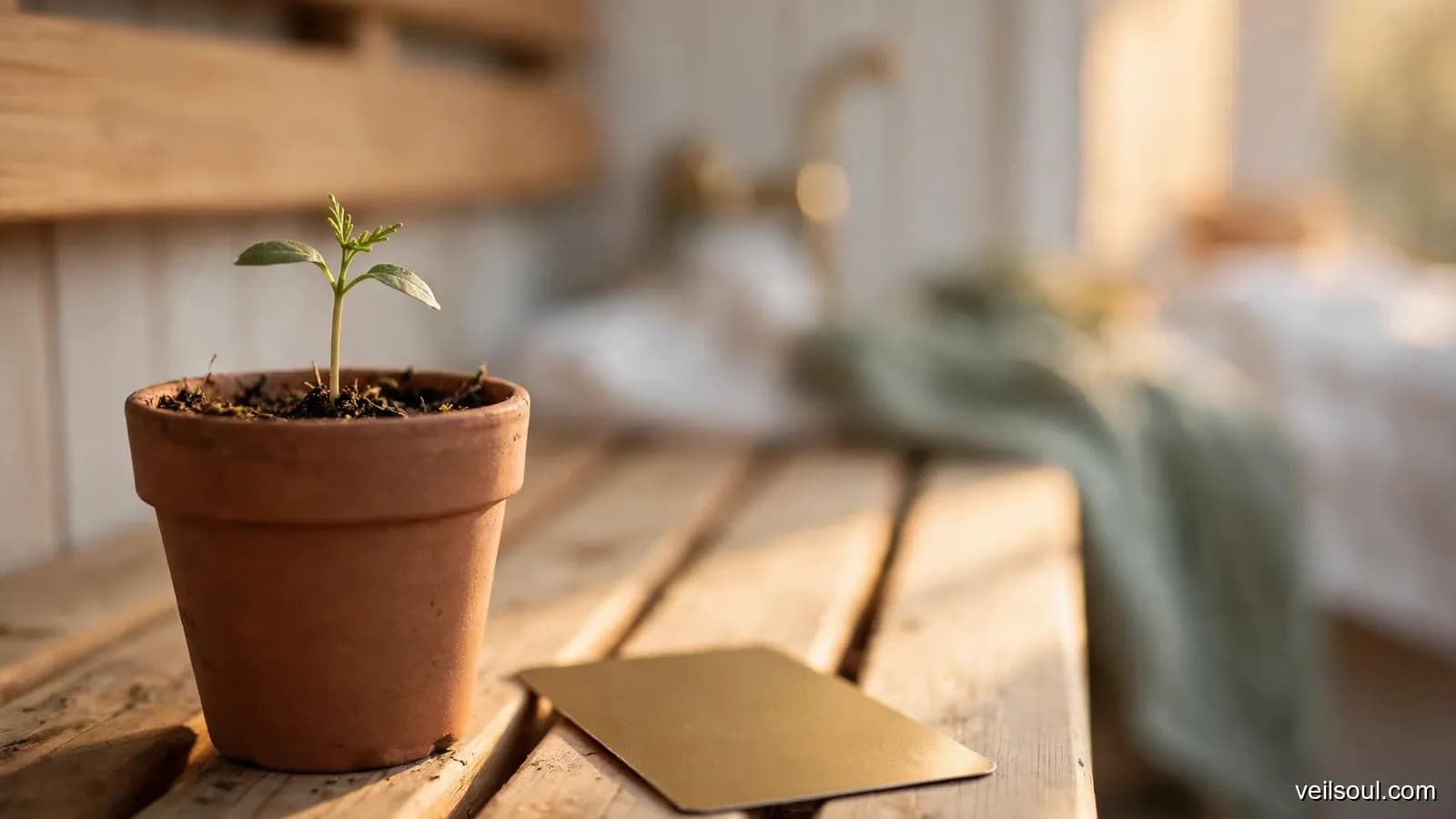
Halfway between planting and harvest: that is where the Seven of Pentacles stands. Upright, this tarot card means patience and honest assessment: you have put real time, money or care into something, it is growing, and now you pause to judge whether it deserves another season of work. Reversed, the Seven of Pentacles points to impatience, effort that is not paying off, or a review you keep postponing because you are afraid of the answer.
In love, the 7 of Pentacles describes a bond, or a search for one, that is growing more slowly than you hoped, and it asks whether the care you give is being returned. Here the card is read as a mirror for your own choices: a reading cannot promise that an investment will pay off, tell you what a partner privately feels, or fix a date for results; it can help you look clearly at what you planted and decide what to do next.
The card at a glance:
- Upright: patience, a mid-season review, long-term investment, slow but real growth, deciding where your effort goes next.
- Reversed: impatience, wasted or misdirected effort, quitting just before results show, avoiding an honest look at the numbers.
- Love: a relationship that grows step by step; reversed, effort that feels one-sided or a plateau nobody names.
- Career and money: long projects, savings and investments in their waiting phase; reversed, returns that fall short of the plan.
- Astrology: Saturn in Taurus, the third decan of Taurus; the Golden Dawn title is Lord of Success Unfulfilled.
- Yes or no: not yet, or yes if you keep tending it; reversed, rethink the approach first.
The gardener who stopped digging
Hands stacked on the spade handle
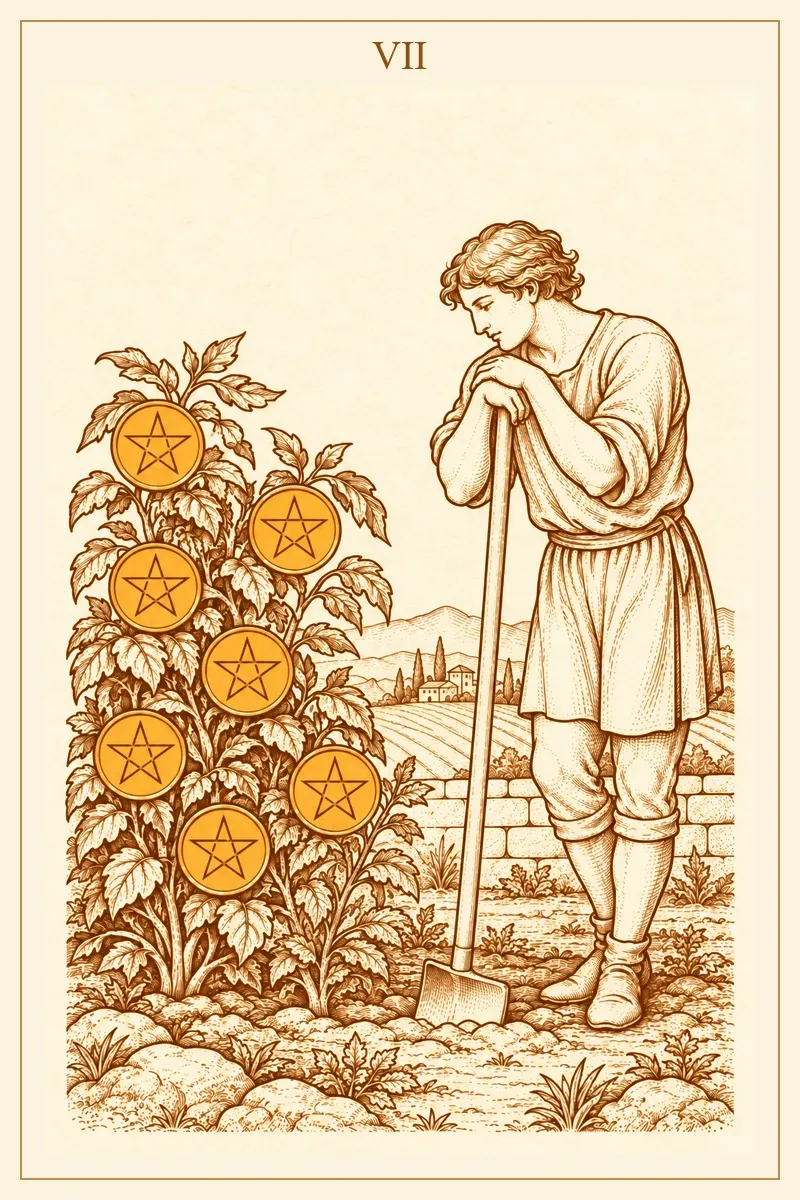
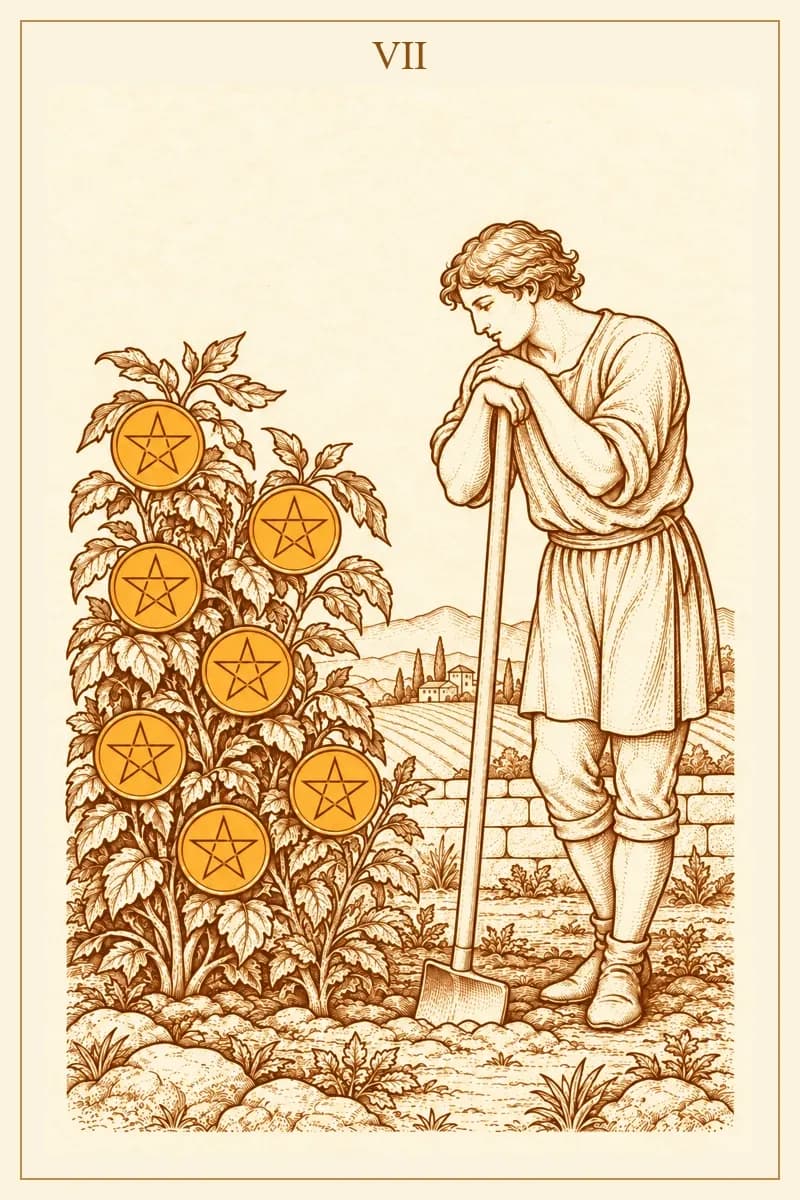
A young man with short curly hair stands at the right of the card, leaning his weight on a long-handled spade. Both hands rest on top of the handle and his chin almost touches them; his head is bowed and his eyes are fixed on the plant in front of him. He wears a plain tunic tied with a sash, sleeves pushed up to the elbow, and knee-length breeches. He is not celebrating or despairing. The spade's blade sits in freshly turned soil, so the digging has been real and recent; he has simply stopped in the middle of the job to decide what it has been worth.
Seven coins ripening among the leaves
On the left, a bushy plant with broad, serrated leaves rises almost to his shoulder, and seven gold pentacles hang among its stems like fruit. They grow at different heights among the stems, which is precise about the kind of wealth involved: something that grows on its own schedule once the groundwork is done. You can water it and weed around it, but you cannot make it ripen faster by staring at it. The coins already gleam as if finished, and that is the tension of the card: results are visible, yet picking them early would waste them.
Low wall, plowed fields and a farmhouse in the distance
Behind the gardener runs a low stone wall, and beyond it, plowed fields roll toward a small farmhouse, a few slender cypress trees and soft hills. Small seedlings dot the ground at his feet. The landscape sets his one plant inside a larger working life, with a home the harvest is meant to support. The question he is weighing is not only "Is this plant doing well?" but "Is this the best use of this ground?"
Saturn's slow clock in a Taurus field
In the Golden Dawn system, a major influence on modern tarot, the Seven of Pentacles belongs to the third decan of Taurus, ruled by Saturn, and carries the title Lord of Success Unfulfilled. Taurus is the fixed earth sign of soil, comfort and things that grow when left in peace. Saturn is the planet of time, limits and earned results. Together they describe what the gardener faces: real progress that needs more time than you would like, and a test of whether you can keep going without instant proof. The title sounds gloomy, but "unfulfilled" here means incomplete rather than failed; the success exists and has not finished arriving. The Taurus and tarot guide collects the other cards tied to this sign.
From the Six to the Eight: where this card sits in the suit
The Six of Pentacles shows a robed figure holding a balance scale in one hand while coins drop from the other into the cupped palms of a kneeling man, with a hooded woman waiting on the other side. The Seven turns from that exchange to investment: no one is handing you anything, and what you have is what you grew. If giving and receiving is what brought you here, the Six of Pentacles meaning covers that side of the story.
Next comes the Eight of Pentacles, where a young craftsman sits at a workbench carving a coin with a chisel, finished coins hung on a tall post beside him and wood shavings scattered at his feet. The Eight is the step after a positive verdict from the Seven: you return to the work and refine it piece by piece. The Eight of Pentacles meaning explores that phase of steady practice.
Seven of Pentacles upright: the mid-season review
Progress you can see, a harvest you cannot yet take
Upright, the card appears when an effort has gone on long enough to show results, but not long enough to deliver its full reward. A business has regular customers but not yet a salary for its owner; a degree is two years in; a savings account is growing. The card asks you to notice that growth honestly, neither inflating it nor dismissing it because it is smaller than the dream.
Patience as a choice
The patience this card describes is active. The gardener is not sitting in the shade waiting for luck; he is standing in his plot with a tool in his hands. Upright, the Seven suggests that what you are building needs consistent, unglamorous care for a while longer, and that frustration with the pace does not mean you chose wrong.
Deciding where the next season of effort goes
The card is also a decision point. A good review sometimes ends with "keep going exactly as you are," sometimes with "keep going, but drop these two things," and occasionally with "this plot will never give me what I need." The upright Seven trusts you to make that call on evidence, not on fear or fatigue: what has worked, what it cost and what you actually want from the harvest.
Seven of Pentacles reversed: digging up seeds or watering a dry stick
Impatience: checking the roots every morning
One reversed reading is impatience. You planted, and now you keep pulling the seedlings up to see whether they have rooted, which is the surest way to stop them. In daily life this looks like switching strategy every few weeks or quitting a course halfway because results are not visible yet. The reversal asks whether the effort has truly failed, or whether it has simply not had time.
Sunk effort in a plant that is not growing
The opposite reading is just as possible: the plant really is not thriving. Months or years of work have produced disappointing results, and you keep going mainly because stopping would mean admitting the time is gone. Here the reversed Seven gives permission to cut your losses or change the method; effort already spent is not, by itself, a reason to spend more.
Avoiding the review altogether
Sometimes the reversal is less about the crop and more about the gardener refusing to look. Bank statements stay unopened, project numbers go unchecked, a conversation about where the relationship is heading keeps being postponed. Telling the first two situations apart is impossible until you do the assessment, which is why the reversed card points to that step first.
The 7 of Pentacles in love: what grows between two people
Upright, in a relationship
For a couple, the upright card describes a relationship that has had real care put into it and is now at a point of quiet reflection. Perhaps progress toward moving in or shared plans is slower than you expected. The card favors patience combined with an honest conversation about where you are, rather than forcing a milestone to prove the relationship is working.
Upright, if you are single or dating
For someone single, the Seven often points to the slow work that comes before a lasting partnership: healing from a past relationship, building a social life, getting clear on what you want. Those seeds are growing even if no one has appeared yet. In early dating, it describes a connection that develops steadily rather than sweeping you off your feet.
Reversed: care that is not returned, or a plateau
Reversed in love, the card can point to an imbalance in effort. One person plans, initiates and repairs while the other coasts, or both feel the relationship has stalled despite real attempts. It can also describe impatience, such as giving up because the early spark settled into something calmer. Before deciding either way, name the plateau out loud and ask what each of you is willing to put in over the next few months. If you drew the card asking how someone feels about you, it can describe a person weighing things up rather than rushing, and only they can tell you where that lands.
Long projects and slow returns: career and money
Career, upright
At work, the upright Seven marks a mid-project checkpoint: a probation period ending, a first year in a new role, a product a few months after launch, a side business that is profitable but small. It is a healthy time to review where your energy is best spent, not a sign that you should be further along, and a good moment to document what you have achieved so it is visible when recognition comes.
Career, reversed
Reversed, the card describes frustration: a promotion that did not come, a project that keeps slipping, a career path that has absorbed years without delivering the growth you expected. The key question is whether the problem is timing or direction. If only the pace is wrong, adjust expectations; if the direction no longer fits, the card supports a planned change rather than a resignation made on a bad day.
Money, upright and reversed
With finances, the Seven is the card of long-term saving and investing in their waiting phase: retirement contributions, a deposit for a home, a business that has not yet reached its tipping point. Upright, the plan looks broadly sound and time is the main remaining ingredient. Reversed, something may be draining resources faster than it returns them. Either way, treat the card as a prompt for a calm review with real numbers, and take significant decisions to a qualified financial professional rather than making them out of frustration.
Recovery, practice and the body's own timeline
In health and well-being questions, the upright Seven encourages patience with changes that take time to show, such as building strength, adjusting sleep or recovering after an illness; consistency matters more than intensity. Reversed, it can point to dropping a routine that was quietly working, or to sticking with one that clearly is not, and a doctor is the right person to tell which. Spiritually, the card treats practice as cultivation: meditation, prayer or study deepens out of sight, and hopping between techniques in search of a quick breakthrough keeps any of them from taking root.
Yes, no or not yet, and how long the wait might be
As a yes-or-no card, the upright Seven of Pentacles leans toward "not yet" or "yes, if you keep investing in it." It rarely gives a fast, unconditional yes, because the results it describes depend on continued effort. Reversed, read it as "not in the current form": the approach needs adjusting before a yes becomes likely.
For timing, readers use a few conventions. Pentacles, the earth suit, is traditionally the slowest, so readers who use suit timing count it in months or seasons rather than days or weeks. Readers who use astrological timing link the card to the third decan of Taurus, roughly May 11 to 20, when the Sun crosses that part of the sign. Others count the number and read seven weeks or seven months. These methods disagree, so use them to pick a check-in date, a day to walk out and look at the plot again, rather than as a prediction.
Four cards that change the harvest
With The Hermit: a review done alone
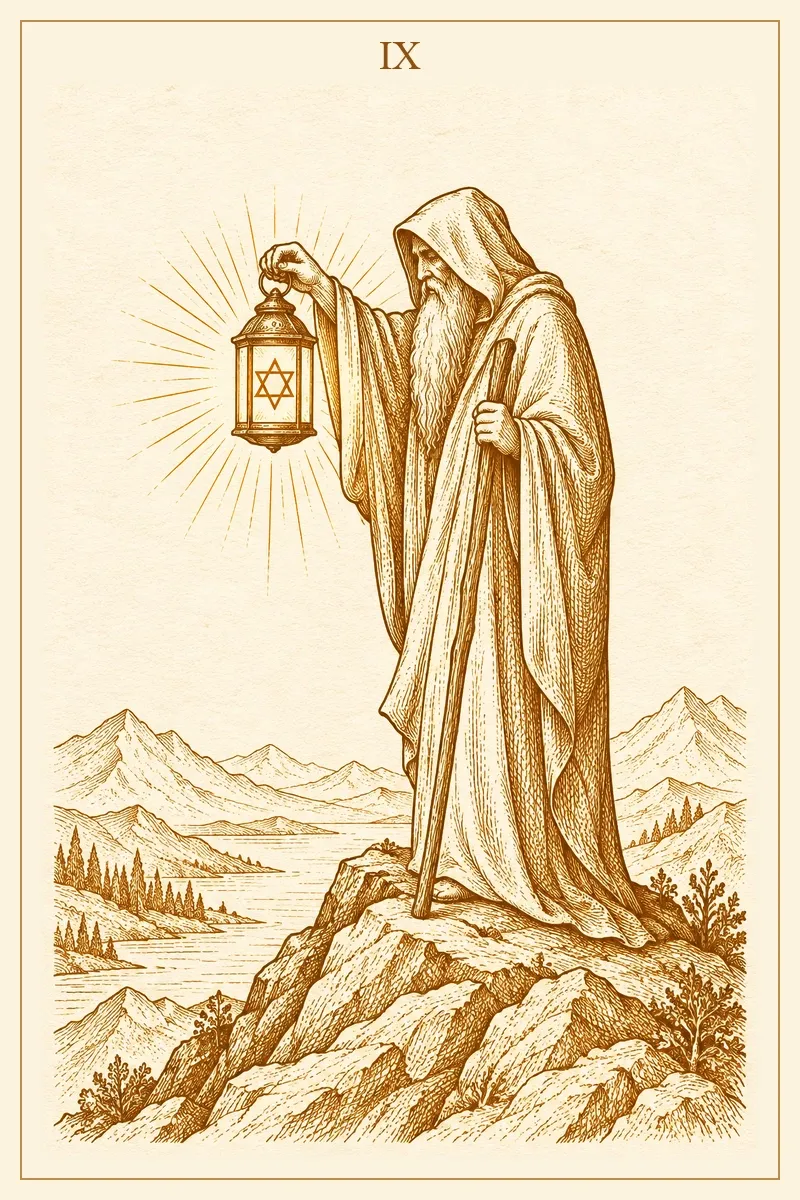
The Hermit stands on a rocky peak above a lake and distant mountains, a long-bearded figure in a hooded cloak, leaning on a staff and holding up a lantern with a six-pointed star inside it. Paired with the Seven of Pentacles, the assessment moves inward: what to keep tending is decided by quiet reflection on what you want, not by comparing yourself with others. The Hermit card meaning goes deeper into this kind of chosen solitude.
With The Empress: the harvest comes in
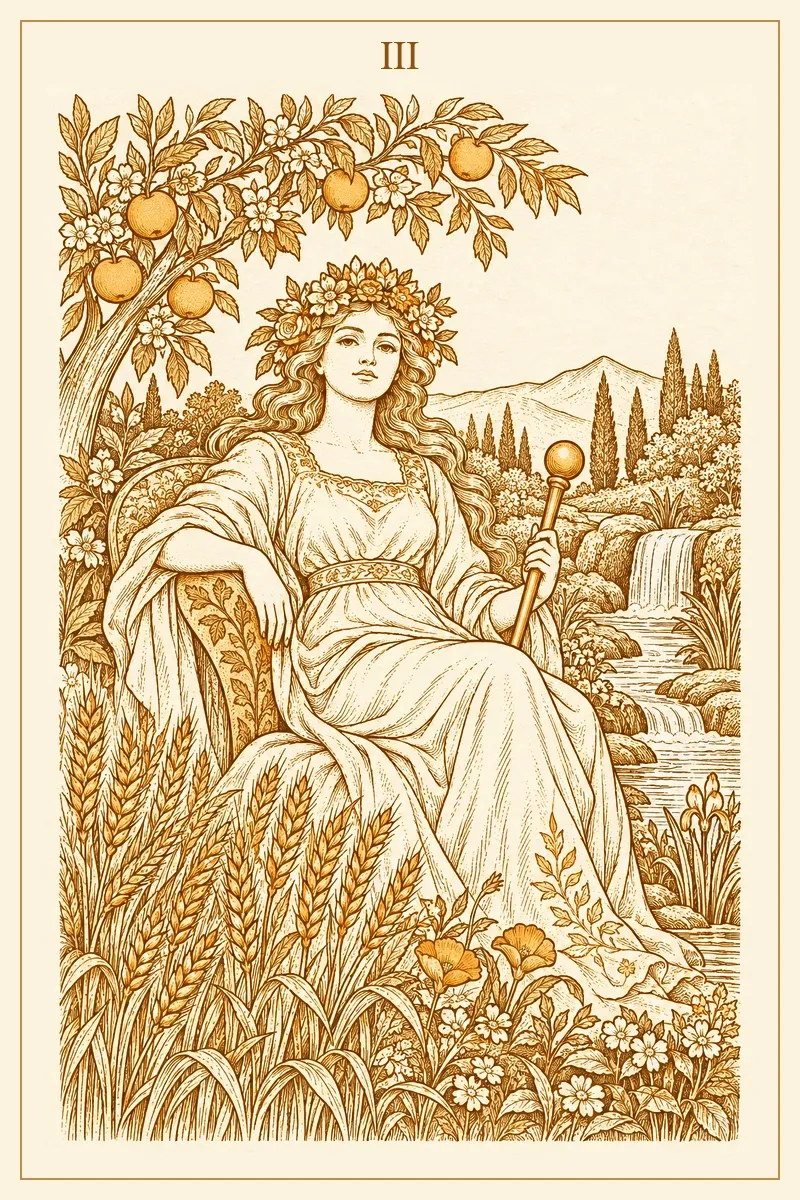
The Empress sits at ease in a garden, a wreath of flowers in her long hair and a scepter in one hand, under a fruiting branch, with ripe wheat at her feet and a waterfall behind her. Beside the Seven, she suggests that the growth you have been watching is close to ripe. It is one of the most encouraging pairings for this card. The Empress card meaning covers abundance and creation in detail.
With The Tower: the plot is disrupted
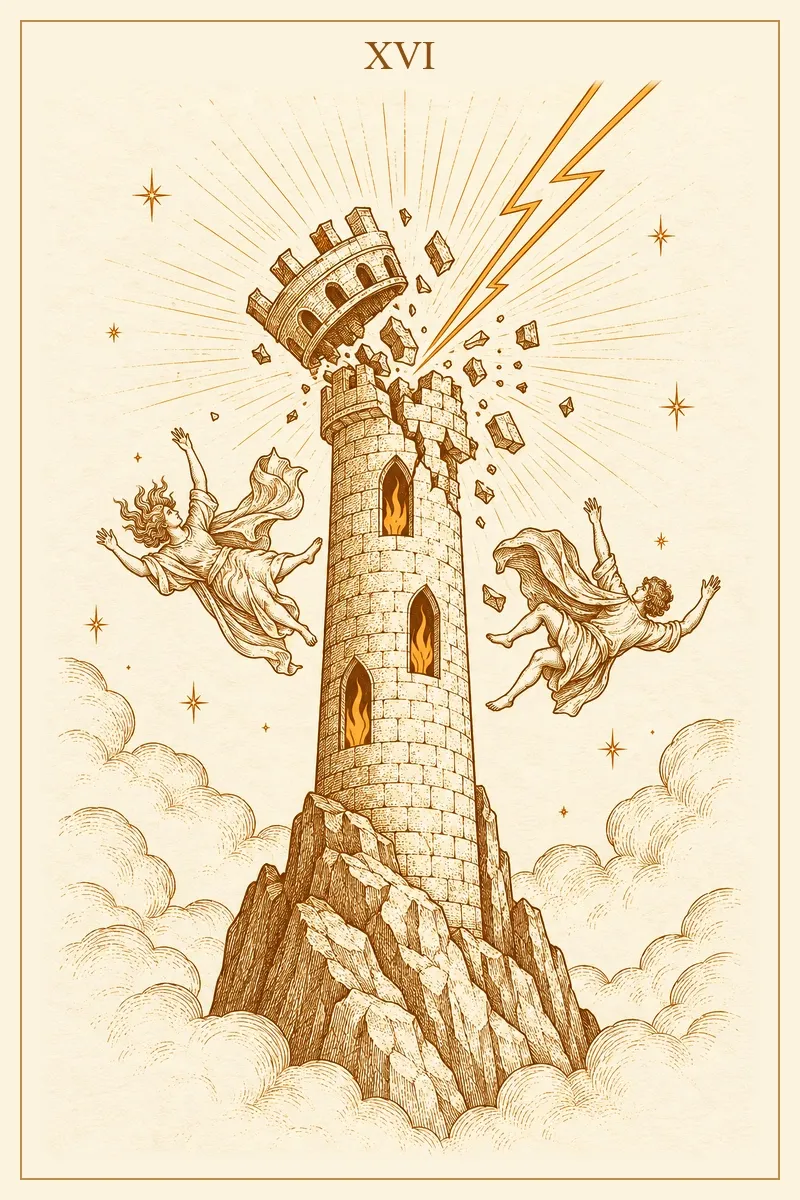
The Tower shows a stone tower on a crag above the clouds, its crenellated top blown off by a bolt of lightning, flames in its windows and two figures falling through the air. With the Seven of Pentacles, it describes a sudden shake-up to something you have been patiently building, such as a client leaving or a market changing. Not everything you grew is lost; the skills and the soil remain. The Tower card meaning looks at what tends to be rebuilt afterward.
With Wheel of Fortune: the season turns
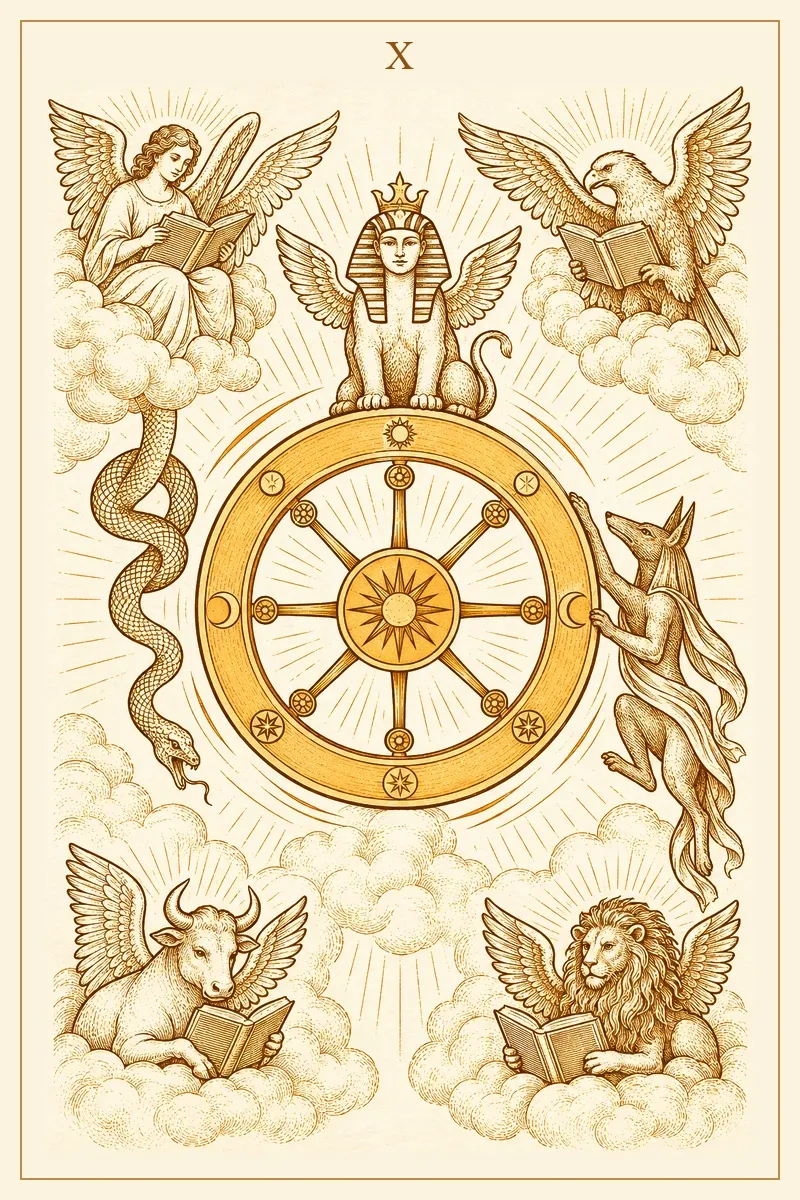
The Wheel of Fortune shows a great golden wheel set with sun, moon and star symbols, a winged, crowned sphinx seated on top, a snake on one side and a jackal-headed figure climbing the other, with winged creatures reading books in the four corners. Next to the Seven, it suggests the long wait is ending and circumstances outside your control are starting to move your way. The Wheel of Fortune card meaning explains how cycles and turning points read in a spread.
Two quieter pairings worth knowing
- With the Nine of Pentacles: patient work matures into an independent comfort you built with your own hands.
- With the Knight of Pentacles: keep going methodically, at the same unhurried pace, because steadiness is what this particular harvest needs.
The Leaning Spade spread: five positions for a long effort
This layout follows the gardener's pause. Think of one long-running effort, such as a project, a relationship, a savings goal or a skill, and lay five cards in a row.
- The planting: what you have actually put in so far.
- What has come up: the real growth, including the parts you might be overlooking.
- The weeds: what is draining time, money or energy from this effort.
- The season: what cannot be rushed, and what needs more time.
- The next move: keep tending, adjust the method, or plant somewhere else.
Read positions two and three together before the rest. It is easy to underestimate what has grown and overlook what is draining it, and seeing both makes the fifth card easier to accept.
A worked example: a ceramics stall eighteen months in
This example is invented to show the spread in use. A woman who makes and sells ceramics on weekends asks: "Eighteen months in, should I keep putting my weekends into the stall, or let it go?" She draws five cards.
- The planting: Eight of Pentacles, upright. Her skill has improved steadily, and it shows in what she makes.
- What has come up: Seven of Pentacles, upright. Repeat buyers, a small mailing list, sales that cover materials: real growth, but not yet the income she imagined.
- The weeds: Five of Wands, upright. Two markets, an online shop and wholesale inquiries are all competing for her time.
- The season: Four of Swords, upright. What cannot be rushed is her own recovery; weekends with no rest are wearing her down.
- The next move: Knight of Pentacles, upright. Keep going, but slowly and methodically, with a plan rather than more hours.
Read together, the cards do not say quit. They say the stall is growing and the way it is run is the problem: too many channels and a pace she cannot sustain. Sensible next steps would be to choose the one channel that brings the most repeat buyers, pause the others for a season, protect one weekend a month for rest, and set a review date three months out with two simple numbers to check: monthly sales and hours worked. If those numbers have not moved by then, she can decide on evidence rather than exhaustion.
Questions for the edge of the field
- Am I waiting because this needs more time, or because stopping feels like admitting a loss?
- What has grown that I keep discounting because it is smaller than the dream?
- If I were starting today, would I plant in this same ground?
Frequently asked questions
Is the Seven of Pentacles a good or bad card?
Mostly good, in a quiet way. Upright, it confirms that effort is producing growth even if the payoff is not complete; reversed, it asks for honest reassessment, but it is rarely a warning of disaster.
What does the Seven of Pentacles reversed mean in love?
It can mean one of two things: effort that feels one-sided, or impatience with a relationship that is growing slowly. Which applies depends on whether you have both been investing, and a direct conversation about expectations is the practical next step.
Does the Seven of Pentacles mean I should give up?
Not by itself. Upright, it leans toward continuing with adjustments. Reversed, it opens the possibility of stopping, but only after an honest review shows the effort is not growing.
How long does the Seven of Pentacles take?
Some readers translate it into months or a season, and some link it to mid-May through its Taurus decan. These are reading conventions, more useful for choosing when to check in again than as a forecast.
Can tarot tell me whether my hard work will pay off?
No. Tarot cannot guarantee outcomes, confirm what other people intend, or set dates. What the Seven of Pentacles can do is help you see the effort clearly: what it has produced, what it costs and whether it still fits what you want. That clarity is often what makes the next decision possible.
How is the Seven of Pentacles different from the Eight of Pentacles?
The Seven pauses to evaluate; the Eight returns to the work with focus. The first asks whether to continue, and the second shows what committed, repeated practice looks like once you have decided to. If you are new to reading the Minor Arcana as a sequence, our beginner's introduction to tarot explains how the suits and numbers fit together.
Walk the rows, then decide
Before you draw again on the same question, try a few small steps that put the card into practice:
- Write down what you have put into this effort over the last six months, and next to it, what has grown.
- Pick one thing to stop doing and one thing to keep doing exactly as it is.
- Put a review date in your calendar, and decide now what would count as enough progress by then.
The Seven of Pentacles does not rush you; it gives you a moment to see clearly. If you would like to explore your own question, you can start a calm reading with Veil Soul whenever it feels right.